
My husband and I recently got back from our road trip down to Texas to spend the week of the Feast of Tabernacles (Sukkot) with a group of believers in Galveston. If you got my newsletter this past Wednesday, then you’ve already read some of my musings from a morning I spent on the balcony of our condo watching the sunrise over the Gulf of Mexico. I had my devotional book, a notebook, and my Bible app opened on my phone. It was a gorgeous sunrise, and a perfect quiet moment for reflection and prayer.
I hope you all aren’t getting tired of me talking about the Feast of Tabernacles, because I want to share one more thing that this festival prompted me to think about more deeply. It’s a lesson God wanted ancient Israel to remember, and it’s also one that the New Testament writers made sure Christians would keep in mind.
One of the things I hear from Christians who don’t observe God’s feast days outlined in Leviticus 23 is that they’re not relevant for us today. I assume that would be easier for me to understand if I’d never observed these days, but having kept them with my family for my whole life I just can’t imagine living without them. And I know my relationship with God would not be as deep if I didn’t have these rhythms of worship built into my weeks and years. There are still lessons to learn from keeping the days God calls holy, and I want to share one with you today about temporary shelters.
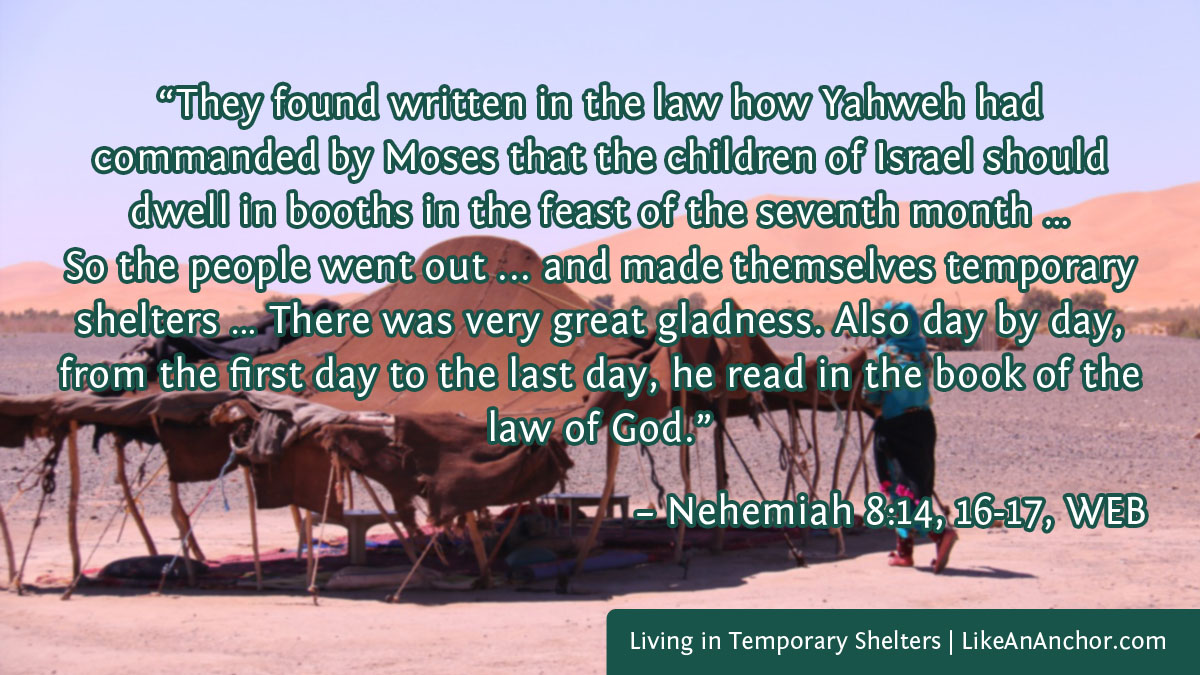
Why Keep this Particular Feast?
When God outlined His holy days for the people of Israel, He told Moses, “These are the Lord’s appointed times which you must proclaim as holy assemblies—my appointed times” (Lev. 23:2, NET). That’s the primary reason to keep the holy days–they belong to God and He calls His people to assemble at His appointed times. He further elaborates on them as He goes on, and explains the symbolism for some of them. The one He spends the most time on in Leviticus 23 is the Feast of Tabernacles (also called the Feast of Booths or Festival of Temporary Shelters). Let’s take a look at that passage.
Yahweh spoke to Moses, saying, “Speak to the children of Israel, and say, ‘On the fifteenth day of this seventh month is the feast of booths for seven days to Yahweh. On the first day shall be a holy convocation. You shall do no regular work. Seven days you shall offer an offering made by fire to Yahweh. On the eighth day shall be a holy convocation to you. You shall offer an offering made by fire to Yahweh. It is a solemn assembly; you shall do no regular work. …
“‘So on the fifteenth day of the seventh month, when you have gathered in the fruits of the land, you shall keep the feast of Yahweh seven days. On the first day shall be a solemn rest, and on the eighth day shall be a solemn rest. You shall take on the first day the fruit of majestic trees, branches of palm trees, and boughs of thick trees, and willows of the brook; and you shall rejoice before Yahweh your God seven days. You shall keep it as a feast to Yahweh seven days in the year. It is a statute forever throughout your generations. You shall keep it in the seventh month. You shall dwell in temporary shelters for seven days. All who are native-born in Israel shall dwell in temporary shelters, that your generations may know that I made the children of Israel to dwell in temporary shelters when I brought them out of the land of Egypt. I am Yahweh your God.’”
Leviticus 23:33-36, 39-43, WEB
Here, the reason God gives for keeping the Feast of Tabernacles forever is so “that your generations may know that I made the children of Israel to dwell in temporary shelters when I brought them out of the land of Egypt.” In Deuteronomy, Moses adds that we must rejoice in this Feast “because Yahweh your God will bless you in all your increase and in all the work of your hands” (Deut. 16:13-15, WEB). So we have this reminder of deliverance and this emphasis on joy because of God’s blessings. This Feast was a time to remember and to celebrate.
The point that struck me this year was that people kept this Feast before they arrived at the Promised Land. I find that really interesting. God set it up as a reminder that they dwelt in temporary shelters before reaching the promised land, but for those 40 years they wandered in the wilderness, they were still living in tents while keeping this Feast. For those people, it was a reminder that their current living conditions were just temporary and God would bring them into a permanent, better situation soon.
Our Temporary Shelters Today
Today, we are like the Israelites who kept the Feast of Tabernacles while still living in temporary shelters and heading toward the Promised Land. Our physical bodies are temporary while we wait for our spiritual bodies. Our dwelling places on earth are temporary as we wait for God’s kingdom–our true homeland–to arrive on earth.
For we know that if our earthly house, the tent we live in, is dismantled, we have a building from God, a house not built by human hands, that is eternal in the heavens. For in this earthly house we groan, because we desire to put on our heavenly dwelling, if indeed, after we have put on our heavenly house, we will not be found naked. For we groan while we are in this tent, since we are weighed down, because we do not want to be unclothed, but clothed, so that what is mortal may be swallowed up by life.
2 Corinthians 5:1-4, NET
Paul isn’t the only one to use tents/tabernacles/temporary shelters as a metaphor for our physical lives. John says Jesus “tabernacled” among us when He became human (John 1:14). Peter talks about it being his duty to continue teaching “as long as I am in this tabernacle” (2 Pet. 1:13-14, NET). We have temporary, physical lives for now. We know that life isn’t permanent; we’re heading toward our own promised land, the Kingdom of God fully realized on earth after Jesus’s return.
By faith Abraham … lived as a foreigner in the promised land as though it were a foreign country, living in tents with Isaac and Jacob, who were fellow heirs of the same promise. … children were fathered by one man … like the number of stars in the sky and like the innumerable grains of sand on the seashore. These all died in faith without receiving the things promised, but they saw them in the distance and welcomed them and acknowledged that they were strangers and foreigners on the earth. For those who speak in such a way make it clear that they are seeking a homeland. In fact, if they had been thinking of the land that they had left, they would have had opportunity to return. But as it is, they aspire to a better land, that is, a heavenly one. Therefore, God is not ashamed to be called their God, for he has prepared a city for them. …
And these all were commended for their faith, yet they did not receive what was promised. For God had provided something better for us, so that they would be made perfect together with us. …
For here we have no lasting city, but we seek the city that is to come.
Hebrews 11:8-9, 12 (italics an allusion to Gen 22:17); 11:39-40, 13:14, NET
When we keep the Feast of Tabernacles now (just like Jesus did when He lived on this earth [John 7]), we’re reminded that we are strangers and pilgrims here. We also remember that just like God delivered ancient Israel from slavery, then had them dwell in booths for a while, then brought them into the Promised Land, He is doing the same for us. He delivers us from sin, but we still have to live our physical lives for a while before He brings us into His kingdom as His spiritually reborn children.
Tabernacles in the Future
The Feast of Tabernacles invites us to look to the future, anticipating God’s kingdom while reminding us that our lives today are temporary. In messages during the Feast, we often spend a lot of time reading millennial prophecies like those in Isaiah. One of the really interesting things about the Feast of Tabernacles is that those prophecies tell us people will still be keeping this Feast after Jesus Christ’s return. We learn this at the end of Zechariah’s prophecy.
It will happen in that day, that living waters will go out from Jerusalem: half of them toward the eastern sea, and half of them toward the western sea. It will be so in summer and in winter. Yahweh will be King over all the earth. In that day Yahweh will be one, and his name one. …
It will happen that everyone who is left of all the nations that came against Jerusalem will go up from year to year to worship the King, Yahweh of Armies, and to keep the feast of booths. It will be, that whoever of all the families of the earth doesn’t go up to Jerusalem to worship the King, Yahweh of Armies, on them there will be no rain. If the family of Egypt doesn’t go up, and doesn’t come, neither will it rain on them. This will be the plague with which Yahweh will strike the nations that don’t go up to keep the feast of booths. This will be the punishment of Egypt, and the punishment of all the nations that don’t go up to keep the feast of booths. In that day there will be on the bells of the horses, “HOLY TO YAHWEH”; and the pots in Yahweh’s house will be like the bowls before the altar.
Zechariah 14:8-9, 16-20, WEB
We don’t have a huge amount of detail about what exactly will happen after Jesus Christ’s return. God gives us an inspiring vision for the future (Rev. 19-21, for example), but there are quite a few things He doesn’t spell out clearly. I find it fascinating that one of the details He wanted us to know is that people will still keep the Feast after He is “King over all the earth,” and that there will be consequences for not observing this festival. It’s got to be important–and the lessons it teaches us must be important–if Jesus risked His life to attend the Festival (John 7:1-13) and God wants people to continue keeping it even after Jesus’s return.
With Sukkot now finished, we’ve completed another yearly cycle of God’s holy days and look forward to starting again next year, with Passover. It’s comforting to approach next year with the reminder that our physical lives and the world we live in are temporary. The struggles we deal with, the dangers we face, and the heartbreaking news stories we hear all the time aren’t going to last forever. God has a plan, and it involves a new heaven and new earth where there will be no more sorrow or death. He’s bringing us into His kingdom and into His family, moving those who faithfully follow Him from temporary here on earth to forever with Him.
Featured image by Pexels from Pixabay

Song Recommendation: “You Are Holy (As for Me and My House)” by Joshua Aaron

 During the Feast of Tabernacles, we usually focus on the fact that we are “strangers and pilgrims on the earth” (Heb. 11:13), as tied in with the Old Testament command that the children of Israel dwelt in temporary sukkah. But God doesn’t intend for us to remain homeless (
 Like An Anchor