Evelina: A Darker Look At Courtship

When I first read Evelina, my observation was that Frances Burney’s style “represents a shift nearing the latter part of the 18th century from fiction as a didactic tool to fiction as a pleasurable reading experience.” While I’m good as saving my literary observations (I have copies of everything I wrote in college), I’m apparently not very good at taking my own advice. This is the first time I’ve read Evelina for pleasure rather than analysis

I chose Evelina for a reread on my Classics Club Book List, and it also fits neatly into the Classics Club’s year-long Women’s Classic Literature Event (Tweet about it with #ccwomenclassics). The first time I read Evelina was in Spring 2010 for an upper-level course on The Early British Novel. Though I didn’t hate any of the other 4 books in this course, Burney’s little epistolary novel from 1778 was by far my favorite.

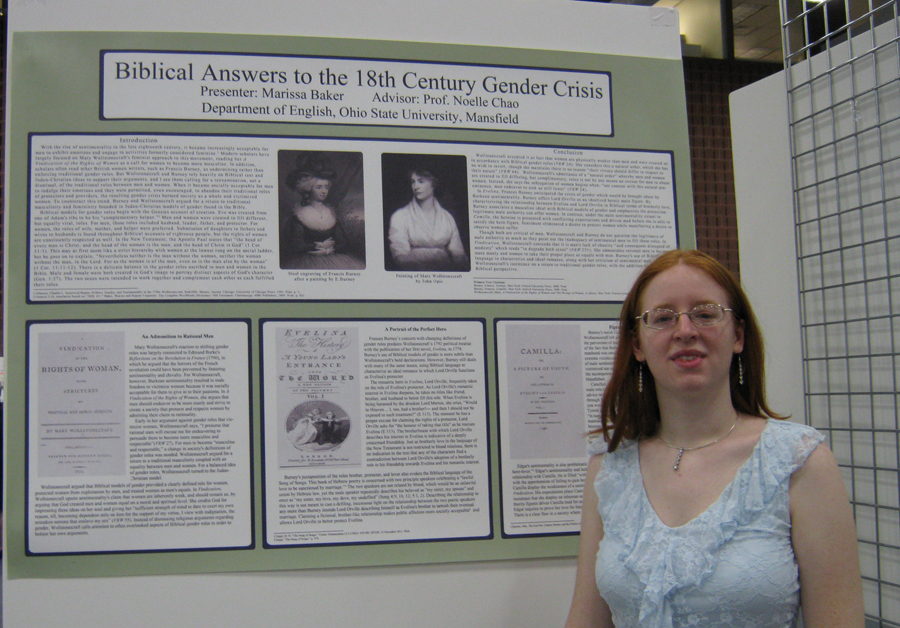
It’s no wonder, then, that when our professor asked me and one other student if we’d like to read more Burney in an independent study I said “yes.” We read Cecelia (1782) and Camilla (1796) – both weighing in at a solid 900+ pages. Then we branched out into Ann Radcliffe with The Romance of the Forest. That lead me to my first undergraduate research project titled “Unmanned Heroes: 18th Century Female Writers and Male Sentimentality. That turned into a 25-page research paper titled “Biblical Answers to the 18th Century Gender Crisis” (click on the title if you’d like to read this), which led me back to reading Evelina academically.
Reading "Evelina" for #ccwomenclassics | marissabaker.wordpress.com
Me at the Denman Undergraduate Research forum in 2012

Now, 4 years later, I’m back reading Evelina and enjoying it more than ever. Frances Burney was a fantastic (and, sadly, under appreciated) writer. Though Evelina was first published anonymously, Burney never hid the fact that she was a female writer. Her novels were quite popular with the general reading public and in artistic circles even during a literary age we often think of as belonging only to “dead white man.” Her style and success paved the way for writers like Jane Austen. In fact, Austen took her title Pride and Prejudice from a scene in Burney’s second novel, Cecilia, and when Austen’s father was seeking publication for that novel he described it as “about the length of Miss Burney’s Evelina.”

Comparing Burney to Austen (another favorite writer of mine), there are clear similarities, especially in Evelina. Both writers focus on a young woman who “marries up” by the end of the novel. Both critique society and social norms with a thinly-veiled sarcastic wit. But the differences are at times even more striking than the similarities. Nowhere in Austen will you find a scene like the one in Evelina when Captain Mirvan impersonates a highwayman and drags Madam Duval into a ditch where he terrifies her for sport. And, though Austen does have her Mr. Willoughbya and Mr. Wickhams, you’ll not find any of her main characters in situations so dangerous as Evelina’s.

Throughout the course of the novel, Evelina is persecuted by a man named Lovel, hounded and even kidnapped by Sir Clement, affronted by a staring Lord (in front of his fiancee), and rudely accosted by strange men at Vauxhall. To quote an essay by Judith Newton that appeared in a 1976 edition of Modern Language Studies, there are few places Evelina can go “without being forced, intruded upon, seized, kidnapped, or in some other way violated.” Newton describes this persecution as a “woman’s fate” once she entered into the marriage market in the 1700s, and points out that Burney “is one of the few writers in the century to take the discomfort of it seriously.”

Indeed, while I’ve frequently thought I might like to visit Jane Austen’s England, Burney’s is much less appealing. It’s populated with aggressive and vulgar people, the public places are unsafe without a large party and/or male protection, and it’s painfully obvious how vulnerable and option-less women were without family and fortune to their name. But it also feels more real. Sense and Sensibility came out in 1811 and Pride and Prejudice in 1813 – a scant 33 and 35 years after Evelina. Things had changed, but not that much. Much as I love Austen, I wonder if Burney was in some ways the braver novelist for calling out her contemporary society on its darker sides.click to read article, "Evelina: A Darker Look At Courtship" | marissabaker.wordpress.com
Click here to get a copy of Evelina. Please note that this is an affiliate link. This means that, at no additional cost to you, I will receive a commission if you click on the link and make a purchase.


A Little Princess and Cinderella

Last week, I compared A Secret Garden to my favorite fairy tale, Beauty and the Beast. The subject of this week’s Classics Club post, A Little Princess by Frances Hodgson Burnett, has fairy tale elements which are even more obvious.click to read "A Little Princess and Cinderella" | marissabaker.wordpress.com

It’s pretty much the exact same story as Cinderella — an only child whose sweet disposition is unaffected by being spoiled is left in the care of an unkind woman after her father’s unexpected death. The austere and jealous guardian transforms the girl into a servant who lives in an attic and makes friends with rodents and birds. Eventually, a wealthy man swoops in and rescues her (Tweet about it).

There are even jealous “step-sister” figures in the form of some of the girls at the school (we’re looking at you, Lavinia). And you could call Ram Dass a “fairy godmother” of sorts, since he transforms Sara’s dingy attic into a princess room simply because he notices she’s so kind and wants to do something nice for her. It’s a key fairy-tale trope — eventually Magic (or it’s human equivalent) will step in and set things right if only you’re a good person.

Read more

The Secret Garden and Beauty and the Beast

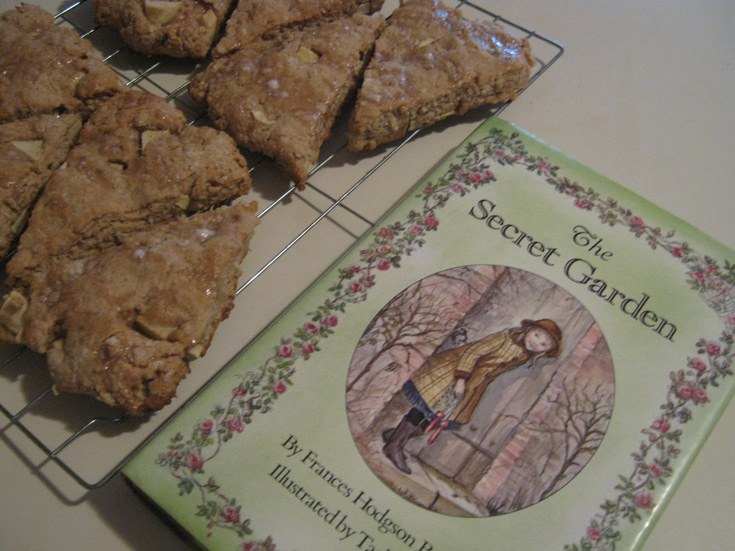
I suppose there might be better ways to spend a Sunday than baking scones, reading and blogging about books and watching Star Trek, but I really can’t think of any right now. They’re cinnamon apple oatmeal scones, and the books are by Frances Hodgson Burnett, and it’s classic Trek with Kirk, Spock and McCoy. Does it get any better?

The Secret Garden #ccwomenclassics | marissabaker.wordpress.com

Both The Secret Garden and A Little Princess are re-reads on my Classics Club book list. They were some of my favorite books as a child, and my sister and I watched the film adaptations over and over when we were younger. Since they also qualify for the Women’s Classic Literature event, I decided to make them my first classics reads for the new year.

I can’t tell you how much I wanted a secret garden. Actually, I never really outgrew that — I’m sure gardens surrounded by high stone walls covered with ivy are more alluring than ones just sitting out in the front yard where anyone can see them. That garden with its hidden door is probably why The Secret Garden was always my favorite of the two books. That and the fact that there were boy characters — books with just girls in them are nice, but books with boys and girls are better even when there isn’t a hint of romance. Read more

Classics Club: Anna Karenina

At 817 pages, Anna Karenina by Leo Tolstoy is the most daunting book I’ve yet read for The Classics Club. I chose the translation by husband-and-wife-team Richard Pevear and Larissa Volokhonsky. Their work translating Russian literature is highly acclaimed, and I liked the idea of a native Russian speaker and a native English speaker working so closely together on the translation. I found their Anna Karenina very readable.

It took me quite a while to read Anna Karenina, but I did enjoy it. The book was just so large it was hard to take everywhere, and I finished several thinner books for more portable reading. I think ‘intermittently’ was probably the best way for me to read Tolstoy. Usually I would read whole Parts in a chunk, but when it switched between different character arcs (and there were several), I needed a short break.

The main reason I was excited to read Anna Karenina was because my creative writing professor always talked about Russian writers as examples of superb character building. In this regard, Tolstoy did not disappoint. My sister, who’s reading War and Peace, said she noticed the same thing. The characters, especially his male characters, are nuanced people with depth of personality. I particularly enjoyed Levin and his story.

Three couples are at the centers of the novels main plots: Stepan and Dolly Oblonsky (Anna’s brother and sister-in-law), Kostya and Kitty Levin (Kitty is Dolly’s sister), and Anna Karenina with Alexei Karenin (her husband) or Alexei Vronsky (her lover). I know why Tolstoy chose Anna Karenina’s name as the title — she’s the only character which connects and influences all the others — but I was a little surprised not to see her play a more prominent (or at least more active) role in all the main plots.

Anna makes one decision — to enter an adulterous relationship with Vronsky — and then everything else just sort of happens. Her affair takes Vronsky out of Kitty’s life, which leads to Kitty’s very wise decision to marry Levin, but that’s the only affect Anna has on that plot line. Her main influence in the Oblonsky family storyline takes place at the beginning of the novel, before she even meets Vronsky. As relatives they cross paths throughout the book, but don’t influence each other much. For all the talk about her strong personality, Anna may be least active main character I’ve read. She takes the easiest road from the moment she throws her life in with Vronsky. She tells her husband only when she can’t bear not to. She won’t accept Karenin’s forgiveness because the self-awareness, growth and repentance necessary is too daunting. She doesn’t accept a divorce because it seems like such a final step that would separate her from her son. She refuses to take an interest in her daughter. She throws herself under a train because she can’t stop sabotaging the one relationship she has left, with Vronsky.

Here we get back to my caveat about Tolstoy’s really great characters mostly being male. I liked Kitty, I sympathized with Dolly, I partly understood Anna, but I didn’t empathize with them and they didn’t always feel real. Or maybe they were realistic, but I just didn’t like Anna and Dolly much? I’m not sure.

Plot wise, it did seem odd to me that the book continued so long after the title character’s death. These last chapters did tells you the main things that happened to Anna’s Alexies after her death, but didn’t follow them closely. Instead, it switched to wrapping up Levin’s subplot of spiritual awakening, which had absolutely nothing to do with Anna. Ending on that note made me wonder if the main point Tolstoy wanted his readers to take away wasn’t the tragedy of Anna’s unhappy families, but the beauty of Levin’s spiritual quest. Levin is also tempted by suicide, but he doesn’t take that route, and instead finds hope in his newly re-awakened faith in God that sits apart from any organized religion. Perhaps Tolstoy hoped his readers would progress on a path of faith, hope and happiness as well.


Click here to get a copy of Anna Karenina. Please note that this is an affiliate link. This means that, at no additional cost to you, I will receive a commission if you click on the link and make a purchase.
The Tenant of Wildfell Hall

I, who never wanted an electronic reading device, read all of Anne Bronte’s The Tenant of Wildfell Hall on my phone. I recently upgraded to a cellphone that actually works where I live, and it also happens to be a smartphone tempting me with free classics on Google Books. I thought it would be easier to pull out my phone and read a little than trying to carry around the printed copy of Anna Karenina I was currently reading (and which I finally finished!).
Like her sister Charlotte did with Jane Eyre, Anne Bronte captivated me with her story. I read it while waiting for a repair on my car’s exhaust system. I read it while eating breakfast. I even read in the bathtub while praying I didn’t drop my phone in the water, but I had to know what happened next.

Stylistically, what caught my eye was that the bulk of the novel is narrated by the main character Gilbert Markham. I’m trying to think of any other female authors of this time period who wrote a first-person narrative from a man’s perspective, but haven’t so far. Read more

Women’s Classic Literature Event

Extra post this week because I’m so excited about the Women’s Classic Literature Event hosted by The Classics Club. I’ve read many great classics written by women, and look forward to discovering more over the next year. Even if you’re not part of the Classics Club reading challenge, you’re still welcome to jump on board with this event using the #ccwomenclassics hashtag to share what you’re reading.

A Survey for the Women’s Classic Literature Event

Introduce yourself. Tell us what you are most looking forward to in this event.

  • As a female writer, I’m all for reading literature written by women. I studied English at The Ohio State University, and my undergraduate research project focused on Frances Burney and Mary Wollstonecraft. For this event, I’m most looking forward to seeing my fellow readers discover amazing classics by women writers, and then gathering suggestions from them for my own “to-read” list.

Have you read many classics by women? Why or why not?

  • I have read quite a few. We picked out some for my high school curriculum (homeschooled), then in college I was blessed to take classes from English professors who made sure to teach fine books written by both men and women.

Pick a classic female writer you can’t wait to read for the event, & list her date of birth, her place of birth, and the title of one of her most famous works.

  • Mary Shelley, born 30 August 1797 in London, England. I’ve read some of her mother’s writings, but nothing by her. Frankenstein is Mary Shelley’s most famous work.

Favorite classic heroine? (Why? Who wrote her?)

  • Jane Eyre, written by Charlotte Bronte. I love first-person narrative when it’s well written, and Bronte makes Jane a spectacular narrator. She’s a strong, clever woman and I admire her moral strength and unabashed living out of her Christian faith. (Bonus: Jane’s a fictional example of my INFJ personality type.)

Recommend three books by classic female writers to get people started in this event. (Again, skip over this if you prefer not to answer.)

  • Evelina by Frances Burney. I did my undergraduate research project on Burney, and highly recommend her work to fans of Jane Austen. Evelina is the shortest and most manageable of her novels, so I suggest trying that one out before jumping into the 900+ page Cecelia or Camilla.
  • Jane Eyre by Charlotte Bronte. If you haven’t read this famous classic yet, I hope you will. It’s one of my favorite books of all time, and I love the characters.
  • North and South by Elizabeth Gaskell. I love this book and the BBC adaptation staring Daniela Denby-Ashe and Richard Armitage. The casting is perfect, and my only quibble with the plot adaptation is the ending/proposal scene … but no more on that for fear of spoilers.

Will you be joining us for this event immediately, or will you wait until the new year starts?

  • I’ll probably write about Tenant of Wildfell Hall in November or December.

Do you plan to read as inspiration pulls, or will you make out a preset list?

  • I’ll pull from the women writers already on my Classics Club list, and maybe add a few more as inspiration strikes.

Share a quote you love by a classic female author — even if you haven’t read the book yet.

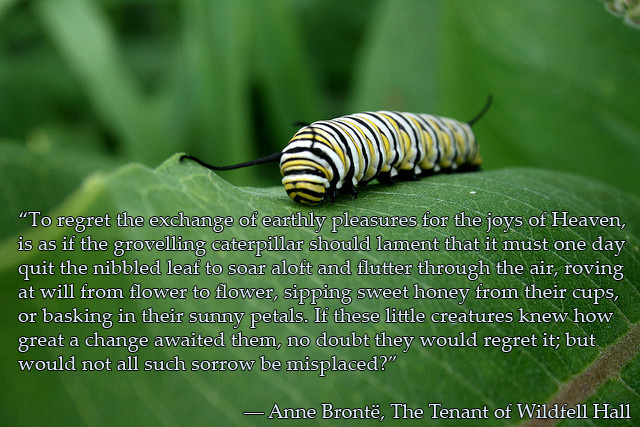
  • Here’s one I took note of when reading Anne Bronte’s Tenant of Wildfell Hall.
Women’s Classic Literature Event | marissabaker.wordpress.com
caterpillar credit: Eli Duke, CC BY-SA via Flickr