The Rightness of Trusting God’s Will Even When It’s Scary

One of the most astonishing statements in all of scripture was made on Passover evening nearly 2000 years ago, on the night in which Jesus was betrayed. Knowing exactly what was about to happen, Jesus still prayed “not my will but yours be done” (Matt. 26:36-46; Luke 22:39-46). This is the ultimate example of meekness–power submitted to the will of God. Jesus could have asked His Father for “more than twelve legions of angels” to free Him from the arresting mob if He’d wanted to(Matt. 26:51-45). Instead, He said, “Father, if this cup cannot be taken away from me unless I drink it, your will must be done” (Matt. 26:42).

Scripture describes Jesus as being “anguished and distressed” and feeling “deeply grieved” in His soul. Emotionally, that sounds like just about as bad as it can get for a human being. Yet even in such a dire situation, He prayed for God’s will to be done. I suspect He even prayed that in part because of the dire situation, using His conviction that God can be trusted and that His will is best to carry Him through what lay ahead.

For us today, who’ve committed to following Jesus’s example, “Your will be done” should also be our prayer during times of testing and trouble (as well as in good times). That’s not always easy to say, though. We might even be afraid or reluctant to pray for God’s will to be done, especially when the future seems uncertain. It comes down to an issue of trust and perspective.

God Knows Best

I often think about the spiritual implications of my struggles with anxiety. If I give in to catastrophizing and fear, what does that say about my level of (mis)trust in God? Connecting that idea to today’s post, it seems that whether or not we want to pray, “Your will be done,” is often tied-in to all those fears and worries. Is God really good all the time? Does He care enough to make this situation work out for me? What if praying for His will means I don’t get what I want or need?

I think we need to reject shaming people (including ourselves) for weaknesses and fears, and rather encourage each other to keep choosing trust and faith over and over again. Anxieties are “afflictions, not sins” (to quote C.S. Lewis), though they can lead us into sin if we let them. Overcoming fear is an ongoing process and it involves conscious choice, including the choice to trust that God knows what He’s doing.

We know that we should pray for God’s will to be done, but we’re often afraid to. Why? Because we do not trust that His will is best for us. We think His agenda and ours are by nature at odds with one another.

Because of our corruption, they may in fact be at odds. But if we could see the whole picture, we would understand that it is our own will that falls short of fulfilling our well-being, not His.

CHRIS TIEGREEN, 365 POCKET DEVOTIONS, DAY 114

It’s often easy to pray, “May your kingdom come, may your will be done on earth as it is in heaven” (Matt. 6:10, NET). When it’s less personal, sometimes it’s easier to wrap our minds around the idea that God changing things and making them better is a good thing (especially when it’s becoming more and more clear how much suffering and corruption is in the world). But it’s often harder to pray, “May your will be done (not mine)” in very personal situations that affect us immediately and directly (especially if we have a preferred outcome in mind). And yet that’s exactly what Jesus did, and what His disciples do.
His Good Plans Will Come to Pass

Paul’s a great example of one of Jesus’s disciples who submitted his own will and plans for his life to God. He started out by persecuting those who believed in Jesus the Messiah, then completely changed his life in response to God making His will known. That cost Paul greatly in terms of physical things, but also blessed him richly in terms of spiritual things.

I’m pretty sure I’ve written before about Paul’s view on trials–“that our present sufferings cannot even be compared to the coming glory that will be revealed to us” (Rom. 8:18, NET). It might not seem at first as if he’s talking about God’s will here, but he is. Going back to Romans 7:14-21, we find Paul describing the struggle between his unspiritual self and the spiritual law of God–his will versus God’s will. Next, Romans 8:1-17 talks about the leading of God’s spirit and Him saving us from sin, which is something He desires/wills for all people (1 Tim. 2:4; 2 Pet. 3:9). Then, Paul describes a struggle in creation, which was not willingly “subjected to futility … in hope,” but as part of God’s will for adopting children into His family (Rom. 8:19-26).

And he who searches our hearts knows the mind of the Spirit, because the Spirit intercedes on behalf of the saints according to God’s will. And we know that all things work together for good for those who love God, who are called according to his purpose …. What then shall we say about these things? If God is for us, who can be against us?

Romans 8:27-28, 31, NET

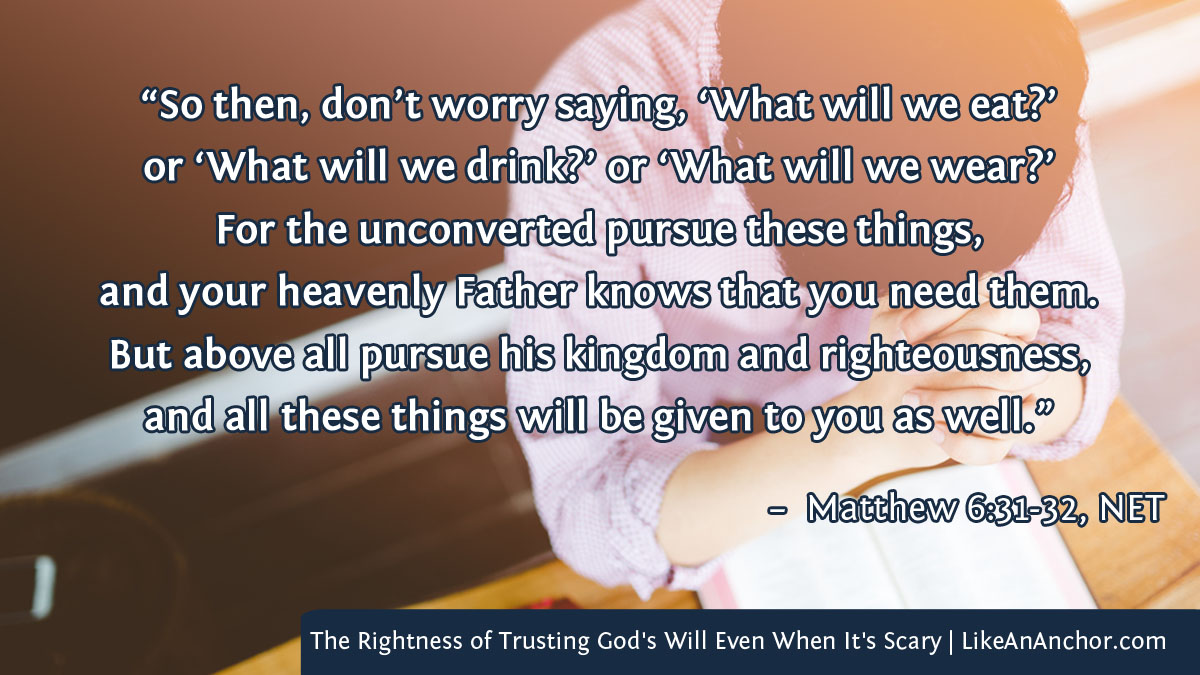
God has a plan. It’s a good plan. And because He’s the all-powerful Creator and Sustainer of the universe, His good plans for each of us and the whole of creation will come to pass. When we keep this in mind, there’s no need for us to fearfully grasp for control or to worry and fret about the future (Matt. 6:25-34).
We Follow in Christ’s Footsteps

I recently started reading C.S. Lewis’s collection of passages from George MacDonald’s writings. One of the quotes which caught my eye says that because God “is against sin,” sometimes it also feels as if He is against the things that we want, strive for, and dream about. Which might actually be the case, if we’re still living lives influenced by sin, but God is never against us. When God is against someone’s sinful desires,” He is altogether and always for them” (Unspoken Sermons, First Series, The Consuming Fire). God is for us, and sometimes that means showing us that the things we want aren’t good for us. MacDonald also said that God’s “wrath will consume what they call themselves so that the selves God made shall appear” (same source). Coming to the Light isn’t always a comfortable process, but it is always good for us.

What these quotes make me think of is the fact that because God’s will and His love always work for good in the end, sometimes the immediate result of submitting to His will is painful, as it was for Jesus. Jesus knew, though, that His suffering was part of God’s plan to bring about good for the whole world, and things happened exactly as the Father purposed (Acts 4:27-28). Jesus prayed for God’s will knowing with absolute certainty “that the Father had handed all things over to him, and that he had come from God and was going back to God” (John 13:3, NET). We also know that He focused on “the joy set out for him” when “he endured the cross, disregarding its shame,” and that He “has taken his seat at the right hand of the throne of God” (Heb. 12: 2, NET). Following His example, we can also pray for God’s will to be done knowing that God has good things in store for us and for the entire world.

Thinking about Jesus’s trust in His Father also adds another layer to how we can understand the verse, “Endure your suffering as discipline; God is treating you as sons” (Heb. 12:7, NET). Jesus did not need to be disciplined in order to correct bad behavior (since He never sinned), but He certainly suffered. Scripture is clear that following in His footsteps will involve suffering (sometimes from the world, sometimes as an attack from spiritual evil, and sometimes as part of God’s refining process that’s meant to strengthen us and help us grow). When we suffer, we know that we’re not going through anything that Jesus wasn’t willing to go through as well; God is not treating us any differently than He did His only begotten son. We also know that we can look forward to the same goal that Jesus focused on–the goal of eternal life together with God, as a family. We can also pray “your will be done” knowing that God is faithful, that He knows what He’s doing, and that He will work things out for good in the end.

Featured image by Jantanee via Lightstock

Guarding What God Has Put in Your Heart

I can’t tell you how many times I’ve heard messages on the importance of guarding our hearts. God wants relationships with people who are pure in heart and who are whole-heartedly devoted to Him. In order to be like that, we need to be careful what we let into our hearts. Guarding our hearts, we’re often told, is about not letting bad things in.

Though that aspect of guarding our hearts is of vital importance, there’s also another side to this. To quote a daily devotional I’ve been reading, “We are to keep things in –things like the Spirit of Jesus, the humility and gentleness, the servanthood and sacrifice, the worship and thankfulness” (Chris Tiegreen, 365 Pocket Devotions, p.23). We need to be careful that we’re not so focused on keeping bad things out that we forget to keep the good things in.

Keep Truth In Your Heart

When Samuel was sent to anoint David, Yahweh told him, “God does not view things the way people do. People look on the outward appearance, but the Lord looks at the heart” (1 Sam. 16:7, NET). What’s in our hearts is what matters most to God. We don’t want to let in things that would corrupt our hearts, but we’re also not evaluated based on what we’ve kept out. God looks at what we keep in.

My child, pay attention to my words;
listen attentively to my sayings.
Do not let them depart from your sight,
guard them within your heart;
for they are life to those who find them
and healing to one’s entire body.
Guard your heart with all vigilance,
for from it are the sources of life.

Proverbs 4:20-23, NET

This is the one Bible passage that clearly instructs us to guard our hearts. It starts out by telling us to put wise words inside us and then “keep them in the center of your heart” (v. 21, WEB). It’s about guarding the good things in our hearts because what’s inside us determines what comes out of our lives, for good or evil.

He said, “What comes out of a person defiles him. For from within, out of the human heart, come evil ideas, sexual immorality, theft, murder, adultery, greed, evil, deceit, debauchery, envy, slander, pride, and folly. All these evils come from within and defile a person.”

Mark 7:20-23, NET

If what’s inside our hearts is bad, the fruit our lives produce will be bad also, no matter how much we polish up the outside. We can, however, with God’s help, replace the bad things with good things. Change has to happen in our hearts as we internalize the words of God, and then we need to guard those good things that He gives us.

Attach Your Hearts to Good Things

Putting His law inside people’s hearts is one of the central aspects of God’s new covenant. When He prophesied the new covenant, He said, “I will put my law within them and write it on their hearts and minds. I will be their God and they will be my people” (Jer. 31:33, NET). That’s what’s happening as part of the covenant Jesus instituted with His sacrifice (Heb. 8:7-13; 10:14-18). In order to have good things come from our lives we need to have good things in our hearts, and that comes from entering this covenant with God. We also need to diligently guard what God is teaching and giving us.

“Don’t lay up treasures for yourselves on the earth, where moth and rust consume, and where thieves break through and steal; but lay up for yourselves treasures in heaven, where neither moth nor rust consume, and where thieves don’t break through and steal; for where your treasure is, there your heart will be also.”

Matthew 6:19-21, NET

Part of guarding our hearts involves being careful about what “treasure” we attach ourselves to. If the things that we care about most and pour our energy into are worldly, that’s where our hearts will be. But if we put our efforts, time, and affection into good and godly things, then that is what our hearts and souls will treasure.

Entrust God With Your Heart

There is one other verse that uses the phrase “guard your hearts.” This time, though, it’s not an instruction for us. It’s something God does for us when we trust Him with our hearts and minds.

Do not be anxious about anything. Instead, in every situation, through prayer and petition with thanksgiving, tell your requests to God. And the peace of God that surpasses all understanding will guard your hearts and minds in Christ Jesus.

Philippians 4:6-7, NET

We talked about this type of peace at length just a couple weeks ago in a post called “Finding Peace On Earth Today.” The peace that God offers is a sort of peace that’s not dependent on external circumstances. Rather, it is a product of a heart that is committed to fully trusting God. True, lasting, godly peace comes when we trust God to take care of the things that threaten to take away our peace. When we pray in every situation, God shares His peace with us and it works to guard our hearts.

The task of guarding our hearts–keeping good things in and stopping bad things from taking over–is a life-long process. It’s something that God expects us to be actively involved in, and it’s something that He’s committed to helping us with.

Featured image by Photo Mix from Pixabay

What Does It Mean To Be Double-Minded, and How Can We Fix It?

I love it when a phrase in a book or a comment from a friend prompts an unexpectedly deep Bible study. Just last week, someone in my church’s scripture writing group suggested we study the phrase “double-minded.” Since there are only two verses in the Bible that use this word (at least in most translations), it sounded like a challenging and intriguing study. It’s also a study that’s relevant to things we struggle with today. It’s so easy to find ourselves becoming filled with worry, questions, and doubt. There are so many different versions of “truth” being marketed today, and it gets confusing. We need to be clear in our own minds what we believe and why so that we’re not double-minded. I hope you’ll find reading about this topic as fascinating–and helpful–as I did. We begin in the opening part of James’s epistle.

But if anyone is deficient in wisdom, he should ask God, who gives to all generously and without reprimand, and it will be given to him. But he must ask in faith without doubting, for the one who doubts is like a wave of the sea, blown and tossed around by the wind. For that person must not suppose that he will receive anything from the Lord, since he is a double-minded individual, unstable in all his ways.

James 1:5-8, NET

The word translated “double-minded” is dipsuchos, meaning “two spirited,” “vacillating” (Strong’s Dictionary), “wavering, uncertain, doubting,” and “divided in interest” (Thayer’s Dictionary). It comes from two words: dis (twice, again) and psuche (breath, spirit). Zodhiates adds that “such a person suffers from divided loyalties. On the one hand, he wishes to maintain a religious confession and desires the presence of God in his life; on the other hand he loves the ways of the world and prefers to live according to its mores and ethics” (dictionary entry 1374). Sounds like something a lot of Christians struggle with today, doesn’t it? James is the only New Testament writer to use this word, and it appears once again closer to the end of his epistle.

Be subject therefore to God. Resist the devil, and he will flee from you. Draw near to God, and he will draw near to you. Cleanse your hands, you sinners. Purify your hearts, you double-minded. Lament, mourn, and weep. Let your laughter be turned to mourning, and your joy to gloom. Humble yourselves in the sight of the Lord, and he will exalt you.

James 4:7-10, WEB

Though there are only two verses using this word, James makes it clear that being “double-minded” is not a good thing. From the context as we read James 1:8, we can say that faith and stability are the opposites of double-mindedness. Then James 4:8 recommends that the double-minded purify their hearts, indicating that being double-minded has something to do with the state of our hearts. It also appears to be something that we can fix, and which God will help us correct.

How Long Will You Waver?

In the Old Testament, the prophet Elijah confronted the people of Israel about their idolatry. They’d constantly sway back and forth between faith in God and following pagan religions. This wavering, uncertain, divided loyalty was not something that pleased God.

Elijah approached all the people and said, “How long are you going to be paralyzed by indecision? If the Lord is the true God, then follow him, but if Baal is, follow him!” But the people did not say a word.

1 Kings 18:21, NET

You can click here to read the entire story. Right now, I want to focus in on the phrase “paralyzed by indecision.” The more literal translation from Hebrew would be, “How long are you going to limp around on two crutches?” (NET footnote). Here, though, it’s an idiomatic phrase and does not refer to physical disability or injury. It’s a picture of someone’s thoughts and loyalty swaying back and forth unsteadily, similar to how James describes the double-minded individual as tossed by the sea. Other translations of this phrase in 1 Kings 18 include, “How long will you waver between the two sides?” (WEB) and “How long will you falter between two opinions?” (NKJV).

The need for us to set doubt aside and be loyal to God alone is also discussed in the New Testament. In his Pentecost sermon recorded in the book of Acts, Peter said, “let all the house of Israel know beyond a doubt that God has made this Jesus whom you crucified both Lord and Christ” (Acts 2:36, NET). We’re not meant to live in a state of indecision. Knowing who Jesus is removes doubt and replaces it with faith. This sort of faith is absolutely essential, “for he who comes to God must believe that he exists, and that he is a rewarder of those who seek him” (Heb. 11:6, NET). We don’t have to get rid of all doubt before we come to Jesus, but at the very least we need to reach a point where we can say, “I believe; help my unbelief!” (Mark 9:24, NET).

Don’t Divide Your Loyalty

The only other Bible verse that uses the word “double-minded” is found in certain translations of Psalm 119:113. In the World English Bible it’s translated, “I hate double-minded men, but I love your law.” The New King James Version is almost identical: “I hate the double-minded.” Offering a slightly different reading, the New English Translation says, “I hate people with divided loyalties.” We cannot afford to live as double-minded people with divided loyalties. It’s impossible to be loyal to God and serve things that are incompatible with His way of life.

No one can serve two masters, for either he will hate the one and love the other, or else he will be devoted to one and despise the other. You can’t serve both God and Mammon.

Matthew 6:24, WEB

Our loyalty and service belongs to God alone. We must follow Jesus’s example of rejecting the siren call of temptation and say, “Go away, Satan! For it is written: ‘You are to worship the Lord your God and serve only him'” (Matt. 4:10, quoting Deut. 6:13, NET). This is exactly what James was talking about when he said, “Be subject therefore to God. Resist the devil, and he will flee from you” right before he said, “Purify your hearts, you double-minded” (James 4:7-8, WEB). God wants the entirety of our hearts, not just the pieces leftover after we do other things in our lives.

O Lord, teach me how you want me to live.
Then I will obey your commands.
Make me wholeheartedly committed to you.
O Lord, my God, I will give you thanks with my whole heart.
I will honor your name continually.

Psalm 86:11-12, NET

Learning to Have an Undivided Mind

Though there are only 2 or 3 scriptures that directly talk about being double-minded, many scriptures talk about the importance of having “one mind” and being “like-minded” with other believers. This doesn’t mean that believers will all have the same personalities, types of lives, or individual opinions. Rather, this like-mindedness is rooted in all of us learning to think in the same way that God thinks. If we’ve been recipients of God’s spirit, then “we have Christ’s mind” (1 Cor. 2:16, WEB). The more we learn to have the same mind as Christ, the more like-minded we become with each other as well.

Now the God of perseverance and of encouragement grant you to be of the same mind with one another according to Christ Jesus, that with one accord you may with one mouth glorify the God and Father of our Lord Jesus Christ.

Romans 15:5-6, WEB

God wants His people to live in unity. We’re meant to care for every follower of Christ as much as we care for ourselves. We’re to work on resolving differences peacefully and prayerfully, seeking to have God’s perspective rather than defend our own opinions. We’re to replace double-mindedness, doubt, and instability with faith and loyalty, following the example of Jesus Christ in how we act and think.

For though we walk in the flesh, we don’t wage war according to the flesh; for the weapons of our warfare are not of the flesh, but mighty before God to the throwing down of strongholds, throwing down imaginations and every high thing that is exalted against the knowledge of God and bringing every thought into captivity to the obedience of Christ.

2 Corinthians 10:3-5, WEB

Through the power of God working inside us, we can choose to change our thoughts. Whether our minds are divided or whole is in large part up to us. We’re not helpless victims of our own doubt but rather mighty warriors who are strong in the Lord. Through Him, we have the power to overcome worry, doubt, and division and instead commit ourselves to lives full of faith.

Featured image by PublicDomainPictures from Pixabay

A Time For Discernment and Standing For What’s Right

We’re going through a pandemic right now, and it has given us the opportunity to ask ourselves some interesting and challenging questions. Take, for example, the issue of closing churches. Here in Ohio, churches are exempt from the order to limit public gatherings to 10 people or less. This is a right and proper application of the separation between church and state. Most churches here moved online, however, following the recommendation of medical and legal counsel. This was also right and proper, for the Bible tells us to respect governing authority (Rom. 13:1-2; Tit. 3:1-2; 1 Pet. 2:13-17) and quarantine the sick (Lev. 13:46; Num. 5:1-3). Just in the last couple weeks, some churches are starting to reopen with social distancing and other precautions in place.

Things didn’t go so well everywhere. New York City Mayor Bill de Blasio threatened to permanently close churches and synagogues if they continued to hold any services. In Mississippi, attendees of a drive-in church services were ticketed $500 for sitting in their cars listening to the pastor on the radio (the DOJ has stepped in on behalf of the church). Some consider churches “essential services,” some do not. Some try to use the crisis to discriminate against religious institutes, others work alongside and defend them.

Jesus warned there will be those who persecute His church. There will be people who try to stop us from meeting, preaching and worshiping rightly. It has already happened throughout history in various places around the world. To be clear, I am not saying encouraging churches to temporarily suspend in-person services during a pandemic is persecution. But this does give us a reminder that we need to be watchful and exercise discernment. This is a good time to ask ourselves questions like, How would we respond if churches were asked to close for a different reason? Or ordered to stay closed, as threatened in New York? What if we were told we could no longer own Bibles, as has happened in other countries?

I don’t bring up these sorts of questions to panic us, but to prepare us. We are told to watch and be ready, and it’s hard to do that if you’re not thinking of things that might happen in the future. We are living in the end times (as humanity has been since the first century per 1 John 2:18). This is a time for discernment and preparedness, and the current crisis can serve as a wake-up call for any of us who may have been growing complacent in the safety and freedom we’ve enjoyed for so long. Read more

Trusting God When You’re Confused By Him: A Study of Lamentations 3

A couple of weeks ago, we talked about the practice of lament. It’s something we rarely discuss in modern Christianity, but it makes up more than 1/3 of the psalms and you can find lament throughout the rest of scripture as well. Instead of hiding their pain, people who lament take it to God in prayer. They turn to Him, bring their complaint in an honest, heartfelt way, ask boldly for help and then, equally boldly, choose to trust in God. I ended that first post about learning how to lament with a quote from my favorite passage in Lamentations:

This I recall to my mind; therefore I have hope. It is because of Yahweh’s loving kindnesses that we are not consumed, because his compassion doesn’t fail. They are new every morning. Great is your faithfulness. “Yahweh is my portion,” says my soul. “Therefore I will hope in him.” (Lam. 3:21-24, all quotes from WEB translation)

This passage is lovely and hopeful, but it’s not the whole story of Jeremiah’s lament. It’s not even his concluding thought for this particular poem. Lament isn’t about convincing yourself to be happy. It’s about trusting God even when you’re not sure you want to. It’s about inviting Him to help you deal with hurt, loss, confusion, anger, and other complex, painful emotions. Hope is part of it, a key part, but there’s a lot more going on as well.

Feeling as If God Is Failing You

The third poem of Lamentations (each of the 5 chapters in this book is a separate poem) begins with the words, “I am the man who has seen affliction by the rod of his wrath.” Unlike other poems in Lamentations, Jeremiah doesn’t start by talking about all of the Lord’s people and how their sufferings affect them. This is about him and what God has done to him, personally. Jeremiah begins this poem talking about how it feels to believe that God is targeting him in particular for intense suffering. Read more

Learning How To Lament

Do you ever feel like maybe God isn’t living up to His promises? That He has abandoned you? Isn’t answering your prayers? Or that He should have done something to fix things and hasn’t?

Those are the sorts of thoughts we often feel guilty for thinking. After all, being a “good Christian” involves trusting God (which we often assume means not questioning Him) all the time no matter what, right? And so we try to ignore these kinds of thoughts and bury them deep where they won’t offend God or make us look bad to the other people in our church. But is that how God wants us to handle our painful questions?

There’s a Biblical practice called lament that models how to deal with anguish, pain, grief, and confusion. People of faith in scripture didn’t bottle up, hide, or ignore these feelings. They took them to God, turning questions we mistakenly think of as a lack of faith (or as a reason to give up on God) into a prayer. Over 1/3 of the Psalms are laments — “a prayer for help coming out of pain” (“Biblical Laments: Prayer Out of Pain” by Michael D. Guinan). There’s also a whole book of the Bible called Lamentations. Lament is found throughout scripture, from prophets, to psalmists, to Jesus. Lament is a good and godly practice and, if we learn how to do it, lament can help us hold on to trusting God even when we can’t figure out what He’s up to.

Praying through a sorrowful mood

My God, my God, why have you forsaken me? Why are you so far from helping me, and from the words of my groaning? My God, I cry in the daytime, but you don’t answer; in the night season, and am not silent. (Psalm 22:1-2, all scriptures from WEB translation)

The feeling of abandonment and despair is one that David felt, most of us can sympathize with, and Jesus echoed on the cross (Matt. 27:46). We know God does not leave or forsake His faithful ones, but that doesn’t stop us from sometimes feeling as if we’ve been forsaken. Last week, we talked about moods of faith in the Psalms, specifically a confident, celebratory mood in Psalm 91. Here in Psalm 22 we get another mood — one that is equally valid for Christians and no less worthy of taking to God in prayer. Read more