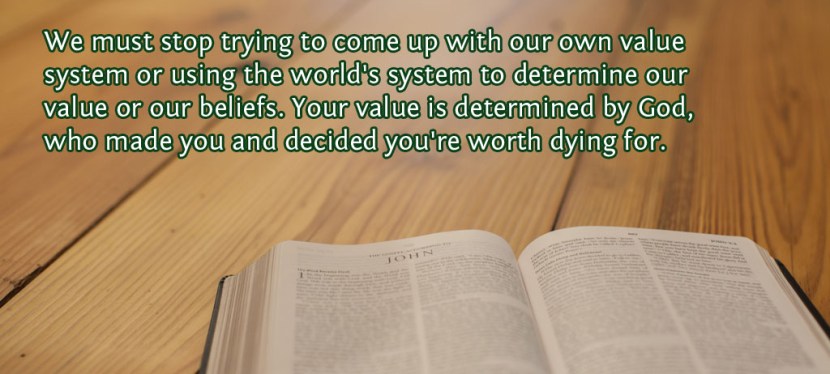
Before we can become the best versions of ourselves and have a right view of ourselves, we have to recognize our true value. The world will tell you that your relationship with yourself is the most important relationship you have, and that increasing your self-esteem will correct any problems you have with feeling like you’re not enough in some way. But following that advice isn’t deeply satisfying because I think deep down we all realize that we can’t assign value to ourselves.
That begs the question, “Who can assign value to you?” Other people, society, or impersonal metrics aren’t good measures either. The only satisfactory answer is God. Only the Creator can assign value to His creation. He knows what He created you for and who He created you to be, and therefore only He can declare how valuable you truly are.
Testing Where To Look For Value
We’ve been talking about Ecclesiastes here on this blog for a couple week now (click here to read “Crash Course in Ecclesiastes” and here for “Letting Death Give Us Perspective On Life“). One of the things that Solomon does in this book is present an in-depth analysis of all the different places that we can look for value.
Solomon experiments with finding value in his own wisdom, in pleasure, in wealth, in fine works, in great power, and in the legacy you leave for future generations. But he describes it all as “vanity” (hebel, H1892) — a transitory, unsatisfactory thing. As we modern people read through Ecclesiastes, we often label Solomon as depressed (probably accurate) and having low self-esteem. But Solomon himself doesn’t describe the problem as not esteeming himself enough. He knows the self isn’t a good place to look for value, and he wants something or someone else to give life meaning and tell him his purpose.
As Solomon works though his existential crisis, he concludes that meaning can only be found in God. God is the one who sets everything in motion and the only one with an accurate perspective on His plan (Ecc. 3:1-15). He’s in heaven and we’re on earth, so we need to be wary of jumping to conclusions about things we know nothing about (Ecc. 5:1-7). In the end, everything boils down to our duty to fear God and keep His commandments (Ecc. 12:13-14). That’s the key to understanding who we are and where our value lies. Read more
 Like An Anchor