What Does It Mean to Worship God?

Years ago when I first studied the topic of “praise,” I remember I immediately wanted to do a follow-up study on “worship.” That’s what I’m doing again this week. We often use “praise and worship” as a connected idea, almost as if they’re the same thing or they’re simply the label for the time during church services when we sing songs to God. But I remember from my last studies on worship that worship in the Bible is a different thing from praise. They can be connected, but they’re distinct ideas.

Praise, as we saw in last week’s post, involves acknowledgement of something God is or does. It includes the ideas of glorifying God, confessing His greatness, blessing and thanking Him, and lifting up His greatness and mighty deeds. In many cases, praise is public, communal, and enthusiastic. It often involves music and singing. Worship, on the other hand, involves bowing before God with humility, respect, and reverence as you offer service to Him. Praise and worship may occur together, but not necessarily.

Worship Words

As usual here on this blog, I like to start topical studies by looking at the Hebrew and Greek words used in the Bible. We’ll also compare them to the English definition, to see where there might be differences that could affect our understanding.

In English, “worship” as a noun means “the feeling or expression of reverence and adoration for a deity.” As a verb (action), it means “show reverence and adoration for (a deity); honor with religious rites” (Google and Oxford Languages). That matches the Hebrew and Greek meanings pretty well, but it’s missing a few points about how we show that reverence, adoration, and honor. We don’t really bow much anymore (at least in modern Western culture), but that sign of humble recognition that we’re entering the presence of someone far superior to us is key to understanding worship in the scriptures.

In Hebrew, “worship” is usually translated from sachah (H7812). This word appears 172 times in the Hebrew Bible, and you can translate it “bow down” or “worship.” Occasionally, English translators may use words like “obeisance” or “reverence” as well. Basically, the word means “to bow down, prostrate oneself” as “before a superior in homage” and “before God in worship” (Brown, Driver, Briggs [BDB]). Strangely (considering how much time they devote to words translated “praise”), the Theological Wordbook of the Old Testament (TWOT) has little to say about sachah. They simply say that the word can mean to “depress” or “weigh down” someone or something, as well as “‘to prostrate oneself’ or ‘to worship'” (TWOT 2360). The meaning seems to be fairly straightforward. There’s also a similar Chaldean word used in the book of Daniel that means to prostrate or “fall down” in worship (H5657; segid).

In the modern NET Bible, the translators sometimes render the Hebrew words abad (H5647; “serve” in KJV) and yare (H3372; “fear” in KJV) as “worship.” They’ll also translate whole phrases like “set their hearts to seek” or “call on the name” as “worship.” The NET isn’t my preferred translation for the Old Testament (I think they sometimes lose the important, poetic word pictures of Hebrew by reducing them to a single English word), but abad is an important word to look at when we’re studying worship. It blends the meanings of several roots, including “to do or make” and “to worship, obey” (TWOT 1553). It involves service offered to someone, often a king or deity. In a proper sense, it includes the “joyous and liberating experience” of serving the one true God (TWOT). Our worship can include obedient service as well as humble and reverent bowing before God.

In Greek, “worship” can be translated from a wide variety of different words. In the KJV, translators chose “worship” to represent all of these words: proskuneo (G4352; prostrate/worship), sebomai (G4576; revere/adore/worship), doxa (G1391; glory), latreuo (G3000; minister/serve), eusebeo (G2151; be pious toward/respect), therapeuo (G2323; wait upon, worship), threskeia (G2356] ceremonial observance/religion), and also a few single-use derivatives of those words (note: worship is not the only translation for most of these words [e.g. doxa is typically translated “glory”]). Most often (54 out of 73 verses), “worship” comes from proskuneo. The NET also translates these words as “worship,” and they translate latreuo as worship more often than the KJV does (which typically uses “service”).

Taking the Hebrew and Greek together, the ideas that come into the English language as “worship” typically involves either 1) prostration and bowing down before God, and/or 2) service given to God. It also includes nuances of respect, adoration, and reverence. With that background, let’s look at how these words (particularly the Hebrew sachah and abad and the Greek proskuneo and latreuo) are used by Bible writers.

Image of a man sitting at a table with his head bowed over an open Bible, overlaid with text from Psalm 95:6, WEB version: "Oh come, let’s worship and bow down. Let’s kneel before Yahweh, our Maker"
Image by WhoisliketheLord Studio from Lightstock

Kneeling in Worship

The earliest record we have of worship comes from Abraham, the Friend of God (Isa. 41:8; Jam. 2:23). When “Yahweh appeared to” Abraham before the destruction of Sodom and Gomorrah, Abraham “ran to meet them from the tent door, and bowed himself to the earth” (Gen. 18:1-2, WEB). Here, “bowed himself” is translated from sachah. Abraham also used this word when God commanded him to sacrifice Isaac, explaining to his servants, “We will worship, and come back to you” (Gen. 22:5, WEB). Just in these examples, we see that worship involves humility, respect, and actions that serve God obediently. Sachah may involve literal bowing, but not always.

Oh come, let’s worship (sacha) and bow down (kara).
    Let’s kneel (barak) before Yahweh, our Maker,
    for he is our God.
We are the people of his pasture,
    and the sheep in his care.

Psalm 95:6-7

Here, “worship” is translated from sachah. It’s paired with kara (H3766) and barak (H1288). Kara specifies literal bending and bowing. It’s used 36 times in scripture, and at least 13 are for bowing to the knees and bending the back in worship (TWOT 1044). Barak is one of the words that we looked at last week; it is more typically translated “bless” and can be translated “praise” in some contexts. The use of these three words together makes it clear sachah isn’t always synonymous with kneeling (there wouldn’t be need for another word to clarify it if that was the case). Worship always involves the attitude of humbly prostrating oneself before God, but doesn’t always mean literally falling to your knees (though it can and often does include that).

Like Hebrew, Greek also has separate words for “bow/kneel” than the word for “bow/worship.” One of them is kampto (G2578), which Paul uses to talk about one of his prayers (Eph. 3:14-19) and to express the proper reaction people should have–and eventually all will have–to Jesus the Messiah.

As a result God highly exalted him
and gave him the name
that is above every name,
so that at the name of Jesus
every knee will bow (kampto)
—in heaven and on earth and under the earth—
and every tongue confess
that Jesus Christ is Lord
to the glory (doxa) of God the Father.

Philippians 2:9-11, NET

You’ll see something similar in the gospels, too, where people “bow down” and “worship” Jesus. The same thing is happening before God’s throne in heaven (Matt. 2:11; Rev. 5:14; 19:4). In these verses, the words are pipto (G4098; literally “fall down”) and proskuneo (G4352; worship). Zodhiates says that proskuneo comes from a root meaning to kiss, which references an “ancient oriental mode of salutation … when one was much inferior, he fell upon his knees and touched his forehead to the ground or prostrated himself, throwing kisses at the same time toward the superior” (The Complete Wordstudy Dictionary: New Testament, entry 4352). This isn’t necessarily literally happening in the New Testament (though, as we’ve seen, people do fall down or bow before God as well as worship), but it’s a custom underlying the action of showing reverence, adoration, and worship to a deity.

Image of hands clasped on an open Bible overlaid with text from Joshua 23:16, NET version:  “If you violate the covenantal laws of the Lord your God which he commanded you to keep, and follow, worship, and bow down to other gods, then the Lord will be very angry with you”
Image by Jantanee from Lightstock

Service As Worship

31 times in the Old Testament, you’ll find sachah and abad in the same verse. Over and over again, God’s people are warned not to bow down to, worship, or serve any other gods (Ex. 20:5; Deut. 11:16; 2 Kings 17:34-35). Doing so violates the covenant ancient Israel made with Yahweh (Josh. 23:16; Jer 22:9). Jesus reiterated the importance of worshiping and serving God alone during His confrontation with Satan following His baptism.

Again, the devil took him to a very high mountain, and showed him all the kingdoms of the world and their grandeur. And he said to him, “I will give you all these things if you throw yourself to the ground and worship me.” Then Jesus said to him, “Go away, Satan! For it is written: ‘You are to worship the Lord your God and serve only him.’”

Matthew 4:8-10, with a quotation from Deut 6:13

Here, because Jesus is quoting from the Old Testament, we can see how he aligned the Hebrew and Greek words for worship. We’re to worship (Greek proskuneo; Hebrew yare) God and serve (Greek latreuo; Hebrew abad) Him. Like the Hebrew abad, the Greek verb latreuo (noun form latreia) involves serving someone greater than you. The root word means “one hired,” indicating this service is voluntary and involves some kind of reward. When worshipping God, it’s not a transactional hiring process, but there are great rewards for those who faithfully serve Him.

Therefore I exhort you, brothers and sisters, by the mercies of God, to present your bodies as a sacrifice—alive, holy, and pleasing to God—which is your reasonable service (latreia).

Romans 12:1, NET

Presenting our entire lives to God as if we’re serving in His temple offering ourselves as a sacrifice to Him is a reasonable service. Reading Hebrews can provide a fascinating study of latreuo. It’s used of temple service under the Old Covenant, which was commanded as part of worshiping God but couldn’t make the worshippers perfect the way that Jesus’s sacrifice does (Heb. 9:1, 6, 9; 10:2). Because of what Jesus did, “the blood of Christ” cleans “your conscience from dead works to serve the living God” (Heb. 9:14, WEB). I said earlier this service isn’t a transactional hiring process, but it is a reciprocal relationship. When we accept Jesus’s sacrifice, we’re supposed to respond with worship and service.

So since we are receiving an unshakable kingdom, let us give thanks, and through this let us offer worship (latreuo) pleasing to God in devotion and awe. For our God is indeed a devouring fire.

Hebrews 12:28-29, with a quotation from Deut 4:249:3.

The Bible gives us a few concrete examples of what this service looks like. Anna the prophetess served God by staying in the temple, fasting, and praying (Luke 2:36-37). Paul served God by following Jesus, believing in the law and the prophets, worshiping in the spirit, and preaching the gospel (Acts 24:10-14; Rom. 1:9; Phil. 3:3). Serving God voluntarily and wholeheartedly is a key aspect of how we worship Him.

Spirit and Truth
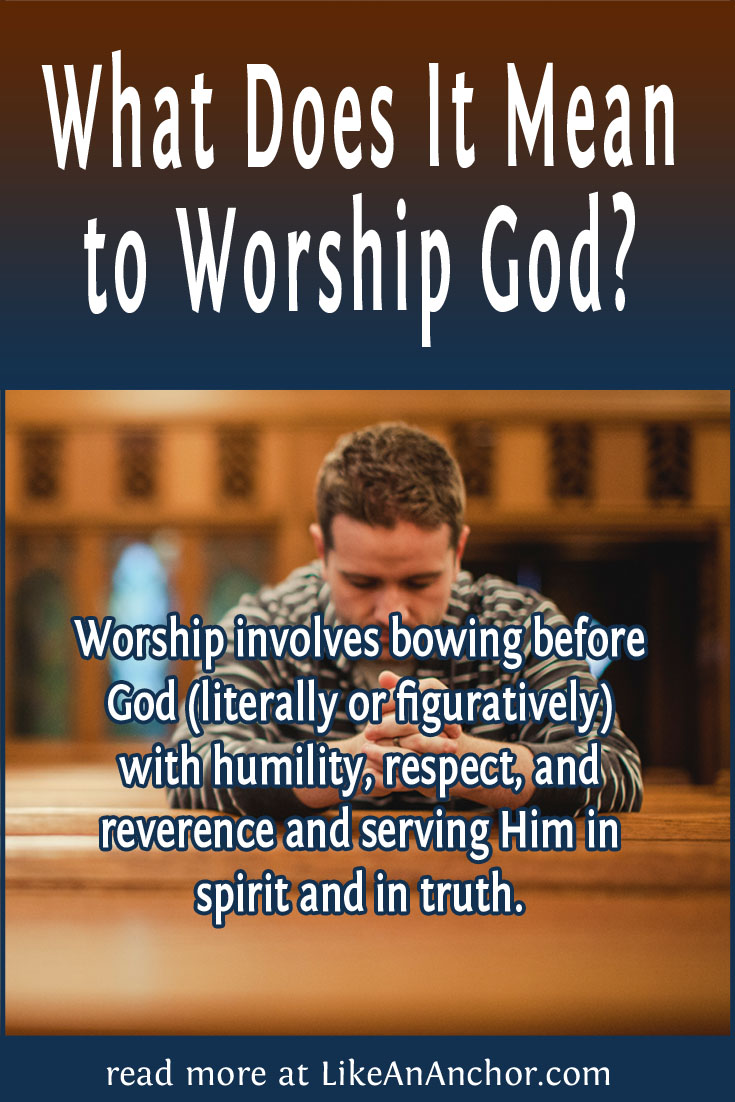
Image of a man sitting in a church pew with his head bowed, overlaid with blog's title text and the words, "Worship involves bowing before God (literally or figuratively) with humility, respect, and reverence and serving Him in spirit and in truth."
Image by Shaun Menary from Lightstock

Returning to the Greek word most often translated worship, proskuneo (G4352), we can fill in a little more of our picture of what it means to worship. In the gospels, people worshiped when they learned that Jesus is the Messiah (Matt. 2:1-2, 11; 14:33; John 9:38). People also worshiped when they ask Jesus for something (Matt. 8:2; 9:18; 15:25). We can continue both these practices today, worshiping Jesus and the Father as we recognize who they are and what they do, and also approaching them with our requests in a humble, worshipful way.

“But a time is coming—and now is here—when the true worshipers will worship the Father in spirit and truth, for the Father seeks such people to be his worshipers. God is spirit, and the people who worship him must worship in spirit and truth.”

John 4:23-24, NET

This conversation that Jesus has with a Samaritan woman is probably the most direct discussion anyone in the Bible has about how we’re supposed to worship. Most of the time, we see examples of people worshipping or instruction to worship God without a specific explanation of how to do that. Here, Jesus gives us a “must” statement for how we need to worship God.

Thoroughly examining what it means to do something in spirit and truth could fill at least one more whole blog post. But I think the easiest way to understand it is to think about Paul’s letters that contrast walking in the flesh to walking in the spirit (e.g. Romans 8). Lives transformed by God are spirit-led, and that should affect our worship as well. For the “truth” aspect, I think of the letter where Paul said we should be “practicing the truth in love” (Eph. 4:15, NET). In this passage, truth is a verb. We don’t think of “truthing” as an action in English, but it is here. The NET notes that we can think of it as “being real or truthful in both conduct and speech” (footnote on Eph. 4:15).

Worship involves bowing before God (literally or figuratively) with humility, respect, and reverence. It also involves the service that you offer to Him. All of this must be done in spirit and in truth for it to qualify as true worship in our New Covenant relationship with God the Father and Jesus the Son.


Featured image by Pearl from Lightstock

Is There a Golden Calf in My Life?

Do you remember the story of the Exodus? The people of Israel–the nation descended from Abraham, Isaac, and Jacob to whom God made great promises–were enslaved in Egypt. They cried out to God for help, and He sent a deliverer. Moses arrived and demanded that Pharaoh let the Israelites go. When Pharaoh refused, God sent 10 plagues that proved His absolute authority. After the final, devastating plague, Pharaoh and the Egyptians were happy to see the people of Israel go. After just a little while, though, Pharaoh angrily pursued them, intending to wipe them out. But God parted a sea for Israel to walk through, then after they’d escaped He used the sea to destroy the whole Egyptian army.

Imagine what it would have been like to see that. To witness all 10 plagues, especially the final ones where there was a clear distinction between God’s people and the Egyptians. Egypt was in darkness for three days, but the Israelites had normal light. All the Egyptian firstborn died, the children of Israel kept the Passover and God spared their lives. You’d have seen an entire sea split in half, walked through on dry land, and then watched as it destroyed the army trying to kill you (Ex. 14). Then, as your travels continued, you saw undrinkable water turn sweet and began gathering manna that appeared miraculously each morning to feed the entire company of people (Ex. 15:22-17:7). And then, your group of former slaves was attacked and you ended up winning the battle (Ex. 17:8-16). Finally, you came to Mount Sinai and literally heard the voice of God thunder down (Ex. 19-20). If you hadn’t been convinced of God’s reality before, you must have been by now!

And yet, after God spoke the 10 Commandments and Moses went up to the mountain to speak with Him more, Israel made a golden calf and started worshipping it. As modern readers, we are often inclined to look back on people of the past and assume that we’re much better than them. How dumb do you have to be, we think, to have witnessed all God’s miracles and then decide a gold statue of a calf is the one you should worship?

Aaron’s Perspective

Let’s take a closer look at this story. After seeing “that Moses delayed coming down from the mountain, the people gathered themselves together to Aaron” and demanded that he “make us gods, which shall go before us” to replace Moses, “the man who brought us up out of the land of Egypt” (Ex. 32:1, WEB). The Hebrew word translated “gods” here is elohym, the same word used in Genesis 1:1 when it says, “God created the heavens and the earth.” It is a plural noun, used both generically of gods but also of the one true God (much like the English word today). The people are requesting a visible deity to take the place of Moses. Now, look at Aaron’s response.

All the people took off the golden rings which were in their ears, and brought them to Aaron. He received what they handed him, fashioned it with an engraving tool, and made it a molded calf. Then they said, “These are your gods, Israel, which brought you up out of the land of Egypt.”

When Aaron saw this, he built an altar before it; and Aaron made a proclamation, and said, “Tomorrow shall be a feast to Yahweh.”

Exodus 32:3-5, WEB (NET notes th

At first, Aaron echoes the people’s request for elohym (and the NET translation notes that “these are your gods” could be translated “this is your god”). But once the calf is built and the altar constructed, he proclaims “a feast to Yahweh.” In contrast to the more general elohym, Yahweh is a very specific name. Look how God revealed that name to Moses, when He first called him to go and deliver Israel.

God said to Moses, “I AM WHO I AM,” and he said, “You shall tell the children of Israel this: ‘I AM has sent me to you.’” 15 God said moreover to Moses, “You shall tell the children of Israel this, ‘Yahweh, the God of your fathers, the God of Abraham, the God of Isaac, and the God of Jacob, has sent me to you.’ This is my name forever, and this is my memorial to all generations

Exodus 3:14-15, WEB

Yahweh is God’s proper name, which He revealed to His people for them to use. God is a description of the type of being He is, Lord is a title, but Yahweh is His name. I think it’s significant that Aaron uses this name here, rather than the name of an Egyptian deity associated with cattle like Apis or Hathor. Aaron didn’t present this as a different god than Israel had followed out of Egypt; he caved to the people’s demands to make a visible representation of a god and then he said worshipping it was worshiping Yahweh.

God’s Perspective

Aaron’s description of the golden calf as the god who brought Israel out of Egypt is baffling to us. But how often do we do something similar, where we come up with an idea and decide we’re honoring God but in reality it has nothing to do with how He tells us to live and worship him?

Yahweh spoke to Moses, “Go, get down; for your people, who you brought up out of the land of Egypt, have corrupted themselves! They have turned away quickly out of the way which I commanded them. They have made themselves a molded calf, and have worshiped it, and have sacrificed to it, and said, ‘These are your gods, Israel, which brought you up out of the land of Egypt.’”

Yahweh said to Moses, “I have seen these people, and behold, they are a stiff-necked people. Now therefore leave me alone, that my wrath may burn hot against them, and that I may consume them; and I will make of you a great nation.”

Exodus 32:7-10, WEB

Whatever Aaron might have thought about what He was doing, Yahweh is very clear about how He viewed the golden calf incident. He was ready to kill everyone involved because they “corrupted themselves” and “turned away quickly out of the way which I commanded them.” Moses interceded on behalf of the people and God mercifully stayed His hand, but this was still a very serious offense. They had “sinned a great sin, and have made themselves gods of gold” (Ex 32:30-31, WEB). Even if some of them had thought they were in the right, it didn’t change the fact that what they did was wrong.

What about New Covenant Christians?

I wonder sometimes if there are areas where I’m just as stubborn as the ancient Israelites about doing something I think honors God but which He would tell me not to do (it’s a regular prayer of mine that He would show me if that is the case). We can say for certain that the New Covenant church is not immune to this issue, as demonstrated by Paul’s letters. He frequently corrects mistakes in people’s understanding of what is and is not pleasing in God’s eyes.

In 1 Corinthians, Paul chides the believers in Corinth for what the NET Bible describes as “immaturity and self-deception” (header for chapter 3). They’d broken into factions following different human teachers and they had an inflated opinion of their own wisdom. They’d even decided to allow sexual immorality within the congregation, and then boast about their tolerance! (1 Cor. 5). And there were other issues as well, which you can read the whole letter to learn more about. Eventually, Paul brings his readers back to the example of Israel at Mount Sinai.

 For I do not want you to be unaware, brothers and sisters, that our fathers were all under the cloud and all passed through the sea, and all were baptized into Moses in the cloud and in the sea, and all ate the same spiritual food, and all drank the same spiritual drink. For they were all drinking from the spiritual rock that followed them, and the rock was Christ. But God was not pleased with most of them, for they were cut down in the wilderness. These things happened as examples for us, so that we will not crave evil things as they did. So do not be idolaters, as some of them were. As it is written, “The people sat down to eat and drink and rose up to play.” …

These things happened to them as examples and were written for our instruction, on whom the ends of the ages have come. So let the one who thinks he is standing be careful that he does not fall. No trial has overtaken you that is not faced by others. And God is faithful: He will not let you be tried beyond what you are able to bear, but with the trial will also provide a way out so that you may be able to endure it. So then, my dear friends, flee from idolatry. 

1 Corinthians 10:1-7, 11-14, NET

One of the basic things that we need to accept when we commit to following God is that He’s the one who gets to determine how we ought to follow Him. It’s not a negotiation or something we come up with on our own. He gives us clear guidelines to follow. There are some things we can personalize–for example, we’re told to sing praises, but the style of music or the number of songs per church service isn’t specified. However, we aren’t given the option to change things completely–for example, eliminate music from worship or replace songs of praise in church services with songs that have nothing to do with God.

Examining Ourselves for Idolatry

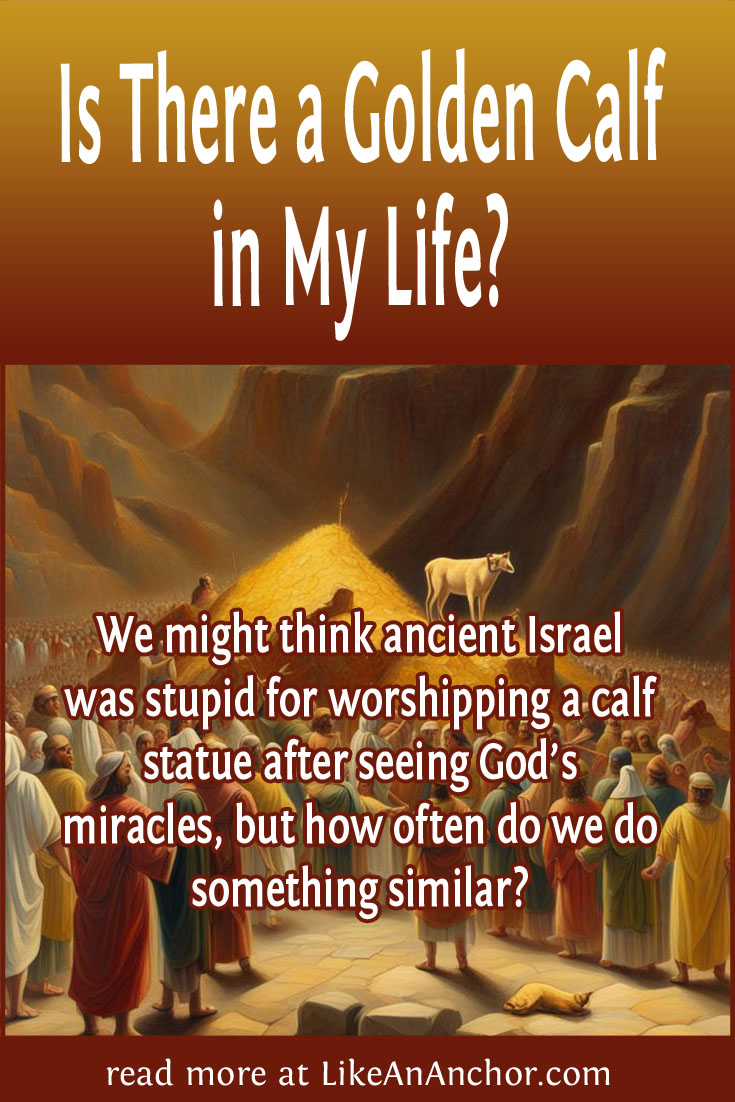
AI generated artistic rendering of Israel at Mount Sinai with the golden calf, overlaid with blog's title text and the words, "We might think ancient Israel was stupid for worshipping a calf statue after seeing God’s miracles, but how often do we do something similar?"
Image AI generated with NightCafe

Music is a relatively simple example. While it can generate sharp controversy and very definite opinions, most reasonable people will admit that music tastes are subjective and there isn’t anything wrong with different styles (i.e. traditional hymns vs. contemporary Christian) provided the lyrics are Biblically sound. Many of the other topics can get more controversial. For example, I think the question of Biblical holy days (e.g. Passover, Pentecost, Sukkot) vs. more recently “Christianized” holidays (e.g. Easter, Christmas) falls into this category. I struggle to wrap my head around why people would keep days God doesn’t tell them to while ignoring the ones that He does.

When we think of idolatry, we usually think of making statues and worshiping them instead of the true God. But it’s more insidious than that and it’s still dangerous today. Paul warned us to “flee from idolatry” (1 Cor. 7:15, NET). John’s final instruction in his first epistle is, “guard yourselves from idols” (1 John 5:21, NET). The ending of Revelation makes clear that idolaters will not be in God’s kingdom (Rev. 21:8; 22:15). It’s a very serious thing, and it’s something we all need to examine ourselves for and make sure we’re not replacing God with some other priority, or trying to worship Him in a way that seems okay to us but that He would say is not the way He commanded.

Now that we’ve started a new year on the Gregorian calendar, I start thinking about the new year that will start in the spring on God’s calendar. This year, the first day of the first month on the Hebrew calendar lines up with April 9th. That gives us about three months now before we’ll be keeping Passover. Traditionally, the time leading up to Passover is a season of self-examination because that’s what Paul tells the Corinthians to do shortly after he gives them the warnings from Israel’s past (1 Cor. 11:17-34). Now is an excellent time to start taking a look at ourselves, and prayerfully asking God to share His perspective on our choices. Personally, I like to pray Jeremiah’s prayer: “Yahweh, correct me, but gently” (Jer. 10:24, WEB). We need His correction, and we also need His mercy when we’re asking for His aid to identify and overcome idolatry or any other sin.


Featured image by ian kelsall from Pixabay

Isaiah Study: God is Incomparable and Irreplaceable

Last week, I started studying Isaiah 40-66. These are the last 27 chapters of the book, and they record an extended dialog where God speaks candidly about His feelings, desires, and plans. In this passage, He revealed His plans for ancient Israel’s immediate future at the time, for the Messiah’s coming (included the four famous Servant Song passages), and for events that are still in the future for those of us reading Isaiah today.

If you go back and read last week’s post, you’ll see I made a list of key themes that I want to study more extensively in this section of scripture. The list included (among other things) God’s defense of His reputation and His power to achieve all He’s promised. Another related point is that God is incomparable and sovereign, so trying to replacing Him with idol worship is foolish.

God shows so much emotion in this section of scripture, and much of it is related to the topic of who He is and how people ought to relate to Him. He’s angry and heartbroken when His people turn away, cutting off contact with Him. He’s confused by Israel’s forgetfulness about all He’s done in the past. He wants them to see Him for who He is and give up their foolish attachment to gods made from wood and stone. Though some of the specific wording is closely connected to Israel of Isaiah’s day, the passages also hold meaning for us today. The specifics of our struggles might be different but we’re not immune from developing an inaccurate view of the Lord.

Mi Chamocha

After God parted the Red Sea in Exodus, Moses and Miriam led the people in a song of joy that includes these words: “Who is like you, Yahweh, among the gods? Who is like you, glorious in holiness, fearful in praises, doing wonders?” (Ex. 15:11, WEB). In Hebrew, “who is like you?” is mi chamocha (which is where we get the names Michael and Michelle). You can hear parts of this Hebrew prayer in The Prince of Egypt’s soundtrack (click here for lyrics with a translation; click here for the song).

As I read through Isaiah 40-66, the phrase mi chamocha kept coming to mind. In the Exodus song, the question, “Who is like you, Lord?” is a rhetorical one. The answer should be obvious when we look at His creation and marvelous miracles, such as rescuing Israel from Egypt–there’s no one who can compare to the Lord. Many years later, though, the descendants of those people who once sang mi chamocha aren’t so sure of the answer. And so God asks a series of questions near the beginning of the passage we’re studying in Isaiah.

Who has measured the waters in the hollow of his hand,
and marked off the sky with his span,
and calculated the dust of the earth in a measuring basket,
and weighed the mountains in scales,
and the hills in a balance?
Who has directed Yahweh’s Spirit,
or has taught him as his counselor? …

To whom then will you liken God?
Or what likeness will you compare to him? …

“To whom then will you liken me?
Who is my equal?” says the Holy One.

Isaiah 40:12-13, 18, 25, WEB

Isaiah’s readers–past and present–need this reminder. In our modern world, it’s easy to forget how awe-inspiring God is. We’re jaded, tired, and distracted; often out-of-touch with the marvels of God’s creation and forgetful of His wonderful works. We need reminders of our insignificance and God’s mighty power (Is. 41:14-20). Yet like Isiah’s first audience, we’ve already witnessed God’s goodness. Now we need to remember it and worship Him accordingly, recognizing that there is no other god (Is. 43:10-13; 44:6-8; 46:5-11; 63:7-14; 64:4).

Image of a woman worshiping with her arms raised and a quote from Isaiah 42:8, WEB version: “I am Yahweh. That is my name. I will not give my glory to another, nor my praise to engraved images.”
Image by Ruby-Rose from Lightstock

Foolish Idolatry

When we turn away from God and put something else in His place, we’re guilty of idolatry. In ancient Israel’s case, this often took the form of literally worshiping other gods. My guess is that most of you reading this today aren’t tempted to carve a block of wood into a shape and bow down to it. Our idolatry temptations are more subtle. They’re still there, though, and it’s still important to be careful of them. The Apostle John makes this clear with the final admonition of his first letter: “Little children, keep yourselves from idols” (1 John 5: 21).

God’s feelings about idolatry take up huge parts of Isaiah 40-66. He keeps coming back to this topic. He seems genuinely puzzled by how a people to whom He’s revealed Himself and who’ve seen Him work wonders could turn from Him and bow down to images they made themselves. It’s simply absurd.

Everyone who makes a carved image is vain.
The things that they delight in will not profit.
Their own witnesses don’t see, nor know, that they may be disappointed. …

No one thinks,
neither is there knowledge nor understanding to say,
“I have burned part of it in the fire.
Yes, I have also baked bread on its coals.
I have roasted meat and eaten it.
Shall I make the rest of it into an abomination?
Shall I bow down to a tree trunk?”

Isaiah 44:9, 19, WEB

God is a logical, rational being and He gave humans the ability to think that way, too. Sometimes, though, understanding is clouded to the point that people can’t even figure out that the same wood they cook their food over doesn’t turn into a god just because someone carved it into a shape.

Over and over God and Isaiah come back to the topic of idolatry, challenging their readers to think about what they’re doing (Is. 44:9-20; 46:5-7; 57:3-11). If people really realized who and what God is, they’d know they could never replace Him. As such, proving who He is and that He’s the one responsible for what happens to His people is a key part of God’s purpose in this section of scripture. He even says one of the main reasons for prophecy is to disprove idols.

I have declared the former things from of old.
    Yes, they went out of my mouth, and I revealed them.
    I did them suddenly, and they happened.
Because I knew that you are obstinate,
    and your neck is an iron sinew,
    and your brow bronze;
therefore I have declared it to you from of old;
    before it came to pass I showed it to you;
    lest you should say, ‘My idol has done them.
    My engraved image and my molten image has commanded them.’

Isaiah 48:3-5, WEB

God is all-powerful. He created everything that exists and He determines the shape of the future. We can rest assured that, just as He accomplished His purposes in the past, so He will bring His future plans to pass as well. And if we ever start losing sight of Who God is and wondering if He has the power to follow-through on all the things He’s promised, we can come back to passages like Isaiah 40-66 for reassurance and reminders (Is. 41:20; 45:7; 46:9-10; 55:8-17; 59:1).

Image of a man praying while studying and a quote from Isaiah 49:23, 26, WEB version: “Then you will know that I am Yahweh; and those who wait for me shall not be disappointed.” ... “Then all flesh shall know that I, Yahweh, am your Savior and your Redeemer, the Mighty One of Jacob.”
Image by WhoisliketheLord Studio from Lightstock

God is Incomparable and Sovereign

Have you ever noticed how much the Bible talks about names? That’s because names in Hebrew culture are connected to a person’s reputation. In an Eastern society, like the one where the people in the Bible lived, family connections, honor, and reputation are extremely important (for more on this topic, see Misreading Scripture with Western Eyes by E. Randolph Richards and Brandon J. O’Brien and Reading the Bible with Rabbi Jesus by Lois Tverberg).

God uses this cultural trait to emphasize how much He cares about the way people perceive Him. It is vitally important to Him that we remember who He is and realize that nothing and no one can compare to Him. Notice these words in part of God’s commission to Cyrus that’s recorded in these final chapters of Isaiah:

I am Yahweh, and there is no one else.
Besides me, there is no God.
I will strengthen you,
though you have not known me,
that they may know from the rising of the sun,
and from the west,
that there is no one besides me.
I am Yahweh, and there is no one else.
I form the light
and create darkness.
I make peace
and create calamity.
I am Yahweh,
who does all these things.

Isaiah 45:5-7, WEB
Image of a smiling woman worshipping with the blog's title text and the words "God’s reputation in our eyes affects our relationship with Him. The more we accurately we see Him, the more properly we relate to and respect Him. "
Image by Pearl from Lightstock

What people think of God doesn’t change who He is; He is the sovereign Lord and creator of all things whether humans believe it or not. Still, He cares about how people–especially His people–view Him. He puts His name on us and tells us not to misuse that Name (Ex. 20:7; Num. 6:27). His reputation in our eyes affects our relationship with Him; the more accurately we see Him, the more properly we relate to Him.

“Listen to me, O Jacob,
and Israel my called:
I am he.
I am the first.
I am also the last.
Yes, my hand has laid the foundation of the earth,
and my right hand has spread out the heavens.
when I call to them, they stand up together.

Isaiah 48:12-13, WEB

The world is full of distracting and worrisome things. That’s true for us today just as it was true in Isaiah’s day. We battle things that vie for our attention and hearts, offering to fill our time with comforting distractions rather than what really matters. We also hear and see constant reminders that the world is violent, unstable, and full of threats to our security and way of life.

God’s word cuts through that whole thick pile of distractions and worries like a sharp blade. How could we spend time in useless distractions when the Creator of the universe wants to speak to our hearts? How could we waste our time worrying about “what ifs” when the all-powerful Lord says He will deliver and preserve us?

God is incomparable and irreplaceable. Who is like the Lord? Only He Himself. There’s no one who can compare and nothing which can replace Him. We need to remember that. It will help keep our hearts in the right place and our eyes on the goal of eternal life with the Lord.

Featured image by Inbetween from Lightstock

The Purpose of Your Redemption

Often when we bring up redemption, we talk about how Jesus redeemed us and why He needed to. We’re sinners–people who’ve broken God’s laws and in doing so earned a death penalty. Jesus shifted that penalty onto Himself. When we accept His sacrifice for our sins, the burden of that sin and the associated death penalty is lifted away so we can live forever with Him.

As incredible as all that is, there’s more to redemption than simply saving us from our sins. God has a purpose for us after we’re redeemed. There’s something He wants us to do and someone He intends for us to become. I find this an exciting thought. God doesn’t start a wonderful work in our lives and then just let us sit there wondering, “Now what?” He gives us a purpose and a goal as well as a dynamic relationship with Him.

Leaving Egypt To Serve God

The way that God delivered ancient Israel from Egypt is a type of how He delivers us from sin. There are so many parallels between the Passover story and the crucifixion story that we don’t have time to go into them all now. In summary, they’re both stories of God’s incredible redemption of a chosen people for a specific purpose. In Exodus, the Lord gives Moses a purpose that he’s supposed to share with Pharaoh for why God wants to take Israel out of Egypt.

Then the Lord said to Moses, “Go to Pharaoh and tell him, ‘This is what the Lord, the God of the Hebrews, has said, “Release my people that they may serve me!

Exodus 9:13, NET

God sets up a contrast here. “The Egyptians ruthlessly made the children of Israel serve” as slaves (Ex. 1:13, WEB), and now God commands them to free His people so they may serve Him instead. This command is repeated over and over early in Exodus as Moses and Pharaoh go back and forth on whether Egypt will obey God’s demand to let Israel go.

The Hebrew word translated “serve” is abad (H5647). It’s used 290 times in the Old Testament. The Theological Wordbook of the Old Testament connects it with two root words that mean “to do or make” and “to worship, obey” (entry 1553). It’s used both of forced labor for an oppressive master and for joyful service given to God. Abad is also the word used for the type of service the Levites performed in God’s tabernacle and temple. As such, when used of serving God, it involves worship and obedience in our actions. We might say, then, that the reason God redeemed His people is so that they could serve Him as joyful worshipers doing actions that glorified Him.

Image of a woman with her hands raised in worship, with text from Exodus 1-0: 3 and 9, WEB version: "Moses and Aaron went in to Pharaoh, and said to him, “This is what Yahweh, the God of the Hebrews, says: ‘How long will you refuse to humble yourself before me? Let my people go, that they may serve me. ... “We will go with our young and with our old. We will go with our sons and with our daughters, with our flocks and with our herds; for we must hold a feast to Yahweh.”
Image by Ruby-Rose from Lightstock

“So That”

There’s a simple phrase that Paul uses in Romans and 2 Corinthians to indicate God redeemed us for a purpose. Jesus died for us and we are crucified alongside him “so that the body of sin would no longer dominate us, so that we would no longer be enslaved to sin” and “so that we serve in newness of the spirit, and not in oldness of the letter” ((Rom. 6:6, NET and Rom. 7:6, WEB; emphasis added).

Now that we’ve been redeemed, we’re to serve God and be reconciled to Him because “God made the one who did not know sin to be sin for us, so that in him we would become the righteousness of God” (2 Cor. 5:20-21, NET, emphasis added). In these passages, Paul draws our attention to the purpose for redemption. God accomplishes our salvation so that something can happen next. Peter uses this type of language as well.

you yourselves, as living stones, are built up as a spiritual house to be a holy priesthood and to offer spiritual sacrifices that are acceptable to God through Jesus Christ. … But you are a chosen race, a royal priesthood, a holy nation, a people of his own, so that you may proclaim the virtues of the one who called you out of darkness into his marvelous light. You once were not a people, but now you are God’s people. You were shown no mercy, but now you have received mercy.

1 Peter 2:5, 9-10, NET

Like ancient Israel (whom Peter references by quoting Hosea), we are called and chosen for a specific purpose. It is “so that” we can proclaim God’s virtues and “offer spiritual sacrifices.” In other words, we’re redeemed so we can serve God, just as the children of Israel were in Exodus.

Next Steps in Light

Image of a man walking in the woods reading a Bible with the blog's title text and the words "God didn't start a wonderful work in our lives just to leave us wondering, "Now what?" He gives us a purpose and a goal."
Image by HarveyMade from Lightstock

So far, we’ve seen the purpose God has for us after redemption described a few different ways. We’re to serve God in the spirit. We’re to become righteous like God. We’re to proclaim His virtues and goodness. Putting it all together, we could sum up our purpose as sincere, obedient worship that results in righteous action.

The book of Hebrews dives deep into this idea. It lays out Jesus’s relationship to the Old Testament sacrifices for sin, explaining how He fulfills them all by offering Himself once as a final, perfectly effective sacrifice. It also describes what we should do next after receiving redemption.

For if the blood of goats and bulls and the ashes of a young cow sprinkled on those who are defiled consecrated them and provided ritual purity, how much more will the blood of Christ, who through the eternal Spirit offered himself without blemish to God, purify our consciences from dead works to worship the living God.

Hebrews 9:13-14, NET

So since we are receiving an unshakable kingdom, let us give thanks, and through this let us offer worship pleasing to God in devotion and awe.

Hebrews 12:28, NET

Look at the wording here. Jesus died for us and purified us so we can “worship the living God.” Then, because we realize that God is offering us incredible gifts, including a place in His kingdom, we should “offer worship pleasing to God in devotion and awe.” These verses also echo other passages that talk about the importance of worshiping God in the spirit (John 4:23-24; Phil. 3:2-3).

As redeemed people, we walk with God in a new, spiritual life. His goal in redeeming us is to make us fully part of His family. Along with that position as family members in covenant with God comes a purpose for us to accomplish. We have a role now; a way that we’re supposed to live. We ought to serve God in the spirit of the law, modeling His righteousness and worshiping Him joyfully. After all, when we consider the gift of redemption, it’s clear that we have much to be joyful about.

Featured image by Pearl from Lightstock

Song Recommendation: “Redeemed” by Big Daddy Weave

Learning From Others’ Spiritual Temperaments: Book Review of “Sacred Pathways” by Gary Thomas

A couple weeks ago, in an article titled “Psychology Isn’t Enough, but It Sure Helps: The Need for Personal, Spiritual Growth in Christianity” I talked about a book by Gary Thomas called Sacred Pathways: Discover Your Soul’s Path To God. I originally read it back in 2017 and I’d planned to write about it here on the blog but for some reason (which I don’t remember now) I never got around to it. So I reread it, and now I’d like to share some thoughts.

Book Overview

Thomas proposes nine “sacred pathways” — spiritual temperaments that describe how we’re most inclined to worship God. In the first chapter, he discusses that in the Christian churches we often expect everyone to worship God the same way. The example he uses is the “quiet time” that became a staple of church training and discipleship programs in the 1970s and ’80s. It involved spending 30 to 60 minutes each morning in prayer, personal worship, and Bible study, then having an accountability partner to check-in that you were keeping up with your routine. Prayer, worship, and study are all good things, but it’s not good if we reduce worship to “rote exercise” or assume everyone has to worship in the exact same way all the time (p. 14-15).

I’ve heard the idea that everyone else should worship “our way” voiced more or less directly by a variety of people in churches I’ve attended. Some think churches that don’t encourage dance are not worshiping Biblically; others worry about the people who aren’t committed enough to follow their example of reading the Bible through every year. I’ve voiced my own frustration with song services that have all the enthusiasm of a funeral dirge, saying we need more life in our worship to make it meaningful. Complaining about those who don’t  worship the way we think they ought is a common thing. But perhaps it betrays a wrong attitude. Read more

Am I Blending My Worship of God With Things That Don’t Honor Him?

Does God care how we worship Him? Some Christians today say (or act) as if He does not. Too many people today ignore parts of the Bible, try to over-rule God’s laws, and adopt extra-Biblical practices in worship. And they really don’t think He’ll mind.

The problem is, God actually does care how you worship Him. If you’re not following Him the way He says to, then you’re not really following Him at all. He is “a jealous God” and He does not accept half-hearted or divided affection. You can’t honor Him by worshiping in ways He does not approve or if you’re also trying to worship something else. It’s not good for us to have divided loyalties or identities. We need to find wholeness in seeking our Lord the way He desires us to seek Him.

Really Get To Know God

Paul tells us that all the things which happened to ancient Israel “were written for our admonition, on whom the ends of the ages have come” (1 Cor. 10:11, WEB). One place where the story of Israel is recorded is the book of Hosea. God used Hosea to warn Israel what would happen to them if they continued to break covenant with Him by blending pagan religions with their worship of the One True God, or “Yahweh” to use His proper name (Ex. 3:14-15). Unfortunately, it’s a message that’s relevant for churches today.

I’m not saying all churches, and certainly not every Christian, is deliberately blending other religions with their faith. But I do think it’s something we should be aware of, and on-guard to avoid. We need to make sure we’re not ignoring parts of His inspired word, rejecting His law, or blending pagan religious practices with our worship. Read more