Redeemed, Adopted, Made New

houseWeek 6 out of 7 in the count to Pentecost!

Several things came together to determine the topic for this week’s post. While I was writing last week’s post, I decided that being made children of God by the Spirit of adoption was too big a topic to tack on to the end of that post. Then another phrase that drew my attention was “walk in newness of life” and I wondered if perhaps both subjects went together. Around the same time, the quote in the image over there on your right showed up via the daily C.S. Lewis quote e-mail I subscribe to. And so we come in a round-about-way to three interconnected topics for today’s post.

Redemption

There’s more than one passage where the redemptive work of Jesus Christ is connected with adopting us into God’s family. Our redemption is both a pre-requisite for being adopted by God and a consequence of the plan to make us children.

having predestined us to adoption as sons by Jesus Christ to Himself, according to the good pleasure of His will, to the praise of the glory of His grace, by which He made us accepted in the Beloved. In Him we have redemption through His blood, the forgiveness of sins, according to the riches of His grace (Eph. 1:5-7)

Before we could have a relationship with the Father, before we could be “accepted in the Beloved,” before we could be Christ’s brethren, He had to give His life to ransom us from captivity to sin (Matt. 20:28; Is. 53:10-11).

looking for the blessed hope and glorious appearing of our great God and Savior Jesus Christ, who gave Himself for us, that He might redeem us from every lawless deed and purify for Himself His own special people, zealous for good works. (Tit. 2:13-14)

This plan to redeem us from iniquity involves a very definite purpose and a plan for our future. I’m tempted to go off on a tangent about how our purification and redemption is tied to the church’s future as  the Bride of Christ (which, as you may know, is one of my favorite Bible subjects), but instead I’ll point you to chapter 4 of my “God’s Love Story” e-book. Getting back to the topic at hand, Galatians 4 tells us we were redeemed so that we can be adopted.

Even so we, when we were children, were in bondage under the elements of the world. But when the fullness of the time had come, God sent forth His Son, born of a woman, born under the law, to redeem those who were under the law, that we might receive the adoption as sons. (Gal. 4:3-5)

Adoption

This word “adoption” that we keep reading is translated from the Greek huiothesis (G5206). It means to place as a son, or receive “another into the relationship of a child of someone.” It makes “a stranger, such as a sinner, into a real son” (Zodhiates, WordStudy Dictionary: New Testament). It is the process by which someone outside of a family is given the rights and privileges of being part of that family.

For as many as are led by the Spirit of God, these are sons of God. For you did not receive the spirit of bondage again to fear, but you received the Spirit of adoption by whom we cry out, “Abba, Father.” The Spirit Himself bears witness with our spirit that we are children of God, and if children, then heirs—heirs of God and joint heirs with Christ, if indeed we suffer with Him, that we may also be glorified together. (Rom. 8:14-17)

We can see in these verses how important the presence of the Holy spirit in us is to the process of bringing us into God’s family. Going back to Galatians 4, the next verses tell us we’re talking specifically of Christ’s Spirit making us His brethren and fellow heirs of God. It’s really incredible to think of — that Jesus loves us so much that he died for the opportunity to share His inheritance with us!

And because you are sons, God has sent forth the Spirit of His Son into your hearts, crying out, “Abba, Father!” Therefore you are no longer a slave but a son, and if a son, then an heir of God through Christ. (Gal. 4:6-7)

As with many things in our spiritual walk, there is a process to becoming children of God. Reading past the verses we quoted in Romans 8, Paul talks about “the sufferings of this present time” while we wait “for the adoption, the redemption of our body” (Rom. 8:18, 23). Galatians describes us as little children undergoing a birthing process “until Christ is formed in you” (Gal. 4:19). As mentioned in the meaning of the word “adoption,” we were something not part of God’s family and we need to go through a process that makes us part of His family.

Remaking

Right after contrasting the “the works of the flesh” (Gal. 5:19-21) with the “fruits of the Spirit” (Gal. 5:22-23), Paul writes about how those who have the Spirit of Christ ought to conduct themselves. (See also Gal. 5:16-18)

And those who are Christ’s have crucified the flesh with its passions and desires. If we live in the Spirit, let us also walk in the Spirit. (Gal. 5:24-25)

We’ve spent quite some time over the past few weeks’ Bible study posts in the first verses of Romans 8, which talk about walking in the Spirit and a spiritual change in the focus of our minds. This time, I want to back-up a couple chapters to Romans 6.

Or do you not know that as many of us as were baptized into Christ Jesus were baptized into His death? Therefore we were buried with Him through baptism into death, that just as Christ was raised from the dead by the glory of the Father, even so we also should walk in newness of life. (Rom. 6:3-4)

Though the Spirit isn’t mentioned here, this is the same thing we’ve been studying in these weeks leading up to Pentecost — the change wrought inside us by the personal, active involvement in our lives by Jesus Christ and God the Father.

For if we have been united together in the likeness of His death, certainly we also shall be in the likeness of His resurrection, knowing this, that our old man was crucified with Him, that the body of sin might be done away with, that we should no longer be slaves of sin….

Likewise you also, reckon yourselves to be dead indeed to sin, but alive to God in Christ Jesus our Lord. Therefore do not let sin reign in your mortal body, that you should obey it in its lusts. (Rom. 6:5-6, 11-12)

Once Jesus begins working in us, it is impossible for us to remain unchanged. And if we go along with this process, the change is dramatic indeed. We are to be completely remade. As C.S. Lewis said in the quote I used for the image at the beginning of this post, “You thought you were going to be made into a decent little cottage: but He is building a palace. He intends to come and live in it Himself.”

This change might not always be pleasant for us, but They are not doing it for selfish reasons. “The wages of sin is death” — that’s what we earn for practicing sin and there’s no getting around it. But God offers us a way to change, to have our sins wiped away and our character altered so we can be given “eternal life in Christ Jesus our Lord” (Rom. 6:23).


Cottage Cheese Chicken Bake

Cottage Cheese Chicken Bake recipe by marissabaker.wordpress.com

“If you could do something with 2 cups of cottage cheese, that would be great.”

Lunch making challenge accepted. And it actually was a challenge — searches for recipes online either didn’t take enough cottage cheese or didn’t sound like they’d taste very good. So I made something up. It actually worked and tasted good on the first try, too, which was a pleasant surprise. We’ll probably make it again.

Cottage Cheese Chicken Bake

print this recipe

Cottage Cheese Chicken Bake recipe by marissabaker.wordpress.com2 skinless, boneless chicken breast halves

1/4 teaspoon salt

1/4 teaspoon black pepper

1 teaspoon olive oil

3 cups uncooked rotini pasta

2 cups cottage cheese

1 can cream of chicken soup or one batch “cream of …” soup substitute

1/3 cup milk

1/2 teaspoon garlic powder

Cottage Cheese Chicken Bake recipe by marissabaker.wordpress.com1 teaspoon dried parsley

1/2 teaspoon dried basil

1/2 cup Parmesan cheese

1 slice of bread, toasted

1/4 teaspoon Italian seasonings

1 Tablespoon butter, melted

Slice or pound chicken breast to 1/3-inch thickness. Sprinkle chicken evenly with salt and pepper. Heat olive oil in a large skillet over medium-high heat. Add chicken to skillet, and cook 5 to 6 minutes on each side or until browned. Slice chicken into bite-sized pieces.

Cottage Cheese Chicken Bake recipe by marissabaker.wordpress.com

Bring large pot of lightly salted water to a boil and cook pasta until al dente, according to package directions. Put cooked pasta into lightly oiled 13x9x2-inch baking dish.

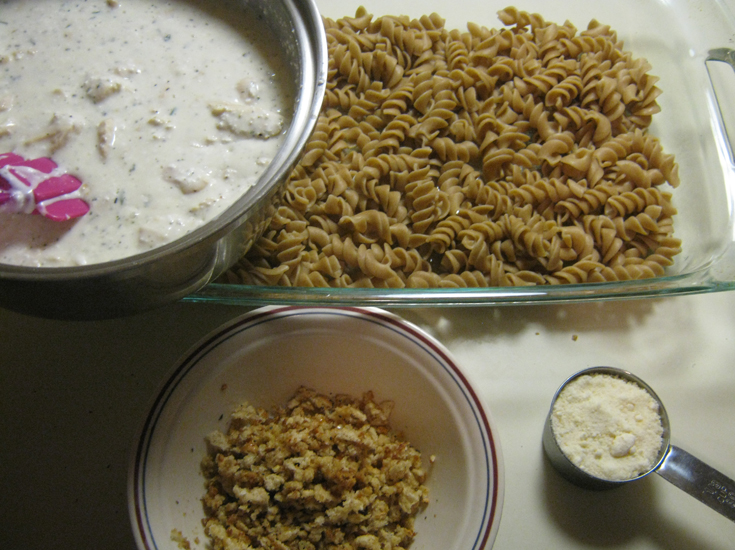
Meanwhile, place cottage cheese, soup, milk, and dried seasonings in a food processor and blend until smooth. Transfer the blended mixture to a saucepan. Add chicken and cook over medium heat until heated through.

Cottage Cheese Chicken Bake recipe by marissabaker.wordpress.com

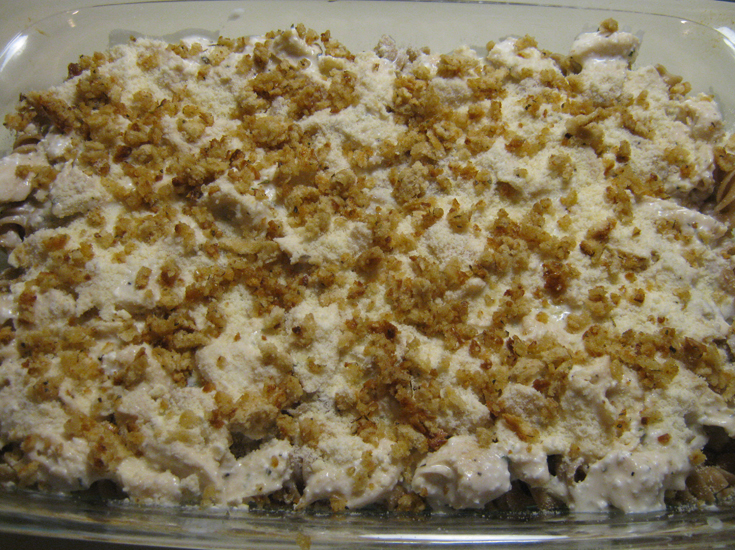
While chicken mixture is cooking, crumble the toasted bread into the melted butter, then stir in Italian seasoning. Once chicken mixture is done, pour it over the pasta. Sprinkle with Parmesan cheese and breadcrumbs. Cover the pan with aluminum foil. Bake in at 350°F for 15 minutes. Remove foil. Bake 5 minutes more or until heated through and bubbling.

Cottage Cheese Chicken Bake recipe by marissabaker.wordpress.com

Thank You For Your Service

Dear Service men and women,

“Thank you” isn’t something I’m likely to tell you in person. I’m not someone who will walk up to you in a store or on the street and express my gratitude for your service to this country, but it’s not because I’m ungrateful. It’s because 1) I don’t usually even say “Hi” to people I recognize unless they see me first, and 2) I don’t like people striking up random conversations with me, so I assume in the absence of definite evidence to the contrary that you won’t either. My modus operandi is to smile (just to make sure you don’t think I’m one of those I-hate-you-because-you-wear-that-uniform people) and then let you go along uninterrupted with whatever brought you here.

So, here’s a long overdue “Thank you” presented in the best way I know how — writing. Thank you to the people throughout our nation’s history who died for our freedom and for the freedom of people in other countries, like my grandpa’s brother who didn’t come home from WWII. To the people who did come home like my great Uncle Bob, who never called himself a war hero and most people didn’t know until his obituary that he was awarded the Purple Heart with one oak leaf cluster and five bronze stars. To my Grandpa, who’s latest reminiscence about his exciting Navy life was about being disciplined for letting himself get sunburned. To the families who are praying for their dear ones overseas, and for the families who have lost someone they love. To the children who Skype with Mommy and Daddy because it will be months before they see them in person. To those currently serving overseas and those who are about to ship-out, like my family’s newly-wed friend whose wife cannot accompany him to South Korea. And to those of you here, who I walk past with a smile. We are praying for you, and we thank you.

Kindling The Spirit

Sabbath number 5 out of 7 in our count to Pentecost! Last week, we looked at what happens as God begins to work with us through His Spirit — baptism, a new way of life, a change in how we worship. This time, let’s focus on “how” instead of what, including how we should respond, starting once again with the baptism of the Holy Spirit.

Unity and Gifts

For as the body is one and has many members, but all the members of that one body, being many, are one body, so also is Christ. For by one Spirit we were all baptized into one body—whether Jews or Greeks, whether slaves or free—and have all been made to drink into one Spirit. (1 Cor. 12:12-13)

Jesus Christ baptizes us into His body, the church, as a beginning to His and the Father’s work in us. That key moment in our lives begins an ongoing process of spiritual growth.

If we back-up to the beginning verses of 1 Corinthians 12, we see the subject is spiritual gifts and unity. Paul tells us how to recognize the Holy Spirit in another person — “no one speaking by the Spirit of God calls Jesus accursed, and no one can say that Jesus is Lord except by the Holy Spirit” (1 Cor. 12:3). He emphasizes that while our gifts and roles differ, we all have the same Spirit, Lord, and God (1 Cor. 12:4-6).

But the manifestation of the Spirit is given to each one for the profit of all: for to one is given the word of wisdom through the Spirit, to another the word of knowledge through the same Spirit, to another faith by the same Spirit, to another gifts of healings by the same Spirit, to another the working of miracles, to another prophecy, to another discerning of spirits, to another different kinds of tongues, to another the interpretation of tongues. But one and the same Spirit works all these things, distributing to each one individually as He wills. (1 Cor. 12:7-11)

Spiritual gifts are the manifestation of God’s Holy Spirit in us, and we have a responsibility in this, to use the gifts we are given. Paul told Timothy to “stir up the gift of God” and not to “neglect the gift that is in you” (2 Tim. 1:6; 1 Tim. 4:14). We ought to do likewise.

Rekindling Fire

There is a short phrase in 1 Thessalonians that is pivotal in discussing how we should respond when God places His Holy Spirit in us.

Do not quench the Spirit. (1 Thes. 5:19)

The word translated “quench” is sbennumi (G4570), which means to extinguish, go out, or quench. It has the sense of putting out a literal or figurative fire (Matt. 12:20; Eph. 6:16; Heb. 11:34). It can also be passive, as when the foolish virgins let their lamps go out and the flame died through inattention (Matt. 25:8). Applying this to the Spirit, we see that not only should we avoid forcibly smothering God’s Spirit in us, but we also cannot neglect it. If we do not use what we have been given by God — including the manifestation of His Spirit — the gifts will be taken away (Matt. 25:24-29).

Therefore take heed how you hear. For whoever has, to him more will be given; and whoever does not have, even what he seems to have will be taken from him. (Luke 8:18)

The metaphor of tending a fire is continued in 2 Timothy 1:6. We’ve already quoted part of this but here’s the whole verse, with the context that shows it’s talking of the Spirit.

Therefore I remind you to stir up the gift of God which is in you through the laying on of my hands.  For God has not given us a spirit of fear, but of power and of love and of a sound mind. (2 Tim. 1:6-7)

This phrase “stir up,” from the Greek anazopureo (G329), is a compound word that means to revive a fire again. Strong’s lists the meaning as “rekindle.” It is the opposite of sbennumi. So, one way we can think of God’s Spirit in us is as a fire that needs fed and stirred up to prevent it from going out.

Indwelling

There are enormous benefits for us in choosing to continually rekindle God’s Spirit in us rather than smother it. One is a continuing relationship with God and Jesus. Another is that the Spirit makes it possible to walk in Christ’s footsteps and be given eternal life (Rom. 8:1-11). Yet another is the aid and assurance poured out on us through the Spirit as we try to lead a Christian life.

Likewise the Spirit also helps in our weaknesses. For we do not know what we should pray for as we ought, but the Spirit itself makes intercession for us with groanings which cannot be uttered. Now He who searches the hearts knows what the mind of the Spirit is, because He makes intercession for the saints according to the will of God. And we know that all things work together for good to those who love God, to those who are the called according to His purpose. (Rom. 8:26-28)

From Hebrews 7:25, we know Jesus Christ is the One who “always lives to make intercession for” us. This connection between Jesus Christ’s personal work in us and the indwelling of the Holy Spirit keeps coming up in these studies. We see it in John 14-16, in Romans 8:9-10, in Christ’s role as the One who baptizes with the Holy Spirit.

Having Christ in us is directly tied to having “the Spirit of Christ” (Rom. 8:9-10; John 14:18; 16:7). He cannot be present in us if we are smothering His Spirit in us. From what I’ve been studying these past few weeks, I would say that the Holy Spirit is the means by which Christ and God dwell in us.

For this reason I bow my knees to the Father of our Lord Jesus Christ, from whom the whole family in heaven and earth is named, that He would grant you, according to the riches of His glory, to be strengthened with might through His Spirit in the inner man, that Christ may dwell in your hearts through faith; that you, being rooted and grounded in love, may be able to comprehend with all the saints what is the width and length and depth and height — to know the love of Christ which passes knowledge; that you may be filled with all the fullness of God. (Eph. 3:14-19)


Berry Swirl Cheesecake (Updated Recipe)

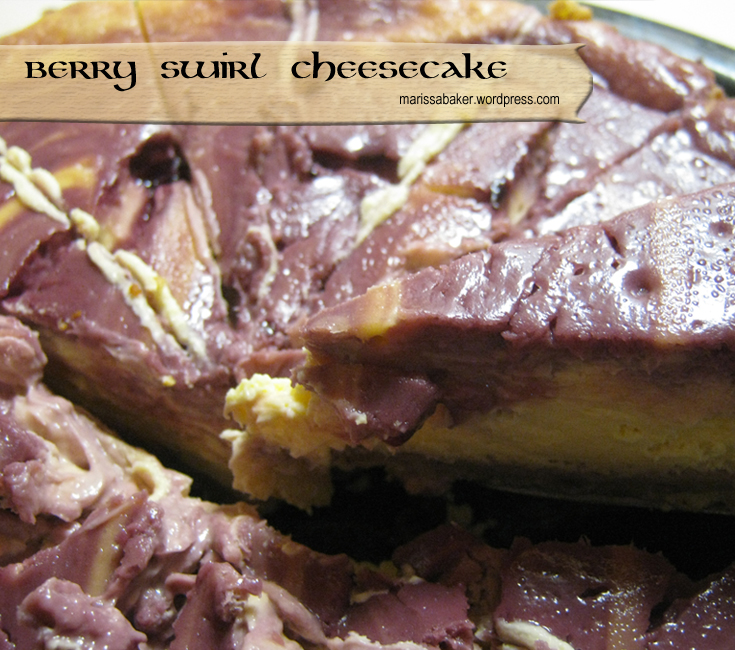
Berry Swirl Cheesecake recipe by marissabaker.wordpress.comI tried out an almond raspberry cheesecake a few weeks ago, which tasted great but I wasn’t quite happy with how it cooked up. Fortunately, this time I ran out of raspberry jam and substituted black raspberry jelly. Oh. My. Goodness. Black raspberries and cheesecake belong together.

The basic recipe is much the same as the last one, but I used dough hooks to make the crust instead of hand-kneading it and that worked well. I also didn’t swirl extra jelly into the top, hoping the cake would crack less. It was less, but still not perfect.

Berry Swirl Cheesecake

Berry Swirl Cheesecake recipe by marissabaker.wordpress.comprint this recipe

Crust

1/2 cup butter, softened

1/4 cup packed brown sugar

1/4 cup ground almonds

3/4 cup all-purpose flour

Preheat oven to 325° F. Line a 9-inch spring-form pan with aluminum foil. Using the dough hooks on an electric mixer, cream butter and sugar. Add ground almonds and 1/2 cup of flour, and mix well. Flour hands and press dough into the spring-form pan. Bake for 12 to 15 minutes.

Filling

3 (8-oz.) packages cream cheese, softened

3/4 cup sugar

1/2 teaspoon vanilla

1/4 teaspoon almond flavoring

3 eggs

1/4 cup berry preserves

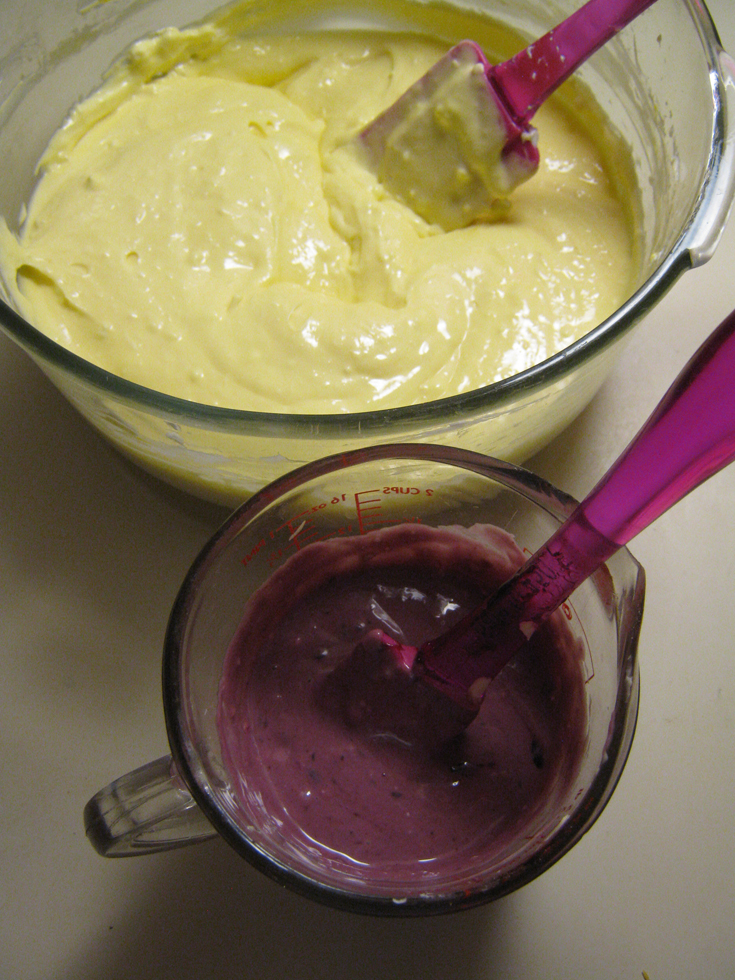
Berry Swirl Cheesecake recipe by marissabaker.wordpress.comBeat cream cheese, sugar, and vanilla at medium speed with electric mixer until well blended. Add eggs, one at a time, mixing at low speed after each addition.
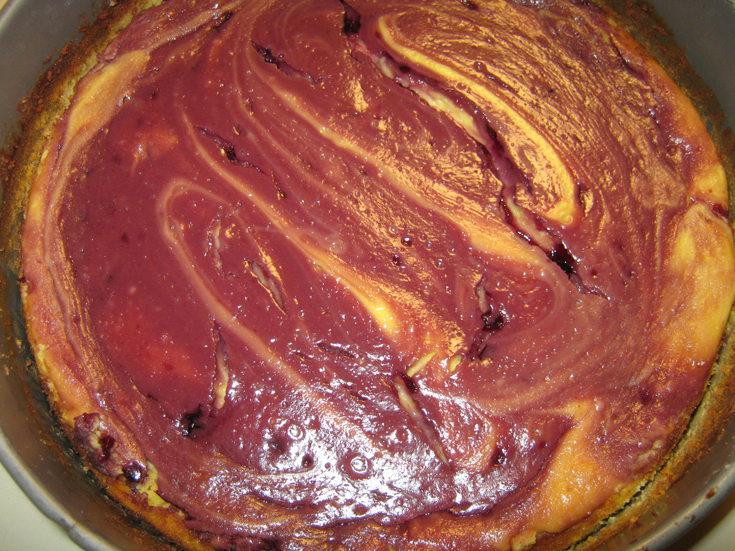

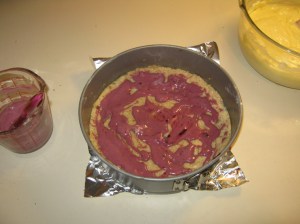
Mix 3/4 cup of batter with 1/4 cup raspberry preserves. Spoon 1/3 of the raspberry mixture over the crust. Pour the remainder of the cheesecake batter into the pan. Drop the remaining raspberry/cream cheese mixture by spoon fulls over the top of the cheesecake and smooth into the batter. Use a knife or spatula to swirl the berry mixture.

Bake cheesecake for 1 hour at 325° F or until center is almost set. Run a knife along the inside edge of the pan ring when it comes out of the oven. Cool before removing rim of pan. Refrigerate 4 hours or overnight.

Berry Swirl Cheesecake recipe by marissabaker.wordpress.com

Kate Morton’s novels

I love Kate Morton’s books. The first one I read, about 2 years ago now, was The Forgotten Garden. It was her second novel, and spans several time periods to discover the history of a girl abandoned on a ship sailing for Australia in 1913. It is not told in chronological order, and moves between the little girl, Nell, and her granddaughter Cassandra as they both travel to England and investigate Nell’s past as tied to the Blackhurst Manor on the Cornish coast.

One of the things I enjoyed most about this novel was the way it wove two different time periods together. If told in chronological order, the story may have been interesting but there would have been no mystery. This way of telling the story does not feel contrived, however, or as if the writer is telling the story out of order simply to confuse the reader with an elaborate plot.

The same is true of Morton’s third book, The Distant Hours, which I read last year.This one has more of a Gothic element. Though the story takes place in both present-day and the relatively modern World War II era, it still has clear ties to the more distant and mysterious past.

It was not until I read Daphne du Maurier’s book Rebecca for the first time a couple weeks ago that I realized what a great influence her writing style had been on Kate Morton (the inside cover of the dust jacket on one of Morton’s books even references du Maurier). A mystery uncovered through flash-backs. A young woman who discovers the past is even darker and more convoluted than she imagined. An ancestral home filled with secrets.

And that brings us to Kate Morton’s first novel, The House At Riverton, which I finally started reading. I’m about 2/3 of the way through now. This most likely means that I’m at the point in the book where I think I have everything pretty much figured out, and all my suppositions are about to be turned upside down. As I read this book, I realize another reason I love Morton’s writing style — there isn’t an extraneous scene in the book. Everything that happens builds the plot or contributes to essential character development. In novels this size (the shortest is 480 pages), that is an achievement.

I’m enjoying this novel quite a lot, partly for the reason that Morton’s writing style is just as enjoyable in her first novel as in later works, and partly because of the many parallels with Dowton Abbey (Morton’s book was published 3 years before the first season aired, so any similarities are coincidence or the script-writer pilfering from her). Unlike the other two novels, where one character in the present is investigating another in the past, the 98-year-old narrator of this book is looking back on her own life and telling her secrets to her grandson and a film maker.

There is one more novel to read once I finish this one, Morton’s latest book The Secret Keeper. I think I will wait a little while before reading it, though, perhaps a whole year like I did in between her other books. I don’t like the thought of not having another one waiting for me when that one is over.

TheGeekSpa.com
don’t forget to check out new Sherlock and Doctor Who themed items in my Etsy store