
As a new parent, I find myself worrying a lot. What if my baby stops breathing in the middle of the night? What if something falls on her and hurts her? How am I supposed to live with knowing that something bad could happen to her?
I had terrible nightmares when I first came home from the hospital, so bad I woke my husband up a couple times as I frantically looked around to find my baby and make sure she was alright. Someone suggested I could follow James’s instruction to call an elder of the church for prayer and anointing as if I was sick (Jam. 5:14-15). I did, and the nightmares stopped that very night, praise God. I didn’t have another one for over two months, and even then it was more of a normal bad dream than the terror-inducing ones from before.
I wasn’t specifically directing these worry-filled questions at God in my mind, but perhaps I should have. He has answers for our fears, worries, anxieties, and what ifs. It’s been over three years since I put together a 30-day scripture writing plan titled “Big Questions,” but I recently dug it back out of my archives to share with my scripture writing group at church for this month and I’ve started considering the topic of questions again.
Thankfully, God lets us ask Him questions. We’re not supposed to rebel against Him and do things our own way (1 Sam. 15:22-23), tempt or put Him to the test (Deut. 6:16; Matt. 4:5-7), or complain, murmur, and argue (1 Cor. 10:10; Phil. 2:14), but He lets us question. He isn’t threatened or put off when we ask something. He might decide not to answer the exact questions we asked (like He did with Job), or He might correct a wrong assumption at the root of our questions (like He did for some of Habakkuk’s questions), or He might indicate that we need to stop asking after we ask for the same thing several times (like He did for Paul), but He doesn’t tell us not to question Him at all.
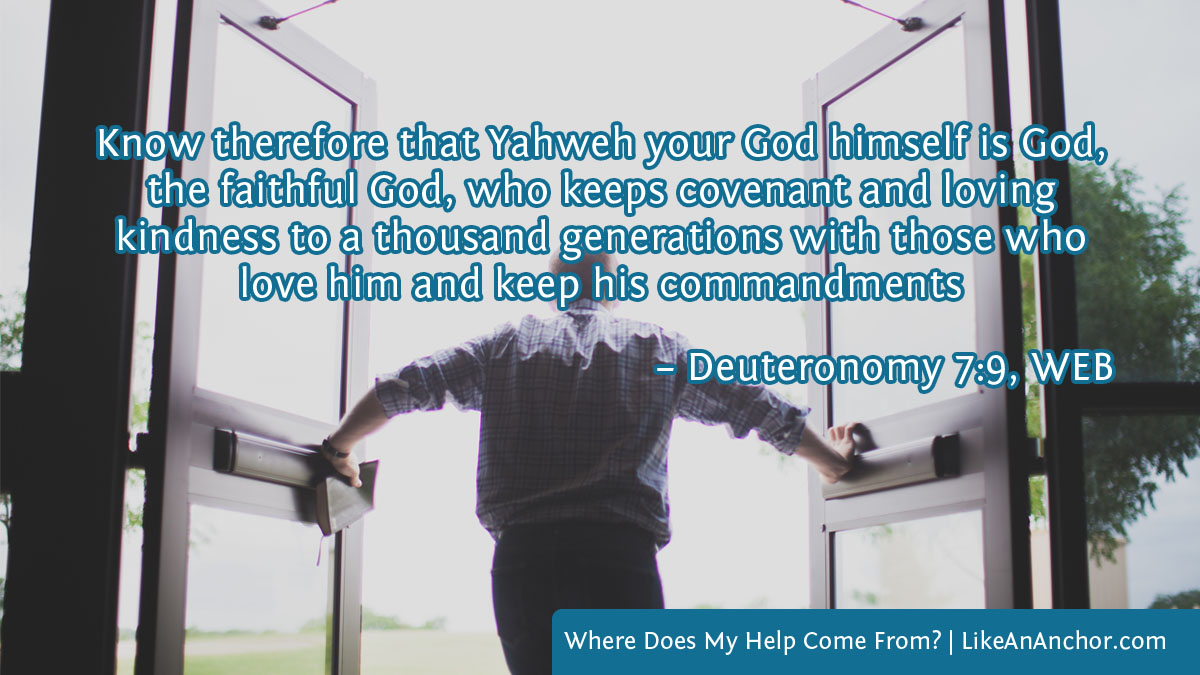
Where is my help?
One of God’s answers to our fearful questions is found in a psalm that kept coming to mind as I worried about my newborn baby. As is often the case for me, I specifically thought of a song, this one with words from Psalm 121: “He that keepeth Israel neither slumbers nor sleeps” (the version playing in my head is one I heard in-person at a Messianic church, but here’s a link to a version of the same song). Repeating this psalm/singing this song was often the only way I could fall asleep, trusting that God would stay awake to watch my baby while I couldn’t.
I will lift up my eyes to the hills.
Psalm 121, WEB
Where does my help come from?
My help comes from Yahweh,
who made heaven and earth.
He will not allow your foot to be moved.
He who keeps you will not slumber.
Behold, he who keeps Israel
will neither slumber nor sleep.
Yahweh is your keeper.
Yahweh is your shade on your right hand.
The sun will not harm you by day,
nor the moon by night.
Yahweh will keep you from all evil.
He will keep your soul.
Yahweh will keep your going out and your coming in,
from this time forward, and forever more.
This psalm starts with a question: “Where does my help come from?” Immediately, the writer answers, “My help comes from Yahweh.” It’s a rhetorical question in this psalm, but for many people it’s a very real question that we wonder about. For those of us asking this question or one of it’s many variations, the psalmist goes on to share reasons that we can count on Yahweh to come through as our helper and keeper.
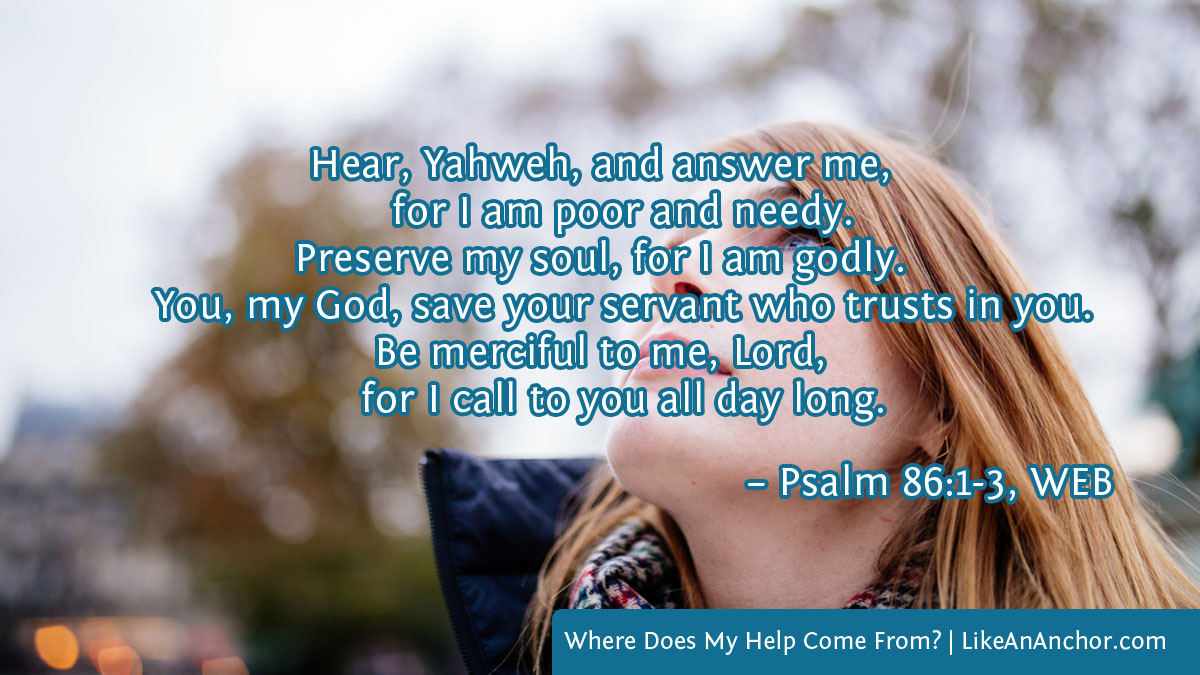
The Keeper
Did you notice how many times the word “keep” or “keeper” is used in Psalm 121? This word is translated from the Hebrew word shamar (H8104), which appears 468 times in the Old Testament. The primary meaning is “to keep, guard, observe, give heed” (Brown, Driver, Briggs [BDB]). Digging deeper, the Complete Theological Wordbook of the Old Testament states, “The basic idea of the root is ‘to exercise great care over'” (TWOT entry 2414). The TWOT breaks it into a few broad categories of meaning within that basic idea:
- “the careful attention to be paid to the obligations of covenant,” such as keeping God’s laws (e.g. Gen. 17:9-10; Ex. 31:13-16; Lev. 18:4-5; Deut. 5:29; Josh. 22:5; Ps. 18:21; 119:34; Ecc. 12:13; Ezk. 11:20)
- This includes God keeping His covenant obligations (e.g. Deut. 7:8-12; 1 Kings 3:6; 8:23; Neh. 1:5; 9:32; Dan. 9:4)
- The act of taking care or guarding something like a flock, house, place, or person (e.g. Gen. 2:15; 4:9; Ex. 22:7; 1 Sam. 17:20; 25:21)
- This one is often used for God “keeping” us (e.g. 1 Sam. 2:9; Ps. 12:7; 145:20; 146:9; Prov. 2:8; 3:26)
- Personally disciplining oneself, such as “guarding the lips” or taking heed to one’s conduct (e.g. Ex. 19:12; Num. 23:12; Deut. 4:9, 23; 11:16; Ps. 39:1; Prov. 13:3; 21:23; Jer. 17:21)
- Taking heed, guarding, or “paying attention” to something important; also used of the keeper or watchman (e.g. Gen. 37:11; Josh. 10:18; 2 Kings 11:5-9; Est. 2:21; Is. 21:11-12)
- “preserving” or “storing up” literal things like food or abstract things like anger (e.g. Gen. 41:35; Ex. 22:7; 1 Sam. 9:24; Mal. 2:7)
The number of times that we’re told to keep covenant with God or to keep ourselves in the right way would make a fascinating study on their own. For this post, though, I want to spend some more time looking at the ways that God keeps us. First, He keeps His covenant obligations. We’re supposed to “exercise great care” to keep ourselves faithful to Him and do things His way, and He is also careful to keep all of His covenant obligations as well. Unlike us, God keeps covenant perfectly. He’s the perfect “keeper,” which leads us to another facet of this word as it applies to God.
May Yahweh Keep You
God keeps covenant with us and He also “keeps” us, exercising great care over His people. For example, when God spoke to Jacob, He introduced Himself by saying, ““I am Yahweh, the God of Abraham your father, and the God of Isaac” and making a promise: “ Behold, I am with you, and will keep you, wherever you go” (Gen. 28:15, WEB). Later, God instructed the Levitical priesthood to use shamar in the blessing for all the children of Jacob (later renamed Israel).
Yahweh spoke to Moses, saying, “Speak to Aaron and to his sons, saying, ‘This is how you shall bless the children of Israel.’ You shall tell them,
‘Yahweh bless you, and keep you.
Yahweh make his face to shine on you,
and be gracious to you.
Yahweh lift up his face toward you,
and give you peace.’“So they shall put my name on the children of Israel; and I will bless them.”
Numbers 6:22-27, WEB
A number of Psalms claim this blessing, with writers calling Yahweh their keeper or asking Him to keep/guard/preserve them (Ps. 16:1; 17:8; 41:2; 86:2; 91:11; 97:10; 116:6; 140:4; 141:9). And these promises aren’t just for people in the Old Testament. As God’s New Covenant people, we can claim these promises of God to His Old Covenant people, as the writer of Hebrews demonstrates here:
Be free from the love of money, content with such things as you have, for he has said, “I will in no way leave you, neither will I in any way forsake you.” (Deut. 31:6) So that with good courage we say,
“The Lord is my helper. I will not fear.
Hebrews 13:5-6, WEB
What can man do to me?” (Ps. 118:6-7).
Remember the question from Psalm 112, “Where does my help come from?” That word translated “help” is ezer, which is the same Hebrew word family as azar, the word used for “helper” in Psalm 118. When we’re looking for help, we can confidently trust that God is our Helper and that we can count on Him as our Keeper who neither slumbers nor sleeps. We can even count on Him to change our minds so we’re less worried.
For God did not give us a spirit of timidity or cowardice or fear, but [He has given us a spirit] of power and of love and of sound judgment and personal discipline [abilities that result in a calm, well-balanced mind and self-control].
2 Timothy 1:7, AMP
I like the Amplified Bible’s version of this verse because “sound mind” (e.g. KJV) or “self control” (e.g. NET) by themselves don’t quite get at what’s going on with the Greek word sophronismos, which includes the sense of discipline leading to self control and/or sound mindedness. God’s spirit inside us can settle the worries and fears swirling in our minds, helping us accept that God really can answer when we need Him to show up as our Helper, the Keeper who exercises great care over us.
Featured image by Temi Coker from Lightstock

Song Recommendation: “Hineh Lo Yanum (Behold He Who Keeps Israel)”

 Like An Anchor
Lovely, Marissa. You’re probably speaking to many hearts. These were familiar thoughts to me, personally and remembering the same thing when my daughter brought each baby home. God is our keeper, and it’s not often the word we think of to meditate
LikeLiked by 1 person
Hello Sister Marissa, Greetings from Algeria,
I find this topic truly interesting. I can feel how difficult it is to be a parent, rearing children. In Islam, it is believed that marriage equals “half of faith”, meaning that, if we divide faith into two halves, the first half being keeping the ordinances and the commandments of God, being nice with our neighbours, …etc, the second half would be the state of being “married” because God knows how truly demanding this task is. This is why God gave a holy and special regard to parents, as when parenting, a mother/father practices self-denial, and patience and sacrifice his/her comfort for the children’s sake. After all, this is a kind of God worshipping, making sure that the weak baby would grow and become an independent adult who, in turn, would continue procreation to fulfil God’s plan, generation after generation.
You’ve mentioned quotes from the book of Psalms, where the psalmist used the word “to keep” “to preserve” “to guard” with its Hebrew root “shamar”. I take this opportunity to share with you a Gregorian chant of Psalm 91. I find it very peaceful and calming when I listen to it. I also want to introduce you to the choir who performed it and to their mission. They are called “Harpa Dei” or “The Harp of God”. I think you may like it…
Psalm 91 Gregorian Chant
Harpa Dei (about us)
That’s it for now, May God be with all your family
Cordially,
Souhil BENASKEUR from Algeria
LikeLike
Thank you for your encouraging comment, and for sharing this beautiful music!
LikeLike