I have started doing some Bible reading with my 18-month-old. I am not sure exactly how much she understands, but since she has developed a keen appreciation for sheep we spent a couple weeks going through Psalm 23 and John 10, and most recently 1 Peter 2:24-25. Now, every time I get out my scripture-writing or Bible study notebooks, she says, “Baa baa!”
In addition to the scripture readings I pick specifically for her, I also read to her the verse of the day from the one-month scripture writing program I’m working on (the ladies’ scripture writing group at my church congregation did “mountains, hills, and cities” last month and “prayer” this month). I tell my toddler that we’re probably not going to find sheep in those verses, but she always says, “Baa baa.” I jokingly told my husband last week that our daughter’s approach to Bible study so far is “Search the scriptures, for in them you will find sheep.”
I’ve been shocked how often her eagerness to hear about “baa baas” is rewarded even when we aren’t specifically studying that topic. I knew that sheep, lamb, and shepherd imagery appears frequently in the Bible, but I had forgotten just how much until she called my attention to it. The English words “sheep” or “lamb” appear 346 times in the New English Translation. That’s a lot of sheep!
As I started this study, I realized that I’d completely forgotten I already wrote three posts in 2023 about shepherds and sheep in the Bible. They were all published in February and March as pre-Passover studies:
- What Can We Learn From Shepherd, Sheep, and Lamb Imagery in the Bible?
- Behold! The Passover Lamb of God
- A Closer Look at the Roles of Pastors and Shepherds
Once again, I find myself thinking about sheep about 6 weeks before we’ll be observing the Lord’s Passover (it’s on the night of March 31st this year). As I reviewed those old posts, I almost gave up on writing this one. I hope, though, that my daughter’s innocent, childish enthusiasm for “baa baas” will help me look at the subject with fresh eyes. There are many theological topics we can look at in relation to sheep, including sheep as sacrifices, Christ as the lamb, God as shepherd, symbolism of His people as sheep, and human pastors as shepherds. When talking about sheep in the Bible with a toddler, though, I wanted to focus on a simple and positive image: God as our Shepherd and us as His sheep.
Provision and Protection
The analogy of God as our shepherd and us as sheep teaches us several foundational concepts about God’s character and the ways He relates to us. Two in particular stood out to me as I considered this topic again. Firstly, shepherds provide for and protect the sheep. I would describe this as the primary thing that “the Lord is my Shepherd” teaches us about God.
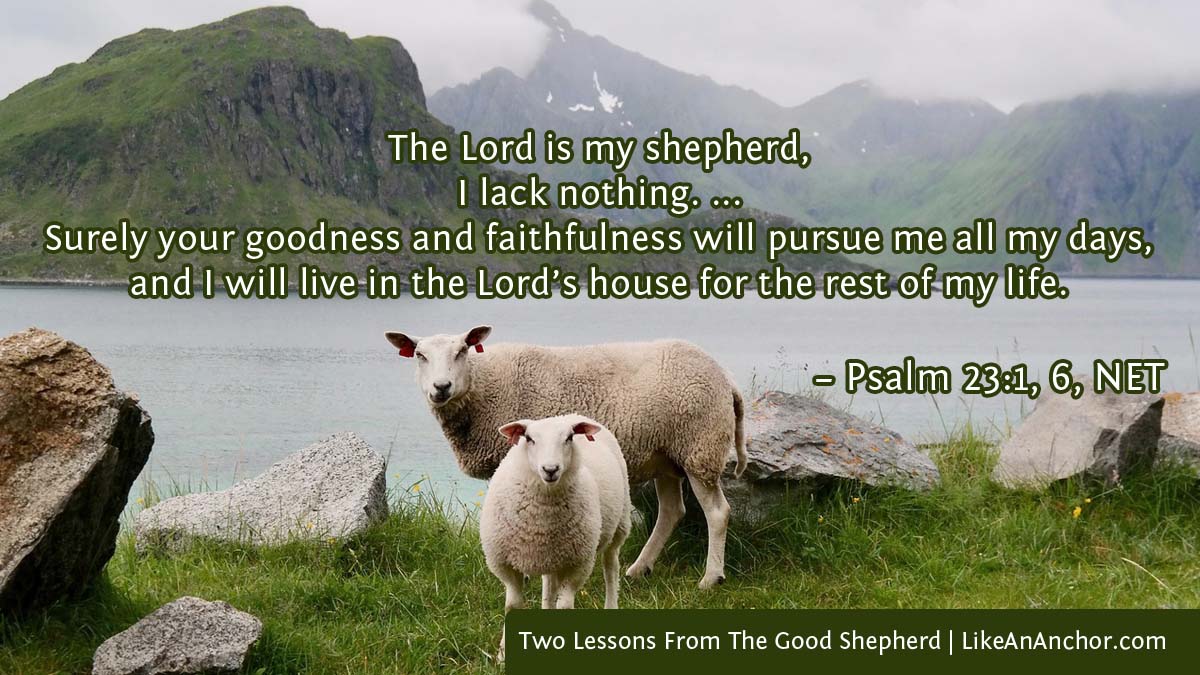
Yahweh is my shepherd;
Psalm 23:1-2, WEB
I shall lack nothing.
He makes me lie down in green pastures.
He leads me beside still waters.
Jesus emphasized provision and protection as well when He was explaining “I am the Good Shepherd.” His sheep are safe, they can find food, and He will give His life to keep them safe.
“I am the door. If anyone enters through me, he will be saved, and will come in and go out, and find pasture. …
“I am the good shepherd. The good shepherd lays down his life for the sheep. The hired hand, who is not a shepherd and does not own sheep, sees the wolf coming and abandons the sheep and runs away. So the wolf attacks the sheep and scatters them. …
“I am the good shepherd. I know my own and my own know me—just as the Father knows me and I know the Father—and I lay down my life for the sheep.
John 10:9, 11-12, 14, NET
Making sure that His sheep are protected and taken good care of is a top priority for God. In the passages in Jeremiah and Ezekiel where He takes Israel’s leaders to account for not being good shepherds, two of God’s primary charges against them is that they did not feed the flock or keep them gathered safely together. Like any good shepherd, God wants His sheep to be well taken care of and He takes direct action to make sure that this is the case. He even goes so far as to lay down his life for the sheep through Jesus’s redemptive sacrifice.
Close Relationship
The second core lesson that the Shepherd-Sheep analogy teaches us is that God wants to have a close relationship with His people.
He restores my soul.
He guides me in the paths of righteousness for his name’s sake.
Even though I walk through the valley of the shadow of death,
I will fear no evil, for you are with me.
Your rod and your staff,
they comfort me. …Surely goodness and loving kindness shall follow me all the days of my life,
Psalm 23:3-4, 6 WEB
and I will dwell in Yahweh’s house forever.
God desires a close personal relationship with His people, both as a church group and as individuals. Psalm 23 reveals David had this type of close relationship with God, and shows us the peace, security, and close dwelling together that we can also have in a relationship with God.
“The one who enters by the door is the shepherd of the sheep. … the sheep follow him because they recognize his voice. They will never follow a stranger, but will run away from him, because they do not recognize the stranger’s voice. …
“I am the good shepherd. I know my own and my own know me—just as the Father knows me and I know the Father—and I lay down my life for the sheep. …
“My sheep listen to my voice, and I know them, and they follow me. I give them eternal life, and they will never perish; no one will snatch them from my hand.”
John 10:2, 4-5, 14, 27-28 NET
Jesus emphasizes the knowing that exists between shepherd and sheep in John 10 as well. One of the things that distinguishes Jesus’s sheep from other people is that we recognize His voice and follow Him. Also, note how closely this point about relationship is connected to protection and provision. Both times Jesus says that He knows His own and they know Him, He also talks about the incredible gifts He is giving us: salvation and eternal life.
He himself bore our sins in his body on the tree, that we may cease from sinning and live for righteousness. By his wounds you were healed. For you were going astray like sheep but now you have turned back to the shepherd and guardian of your souls.
1 Peter 2:24-25, NET
As our good shepherd, God gives provision and protection and welcomes us into a close relationship with Him. Once, we were like sheep who ran away from our shepherd. But our Good Shepherd came to earth, sought us out, gave His life to save us, and now lives again to continue protecting and providing for those who turn back to Him. God as shepherd and us as sheep is a comforting analogy that emphasizes how secure we are in His wonderful hands.
Featured image by Aart Beijeman from Pixabay

Song Recommendation: “Still Waters (Psalm 23)” by Leanna Crawford

 Like An Anchor