
I wrote about Zephaniah in my 2015 Lessons from the Minor Prophets series, but when I reread that post recently it didn’t really dig into the book of Zephaniah as much as I wanted. I’ve been picking a passage of scripture each week to read with my toddler, and a couple weeks ago it was Zephaniah 3:16-17. My toddler loves music, and I thought she might connect with a passage about God singing much like she has connected with passages like Psalm 23 and John 10 since she likes sheep. That made me want to revisit Zephaniah.
Christians often talk about the Bible as a living book. The words in it don’t change and new information isn’t being added to it anymore, yet it always seems like there is something more to discover when you revisit the text. Last time I wrote about Zephaniah, I focused on the message not to fear. This time, I noticed something connected but different.
Knowing Bad Things Will Come
Zephaniah prophesied during the reign of King Josiah (Zeph. 1:1), one of Judah’s righteous kings, but his book is mostly focused on future judgement. Josiah “did that which was right in Yahweh’s eyes, and walked in all the ways of David his father, and didn’t turn away to the right hand or to the left” (2 Kings 22:2, WEB). He repented when he read God’s law and took steps to remove paganism from Judah, but that didn’t stop God’s plan to judge His people for their sins. You can read all about this in 2 Kings 22-23 and 2 Chronicles 34-35, but let’s look at a few key passages.
When the king had heard the words of the book of the law, he tore his clothes. The king commanded Hilkiah the priest, Ahikam the son of Shaphan, Achbor the son of Micaiah, Shaphan the scribe, and Asaiah the king’s servant, saying, “Go inquire of Yahweh for me, and for the people, and for all Judah, concerning the words of this book that is found; for great is Yahweh’s wrath that is kindled against us, because our fathers have not listened to the words of this book, to do according to all that which is written concerning us.”
So Hilkiah the priest, Ahikam, Achbor, Shaphan, and Asaiah went to Huldah the prophetess, the wife of Shallum the son of Tikvah, the son of Harhas, keeper of the wardrobe (now she lived in Jerusalem in the second quarter); and they talked with her. She said to them, “Yahweh the God of Israel says, ‘Tell the man who sent you to me, “Yahweh says, ‘Behold, I will bring evil on this place and on its inhabitants, even all the words of the book which the king of Judah has read. Because they have forsaken me and have burned incense to other gods, that they might provoke me to anger with all the work of their hands, therefore my wrath shall be kindled against this place, and it will not be quenched.’” But to the king of Judah, who sent you to inquire of Yahweh, tell him, “Yahweh the God of Israel says, ‘Concerning the words which you have heard, because your heart was tender, and you humbled yourself before Yahweh when you heard what I spoke against this place and against its inhabitants, that they should become a desolation and a curse, and have torn your clothes and wept before me, I also have heard you,’ says Yahweh. ‘Therefore behold, I will gather you to your fathers, and you will be gathered to your grave in peace. Your eyes will not see all the evil which I will bring on this place.’”’” So they brought this message back to the king.
1 Kings 22:11-20, WEB
Josiah received the message from God through Huldah that he couldn’t do anything that would make God relent of His anger. The only thing God promised was to let Josiah enjoy peace during his lifetime because of his humble and repentant heart. It is after this that Josiah institutes wide reforms in Israel. He gathered his people to witness him make a covenant to follow God. He demolished locations of pagan worship and executed pagan priests. He ordered all his people to keep the Passover to honor God.
There was no king like him before him, who turned to Yahweh with all his heart, and with all his soul, and with all his might, according to all the law of Moses; and there was none like him who arose after him. Notwithstanding, Yahweh didn’t turn from the fierceness of his great wrath, with which his anger burned against Judah, because of all the provocation with which Manasseh had provoked him. Yahweh said, “I will also remove Judah out of my sight, as I have removed Israel; and I will cast off this city which I have chosen, even Jerusalem, and the house of which I said, ‘My name shall be there.’”
2 Kings 23:25-27, WEB
I think it’s fascinating that Josiah did righteous things on a nation-wide scale and committed himself to keeping covenant with God even though he knew that his righteousness wasn’t going to turn God’s wrath away from his country. Josiah didn’t do all of this because he thought it would change God’s mind about punishing Judah (at least, there’s no indication of that in the text). He did it because it was the right thing to do even though his righteousness and the actions he took as the nation’s leader would not be enough to stop God from pouring wrath out on the people. There’s a lesson in that for us today. As we draw closer to the time of Jesus’s return, praying for people in the increasingly ungodly world or trying to make things better might seem a hopeless task, and yet it is still something we ought to do (see 1 Tim. 2:1-8).
A Day of Darkness
It’s often hard when reading books of Old Testament prophecy to separate what has already happened from what is still in the future. There are even some dual applications of prophecies, where the prophecy applied to something that happened with ancient Israel and to something that has happened or will happened during the New Testament church era. Even when the prophecy was directed at ancient Israel specifically, though, we can still learn from what happened and extract lessons for today (see 1 Cor 10:1-11). Revelation and prophecies in the gospels tell us the time before Jesus’s return will involve judgement from God on the earth and outpouring of His wrath, much like God told Zephaniah about. Josiah’s rule was followed by the fall of Judah and Babylonian captivity for ancient Israel. Zephaniah’s prophecies clearly reference that, but some sections also sound more like Revelation and a time that is still to come.
The great day of Yahweh is near. It is near and hurries greatly, the voice of the day of Yahweh. The mighty man cries there bitterly. That day is a day of wrath, a day of distress and anguish, a day of trouble and ruin, a day of darkness and gloom, a day of clouds and blackness, a day of the trumpet and alarm against the fortified cities and against the high battlements. I will bring such distress on men that they will walk like blind men because they have sinned against Yahweh. Their blood will be poured out like dust and their flesh like dung.
Zephaniah 1:14-17; 3:8 WEB
…
“Therefore wait for me”, says Yahweh, “until the day that I rise up to the prey, for my determination is to gather the nations, that I may assemble the kingdoms to pour on them my indignation, even all my fierce anger, for all the earth will be devoured with the fire of my jealousy.”
As much as we all look forward to the time of Jesus’s return, the resurrection from the dead, and the transformation of His faithful followers to become like Him, the path to get there is going to be hard. Amos wrote, “Woe to those who wish for the day of the Lord! Why do you want the Lord’s day of judgment to come? It will bring darkness, not light” (Amos 5:18, NET). We must pray “may your kingdom come” while also knowing that there will be hard times before “The kingdom of the world has become the kingdom of our Lord and of his Christ, and he will reign for ever and ever” (Rev. 11:15, NET). Like King Josiah, we need to choose to live good lives today even knowing that God’s wrath is coming.
Rejoice With Singing

Gather yourselves together, yes, gather together, you nation that has no shame, before the appointed time when the day passes as the chaff, before the fierce anger of Yahweh comes on you, before the day of Yahweh’s anger comes on you. Seek Yahweh, all you humble of the land, who have kept his ordinances. Seek righteousness. Seek humility. It may be that you will be hidden in the day of Yahweh’s anger.
Zephaniah 2:1-3, WEB
Even in the midst of great calamity, God always offers a lifeline of hope. Josiah’s righteous actions and heartfelt commitment to God delayed God’s wrath until after his lifetime. People after him were told that if they seek God, righteousness, and humility and keep His ordinances they may be hidden in the day of His anger. It’s similar to what Jesus told people when speaking of the time before His return: “be watchful all the time, praying that you may be counted worthy to escape all these things that will happen, and to stand before the Son of Man” (Luke 21:36, WEB). And even if we don’t escape the bad experiences, we can still look forward to glorious joy on the other side.
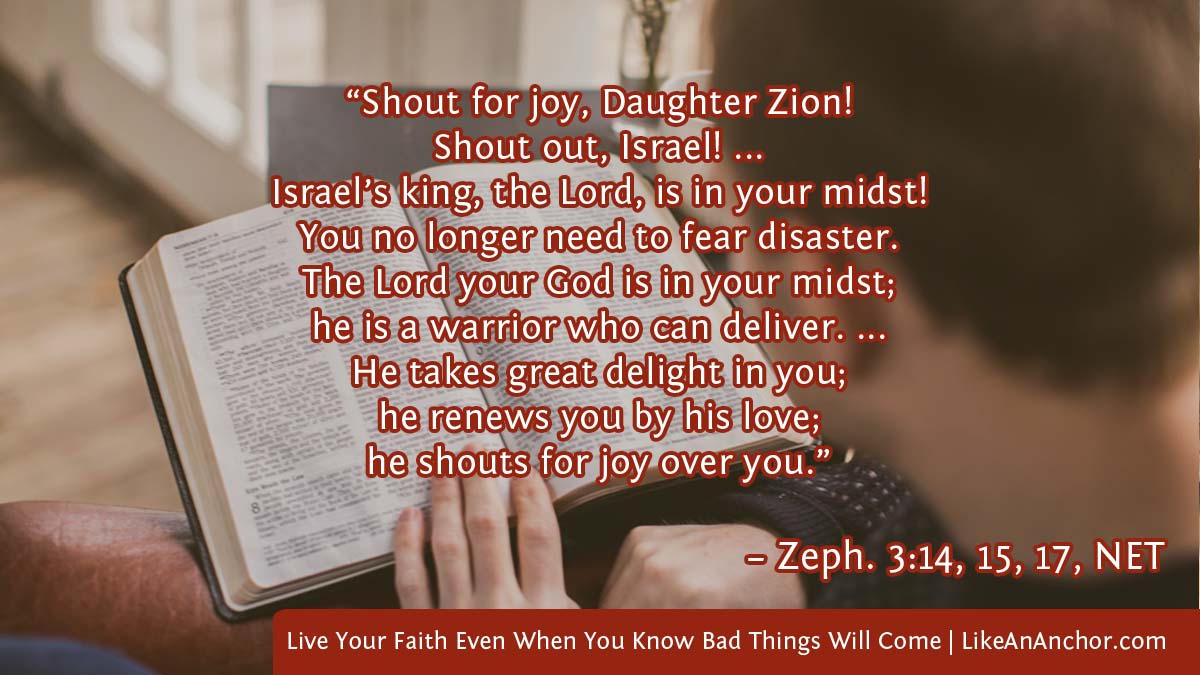
Sing, daughter of Zion! Shout, Israel! Be glad and rejoice with all your heart, daughter of Jerusalem. Yahweh has taken away your judgments. He has thrown out your enemy. The King of Israel, Yahweh, is among you. You will not be afraid of evil any more. In that day, it will be said to Jerusalem, “Don’t be afraid, Zion. Don’t let your hands be weak.” Yahweh, your God, is among you, a mighty one who will save. He will rejoice over you with joy. He will calm you in his love. He will rejoice over you with singing. … At that time I will bring you in, and at that time I will gather you; for I will give you honor and praise among all the peoples of the earth when I restore your fortunes before your eyes, says Yahweh.
Zephaniah 3:14-17, 20, WEB
This imagery is incredible, and a stark contrast to the burning wrath earlier. It’s a hopeful, encouraging passage that talks about God’s future with His people where they will sing, be glad, and rejoice with no reason for fear. I also love the details about God’s feelings toward His people, especially that “He will rejoice over you with singing.” I usually think about angels and people singing praises to God, not about God Himself singing. It’s amazing to think that we are the reason He breaks out into joyful song (or joyful shouts, depending on the translation). At this time, God will be with us, and He is mighty to save. We’re already seeing fulfillment of that now, with the Father and Jesus dwelling in us and accomplishing our salvation (John 14:18-20; 15:4-5; 17:20-23).
Josiah was one of ancient Judah’s most righteous kings, yet Huldah’s and Zephaniah’s prophecies foretold God’s wrath would still descend on the people. Even knowing that bad things were coming, Josiah committed himself to living righteously and doing good in his nation. We can learn from that example today and also from the hopeful message at the end of Zephaniah’s book. Knowing that God loves us and protects us, we can be calm and unafraid as we work to live righteous lives even when we’re going through trials at the moment.
Featured image by Corey David Robinson from Lightstock

Song Recommendation: “Even If” by MercyMe

 Like An Anchor