The Importance of Spiritual Vigilance

Last week, we started a series of posts on spiritual warfare. Following the outline Paul gives us in Ephesians, we began with “be strong in the Lord, and in the strength of His might” (Eph. 6:10, WEB). Knowing where we get the strength to fight a spiritual war lays the groundwork. The next point is realizing what we’re up against.

Put on the whole armor of God, that you may be able to stand against the wiles of the devil. For our wrestling is not against flesh and blood, but against the principalities, against the powers, against the world’s rulers of the darkness of this age, and against the spiritual forces of wickedness in the heavenly places. (Eph. 6:11-12, WEB)

No wonder we need to be strong in the Lord! Those are adversaries we can’t even see, much less fight on our own. Thankfully, God doesn’t expect us to.

The Importance of Spiritual Vigilance | marissabaker.wordpress.com
Photo credit: Pearl via Lightstock

The Battle Is Won

When Jesus came to this earth as a human, lived a sinless life, then died for our sins, He assured Satan’s defeat. It’s such a sure thing that scripture talks of Satan (whose name means “adversary”) as having already been defeated even though he still has a little while to keep influencing people here on earth (Rev. 12:12).

having stripped the principalities and the powers, [Jesus] made a show of them openly, triumphing over them in it. (Col. 2:15, WEB)

Shortly before His crucifixion, Jesus told His followers that the “Prince of this world” was about to be cast out (John 12:31). Other verses speak of Christ having “led captivity captive” (Eph. 4:8; Ps. 68:18) and of binding Satan to destroy his kingdom (Luke 11:17-23). Those all point to the truth that Jesus has already sealed our Adversary’s fate.

Since then the children have shared in flesh and blood, [Jesus] also himself in the same way partook of the same, that through death he might bring to nothing him who had the power of death, that is, the devil, and might deliver all of them who through fear of death were all their lifetime subject to bondage. (Heb. 2:14-15, WEB)

Jesus has brought the devil to nothing. The Adversary can seem pretty scary at times, but ultimately, he can’t win. Jesus made certain that God wins this fight. So really all we need to do if we want personal victory is to stay on the winning side.

But The Threat Is Out There

All this isn’t to say we shouldn’t have a healthy level of caution. Just because Satan’s defeat is assured doesn’t mean he can’t still affect us. He’s a very real threat and underestimating him can leave us in a vulnerable position. The Adversary is a roaring lion, not a declawed house cat. Read more

Another Post About Kylo Ren: My Thoughts on The Last Jedi and Emotionally Driven Villains

Note: an updated post about Kylo Ren’s Myers-Briggs type can be found on my Star Wars Personalities blog

If you were reading this blog two years ago, you know Kylo Ren is the new Star Wars character I found most intriguing. While most other fans were debating who Rey’s parent’s could be and what we might learn about Snoke’s origins, I was in the smaller group analyzing Kylo’s character arc and reading every in-canon novel looking for glimpses of his backstory.

Honestly, the thing I was most excited for going into The Last Jedi was seeing whether or not I’d still type him as an ENFJ after learning more about his character. My siblings seemed to think that was weird, but what can I say — I love a good Idealist-type villain and writing/thinking about personality types is what I do. Can you blame me?

And so this is my second post about Kylo Ren on this blog. If you haven’t seen The Last Jedi yet now’s the time to stop reading because

SPOILER WARNING

Seriously, if you don’t want to learn about major plot points and character arcs in The Last Jedi then get yourself to a theater before you read this blog post.

Another Post About Kylo Ren: My Thoughts on The Last Jedi and Emotionally Driven Villains | marissabaker.wordpress.com

Where Are The Knights of Ren?

This might be my biggest question coming out of the film. We caught a brief glimpse of the Knights of Ren in The Force Awakens and learned that Kylo is “master of the knights of Ren,” but that’s about it. People weren’t even sure whether the Knights of Ren were an order Kylo joined or one that he founded (I was on the “founded” side of the argument, suggesting “Knights of Ren” should be taken as “Knights who follow/belong to Ren”).

In The Last Jedi, Luke reveals that he was training 12 students when Kylo destroyed his new Jedi academy. A “handful” of the students joined Kylo and he slaughtered the others. It’s not too much of a leap to say that those students became the Knights of Ren, which would support my favorite theory for their origin, but where are they now? They’re not mentioned by name in this new film and it seems that if Kylo had a half-dozen force wielders sworn to follow him he should have been using them to hunt down the last of the resistance as well as Rey and Luke.Another Post About Kylo Ren: My Thoughts on The Last Jedi and Emotionally Driven Villains | marissabaker.wordpress.com

ReyLo Drama

I really can’t talk about Kylo Ren in The Last Jedi without talking about what happened between him and Rey. When they started communicating across the galaxy with each other I was really expecting a sibling reveal. It just so neatly parallels Luke and Leah’s Force-assisted communication. But then we find out Snoke was behind the connection and Rey’s parents are “nobodies.” I’m a little disappointed that there isn’t more of a reason for her connection with Anakin’s/Luke’s lightsaber, but I’m okay with this direction for her character’s story. She doesn’t have to be a Skywalker to be strong in the Force — the thousands of Jedi who existed prior to there even being a Force-sensitive Skywalker proves that.

Anyway, back to Rey and Kylo. It really wasn’t clear there for most of the film whether he would turn to the Light or she would turn to the Dark. I loved that edge-of-your-seat emotional drama. The moment where they touched hands (you know that one I’m talking about) gave me all the feels and watching them fight Snoke’s guard together might have jumped into my top-3 favorite lightsaber battles (I’ll have to watch it again, probably very soon, to be sure).

Another Post About Kylo Ren: My Thoughts on The Last Jedi and Emotionally Driven Villains | marissabaker.wordpress.com

I Still Think He’s An ENFJ

I’m beyond happy that my post from two years ago speculating about Kylo’s origins and personality type is still relevant after what we learn in The Last Jedi. I don’t think they contradicted any of my guesses, and when we learn that Kylo destroyed Luke’s academy after waking to see his mentor holding a lightsaber over him … well, that just supports my theory that Kylo was desperate for a mentor figure who would actually be there for the “real” him instead of one that was so terrified of his potential to be like Vader that he thought about killing him.

Also, I still think Kylo Ren/Ben Solo is an ENFJ personality type, albeit a very unhealthy version. He’s still showing a strongly idealist (NF) streak and his pitch to Rey when asking her to join him is right out of the NFJ villain textbook. It’s the same kind of argument you see in INFJ Ra’s Al Ghul use: the world is broken, so we need to wipe it clean and rebuild something that actually works.

I had a few people argue on my last post that Kylo is an introvert, but I’m still going to go with Extrovert. I feel like he’s leading with his Extroverted Feeling rather than Introverted Intuition, and when we see him go into “stress mode” it looks more like the ENFJ’s inferior Thinking than the INFJ’s inferior Sensing. I’m sure General Hux would say Kylo is excessively critical, displays convoluted logic, and has obsessive behaviors when in the “the grip” of his 3-year-old mental process. In contrast, a stressed INFJ is usually characterized by obsessive focus on external data (Kylo ignores such data), overindulgence in sensory pleasure (not something we see from Kylo), and adversarial attitude to the outer world (his rage is more focused on specific people than the idea that the world is out to get him).Another Post About Kylo Ren: My Thoughts on The Last Jedi and Emotionally Driven Villains | marissabaker.wordpress.com
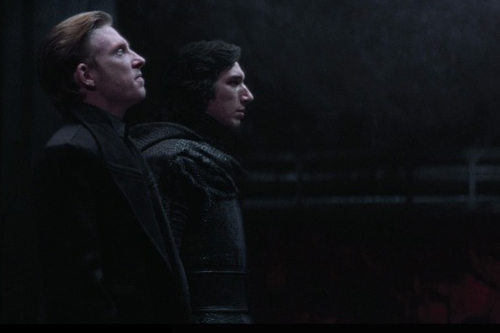
An Emotion-Driven Villain

I love that as a villain, Kylo’s driving motivation is far more about connection (or lack thereof) than power (which is another reason to type him as a Feeling-dominant ENFJ). His major choices in this film all have to do with who he is and isn’t connecting with. We learn that in the past he lashed-out at Luke and all his students when he believes his mentor was about to kill him, and we see a similar thing happen when he kills his current mentor Snoke. Snoke has been telling Ren the whole movie that he’s pathetic and easily controlled, so when Snoke demands Kylo kill the one person he’s formed a new bond with (Rey), Kylo kills Snoke instead.

It’s a very Sith-like move to kill your mentor and take an apprentice, but that’s not exactly what Ren is trying to do. He’s been building an emotional connection with Rey and his pitch to her is less rule-the-galaxy-and-bring-order (like ENTJ Vader) than it is bury-what-hurt-us-and-build-something-new. And that’s on top of his assurance that she means something to him personally after they learn that she comes from nowhere and is a “nobody” (Update: director Rian Johnson has confirmed that Kylo, at least, believes he’s telling the truth). Even if the rest of the universe doesn’t care about them they could share a connection that would reshape the entire galaxy. It’s about relationship, not just power. And when Rey leaves him too, Kylo lashes out with such violence that even Hux thinks it’s excessive. When the red-headed Nazi thinks you’ve gone too far it might be time to reign yourself in.

It’s going to be really interesting to see where this goes next. Much as I would love to see him truly follow in the steps of Darth Vader/Anakin Skywalker by turning back to the Light, I’m not really expecting a redemption arc for Kylo at this point. It’s probably more a toss-up whether Rey or Hux manage to kill him first (maybe Rey will best him in a duel, then Hux will shoot him as she’s struggling to decide whether or not to spare Kylo).


Another Post About Kylo Ren: My Thoughts on The Last Jedi and Emotionally Driven Villains | marissabaker.wordpress.com

What Does It Mean To Be Strong In The Lord?

Ephesians 6 is the most famous passage talking about spiritual warfare. And because I’ve been rolling the idea of doing a study series on the armor of God/spiritual warfare around in my mind for some time now, it makes sense to start there. So let’s jump right in.

Finally, my brethren, be strong in the Lord, and in the power of his might. (Eph 6:10, KJV)

Before we can start getting ready to fight a spiritual battle, we must recognize where the strength to do such a thing comes from. On our own, we couldn’t fight spiritual adversaries. We need to “be strong in the Lord” to do that. But what does being strong in Him really mean?

Becoming Empowered

The word translated “be strong” is endunamoo (G1743). It comes from a combination of the word en (G1722), which is a preposition meaning in, by, or with, and dunamoo, which is a form of dunamis (1411). Dunamis means “inherent power,” such as Jesus used to perform miracles (Luke 8:46). So this word in Ephesians means to be filled with inherent, active, achieving power. And because we’re strong “in the Lord,” it’s the same kind of power He has.

I can do all things through Christ, Who empowers me. (Phil. 4:13, HBOO)

We, who have no hope of standing up against a spiritual onslaught on our own, can do “all things,” including spiritual warfare, when Jesus empowers us. That means the One who can cast out devils with a word and who saw Satan fall like lightning from heaven (Luke 10:17) isn’t just fighting on our behalf. He’s sharing His power with us so we can fight alongside Him.

Read more

How Does It Feel To Be Human?

OneRepublic’s song “Human” is about a man who’d fallen out of contact with God and now turns to Him when things are going badly. They “had a conversation” where the singer asks questions and pours out his frustrations. Then God “said the strangest thing.”

He said, “How does it feel to be human?
Do some of the best plans you make get ruined?
Do people curse you when flowers ain’t blooming?
How does it feel?”
He said, “How does it feel to be human?
If I could for one day I just might do it
Dance ’til the sun comes up to my music
How does it feel?”

While OneRepublic doesn’t sing “Christian music,” the band members are Christians and they know just as well as we do that God does have experience being human as Jesus Christ. But even knowing that, I think most of us can identify with the feeling in this song. We know Jesus lived as a human. But sometimes we still don’t feel like He can fully sympathize with exactly how hard it is. That it must have been easier/different for Him since He was fully God at the same time He was fully human.

Even More Than Salvation

If someone asked you why Jesus became human, most of us would say, “To save us” (or some variation on that idea). And that’s certainly accurate, for “Christ Jesus came into this world to save sinners” (1 Tim. 1:15, WEB). That is not, however, the only reason He came to this earth.

Some of the other reasons Jesus gave for Him coming into the world include preaching the gospel (Mark 1:38; Luke 4:43) and witnessing to truth (John 18:37). As we read through the gospels, it becomes clear that the work given to Jesus by the Father involved more than “just” dying in our place to cleanse us from sin. I hate saying “just” becasue salvation is such an incredible gift on its own that it should blow our minds. But Jesus wanted to do even more for us. And one of the things He wanted to do was learn how it feels to be human. Read more

How Full Is Your Marble Jar?

I have issues with trust. I knew this to a certain extent, but being in a relationship has brought it to the forefront of my attention. My boyfriend wants to build the kind of trust that I’ve always wanted in a relationship, which is fantastic. But it’s harder to get there than I was expecting and that’s frustrating for both of us. I probably feel safer with him than anyone else who I haven’t known a minimum of 10 years and yet I still feel nervous opening up to him and being “me” around him.

As I mentioned a few weeks ago, I love Brené Brown’s TED talks. Since writing that post, I’ve read her book The Gifts of Imperfection and I’m halfway through Daring Greatly. Since I’ve been confronting some deep-seated fear issues as well as this trust thing, they’ve been really good books for me. They’re tough, though. For example, she has a list of 10 things that “Wholehearted” people who believe in their worthiness do. I’ve only got one down pretty good and maybe half of two others. And that’s even though all 10 points on the list are things that, in theory, I agree are good and which I’ve considered worth pursuing for quite some time.

How Full Is Your Marble Jar? | marissabaker.wordpress.com
Photo credit: timlewisnm CC BY-SA via Flickr

The Anatomy Of Trust

Earlier this year, Brené Brown gave a talk called “The Anatomy of Trust.” In this talk, she tells a story that she also relates in Daring Greatly about her daughter experiencing a betrayal of trust at school. You can click here to read the full story or just watch the video below, but in short summary the situation got so bad that the teacher took marbles out of the Marble Jar (marbles go in when the kids are making good choices and come out if they’re breaking rules, acting out, etc.). Read more

How Visible Is Your Commitment to Christ?

The culture we live in is not a godly one. None of us can say we live in a “Christian nation.” While we may share some values with the dominant culture(s), living the way Jesus did involves a very different lifestyle than the ones that are most socially acceptable.

That leaves Christians with a choice. We can either lie-low and try to fit in as much as we can, or we can embrace the fact that a commitment to living like Christ involves living counter-culturally. The later is hard. But if we want to become part of God’s family, we have to become like Him instead of staying like the world.

How Visible Is Your Commitment to Christ? | marissabaker.wordpress.com

We need a transformative relationship with Jesus

It’s not something we like to think about, but the scriptures indicate that not everyone who thinks they’re following Jesus will actually end up in His kingdom. One of these passages is found in Jesus’ sermon on the mount. It’s a serious, scary warning that we do well to pay attention to.

Not everyone who says to me, ‘Lord, Lord,’ will enter into the Kingdom of Heaven; but he who does the will of my Father who is in heaven. Many will tell me in that day, ‘Lord, Lord, didn’t we prophesy in your name, in your name cast out demons, and in your name do many mighty works?’ Then I will tell them, ‘I never knew you. Depart from me, you who work iniquity.’ Everyone therefore who hears these words of mine, and does them, I will liken him to a wise man, who built his house on a rock. (Matt. 7:21-24, WEB)

We learn several important things from this passage. Firstly, it’s possible to think you’re following Jesus and still not be in a relationship with Him. Whether or not He knows you is more important than the showy things you do in His name.

Secondly, He tells us how to become people He knows. We must do His Father’s will, hear His teachings, and act on them. Those actions will give us a strong foundation so that when life pounds on us we won’t fall (Matt. 7:25-27). It’s also going to drastically change how our lives look. Read more