What Are God’s Holy Days and Why Would We Care?

Prayer is a time we can choose to come before God however we are, whenever we want, and whatever we need. In these cases, we’re sort of “in control” of the interaction. There are also times when God commands/invites us to come before Him on His terms. Those times when God “hosts” us are His weekly Sabbath and the yearly holy days.

Though I’ve been keeping the holy days outlined in Leviticus 23 my whole life, I hadn’t thought about them quite like this before. My family and I kept the Feast of Tabernacles (Sukkot) with a group in West Virginia this year, and one of the Bible studies there was called “Keeping A Holy Convocation.” It’s one of the best, most thought-provoking messages I’ve ever heard and it’s what prompted today’s post (click here to listen to that Bible study).

I won’t take the time here to address the question of whether or not modern believers should keep these holy days, but you can check out my posts “Top 5 Reasons for Christians to Keep God’s Holy Days” and “Rhythms of Worship” if you’re curious. One reason these days are important to us is that they teach us about God’s plan and His priorities, including who we’re meant to be in Him. They’re part of our identity as God-followers, which makes them a key part of our faith and it also relates to this blog’s theme of finding our true selves in God.

This is probably going to be the first post in a series, since there is so much to explore in this topic and I don’t want today’s post to become unreadably long. So for now, let’s just take a look at the ways God describes His holy days. There are 5 key Hebrew words that give us a picture of what these days are and why we should care about them.

Mo’ed

The word mo’ed (Strong’s number H4150) means an appointed time and/or place, as well as an assembly or congregation. The word is used 223 times in the Bible. It’s also translated “season,” as in its first use in Genesis:

God said, “Let there be lights in the expanse of sky to divide the day from the night; and let them be for signs to mark seasons, days, and years” (Gen. 1:14, WEB)

Mo’ed is used of the time for a baby to be born, the right season to keep a commanded Feast day, and for the place of a gathering and/or the people gathered. The Rabbi at my Messianic congregation defines mo’ed as the right person/people, in the right place, at the right time, for the right reason.

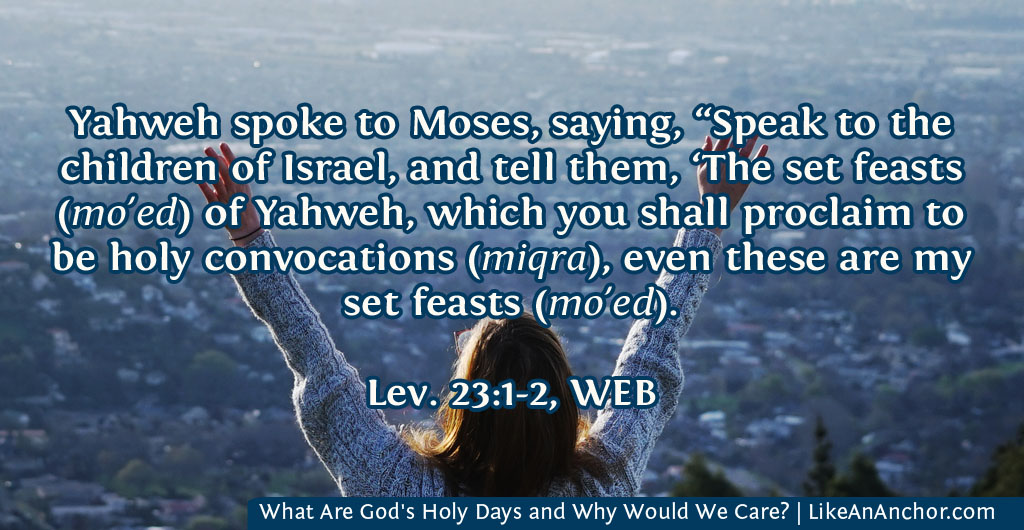
Yahweh spoke to Moses, saying, “Speak to the children of Israel, and tell them, ‘The set feasts (mo’ed) of Yahweh, which you shall proclaim to be holy convocations, even these are my set feasts (mo’ed). … These are the set feasts (mo’ed) of Yahweh, even holy convocations, which you shall proclaim in their appointed season (mo’ed). (Lev. 23:1-2, 4 WEB)

The root word of mo’ed is ya’ad (H3259), which means to appoint, assemble, meet, or betroth. The betrothal translation isn’t used much, but I find it interesting given how much the analogy of Christ as our bridegroom is tied-in with the holy days.

Miqra

Miqra (H4744) is considered a synonym for mo’ed and it’s used 23 times in the Bible. It refers to a rehearsal, assembly, or convocation (which means to call together, as for a meeting). God’s feast days are called “holy convocations,” marking them as meeting times set apart for His purposes.

Yahweh spoke to Moses, saying, “Speak to the children of Israel, and tell them, ‘The set feasts of Yahweh, which you shall proclaim to be holy convocations (miqra), even these are my set feasts. … These are the set feasts of Yahweh, even holy convocations (miqra), which you shall proclaim in their appointed season. (Lev. 23:1-2, 4 WEB)

Miqra can also mean reading aloud. Its root word qara (H7121) means to call, cry out, recite, or enunciate a specific message. In some cases, it means calling by or calling on a name.

They read in the book, in the law of God, distinctly; and they gave the sense, so that they understood the reading (miqra). Nehemiah, who was the governor, and Ezra the priest the scribe, and the Levites who taught the people, said to all the people, “Today is holy to Yahweh your God. Don’t mourn, nor weep.” For all the people wept, when they heard the words of the law. (Neh. 8:8-9, WEB)

The use of miqra to mean readings or callings is often connected to the Feasts. Here in Nehemiah, the people had just rediscovered the fall holy days and were devastated to learn how much they’d lost. As the story continues, we see them overjoyed at the chance to keep the Feast of Tabernacles (Neh. 8:11-18).
What Are God's Holy Days and Why Would We Care? | LikeAnAnchor.com
Photo credit: Ruby-Rose via Lightstock

Chag

The previous two words apply to all the holy days of God. This one, chag (H2282), is used more specifically. It means festival or feast, and refers to the three pilgrim feasts of God: Unleavened Bread, Pentecost, and Tabernacles. Chag appears 62 times in the Old Testament.

Three times in the year all of your males shall appear before Yahweh your God at the place that he will choose, at the Feast (chag) of Unleavened Bread and at the Feast (chag) of Weeks and at the Feast (chag) of Booths, and they shall not appear before Yahweh empty-handed. Each person shall give as he is able, that is, according to the blessing of Yahweh your God that he has given to you. (Deut. 16:16-17, LEB)

These holy festival seasons are described with a different word than the other holy days, and there are some differences in how they’re kept. For example, individuals are told to bring offerings during these days, but not on the other holy days. We’re also told to “keep” these days, which is the word chagag (H2287). Chagag is the root word of chag, and it means to hold or keep a feast. It can also be translated “dance” or “reel,” which connects to other instructions to rejoice in these days.

Shabbat

Shabbat and the closely related word shabbaton (H7676 & H7677) refer to a Sabbath observance. These words show up 122 times in the Old Testament. They are used of the weekly Sabbath and of the fall holy days (Lev. 23:24, 32, 39).

Six days shall work be done, but on the seventh day is a Sabbath (shabbat) of solemn rest (shabbaton), a holy convocation; you shall do no kind of work. It is a Sabbath (shabbat) to Yahweh in all your dwellings. (Lev. 23:3, WEB)

The root word is shabbath (H7673), which means to cease, desist, or rest, and that’s something we do on all the holy days. Though shabbat is not used of the spring holy days or Pentecost, instructions about these days still include the command to not work, so we tend to describe them as Sabbaths as well.

Atsarah

This last word only shows up 11 times in the whole Bible. Atsarah (H6116) means an assembly or sacred/solemn meeting of a company or group. The atsarah that belonged to God are among the things that Israel profaned.

When you come to appear before me, who has required this at your hand, to trample my courts? Bring no more vain offerings. Incense is an abomination to me; new moons, Sabbaths, and convocations: I can’t bear with evil assemblies (atsarah). My soul hates your New Moons and your appointed feasts. They are a burden to me. I am weary of bearing them. (Is. 1:12-14, WEB)

In a positive sense, atsarah is only used specifically of the Last Day of Unleavened Bread (Deut. 16:8) and the 8th day concluding the Feast of Tabernacles (Lev. 23:36). Its root word, atsar (H6113), means to restrain, retain, withhold, close up, or refrain. Apparently, these are two most solemn holy days that God commands.

Why So Much Repetition?
What Are God's Holy Days and Why Would We Care? | LikeAnAnchor.com
Photo credit: Pearl via Lightstock

I’ve heard it said that we should listen closely even when God says something once, but when He says something two or more times then we know it’s something to pay extra attention to. Not only does He talk about these holy days more than once, He uses five different words to explain over and over again how special they are.

The God who cared so much about these days in the Old Testament is the same God that we worship today, which should be reason enough for us to care about these days as well. I’m very much looking forward to studying deeper into His holy days, including how He talks about us keeping them and why He wants so much to share them with His people. I hope you’ll join me 🙂

Free resource! Click here to download a chart summarizing these holy days, including the Hebrew words used for each, when and how they were observed, and New Covenant applications:


Ostriches, 200-year-old Fanfiction, and The Swiss Family Robinson

There’s a good chance that if I mention The Swiss Family Robinson you know what I’m talking about. This story of a castaway family has enchanted readers since its first publication in 1812. Even if you haven’t read a version, there’s a good chance you’ve seen or at least heard of one of the film adaptations.

I don’t remember if I first came across this story as a Great Illustrated Classics book or through the 1960 Disney film. I’m sure one led quickly to the other. Shortly after that, I found a more “grown-up” version of the book in my favorite book store. It was a 1968 edition that was about 12 tall by 8 inches wide, and the margins were filled with illustrations of animals and explanatory notes. I read it so much the book literally fell apart.Ostriches, 200-year-old Fanfiction, and TheSwiss Family Robinson | LikeAnAnchor.com

The Great Fanfic Conspiracy

When I started looking for a replacement copy, I realized this book was originally written in German and that there was more than one English version to choose from. This led to a startling revelation.

I had never read The Swiss Family Robinson. Read more

Exchanging Your Foundation Stones

Some people today treat identity as fluid, easy to change or choose. Whatever you “identify as” in the moment is what matters, and the rest of us are supposed to play along. But identity — the answer to “who are you?” — is actually something formed over time. All our experiences, our personality traits, our choices build who/what you are. There are parts of identity that we can’t change, and if you want to change the other parts it requires hard work and a fundamental shift in how we think and behave.

The word “fundamental” comes from the same root as “foundation” (Latin fundare “to found/lay a base for”). Many of our foundations are laid when we’re young. We ask questions like “Who am I?” and “What do I value?” and we figure out answers that stick with us as we grow. We might not be using those words, but nevertheless we pick up things that become part of our identities and create the lenses through which we see the world.

Building Blocks of Self

Let’s think of each of the things making up our identity as blocks that go into our foundations. Someone who grew up in a good, healthy family might have blocks like “I am loved,” “It is safe to trust other people,” and “I am allowed to have healthy boundaries.” Or they might have grown up in a good family, but still incorporated blocks like, “I am loved, but I’m not worthy of it” or “I can only trust people in my family.” Others, who perhaps didn’t grow up in a good situation at all, have blocks like, “I am not worth loving,” “Trusting other people always leads to me getting hurt,” or “My needs and wants will never be honored.”

These foundational ideas don’t always stay the same. You can swap some out or re-write them as more experiences happen and you make choices about how to live your life. You might lose good foundations as you grow and pick up new blocks that aren’t healthy and supportive. On the other hand, you can also over-write bad foundations and put more positive ideas into your identity. Read more

Here’s What Happens When Church Hurts An INFJ

INFJs can get hurt pretty easily. Usually, these hurts come from other people, but in some cases they come from institutions like a church. Of course groups like this are made up of people, but in many cases the hurts that happen within a group aren’t blamed on individuals. They’re blamed on the organization or sometimes, for churches and religious groups, on God.

So what happens when church hurts an INFJ? One thing I found most interesting about my article “Religion and the INFJ” is how many people I’ve heard from who relate to what I mentioned in that post about INFJs being turned-off from church/religion/God. This phenomena isn’t limited to Christian INFJs, but that is who I’ll be focusing on today.

Door Slamming God

You’ve probably heard of the INFJ door slam, right? That’s what happens when someone hurts an INFJ so much that they “slam the door” and stop investing energy in the relationship. In certain situations, INFJs can also door slam whole groups of people, or even concepts like “romance.” Some INFJs who’ve had particularly terrible experiences with religions even slam the door on God. Read more

Do You Value The Gifts From Your Bridegroom?

God has invited us to become part of the greatest love story ever told. As Jesus said, “The kingdom of heaven may be compared to a man — a king — who gave a wedding feast for his son” (Matt. 22:2), LEB). That’s what God the Father is doing. He’s inviting us to be part of the marriage He’s planing for His son in the key role of the bride.

The people listening as Jesus spoke this parable would have known about all the wedding customs implied by this comparison. If you want to learn more about what was involved in a father planning his son’s marriage, I recommend “The Ancient Jewish Wedding” by Jamie Lash (click to read). There’s a lot of incredible things in these traditions that point to Jesus, but we’ll just focus on one for today.

A Jewish bridegroom would give his bride gifts as part of the betrothal process. He’d seal the betrothal agreement and then go away for a while to prepare their new home, leaving a gift along with his pledge to return. The gift(s) were meant to remind the bride of her groom. Think of it like an engagement ring. It’s no surprise, then, that our bridegroom Jesus Christ also “gave gifts to people” (Eph. 4:7-8, WEB).

Gift Of the Spirit

As we talked about in my Pentecost post earlier this year, the holy spirit is the chief of our bridal gifts.

in whom you also, having heard the word of the truth, the Good News of your salvation—in whom, having also believed, you were sealed with the promised Holy Spirit, [which] is a pledge of our inheritance, to the redemption of God’s own possession, to the praise of his glory. (Eph. 1:13-14, WEB with “who” corrected to “which.” See article, “What Is The Holy Spirit?”)

The holy spirit wasn’t given until after Jesus was glorified and had fulfilled the other parts of establishing the marriage covenant (John 7:39). Only then did He and His father give “the gift of the holy spirit” (Acts 2:38). Each time God gives the holy spirit to a new believer, He’s marking us as belonging to the Bridegroom and pledging that He will come back and fulfill all His promises. Read more

10 Things INTJs Need In A Friendship

Ever wonder how to be friends with an INTJ? People with this personality type have a reputation for being intelligent and aloof loners, but like many stereotypes this isn’t really all that accurate. INTJs put a high value on friendships and they can make wonderful friends.

As someone with an INTJ best friend who also happens to be my sister, I find it puzzling when I hear people talk about INTJs as unfeeling or robotic. I’ve laughed out-loud a few times (thankfully not during an in-person conversion) to see people say INTJs don’t care about their friends or have no emotions. That couldn’t be farther from the truth. If an INTJ comes across as uncaring it was most likely by accident (and if not they’ll probably be honest enough to let you know).

If you’re not yet sure why you’d want an INTJ friend, check out this article: “7 Reasons Why You Need an INTJ Friend in Your Life.” Since you’re reading today’s article, though, I’m going to assume you either want to make friends with an INTJ or you want to be a better friend to the INTJs in your life. And so, without further ado, here are 10 things INTJs need in a friendship.

Looking for a test that can help you discover your personality type? I recommend the free test from Personality Hacker (click here to take it). Please note that this is an affiliate link, which means if you make a purchase after taking the test I’ll receive a small commission at no additional cost to you.

1) Loyalty

INTJs are fiercely loyal once they care about you. After you earn their trust and they consider you a friend, you can bet they’ll expect the same kind of loyalty from you that you’re getting from them. Betraying an INTJ is the fastest way to end the friendship. You’ve heard of INFJ doorslams, right? INTJs can be just as bad, or even worse. If you get doorslamed by an INTJ you might as well not exist anymore. Read more