I don’t talk much about my fiction writing on this blog. In fact, I don’t even write fiction under my own name — I use the pen name Maris McKay to keep my non-fiction and fiction separate. But this blog is partly about me sharing major things going on in my life with all of you, and so I’ve decided to let you all know about something exciting that happened in the fiction-writing part of my life.
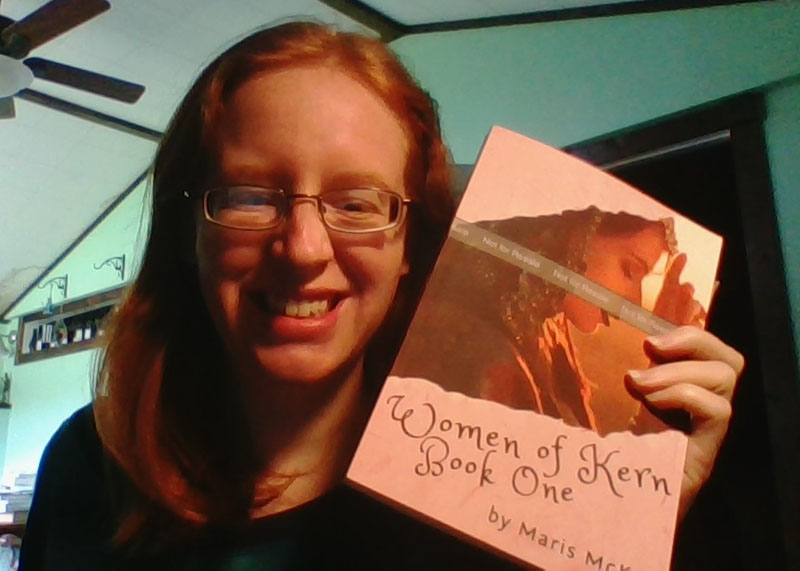
I published my first book!!!
Technically this isn’t really my first book since The INFJ Handbook and God’s Love Story have been available for quite some time now, but it’s my first fiction book and it’s the first of my books available in paperback as well as ebook. Getting the proof copy was ridiculously exciting.
What It’s About
Most of my fiction is fantasy, and this new short story collection is no exception. All the stories are set in the fantasy world of Kern, which you can learn more about on my other website (click here). Here’s the description printed on the back cover:
A negotiator who uses herself as a bargaining chip.
An adventurous spirit trapped by her culture and family.
A resistance fighter leading her captors into a trap.
A reclusive horse trainer swept into a quest for treasure.
An elderly, overlooked servant smuggling slaves out of her country.
A woman with a gift that seems like far more trouble than it’s worth.
A princess whose arranged marriage puts her in the hands of pirates.
A shepherdess fighting to save her sister.
A belly-dancing assassin who fakes her targets’ deaths.
These are the women of Kern — the sort of women who in our own world are all too often ignored, overlooked, forgotten, and silenced by history. Enter their world of magic, adventure, and romance through nine short stories and novellas driven by women with the strength and courage to shape their own destinies.
FAQs
I’m anticipating a few questions about this book, so I want to answer them here (feel free to ask others in the comments):
Q: Is this Christian fiction?
A: No. It is fiction written by a Christian and certain stories have Christian themes, but it is not “Christian fiction.”
Q: Is this book clean?
A: Mostly? I’d describe it as PG-13 for violence and sex. My target audience is adults and older teens, not children.
Q: Why the pen name?
A: Several reasons:
The website “marissabaker.com” was taken.
I didn’t want people searching for this blog finding my fiction page instead, or those looking for my fiction to find articles I’d written about gardening (less of a problem now than it was a few years ago when I was writing for eHow).
Since I write such a wide variety of things (non-fiction about personality types, Christian non-fiction, and fantasy/sci-fi) I thought it would be easier to write non-fiction and fiction under separate names.
Giveaway
Update: the giveaway is now closed. If you would still like to get a copy of Women of Kern either as an ebook or in paperback, click here to visit my Amazon page.
Scripture talks about baptism — full immersion in water — as a first step in believers’ walks of faith. It’s an outward sign of our identification with God’s people and our commitment to leave our old lives behind. Some church groups stop there, some sprinkle people from a baptismal instead, and Messianics continue to mikvah on a semi-regular basis.
I thought practicing mikvah once a year (more or less) was an odd idea when I started attending a Messianic group. Part of me still does, though I don’t really see anything wrong with it. However, while we are supposed to undergo water baptism at least once, it doesn’t stop there. When Scripture talks about multiple baptisms they’re not all done with water. Here’s what John the Baptist said about the baptism he was doing and the baptisms Messiah would do:
I baptize you with water for repentance, but the one who comes after me is more powerful than I am, whose sandals I am not worthy to carry. He will baptize you with the Holy Spirit and fire. (Matt. 3:11, LEB)
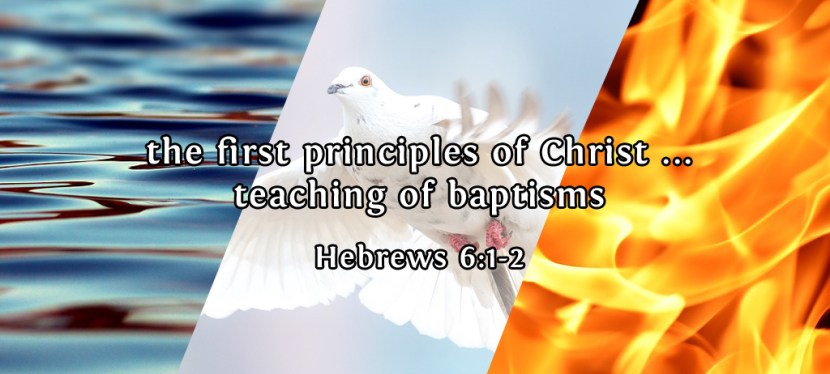
Water, spirit, and fire — those are the three baptisms that John tells us believers in Jesus will go through. I think this is what the writer of Hebrews means when he describes “the doctrine of baptisms” (plural) as a foundation of Christianity (Heb. 6:1-2).
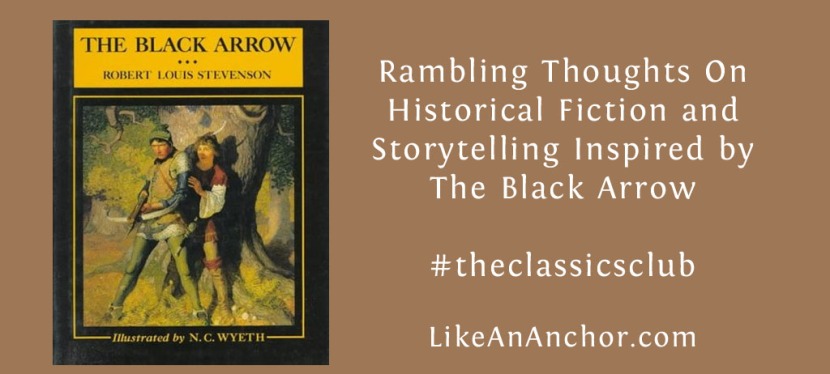
I’m not sure what to write about Robert Louis Stevenson’s The Black Arrow (1888). It’s a fun story, and it makes me want to either read Shakespeare or re-watch The Hollow Crown: War of the Roses. Or both — both would be good. But I don’t feel like there’s a whole lot to talk about for a Classics Club book post.
Maybe I should write a post about BlacKkKlansman instead, since I just watched that movie yesterday and I have lots of thoughts about it swirling around. (In short, I thought it was a very well-done movie about an important subject, but I felt the director undermined its message by adding news footage on the end that tied this story of the past to a specific incident and president of today. You don’t need to spoon-feed viewers your ideas. Let us make the connection ourselves.)
Anyways, that’s off-topic. The Black Arrow is about political and ideological groups fighting each other, characters who feel torn between two sides of an issue, someone who’s pretending to be something they aren’t, villains who think they’re better than everyone else, and a crusader-type character avenging oppression and injustice.
Actually you could use all those descriptions of BlacKkKlansman, too, even though the two stories are really nothing alike. I guess it just goes to show how themes in story telling can span different cultures and centuries. I’m fascinated by this phenomenon. Take fairy tales, for example. There are over 900 versions of Cinderella and nearly every culture has its own take on the story. Why? Did the story start one place and somehow travel that much? Or is it due to something like Jung’s theory of the collective unconscious?
And we’re off-topic again. Back to Stevenson. The Black Arrow is a loosely historical story set during the War of the Roses. The main character is Richard “Dick” Shelton, who i’m afraid I didn’t care about at all for the first couple chapters. Actually, I didn’t care much about him by the end of the book either even though he does experience some basic character growth. He seems stubbornly determined not to think about what’s going on around him and that irritates me.
Initially, young Shelton picks a side in the political conflict just because that’s the side his guardian is on. Then, after he learns his guardian killed his father, Dick declares for the other side. And he sticks with that decision because it’s dishonorable to flop back and forth even though he hasn’t got a clue what he’s fighting against or in support of. I know lots of people fight for causes they don’t really understand, but should the hero of a book be killing people based on what was for him a mostly arbitrary decision?
In similarly oblivious fashion, Dick Shelton seems to be the only character who doesn’t know John Matcham is actually a disguised woman even though he spends several days traveling alone with her. As soon as he finds out John is actually Joanna Sedley, though, Dick promptly proposes marriage. He doesn’t know much more about her than that she’s female and they have a common enemy in their mutual guardian, but apparently it’s enough to avow undying love. I’m not impressed with him.
My few complaints aside, The Black Arrow is a fun adventure story and it doesn’t pretend to be anything else. Still, this probably isn’t a book that I’ll re-read again (I’d read it once around high school) nor one of the classics that I’ll think much about. On another side-note, I appreciated the author’s notes about where he changed historical facts to fit his story. I have no problem with writers taking a certain amount of creative liberties with history, but if you’re going to write historical fiction it’s nice to know when and how you’re stepping away from the facts.
Honestly, this is my favorite way to learn history — read it in fictional form, then look-up how close it is to being accurate. Mara: Daughter of the Nile (while not historically accurate) got me interested in ancient Egypt. I really didn’t care much about the founding fathers (though my history-loving mother made sure I read plenty of non-fiction while we were homeschooling) until listening to Hamilton. I guess I’m just more intrigued by stories and characters than by descriptions of events and people, so when someone offers me real events as stories and historical people as characters I’m hooked.
Has God changed His mind about what He expects from people? Some think He has, or should. It’s the 21st century, they say. Those notions of morality are old-fashioned and need an update. Others think the change already happened and God doesn’t expect anything from you under the new covenant. You’re saved by grace and that’s it; no action required.
Neither of these ideas accurately reflects the picture God gives us in scripture. And while the idea of God brushing some rules under the rug can be a nice one if you plan to break those rules, it sets up a chilling precedent. Do you really want to serve a God who will change what’s expected of you or how He defines morality? If we can’t count on God to stay self-consistent we can’t trust Him and we’d have no hope to anchor our souls. Honestly, I find the idea of a God who changes the rules far more upsetting than that of a God who consistently expects certain things of His people.
God Wants You To Live
Thankfully, God reveals Himself in the Bible as reliable and consistent. That doesn’t mean He’s always predictable — He’s far too much for our minds to put Him in neat little boxes. But He will always act according to His character, keep His promises, and uphold His laws. Read more →





 Like An Anchor