Fighting Something You Can’t See

Choosing to follow God means we’re walking in harmony with Him. And that means we’ll be walking out-of-step with this world and with “the god of this world,” as Yahweh’s adversary is called (2 Cor. 4:4). In many ways, our Christian walk is one of warfare and struggle.

One of my ongoing struggles is with anxiety. My mind wants to loop through worst-case scenarios and imagine all the “what if?”s in a given situation. I’m often nervous, jumpy, and preoccupied with what’s going on in my head. My anxieties are something I can’t see, and unless I tell people about them or have a panic attack in public most wouldn’t have a clue how much it impacts my life (they call this “high functioning anxiety”).

Scriptures tell us that as Christians, the battles we face have spiritual components. These sorts of battles are difficult whether they’re visible to other people or not; whether they’re internal or external. But even when we feel like we’re battling something we can see — a nasty coworker, a disease, a failing relationship — Paul reminds us that we “do not wrestle with flesh and blood.” There are spiritual forces behind all the battles we face (Eph. 6:12). And we can’t see the full extent of our battles, or fight them effectively, without God’s help.

The Usual Type of Battle

It’s often a struggle for me to answer the question, “How’ve you been?” or “How was your week?” Unless something electronic breaks or someone I care about is going through something, my weeks would usually look pretty good from the outside. And I don’t want to tell most people that I’ve been struggling all week with something that’s only a problem inside my own head.

There’s a stigma against admitting you’re struggling. You might be seen as a saintly example of endurance if you’re facing a physical trial. But in many churches it’s a different story when you’re battling something mental or emotional. So many people see interior struggles as either a lack of faith or something that you could just “get over” if you prayed about it enough. However, there’s a passage in 2 Corinthians where Paul makes it sound like struggles within ourselves are the kinds of battles Christians usually face.

For though we walk in the flesh, we don’t wage war according to the flesh; for the weapons of our warfare are not of the flesh, but mighty before God to the throwing down of strongholds, throwing down imaginations and every high thing that is exalted against the knowledge of God, and bringing every thought into captivity to the obedience of Christ (2 Cor. 10:3-5, WEB)

Our warfare isn’t primarily a physical battle. It’s a spiritual and internal one that can also spill over into our outer lives. Even when the Adversary uses outside attacks it’s still part of a battle for our minds, hearts and spirits. It’s well past time for Christians to recognize this and start supporting each other through the invisible battles we all face. Read more

Anxiety Kitty: The Not-So-Surprising Way Pets Improve Mental Health

Remember that nervous cat I adopted a few months ago who spent all his time hiding under couches and beds or in closets? (click here to read “Lessons From My Nervous Cat”). My plan was to pour as much patience, love, and understanding into his life as I want people to show me when I’m scared. I wanted to show him that he had a safe home now.

Well, it’s working. Flynn is turning into quite the friendly cat, especially with me but also with the rest of the people he sees every day. And he’s even getting better around non-family members. We had several people over for dinner last night for a total of 14 humans around. Flynn hid when they were all in the house together, but after we sat down to dinner (some outside and some in the dining room) he actually wandered around out in the open and let people he didn’t know pet him.

After doing some research, I learned that clicker training is the one thing people have found that helps anxious cats settle down and feel safe. No one knows why teaching a cat to do simple tricks on command combats anxiety, but it does. My theory is that when the cat gets positive reinforcement for certain actions the additional structure helps make them feel secure. Whatever the reason, it’s adorable. It’s mostly about teaching him to do things he was already doing on command (touch my fingers, come when called, jump on and off chairs, and stand on his hind legs). The “stand” command is everyone’s favorite. He’s just so cute!

Anxiety Kitty | marissabaker.wordpress.com

As I’ve helped Flynn with his anxiety, he’s been helping me with mine. Before a lunch date a few weeks ago (the first since my breakup), he spent the whole morning following me around and checking in on me. Every few minutes while I was working at my desk he’d hop out of the window and walk over to “talk” with me and have his head rubbed. And when I walked into a different room he followed. Since then, he’s kept that pattern up most of the days my anxiety has spiked.

I’m honestly shocked how in-tune he is with my emotional state. A few days ago I was working on a guest post sharing my testimony about anxiety (I’ll share a link here when it goes live) and I hit a point in my writings where I just burst into tears sitting at my desk. I went for a walk outside and when I came back Flynn walked around my feet crying until I responded to him. He actually let me pick him up and hold him for a good 30 seconds (he hates being cuddled and usually wiggles as soon as you pick him up). Then a little while later when I was journaling and crying he spotted me, ran into the room, jumped up on the bed with me and stayed there purring until someone else came home. The only other times he sits on my bed with me is late at night, so this was really outside his normal behavior.

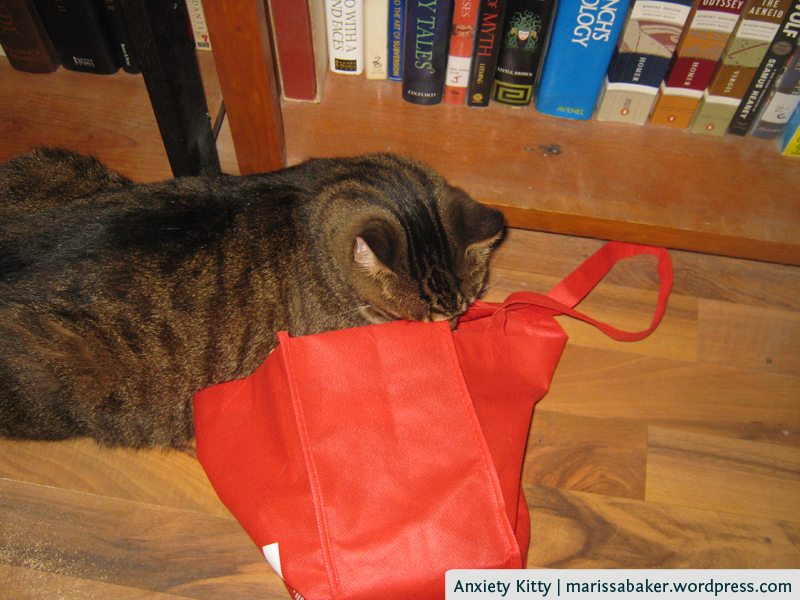
We’ve also discovered another shared love: old books. I collect Grosset & Dunlap series books (like Hardy Boys, Nancy Drew, Tom Swift, Rick Brant, and others). I found two bags full of books I needed for my collection at a book sale on Friday and they’re in really good shape. Flynn acted like the bags were full of catnip. He dove into the Hardy Boys bag head first and rolled around on the books until I pulled him out and tied the bag shut so he wouldn’t damage them. Then he climbed into the bag that I’d had Rick Brant books in earlier. He looked almost as happy with the books as I am.

Anxiety Kitty | marissabaker.wordpress.com

There’s just something comforting about sharing my home with a fluffy critter. Cats are my choice, but I’m sure other pet owners can relate whether they love dogs, rabbits, gerbils, or even non-fluffy pets. People are happier and healthier around animals. In fact, one survey found that 74% of pet owners reported mental health improvements from pet ownership.

The Anxiety and Depression Association of America says, “pets and therapy animals can help alleviate stress, anxiety, depression, and feelings of loneliness and social isolation.” That’s so true for me. Adopting Flynn and starting counseling are the two biggest things that have helped me deal with my anxiety this year, as well as my post-breakup grief. I know pet ownership isn’t for everyone, and would never tell you to get a pet if you’re not sure you could take care of it. But for those of us who can have pets, they can be a huge help when you’re going through something.

You don’t need to have a mental health issue to benefit from caring for an animal. For example, I suggested in my post on developing Sensing as an INFJ or INTJ that pets can help ground these personality types in the real world. INxJ types are normally a bit out-of-touch with the physical world and there’s nothing like knowing some other life form needs you in order to stay alive and happy to get you out of your own head for a while. Whatever your personality type, pets can be a huge blessing.

What about you? Do you have an animal friend who helps you when you’re struggling with something?

Under God’s Authority

I thought last week’s post was going to be my last one on the topic of authority. But we still haven’t really talked about the big reason for Christians to use authority rightly (part one), to respond well to authority in the church (part two), and to respect worldly authorities (part three). We’re to do all this because we’re under God’s authority.

Any time we rebel against or balk at one of of God’s commands (including the ones about respecting positions of authority), we’re questioning God’s authority. We’re rebelling against His right to tell us how we’re supposed to live. And that’s not something people who describe themselves as Christ-followers should be doing. We should be in awe of our God and treat Him with the utmost respect.

His Authority As Lord

Once you acknowledge Yahweh as your God, you should also recognize His rights as creator and ultimate authority in the universe. When we call Jesus Lord, we’re saying He’s our owner, master, and ruler (kurios, G2962). And if we’re going to call ourselves Christians, we need to live as if we really believe this is true.

Woe to the one who strives with his maker, a potsherd among potsherds of earth! Does the clay say to the one who fashions it, ‘What are you making?’ and ‘Your work has no hands’? (Is. 45:9, LEB)

Not only does God have claim on us as our creator, He also claims the rights of a redeemer. You are part of “the church of God, which he hath purchased with his own blood” (Acts 20:28, KJV).

Or don’t you know that your body is a temple of the Holy Spirit which is in you, which you have from God? You are not your own, for you were bought with a price. Therefore glorify God in your body and in your spirit, which are God’s. (1 Cor. 6:19-20, WEB)

We belong to God and He has absolute authority over every human life, whether we acknowledge His rights or not. And for those of us who do know Yahweh as our God, we need to make sure we respect His authority. Read more

Authority In The World

This probably isn’t going to be a very popular post in the little series I’m doing about how Christians relate to authority. Bible-believers like to ignore or debate around the verses that talk about how we’re supposed to respect  authority figures in the world. We’re pretty good at finding loop-holes so we can grumble about paying our taxes, complain about the President, and ignore as many “little” laws as possible (like the speed limit).

But I haven’t found any Bible verses that say it’s okay to say nasty things about people in power or rebel against earthly authority unless one of man’s laws conflicts with following God. I’m hoping in this post we can try to set aside our preconceived ideas and puzzle out what God’s instructions are and how to apply them today, rather than looking in scripture for excuses to keep resenting authority in the world.

Who Counts As Authority?

The key verses we’ll be looking at today are Romans 13:1-7, 1 Timothy 2:1-4, Titus 3:1-2, and 1 Peter 2:13-17. These verses talk about various types of human rules and rulers. Here’s a list:

  • Authorities — exousia (G1849). Authority, power, rule of government (Rom. 13:1-5; Tit. 3:1).
  • Rulers — archon (G758). Commander, chief, leader (Rom. 13:3).
  • Servant — diakonos (G1249). One who executes commands (Rom. 13:4).
  • Servants — leitourgos (G3011). Minister, a servant of the state (Rom. 13:6).
  • Kings — basileus (G935). Leader of the people, commander (1 Tim. 2:2; 1 Pet. 2: 13, 17).
  • All who are in authority — huperoche (G5247). Elevation, superiority (1 Tim. 2:2).
  • Rulers — arche (G746). Principalities, a person who is first (Tit. 3:1).
  • Be obedient — peitharcheo (G3980). To be persuaded by or obey a ruler/magistrate (Tit. 3:1)
  • Every ordinance — ktisis (G2937). Building, institution (1 Pet. 2:13).
  • Governors — hegemon (G2232). A leader of any kind (1 Pet. 2:14).

I think that covers pretty much everything. Those might not be the titles we use today, but the meaning is clear. These verses we’ll be looking at cover all types of worldly authority from your boss at work, to the lawmakers in your county, to the head of state. And we’re also told to respect the laws put in place by these people.Authority In The World | marissabaker.wordpress.com

Respect And Honor

Most of us (speaking from the perspective of a blogger in the U.S.) don’t even think about what it would mean to live in an honor-based society. We value individual freedom over the collective good. We cling to our right to express our ideas freely (a right which I’m using to post this article). We don’t like to think of people deserving respect or honor simply by virtue of their position. In fact, we often treat those with authority (or anyone who steps into the public eye) as fair-game for our nastiest comments. But God expects something different of us. Read more

Christian Reporting Would Work Better If We Actually Talked About Facts, Not Just Fear

If you follow any sort of Christian news outlets or have Christian friends on Facebook, there’s a good chance you’ve seen headlines like, “California Bans Bible Sales.” Or, as the title of a YouTube video I recently saw states it, CALIFORNIA BANS BIBLES!

The law in question is “California bill AB 2943, a measure that puts strict limits on programs that aim to change a person’s sexual orientation. The legislation, which passed out of the state assembly and over to the Senate, bans any advertising, offering to engage in, or engaging in sexual orientation change efforts with an individual'” (PolitiFact.com).

A quick Google search will reveal that this Bill does not, in fact, ban Bibles. It doesn’t even ban churches from offering conversion therapy as long as they don’t charge for it (FactCheck.org). And the fact that Christian news outlets are relying on the false claim of Bible banning as a headline is undermining their credibility. This is click-bait at it’s worst, designed to scare Christian readers rather than start an actual dialogue about the real dangers of the bill. And anyone (even a Christian) with a logical, questioning mindset who fact-checks this claim will quickly find it’s wrong. And then why should they bother listening to what else the news article (or its source) has to say?

That’s what irritates me most about Christian response to this bill. They/we are not talking about what’s actually going on. We’re twisting facts to scare people. No wonder people accuse Christians of not being in touch with reality!

The reality is that California’s new law bars people who want to determine their own sexual orientation from getting help. It forbids people who have homosexual urges and want to change from seeking counseling, and it also stops people who could help them from offering counsel. There was already a law in place preventing “sexual orientation change efforts” for children under the age of 18, but this new bill restricts the rights of adults to voluntarily seek counselling. I’m sure the people who advocated for this law would be enraged were it reversed (forbidding people who’ve lived as heterosexual from exploring other options).

This sort of law shouldn’t just worry Christians. It should worry anyone who doesn’t want the government legislating their sex life, their access to mental health resources, or their religious expression.

The headline “California Bans Bibles” is inaccurate and misleading. It’s not responsible reporting. And it’s actually distracting from talking about what’s really going on. Why aren’t more Christian websites using a headline like, “California Restricts Adult Citizen’s Rights To Seek Counseling”? That gets to what’s actually going on and it’s something non-Christians might click on as well.

Once we’re talking about the human rights that California’s bill is restricting right now, then we can talk about the danger of it leading to more restrictions in the future. Because when a state assumes the power to dictate what sort of programs a church can offer, that’s a freedom of religion violation. And it’s not much of a leap to go from a vaguely worded prohibition against selling any program designed to change a person’s sexual orientation to banning books, which is a freedom of speech violation. This makes California’s bill a violation of everyone’s First Amendment rights. And that’s a much bigger story than the inaccurate claim that they’re banning Bibles.

Being Under Authority In The Church

When we talk about authority, we tend to sort people into groups: those who have authority and those under authority. There’s also a good chance we think of friction between these two groups — one controlling and the other resenting. But that’s not how authority is meant to work in God’s church.

I’ve started a study on how true Christians relate to authority, and if you haven’t read last week’s post you’ll want to click here and do that before reading this one. In that post, we talked about Jesus’ saying His church will be run differently than the way authority works in the world. He is the only Lord and He has all authority. The people given authority under Him are supposed to act as servants. Some, like Paul, even gave up rights they could have demanded because serving the brethren was more important than proving they had power.

As we all know (many of us first-hand) church leaders don’t always wield authority in a right and godly way. But whether they’re doing what they’re told to or not, all of us still have to respond in the ways God wants us to. We’re responsible for our own actions. So how should we respond to authority in the church, whether good or bad?

A Responsibility To Peace

Firstly, we have to remember to treat those in authority the same way we do other brethren. God wants peace in His church and among all His people, regardless of what role they play in His church.

Make my joy full, by being like-minded, having the same love, being of one accord, of one mind; doing nothing through rivalry or through conceit, but in humility, each counting others better than himself (Phil. 2:2-3, WEB)

We’re to cultivate this kind of relationship with all our brethren, including those who are in some kind of authority position. Entering ministry doesn’t make someone fair game for your criticism or hostility. You’re still bound by the instruction, “If it is possible, as much as it is up to you, be at peace with all men” (Rom. 12:18, WEB). Read more