Announcing A Second Blog

Announcing A Second Blog | marissabaker.wordpress.com

I’m working on shifting this blog’s focus to more of an encouraging, self-help site. My main target audience will be Christians who are interested in personal development, though the MBTI posts will stay accessible to a wider audience as well. Not much is going to change in terms of post content, at least for right now. I’ll still finish up my Classics Club list and I’ll continue blogging about Myers-Briggs types and Bible study topics. But I do want to start narrowing the focus a little.

At the same time, I’ve been wanting to expand on my project to type fictional characters from the Star Wars universe. And so to avoid cluttering up this blog with posts about fictional characters’ personality types, I’m launching a new blog for those posts:

Costumes and Characters: A Star Wars Blog

Announcing A Second Blog | marissabaker.wordpress.com
My latest sewing project: Viking-era apron dress and underdress

This new blog will feature in-depth analysis of Star Wars characters’ personality types. I’ll also be keeping a new version of my Star Wars MBTI Chart there, which will update as I continue to type new characters.

The “costumes” part of the title comes from a hobby of mine that I haven’t really talked about before on this blog. So far all the costumes I’ve created have been for Renaissance Faires, but I’m starting to turn that into a Star Wars-related hobby as well. My first project is the Queen’s Handmaiden Flame Gown from The Phantom Menace. There aren’t any tutorials or patterns available on this gown and I’m excited to tackle the challenge of figuring out the design.

If you’re interested in Star Wars (or even just in seeing fictional examples of the different personality types), I’d really appreciate you checking out this new blog and clicking the “Follow” button. Thanks!


The Right Way To Use Authority

There’s a young adult event coming up in a few weeks that I’m planning on going to. The theme is “How true Christians relate to authority in the world and in the church.” This is a topic that’s been nagging at my mind for some time now anyway, so with this event coming up I thought it would be a good time to start studying what God has to say about authority.

I’m going to blame American/Western cultural influence for why the word “authority” sometimes rubs me the wrong way. And I’m sure I’m not the only one with that reaction, even though the Bible, not our culture, is supposed to be what’s guiding how we respond to things. But just because authority might leave a sour taste in our mouths doesn’t mean it isn’t an important concept for Christians to understand.

Who Gets To Be Lord?

One thing Jesus made clear in His earthly ministry is that authority among His people works differently than in the world.

Jesus summoned them, and said to them, “You know that they who are recognized as rulers over the nations lord it over them, and their great ones exercise authority over them. But it shall not be so among you, but whoever wants to become great among you shall be your servant. Whoever of you wants to become first among you, shall be bondservant of all. For the Son of Man also came not to be served, but to serve, and to give his life as a ransom for many.” (Mark 10:42-45, WEB)

In the nations, rulers exercise authority and lord over people. The word “lord over” is katakurieuo (G2634). It comes from kata (G2596 — preposition meaning down, which acts as an intensive) and kurieuo (G2961 — lordship/dominion). The compound katakurieuo means having mastery over others or putting them down in subjection. Peter uses this word when telling elders how not to behave. Read more

5 Tips For INFJs Going Through Heartbreak

You know you’re a writer when one of the first things you think after a breakup is, “I could turn this into a blog post.”

It’s taken me about three months to get to the point where I felt I could write the post I wanted to — an article sharing tips for other INFJs going through heartbreak. I was quite certain I would get through this heartbreak eventually, but I wasn’t going to write this post until I felt like I had some good things to share with you.

When INFJs finally let someone in (not an easy thing for us to do), we tend to become very attached to them. We “map” them into our inner world so being with them is almost as relaxing/energizing as being alone. We rearrange our lives to make room for them. We start to consider their needs, wants, and desires as equally (or even more) important as our own. So when a relationship like that ends (whether it’s dating, marriage, or even a close friendship) it leaves a huge hole in our lives.

In some ways, of course, that’s true for everyone who really cares about someone and then loses that relationship. Today, though, I’m just focusing on one personality type. We INFJs don’t let many people in, and losing a close relationship often feels like being cut lose from an anchor. Especially if we still care about the person deeply (rather than in the case of an emotionless door slam). Read more

Becoming One Flesh With Jesus Christ

Today’s post is something of a continuation to last week’s post, The Bridegroom’s Pledge. As Jesus Christ’s bride, the church is supposed to be getting ready for a marriage that will take place when He returns. If this were a human wedding, preparations for it would include things like picking a date and venue, mailing out invitations, and hiring a caterer. But none of those things are any use in preparing for a wedding to Jesus. He needs us to focus on something different, something that will strengthen a relationship He intends to last into eternity.

Diversity In Oneness

He who loves his own wife loves himself. For no man ever hated his own flesh; but nourishes and cherishes it, even as the Lord also does the church; because we are members of his body, of his flesh and bones. “For this cause a man will leave his father and mother, and will be joined to his wife. The two will become one flesh.” This mystery is great, but I speak concerning Christ and of the church. (Eph. 5:28-32, WEB)

In these verses, Paul quotes Genesis 2:24 about the husband and wife becoming one flesh. The Hebrew word for “one” is echad (H259). It’s the same word use in the Shema: “Hear, Israel: Yahweh is our God. Yahweh is one” (Deut. 6:4, WEB).

While echad can mean the number one, in these verses “It stresses unity while recognizing diversity within that oneness” (TWOT entry 61). A husband and wife don’t literally merge into a single being. And God (Elohim) consists of two Beings. But they can be called one because they’re united. That’s the sort of relationship we’re supposed to be developing with Christ. Read more

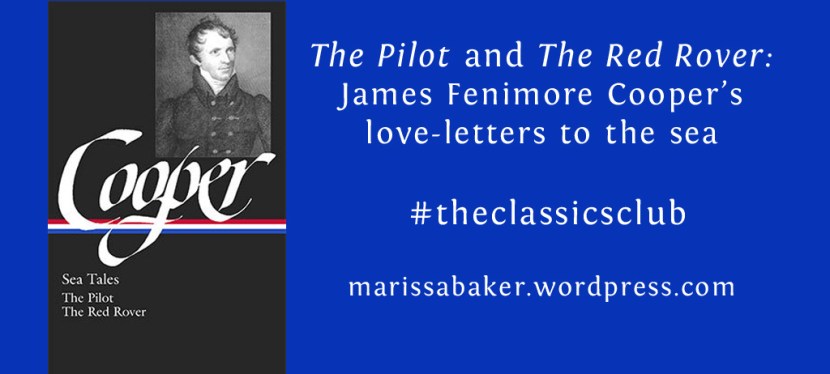
The Pilot and The Red Rover: James Fenimore Cooper’s love-letters to the sea

I’m going to knock two books off my Classics’s Club List in this post. They’re both written by James Fenimore Cooper (best known for The Last of the Mohicans) and both take place on and near the sea, so grouping them together makes sense. In fact, the library book I read has both in a single volume. The Red Rover (1827) is a re-read for me, but The Pilot (1824) was new.

I really wanted to like these books. They’re the sort of stories that I usually love. But I just wasn’t really liking them and found myself skimming large chunks. It wasn’t until halfway through The Red Rover (which I read second) that I finally figured out why. My favorite books are usually character-driven, but Cooper isn’t really writing to tell his characters’ stories. He’s writing love-letters to the sea and the men who sail her waves.

Scarcely A Favorite With Females

In a preface to the 1849 edition of The Pilot, it says that this book “could scarcely be a favorite with females. The story has little interest for them, nor was it much heeded by the author of the book in the progress of his labors. His aim was to illustrate vessels and the ocean rather than to draw any pictures of sentiment and love.”

At first, I felt compelled to prove him wrong. I like books about vessels and the ocean. And the story’s plot centers around two young American naval officers (Griffin and Barnstable) who risk their real mission in trying to rescue the women they love. There’s also a mysterious Pilot, who has an equally mysterious connection with another woman at the house. It’s a perfect recipe for a romantic adventure.

But Cooper doesn’t take full advantage of the compelling plot he’s crafted. Oh, he keeps with that story line but the characterization starts falling apart. Cooper will spend several chapters describing in loving, minute detail how a ship’s crew navigates away from a particularly dangerous piece of coastline during a storm. But if you’re expecting such care taken with the characters you’re in for a disappointment. Read more

The Bridegroom’s Pledge

If you’ve been reading this blog for a while, you probably know my favorite way of looking at the Lord’s relationship with His people is as a love story. This seems to be one of God’s favorite analogies as well, since He weaves betrothal and marriage imagery throughout His word.

Pentecost, which takes place tomorrow, isn’t often talked about in the context of God’s love story. It’s best known among Christians as the day when the disciples received the Holy Spirit in Acts 2 and as a harvest festival from the Old Testament. But just a little digging into this day’s context within a Hebrew mindset and Jewish tradition reveals how strongly it’s connected with the love story God is writing between Him and His people.

A Promise To Come Back

The Bridegroom's Pledge | marissabaker.wordpress.com
Photo by Brooke Cagle on StockSnap

The Jewish name for Pentecost is Shavuot, which means “sevens” in reference to counting seven weeks of seven days from the Sabbath after Passover. Pentecost is then kept on the Sunday after the seventh Sabbath (hence the name “Pentecost,” which means count fifty). The root word for Shavuot is shaba, which means the number seven as well as an oath or pledge (TWOT entry 2318 and 2319).

In Jewish wedding traditions, brides are chosen by the groom’s father just as God the Father chooses whom to call into relationship with His Son. The groom pays a bride price for her, just as Jesus (or Yeshua, to use His Hebrew name) bought us with His own blood (1 Cor. 6:15-20). The betrothal agreement was a covenant, the same type of relationship that God has made with His people at least as far back as Noah. Once the bride consents to this arrangement the marriage covenant was sealed with a cup of wine, as Yeshua sealed His covenant with us at Passover (Luke 22:20; 1 Cor. 11:25).

Then the bridegroom went away to prepare a home for His bride, which is what Yeshua told His disciples He’d be doing while He was gone (John 14:1-3). A Jewish bridegroom would be gone for about one to two years before returning to claim his bride. He didn’t just drop off the face of the earth, though. He left a gift with her and made an oath or pledge to come back.

A Gift For The Bride

When Abraham’s servant found a wife for Isaac, he “brought out jewels of silver, and jewels of gold, and clothing, and gave them to Rebekah” (Gen. 24:53, WEB). Similarly, Yahweh talks about the lavish gifts of clothing and jewelry He gave Israel when He entered into covenant with them (Ezk. 16:8-14). Our bridegroom, Yeshua, did something similar for us on the day of Pentecost. Read more