Still No Oven / Hero Archetypes

Since I am still without an oven, I’m going to depart from my schedule and post something other than a recipe today. The repairman is supposed to come this afternoon so, in lieu of writing about food, I’m going to write about writing.

Over on MarisMcKay.com, I’ve been working on a series of blog posts about character archetypes. I’ve spent too much time on the accompanying images not to try and broaden the audience, so this post will be devoted to heroes and I’ll dedicate Monday’s post to heroines. While collecting the examples of each type, I noticed sci-fi/fantasy may be overrepresented, but that’s what I’m most familiar with and I’ve decided not to apologize for it.

This theory of character development is contained in a book titled The Complete Writer’s Guide to Heroes and Heroines: Sixteen Master Archetypes. The ideas are based on Jung’s theory of collective unconscious. He identified major archetypes that arise from memories of shared human experience and serve as models for personalities.  For this book, the authors suppose that

 At the very core of a character, every hero can be traced back to one of eight major archetypes, as can every heroine. The core archetype tells the writer the most basic instincts of heroes or heroines — how they think and feel, what drives them and how they reach their goals.

Hero Archetypes
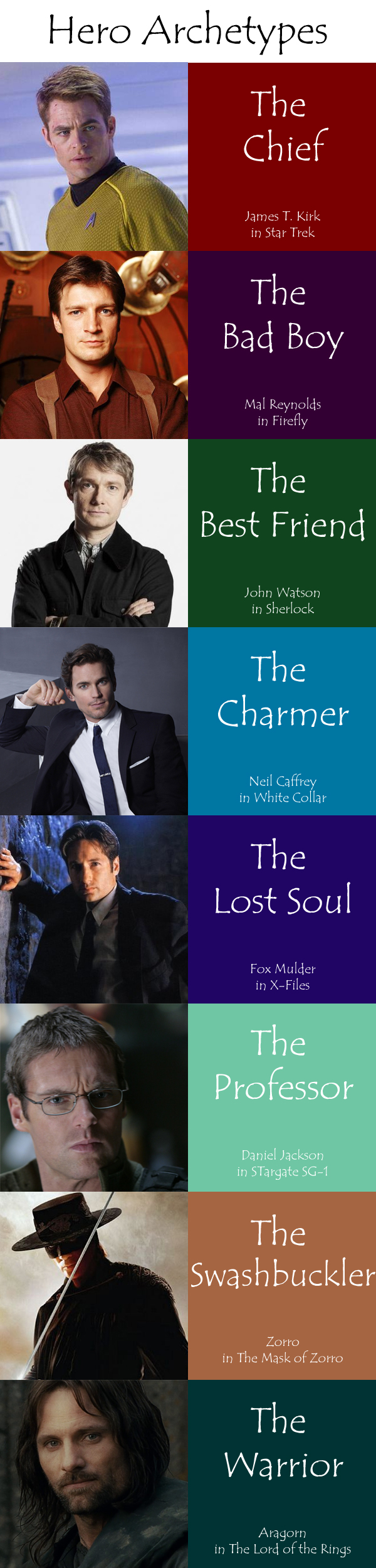
Eight hero archetypesThe Chief His major virtues are that he is goal-oriented, decisive, and responsible. He can also be stubborn, unsympathetic, and dominating. “He is a man who seizes control whenever possible. Active, dynamic, and strong-willed, he urgently needs to fix problems and produce results.” This type of character is not discouraged by challenge, and is typically a born leader or a conqueror type of character.

The Bad Boy This type is succinctly described as “every schoolgirl’s fantasy and every father’s nightmare.” He is typically charismatic, street smart, and intuitive, but is also pessimistic, bitter, and volatile. This character “struts into every room, daring one and all to knock the chip from his shoulder. … All his life, he has been pointed out as a bad example, so he does his best to maintain that reputation.”

The Best Friend “Decent, kind and responsible … He fits in everywhere and is universally liked. Whether he operates out of a sense of duty or genuinely enjoys giving of himself, he is always there.” His main virtues are stability, a supportive nature, and tolerance. His flaws are that he can be complacent, myopic, and unassertive.

The Charmer This is the likable rogue type who can “make you believe in fairy tales” but “is not always there in the ever-after”. He is creative, witty, and smooth, but also manipulative, irresponsible, and elusive.  “Exuding enormous charisma, he showers the people in his life with gifts of laughter and happiness. He is always fun, often irresistible, and frequently unreliable.”

The Lost Soul This character is devoted, vulnerable, discerning, brooding, unforgiving, and fatalistic. He is defined by an isolating event from his past. He “drifts through life with a heavy heart and a wounded spirit. He is dramatic, intriguing, and secretive. … This man has a poet’s voice, an artist’s creative genius, and a writer’s grasp on emotions.”

The Professor Some of my favorite characters — Daniel Jackson, Spock, Sherlock Holmes — share this type. They are “used to being the smartest man in the room,” are experts in their field, and can be absent minded or highly organized. They are analytical and genuine, but also insular, inhibited, and inflexible.

The Swashbuckler This character is an explorer or a daredevil,  fearless and foolhardy. He is exciting but unreliable, capable of finding a solution to any problem, but selfish in pursing his goals. “He loves to leave his mark on every exploit, so he chooses the most rash and flamboyant method of achieving his aim. Impulsive and creative, this man lives for the next adventure.”

The Warrior Tenacious, principled, and noble, this character type is compelled to see justice done. They can be self righteous, relentless, and merciless with their enemies. A character of this type “believes evil cannot go unpunished. He cannot allow the bad guys to walk away, so trouble seems to follow him wherever he goes.” He defends the weak and is the perfect protector.

Writing With Archetypes

I’ve found this book helpful in coming up with ideas for strong characters. For one character, who was disappearing into the background of my finished novel, it’s helped me flesh him out so much that the sequel will be his story. He is a Warrior, and I’m going to layer on some Lost Soul characteristics to make him even more unique.

There is a wide variety within each type, so even if you don’t combine them there is plenty of room for character development. As the writers of this book said, Henry Higgins from My Fair Lady is a chief, like Captain Kirk, but you wouldn’t want him commanding a Starship. If you’re a writer and you can find a copy (the book is out of print, so I use one from the library), I highly recommend this resource.

Living With Style, Class, and Grace

Book cover: How to Be a Hepburn in a Hilton World: The Art of Living with Style, Class, and GraceI recently finished a delightful little book called How to Be a Hepburn in a Hilton World: The Art of Living with Style, Class, and Grass. It is written by a publicist for Warner Bros. Records named Jordan Christy. The basic idea behind the book is that in the years since Audrey Hepburn graced the silver screen, our culture has come to uphold standards of behavior that are simply unacceptable for smart girls to follow. This book sets out to show “modern ladies how they can be beautiful, intelligent, and fun while retaining values and morals.”

One of the most welcome things about this book is that it is not a Christian guide to modesty. I’m not saying those types of books can’t be helpful, but it was refreshing to find a book written for women who want to (or have to) work in a business setting instead of on an idylic homestead. It tells girls you can be modern as well as feminine, that you don’t have to wear ankle-length skirts to be modest, and that acting like a lady can be fun instead of restrictive. I think it would be a great book to give girls who feel like the commonly presented Christian ideals of womanhood are shutting them out (for the record, this does not include me, but does describe some of my close friends).

Just to be fair, there were some things I did not like about the book. In an effort (I assume) to keep the text relevant to modern readers, Christy uses many examples of actresses, characters, and reality shows. There were enough to become excessive (and I didn’t recognize most of them). Her writing style might also seem blunt and off-putting to some readers.

Best Quotes

Chapter 1: Keep Your Chin Up and Your Skirt Down

“If we want [guys’] undivided attention for a bout 2.4 seconds, we should keep wearing our glittery minis and doing the bend-and-snap. But if we want a real relationship with a real gentleman, we should just keep being our smart, classy, fabulous selves.” Or, for those who’ve never worn a mini skirt in their lives, don’t be tempted to compromise.

Chapter 2: Words, Words, Words

This chapter advised reading and increasing our vocabularies so we can become better conversationalists. She also covers knowing when to speak and when to keep silent, quoting George Eliot: “Blessed is the man who, having nothing to say, abstains from giving us wordy evidence of the fact.”

Chapter 3: Use Some Elbow Grease

“Unfortunately, that hard-work-doesn’t-hurt mentality appears to be in short supply these days. Why? It’s become painfully clear that our society just doesn’t support a sincere work ethic anymore.” Be that as it may, if you want to be a classy, respectable young woman, you have to be willing to work.

Chapter 4: Choose Your Friends Wisely

We need to find friends “who will help us kick our own vices, not just drag us down in the mire with them and theirs. If we’re struggling with self-image and potential eating-disorder thoughts … we need to find ourselves some normal, curvy friends who will take us to counseling and won’t care if we’re a size 2 or a 10.”

Chapter 5: Let Him Come Calling

“Regardless of the guy’s current status, bank account, background, or beliefs, if he’s interested, he will do the pursuing. There’s no need to interfere with the ways of nature! Doing so will only scare him off.” This is one chapter I had a little disagreement with. She doesn’t allow for anything in between completely-ignore-the-guy and obnoxiously-pester-him-with-text-messages-every-few-hours. If you’re already friends, shouldn’t you be allowed to Facebook or e-mail him once in a while to keep in touch?

Chapter 6: Dress to Impress

Two quotes this time: “While it may seem frivolous to some, our personal style does more talking than we ever could about ourselves — and we want to make sure it’s saying nice things!” “While it can be tempting to want to keep up with the current inseam trends, the respect we’ll receive from not exposing our chest region and upper thighs is worth so much more than the five-seconds stares we’d get from a bunch of ogling buffoons.”

Chapter 7: Less Is More

“Our society is undoubtedly of the flashier/louder/faster/stronger mentality, and for some reason makeup tends to fall into the same category, but it really should be placed indefinitely in the less-is-more category. … We need to realize makeup is a simply something to enhance certain features — not a daily necessity that needs to be applied from sunup to sundown.”

Chapter 8: Have Your Cake and Eat It Too

“You can healthfully and happily maintain your weight without taking any weird voodoo pills or sprinting a marathon on the treadmill every week. You simply need to find a steady balance between those leafy greens and that Sprinkles cupcake. Let’s become the new poster children for happy, healthy young women.”

Love in the Enderverse

Cover of the only version of Ender’s Game I could find in the library

Since the beginning of this year, I’ve been reading Orson Scott Card’s Ender books. Well, perhaps it would be more accurate to say I’ve been absorbed by them. So far, I’ve finished Ender’s Game, the three sequels, and four of the Shadow books (Shadows in Flight is waiting for me on the bookshelf). After finishing these books, I feel like I know the characters better than many people I’ve been friends with for years.

I’d been meaning to read more Orson Scott Card for some time, since I stumbled upon one of his short stories in a sci-fi collection. Ender’s Game moved to the top of my reading list after I found out it’s going to be a film. I wanted to read the book before Hollywood ruins it (don’t get me wrong — I’m going to see the movie and it might be good, but there’s no way it can be as good as the book).

The Ideas

It’s not just the amazing characters that make these books so compelling. The ideas that Card presents in his stories are some of the most fascinating I’ve ever encountered in fiction. Ender’s key to defeating an enemy is just a sample of these compelling ideas (quote is from Ender’s Game, the idea shows up in all the books).

In the moment when I truly understand my enemy, understand him well enough to defeat him, then in that very moment I also love him. I think it’s impossible to really understand somebody, what they want, what they believe, and not love them the way they love themselves. And then, in that very moment when I love them…. I destroy them.

Don’t you just want to give him a hug? Anyway, this is the idea I’ve pondered the most since starting this series: when you fully understand someone and see through their eyes, you can’t help but love them. This is underscored (for me at least) by my reaction to the characters. By the end of Ender’s Game, I knew him and felt for him. I had similar connections with Bean in Ender’s Shadow and Peter in the other Shadow books, especially Shadow of the Giant. Orson Scott Card wrote the characters so well that readers can understand them well enough to love them (to the point that I finished three of these eight books in tears not necessary because I was sad, but because I was overwhelmed by how much I sympathized with the characters).

A Spiritual Question

One of the thoughts this idea — the connection between understanding someone and loving them — has sparked in my mind is a possible answer to a spiritual question. Just reading though the Bible, I can accept “God so loved the world, that He gave His only begotten Son” (John 3:16). But when I start to think about this a little more deeply it’s mind-blowing. Christ didn’t come to die only for the good “lovable” people in the world. He died for and loved everyone, even the people we would classify as the most unlovable. How is such love possible?

Since reading books from the Enderverse, I’ve been wondering if God’s love for everyone might have something to do with the fact that He is all-knowing. He understands everything  and sees into our hearts, and even when He does not approve of our actions or is angry with us, He loves perfectly. It’s an interesting “something to think about.”

If you’d like to try reading these novels, here’s a list of books in the series. It shows both publication order and a (rough) chronological order in the Enderverse.

Fairy Tales

I love fairy tales. When I was little, my exposure to fairy tales was mostly through Disney films (my favorite is Beauty and the Beast, just in case anyone is wondering). I started seriously reading fairy tales just a few years ago, when my favorite English professor loaned me a collection of Celtic Fairy Tales. Since then, I’ve read all the Brothers Grimm tales, many of Andersen’s fairy tales, more Celtic folklore, and collections of French fairy tales including Perrault’s writings.

I’ve been reading some of C.S. Lewis’s essays collected in the book “Of Other Worlds.” I’ve enjoyed reading his fiction (Narnia and the Space Trilogy), as well as Mere Christianity, so it was nice to get insight into his mind and writing process. For the blogt I wrote to post on my writing website tomorrow (yes, I write under a pen name), I turned to one of these essays for inspiration. I liked writing it so much, that I decided to post it here as well.

C.S. Lewis on Children’s Writings

By tracking down a quote on Pinterest, I came across C.S. Lewis’s essay “On Three Ways of Writing For Children” (full text online here). Though I don’t write specifically for children, I like to think that my fantasy novels would appeal to (and be appropriate for) some young people. After all, I can’t be the only child who was reading Jules Verne by age 10 and searching for other stories of the fantastic.

The essay becomes most interesting to me when Lewis addresses the question of what kinds of stories are worth reading as children. Since he wrote children’s fantasy — not because he set out to write for children, but “because a children’s story is [sometimes] the best art-form for something you have to say” — he spends much of the essay defending fairy tales.

If I have allowed the fantastic type of children’s story to run away with this discussion, that is because it is the kind I know and love best, not because I wish to condemn any other. But the patrons of the other kinds very frequently want to condemn it. About once every hundred years some wiseacre gets up and tries to banish the fairy tale. Perhaps I had better say a few words in its defence, as reading for children.

Just as when Lewis was writing (in 1952), modern parents have been banning classic fairy tales. Hansel and Gretle and Little Red Riding Hood are not read because they are “too scary,” but there are other reasons as well. More than 50% of parents wouldn’t “read their kids Cinderella because the heroine spends her days doing housework. Many felt that this theme of female domesticity didn’t send a good message.” The politically incorrect word “dwarves” disqualifies Snow White from polite society. Rapunzel’s kidnapping and imprisonment is “too dark” a theme (actually, it is darker than they think– in the Grimms version she’s not actually kidnapped. Her father gives her to a witch to save his own life).

Whether or not to read fairy tales (and which ones to read) to children is a choice that will vary from parent to parent and also depends on the child. There are plenty of fairy tales I wouldn’t read to a very young or sensitive child (like The Little Mermaid, where she is in agony the entire time she has legs and dies at the end). But on the whole, I tend to agree with Lewis when he said,

Since it is so likely that they will meet cruel enemies, let them at least have heard of brave knights and heroic courage. Otherwise you are making their destiny not brighter but darker. Nor do most of us find that violence and bloodshed, in a story, produce any haunting dread in the minds of children. As far as that goes, I side impenitently with the human race against the modern reformer. Let there be wicked kings and beheadings, battles and dungeons, giants and dragons, and let villains be soundly killed at the end the book. Nothing will persuade me that this causes an ordinary child any kind or degree of fear beyond what it wants, and needs, to feel. …

It would be nice if no little boy in bed, hearing, or thinking he hears, a sound, were ever at all frightened. But if he is going to be frightened, I think it better that he should think of giants and dragons than merely of burglars. And I think St George, or any bright champion in armour, is a better comfort than the idea of the police.

As a child who was deeply afraid of things that go bump in the night, I can wholeheartedly support Lewis’s claim that a “bright champion in armour” is a far better comforter than the police. And if my mind had not been filled with fairy tales, fantasy, and knights in shining armor I would never have dreamed up Jamen and Karielle or Bryant and Aelis (who now live in my in-progress and finished novels) or invented Ves’endlara.

Which fairy tales would you read, or not read to children? As an adult, do you enjoy reading fairy tales?

Fortuitous Fabric Shopping

Yesterday, my brother and I went fabric shopping. This in itself is momentous, considering he suffers from an allergy to all shopping that does not involve food or manly building projects. But he wants a Medieval costume for SCA events and I told him I’d sew it if he picked out the pattern and fabric.

I stumbled upon the Society for Creative Anachronisms a few years ago, but didn’t join because I didn’t want to be by myself when I went to the meetings. Now that my brother is older, he thinks full armored combat sounds amazing and can’t wait to join me in pretending we live in pre-17th-century Europe.

While we were getting our chosen fabric cut at Jo-Anne’s, the woman who was waiting on us asked what the costume was for. We told her, and lo-and-behold she was a member of our local SCA group. She invited us to the meetings, told us what to expect, said there were a couple people close to my brother’s age there, and (best of all) that they have people in the group who practice Medieval painting. As in, illuminated manuscripts. As in, I-CAN-BARELY-CONTAIN-MY-EXCITEMENT.

I got to see a collection of illuminated manuscripts at the Cleveland Museum of Art a couple years ago. “The Glory of the Painted Page,” it was called, and it was indeed glorious. I love books, and have a great deal of admiration for those long-dead artists who hand wrote and carefully illustrated manuscripts from the Medieval period. To have the opportunity to learn that art is incredibly exciting.