5 Weird Ideas I Picked Up From Courtship

If you grew up in a conservative Christian setting or the home-school community of the late 1990s and early 2000s, you mostly likely read I Kissed Dating Goodbye by Joshua Harris. After its release in 1997, it quickly became the go-to book in the courtship-vs-dating debate. If your friends didn’t hand it to you with an enthusiastic, “You have to read this book,” your mom probably thought it “would be good for you.” Or maybe you just picked it up on your own because of that suave guy on the cover tipping his hat (you know what I’m talking about, girls).

When I first read this book as a very “Christian” never-been-kissed teenager, all this courtship stuff seemed like a good idea. I mean, who doesn’t want a relationship guaranteed to lead to true love while keeping both God and your parent’s happy? The problem is, courtship doesn’t reliably work, and it gives you some pretty weird ideas to carry around if you eventually start trying to date like a semi-normal person.

Never Be Alone With A Guy

After reading I Kissed Dating Goodbye, my teenage self wrote up a list of things I would and wouldn’t do now that I knew the “right” way to interact with guys. Number 4 on my list was “ I will not put myself in a potentially compromising situation by being alone with a guy unless there are other people in the near vicinity.”

For us girls, this idea makes interacting with both married and single men awkward because you just know if you’re alone with them for any length of time you’re practically forcing them to have impure thoughts about you. This simply isn’t true (for one thing, people are responsible for their own feelings and thoughts), but having that idea in the back of your mind can make you feel guilty even in completely innocent situations.

Brothers, Not Boyfriends

That cute guy you walked past at the supermarket? the coworker who smiles at you every morning? They are not potential dating material–you’re are supposed to treat every man you meet just like you would your brother. If you start to even think about him as a potential boyfriend, you need to get your thoughts under control because you’re defrauding him and his future wife (who probably won’t be you). And courtship says the same thing to guys as well–think of every woman you meet as your sister until you’re ready to get married to her.

There are several problems with this idea. 1) Even after being told how “wrong” this is, you might still wonder (even briefly) if every attractive man or woman you meet is “the one.” The only difference is you feel guilty about it. 2) I’m perfectly comfortable leaning against my brother’s shoulder, looping my arm through his, going to him when I need help with something, and laughing and talking freely with him. That’s okay, because he actually is my brother. If I treat another guy like that, he’ll think I’m flirting and people will ask if we’re dating. 3) if you really do succeed in thinking of all your friends in a completely unromantic way, you’re less likely to pursue a romance.

Dad Has To Approve

Ideally in courtship, a man will decide he wants to pursue a relationship with a girl he is friends with, and then he will ask her father for permission to court her. As a young teen, having parental approval before you go out on a date makes sense when you have involved, caring parents. But courtship extends this principle to any age, and it becomes more and more impractical as you get older.  If a girl plans to move out of her parent’s house, go to school, or work outside their home, she’ll end up interacting with men who’ve never even met her parents and who haven’t heard of courtship. Have fun trying to explain to a really great guy who just asked you out for coffee that he needs to talk with your dad first because there’s no such thing as a casual date.

Personally, I have a good relationship with both my parents and I want them to approve any man I marry or even seriously date. However, they haven’t met all the guys I know, and I’d be comfortable going out with a guy who hasn’t met my parents but is respected by our mutual friends. Other girls don’t have a good relationship–or any relationship–with their parents. Courtship gives the impression that if her father is not in the picture, the guy better hope there’s a male authority figure in her life to talk to because heaven forbid she make up her own mind about something like this.
courtship

First Comes Courtship, Then Comes Marriage

Up until a couple is officially courting, they aren’t supposed to be alone or interact romantically in any way. Groups outings are the rule. Then as soon as they’re courting, they are set on the fast-track to marriage (it’s basically like an engagement, which makes proposals almost a moot point). Either you’re “just friends,” or you’re “exploring the possibility of marriage.” There’s no in between.

This brings us to a problem with courtship that underlies all the ones we’ve talked about already–courtship assumes that every interaction between men and women is extremely weighty and romantically charged. You can’t go on a casual date hoping to get to know someone better because courtship tells you  there’s no such thing as a “casual date.” You’re either friends, or you’re on the road to marriage.

Most people I know who’ve bought into the idea of courtship don’t actually get to the courtship part. It’s too intimidating of a commitment. When you leave courtship and try to date normally, though, you still have this idea that if a guy asks a girl out, that must mean he’s thinking of marrying her someday. It’s a really weird headspace to be in.

No Touching!

Courtship rules say absolutely no physical intimacy before you’re married. Depending on who you talk to, this even includes hand holding, hugs, or a quick kiss. Also, they add in the idea of “emotional sex” so that even having feelings for someone becomes wrong. Now, I do believe that God intends His people to save sex until marriage, but going to this extreme is a recipe for–you guessed it–more guilt.

People have written whole articles about how the teachings of physical and emotional purity from courtship books like I Kissed Dating Goodbye actually damage healthy relationships. You second-guess every hand-hold and shoulder touch, wondering if you’re sending the “wrong message.” You’re scared to fall in love because you don’t want to give pieces of your heart away to someone you might not marry, as if caring about someone leaves you with less capacity to care about someone else later (I wrote a whole post addressing this idea).

So what’s the alternative? The Christian community ran away from worldly dating for a reason, and problems like shallow short-term relationships and accelerated intimacy are still there. But courtship didn’t give us a viable alternative. Instead, I rather like the idea of going back to a more old-fashioned version of dating (as suggested by Thomas Umstattd, whom I also linked to in the intro). Debra Fileta supports a similar idea in her book and website True Love Dates. It’s not perfect, and I don’t think relationships will every be easy, but at least it sounds better than courtship!
Some Thoughts on Feminism and Modesty

Amazon.com: A Return to Modesty

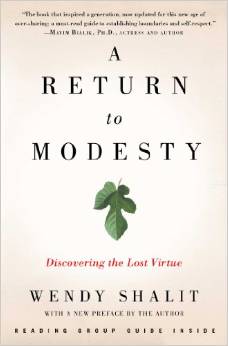
I mentioned a couple weeks ago that I recently read a book called A Return to Modesty: Discovering the Lost Virtue by Wendy Shalit. One of the first things she tackles in this book is the “polarized debate about sex,” particularly between the conservatives and the feminists.

She challenges conservatives to “take the claims of feminists seriously,” because you can dismiss however many studies and stories you like as “exaggeration” but the fact remains that “a lot of young women are very unhappy …. I want conservatives to really listen to these women, to stop saying boys will be boys, and to take what these women are saying seriously.”

To the feminists, Shalit writes, “I want to invite them to consider whether the cause of all this unhappiness might be something other than the patriarchy.” We’ve gotten rid of that just about as much as possible, and things have gotten worse rather than better. Perhaps men aren’t the enemy.

This book was published in 1999. That was almost 16 years ago, and we are still dealing with the exact same issues. On the one side, we see conservative Rush Limbaugh respond to a street harassment video by describing it as not a big deal because the men were just being polite. On the other side, there are still rants about patriarchy on Jezebel.com (language/content warning).

But just a little over two months ago Emma Watson, British actress and UN Women Goodwill Ambassador, gave a speech about feminism where her vision for gender equality sounded remarkably similar to ideas Wendy Shalit arrives at while defending the power of modesty. Are we starting to find common ground, and is there hope for a peaceful resolution to “the war between the sexes”?

A Trip to the 18th Century

It might seem odd to take a 3-century detour when talking about issues in modern culture. But when I started reading Francis Burney’s novels Cecelia (1782) and Camilla (1796) as part of an independent study my junior year of college, I was struck by how the gender issues facing those heroines were so remarkably like what women in my church regularly complain about. Where are the “real men?” we ask, looking around and seeing adult men who act like overgrown boys and have little interest in committing to marriage. We typically blame feminism, for telling boys that it was wrong to be “masculine” and to stop oppressing girls by taking care of them.

Portrait of Francis Burney by her relative Edward Burney

A contemporary of Burney, Mary Wollstonecraft wrote a book called A Vindication of the Rights of Women (1792), which is often considered one of the first feminist writings. When you actually read her book, however, it becomes clear that she is arguing for arguing for a reexamination, not a dismissal, of the traditional roles between men and women. She believes men and women are equal in God’s eyes, but that argument doesn’t mean they don’t both have distinct roles to fill.

Both these writers were responding to a moment called “sentimentality,” which encouraged men to indulge their emotions and abandon their traditional roles of protectors and providers. The result was something like what we see today — when men are no longer encouraged to protect or respect women, more and more women are victimized. That’s where we made our mistake, both in the 18th and the 20th/21st centuries. We thought men would treat women better if we told them to stop being manly, when in fact the opposite is true.

HeForShe

When Emma Watson introduced her talk about gender equality and the #HeForShe campaign, she first addressed issues people have with the word “feminism.”

the more I spoke about feminism, the more I realized that fighting for women’s rights has too often become synonymous with man-hating. If there is one thing I know for certain, it is that this has to stop. For the record, feminism by definition is the belief that men and women should have equal rights and opportunities. It is the theory of political, economic and social equality of the sexes.

One of the key points of Watson’s speech is that both men and women must be working together if we are ever to achieve a gender equality that benefits and protects both men and women.

How can we effect change in the world when only half of it is invited or feel welcome to participate in the conversation? Men, I would like to take this opportunity to extend your formal invitation. Gender equality is your issue, too. Because to date, I’ve seen my father’s role as a parent being valued less by society, despite my need of his presence as a child, as much as my mother’s. I’ve seen young men suffering from mental illness, unable to ask for help for fear it would make them less of a man. …

If men don’t have to be aggressive in order to be accepted, women won’t feel compelled to be submissive. If men don’t have to control, women won’t have to be controlled. Both men and women should feel free to be sensitive. Both men and women should feel free to be strong.

When we turn issues of gender into a “battle of the sexes” instead of a friendly discussion or a cause to work on together, both men and women lose the battle. You can’t build peaceful relations on a foundation of strife.

Courteous Men

Wendy Shalit discusses essentially the same issue, though she comes from the perspective of restoring part of the traditional gender roles (I suspect Burney and Wollstonecraft would both approve). Rather than pushing for an increasingly “nonsexist” approach to raising boys (in this example), she argues for “a good dose of sexist upbringing: how to relate as a man to a woman.”

Today we want to pretend there are no differences between the sexes …. We try to cure them of what is distinctive instead of cherishing these differences and directing them towards each other in a meaningful way. We can never succeed in curing men and women of being men and women, however, and so these differences emerge anyway — only when they do, the emerge in their crudest, most untutored form (p.153).

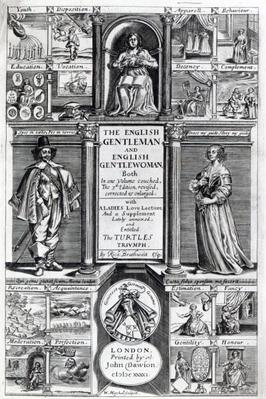
Frontispiece to ‘The English Gentleman and English Gentlewoman’ by Richard Braithwaite, 1641

She also goes back to a previous century to illustrate her arguments, all the way to 1630 and 1631 — the years Richard Brathwait’s The English Gentleman and The English Gentlewoman were published. Shalit’s reading of these texts is that  there was a “link between male obligation and female modesty” where men attained “perfection” by treating women with respect (p.99-102). In this century, men were not compelled to respect women by an outside authority — they were taught that this  was the only way for real men to behave.

The argument from external authority labels a man as evil if he date-rapes or sexually harasses a woman. From the standpoint of modesty, he is behaving abominably, but more crucially, he is really missing the whole point. He hasn’t understood what it means to be a man (p.104).

The feminists who see patriarchy as oppressive balk at this idea, but Shalit assures them, “I doubt that if men are taught to relate courteously to women, women would be suddenly thrown out of all the professions, as some contend. Maybe, on the contrary, it would be much easier for the sexes to work together.” Isn’t this, at its core, what Emma Watson’s brand of feminism is asking for? men and women who can work together toward common goals with mutual respect. Isn’t that something we all want?

Baby, It’s Cold Outside

You might have noticed a lack of blog post last Monday. I’d been planning to write something about a book I recently read called A Return to Modesty by Wendy Shalit, but came down with pneumonia. The only reason there were posts on the past two Saturdays is that they were already written (it seems like whenever a Bible study comes together really well so I have an extra Sabbath post ready “just in case,” something comes up that gives me a reason to use it).

It’s been nearly two weeks now and I still don’t feel fully recovered (much better, though!). So instead of a thoughtful book review, I want to talk to you about a song that’s been stuck in my head. Or rather, a specific version of the song.

You’re no doubt familiar with the song “Baby It’s Cold Outside.” You might even have heard Idina Menzel and Michael Bublé’s new cover already, but if you haven’t seen the video yet please take a few seconds to at least glance at it, since that’s a big part of what I want to talk about.

Apparently they’ve tried to turn this song into a cute family-friendly version for the holidays. If you close  your eyes, though, it still sounds like a man trying to seduce a woman. But then you open your eyes and see a cute little pre-adolescent kids acting out the roles. In the words of Jubal Early, does that seem right to you?

In the original score, written in 1944 by Frank Loesser, the two singing parts are called “wolf” and “mouse,” with a male voice usually singing “wolf” and a female voice usually singing “mouse” (thought not always — did you know Joseph Gordon Levit could sing?). Actually, it turns out we can talk about Wendy Shalit’s book after all, since she mentions “Baby, It’s Cold Outside” in her modesty book.

Now this song is very stereotypical because certainly not all men are hungry wolves and not all women reticent mice. Indeed, I’ve known quite a few hungry woman and mousey men. However, the simple fact remains that a young woman in 1948 had a hundred and one reasons to say no to sex, if she wanted to say no, and those reasons were credible. The story we are told today is that all these reasons, such as a father waiting up for you, were oppressive to women. And yet in their absense we can appreciate how an earlier generation of girls was made powerful by them. (A Return to Modestly, p.55)

If she’d seen this music video, though, I’m not sure Miss Shalit would have put her discussion of it under the heading “Girls Who Can’t Say No” as a contrast between today’s culture and that of 1948 (the year Loesser sold the rights to MGM). I think she might have moved the discussion to one of the many passages in her book where she talks how much we as a culture sexualize our children. For one thing, she draws a parallel between assigning sex-education classes to younger and younger students and increasing levels of student-on-student sexual violence in schools.

The associative link between the disenchanting of sex and increased sexual brutality among children works like this: if our children are raised to believe, in the words of the New Jersey kindergarten teacher, that talking about the most private things is “no different from talking about an elbow,” they they are that much more likely to see nothing wrong in a certain kind of sexual violence. (A Return to Modestly, p.19)

Now, I’m not saying this cute little music video is going to lead to increased levels of sexual assault among children. Rather, it bothers me as part of a trend that portrays young children in more and more sexualized ways. Most people I know would hope their 10- or 11-year-olds didn’t understand what’s going on in this song — they wouldn’t be encouraging them to sing it. And if this little boy was older, I’m not sure which interpretation of the song this performance would make me lean towards. Does “mouse” want to stay but feels she should leave, and “wolf” is persuading her to do what she wants? Or is “mouse” really trying to get away, and “wolf” is blocking her escape? Depends on how you sing the song, and how you feel about the line “What’s in this drink?” that was cut from the video, but not the version on Idina Menzel’s CD.

Am I over-thinking this? Perhaps. But it saddens me how many people think this is just a cute little video and don’t seem to see the potential implications of two children singing what is a rather adult song. Sure they’re adorable and talented, but was it a good idea for the adults who were in charge of creating this music video to use them like this? I really don’t think so.

Living With Style, Class, and Grace

Book cover: How to Be a Hepburn in a Hilton World: The Art of Living with Style, Class, and GraceI recently finished a delightful little book called How to Be a Hepburn in a Hilton World: The Art of Living with Style, Class, and Grass. It is written by a publicist for Warner Bros. Records named Jordan Christy. The basic idea behind the book is that in the years since Audrey Hepburn graced the silver screen, our culture has come to uphold standards of behavior that are simply unacceptable for smart girls to follow. This book sets out to show “modern ladies how they can be beautiful, intelligent, and fun while retaining values and morals.”

One of the most welcome things about this book is that it is not a Christian guide to modesty. I’m not saying those types of books can’t be helpful, but it was refreshing to find a book written for women who want to (or have to) work in a business setting instead of on an idylic homestead. It tells girls you can be modern as well as feminine, that you don’t have to wear ankle-length skirts to be modest, and that acting like a lady can be fun instead of restrictive. I think it would be a great book to give girls who feel like the commonly presented Christian ideals of womanhood are shutting them out (for the record, this does not include me, but does describe some of my close friends).

Just to be fair, there were some things I did not like about the book. In an effort (I assume) to keep the text relevant to modern readers, Christy uses many examples of actresses, characters, and reality shows. There were enough to become excessive (and I didn’t recognize most of them). Her writing style might also seem blunt and off-putting to some readers.

Best Quotes

Chapter 1: Keep Your Chin Up and Your Skirt Down

“If we want [guys’] undivided attention for a bout 2.4 seconds, we should keep wearing our glittery minis and doing the bend-and-snap. But if we want a real relationship with a real gentleman, we should just keep being our smart, classy, fabulous selves.” Or, for those who’ve never worn a mini skirt in their lives, don’t be tempted to compromise.

Chapter 2: Words, Words, Words

This chapter advised reading and increasing our vocabularies so we can become better conversationalists. She also covers knowing when to speak and when to keep silent, quoting George Eliot: “Blessed is the man who, having nothing to say, abstains from giving us wordy evidence of the fact.”

Chapter 3: Use Some Elbow Grease

“Unfortunately, that hard-work-doesn’t-hurt mentality appears to be in short supply these days. Why? It’s become painfully clear that our society just doesn’t support a sincere work ethic anymore.” Be that as it may, if you want to be a classy, respectable young woman, you have to be willing to work.

Chapter 4: Choose Your Friends Wisely

We need to find friends “who will help us kick our own vices, not just drag us down in the mire with them and theirs. If we’re struggling with self-image and potential eating-disorder thoughts … we need to find ourselves some normal, curvy friends who will take us to counseling and won’t care if we’re a size 2 or a 10.”

Chapter 5: Let Him Come Calling

“Regardless of the guy’s current status, bank account, background, or beliefs, if he’s interested, he will do the pursuing. There’s no need to interfere with the ways of nature! Doing so will only scare him off.” This is one chapter I had a little disagreement with. She doesn’t allow for anything in between completely-ignore-the-guy and obnoxiously-pester-him-with-text-messages-every-few-hours. If you’re already friends, shouldn’t you be allowed to Facebook or e-mail him once in a while to keep in touch?

Chapter 6: Dress to Impress

Two quotes this time: “While it may seem frivolous to some, our personal style does more talking than we ever could about ourselves — and we want to make sure it’s saying nice things!” “While it can be tempting to want to keep up with the current inseam trends, the respect we’ll receive from not exposing our chest region and upper thighs is worth so much more than the five-seconds stares we’d get from a bunch of ogling buffoons.”

Chapter 7: Less Is More

“Our society is undoubtedly of the flashier/louder/faster/stronger mentality, and for some reason makeup tends to fall into the same category, but it really should be placed indefinitely in the less-is-more category. … We need to realize makeup is a simply something to enhance certain features — not a daily necessity that needs to be applied from sunup to sundown.”

Chapter 8: Have Your Cake and Eat It Too

“You can healthfully and happily maintain your weight without taking any weird voodoo pills or sprinting a marathon on the treadmill every week. You simply need to find a steady balance between those leafy greens and that Sprinkles cupcake. Let’s become the new poster children for happy, healthy young women.”