Faith As A Fruit

Faith is a huge topic in the Bible, one that whole books have been written about (I reviewed one of those books just last year). Today, I want to look at faith specifically from the perspective of the fruit of the spirit passage in Galatians. In other words, we’re examining faith as something that’s produced in your life when God’s spirit is inside of you.

But the fruit of the Spirit is love, joy, peace, patience, kindness, goodness, faithfulness, gentleness, and self-control. Against such things there is no law.

Galatians 5:22-23, NET

Last week, I mentioned that I realized I’d never finished my 30-Day Scripture Writing series on the fruit of the spirit. The last two remaining topics are “faith” and “gentleness,” so today we’re focusing on faith. I spent this past week reading through the many Bible verses mentioning faith as well as belief (since they’re such closely related words) and looking into the Greek and Hebrew words behind the English translations. My initial “short list” as I started narrowing down which scriptures to include was 78 passages, which gives you an idea just how many verses on faith there are in the Bible. I did eventually get it down to 30 (you’ll find a link to the finished scripture-writing plan at the end of this post).

Faith and Truth

In the Old Testament, you’ll find the word “faithfulness” more often than “faith.” Usually, it’s talking about God’s faithfulness (Deut. 7:9; Ps. 33:4; 89:1; Is. 25:1; Lam 3:23) or humanity’s faithfulness or unfaithfulness to Him (2 Chr. 29:6; 31:20; Hos. 4:12). In these scriptures, “faith” as a concept takes a backseat to the idea of living a faithful life. It’s clear that faith involves action; a change in your entire way of life because of being in a covenant relationship with God.

You are Yahweh, the God who chose Abram, brought him out of Ur of the Chaldees, gave him the name of Abraham, found his heart faithful before you, and made a covenant with him … for you are righteous.

Nehemiah 9:7-8 , WEB

In Hebrew, the word “faith” is typically translated from the root word aman (H539) or one of several other words in this word family (e.g. amen, emuna, emet) (Theological Wordbook of the Old Testament [TWOT], entry 116). Interestingly, this is the same group of words for “truth.” At it’s most fundamental, the “root idea is firmness or certainty” and it “shows that biblical faith is an assurance, a certainty, in contrast with modern concepts of faith as something possible, hopefully true, but not certain” (TWOT 116). It’s something that’s absolutely dependable; something that gives you stability.

Know therefore that Yahweh your God himself is God, the faithful God, who keeps covenant and loving kindness with them who love him and keep his commandments to a thousand generations

Deuteronomy 7:9, WEB

We can rely on our faithful God. This fact is emphasized over and over in scriptures, particularly in the Old Testament. But God also wants to be able to rely on us to act faithfully. It’s a commitment that is supposed to go both ways, as it did with Abraham, David, and Hezekiah (Neh. 9:7-8; 1 Kings 3:6; 2 Chr. 31:20).

Image of four people sitting around a table with their Bibles open overlaid with text from Ps. 101:6, WEB version: "My eyes will be on the faithful of the land, that they may dwell with me. He who walks in a perfect way, he will serve me."
Image by Ben White from Lightstock

A Thing and an Action

Faith in the New Testament also involves action and devotion, but it’s a little harder for us to see that in our modern translations. In Greek, “faith” is translated from the noun pistis (G4102), which implies active loyalty and trust. The verb form pisteuo (G4100) is often translated “believe.” Now, that makes things a bit confusing because in English faith and belief aren’t quite the same. The top definition for “faith” provided by Google and Oxford Languages is “complete trust or confidence in someone or something.” For “believe,” the top definition is “accept (something) as true; feel sure of the truth of” and it’s also become synonymous with “think” or “suppose.” So there are overlaps in the definitions, but they don’t have the same connotations.

As I talked about in my newsletter earlier this week, there isn’t a verb (action) form of “faith” in English–it’s always a noun (person, place, or thing)–so translators had to use a different word to translate the action-form of “faith.” We need to keep that in mind when we’re reading the New Testament. When we read “believe” it’s not just an intellectual agreement or an emotional feeling that something is true; it is faith in action. Even when Bible writers use the noun form, they still describe faith as something that you’re supposed to do, not just have.

Woe to you, scribes and Pharisees, hypocrites! For you tithe mint, dill, and cumin, and have left undone the weightier matters of the law: justice, mercy, and faith. But you ought to have done these, and not to have left the other undone. 

Matthew 23:23, WEB

We can’t leave faith “undone.” It’s an active thing. When we read that Jesus came preaching, “The time is fulfilled, and God’s Kingdom is at hand! Repent, and believe in the Good News” (Mark 1:15, WEB), “believe” is a command to engage in the activity of faith.

 Believe me that I am in the Father, and the Father in me; or else believe me for the very works’ sake. Most certainly I tell you, he who believes in me, the works that I do, he will do also; and he will do greater works than these, because I am going to my Father.

John 14:11-12, WEB

We often think of faith as separated from works in modern Christianity, thinking of verses like Paul saying Abraham was justified by faith rather than his works (Rom. 3:27-4:21) while ignoring James using the exact same example to show that faith without works is dead (Jam. 2:14-26). Faith is absolutely connected to works–a faithful life naturally produces certain fruit. (Paul’s point is that salvation is not dependent on works, but on the faithfulness of Jesus and our active belief in Him.)

Image of a woman looking up at the sky overlaid with text from Jude 1:20-22, WEB version: "But you, dear friends, by building yourselves up in your most holy faith, by praying in the Holy Spirit, maintain yourselves in the love of God, while anticipating the mercy of our Lord Jesus Christ that brings eternal life."
Image by Brightside Creative from Lightstock

Cultivating Active Faith

So what does faith do? In other words, if you have faith, what does it look like to turn that into action? For one thing, it leads to growth as a Christian.

For this reason I kneel before the Father, from whom every family in heaven and on earth is named.  I pray that according to the wealth of his glory he will grant you to be strengthened with power through his Spirit in the inner person, that Christ will dwell in your hearts through faith, so that, because you have been rooted and grounded in love, you will be able to comprehend with all the saints what is the breadth and length and height and depth, and thus to know the love of Christ that surpasses knowledge, so that you will be filled up to all the fullness of God.

Ephesians 3:14-19, NET

Remember, we’re talking about “faith” in the context of the fruit of the spirit. Here in Ephesians, Paul prayed for those in the church that they would be “strengthened with power through His spirit” so “that Christ will dwell in your hearts through faith.” God’s spirit inside us enables Christ to dwell in us through faith, and then that leads to major spiritual growth. One result of this growth is that faith shifts our mindset about things.

Jesus answered them, “Have faith in God. For most certainly I tell you, whoever may tell this mountain, ‘Be taken up and cast into the sea,’ and doesn’t doubt in his heart, but believes that what he says is happening; he shall have whatever he says. Therefore I tell you, all things whatever you pray and ask for, believe that you have received them, and you shall have them.”

Mark 11:22-24 , WEB

This verse isn’t just about literally picking up mountains (though it certainly isn’t the only verse about faith/believing having tangible effects in the world [Mark 16:15-18; John 14:11-12]). It’s also about actually trusting that God responds when you talk with Him (John 16:24-27). To put it in Old Testament terms, faith on your part means actually trusting that God is faithful to His part of the covenant relationship.

But my righteous one will live by faith, and if he shrinks back, I take no pleasure in him. But we are not among those who shrink back and thus perish, but are among those who have faith and preserve their souls. Now faith is being sure of what we hope for, being convinced of what we do not see.  …

Now without faith it is impossible to please him, for the one who approaches God must believe that he exists and that he rewards those who seek him.

Hebrews 10:38-11:1, 11:6, NET (bold italics mark a quotation from Hab 2:4).

We can’t function as Christians without faith. And we need to make a conscious effort to cultivate that faith in our lives. We need to hold onto faith (1 Tim. 1:18-19), pursue it (1 Tim. 6:11-12; 2 Tim. 2:22), fight for the faith (Jude 1:3; 2 Tim. 4:7-8), and build up our faith (Jude 1:20; Col. 2:6-7). Like the other character traits and inner attitudes described as “fruit of the spirit,” faith isn’t just something we have passively but something we actively cultivate as God works in and with us.

Acting On Faith

Many people today think that faith in God means simply believing that He exists. But in biblical terms, that head knowledge only turns into faith when we act on it. If it’s just an intellectual acknowledgement of God’s existence and power, then it’s not any more “faith” than the sort of belief in God that demons have.

What good is it, my brothers and sisters, if someone claims to have faith but does not have works? Can this kind of faith save him? If a brother or sister is poorly clothed and lacks daily food, and one of you says to them, “Go in peace, keep warm and eat well,” but you do not give them what the body needs, what good is it? So also faith, if it does not have works, is dead being by itself. But someone will say, “You have faith and I have works.” Show me your faith without works and I will show you faith by my works. You believe that God is one; well and good. Even the demons believe that—and tremble with fear.

James 2:14-19, NET

We need to be cautious about counterfeit versions of faith or things that tempt us to fall away from the faith. About 2,000 years ago, Paul warned Timothy, “Now the Spirit explicitly says that in the later times some will desert the faith and occupy themselves with deceiving spirits and demonic teachings, influenced by the hypocrisy of liars whose consciences are seared” (1 Tim. 4:1-2, NET). That’s no less true today than it was then. Somewhat ironically, navigating a world where people desert the faith and try to lure God’s people away from living faithful lives is one of the trials that can strengthen our faith (James 1:2-3).

… you may have to suffer for a short time in various trials. Such trials show the proven character of your faith, which is much more valuable than gold—gold that is tested by fire, even though it is passing away—and will bring praise and glory and honor when Jesus Christ is revealed. You have not seen him, but you love him. You do not see him now but you believe in him, and so you rejoice with an indescribable and glorious joy, because you are attaining the goal of your faith—the salvation of your souls.

1 Peter 1:6-9, NET

Here, Peter reminds us that the end goal of faith is salvation. It’s not a one-time thing where we have a moment of faith, say we love Jesus, and then salvation happens right there. It’s a life-long process. When we enter a relationship with God, we’re making a covenant with Him that includes an agreement to be faithful to Him for the rest of our lives and on into eternal life (Acts 2:38; Rom. 10:10; Phil. 3:8-15) (and, on His part, He agrees to faithfully grant us forgiveness and salvation, share His spirit with us, and enable us to become like Him).

With God’s spirit inside us, faith reshapes our lives. It becomes a central aspect of us and something that we actively do as well as believe. Living in faith involves what we think, the way we conceptualize the world, how we respond to other people, the choices we make every day, and all of our actions. If you’d like to spend more time on this topic, follow this link to download any of my free 30-day scripture writing plans or click here to download the “faith” PDF directly:


Featured image by diapicard from Pixabay

Always Love, Never Compromise: Relating To Those Outside Your Faith

Our society idolizes tolerance. We’re “supposed” to understand the other’s point of view, support them in living however they want, and admit they’re no less “right” than we are. From a Christian’s perspective, though, today’s ideas of tolerance look more like an attack on objective morality. People who disagree with you don’t just want you to tolerate them; they want you to agree with them. And in many cases they’re not willing to extend even tolerance back to you, much less agreement.

There are two extreme reactions Christians might have when faced with a society like ours: 1) go along with society or 2) start attacking people we don’t agree with. But neither of those options is the best one. Better to ask, “Does the Bible offer any guidelines for Christians navigating such as society?” People of God have always had to interact with people outside their faith, and scripture does provide guidelines for how we can approach such relationships.Always Love, Never Compromise: Relating To Those Outside Your Faith | marissabaker.wordpress.com

Don’t Judge People

This first guideline has nothing to do with accepting the wrong things we see ungodly people doing. We can make moral decisions about another person’s actions (e.g. discern between right and wrong) and in the appropriate context tell them they’re not lining up with God’s law (e.g. preach the gospel and call for repentance). But to pronounce a sentence on someone and condemn them is not our right.

For what is it to me to judge those outside? Should you not judge those inside? But those outside God will judge. Remove the evil person from among yourselves (1 Cor. 5:12-13, LEB)

In the verses leading up to these, Paul has been talking about the need for Christians to exercise sound judgement within the church. He’s giving them a directive to put out of the church people who say they follow God yet flagrantly and unrepentantly practice sin. In contrast to that, he tells us it’s not our responsibility to do the same to people outside the church. We can’t condemn non-Christians for not acting like Christians. God’s the one who gets final say on their lives.

Read more

Animating Your Faith

There’s a statement in James that we’re all familiar with: “faith without works is dead.” While we can all agree James makes this statement, we don’t always agree on what it means. Citing other scriptures that say we’re justified by faith without works, some argue that a faithful Christian isn’t obligated to do things like obey God’s law or perform good deeds.

But “faith without works is dead” isn’t a statement James makes casually. It’s part of a larger teaching he’s sharing and it’s also part of an analogy that goes like this: “For just as the body without the spirit is dead, so also faith without works is dead (James 2:26, LEB).

In this analogy, faith is like our bodies and works are like our spirits. James is telling us that works give life to our faith in the same way the spirit in man gives life to our bodies. This is in response to a rhetorical question he asked earlier in the epistle: “Can we be saved by faith without works?” The answer he gives is “no.”click to read article, "Animating Your Faith" | marissabaker.wordpress.com

Believing Isn’t Enough

Faith is essential. It’s impossible to please God without faith, “for he that cometh to God must believe that He is, and that He is a rewarder of them that diligently seek Him” (Heb. 11:6, KJV). But it’s not the only thing God is looking for in His people. Read more

Replacing Worry (Lessons from Zephaniah)

We live in the midst of a dangerous, confusing world, and it’s getting worse as we move ever closer to the time of Christ’s return.

And you will hear of wars and rumors of wars. See that you are not troubled; for all these things must come to pass, but the end is not yet. For nation will rise against nation, and kingdom against kingdom. And there will be famines, pestilences, and earthquakes in various places. All these are the beginning of sorrows. (Matt. 24:6-8)

Our first instinct when things get bad is to worry and panic. This is precisely what we’re told not to do. Easier said than done, though, isn’t it? Worry’s not something you can just turn off — you have to replace it with something else.

No Reason for Fear

Zephaniah prophesied during the reign of King Josiah, so things were going pretty well at the time for the nation of Judah. Even so, he warned about a time much like our own when things would start looking pretty bleak for God’s people. In the midst of these dark prophecies, though, Zephaniah’s book gives great reason for not giving in to fear.

In that day it shall be said to Jerusalem: “Do not fear; Zion, let not your hands be weak. The Lord your God in your midst, the Mighty One, will save; He will rejoice over you with gladness, He will quiet you with His love, He will rejoice over you with singing.”(Zeph. 3:16-17)

Replacing Worry | marissabaker.wordpress.comGod doesn’t just tell us not to have fear. He gives us assurances designed to make fear impossible. “Fear not” because God Himself is with you to save you. “Fear not” because of His steadfast love, which Paul says nothing can separate us from (Rom. 8:35-39). “Fear not” because the Lord delights in you (Deut. 10:15; Is. 62:4).

He Himself has said, “I will never leave you nor forsake you.” So we may boldly say: “The Lord is my helper; I will not fear. What can man do to me?” (Heb. 13:5-6)

I still struggle with removing fear on a practical level, but abstractly I know fear simply doesn’t make sense for a Christian. The God who created the universe personally guarantees that He won’t abandon you. I always find things I’m scared of less frightening if there’s a good friend beside me, and what better friend could we have to cling to for assurance and stability in times of fear than God Himself?

Live By Faith

We replace worry with faith by consistently turning to God.

Seek the Lord, all you meek of the earth, who have upheld His justice. Seek righteousness, seek humility. It may be that you will be hidden in the day of the Lord’s anger. (Zeph. 2:3)

Seeking after God and consistently following His commands is the best way to get close to Him, which is the best place to be in times of trouble. No matter what happens, our focus must stay on God as we live by faith.

Therefore you also be ready, for the Son of Man is coming at an hour you do not expect. (Matt. 24:44)

Living without fear doesn’t involve burying our heads in the sand and ignoring things that might make us afraid. Rather, it involves a watchful readiness while living in the faith and confidence of our Messiah.

Who then is a faithful and wise servant, whom his master made ruler over his household, to give them food in due season? Blessed is that servant whom his master, when he comes, will find so doing. (Matt. 24:45-46)

Replacing Worry | marissabaker.wordpress.comWhen we stand before Christ at the end of this earth or the end of our lives — whichever comes first — we want to be found “so doing.” Consistent growth and faithfulness will be rewarded.

But what if you’re lacking in faith, and still suffering from worry? Ask God for help. He won’t turn down a sincere plea for help, even if it’s help with our unbelief.

 But let him ask in faith, with no doubting, for he who doubts is like a wave of the sea driven and tossed by the wind. For let not that man suppose that he will receive anything from the Lord; he is a double-minded man, unstable in all his ways. (James 1:6-8)

Brethren, let us pray for stability in our walk with God — to be grounded so firmly on the Rock of Jesus Christ that we won’t be tossed about with fear. Wavering and worry go hand-in-hand, and we need God’s help to overcome that and “continue in the faith, grounded and steadfast” (Col. 1:23).

Much Too High A Price

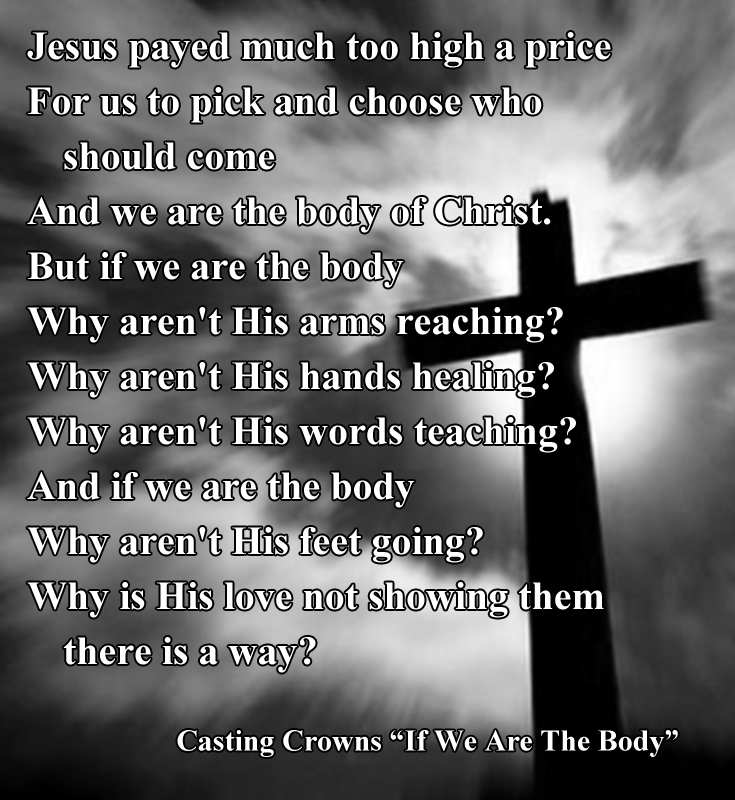
I wrote last week about questions the church can ask herself regarding our role as the body of Christ. Like the Casting Crowns song “If We Are The Body,” it was meant as a challenge for the church as a whole to reach out with compassion, heal others, teach Jesus Christ’s words, walk in His steps, and love everyone. The reason for this is mentioned in the line which provides me with a title: “Jesus payed much too high a price / For us to pick and choose who should come / And we are the body of Christ.”

What Price?

Christ said, “I am the good shepherd. The good shepherd gives His life for the sheep” (John 10:11). That, in a nutshell, is the price paid. He willingly gave up first His eternal existence with the Father and then His human life to be a sacrifice for sins (John 1:1-2, 14). A more complete picture of what this entailed can be found in Isaiah 52:13-53:12. Here’s a few verses:

He is despised and rejected by men, a Man of sorrows and acquainted with grief. And we hid, as it were, our faces from Him; He was despised, and we did not esteem Him. Surely He has borne our griefs and carried our sorrows; yet we esteemed Him stricken, smitten by God, and afflicted. But He was wounded for our transgressions, He was bruised for our iniquities; the chastisement for our peace was upon Him, and by His stripes we are healed. (Is. 53:3-5)

I have a hard time thinking of what to write after this. It’s so deeply moving to think of how much He suffered for my sake, and for your sake, and for the entire world (John 1:29; 4:42; 6:33; 12:47).

For God so loved the world that He gave His only begotten Son, that whoever believes in Him should not perish but have everlasting life. For God did not send His Son into the world to condemn the world, but that the world through Him might be saved. (John 3:16-17)

I find it interesting that John 3:16-17 doesn’t say that Christ died to save the church — it says He died for the entire world. The goal is to save as many people as possible (2 Pet. 3:9).

Paid For Whom?

No one can come to Christ unless the Father draws them (John 6:44), and once that happens “he who believes in the Son has everlasting life” (John 3:36). If someone shows up at church with that one requirement — belief in Jesus Christ — then we have no right to turn them away. Their belief is a sign that God is working with them. Look how strongly Christ rebuked His disciples when they thought certain people were not worth His time:

Then they brought little children to Him, that He might touch them; but the disciples rebuked those who brought them. But when Jesus saw it, He was greatly displeased and said to them, “Let the little children come to Me, and do not forbid them; for of such is the kingdom of God. Assuredly, I say to you, whoever does not receive the kingdom of God as a little child will by no means enter it.” (Mark 10:13-15)

"Much Too High A Price." marissabaker.wordpress.comIn Matthew, Jesus further said, “Whoever receives one little child like this in My name receives Me. Whoever causes one of these little ones who believe in Me to sin, it would be better for him if a millstone were hung around his neck, and he were drowned in the depth of the sea” (Matt. 18:5-6) Since we are all God’s children, whatever age we are, I think it safe to extend what Christ says concerning His little ones to every new believer. James 2 talks about not showing partiality, or respecting people based on how much money they have. This principle can be extended to other factors as well. Take the example of “strangers” who joined Israel in the Old Testament.

“Also the sons of the foreigner who join themselves to the Lord, to serve Him, and to love the name of the Lord, to be His servants — everyone who keeps from defiling the Sabbath, and holds fast My covenant — even them I will bring to My holy mountain, and make them joyful in My house of prayer. Their burnt offerings and their sacrifices will be accepted on My altar; for My house shall be called a house of prayer for all nations.” The Lord God, who gathers the outcasts of Israel, says, “Yet I will gather to him others besides those who are gathered to him.” (Is. 56:6-8)

In our modern churches of God, a similar situation might be new people coming into the church without a Worldwide background and no clue who Mr. Armstrong was. Or maybe people in other groups that we not-so-secretly wonder if they are really part of the body. It is not our place to make judgements about who is and who is not part of Christ’s body and living in His sheepfold (John 10:16). If someone believes in Him, we should welcome them with open arms. If they keep His Sabbaths and enter into covenant with Him, like the strangers in Israel, we must not dismiss them.

Then Peter opened his mouth and said: “In truth I perceive that God shows no partiality. But in every nation whoever fears Him and works righteousness is accepted by Him.” (Acts 10:34-35)

This statement should disabuse us of any notion that people of a certain social class or church background or ethnic group are in some way better or worse than others. The Pharisees had that idea — “We have Abraham as our father” — and John the Baptist told them they were a “brood of vipers” and “that God is able to raise up children to Abraham from these stones” on the ground near the river. Their background did not matter, only that they repent and “bear fruits worthy of repentance” (Matt. 3:7-9).

What Should We Do?

"Much Too High A Price." marissabaker.wordpress.comThe Father and Jesus want to save every single person who will let them. Are we helping them in that goal as members of the body of Christ? Or are people “tripping over me” when they try to reach God (Rom. 14:13)? We are so quick to take and cause offense, to indigently puff up and bluster at people over even trivial things like music selection, whether or not to worship with hands raised, and are jeans appropriate for church services. But look at Paul’s attitude:

Give no offense, either to the Jews or to the Greeks or to the church of God, just as I also please all men in all things, not seeking my own profit, but the profit of many, that they may be saved. (1 Cor. 10:32-33)

How much less strife would there be within the church and in our interactions with those who do not yet believe if this were our attitude!

Let each of us please his neighbor for his good, leading to edification. For even Christ did not please Himself; but as it is written, “The reproaches of those who reproached You fell on Me.” (Rom. 15:2-3)

When we set aside our selfishness and look after other people before ourselves, we are following in Christ’s footsteps. When we are becoming like the “head over all things to the church,” we truly begin acting like the body of Christ (Eph. 1:22-23). We are supposed to imitate God and “walk in love, as Christ also has loved us and given Himself for us, an offering and a sacrifice to God for a sweet-smelling aroma” (Eph. 5:2). In the night He was betrayed, Jesus said, “This is My commandment, that you love one another as I have loved you” (John 15:12). Lest we think this statement is ambiguous, John spells it out clearly in his first epistle: “By this we know love, because He laid down His life for us. And we also ought to lay down our lives for the brethren” (1 John 3:16). Still, we might try to find some wiggle-room in this command. It only says to love the brethren — I don’t have to love all those other people, right? Wrong.

But I say to you, love your enemies, bless those who curse you, do good to those who hate you, and pray for those who spitefully use you and persecute you, that you may be sons of your Father in heaven; for He makes His sun rise on the evil and on the good, and sends rain on the just and on the unjust. For if you love those who love you, what reward have you? Do not even the tax collectors do the same? And if you greet your brethren only, what do you do more than others? Do not even the tax collectors do so? Therefore you shall be perfect, just as your Father in heaven is perfect. (Matt. 5:44-48)

Well there it is — not a smidgin of wiggle-room left. We have to love everyone the way God loves them and the way He loves us. Jesus paid the highest price ever paid so that the world could be saved. He is not going to look kindly on our actions if we try to pick and choose who is worth our love and who we should “let in” to His body. That’s not our call.

"Much Too High A Price." marissabaker.wordpress.com

“Daddy, give me sixpence”

marissabaker.wordpress.comWe had evening services yesterday, so there was a whole free day to fill with activities. My plan was to find all the book stores in the area and visit each, but we ended up at two antique stores and a mall instead. There was, however, a used book store in the mall, so I have one of the bookstores here checked off my list. I was particularly glad we stopped because I finally found a copy of C.S. Lewis’s Mere Christianity in hardcover for less than Amazon.com sells the paperback.

Some time ago, I signed up for an e-newsletter through biblegateway.com that sends a C.S. Lewis quote every day. This morning, it was a quote from Mere Christianity. It’s long, but I’d like to share it with you, if you don’t mind.

As a great Christian writer (George MacDonald) pointed out, every father is pleased at the baby’s first attempt to walk: no father would be satisfied with anything less than a firm, free, manly walk in a grown-up son. In the same way, he said, “God is easy to please, but hard to satisfy.”

I think every one who has some vague belief in God, until he becomes a Christian, has the idea of an exam or of a bargain in his mind. The first result of real Christianity is to blow that idea into bits. When they find it blown into bits, some people think this means that Christianity is a failure and give up. They seem to imagine that God is very simple-minded! In fact, of course, He knows all about this. One of the very things Christianity was designed to do was to blow this idea to bits. God has been waiting for the moment at which you discover that there is no question of earning a pass mark in this exam or putting Him in your debt.

Then comes another discovery. Every faculty you have, your power of thinking or of moving your limbs from moment to moment, is given you by God. If you devoted every moment of your whole life exclusively to His service you could not give Him anything that was not in a sense His own already. So that when we talk of a man doing anything for God or giving anything to God, I will tell you what it is really like. It is like a small child going to his father and saying, “Daddy, give me sixpence to buy you a birthday present.” Of course, the father does, and he is pleased with the child’s present. It is all very nice and proper, but only an idiot would think that the father is sixpence to the good on the transaction. When a man has made these two discoveries God can really get to work. It is after this that real life begins.

I think this is a great way to look at our relationship with God as His children. There’s not a thing we can do to earn salvation on our own. The second paragraph in this quote is saying basically the same thing Paul says when he writes, “For by grace you have been saved through faith, and that not of yourselves; it is the gift of God,not of works, lest anyone should boast” (Eph. 2:8-9). Every good thing in our lives is a gift directly from God. All that is good in us is a result of His work in our lives. We bring nothing to our relationship with God but our broken selves, desperately in need of Him to make us whole.

Such a realization is important because we cannot have a relationship with God without humility, and we cannot have humility if we think we are doing God a favor by agreeing to be part of His family. God’s family will be made up of people who know they have nothing to offer God and are wild with joy that He wanted to work with them anyway.