Is there anything we have to do in order to be a Christian? Some will tell you the answer is “no” — that salvation is a free gift and once you accept it you’re a Christian and there’s nothing else you need to do. Others will say “yes” — that you’re not a Christian unless you keep God’s commandments and follow Jesus Christ.
The truth is that God offers salvation freely, but you have to accept the gift on God’s terms. Those terms are called covenants — agreements that involve two parties binding themselves together with oaths. On the spiritual level, God initiates covenants, establishes the terms and promises, and binds Himself to the covenant oaths. These covenants are unfailing and sure, regardless of human action. We can choose whether or not to walk in covenant with God, but the covenant, and associated consequences for sin, stand whichever you decide.
Choose Covenant
“I make this covenant and this oath, not with you alone, but with him who stands here with us today before the Lord our God, as well as with him who is not here with us today,” Moses recorded in Deuteronomy 29:14-15. Not entering into covenant with God does not mean you’re getting out of consequences for sin — it means you’re choosing a path of death (Deut. 29:18-28). Read more →
All the holy days point to Jesus Christ, often in multiple ways. For the soon-approaching Pentecost — the Feast of Firstfruits — Jesus is Himself “the firstfruits of those who have fallen asleep” because He was the first of God’s people to raise from the dead to eternal life (1 Cor. 15:20-23). He’s also the one who redeemed us, making it possible for us to be firstfruits, and He’s the reason we receive the Holy Spirit, which was first given to the New Testament church on Pentecost (John 14:26; 16:7).
On the surface, the term “firstfruits” simply refers to the first agricultural produce of the harvest season. In the Hebrew scriptures, firstfruits were offered to God before you harvested anything for yourself. This offering occurred after Passover on a Sunday morning and kicked-off the 50-day count to Pentecost (Lev. 23:1-21).
Pentecost, also called the Feast of Weeks or Feast of Harvest, pays a key role in God’s plan. Even churches that no longer keep the other holy days often mark Pentecost because that’s when the Holy Spirit was given to the New Testament church (Acts 2:1-4). In Leviticus 23, instructions about the wave-sheaf, 50-day count, and Pentecost occupy more than 1/3 of the entire chapter. Clearly, there’s something here we’re supposed to take careful note of.
Gleanings and Ruth
Embedded in the holy days discussion of Leviticus 23 is a peculiar verse. It doesn’t seem related to the chapter’s subject, yet it follows immediately after the instructions about Pentecost.
When you reap the harvest of your land, you shall not wholly reap the corners of your field when you reap, nor shall you gather any gleaning from your harvest. You shall leave them for the poor and for the stranger: I am the Lord your God. (Lev. 23:22)
Why would God put this law in place while discussing the holy days? It doesn’t seem to make sense. It does, however, connect Pentecost with the story of Ruth. In Jewish tradition, Ruth is read every Pentecost, and perhaps that’s a clue as to why the law of gleanings is discussed here.
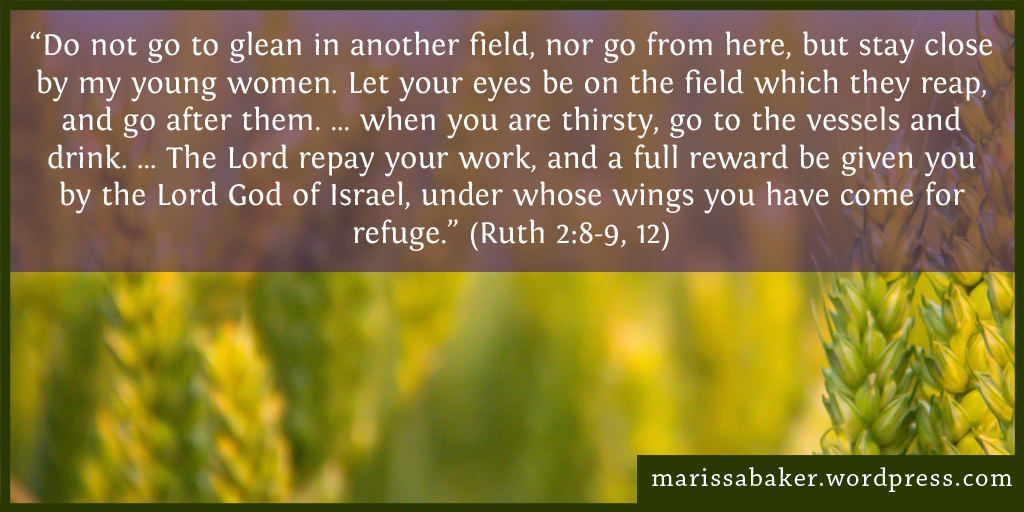
When Ruth and Naomi arrived in Bethlehem they’re both poor and Ruth was a “stranger,” a Moabitess instead of an Israelite. She more than qualified for gleaning under the law given in Leviticus, as well as the repetition in Deuteronomy 24:19 which added the “fatherless” and the “widow” to the list of those who could glean.
Instead of just letting Ruth glean, Boaz offered her protection (Ruth 2:9), provided food for her (2:14), and told his reapers to drop grain on purpose so she could glean as much as she wanted (2:15-16). When she first meets Boaz, Ruth’s relation to him is strikingly similar to us when first encountering Christ. He is good, and wealthy, and powerful while we have nothing. We don’t deserve anything from Him, and yet He offers us blessings beyond expectation.
When Jesus died, He opened up the covenants to non-Israelites. Prior to accepting His sacrifice, we were all “strangers from the covenants of promise, having no hope and without God in the world” (Eph. 2:12). We were the sort of people who couldn’t expect more than the gleanings.
But He answered [the Gentile woman] and said, “It is not good to take the children’s bread and throw it to the little dogs.” And she said, “Yes, Lord, yet even the little dogs eat the crumbs which fall from their masters’ table.” (Matt. 15:26-27)
Jesus did honor this woman’s faith and heal her daughter (Matt. 15:21-28), but by-and-large people outside Israel didn’t have access to God before the cross. Strangers who converted, like Ruth (Ruth 1:16; 2:12), were the exception rather than the rule. That didn’t really happen until after Christ’s Passover sacrifice, His ascension to the Father on wave-sheaf Sunday (click here for a timeline), and the Pentecost recorded in Acts 2.
Then Peter said to them, “Repent, and let every one of you be baptized in the name of Jesus Christ for the remission of sins; and you shall receive the gift of the Holy Spirit. For the promise is to you and to your children, and to all who are afar off, as many as the Lord our God will call.” (Acts 2:38-39)
Peter didn’t realize this included Gentiles until latter (Acts 10:34-35, 44-48; 11:18), but speaking by inspiration of the Spirit He still proclaimed salvation for all whom God calls. This was a huge step in God’s plan to save the world through Jesus Christ (John 3:16; 12:47), and it’s connected with Pentecost.
Redeemed Firstfruits
In the epistle of James, we’re told the Father “brought us forth by the word of truth, that we might be a kind of firstfruits of His creatures” (James 1:18). The church is composed of the first people God will “harvest” from the world. We’re a rather unusual sort of firstfruits, though.
For you see your calling, brethren, that not many wise according to the flesh, not many mighty, not many noble, are called. But God has chosen the foolish things of the world to put to shame the wise, and God has chosen the weak things of the world to put to shame the things which are mighty; and the base things of the world and the things which are despised God has chosen, and the things which are not, to bring to nothing the things that are, that no flesh should glory in His presence. (1 Cor. 1:26-29)
God picks us up from the things devalued and discarded by the world. In other words, He finds His firstfruits among the gleanings. He’s taking people who are underwhelming and overlooked and transforming us into something glorious. Like Ruth, we were strangers who are brought into fellowship with God’s people by a Redeemer (Ruth 2:20; Tit. 2:13-14).
My renewed interest in studying covenants started with a Greek dictionary. Typically, I would define covenant as “a binding agreement between two parties,” which is a very basic description of the Hebrew word berith (H1285). For the New Testament, though, Spiros Zodhiates says diatheke (G1242) refers to “the disposition which a person makes of his property in prospect of death, i.e. his testament” and shows “a unilateral demonstration of the will of the testator.”
I’ve always been confused by the discussion about testaments in the book of Hebrews because it didn’t all line-up with my idea of covenants. Do we enter covenant with God as a mutual agreement, or are we benefactors of God’s unilateral will (whether we want it or not)? And how, exactly, do we become partakers of this covenant? After 3 weeks of study, I realized the answer is a little bit of both and that clarity for this question is found in Jesus Christ (that should have been obvious, right?) Read more →
I thought I had a pretty good grasp of covenants. Studying this subject for the past three weeks, though, has taught me the truth of Paul’s words: “if anyone thinks that he knows anything, he knows nothing yet as he ought to know” (1 Cor. 8:2). Covenants are so much deeper, so much more entwined with the plan of God than I’d previously realized. And so I went back to the beginning to review covenants (today’s post) before diving deeper into the subject (next weeks’ posts).
The relationships God establishes are consistently described through scripture as covenants, so to understand how God relates to people we have to study the principles of godly covenants. Hebraic understanding of covenants in the Old Testament forms the basis for understanding what a covenant between God and man involves. We need to understand that before we can even begin to get into the New Testament because Christ’s covenanting work (and the NT writers’ discussions of that) grew out of the covenants recorded in the Old Testament.
Signs of Covenant
If you read anything on covenant history in Biblical times, you’ll learn that covenant agreements involved the establishment of a relationship between two parties, an agreement on terms/promises, and sealing the covenant with some sort of sign. For the covenant with Noah, this sign was a rainbow (Gen 9:13). For most major covenants, though, the sign involved blood. Read more →
My parents tell me my first words were “Dada” and “duck.” I’m sure many of your parents also shared with your how excited they were when you first started talking, or perhaps you have kids of your own and eagerly waited for the first words to come from their mouths. We view first words as important, even on into adulthood when we meet someone for the first time. Based on the words people speak, we form ideas about their priorities, character, and motives.
We don’t know what baby Jesus’s first words were, but we do have four gospels that contain many words He spoke while walking on this earth. Looking at the first words each writer records Christ speaking gives us key insight into His character and priorities. Read more →
While some churches might question whether or not the Passover is relevant to modern Christianity at all, the question in the churches I’ve been associated with has been whether Passover should be observed on the 14th or 15th of the Hebrew month Nisan/Abib. We’re convicted of following Jesus Christ’s example of taking the Passover (see last week’s post), but are haunted by a question of when.
Timing Passover is complicated by the fact that the Hebrew day begins at sundown, which means traditionally the Jews could kill the Passover lamb on the 14th, but eat the meal on the 15th that evening. If you look at a Hebrew calendar, you’ll see that this year the 14th of Nisan falls on Friday, April 22. That means the 14th actually begins at sunset on Thursday and ends on Friday evening.
This post is going to be a bit more of a technical deep-dive than usual. I almost didn’t share it, but the question of a 14th or 15th Passover is one you’ll run into if/when you start keeping Passover. I wanted to re-study the topic for myself, and thought some of you might find it interesting as well. I’ve been keeping Passover on the 14th since I was baptized in 2008, but it’s always a good idea to take a second (or third) look at your assumptions to make sure they line up with scriptures.
When trying to answer the question of when to keep Passover, we often go to sources outside the Bible such as oral and written Jewish tradition and historical writings from the time of Jesus. While those can be useful, the most important question when tackling a subject like this is, “What does the Bible say?” We have to start with all the information God gives us directly in scripture and then see what other sources can add. If those sources contradict the inspired word of God, then they’re no good.
The Command
Let’s start with the very first Passover in Exodus. Pharaoh has refused to “let my people go” through 9 different plagues and the final plague, death of the firstborn, is eminent. Before that plague hit Egypt, God delivered instructions for what the Israelite were supposed to do so the plague would pass over them. Read more →




 Like An Anchor