Cycles of Judgement, Repentance, and Blessing (Lessons from Joel)

I recently heard that pastors tend to use the same set of scriptures over and over when speaking. It’s probably not even on purpose — you just naturally go to the verses you know well and are comfortable with when writing about a given topic. I wondered if I do that in this blog, and started trying to think of scriptures that I don’t regularly quote. The minor prophets came to mind. I spend time in Hosea, but not really any of the others. And so I though, why not start a study on these 12 books and see what the Lord might have to teach me.

Repent From the Heart …

Joel begins with prophecies of destruction. First, he warns Israel that locusts will sweep through and destroy the food crops. There wouldn’t even be enough harvest to supply the offerings in the temple (Joel 1:9).

Consecrate a fast, call a sacred assembly; gather the elders and all the inhabitants of the land into the house of the Lord your God, and cry out to the Lord. Alas for the day! For the day of the Lord is at hand; it shall come as destruction from the Almighty. (Joel 1:14-15)

Mercy triumphs over judgement (James 2:13), but that doesn’t mean God won’t punish sin. Sometimes, that’s the only way to get our attention and save us by turning us back to Him.

In chapter 2, the prophecy shifts to what is still for us future events (at least, that’s what it looks like to me. Zodhiates’ study Bible says there is some disagreement among scholars). It sounds a lot more like Revelation, though, than a famine caused by locusts. Regardless of the timing, the conclusion of both prophesies is the same — an immediate call to repentance.

“Now, therefore,” says the Lord, “Turn to Me with all your heart, with fasting, with weeping, and with mourning.” So rend your heart, and not your garments; return to the Lord your God, for He is gracious and merciful, slow to anger, and of great kindness; and He relents from doing harm. Who knows if He will turn and relent, and leave a blessing behind Him — a grain offering and a drink offering for the Lord your God? (Joel 2:12-14)

We should stay close to God through both good times and bad, but if we have drifted away He is still ready to hear us as individuals and as a nation. Genuine repentance from the heart will always get God’s attention.

… And There Will Be Blessings

Joel tells us that when all the people — including the elders, youth and ministry (Joel 2:16-17) —  come to God with tears and a request for mercy, He will hear.

Then the Lord will be zealous for His land, and pity His people. The Lord will answer and say to His people, “Behold, I will send you grain and new wine and oil, and you will be satisfied by them; I will no longer make you a reproach among the nations.” … Fear not, O land; be glad and rejoice, for the Lord has done marvelous things! (Joel 2:18-19, 21)
Lessons From Joel | marissabaker.wordpress.comGod promises to send so many blessings that they will make up for everything that was lost in the plagues described earlier (Joel 2:25). This makes me think of  a passage in Romans, where Paul writes, “I consider that the sufferings of this present time are not worthy to be compared with the glory which shall be revealed in us” (Rom. 8:18). There’s certainly no reason Christians can’t be happy and joyful in their lives today, but often our walks are marked by trials and touched by sorrow. Either way, we have a magnificent future to look forward to, and focusing on that can help us endure as we follow in Christ’s footsteps (Heb. 12:1-3).

Then you shall know that I am in the midst of Israel: I am the Lord your God and there is no other. My people shall never be put to shame. And it shall come to pass afterward that I will pour out My Spirit on all flesh; your sons and your daughters shall prophesy, your old men shall dream dreams, your young men shall see visions. And also on My menservants and on My maidservants I will pour out My Spirit in those days. (Joel 2:27-29)

Fulfillment of this prophecy began on the Pentecost where the disciples were given the Holy Spirit, which Peter points out as he quotes Joel 2:28-32 when he explains what’s going on (Acts 2:14-21). The remainder of the prophecy, and Joel chapter 3, relate to future judgement.

In Joel, we’ve already seen cycles of judgement, repentance, and blessing. Now, the subject turns back to the tribulation and wars before the coming of Jesus Christ. Though things look extremely bleak, once again it will ultimately result in blessing for the people who stay faithful to God (Joel 3:16-21)

The Lord also will roar from Zion, and utter His voice from Jerusalem; the heavens and earth will shake; but the Lord will be a shelter for His people, and the strength of the children of Israel. (Joel 3:16)

There is hope and help for us now, and in the future if we whole-heartedly draw near to God. That’s a main message of the book of Joel — bad things are going to happen because of sin, and therefore we need to draw near to God and repent so good things can happen to us in the end.
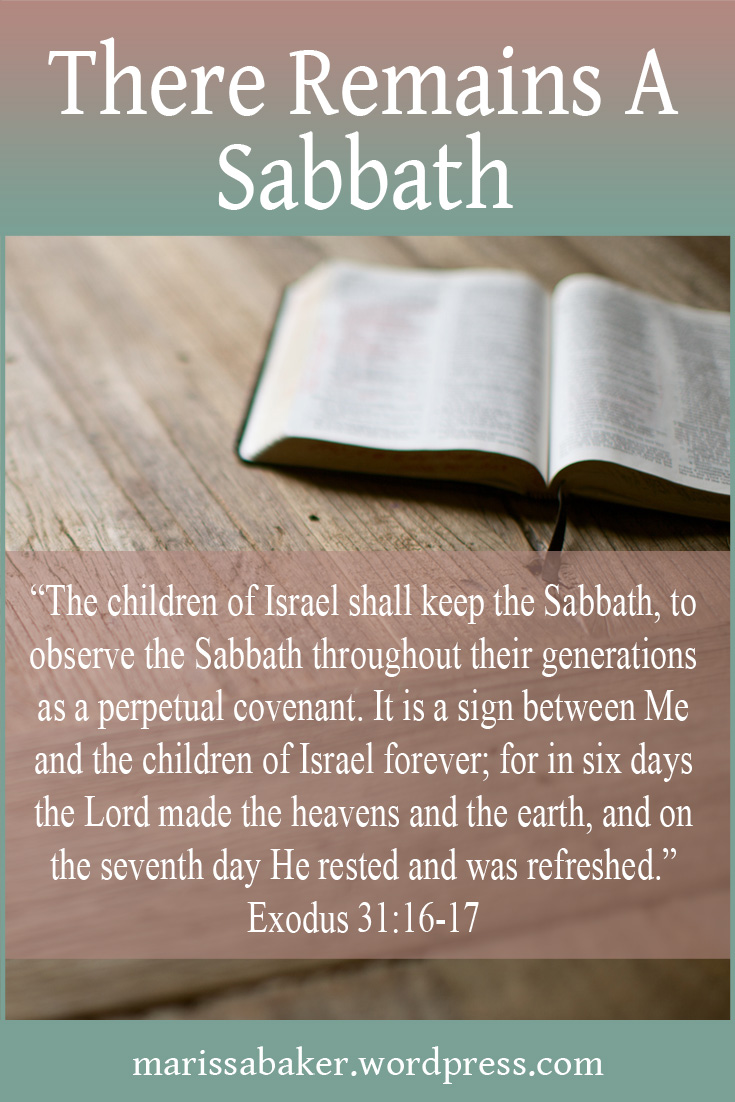
There Remains A Sabbath

I’ve mentioned before that I keep Saturday as a Sabbath rest, but I don’t think I’ve talked about why. Not every Christian is convicted of this, but I’m seeing more and more acknowledging the value of “sabbathing.” It’s just a small step from realizing that God’s command to rest is good, to resting on the day He set aside from the beginning of creation.

Thus the heavens and the earth, and all the host of them, were finished. And on the seventh day God ended His work which He had done, and He rested on the seventh day from all His work which He had done. Then God blessed the seventh day and sanctified it, because in it He rested from all His work which God had created and made. (Gen. 2:1-3)

There Remains A Sabbath | marissabaker.wordpress.com

This verse tells us God chose a certain day, the seventh, as a day of rest. He gave this day a special blessing, and set it apart for sacred use. “Sanctified” in the Hebrew carries the sense of separating something from “the common or profane” and placing it in “the sphere of the sacred” (Theological Wordbook of the Old Testament, p.1989). That’s what God did with the Sabbath day from the beginning of the world. Read more

Thoughts on John 9

I don’t often spend most of a week studying just one chapter of the Bible, but John 9 captured my attention and didn’t let go. It is the story of Jesus healing a blind man, and unlike many miracles which are recorded in just a few short verses, this story takes up an entire 41-verse chapter.

This chapter is packed full of interesting things to learn. I focused on three main points that I noticed for this post, but I’m sure there’s more. If anyone else feels moved to study John 9, I’d love to hear your thoughts!

A Reason For Suffering

Now as Jesus passed by, He saw a man who was blind from birth. And His disciples asked Him, saying, “Rabbi, who sinned, this man or his parents, that he was born blind?”

Jesus answered, “Neither this man nor his parents sinned, but that the works of God should be revealed in him. (John 9:1-3)

The assumption the disciples made is all too common, even today — that the bad things which happen to us and others are a kind of punishment. Sometimes, however, God allows trials of various sorts to affect us because they fit into His plan for doing good. In this particular case, the man’s blindness was used to introduce him to Jesus and demonstrate to other people that Jesus is the Son of God.

It worked, too. This healing caused a huge stir in the Jewish community. This was partly because of the spectacular nature of the miracle, and partly because Jesus healed on the Sabbath. As the Word of God, Jesus was the One who told Israel about the Sabbath in the first place — He knew how to keep it holy. Doing good on the Sabbath wasn’t a sin, but it did anger the Pharisees because it violated some rules they’d added.

 Therefore some of the Pharisees said, “This Man is not from God, because He does not keep the Sabbath.” Others said, “How can a man who is a sinner do such signs?” And there was a division among them. (John 9:16)

Though they publicly condemned Jesus, they weren’t so sure behind the scenes. This miracle made them think, and I wonder if some of them eventually became believers. Nicodemus couldn’t have been the only Pharisee wondering if maybe, just maybe, Jesus really was the Christ (John 3:1-2).

A Simple Testimony

After he was healed, the man who’d been blind doesn’t leap, shout, and tell everyone what happened. He didn’t do anything to call attention to himself, and only talked about the miracle when people started asking him what happened.

He answered and said, “A Man called Jesus made clay and anointed my eyes and said to me, ‘Go to the pool of Siloam and wash.’ So I went and washed, and I received sight.” (John 9:11)

After hearing this, the people took him to the Pharisees and he repeated his story again (verse 15). Not believing him, they called in his parents, who were scared of being excommunicated and wouldn’t say anything except to affirm that he had, indeed, been blind (verse 18-23).

So they again called the man who was blind, and said to him, “Give God the glory! We know that this Man is a sinner.”

He answered and said, “Whether He is a sinner or not I do not know. One thing I know: that though I was blind, now I see.” (John 9:24-25)

I think what the Pharisees were trying to do was convince this guy to say God healed him, and leave Jesus out of it. That never works — for “whoever denies the Son does not have the Father either” (1 John 2:23). When the Pharisees kept pressuring him, this man delivered a very simple testimony that enraged the Pharisees, who prided themselves on their intellect and knowledge of God.

The man answered and said to them, “Why, this is a marvelous thing, that you do not know where He is from; yet He has opened my eyes! Now we know that God does not hear sinners; but if anyone is a worshiper of God and does His will, He hears him. Since the world began it has been unheard of that anyone opened the eyes of one who was born blind. If this Man were not from God, He could do nothing.” (J0hn 9:30-33)

There’s something to be said for paying attention to “the simplicity that is in Christ” (2 Cor. 11:3). The man who went with the simple, obvious explanation — that Jesus is a good man who performed a miracle — was much closer to God than the thoroughly educated church leaders.

A Personal Connection

After testifying to Jesus’ work in his life, the Pharisees excomunicated the formerly blind man (verse 34). This relates back to an earlier verse, which tells us “the Jews had agreed already that if anyone confessed that He was Christ, he would be put out of the synagogue” (John 9:22). This doesn’t sound so bad to us today — if we get kicked out of one church there are plenty more right down the street. In the Jewish culture of Jesus’ time, though, it meant banishment from religious life.

In his definition of aposunagogos (G656), Zodhiates notes that the highest degree of “casting out” (there were three) is “an exclusion from all the rights and privileges of the Jewish people, both civil and religious. The offender was considered as dead.” Jesus warned His followers about this possibility in John 16:2. Following Jesus was a huge, dangerous step for Jews. It meant risking isolation from other people and, if you believed the Pharisees, from God.

Jesus heard that they had cast him out; and when He had found him, He said to him, “Do you believe in the Son of God?”

He answered and said, “Who is He, Lord, that I may believe in Him?”

And Jesus said to him, “You have both seen Him and it is He who is talking with you.”

Then he said, “Lord, I believe!” And he worshiped Him. (John 9:35-38)

We don’t often see examples of Jesus making follow-up visits with people He healed, but it is clear from these verses that He was keeping track of what happened with this man. As soon as He heard about the Jews excommunicating the formerly blind man, Jesus tracked him down to encourage him and confirm his faith. This man was cast out by the Jews, but he was welcomed by the Messiah.

I’m touched by the personal attention Jesus gave this individual, and the parallels with our own calling. Jesus healed him, apparently without being asked to, and changed his whole life. In much the same way, God may call us when we’re not even looking for Him and don’t know how desperately we need His life-changing power.

This healing opened the blind man’s spiritual as well as physical eyes. Many of us today can relate the rejection he experienced when he started to share the story of how Jesus touched his life. I hope we can also relate to the comfort of having a personal connection with this great Being, who doesn’t leave people alone to navigate their new-found faith.

Ready To Be Faithful

How do you know when you’re ready for baptism?

For those in churches that teach baptism is the sign of our covenant with God, this is a weighty question. If you’re just coming into the church, how do you know when you’re ready to go through with this ceremony? If you grew up in the church, how do you know God is really calling you into covenant with Him? What should you look for, and what do you need, before you get baptized?

The answer is both simpler and more complicated than you might think. It has very little to do with how long you council with a minister or how many baptism booklets you read, and everything to do with the state of your heart. Before we get into the body of this post, though, (just so we’re starting out on the same page) here’s a bit of background. I believe baptism by full immersion in water is an outward sign of an adult Christian’s covenant with God. I grew up in a Christian community that taught this, and I was baptized shortly after my 19th birthday.

Repent

Ready To Be Faithful | marissabaker.wordpress.com
bg image credit: Kelly Hunter, CC BY

When John the baptist began his ministry, he preached “Repent, for the kingdom of heaven is at hand!” (Matt. 3:2).  Those who came to be baptized confessed their sins as part of the baptism (Matt. 3:6). To further emphasize the need for repentance, he told the Pharisees and Sadducees who came to his baptism to “bear fruits worthy of repentance” if they wanted to be saved (Matt. 3:8).

In the Bible, repentance is “regret accompanied by a true change of heart toward God” (G3340, Zodhitates). To enter covenant with God, the first requirement is that we realize we are sinners, genuinely regret the wrongs we’ve committed, and recognize our need for Jesus Christ’s atoning sacrifice.

Now when they heard this, they were cut to the heart, and said to Peter and the rest of the apostles, “Men and brethren, what shall we do?”

Then Peter said to them, “Repent, and let every one of you be baptized in the name of Jesus Christ for the remission of sins; and you shall receive the gift of the Holy Spirit. (Acts 2:37-38)

In general the steps are: 1) repentance, 2) baptism, 3) receive the Holy Spirit (there are exceptions to this order, as in Acts 10). Often, we feel like we need reach perfection, or at least be “good enough” before baptism. Really, though, we need to realize we are not perfect so we can commit and submit to God. Then, after we realize how desperately we need Him and ask Him to be part of our life, He gives us the tools we need to grow toward perfection.

Believe

Looking at another baptism recorded in Acts, we find one more requirement for baptism. Here, Philip is teaching an Ethiopian eunuch about Jesus.

 Now as they went down the road, they came to some water. And the eunuch said, “See, here is water. What hinders me from being baptized?”

Then Philip said, “If you believe with all your heart, you may.”

And he answered and said, “I believe that Jesus Christ is the Son of God.”

So he commanded the chariot to stand still. And both Philip and the eunuch went down into the water, and he baptized him. (Acts 8:36-38)

In the New Testament, “believe” is translated from the same words as “faith” — pisteuo (G4100), a mental persuasion, faith, or belief, and pistis (G4102), ” a knowledge of, assent to, and confidence in certain divine truths” (Zodniates).

But without faith it is impossible to please Him, for he who comes to God must believe that He is, and that He is a rewarder of those who diligently seek Him. (Heb. 11:6)

Your faith doesn’t have to be perfect before you get baptized, but you should believe that God exists, that Jesus is the Messiah, and that They have a plan for your future. Maybe our faith is young or small, and we’re at a place where we’re saying, “Lord, I believe; help my unbelief!” (Mark 9:24). That’s okay. God knows we’ll still have work to do after baptism. In fact, He expects us to keep growing after we commit to Him.

Commit

Ready To Be Faithful | marissabaker.wordpress.com
bg image credit: Kelly Hunter, CC BY

When you’re counseling for baptism, ministers typically have you read the “count the cost” scriptures in Luke 14:25-33. We learn we can’t cling to anyone or anything other than Christ. We’re told we must be prepared to give up everything we have. Before taking this step in our relationship with God, we must seriously evaluate our commitment level. Christianity isn’t something you can do part-time or half-way. We have to be all-in.

I’m willing to venture a guess that those of us who’ve been baptized didn’t really understand exactly what we were getting into. Our knowledge and understanding deepen so much as we grow, and the commitment I made at baptism means more to me now than it did back in 2008. We don’t need have perfect knowledge before we get baptized — we just need to know we’re willing to follow God no matter what. I’ve heard it compared to marriage. You don’t have to be perfect to get married, or even understand everything about marriage, but you do have to make a commitment that you’ll be faithful.

I will betroth you to Me forever; yes, I will betroth you to Me in righteousness and justice, in lovingkindness and mercy; I will betroth you to Me in faithfulness, and you shall know the Lord. (Hos. 2:19-20)

If our commitment to God is a marriage (2 Cor. 11:2), then baptism is when we say our vows. We promise to stay faithful to Him in sickness and in health, to follow His authority, and to work through our problems with Him instead of running away. Baptism is a promise of faithfulness to our faithful Creator. If we’re ready to be faithful, then we’re ready to be baptized.

What Do I Still Lack?

What Do I Still Lack? | marissabaker.wordpress.com
bg image credit: Irina Patrascu, CC BY

If you could ask God one question, what would it be?

Several years ago, I heard a speaker say that he thought most of us would ask, “When is Christ returning? How much longer do we have to wait?” That’s not what I’d ask, though. Does it really matter to you whether it’s 10 months, or 10 years, or 10,000 years? We could quite literally die today (though we don’t like to think about it), so we should be working on being ready to meet God at any moment. We should be watchful, yes, but the focus is on growing to be like Him and knowing Him more fully.

With that in mind, I think my question would be more like that of the rich young man in Matthew 19 and Mark 10.

The First Question

Now behold, one came and said to Him, “Good Teacher, what good thing shall I do that I may have eternal life?”

So He said to him, “Why do you call Me good? No one is good but One, that is, God. But if you want to enter into life, keep the commandments.”

He said to Him, “Which ones?”

Jesus said, “‘You shall not murder,’ ‘You shall not commit adultery,’ ‘You shall not steal,’ ‘You shall not bear false witness,’ ‘Honor your father and your mother,’ and, ‘You shall love your neighbor as yourself.’ ” (Matt. 19:16-19)

I get the impression that this is the bare minimum required to get into God’s kingdom. We know from Hebrews that the law by itself isn’t enough to save us, so we’ll assume this list implies that we also repent and accept Jesus Christ’s sacrifice for our sins. There’s also a relational aspect implied.

 If you keep My commandments, you will abide in My love, just as I have kept My Father’s commandments and abide in His love. (John 15:10)

So, to get into God’s kingdom we need to repent and be cleansed of our sins, keep the commandments, and walk in relationship with God. But what if we feel like we’re doing all this, and still there’s something missing?

The Second Question

The young man said to Him, “All these things I have kept from my youth. What do I still lack?”

Jesus said to him, “If you want to be perfect, go, sell what you have and give to the poor, and you will have treasure in heaven; and come, follow Me.”

But when the young man heard that saying, he went away sorrowful, for he had great possessions. (Matt. 19:20-22)

That’s the question I would ask — “What’s missing from my Christian walk? What do I still lack?” Honestly, though, the thought of getting an answer is kinda scary. I think Jesus would look into my heart and find the biggest thing that is pulling me toward this life instead of Him, and tell me to give it up. Would I be like the disciples, who could say, “we have left all and followed You” (Matt. 19:27), or would I be like this young man who wasn’t ready to go that far for Jesus?

Paul had a proper perspective on this sort of situation. He didn’t even ask the question, but Jesus answered it anyway. Once Paul realized that faith in Jesus as the Messiah was what his walk with God needed, he gave up his prestige as a pharisee to become a persecuted, itinerant preacher.

But what things were gain to me, these I have counted loss for Christ. Yet indeed I also count all things loss for the excellence of the knowledge of Christ Jesus my Lord, for whom I have suffered the loss of all things, and count them as rubbish, that I may gain Christ …. Not that I have already attained, or am already perfected; but I press on, that I may lay hold of that for which Christ Jesus has also laid hold of me. (Phil. 3:7-8, 12)

Both here and in Matthew 19, the word “perfect” is translated from teleios (G5046), which we talked about last week. It is connected with growth as a Christian; becoming more mature as we become more like Christ.

We might be able to get by doing the bare minimum, but that’s not how we reach perfection. We become perfect by learning to think like God (Matt. 5:43-48) and giving up anything that keeps us from fully committing to Christ. Let’s not allow fear to hold us back from taking a good, hard look at ourselves and asking God, “What do I still lack?”

Growing To Perfection

Have you ever wondered why God commands us to be perfect when it seems so impossible? In English, the word means things like, “being entirely without fault or defect” and “corresponding to an ideal standard or abstract concept” (Merriam-Webster Dictionary). When we read that and think of verses like “all have sinned and fall short of the glory of God” (Rom. 3:23, NET), we might get discouraged. It’s disheartening to look at ourselves and realize how far we are from perfection.

The task of becoming perfect seems even more daunting when we read, “So then, be perfect, as your heavenly Father is perfect” (Matt. 5:48, NET). How could we ever become as perfect as God is? If we don’t give up altogether thinking of that monumental task, it’s easy to get caught in a cycle of trying to be perfect, failing, and then falling into depression and/or guilt. We might think we’re not good enough for God. We might know that achieving perfection is only possible with God’s help, but still feel like if only we worked at it a little harder we’d be able to use His help more effectively and stop being so imperfect.

God doesn’t set us up for failure, though. Rather, His way of looking at perfection is very encouraging. First, we need to remember that Jesus told us things which are impossible for men are possible for God (Matt. 19:26). Next, let’s look at what “perfect” means in the Bible and how it’s used, because it’s different than we might expect.

What is “Perfect”?

Let’s start with an example. In the Old Testament, God described Job as a “perfect” or “blameless” man twice at the beginning of Job’s story (Job 1:8; 2:3). We know that Job learned and grew as a result of the trials he went through. God even showed up personally to set Job straight. And yet God could describe Job as “perfect” with complete honesty before all that growth happened.

The word in Hebrew that’s translated “perfect” in the KJV is tam (H8535), which refers to completeness and entirety. It doesn’t necessarily mean finished, though — rather, it describes someone moving “naturally toward that which is ethically sound” (Theological Wordbook of the Old Testament entry 2522). Thus in the Bible, we can be described as “perfect” while being on the path toward perfection–toward being like God.

As for God, his way is perfect.
    Yahweh’s word is tested.
    He is a shield to all those who take refuge in him.
For who is God, besides Yahweh?
    Who is a rock, besides our God?
God is my strong fortress.
    He makes my way perfect.

2 Samuel 22:31-33, WEB

God is perfect in an absolute sense, and He takes on Himself the task of moving us toward similar perfection. As long as we are growing toward being like Him, He can describe us as “perfect” just like He called Job perfect.

This idea of growth also fits in with the New Testament writings. There are two main words translated “perfect” from Greek, and one is teleios (G5046). It means something that is finished or complete, as in completely blameless, or a person who is full-grown in mind and understanding (Zodhiates). This “full growth” is what Jesus Christ prayed His followers would experience.

The glory which you have given me, I have given to them; that they may be one, even as we are one; I in them, and you in me, that they may be perfected into one; that the world may know that you sent me and loved them, even as you loved me.

John 17:22-23, WEB

Perfection as a Christian has everything to do with growth. If we think we’re already perfect, then we’re not (1 Cor. 10:12). But if we’re pursuing perfection by trying to be like God and deepening our relationship with Him, then He talks about us as if we’re already perfect.

Image of a man pushing open a door overlaid with text from Ephesians 4:13, NKJV version:  “till we all come to the unity of the faith and of the knowledge of the Son of God, to a perfect man, to the measure of the stature of the fullness of Christ”
Image by Pearl from Lightstock

On To Perfection

God the Father and Jesus Christ don’t leave us in the dark about how to grow toward perfection. The key is to focus on them rather than ourselves. We’re not trying to make ourselves perfect; we’re trying to mimic them. We’ll never eclipse their perfection, but we can become like them. That won’t be fully realized in this life, but we start the process now and in the future we’ll be so much “like him” that “we will see him just as he is” (1 John 3:1-3).

A disciple is not above his teacher, but everyone who is perfectly trained will be like his teacher.

Luke 6:40, NKJV

This verse brings us to the other Greek word frequently translated “perfect.” Katartizo (G2675) means “to put a thing in its appropriate condition.” It can mean repairing something that was broken, setting a person right with God, and preparing or equipping someone for a purpose (Zodhiates). Here in Luke, Jesus is telling us that in order to become whole, complete and right with God, we have to become like Him. Growing the whole church body toward being like Christ is one of the most important responsibilities of the church (Eph. 4:10-14). The closer we get to “attaining to the measure of Christ’s full stature” (Eph. 4:13, NET), the more mature we become as Christians.

Keep Growing!

Image of a woman looking up at the sky with the blog's title text and the words "We know we're not sinless or flawless and perfection might seem an unattainable goal. But God still calls people "perfect" when they're growing toward being like Him."
Image by Brightside Creative from Lightstock

We all have a responsibility to grow. Not to make ourselves perfect as if we could fix all our flaws ourselves, but to keep moving toward being like God. God doesn’t get angry and pounce on us when we stumble and fall or miss the mark; He helps us get back up. When we repent and keep growing, He still calls us perfect. It’s only when we stagnate (or sin and refuse to repent and change) that we get into real trouble.

For although by this time you should be teachers, you again need to have someone teach you the rudiments of the first principles of the revelations of God. You have come to need milk, and not solid food. For everyone who lives on milk is not experienced in the word of righteousness, for he is a baby. But solid food is for those who are full grown, who by reason of use have their senses exercised to discern good and evil.

Therefore leaving the teaching of the first principles of Christ, let’s press on to perfection—not laying again a foundation of repentance from dead works, of faith toward God, of the teaching of baptisms, of laying on of hands, of resurrection of the dead, and of eternal judgment. This will we do, if God permits.

Hebrews 5:12-6:3, WEB

“Why aren’t you growing?” the writer of Hebrews asks. “You know what the elementary principles are, so build on them.” If you’re a brand-new Christian then you will be learning those principles, but as the years pass you’re supposed to keep building. We have a foundation — Jesus Christ whose sacrifice perfects us (1 Cor. 3:11; Heb. 10:14) — and now is the time to start building on that foundation. Even though God refers to us as  perfect before we actually reach that goal, we can’t become complacent.

Not that I have already attained this—that is, I have not already been perfected—but I strive to lay hold of that for which Christ Jesus also laid hold of me. Brothers and sisters, I do not consider myself to have attained this. Instead I am single-minded: Forgetting the things that are behind and reaching out for the things that are ahead, with this goal in mind, I strive toward the prize of the upward call of God in Christ Jesus. Therefore let those of us who are “perfect” embrace this point of view. If you think otherwise, God will reveal to you the error of your ways.

Philippians 3:12-15, NET

Even the Apostle Paul didn’t think he could stop pursuing perfection, and he wrote over 30% of the New Testament text! But he didn’t let the fact that he wasn’t perfect yet discourage him. He also encouraged his fellow Christians to keep growing toward perfection and maturity in Christ. Like Paul, I hope we can accept the fact that we’re not yet perfect while continuing to move towards being like Jesus and our Father. We don’t have to beat ourselves up over not being “good enough.” God calls us perfect as long as we keep growing toward being like Him.


Featured image by Pearl from Lightstock