The more I study the Bible, its historic context, and the languages it was originally written in, the more I realize that native English speakers are not well equipped to wrap our minds around Hebrew. I’ve been writing quite a bit about this recently as I look at specific topics like “Waiting in Hope” and “Putting ‘Spare the Rod’ In Context.”
I’ve heard a lot of people, especially those who love the KJV Bible translation, express that they want as close as possible to a 1-to-1 translation of the Bible. They think it’s most accurate if there’s a Hebrew or Greek word directly translated to an English word without anything taken away or added in the number of words. I lean that way with most of my translation preferences, too, but I’m starting to think that while that might be a fairly good way to translate Greek, it’s not all that helpful for Hebrew.
Painting With Words
If you don’t count proper names, Biblical Hebrew has about 7,000 distinct words. Modern Hebrew has about 33,000 words, which is a much expanded vocabulary pool but still significantly smaller than English. Webster’s dictionary currently includes about 470,000 entries for English words and some estimates place the number of English words close to 1 million. That doesn’t mean that Hebrew is a more limited language, though. One of the things that it means is there are a lot of Hebrew words where one word represents concepts that English splits up into multiple words (e.g. “wait” and “hope” are distinct in English, but they’re both valid translations of a single Hebrew word).
Hebrew is full of desert browns and burnt umbers of a nomadic, earthy people who trekked through parched deserts and slung stones at their enemies. Overall its palette only contains a small set of colors … Because of its small vocabulary, each word has a broader possible meaning.
The Hebrew of the Bible … expresses truth by splashing on rich colors with a thick brush, like Van Gogh. … even though the details are quite rough, you mentally fill them in, inferring them from the context. Your mind is used to doing this – figuring out meaning from context. Even when you communicate in English, you rely on common experience to fill in the gaps. You sketch out a scene with a few word-strokes, and let people figure out the rest. Hebrew simply relies on this much more than we do.
I really like Lois Tverberg’s comparison of languages to painting styles. Hebrew uses broader brush strokes and a more limited color pallet while English uses a fine-tipped brush, different colors, and more colors. No English translation will ever be perfect because Hebrew and English are so different; that’s one reason it’s helpful to look at multiple translations when studying. It’s also helpful to learn at least a few important Hebrew words even if you can’t devote the time needed to learn the whole language.
Image by Matt Vasquez from Lightstock
An AI-Assisted Case Study on Exodus 20:7
As I’ve been pondering this topic again recently, I keep mulling over a specific question: If there isn’t a 1-to-1 correlation for most Hebrew-to-English translations, would it be helpful to think of key Hebrew words as multiple English words. For example, in English we have “You shall not take the name of the Lord your God in vain” for Exodus 20:7 (NET). But would it be more accurate to say “You shall not take/carry/use the name/reputation of Yahweh your Elohim in [a] vain/empty/worthless [way]”?
I thought I was on the right track, but I wasn’t sure who to ask about it. I don’t have access to a Biblical Hebrew scholar that I’m aware of, or the time to devote years to really learning the language. Then I remembered I’d been reading about and listening to podcasts on Artificial Intelligence (AI) recently, and one of the things people agree it’s a good tool for is research (some saying it’s a better search engine than Google now). I had been in the “I’m a real writer; I don’t use AI!” camp but the more I read about it, the more I’m convinced of two things: 1) ignoring it won’t make AI go away, and 2) there are some situations where it can be a helpful tool. In this particular case, an AI model can process vast amounts of information on Biblical Hebrew in a matter of seconds that would take me months or even years to work through.
Now, there is something we need to keep in mind as we look at the AI response. AI models like ChatGPT (the one that I used) can “hallucinate,” or make up information. That’s why I asked it about Exodus 20:7 and Proverbs 29:15. These are two verses that I’ve already studied quite a bit, so I’d be more likely to recognize if there was something wrong with the AI response. The AI response matched everything I’ve found in my own studies, so I’m reasonably confident that the additional information it provided is also accurate. Here is the link to my full chat if you want to check it out for yourself, and here are some highlights from the AI response:
Biblical Hebrew is a compact, context-dependent language with far fewer words than English. A single Hebrew word often holds multiple layers of meaning, depending on context, syntax, and cultural backdrop. English, by contrast, tends to slice meanings more finely, distributing them across many distinct words. So, when translating Hebrew to English, it’s not just about replacing words — it’s about reconstructing meaning.
This is why your suggestion — to think of Hebrew words as mapping onto multiple English possibilities — is both linguistically sound and theologically wise.
Image by Pearl from Lightstock
After unpacking my specific example, the AI model suggested two possible expanded translations of Exodus 20:7.
A Fuller Rendering: “You shall not lift up or invoke the name/reputation of Yahweh your Elohim in a false, empty, or worthless manner.” …
This approach does not clutter the meaning — it actually recovers the ethical and relational weight of the command. It’s not just about speech. It’s about how we represent God’s character in our lives, words, oaths, and actions.
I was honestly surprised that ChatGPT gave me such a nuanced, thorough response to my question. It was eerily similar to talking with a knowledgeable, personable professor or scholar who genuinely takes pleasure in helping other people broaden their understanding. It didn’t really tell me something brand new, but it was nice to get confirmation that I’m on the right track as I try to wrap my head around Biblical Hebrew. I hope it gave you some food for thought too.
Sometimes, we see something in scripture that we really like. A specific word or phrase in a specific translation speaks to us, and we get excited about that phrase. For example, in the KJV Proverbs 29:18 says, “Where there is no vision the people perish.” I’ve heard quite a few people use that to say that if we can’t visualize our end goal, we’ll fail. But more modern translations often say something like “prophecy” (LEB), “prophetic vision” (NET), or “revelation” (WEB) because those are closer to the meaning of the Hebrew word chazon (H2377). “Vision” was a perfectly good translation of chazon in 1611 (in the sense of “I’ve seen a vision”), but English meanings have shifted enough that it’s no longer the best word to use and can lead to misinterpretation.
I recently came across another verse where something similar happened. In Amos 7, English translations typically talk about a “plumb line” that God placed in the midst of His people Israel. It’s an analogy that many like. A plumb line is “a line (as of cord) that has at one end a weight (such as a plumb bob) and is used especially to determine verticality” (Merriam-Webster). People have taken this analogy and run with it, and you can find dozens of articles and sermons talking about God’s plumb line and wondering if we measure up. But when I read this passage in the New English Translation, they used the word “tin” instead. It’s such a dramatically different translation that I dug into it more to see how that happened and to try and figure out what Amos 7 means.
First, let’s take a look at the Bible verses in question. Here is how it reads in a translation that uses plumb line:
Thus he showed me and behold, the Lord stood beside a wall made by a plumb line, with a plumb line in his hand.Yahweh said to me, “Amos, what do you see?”
I said, “A plumb line.”
Then the Lord said, “Behold, I will set a plumb line in the middle of my people Israel. I will not again pass by them any more. The high places of Isaac will be desolate, the sanctuaries of Israel will be laid waste; and I will rise against the house of Jeroboam with the sword.”
Amos 7:7-9, WEB
And here it is in the New English Translation:
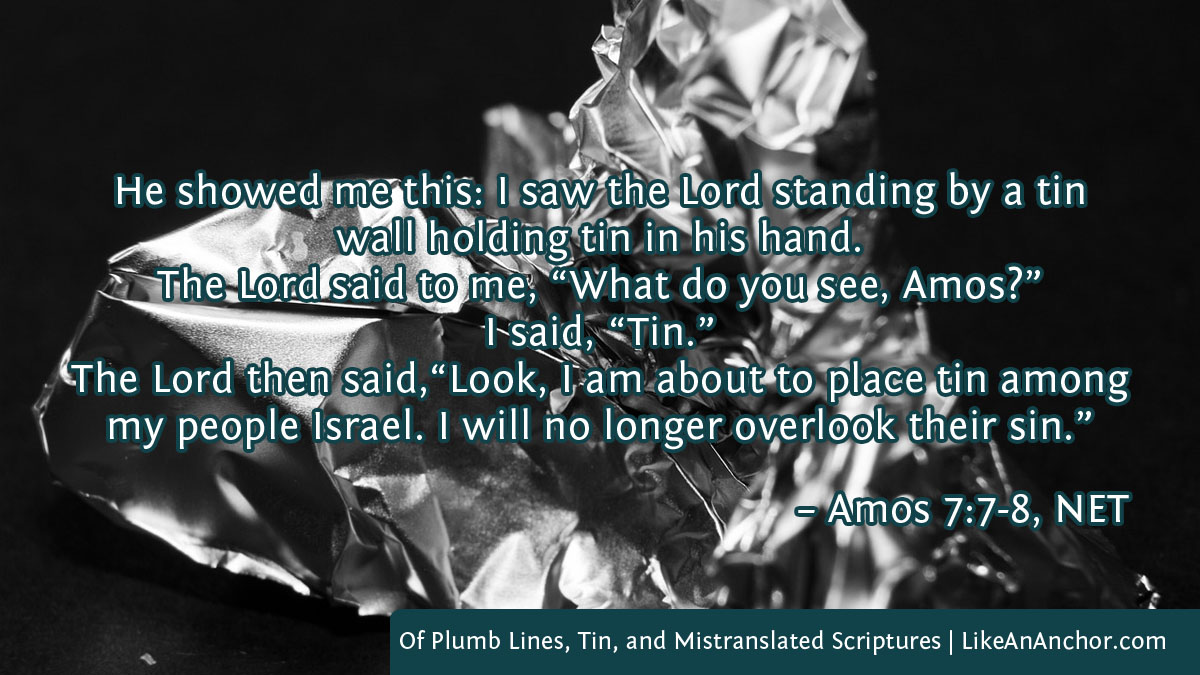
He showed me this: I saw the Lord standing by a tin wall holding tin in his hand. The Lord said to me, “What do you see, Amos?” I said, “Tin.” The Lord then said,
“Look, I am about to place tin among my people Israel. I will no longer overlook their sin. Isaac’s centers of worship will become desolate; Israel’s holy places will be in ruins. I will attack Jeroboam’s dynasty with the sword.”
Amos 7:7-9, NET
Obviously, these are two very different translations that lead to very different interpretations of this verse. Thankfully, the NET is very good about documenting the translators’ choices and sharing the reasoning behind them in footnotes. Here’s part of what they say about the tin vs. plumb line translation:
The Hebrew word אֲנָךְ (ʾanakh), “tin,” occurs only in this passage (twice in verse 7 and twice in verse 8). The meaning “tin” is based on its Akkadian cognate annaku. The traditional interpretation of these verses (reflected in many English versions) assumed that אֲנָךְ meant “lead.” Since lead might be used for a plumb line, and a plumb line might be used when building wall, the “lead” wall was assumed to be a wall built “true to plumb” while God holds a “lead” weighted plumb line in his hand. In this view the plumb line represents a standard of evaluation. This understanding developed before Akkadian was deciphered and the type of metal clearly identified for annaku. (In Hebrew “lead” is עֹפֶרֶת; ʿoferet.)
One of my go-to Hebrew dictionaries confirms that the “plumb line” translation is based on the assumption that anak means “plummet, plumb, lead-weight” (BDB; H594). It still seems like quite a leap to go from a word that you think means “lead” to translating it as “plumb line.” I guess translators didn’t think lead on its own made sense, so they tried to think of what lead might be used for in the context of a wall. Since lead weights could be used on plumb lines, and plumb lines would be used to make a wall vertical, we ended up with the plumb line translation in Amos 7. But then scholars did more work with the Akkadian language and learned the Hebrew anak most likely means “tin” instead of “lead.” Now we’re back to the problem of figuring out why God would give a prophet a vision of God holding a relatively soft type of metal while standing next to a wall made of the same metal, then say He’s going to put that metal in the midst of His people.
If “plumb line” changes to “tin,” then the traditional interpretations of this scripture don’t make sense anymore. Assuming that “tin” is the correct translation, what could it mean? The NET footnote suggests a few possibilities:
Some view the tin wall and piece of tin as symbolic. If the tin wall of the vision symbolizes Israel, it may suggest weakness and vulnerability to judgment. … Their citadels, of which the nation was so proud and confident, are nothing more than tin fortresses. Various proposals depend on selecting some quality about tin and suggesting a role for that in this context. However, it is more likely that this is a case of a sound play like the next vision in Amos 8:1-2 (see also Jer 1:11-14). With the presentation technique of a sound play, the vision is not the prophecy, only the occasion for the prophecy. God gets the prophet to say a certain sound and then spins the prophecy off that. See the note at 7:8.
The sound play isn’t something you can easily translate, so it’s hard to see it when we read Amos in English. The NET translators hint at it by rhyming “tin” with “sin” (“Look, I am about to place tin among my people Israel. I will no longer overlook their sin” [Amos 7:8, NET]), but it’s still not obvious unless you either read Hebrew or have resources like the NET Bible to point out what’s happening in the original language.
While the sound play does sound like a reasonable explanation, the possible interpretation linked to characteristics of tin also makes sense in context. Amos 7:7-9 is just one of three visions that the Lord shows Amos in sequence. The first two both involve Yahweh revealing a judgement against Israel, first a plague of locusts and then one of consuming fire. Both times, Amos begs for a reprieve because Israel is too “small” or “weak” to withstand such punishment. Both times, Yahweh decides not to use that punishment (Amos 7:1-6). It could be that the weakness of tin is linked with the weakness that Amos identifies in Israel. Though Israel is weak, the Lord “will no longer overlook their sin” and eventually the holy places and kings will be destroyed (Amos 7:7-9).
If you really liked the “plum line” analogy, you might find it disappointing to learn about the “tin” translation. But there is one other verse where “plumb line” is a good translation.
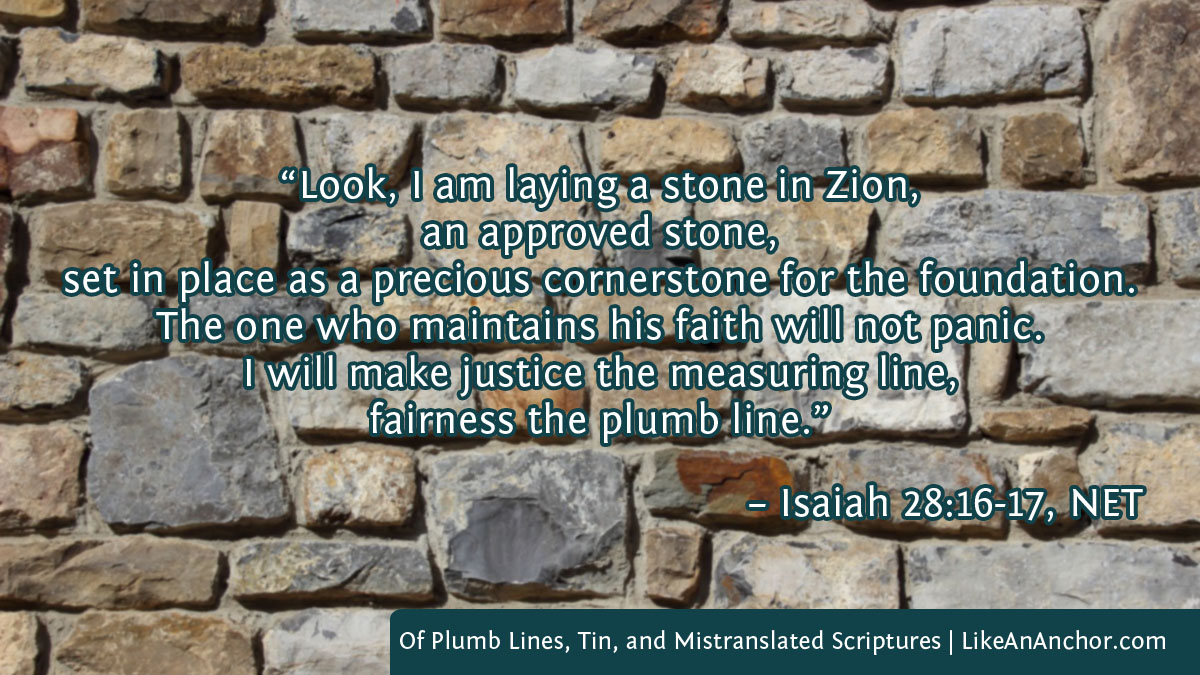
Therefore the Lord Yahweh says, “Behold, I lay in Zion for a foundation a stone, a tried stone, a precious cornerstone of a sure foundation. He who believes shall not act hastily. I will make justice the measuring line, and righteousness the plumb line. The hail will sweep away the refuge of lies, and the waters will overflow the hiding place.”
Isaiah 28:16-17, WEB
Here, “plumb line” is translated from mishqeleth. It means “level, leveling tool or instrument, plummet” (BDB; H4949). It’s a tool used in building, which makes sense because the context is Yahweh laying the Messiah as the foundation stone for the house He planned to build with the New Covenant church (Eph. 2:20; 1 Pet. 2:5-7).
Yahweh measures the house He’s building using instruments of justice and righteousness. We can still say that He places a plumb line in His people and expects us to measure up to His standards; we just shouldn’t use Amos 7 as the scriptural support for that idea.
As we discussed last week, all scripture is God-breathed. Sometimes, though, the involvement of fallible human beings–or even just the natural evolution of language–can muddy the meaning, especially in translation. If we learn that there’s a more accurate translation of a scripture that’s closer to the original intent, then that’s the one we should go with. We shouldn’t just accept any new interpretation blindly, but with careful investigation and prayer it’s usually possible to discern which translation(s) are more accurate when there’s a significant difference between them.
One of the major turning points in my life involved taking a class on the English Bible as literature in my second semester of college for my undergraduate degree. The English Bible class helped me realize I can study the Bible as a scholarly project, I can defend my faith intelligently to other people, and how deeply the Bible in translation influenced the Western literary tradition. It also (along with a Shakespeare class and, more significantly, the Shakespeare professor) helped inspire me to pursue an English degree.
The Bibles that we read in English support this type of scholarly work. The format of pretty much every Bible you can pick up is designed for study and reference. “The addition of chapter breaks in the 13th century and verse numbers in the 16th century” made the standard Bible format “fragmented” into tidbits for cross-referencing different sections and pulling out isolated passages to preach about (“Three Bad Ways We Read the Bible and Three Tips to Improve“).
This is very different from the way we read most books. The only books that typically have similar layouts, references, and annotations are scholarly publications of texts like Shakespeare’s plays or The Iliad. This makes sense in some ways; the Bible is an ancient text and modern readers benefit from notes explaining context. But if you ever had to read a scholarly edition of a literary work, you probably realized that the notes and layout can also get in the way of your reading. For example, by the time you figure out what’s going on with Shakespeare’s language, you might have lost the plot thread.
In contrast, books that we read for enjoyment rarely have cross references and notes. Even non-fiction that is properly cited tucks the notes away in discreet footnotes or endnotes. Fiction may use glossaries at the back for historic context and pronunciation guides, but there’s rarely anything to interfere with the text itself. These books are designed for immersive reading. You can even read older texts immersively if you familiarize yourself with the writing style. For example, when I first started reading 17th and 18th century English literature, I read the introduction and all the notes. Now that I know more about the historical context and the language the writers used, though, I just dive right into the story.
What if we could read the Bible that way? Like it’s a story that we’re eager to lose ourselves in, without verse numbers and center notes getting in the way?
For context, when I say “story” I mean “an account of people and events, real or imaginary.” I am not suggesting that the Bible is fictional when I say that it is written as a story. I mean that this book has a narrative structure. More specifically, there are several metanarratives (overarching stories or big themes) that you can see when reading the whole Bible. I write about one, “A Story of Battle and Victory,” in my new Armor of God Study Guide. We have a harder time seeing those narrative themes if we’re only reading isolated chunks of the Bible.
Bible reading rates are shockingly low among Christians. Part of this is lack of time, but part is also because we’re not sure how to read it or we don’t really want to (more on this later, with data). And when we do read it, often we go to specific parts that make us feel better or which we think will offer guidance when we’re making decision.
The Bible is a book we can turn to for comfort and it does contain vitally important instructions, but it’s not just an instruction manual, a list of laws, or a collection of reassurances. The Bible is how God tells us about Himself, and when we read the whole thing together, we see He’s revealing Himself through a story with central themes of creation and redemption, love, building a family, and founding a kingdom. And I think maybe if we realized that, it would be easier to read the Bible more.
Image by Ben White from Lightstock
How Jesus Read The Bible
In Jesus’s time, if you wanted to read the Bible you’d have to go to a synagogue and unroll scrolls (assuming you were one of the people allowed to touch those scrolls). There weren’t chapter and verse breaks; only breaks between books. Scripture text was meticulously copied by hand and, as the text is sacred, great care was taken not to introduce mistakes into the text (“The Torah Scroll: How the Copying Process Became Sacred“). The lengthy copying process meant that owning a copy of scripture was out of reach of most individuals or families. Synagogues had copies that rabbis could read aloud to people. We can see an example of reading this type of scroll in the gospels.
Now Jesus came to Nazareth, where he had been brought up, and went into the synagogue on the Sabbath day, as was his custom. He stood up to read,and the scroll of the prophet Isaiah was given to him. He unrolled the scroll and found the place where it was written,
“The Spirit of the Lord is upon me, because he has anointedmeto proclaim good newsto the poor. He has sent meto proclaim releaseto the captives and the regaining of sightto the blind, to set freethose who are oppressed, to proclaim the yearof the Lord’s favor.”
Then he rolled up the scroll, gave it back to the attendant, and sat down. The eyes of everyone in the synagogue were fixed on him. Then he began to tell them, “Today this scripture has been fulfilled even as you heard it being read.”
Luke 4:16-21, NET (bold italics a quotation from Isa 61:1-2a)
Jesus hadn’t memorized that He’d need to turn to Isaiah 61 to read this verse. He was familiar enough with the whole scroll of Isaiah that He knew were to find this part within a much larger passage near the end of the scroll. And He didn’t only know where to look up passages and read them; He had large sections of scripture memorized. Just in the recorded gospels, we have evidence of Jesus quoting from “parts of the Scripts from all of the books of Law, most of the prophets, and some of the Writing – altogether 23 of the 36 books of the Modern Hebrew Bible” (Evans, 2006b, quoted in Metsämuuronen, 2019). It’s very possible that He had the entire Torah and large portions of the rest of the Old Testament (if not the whole thing) committed to memory.
Most of Jesus’s students and listeners were also Biblically literate, and when He referenced one part of a scripture they likely filled in the context automatically. Jewish children of the day grew up steeped in their religion, keeping the Sabbath and laws, learning from their parents, and frequently hearing scripture. Boys and girls started formal schooling around age six, and likely knew how to read before that (Metsämuuronen, 2019, “How Jesus Learned the Scriptures?”). Everyone learned Torah up to age 13, but only the most accomplished (male) students would go on to deeper studies with rabbis. It’s very likely that Jesus wasn’t one of the students chosen for advanced education since “the Jewish leaders were astonished” by the way He taught “and said, ‘How does this man know so much when he has never had formal instruction?'” (John 7:15, NET).
We don’t really have anything equivalent to this type of learning today. We’re so used to being able to look things up in books or on our phones that we don’t memorize much information. But imagine if you’d spent seven years of your childhood studying the first five books of the Bible. You’d know them as well as you know colors, shapes, multiplication tables up through 10, how to put a sentence together in your native language, and the controls for your favorite video game.
Image by Jantanee from Lightstock
Balancing Bible Reading and Bible Study
To be clear, I’m not saying it’s wrong to study the Bible in sections or by topic. In fact, since the Bible is such a big book, having center cross-references can help us appreciate the connections between different parts of scripture more easily. The chapter and verse numbers make it much easier for people to make sure they’re on the same page (quite literally) when having a Bible discussion, or for someone to follow along with and double-check a teacher. I usually choose to study the Bible thematically/topically, and I share those studies here.
One of the primary ways I relate to the Bible (e.g. my spiritual temperament) is intellectually. But I also sometimes wonder if I approach the Bible too academically and lose touch with the wonder of being in a relationship with God. That’s another aspect of my spiritual temperament: worshiping God with contemplation and adoration. The reference/study format for Bibles doesn’t really support that sort of immersive, story-reading Bible interaction, though.
Several years ago, a Kickstarter caught my eye. “Bibliotheca is an elegant, meticulously crafted edition of the Bible designed to invite the reader to a pure, literary experience of its vast and varied contents,” without any verse numbers or chapter breaks (bibliotheca.co). It was far outside my price range at the time and so I did not back the Kickstarter, but I desperately wanted to. I was reminded of that this past week when I read “Three Bad Ways We Read the Bible and Three Tips to Improve” on Tyndal.com. This article suggests using “a reading Bible” rather than a study Bible, finding a reading group so you’re not studying in isolation, and establishing a “reading rhythm” so you’re regularly reading the Bible.
This article recommends the Immerse Bible, which I was excited about at first but not so much after I checked up on the NLT translation by reading several chapters of Romans (my favorite book to look at when checking the quality of a translation). I think I’ll stick to the Tree of Life version as my reading Bible. The print copy I have still has chapter and verse numbers, but the verse numbers at least are minimized to reduce their impact on the text. Maybe someday I’ll try out Bibliotheca or find another reading Bible I like.
I think it’s important to balance reading straight through the Bible as if it’s a story you love so much you can’t put it down, and studying the Bible deeply like it’s the most important academic research you’ve ever done. By reading through the whole Bible, you gain vital context and the overarching stories/themes. By studying the Bible carefully and reading supportive texts, you can learn historical context, what the words used originally mean, and deepen theological understanding. Both support you in deepening your understanding of the scriptures that God breathed into existence and that He uses to teach us about Himself, what He expects of us, and how He relates to His people.
But evil people and charlatans will go from bad to worse, deceiving others and being deceived themselves.You, however, must continue in the things you have learned and are confident about. You know who taught youand how from infancy you have known the holy writings, which are able to give you wisdom for salvation through faith in Christ Jesus. Every scripture is inspired by God and useful for teaching, for reproof, for correction, and for training in righteousness, that the person dedicated to God may be capable and equipped for every good work.
2 Timothy 3:13-17, NET
The Bible is without doubt the most important book ever written. As followers of God, we’re blessed to know how important this book is and that the text comes straight from Him (through human writers, copiers, and translators). And yet, many people calling themselves Christians aren’t reading the book very much or at all.
Engaging With Something Epic
Image by Creative Clicks Photography from Lightstock
According to the Pew Research Center, about 63% of Americans currently identify as Christians (“How U.S. religious composition has changed in recent decades“). Yet according to the American Bible Society’s 2023 State of the Bible report, only 39% “of Americans said they used the Bible three or more times per year” (“State of the Bible 2023,” p. 6). Three or four times a year isn’t all that much. For more frequent users, “about 63 million American adults (24%) use the Bible—on their own, outside of a church service—at least once a week” (“State of the Bible 2023,” p. 7). Assuming most of the Bible-readers also identify as Christian, that means less than half the Christians pick up their Bibles at least once every week.
Interestingly, when American Bible Society’s survey asked people if they wanted to read the Bible more, 52% said “yes” (“State of the Bible 2023,” p. 12). When asked what challenges kept them from Bible reading more, relatively few said the layout was difficult or that they found the stories confusing (“State of the Bible 2023,” p. 11). The top reasons were, “Not enough time,” “Don’t know where to start,” and “Lack of excitement about reading it.” I don’t know this for sure, but I wonder if we spent more time talking about the story of the Bible and the big metanarrative themes it might be easier for people to pick up the book, start at the beginning, and get excited about reading the Bible.
One of the theories for why modern people find video games so engaging is because immersive adventures make us feel like we’re part of something bigger than ourselves; we long for “epic meaning” and to be part of an “epic story” (McGonigal, “Gaming can make a better world”). Now, I’m a gamer. I get why games are so engaging and I think the right kinds of games can be encouraging and educational as well as fun. But I don’t go to games for meaning, and I think it’s heartbreaking that as a society, we have lost touch with real-world things that welcome us to be part of something bigger than ourselves.
Do you like epic stories of great battles with good versus evil? God’s calling you to fight alongside Him in one (Eph. 6:10-18).
Do you like sweeping tales of daring and epic romance? Jesus conquered death to ransom His bride, and He wants that bride to include you (2 Cor. 11:2; 1 Tim. 2:5-6; Rev. 19:6-8).
Do you want to be involved in something on a world-saving, eternity-mattering scale? God offers you a position in His kingdom that will last forever, which He’s been preparing since the foundation of the world (Mat. 25:34; Rev. 1:5-6).
I remember the first time I read a Bible, it was a children’s Bible with very simple text and cute illustrations. The authors boiled everything down to big ideas and the main story beats. God created everything. Man fell. God asked people like Noah, Abraham, and the nation of Israel to be in relationship with Him. God rescued Israel from Egypt. Israel rebelled and God sent prophets. Jesus came to save us all, died, and rose again. The New Covenant church is what we’re part of now. Jesus is coming back.
Maybe that’s where we should all start. Not necessarily by reading a Bible for toddlers, but reading with an understanding of the main things that happen in the Bible and what that reveals to us about God. The details are vitally important, but we need the big picture if we’re going to make sense of them. We need the narrative God uses to reveal Himself, His values, and His purpose to understand how we fit into it all and what He expects from us when we’re in a relationship with Him.
I’ve been going back and forth on making a post like this for quite some time now. There isn’t one right formula for studying your Bible, and I’m not saying there is. As long as you’re reading God’s word, praying for His guidance, and working to know Him better then you can have a productive study. I don’t want to imply the way I study is the “right” or “best” way. But a few people have asked me to recommend Bible study resources, and I also realized that some of the study tools I use to help me understand the Greek and Hebrew behind our English translations aren’t familiar to everyone.
In this post, I’ll go through resources I use frequently and highly recommend. If you have other resources that you like to use, I’d love to learn about them. Please leave a comment so everyone reading can benefit from the recommendations 🙂
Disclaimer: Some of the links on this page are affiliate links (marked with an *). This means that if the resource I mention is available for purchase on Amazon, I provide a link and if you use that link to make a purchase I will receive a commission (at no additional cost to you).
Background Reading
Whenever I’m reading a text, I like to ask myself contextual questions. When was this written? Who was it written for? What culture(s) influenced the writer? When reading the Bible, the ultimate author behind the text is God, but He used human beings who were influenced by the world they lived in. Modern, Western Christians often think of Christianity as a Western/European religion and either don’t think about or misunderstand the ancient Eastern cultural context. This can lead to misinterpretations of the Bible and misunderstandings about underlying concepts such as how language works.
Misreading Scriptures with Western Eyes (coupled with attending a Messianic congregation for several years) fundamentally changed how I read the Bible, I think very much for the better. The modern world, particularly modern Western culture, is not very similar to the Biblical world. While God’s message is simple enough for a child to understand and His word can speak to everyone where they are, it’s also full of riches so deep we’ll never reach the bottom. Familiarizing yourself with the cultural context is key to understanding the Bible on a deeper level. These are my two favorite books I’ve found so far on that topic:
There are three free digital resources that I use to support a deeper study of God’s word. These tools provide a variety of Bible translations, the ability to compare those translations, resources for studying the Greek and Hebrew behind our English translations, and a variety of commentaries. I use all of these tools to varying degrees, depending on exactly what I’m trying to study.
MySword app–this is a free-to-download Android app. I use this app on my phone as my Bible when at church, traveling, and often when studying at home. It makes it easy to compare translations, look up words in a dictionary, and do pretty robust word studies all in the palm of your hand. It’s also a great supplement to the language tools I’ll talk about in the next section.
The search tool for MySword is pretty good, and you can search for Greek and Hebrew words by searching for the Strong’s number in translations that include those. However, the free version of MySword doesn’t include all the search tools that eSword has and it limits you to 100 results.
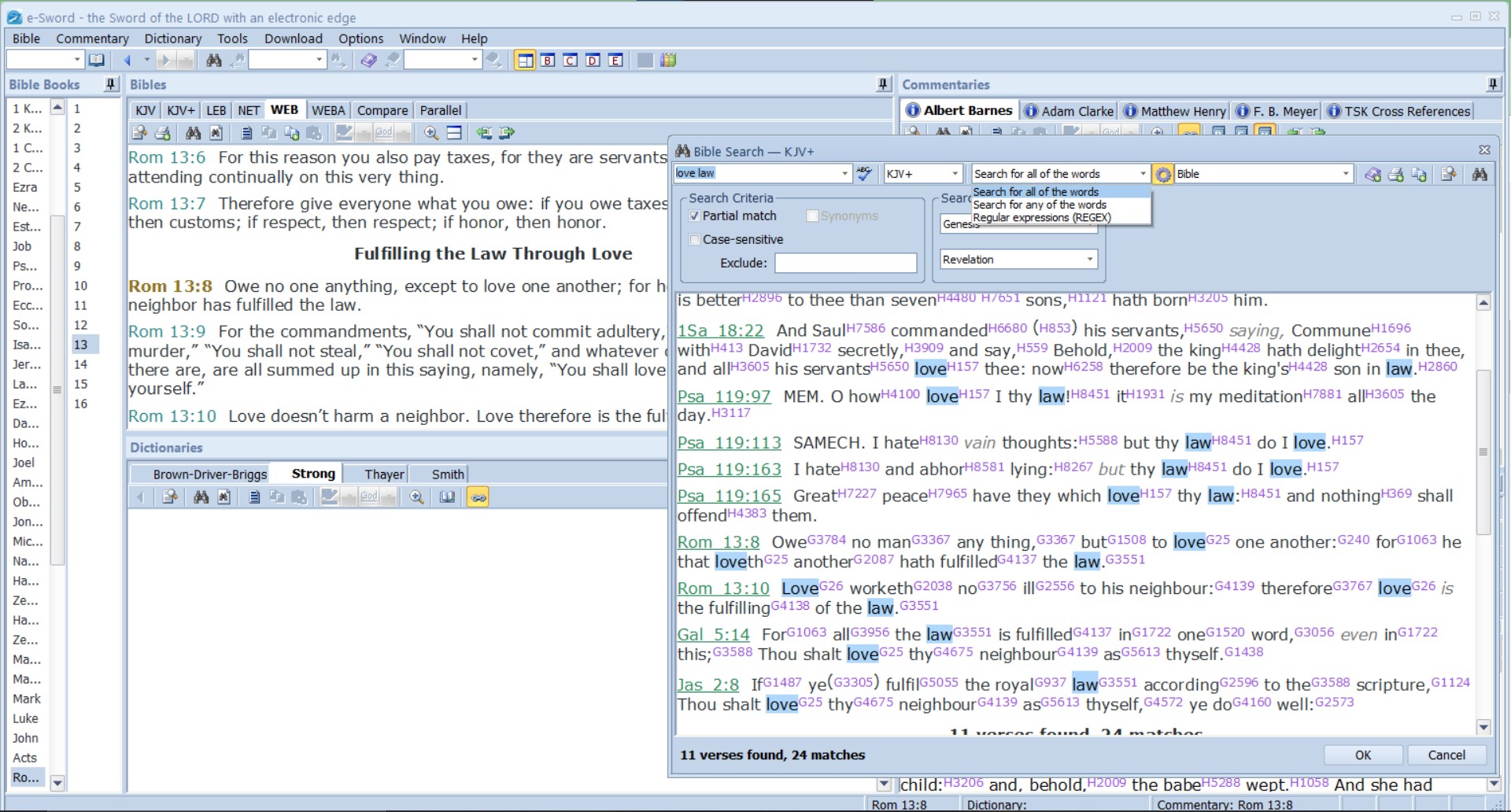
eSword for PC–a free-to-download Bible study program. I mostly use this one if I want to search for specific words or topics in the Bible. The search tools are robust (even more so than MySword) and make it easy to search for parts of words, whole words, and Greek and Hebrew words (by searching for the Strong’s number). You can also have a Bible, dictionary, commentary, and your own notes all open on the same screen.
BibleGateway–an online resource that makes comparing Bible translations very simple. It’s the easiest tool I’ve found for looking at multiple translations side-by-side and doing full text searches of more than one translation at the same time. I use it all the time when writing my blog posts for this site. One thing I like about this website compared to MySword or eSword is that it includes full footnotes (very handy with translations like NET).
Screenshot showing eSword search tool
Language Tools
I’ve done some formal study of Greek–enough to recognize words, understand basic grammar, and read it a little–but not much for Hebrew. The tools I use to study the Bible’s original languages aren’t a perfect substitute for really learning the languages, but I think they do make it easier for someone with a basic understanding of how language works (something any of us can learn relatively easily) to get a deeper look into the nuances of the Bible without devoting their lives to a study of ancient languages.
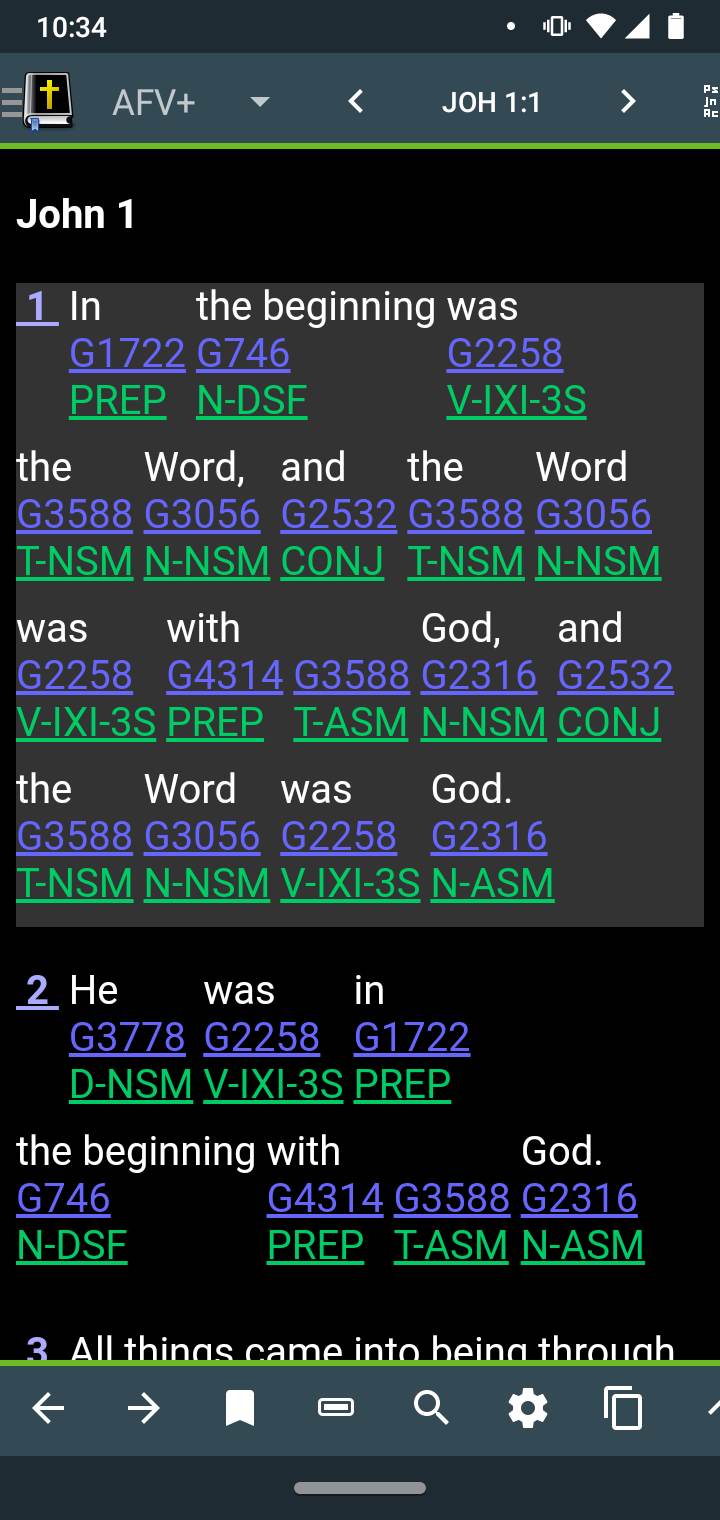
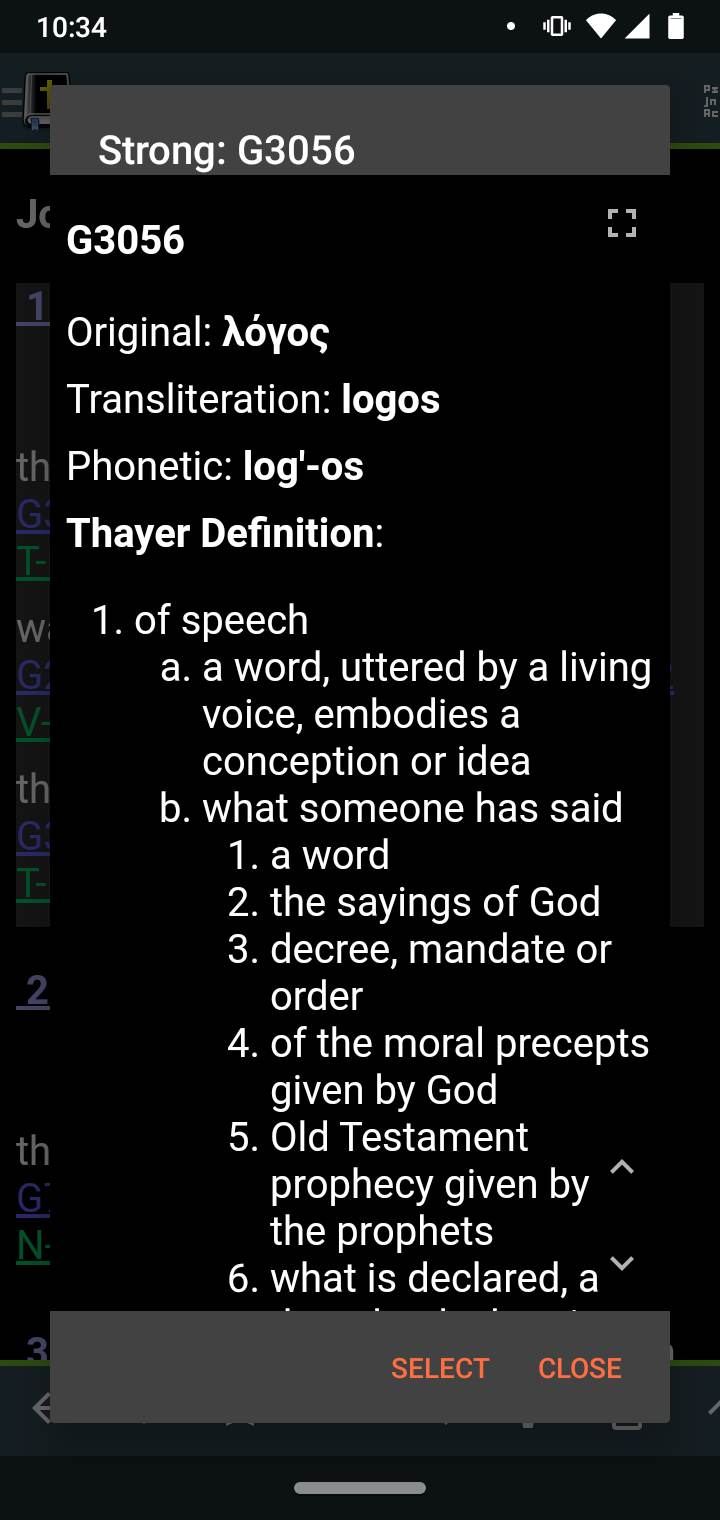
In both eSword and MySword, I recommend Thayer’s Dictionary for Greek and Brown-Driver-Briggs (BDB) for Hebrew. Both of these digital tools offer downloadable modules that link those dictionaries to Strong’s numbers. For any Bible translation that includes Strong’s numbers, you can click on that number and go right to the dictionary. Some of the translations also offer codes that give you more insight into how the word is used. For example, here’s what John 1:1 looks like in the MySword module for A Faithful Version with Strong’s numbers and Morphology (AFV+) if you click on more detail for the word translated “Word.”
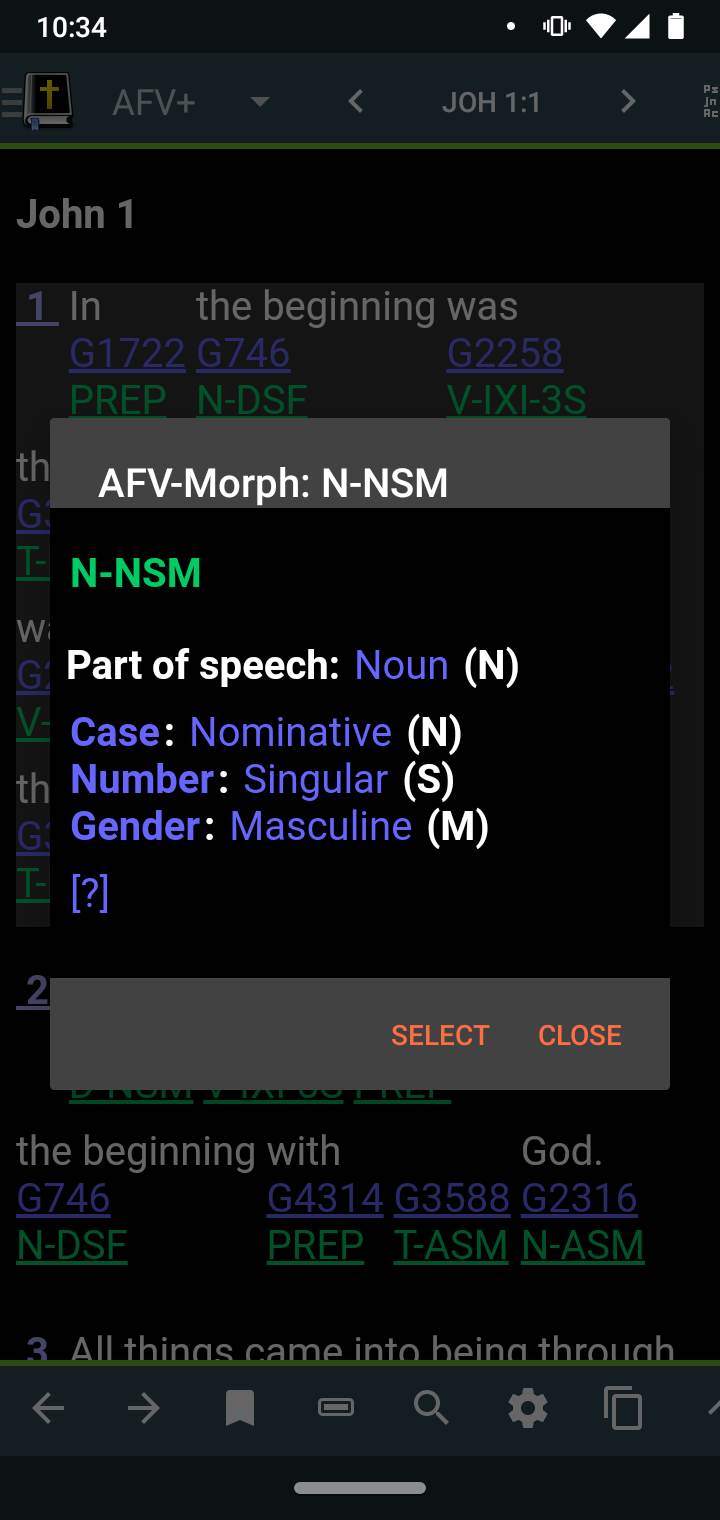
Screenshot of MySword AFV+ translationScreenshot of MySword Thayer’s DictionaryScreenshot of AFV+ morphology
I don’t read AFV+ much just because all those codes can get confusing to look at, but it is great for looking up the nuances behind a translation. If you click on the Strong’s number (G3056), it takes you to Thayer’s dictionary. I don’t have this in the screenshot, but if you scrolled down it would also provide Strong’s definition and a list of all the places this word is used in the New Testament (you could also search for G3056 in the AFV+ or other Strong’s coded translation to see all the places its used).
If you click on the morphology link (N-NSM) this translation shows you linguistic information for the word. Logos is a noun, and here it’s in the nominative case (identifying logos as the subject of the sentence), singular in number, and masculine gender (Greek has gendered nouns much like French or German). I use this tool most often to look up whether a word is singular or plural since you can’t always tell in English (e.g. when Paul says “you are the temple of God,” “you” is plural in the Greek but ambiguous in English).
Hebrew and Greek Dictionaries
In addition to these digital language tools, I also have two print dictionaries that I really like. These provide more complete definitions than the tools in eSword or MySword and also help you understand how different words relate to each other.
Theological Wordbook of the Old Testament* (TWOT) by Laird R. Hariss, Gleason L. Archer, Jr., and Bruce K. Waltke — my favorite Hebrew dictionary. Rather than being tied to Strong’s numbers, this dictionary groups Hebrew words by their root, which provides a much deeper look at the nuances of the Hebrew language. The different numbering system can make this one a bit more challenging to use, but in MySword the BDB dictionary module makes things easy by telling you where to look up the word in TWOT.
Google Is Your Friend
Another general tool that I use a lot is a simple Google search. Don’t know what the Genitive Case is in Greek? There are language-learning tools to help you understand Greek grammar. Partly remember a verse but can’t find it in eSword, MySword, or BibleGateway? Try Googling the words you remember with the word “Bible” and it’ll help you figure out if it’s in a translation you hadn’t thought of or if it’s a quote from something else. Suddenly need an interlinear version of the Septuagint? I recently found one on StudyLight.org. We’re fortunate to live in a time when we have access to Bible Study tools people even just a few decades before could only dream about or could only access in specialized print books.
Most of my Bible studies end up on this blog. That means I’m usually looking at specific topics when I study, so being able to search the Bible effectively, look up Hebrew and Greek words, and compare translations is super helpful. It’s also helpful to be listening to and reading things that prompt Bible-related ideas that can turn into studies which then show up here on my blog. Here are some of my favorite Christian resources for inspiring new studies:
“Truth Be Told” podcast–a thoughtful and thought-provoking “theology and apologetics podcast born out of a love of God‘s word, a hope to find common ground with those who study it, and a desire to outline truth as the Bible tells it.”
Listening to Sermons–usually I don’t go out of my way to listen to extra messages, but I hear ones very much like those I link to for this point every week at my local church. So many of my ideas for Bible studies and then blog posts come from a phrase or scripture that catch my ear in a message someone else is giving, often on a completely different topic.
As I mentioned before, not everyone Bible studies the same way, and that’s okay. We have different spiritual temperaments and different ways we most easily connect with God and His word. Some might spend more time reading whole books rather than focusing on topics. Some might find the most value in picking one verse and meditating on it for their whole study time. Others could read, then search for ways to put those lessons into real-world action. And I’m sure there are way more study styles than I could list here.
I like Gary Thomas’s book Sacred Pathways* as a tool to describe those temperaments (you can read my full review by clicking here). I most closely align with what he calls the “Contemplative” and “Intellectual” temperaments, and I suspect others with similar ways of relating to God will be the ones that find this post most useful (if they haven’t already tracked down similar resources of their own). Still, I hope some of these tools and resources will be helpful for you whatever your spiritual temperament. And I hope you’ll share some of your own favorite resources in the comments.
![Image of a man studying the Bible overlaid with text from Ex. 20:7, AMP version: “You shall not take the name of the Lord your God in vain [that is, irreverently, in false affirmations or in ways that impugn the character of God]; for the Lord will not hold guiltless nor leave unpunished the one who takes His name in vain [disregarding its
reverence and its power]."](https://likeananchor.com/wp-content/uploads/2025/07/bibilical-hebrew-1.jpg)






 Like An Anchor