Becoming “Noble Harry”

Check out this article I wrote for Femnista’s Shakespeare issue (and perhaps a few of their other articles while you’re at it)! It’s always a pleasure to write for and read this online magazine/blog.

I have no trouble answering the question, “What’s your favorite Shakespeare play?” (though it sadly isn’t asked very often). My answer has been Henry V since I first read it in high school. I grew up immersed in classical tales of adventure and heroism–stories by Robert Louis Stevenson and Jules Verne, legends about Robin Hood and King Arthur. In that context, my affection for Henry V comes as no surprise.

“Noble Harry,” as Shakespeare dubs the character, is the quintessential heroic figure. He’s a man of action, a brilliant soldier, a king committed to justice only where he cannot show mercy, a believer in God’s sovereignty, and a romantic figure in his wooing of Kathrine. Shakespeare is far too talented a storyteller to leave even his heroic figures one-dimensional, though. There’s much more to Henry’s character than being a perfect king.

Continue Reading: Becoming “Noble Harry”

Save

Female Difficulties

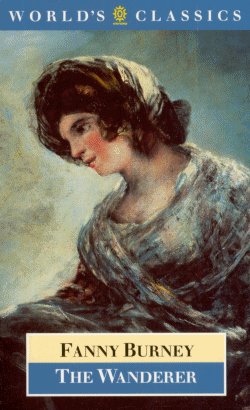
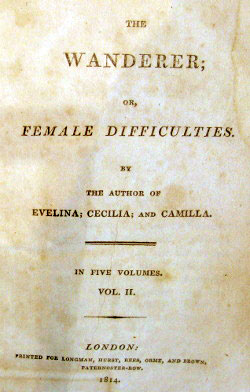
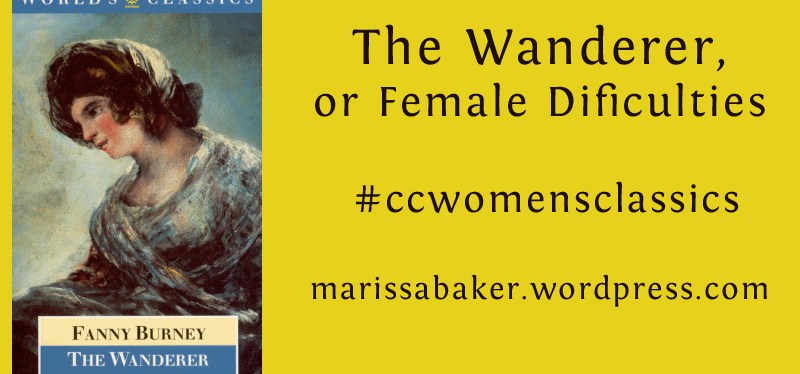
The Wanderer; or, Female Difficulties #ccwomensclassics post | marissabaker.wordpress.comMy title for this post is the subtitle for Frances Burney’s final novel, The Wanderer. It was one of the first books I put down when compiling my Classics Club Book List, and I’m reading it this year for the Women’s Classic Literature Event. Finishing this book means I’ve now read all Burney’s major fiction works (that is a grand total of 3,133 pages of text, so it’s a pretty big deal). I am Reader, hear me roar.

Note: spoilers follow for this 202 year old book.

The Wanderer, or Female Difficulties is the tale of a penniless emigree from revolutionary France trying to earn her living in England while guarding her own secrets. Combining the best elements of the gothic and historical novels, this newly appreciated work is an extraordinary piece of Romantic fiction. Burney’s tough comedy offers a satiric view of complacent middle-class insularity that echoes Godwin and Wollstonecraft’s attacks on the English social structure. The problems of the new feminism and of the old anti-feminism are explored in the relationship between the heroine and her English patroness and rival, the Wollstonecraftian Elinor Joddrel, and the racism inherent within both the French and British empires is exposed when the emigree disguises herself as a black woman. (Goodreads summary)

This is probably the Burney novel that I found most frustrating. Evelina, her first novel, is the easiest to read, though it still engages with the darker side of 18th century romance. Her next two, Cecelia and Camilla, are more difficult (especially if you’re expecting an Austen-style romance). The heroines are persecuted relentlessly, in grave danger several times, and the heroes fail to live up to the name.  The Wanderer takes these themes a step further. Instead of giving her characters ineffective guardians, Burney doesn’t leave the Wanderer, who goes by the name “Ellis” for much of the book, anyone to turn to at all. Instead of revealing the plight of a young woman having difficulty navigating the marriage market, Burney shows the struggles of a woman completely alone without name or resources to protect and support her.

The Wanderer; or, Female Difficulties #ccwomensclassics post | marissabaker.wordpress.comThe Wanderer is a scathing rebuke of society on many different levels. Burney takes full advantage of her lengthy text to discuss the French Revolution, snobbery in the upper classes, gender inequalities, racial stereotypes, modern suspicion of an afterlife, suicide, social perceptions and stereotypes, abusive/coercive relationships, and duty to family (just to name the ones that come to mind within a minute). The amount of ground she covers is really quite impressive. Even more impressive is that she manages to show both sides of most issues. Sometimes you can easily tell where Burney stands, but not always. For several of the ideas discussed, it seems she just wants readers to open their eyes and see that things aren’t always black and white.

What frustrated me when reading The Wanderer wasn’t the issues being discussed or even so much the drawn-out plot line. It was Ellis’ character. The narrative stays with Ellis but maintains a distance that makes it very difficult to sympathize or identify with her. For the better part of the book, we don’t know any more than the other characters about who she is and what her motivations are. We rarely even know what she’s thinking. What’s worse, we seldom hear her say anything. There are a few scenes where Ellis speaks clearly and decisively, but mostly she stands mute. She is silent while other characters misconstrue her motivations, put words into her mouth, accuse her unjustly, and even propose romantic connections. A few words pass her lips, but mostly she stands in acute emotional agony hoping the other characters will understand her inarticulate protests. Even Mr. Harleigh, the heroic figure in this story, becomes so frustrated by this that there are times he is almost violent in his insistence that she give him a straight answer.

Silencing the main character frustrated me, but it also draws attention to the difficulties Burney is discussing. It might be tempting to read the subtitle “Female Difficulties” simply as a critique of the challenges women faced in 18th century society. We could say that it is the other characters who make life difficult for Ellis because society is set-up to be suspicious of a woman alone and to limit her options. But it goes even deeper than that. The type of femininity ingrained the naturally elegant and lady-like Ellis make her situation even more difficult. She is one of her own worst enemies because of her limiting view of her own role as a woman. It’s not seemly for a lady to perform in public, so she refuses to give a concert until she’s shamed into it by a need to pay her debts. It’s not ladylike to accept pecuniary aid from a man, so she becomes entangled in a host of embarrassing situations trying to return gifts that were made anonymously to spare her delicacy. It’s a shame for a woman to run away from her husband, so she conceals the fact that she was forced into a marriage that’s barely recognizable under the law even when it means leading on another man who’s falling in love with her.

Like today, 18th Century culture was struggling with ideas surrounding gender definitions, roles, and expectations. Burney recognized that the problems regarding inequalities between men and women weren’t just external, but also ingrained in prevailing ideas about what constitutes masculinity and femininity. I argued when writing my undergrad thesis about her other novels that Burney countered the gender crisis of her day by advocating for a return to Biblical gender ideals where men and women are recognized as having unique strengths and roles yet also viewed as equally important. In this book, published 18 years after Camilla, there’s little evidence of that hope. Burney seems more cynical about society’s ability to change and points out problems without offering a way to fix things. It’s up to us, the readers, to try and find a solution or to live with the consequences of inaction.wanderer

Click here to get a copy of The Wanderer. Please note that this is an affiliate link. This means that, at no additional cost to you, I will receive a commission if you click on the link and make a purchase.

Save

Tarzan of the Apes and Darwinian Racism

I was only planning to read female authors from my Classics Club list this year (since they’re having their Women’s Classic Literature event), but a recent film trailer took me back to Tarzan of the Apes (1912) by Edgar Rice Burroughs. When I first read Tarzan as a young teen, “with the noble poise of his handsome head upon those broad shoulders, and the fire of life and intelligence in those fine, clear eyes” he became one of my (many) literary crushes (Chapter XIII).

While he was “muscled as the best of the ancient Roman gladiators … yet with the soft and sinuous curves of a Greek god,” what impressed me most was that Tarzan taught himself to read from books he found in his human parents’ cabin. He could read and write fluent English by the age of 18, even though the only other language he had any experience with was the limited vocabulary of the fictive “anthropoid apes” who raised him. By the end of the book, he speaks fluent French as well. I consider myself reasonably intelligent, had the advantage of not being raised by apes, and I haven’t even managed to become bi-lingual.

Tarzan of the Apes and Darwinian Racism | marissabaker.wordpress.com
photo credits: “Tarzan” by Sean MacEntee and “Gorilla” by Hendrik Dacquin, CC BY via Flickr

Yet shadowed by these descriptions of a super human Tarzan is a disturbing form of racism. Racism is evident from the moment the first black characters appear in the story, yet it goes far deeper than a matter of antiquated ideas about race popping up in the way a Classics author writes descriptions. Burroughs’ racism in Tarzan represents a mindset heavily influenced by evolutionary ideas about biology and race. Read more

Thoughts on the Physicality of Christianity

I was in Michigan over the weekend for Last Day of Unleavened Bread and the Sabbath, heard some thought-provoking messages, and had some interesting discussions. One of these messages (and related discussion) touched on the role physical actions play in our Christian walk.

By itself the message I heard  would have prompted many thoughts on the subject, but taken together with a book I’ve been reading it’s quite a chunk of spiritual meat to chew on. I’ll probably write more about this topic when I’m not functioning on ~5 hours sleep and a chocolate hangover, but those are my thoughts right now.

Blocking the Light?

In the message I’m referencing, the speaker talked about Passover symbols (foot washing, bread, and wine) and said “the physical acts are irrelevant” but we keep them because they’re good reminders. That wrinkled my eyebrows a bit, but I thought I’d keep an open mind and hang in there to see where this went.

It went to Colossians 2:16-17: “So let no one judge you in food or in drink, or regarding a festival or a new moon or sabbaths, which are a shadow of things to come, but the substance is of Christ.” He took this and defined shadow as the absence of light, and then called the holy days that we were gathered to keep “blocked light.” The next place he took the analogy was back to the Passover, asking, “Why would Jesus partake of a shadow that’s blocking the light?” The message then jumped to saying that since “He wouldn’t do something like that” the words must function on another level, as in Luke 22:18 referring to our communion with the kingdom of God inside us today rather than an actual event in the future.

“Shadows” by pwjamro, CC BY via Flickr

Obviously I’ve oversimplified his points, but you get the basics of what I want to cover. The crux of his message rested on the idea that “the physical acts are irrelevant.” That led to talking the implication that because holy days, sabbaths, etc. are described as “shadows” they may distract us from living in the Light. But the word for “shadow” in the Greek can mean two different things, much like it can in English. You have the physical absence of light in the sense of “darkness and gloom,” and you have the metaphorical sense. For the Greek word skia (G4639), that means a foreshadowing of a full and perfect image not yet seen clearly. You have to infer the meaning from context. And when the context is discussing Sabbaths that are a key part of God’s covenants and saying that they point to Christ, I have to go with the metaphorical meaning as most likely.

Embodied Liturgy

Then on the other side of the spectrum we have the book I’ve been reading called Desiring the Kingdom: Worship, Worldview, and Cultural Formation by James K. A. Smith (between this and Fill These Hearts, I’ve been reading a surprising amount of truly fascinating Catholic theological works lately). I haven’t yet finished this book and it’s a deeply academic text that defies easy summary. One of his main points, however, is that humans are primarily lovers (“I love, therefore I am” rather than “I think/believe, therefore I am) and that we require embodied liturgies to aim our desires in a correct direction.

“MercyMe” by Susan Lloyd, CC BY via Flickr

While my church does have many physical things we do as part of worshiping God (like resting on the Sabbath day, the Passover symbols, and water baptism) this particular view of physicality in worship was new to me. He seems to be prioritizing physical acts of worship over learning theology and understanding doctrines, which makes me uncomfortable, but the idea of doing what God tells us to just because He says so before we understand why does make sense. I also find the argument that we should engage with God on every level — including emotional — very compelling, especially in light of the many scriptures talking about the role of our hearts in our walk with God.

Balance

I’m thinking something between these views is probably closest to right. Yes, the physical isn’t the main point because it’s largely there to teach us more important spiritual lessons. Focusing too much on physical is one of the things that got the pharisees in trouble — you need to have a right relationship with God or it doesn’t matter how good you look on the outside or how closely you keep the letter of the law.

Still, the physical is vitally important. God created us as physical beings full of desires that He tells us to direct toward Him. If the physical didn’t matter, God wouldn’t spend so much time telling us what to do and what not to do. The state of our hearts is of paramount importance and we’re supposed to control our thoughts, but that results in physical actions. And if we’re in a right relationship with God, we’ll be walking in Jesus’s footsteps (including the physical things He did, like Passover) and keeping His commandments.

What about you? any thoughts on the role physical actions should (or shouldn’t) play in our Christian walk?

Books That Tell Truth Through Lies

As I was going through blog posts in my inbox yesterday,  I noticed two of my fellow bloggers were writing about reading recommendations and lists. Juni Desireé was posting about the top 10 books on her reading list for this year, and Socratic MBTI offered three quick recommendations for “enriching” books to read. In the past, I’ve shared a couple lists of my own, including my favorite fantasy books, but that was way back in 2013 (I’ve been blogging that long!?!). Sounds like it’s time for another recommended books post! Fiction That Tells The Truth

Books That Tell A Truth Through Lies | marissabaker.wordpress.com

I’m taking the title of this post from one of my favorite ideas — that even though “fiction” is defined as imaginary or untrue it is, in fact, a vehicle for telling the truth.

“That’s what fiction is for. It’s for getting at the truth when the truth isn’t sufficient for the truth.” ― Tim O’Brien

“Fiction reveals truth that reality obscures.” ― Ralph Waldo Emerson

“Fiction is the lie through which we tell the truth.” ― Albert Camus

“A fiction writer weaves a fabric of lies in hopes of revealing deeper human truths.” ― Wally Lamb

That’s my favorite kind of fiction. Any good story can teach you something true about yourself or other people, but truly great stories are going to get at a “deeper human truth” than is often isn’t possible in any other form. Child-labor laws would have passed in Britain without Dickens, but would it have happened as quickly if people hadn’t read Oliver Twist? Would the phrase “Catch-22” have entered our vocabulary if Joseph Heller wrote an essay instead of a novel?

Many books exist to share truths or make us think about something we’d otherwise overlook. One of the more famous is 1984 by George Orwell, which I’ve never actually finished reading (I know, I know — I’ll go hide in the corner now). Many others teach us truths seemingly by accident while telling a story. Here are just a few examples :

*note: there will be spoilers for all these books.

The Lord of the Rings
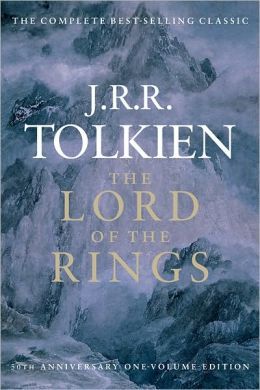
Tolkien insisted his The Lord of the Rings trilogy was not allegorical or inspired by his personal life, but I think we can at least say that his faith (Catholic) and his history (serving in both World Wars) influenced his writings. It’s a classic battle of good verses evil that set the stage for every epic fantasy adventure written since.

Just in case you’ve escaped reading or watching LOTR, the formerly-vanquished dark lord Sauron has come back into power in Middle Earth and is attempting to regain control of a magic ring that will let him subdue all lands and people under his power.  Though there are great warriors involved in the fight, the final victory hinges on two little hobbits from the middle of nowhere who hiked a very, very long way to destroy the ring.

By taking us outside of our own world, Tolkien shares universal truths about what makes a real friendship, the sacrifices required to do the right thing, and the importance of resisting evil even when it seems hopeless. One of the truths that hits me the hardest when reading or watching Lord of the Rings is how helpless we are to resist evil on our own. Frodo was incredibly strong on an emotional and psychological level and he carried the ring longer than any other character could have, but he still couldn’t make it up to Mount Doom by himself. Sam carried him the rest of the way and Frodo still wouldn’t have destroyed the ring if Gollum hadn’t fought him for it and carried it into the fires when he fell. Even heroes are susceptible to evil’s pull and they can’t overcome alone.

Mockingjay

I’ve read the whole Hunger Games book series and just watched Mockingjay Part II this past weekend. Suzanne Collins grew up learning about military history from her father — a Vietnam veteran and history professor. She didn’t go the history professor route herself, though, instead majoring in theater and telecommunications, then earning a master’s degree in dramatic writing.

The Hunger Games, Catching Fire, and Mockingjay all take a good, hard look at what the article linked above describes as “necessary and unnecessary wars.” They quote Collins saying, “If we introduce kids to these ideas earlier, we could get a dialogue about war going earlier and possibly it would lead to more solutions.” In this case, the writer approached her storytelling hoping to convey truths about and get a dialogue started on ideas relate to war.

My mother, brother and I were talking yesterday about how Mockingjay is a story that sticks with you. It’s not something you can just read/watch and move on from. This is largely owing to what is probably Collins’ least popular authorial choice — killing Finnick Odair. In the book I actually read right over his death the first time and then had to go back and figure out what happens to him. His death isn’t the driving force in a major plot point (like Prim’s death) and he doesn’t have a dying scene all of his own (like Rue does in the first book). He just dies senselessly and tragically while the action moves on without him. And that’s the point. In real life, death doesn’t always make sense or serve a specific purpose.

Ender’s Game

This book could have so easily been nothing more than a story about a futuristic society that trains children to kill aliens. But Ender’s Game was written by Orson Scott Card (one of my all-time favorite writers) and there’s much more to it than that. The real story isn’t about the alien threat — it’s about human nature.

Ender’s Game wrestles with the question of how far it’s “okay” to go when you’re at war, and it does so from the perspective of a child who’s been immersed in a militaristic system for the bulk of his formative years. Just in case the military training isn’t enough to make him comfortable with genocide, though, he’s taught the entire thing is a game — that none of the aliens will actually die if he wins.

As the story unwinds, we’re forced to confront ideas that can spill over into our own world. How violent can games become before they start affecting reality? When, if ever, are large-scale preemptive strikes an acceptable form of self-defense? What is an adult’s responsibility toward children?

Somewhat less obvious is the question of an individual’s responsibility within society. Ender was raised from a young age to think of the Buggers (this name was changed to Formics in later Enderverse writings) as enemies you must destroy at all costs. He should have been thoroughly brainwashed into believing this, and yet learning he’d succeeded in wiping out his enemy in real life rather than just in-game nearly destroyed him. He devoted the rest of his life to making others understand the Hive Queen’s perspective and trying to set things right by bringing back the Formics species. Perhaps that’s the real take-away truth from Ender’s Game — there are at least two sides (and often more) to every story and it’s not always easy to see who’s right.

Your Turn: What are some of the truths you’ve discovered in and through fiction?

Evelina: A Darker Look At Courtship

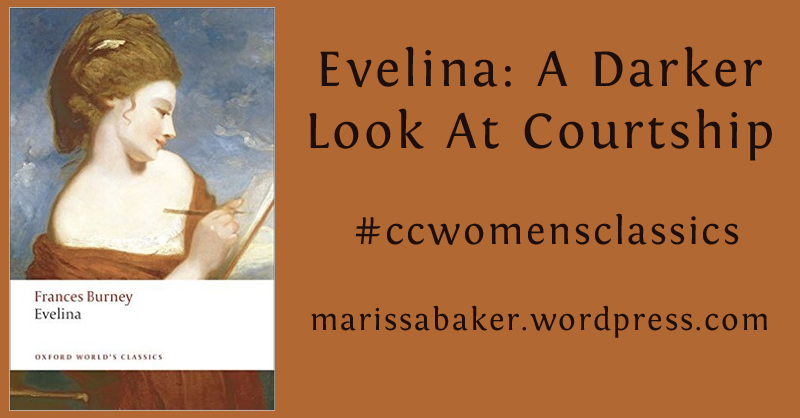
When I first read Evelina, my observation was that Frances Burney’s style “represents a shift nearing the latter part of the 18th century from fiction as a didactic tool to fiction as a pleasurable reading experience.” While I’m good as saving my literary observations (I have copies of everything I wrote in college), I’m apparently not very good at taking my own advice. This is the first time I’ve read Evelina for pleasure rather than analysis

I chose Evelina for a reread on my Classics Club Book List, and it also fits neatly into the Classics Club’s year-long Women’s Classic Literature Event (Tweet about it with #ccwomenclassics). The first time I read Evelina was in Spring 2010 for an upper-level course on The Early British Novel. Though I didn’t hate any of the other 4 books in this course, Burney’s little epistolary novel from 1778 was by far my favorite.

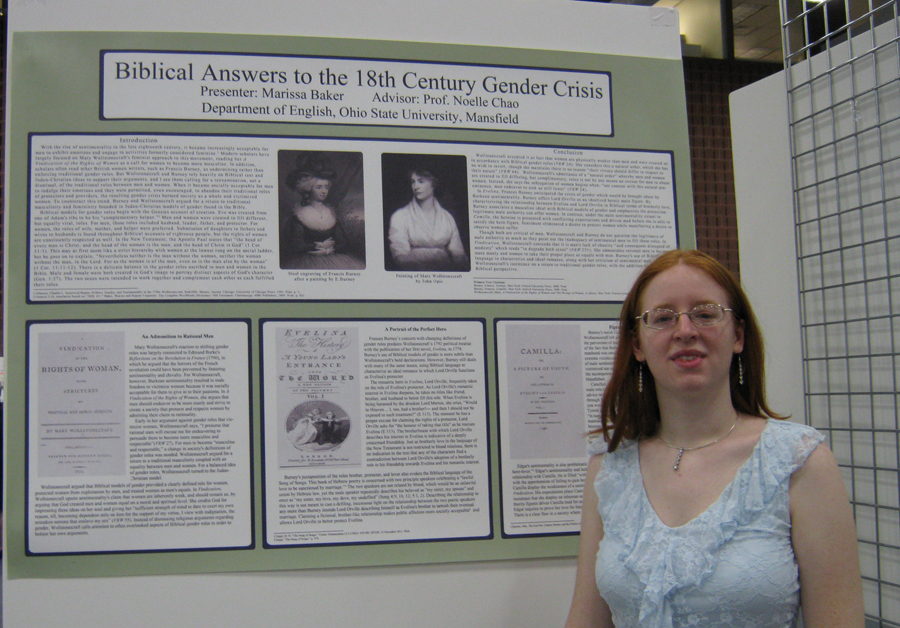
It’s no wonder, then, that when our professor asked me and one other student if we’d like to read more Burney in an independent study I said “yes.” We read Cecelia (1782) and Camilla (1796) – both weighing in at a solid 900+ pages. Then we branched out into Ann Radcliffe with The Romance of the Forest. That lead me to my first undergraduate research project titled “Unmanned Heroes: 18th Century Female Writers and Male Sentimentality. That turned into a 25-page research paper titled “Biblical Answers to the 18th Century Gender Crisis” (click on the title if you’d like to read this), which led me back to reading Evelina academically.

Reading "Evelina" for #ccwomenclassics | marissabaker.wordpress.com
Me at the Denman Undergraduate Research forum in 2012

Now, 4 years later, I’m back reading Evelina and enjoying it more than ever. Frances Burney was a fantastic (and, sadly, under appreciated) writer. Though Evelina was first published anonymously, Burney never hid the fact that she was a female writer. Her novels were quite popular with the general reading public and in artistic circles even during a literary age we often think of as belonging only to “dead white man.” Her style and success paved the way for writers like Jane Austen. In fact, Austen took her title Pride and Prejudice from a scene in Burney’s second novel, Cecilia, and when Austen’s father was seeking publication for that novel he described it as “about the length of Miss Burney’s Evelina.”

Comparing Burney to Austen (another favorite writer of mine), there are clear similarities, especially in Evelina. Both writers focus on a young woman who “marries up” by the end of the novel. Both critique society and social norms with a thinly-veiled sarcastic wit. But the differences are at times even more striking than the similarities. Nowhere in Austen will you find a scene like the one in Evelina when Captain Mirvan impersonates a highwayman and drags Madam Duval into a ditch where he terrifies her for sport. And, though Austen does have her Mr. Willoughbya and Mr. Wickhams, you’ll not find any of her main characters in situations so dangerous as Evelina’s.

Throughout the course of the novel, Evelina is persecuted by a man named Lovel, hounded and even kidnapped by Sir Clement, affronted by a staring Lord (in front of his fiancee), and rudely accosted by strange men at Vauxhall. To quote an essay by Judith Newton that appeared in a 1976 edition of Modern Language Studies, there are few places Evelina can go “without being forced, intruded upon, seized, kidnapped, or in some other way violated.” Newton describes this persecution as a “woman’s fate” once she entered into the marriage market in the 1700s, and points out that Burney “is one of the few writers in the century to take the discomfort of it seriously.”

Indeed, while I’ve frequently thought I might like to visit Jane Austen’s England, Burney’s is much less appealing. It’s populated with aggressive and vulgar people, the public places are unsafe without a large party and/or male protection, and it’s painfully obvious how vulnerable and option-less women were without family and fortune to their name. But it also feels more real. Sense and Sensibility came out in 1811 and Pride and Prejudice in 1813 – a scant 33 and 35 years after Evelina. Things had changed, but not that much. Much as I love Austen, I wonder if Burney was in some ways the braver novelist for calling out her contemporary society on its darker sides.click to read article, "Evelina: A Darker Look At Courtship" | marissabaker.wordpress.com

Click here to get a copy of Evelina. Please note that this is an affiliate link. This means that, at no additional cost to you, I will receive a commission if you click on the link and make a purchase.