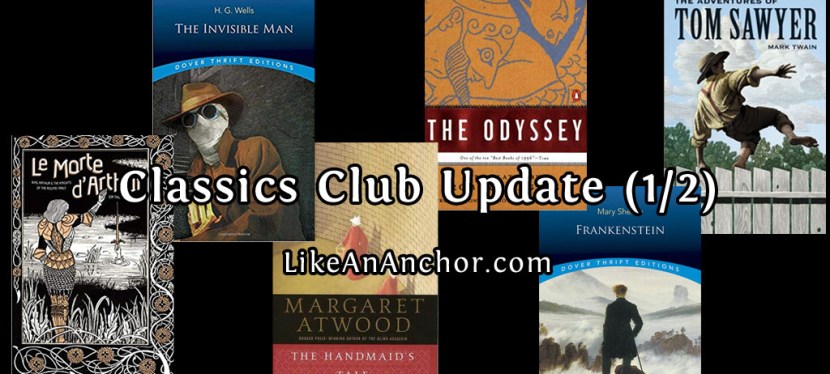
Classics Club Update (1/2)

Almost five years ago, I committed to reading 50 classic works of literature in 5 years. I’m starting to worry I won’t actually finish my Classics Club list by the August 18 deadline, despite the fact that I’ve already read more than 50 books this year alone. They just haven’t been the right books for the list (even with swapping out some of the titles for ones I’m more interested in now).

I’m not out of time yet, though, so I’m going to keep trying. Part of the agreement includes blogging about each title, but since this isn’t really a book blog I’m not going to write a whole post about each book I’ve read. Instead, here are a collection of my thoughts on six of the twelve books that were still on my list.

Frankenstein

Classics Club Update (1/2) | LikeAnAnchor.comMary Shelley’s Frankenstein has been on my list since the beginning. I’d read some of her mother’s work and had seen an on-stage version of Frankenstein as well as a modernized YouTube series, but this was my first time reading the original novel. It wasn’t entirely what I’d expected, though the format is familiar from reading other books from this time period. The story is told as if Victor Frankenstein is sharing his research (along with a cautionary tale) to the explorer who found him pursuing his created creature toward the North Pole.

Probably the thing that fascinated me most was the role Frankinstein’s psychology played in the story. Published in 1818 — 38 years before Sigmund Freud was even born — Mary Shelley explores the idea that Frankinstein’s path was shaped by his environment and his childhood as much as by the conscious choices he made. Did he make himself into the monster that created this creature? Or did was he a tragic product of his past? The story seems unsure and leaves us to answer that question for ourselves. Read more

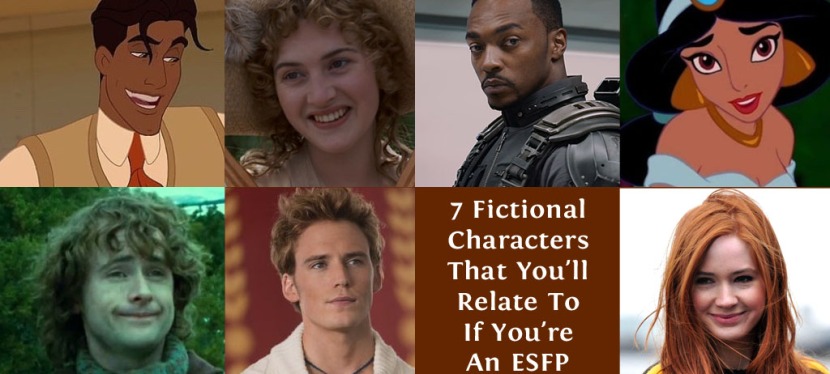
7 Fictional Characters That You’ll Relate To If You’re An ESFP

What fictional characters do you relate to as an ESFP?

Just as we can describe real people using the Myers-Briggs® typology system, we can also type well-written fictional characters. Some of fiction’s most iconic and intriguing characters are ESFPs and today we’re going to talk about seven that I think real-life ESFPs will find relatable.

One great thing about looking at character personality types is that it helps us better understand people who have different types than we do. Fictional ESFPs can serve as examples for what real-life ESFPs might be like, and also show how much variation can exist between individuals with the same type.

The things that makes ESFPs such great fictional characters are much the same things that make them so magnetic in real-life. ESFPs are engaging, passionate people who love “tangible reality” (to quote Jung’s description of Sensation types). They’re charming, interested in other people, and often have a talent for entertaining. Plus, ESFPs also have a highly practical side. It’s no wonder the fictional versions of this type can make for such intriguing characters!

Amy Pond

Like other EP types, Amelia Pond from Doctor Who thrives on new experiences. More specific to ESPs is the fact that Amy is very much in-tune with the physical world and finds ways (like modeling and working as a Kissogram) to engage with that world in sensual ways. She’s also easily bored when there aren’t new places to explore and experiences to be had (which is one reason she loves traveling with the Doctor).

Though a Feeling type, Amy is guarded with her emotions and often struggles with picking up on what other people are feeling. The Feeling side of her personality is turned inward, and mostly shows up as a strong desire to be true to her authentic self. She makes decisions based on what she believes is right. When she does share her thought processes, it’s mostly in a no-nonsense way that makes use of her tertiary Extroverted Thinking. She’s one of the fictional ESFPs that demonstrates this type has much more to offer than just being the life of the party. They can also be intelligent, stubborn, and principled people like Amy. Read more

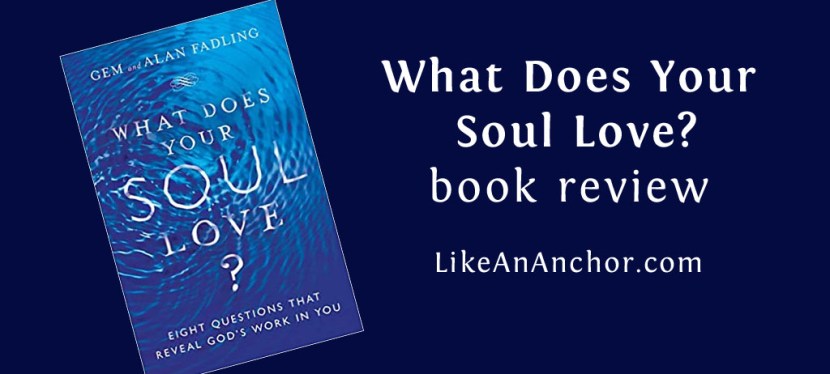
What Does Your Soul Love? book review

Whenever I discover a new resource for helping us “find our true selves in the people God created us to be,” I like to make sure I share it with you. One of the most recent I’ve come across is What Does Your Soul Love? Eight Questions That Reveal God’s Work In You by Gem and Alan Fadling.

This is a book about discovering who you are by learning about how God is working inside you. I requested an ARC (advance review copy) through NetGalley because I thought it might be interesting. I wasn’t expecting it to make me think so much or encourage spiritual transformation and personal growth at such a deep level.

The authors ask readers a series of eight questions designed to cultivate “deeper awareness and soul focus.”

  1. What do you really want?
  2. What is getting in your way?
  3. Where are you hiding?
  4. What is most real to you?
  5. How are you suffering?
  6. What are you afraid of?
  7. What are you clinging to?
  8. What does your soul love?

With each chapter, they discuss a core aspect of who we are deep down inside. Desire, resistance, vulnerability, truth, pain, fear, control, joy – how we experience and relate to these things has a huge impact on who we are as people. As the chapters unfold, the Fadlings discuss each topic in depth and invite us to think about change in these areas as something that happens inwardly as a result of God’s work in us rather than as outward changes we need to try and make ourselves.

Reading this book has already inspired two posts on this blog: “Am I Living A Flesh Life Or A Spirit Life?” and “There’s Only One Sovereign, And It Isn’t Me.” I really like books that make me think about something so deeply that I’m inspired to write about it. I’ve already talked about some of my favorite quotes from this book in those posts, so I won’t go over them again. There are a few others I want to share with you, though:

“We don’t change so that we’ll be loved more by God. We are measurelessly loved by God, so we are free and enabled to change in all the ways we long for.”

“The first step toward peace is to accept what is. Notice I didn’t say condone what is; I said, accept what is. We must become people who acknowledge what is actually going on.”

“Obedience and confidence go together. When I go my own way, I go alone. When I walk with God, I go forward in good company.” — all quotes by Gem and Alan Fadling from What Does Your Soul Love?

That’s just a tiny sample of the nuggets of wisdom in this book. I really liked most of the content and it prompted me to think deeply about the personal growth work I’ve been doing lately. The book also includes exercises and reflection questions at the end of each chapter, which were hit-and-miss for me personally. Some were extremely helpful while others fell-flat.

I also didn’t resonate with many (though not all) of the authors’ personal examples and found myself skimming over them a few times. However, that was more of a personal preference than an issue with the book. Overall, I found the questions, content, and perspective on growth offered in What Does Your Soul Love? challenging in all the best ways. I highly recommend it for anyone interested in spiritual growth and development.


What Does Your Soul Love? comes out on September 17th. Click here to pre-order a copy of this book. Please note that this is an affiliate link, which means that at no additional cost to you I’ll receive a small commission if you clock on the link and place an order.

My thanks to InterVarsity Press, Gem and Alan Fadling, and NetGalley for an ARC of this book. Opinions expressed in this review are completely my own.

7 Fictional Characters That You’ll Relate To If You’re An ESTP

What fictional characters do you relate to as an ESTP?

Just as we can describe real people using the Myers-Briggs® typology system, we can also type well-written fictional characters. Some of fiction’s most iconic and intriguing characters are ESTPs and today we’re going to talk about seven that I think real-life ESTPs will find relatable.

One great thing about looking at character personality types is that it helps us better understand people who have different types than we do. Fictional ESTPs can serve as examples for what real-life ESTPs might be like, and also show how much variation can exist between individuals with the same type.

Much like ISTPs, ESTP characters make fantastic action heroes. But they’re also far more than that. You’ll find ESTPs in fiction (and in real life) using their natural strengths in a variety of ways as they lead others, solve problems, and adapt to life moment by moment. The way their minds work make them compelling, dynamic characters that often capture our hearts and imaginations.

James T. Kirk

Lenore Thomson types Jim Kirk as an Intuitive type in her otherwise excellent book Personality Types, but I’m more inclined to agree with Susan Storm that he’s an ESTP. To quote her article about The Greatest Movie Heroes of Every Myers-Briggs® Personality Type, “Jim Kirk embodies the impulsive, opportunistic nature of the ESTP personality type. He lives fully in the moment and is quick to react to changes in his environment. He loves a fast-moving, daring lifestyle and loves to experience new and novel things.”

Kirk is every bit as charming as you’d expect from ETP types with tertiary Extroverted Feeling. This function also gives him an edge in understanding people (though as a tertiary function it isn’t his strongest suit) and lends an easy carelessness to the way he presents himself to the world. People may initially misinterpret him as shallow and/or “boyish,” but he continually demonstrates that he thinks deeply about things. He’s quick to come up with clever plans, to understand what’s going on in unexpected situations, and often shares deep insights about complex ethical questions he’s working to make sense of. Read more

7 Fictional Characters That You’ll Relate To If You’re An ENFJ

What fictional characters do you relate to as an ENFJ?

Just as we can describe real people using the Myers-Briggs® typology system, we can also type well-written fictional characters. Some of fiction’s most iconic and intriguing characters are ENFJs and today we’re going to talk about seven that I think real-life ENFJs will find relatable.

One great thing about looking at character personality types is that it helps us better understand people who have different types than we do. Fictional ENFJs can serve as examples for what real-life ENFJs might be like, and also show how much variation can exist between individuals with the same type.

The things that makes ENFJs such great fictional characters are also the things that make them so engaging in real life. ENFJs tend to have extraordinary charisma, keen insight into other people’s needs and desires, and a genuine desire to help others. They make wonderful leaders, teachers, and counselors and in many cases those are roles we see them filling in fiction as well as real life.

Charles Xavier

Professor X is usually typed either as an INFJ or ENFJ. But for the film versions at least, I think he’s more of an ENFJ (though all NF types could probably find him relatable due to his idealism and drive to help others). Especially as a young man, Charles is very outgoing and friendly in social situations and puts the well-being of others as one of the his primary concerns. He’s also more live-in-the-moment than most INFJs, which is partly a result of having Extroverted Sensing as his tertiary instead of inferior function.

In many ways, Xavier’s superhuman abilities are an extension of the ways that an NFJ’s mind naturally works. For example, Extroverted Feeling is often linked to an ability to feel others’ emotions. Pair that with pattern-recognizing Introverted Intuition and it can almost seem like INFJs and ENFJs have the ability to read minds. Real-life ones can’t, of course, nor can they predict the future or see into someone’s past. But they do have a keen insight into understanding how people think and can put together patterns well enough to predict probable outcomes. Read more

7 Fictional Characters That You’ll Relate To If You’re An ISFP

What fictional characters do you relate to as an ISFP?

Just as we can describe real people using the Myers-Briggs® typology system, we can also use the system to type well-written fictional characters. Some of fiction’s most iconic and intriguing characters are ISFPs and today we’re going to talk about seven that I think real-life ISFPs will find relatable.

One great thing about looking at character personality types is that it helps us better understand people who have different types than we do. Fictional ISFPs can serve as examples for what real-life ISFPs might be like, and also show how much variation can exist between individuals with the same type.

One of the things that makes ISFPs such great fictional characters is their strong, personal moral compass and their commitment to living life authentically. Plus, they pair that introverted side with a zest for life that carries over into the outer world as well.

Arya Stark

Arya’s fiercely individualistic nature and vivid moral worldview hint at a strong preference for Introverted Feeling (Fi). That, coupled with her sensory, in-the-moment skills that come with her co-pilot Extroverted Sensing, make her a relatable character for many ISFPs (there’s quite a bit of debate about which type she is, though, as she’s relatable for many other SPs and FPs as well). Some ISFPs (like Arya) can be pretty social and enjoy the company of others, but from what I remember of the books, and what I’ve heard about her character in the TV show, it seems like she’s leading with Fi.

Many real-life ISFPs can identify with Arya’s strong morals and ethics, which are intensely personal. It’s also pretty common for ISFPs to have a strong sense of their own identity and resist efforts to make them fit into other’s expectations, as Arya does. She also prefers to keep her feelings private and interact with the outer world through taking action or voicing an opinion rather than expressing her inner self in words. Read more