Inheriting Covenants: Revisited

I’ve been thinking about covenants a lot lately, especially the topic of which covenants transfer to us today and how that happens. I think of this as the topic of “inheriting covenants,” the title of a blog post I wrote way back in 2016. When I realized how long ago I wrote that post, I wanted to revisit the topic. As we grow in our walk with God, we should gain a deeper appreciation and understanding of His word. It’s good to go back sometimes and revisit topics we thought we understood well. As Paul said, “If someone thinks he knows something, he does not yet know to the degree that he needs to know” (1 Cor. 8:2, NET). There’s so much depth to God’s word; so much to learn as we grow.

Defining Covenants

Let’s start with the basics. In Hebrew, the word for “covenant” is berith (H1285). In Greek, for the New Testament, the word is diatheke (G1242). These words don’t mean exactly the same thing, and so it can be challenging for us today to figure out what the Biblical writers meant by covenants and how they worked. Also, most of our lives aren’t based on covenants today; in the U.S., I’ve rarely heard that word used outside of a religious context. We need to do some linguistic and historical research to understand covenants, which are so important to the Biblical world and God’s ongoing relationships with humanity.

The Theological Wordbook of the Old Testament (TWOT) notes that “Apart from blood ties the covenant was the way people of the ancient world formed wider relationships with each other” (entry 282a). Covenants have to do with establishing relationship. They were binding agreements between two parties that people in the ancient world took very seriously; “There is no firmer guarantee of legal security peace or personal loyalty than the covenant” (Behm, qtd. in TWOT). When God made a covenant with His people, we was binding Himself in relationship to them in the most reliable way possible. Like other covenants, the ones between God and humanity include both expectations and promises. Covenant documents between people survive to the present day, and the format of them has many similarities with God’s Ten Commandments and the book of Deuteronomy (Klein, ref. in TWOT).

In Greek, diatheke means testament, as in “the last disposition which one makes of his earthly possessions after his death,” or a covenant agreement (Thayer). According to Spiros Zodhiates, dispensation/testament is always the usage in classical Greek (The Complete WordStudy Dictionary of the New Testament, entry 1242). New Testament writers picked this word to use for covenants. That might seem odd at first, but Zodhiates proposes a definition of covenant that covers both the unilateral enactment of diatheke and the established relationship of berith. He writes that what we describe as a covenant “is a divine order or agreement which is established without any human cooperation and springing from the choice of God Himself whose will and determination account for both its origin and its character” (entry G1242, section IV).

Indeed, we always see God as the initiator of covenants and, by necessity, the relationship established by a covenant with God is always one where He is the superior party. God calls us His friends, but that is a gracious choice on His part; we are by no means His equals nor can we make demands of Him. We either choose to accept the covenants He offers, or we reject relationship with Him. We don’t get the chance to insert our own demands into the covenant; we trust that we’re more than adequately protected and provided for by His promises.

Image of a woman reading the Bible overlaid with text from Jeremiah 31:31, 33, NET version: "Indeed, a time is coming," says the Lord, "when I will make a new covenant with the people of Israel and Judah. ... I will put my law within them and write it on their hearts and minds. I will be their God and they will be my people."
Image by Matt Vasquez from Lightstock

Key Covenants

There are four main covenants that God made with human beings that are recorded in the Old Testament writings: the Noahic Covenant, the Abrahamic Covenant, the Sinai Covenant, and the Davidic Covenant. There are other covenants mentioned, but those are the big ones. The BibleProject has a great summary of these on YouTube:

With the exception of the Noahic Covenant, the covenants God made with people included expectations for God’s human covenant partners. God kept up His covenant promises, but people broke the covenants with God. That put us under a death-penalty; a curse (Rom. 3:23; 5:12; Gal. 3:10). Then Jesus came along. As a human being, He was a physical descendant of Abraham, an Israelite heir of the covenants with God, and a man in the lineage of David (Acts 2:29-31). He was born into the physical position of an heir to all these key covenants. He also came as God in the flesh, so He can see covenants from both sides and keep covenant perfectly both as God and human.

Prior to Jesus Christ coming to this earth, all except the Noahic Covenant were linked to Abraham’s descendants. The Sinai Covenant was with all of physical Israel and included a fuller revelation of God’s law and expectations. The Davidic covenant was more specific, applying to one line of the tribe of Judah. It was possible for a stranger to join themselves to Israel and become part of the Abrahamic and Sinai Covenants with God, as Rahab and Ruth did, but it was apparently quite rare and more often than not was discussed in a prophetic context (Is. 56:6-7).

That also changed with Jesus’s coming. In the New Testament, Paul writes to Gentile believers that they were “alienated from the citizenship of Israel and strangers to the covenants of promise, having no hope and without God in the world” until the time of their conversion. They were not previously heirs to the covenants, “But now in Christ Jesus you who used to be far away have been brought near by the blood of Christ” (Eph. 2:12-13, NET). This is a fulfillment of a promise that God delivered through His prophets; a promise to make a better New Covenant with the people of Israel and the spiritual descendants of Abraham.

A Question of Inheritance
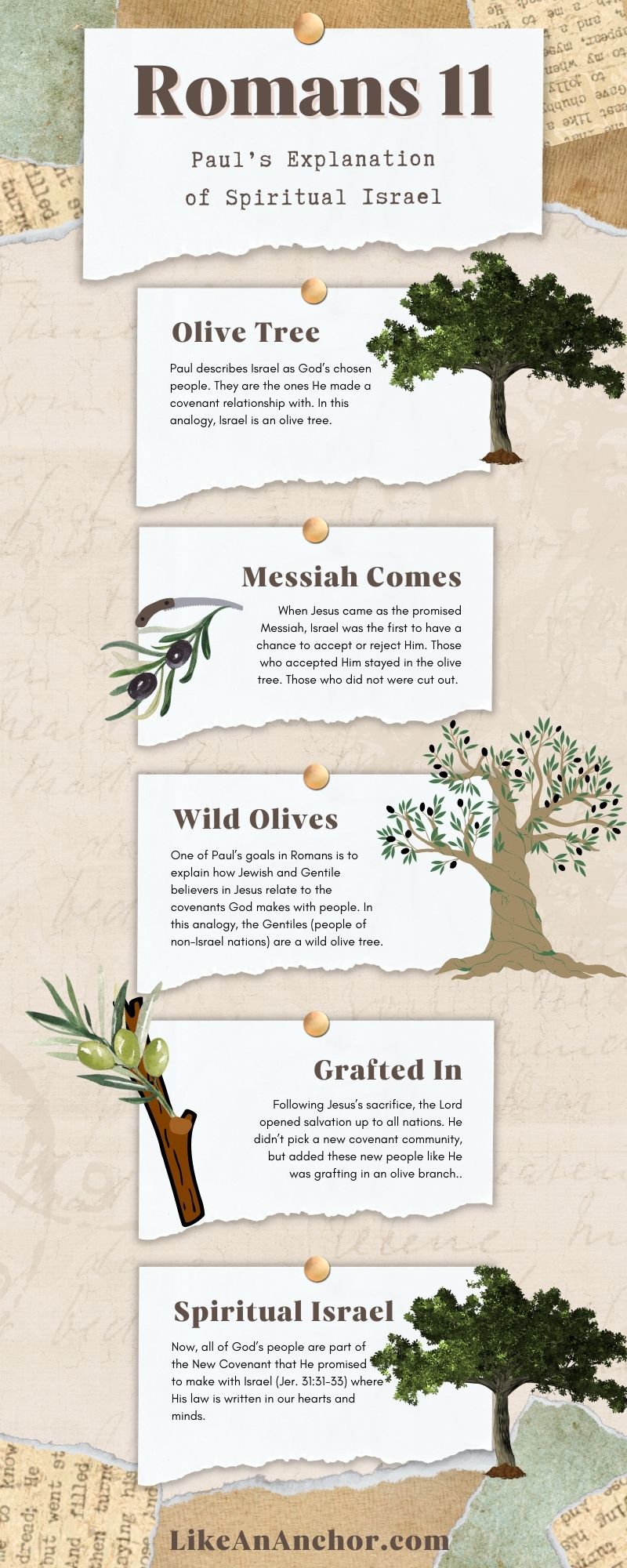
Infographic illustrating the "grafted in" analogy Paul uses for how Jewish and Gentile Christians enter the New Covenant community with God.

I usually go to Romans when I want to discuss covenants, which is where we were a couple weeks ago when I shared an infographic illustrating how all God’s people become spiritual Israel. Today, though, we’re going to spend some time in Galatians.

In this letter, Paul writes to a group of churches with the expressed purpose of countering distorted gospels (Gal. 1:6-8). He wants to ensure that they follow the pure gospel that he receive, not some distortion arising from human reasoning (Gal. 1:1, 11-12, 15-24). That’s the perspective Paul’s coming from when he discusses covenants in this letter.

It appears that the Galatian believers had been deceived by a person or group who told them they needed to keep the whole Jewish law in order to be saved. The Galatians were worried that the male believers needed to be circumcised, that they had to keep the whole Old Covenant law, and that they additionally had to keep Jewish additions to God’s law. Paul reminds them that it is Jesus’s faithfulness that brings us righteousness and justification, not our own efforts. That doesn’t mean we break God’s law; Christ in us most certainly does not encourage sin. But He also didn’t save us and give us the Spirit so that we could then save ourselves by our own efforts. Rather, we’re following the example of Abraham.

Just as Abraham believed God, and it was credited to him as righteousness, so then, understand that those who believe are the sons of Abraham. And the scripture, foreseeing that God would justify the Gentiles by faith, proclaimed the gospel to Abraham ahead of time, saying, “All the nations will be blessed in you.” So then those who believe are blessed along with Abraham the believer. 

Galatians 3:6-9, NET (bolt italics mark quotes from the Old Testament)

Here, Paul quotes from the record in Genesis of God cutting a covenant with Abraham (Gen. 15). This covenant is one of inheritance and blessing. We learn more about it in Genesis 17 and 18, which Paul also quotes. If you read that section, you’ll notice that God’s covenant with Abraham included people following the Lord’s way and doing what is right. But, as Paul emphasizes, the promises come to Abraham and his descendants because God is faithful, not because they kept the Law that God later shared as part of the Sinai Covenant or because they observed Jewish traditions added later.

God does want people to follow His law (it defines sin and, since sin is not consistent with God’s character, it damages relationships between us and Him). But God also knows that all people sin. It is very, very good for us that He upholds His part of covenants even when people aren’t faithful, because one of those covenant promises was that God would send Jesus as the Messiah. That’s how we inherit the Abrahamic Covenant promises: through Jesus Christ.

 Brothers and sisters, I offer an example from everyday life: When a covenant has been ratified, even though it is only a human contract, no one can set it aside or add anything to it. Now the promises were spoken to Abraham and to his descendant. Scripture does not say, “and to the descendants,” referring to many, but “and to your descendant,” referring to one, who is Christ. What I am saying is this: The law that came 430 years later does not cancel a covenant previously ratified by God, so as to invalidate the promise. For if the inheritance is based on the law, it is no longer based on the promise, but God graciously gave it to Abraham through the promise.

Galatians 3:15-18, NET (bolt italics mark quotes from the Old Testament)

A few verses later, Paul says that the Law was “added because of transgressions, until the arrival of the descendant to whom the promise had been made” (Gal. 3:19, NET). He also says the law was a guard to keep us safe and a “tutor to bring us to Christ, that we might be justified by faith” (Gal. 3:24, WEB). The law defines sin for us and reveals the penalties for breaking God’s covenant law. As transgressors of the covenant, we deserved to inherit the curses contained in the covenanting words (Deut. 11:26-32; 27:1-28:68). The only one who perfectly kept God’s covenant was Jesus Christ, and so He’s the only one who truly deserved to inherit all the promises. When He died, He “willed” those promises to us. We inherit the Abrahamic Covenant alongside Him, and through Him we’re brought into the New Covenant that God long ago promised would replace the Old (Sinai) Covenant (Jer. 31:31-34; Heb. 8).
Image of a man reading the Bible overlaid with text from Galatians 3:26-29, NET version:  " For in Christ Jesus you are all sons of God through faith. For all of you who were baptized into Christ have clothed yourselves with Christ. There is neither Jew nor Greek, there is neither slave nor free, there is neither male nor female—for all of you are one in Christ Jesus. And if you belong to Christ, then you are Abraham’s descendants, heirs according to the promise."
Image by Matt Vasquez from Lightstock

Promises Through Jesus

I find it so fascinating that the New Testament writers use the fact that the Greek word for covenant also means last will and testament to connect the idea of covenant inheritance to our adoption as God’s children (Gal. 3:26-4:7; Rom. 8:14-17). The author of Hebrews spends quite a bit of time explaining this concept, particularly the transition from Old to New Covenant.

 And so he [Jesus] is the mediator of a new covenant, so that those who are called may receive the eternal inheritance he has promised, since he died to set them free from the violations committed under the first covenant. For where there is a will, the death of the one who made it must be proven. For a will takes effect only at death, since it carries no force while the one who made it is alive. 

Hebrews 9:15-17
Image of a man and woman reading the Bible together, overlaid with blog's title text and the words, "Jesus makes all who believe in and fellow Him heirs of God's covenant promises."
Image by Anggie from Lightstock

As the Word of God, Jesus is (almost certainly) the God-being who delivered the first covenants in the Old Testament. Then, as the original testator, He died so we can be freed from the Old Covenant and join Him in a New Covenant (Jer. 31:32-34; Rom 7:1-4). At the same time, as a human heir to all the covenants (and the only person who kept humanity’s side of the covenant bargain, since He never sinned), Jesus died to take on Himself the penalty we earned for breaking the covenant, purify us with His blood, and bring us into a new covenant (Heb. 9:18-28). Yet another layer is that He inherits all the promises, wills them to us at His death, then rises again to inherit as well (Eph. 1:3-21).

We were also assigned an inheritance in him, having been foreordained according to the purpose of him who does all things after the counsel of his will, to the end that we should be to the praise of his glory, we who had before hoped in Christ. …

For this cause I also …  don’t cease to give thanks for you, making mention of you in my prayers, that the God of our Lord Jesus Christ, the Father of glory, may give to you a spirit of wisdom and revelation in the knowledge of him, having the eyes of your hearts enlightened, that you may know what is the hope of his calling, and what are the riches of the glory of his inheritance in the saints, and what is the exceeding greatness of his power toward us who believe, according to that working of the strength of his might which he worked in Christ, when he raised him from the dead

Ephesians 1:11-12, 15-20, WEB

It’s amazing to me that God invites us to be covenant partners with Him and participate in the relationships that He’s been building with humanity since the world began (the word “covenant” isn’t used in the creation story, but the words of His promises to Adam and Eve are covenant-like, and some call it the Adamic Covenant). People often say that God wants a personal relationship with you, and covenants are the way that the Bible describes that relationship. They’re so important to understanding our role in God’s plan and His family, and I don’t think we talk about them enough. The more deeply and completely we understand covenants, the better we’ll understand God and the relationship He wants to have with us.


Featured image by falco from Pixabay

Psalm 25: A Friendship Covenant With God

I love reading through Psalms, as I’m sure many of you do. They’re among the most beloved passages of scripture. You probably have several at least partly memorized. Many are set to music, and people of God have been singing them for thousands of years. As familiar as they are, there’s still more to learn from them. As we read the Psalms, we might notice something we hadn’t thought of before or the Lord might grant us a deeper understanding of truths we’ve read over and over.

Today, I want to look at one of David’s psalms. We don’t know when he wrote Psalm 25, but there is a note that tells us he was the author. From the psalm itself, we can assume that David was facing some sort of trouble when he wrote it because he asks God for help. It’s not one of the more desperate sounding psalms, though; David seems to have peace in this trouble and confidence that God will hear His prayer and respond.

To you, Yahweh, I lift up my soul.
My God, I have trusted in you.
    Don’t let me be shamed.
    Don’t let my enemies triumph over me.
Yes, no one who waits for you will be shamed.
    They will be shamed who deal treacherously without cause.

Psalm 25:1-3, WEB

In these opening lines, we see David coming to Yahweh (God’s proper name, see Ex. 3:14-15) in prayer. In a respectful, conversational poem, David states his trust, makes a request, and says that he knows Yahweh responds to these types of prayers from His people. David was confident that God can be counted upon to keep His promises, and he also knew that God wants us to ask Him for things. Prayer keeps lines of communication open and builds relationship, even though God already knows exactly what we need.

Forgiveness and Faithfulness

I find it interesting that even though David opens the prayer with a specific request (“Don’t let me be shamed. Don’t let my enemies triumph over me”), he immediately shifts from asking for deliverance to asking for instruction. He wants God to teach him because he’s confident in the God of his salvation.

Show me your ways, Yahweh.
    Teach me your paths.
Guide me in your truth, and teach me,
    For you are the God of my salvation,
    I wait for you all day long.

Psalm 25:4-5, WEB

David doesn’t spend the whole prayer asking for God to rescue him from a physical situation. The bulk of the psalm is spent on discussing relationship. There’s teaching, and covenant-keeping, and claiming the Lord as “my God.” David also discusses his sin, likely because that damages relationship with God. Jesus hadn’t died for our sins yet when this psalm was written, but David knew about the promised Messiah (Acts 2:22-31) and he knew that God is merciful and gracious to forgive. Then, as now, God deeply desires a relationship with His people and He is eager to forgive sins and mend broken relationships if only we’ll turn to Him.

Yahweh, remember your tender mercies and your loving kindness,
    for they are from old times.
Don’t remember the sins of my youth, nor my transgressions.
    Remember me according to your loving kindness,
    for your goodness’ sake, Yahweh.
Good and upright is Yahweh,
    therefore he will instruct sinners in the way.
He will guide the humble in justice.
    He will teach the humble his way.
All the paths of Yahweh are loving kindness and truth
    to such as keep his covenant and his testimonies.
For your name’s sake, Yahweh,
    pardon my iniquity, for it is great.

Psalm 25:6-11, WEB

If you read my new Armor of God study guide or a blog post that mentioned battle prayers of Biblical kings, you might remember that these types of prayers acknowledge God’s power to help, make a request for help, and claim the Lord as their God (2 Chr. 14:9-12; 20:5-12; Is. 37:14-20). The praying person may also remind God of His previous faithfulness, asking that He will continue to guard the people He made a covenant with. We see those elements in David’s battle prayer as well, alongside his request for instruction and restored relationship.

Image of a man reading the Bible, overlaid with text from Psalm 25:12-14, NET version: "The Lord shows his faithful followers the way they should live. They experience his favor; their descendants inherit the land. The Lord’s loyal followers receive his guidance, and he reveals his covenantal demands to them."
Image by Matt Vasquez from Lightstock

Covenant Kindness

Earlier in the psalm, when David prays, “Yahweh, remember your tender mercies and your loving kindness,” the phrase “loving kindnesses” is translated from the Hebrew word chêsêd (H2617). It’s challenging to translate this into English. Often translators choose words like “kindness” or “mercy,” but those miss the word’s deep connection with covenants. There is scholarly argument over whether chesed is faithfulness to covenant obligations, or mercy/kindness as a character trait of God that underlies His covenants, but either way this word is inextricably linked in scripture to the formal relationships God makes with people (Theological Wordbook of the Old Testament entry 698).

What man is he who fears Yahweh?
    He shall instruct him in the way that he shall choose.
His soul will dwell at ease.
    His offspring will inherit the land.
The friendship of Yahweh is with those who fear him.
    He will show them his covenant.

Psalm 25:12-14, WEB

In this psalm, David delights in God’s goodness and faithfulness to the covenant, and also asks for God’s gracious forgiveness so David could be counted as one who keeps covenant with God. Even the most faithful human beings–David himself being called a man after God’s own heart–miss the mark. We sin, which damages relationship and breaks covenant agreements with God. That’s one reason He planned on a New Covenant through Jesus Christ; He knew the Old Covenant wasn’t enough on its own to fix humanity’s rebellion and establish eternal relationships (Heb. 8:6-12). It is His grace that makes it possible for us to keep covenant with Him, and Jesus’s sacrifice that makes it possible for us to be considered righteous.

Verse 14–the one about friendship and covenants–is the one that made me want to look at this psalm more closely. When we receive grace, we have a responsibility to live faithfully with God as His loyal friends. In this psalm, David connects friendship with God to hearing Him and heeding His instructions. Friends of God like Abraham, David, and Jesus’s disciples share a special relationship with God (Isa. 41:8; James 2:23; John 15:14). There’s something precious about loving God in this way, and sharing a covenant relationship with Him.

Emotional Plea for Aid

As David wraps up this psalm, he returns to his plea to God for deliverance from enemies. He’s still confidently looking to God, but he admits to being “desolate and afflicted” with a troubled heart. I like these sorts of psalms, because they reassure me that God wants us to express our honest emotions in our prayers.

My eyes are ever on Yahweh,
    for he will pluck my feet out of the net.
Turn to me, and have mercy on me,
    for I am desolate and afflicted.
The troubles of my heart are enlarged.
    Oh bring me out of my distresses.
Consider my affliction and my travail.
    Forgive all my sins.
Consider my enemies, for they are many.
    They hate me with cruel hatred.
Oh keep my soul, and deliver me.
    Let me not be disappointed, for I take refuge in you.
Let integrity and uprightness preserve me,
    for I wait for you.
God, redeem Israel
    out of all his troubles.

Psalm 25:15-22, WEB

As I write this blog post, there’s war in Israel following recent terrorist attacks. Around the world, “More than 360m Christians suffer high levels of persecution and discrimination for their faith” and 5,621 were killed for their faith last year (Open Doors World Watch List 2023). Even those of us not facing physical persecution fight spiritual battles that take many forms. We can think of many reasons we might want to pray this prayer alongside David today.

While we pray for deliverance for ourselves and God’s people, we can also follow David’s example of focusing not only on our immediate physical needs but also our spiritual ones. We can pray for rescue from enemies and from our own sins. We can pray for God’s friendship, express respect for His covenant and His teachings, and praise Him for the deliverance we confidently expect.


Featured image by Pexels from Pixabay

Living in Temporary Shelters

My husband and I recently got back from our road trip down to Texas to spend the week of the Feast of Tabernacles (Sukkot) with a group of believers in Galveston. If you got my newsletter this past Wednesday, then you’ve already read some of my musings from a morning I spent on the balcony of our condo watching the sunrise over the Gulf of Mexico. I had my devotional book, a notebook, and my Bible app opened on my phone. It was a gorgeous sunrise, and a perfect quiet moment for reflection and prayer.

I hope you all aren’t getting tired of me talking about the Feast of Tabernacles, because I want to share one more thing that this festival prompted me to think about more deeply. It’s a lesson God wanted ancient Israel to remember, and it’s also one that the New Testament writers made sure Christians would keep in mind.

One of the things I hear from Christians who don’t observe God’s feast days outlined in Leviticus 23 is that they’re not relevant for us today. I assume that would be easier for me to understand if I’d never observed these days, but having kept them with my family for my whole life I just can’t imagine living without them. And I know my relationship with God would not be as deep if I didn’t have these rhythms of worship built into my weeks and years. There are still lessons to learn from keeping the days God calls holy, and I want to share one with you today about temporary shelters.

Why Keep this Particular Feast?

When God outlined His holy days for the people of Israel, He told Moses, “These are the Lord’s appointed times which you must proclaim as holy assemblies—my appointed times” (Lev. 23:2, NET). That’s the primary reason to keep the holy days–they belong to God and He calls His people to assemble at His appointed times. He further elaborates on them as He goes on, and explains the symbolism for some of them. The one He spends the most time on in Leviticus 23 is the Feast of Tabernacles (also called the Feast of Booths or Festival of Temporary Shelters). Let’s take a look at that passage.

 Yahweh spoke to Moses, saying, “Speak to the children of Israel, and say, ‘On the fifteenth day of this seventh month is the feast of booths for seven days to Yahweh. On the first day shall be a holy convocation. You shall do no regular work. Seven days you shall offer an offering made by fire to Yahweh. On the eighth day shall be a holy convocation to you. You shall offer an offering made by fire to Yahweh. It is a solemn assembly; you shall do no regular work. …

“‘So on the fifteenth day of the seventh month, when you have gathered in the fruits of the land, you shall keep the feast of Yahweh seven days. On the first day shall be a solemn rest, and on the eighth day shall be a solemn rest. You shall take on the first day the fruit of majestic trees, branches of palm trees, and boughs of thick trees, and willows of the brook; and you shall rejoice before Yahweh your God seven days. You shall keep it as a feast to Yahweh seven days in the year. It is a statute forever throughout your generations. You shall keep it in the seventh month.  You shall dwell in temporary shelters for seven days. All who are native-born in Israel shall dwell in temporary shelters, that your generations may know that I made the children of Israel to dwell in temporary shelters when I brought them out of the land of Egypt. I am Yahweh your God.’”

Leviticus 23:33-36, 39-43, WEB

Here, the reason God gives for keeping the Feast of Tabernacles forever is so “that your generations may know that I made the children of Israel to dwell in temporary shelters when I brought them out of the land of Egypt.” In Deuteronomy, Moses adds that we must rejoice in this Feast “because Yahweh your God will bless you in all your increase and in all the work of your hands” (Deut. 16:13-15, WEB). So we have this reminder of deliverance and this emphasis on joy because of God’s blessings. This Feast was a time to remember and to celebrate.

The point that struck me this year was that people kept this Feast before they arrived at the Promised Land. I find that really interesting. God set it up as a reminder that they dwelt in temporary shelters before reaching the promised land, but for those 40 years they wandered in the wilderness, they were still living in tents while keeping this Feast. For those people, it was a reminder that their current living conditions were just temporary and God would bring them into a permanent, better situation soon.

Our Temporary Shelters Today

Today, we are like the Israelites who kept the Feast of Tabernacles while still living in temporary shelters and heading toward the Promised Land. Our physical bodies are temporary while we wait for our spiritual bodies. Our dwelling places on earth are temporary as we wait for God’s kingdom–our true homeland–to arrive on earth.

For we know that if our earthly house, the tent we live in, is dismantled, we have a building from God, a house not built by human hands, that is eternal in the heavens. For in this earthly house we groan, because we desire to put on our heavenly dwelling, if indeed, after we have put on our heavenly house, we will not be found naked. For we groan while we are in this tent, since we are weighed down, because we do not want to be unclothed, but clothed, so that what is mortal may be swallowed up by life.

2 Corinthians 5:1-4, NET

Paul isn’t the only one to use tents/tabernacles/temporary shelters as a metaphor for our physical lives. John says Jesus “tabernacled” among us when He became human (John 1:14). Peter talks about it being his duty to continue teaching “as long as I am in this tabernacle” (2 Pet. 1:13-14, NET). We have temporary, physical lives for now. We know that life isn’t permanent; we’re heading toward our own promised land, the Kingdom of God fully realized on earth after Jesus’s return.

By faith Abraham … lived as a foreigner in the promised land as though it were a foreign country, living in tents with Isaac and Jacob, who were fellow heirs of the same promise. … children were fathered by one man … like the number of stars in the sky and like the innumerable grains of sand on the seashore. These all died in faith without receiving the things promised, but they saw them in the distance and welcomed them and acknowledged that they were strangers and foreigners on the earth. For those who speak in such a way make it clear that they are seeking a homeland. In fact, if they had been thinking of the land that they had left, they would have had opportunity to return. But as it is, they aspire to a better land, that is, a heavenly one. Therefore, God is not ashamed to be called their God, for he has prepared a city for them. …

And these all were commended for their faith, yet they did not receive what was promised. For God had provided something better for us, so that they would be made perfect together with us. …

For here we have no lasting city, but we seek the city that is to come.

Hebrews 11:8-9, 12 (italics an allusion to Gen 22:17); 11:39-40, 13:14, NET

When we keep the Feast of Tabernacles now (just like Jesus did when He lived on this earth [John 7]), we’re reminded that we are strangers and pilgrims here. We also remember that just like God delivered ancient Israel from slavery, then had them dwell in booths for a while, then brought them into the Promised Land, He is doing the same for us. He delivers us from sin, but we still have to live our physical lives for a while before He brings us into His kingdom as His spiritually reborn children.

Tabernacles in the Future

The Feast of Tabernacles invites us to look to the future, anticipating God’s kingdom while reminding us that our lives today are temporary. In messages during the Feast, we often spend a lot of time reading millennial prophecies like those in Isaiah. One of the really interesting things about the Feast of Tabernacles is that those prophecies tell us people will still be keeping this Feast after Jesus Christ’s return. We learn this at the end of Zechariah’s prophecy.

It will happen in that day, that living waters will go out from Jerusalem: half of them toward the eastern sea, and half of them toward the western sea. It will be so in summer and in winter. Yahweh will be King over all the earth. In that day Yahweh will be one, and his name one. …

It will happen that everyone who is left of all the nations that came against Jerusalem will go up from year to year to worship the King, Yahweh of Armies, and to keep the feast of booths. It will be, that whoever of all the families of the earth doesn’t go up to Jerusalem to worship the King, Yahweh of Armies, on them there will be no rain. If the family of Egypt doesn’t go up, and doesn’t come, neither will it rain on them. This will be the plague with which Yahweh will strike the nations that don’t go up to keep the feast of booths. This will be the punishment of Egypt, and the punishment of all the nations that don’t go up to keep the feast of booths. In that day there will be on the bells of the horses, “HOLY TO YAHWEH”; and the pots in Yahweh’s house will be like the bowls before the altar. 

Zechariah 14:8-9, 16-20, WEB

We don’t have a huge amount of detail about what exactly will happen after Jesus Christ’s return. God gives us an inspiring vision for the future (Rev. 19-21, for example), but there are quite a few things He doesn’t spell out clearly. I find it fascinating that one of the details He wanted us to know is that people will still keep the Feast after He is “King over all the earth,” and that there will be consequences for not observing this festival. It’s got to be important–and the lessons it teaches us must be important–if Jesus risked His life to attend the Festival (John 7:1-13) and God wants people to continue keeping it even after Jesus’s return.

With Sukkot now finished, we’ve completed another yearly cycle of God’s holy days and look forward to starting again next year, with Passover. It’s comforting to approach next year with the reminder that our physical lives and the world we live in are temporary. The struggles we deal with, the dangers we face, and the heartbreaking news stories we hear all the time aren’t going to last forever. God has a plan, and it involves a new heaven and new earth where there will be no more sorrow or death. He’s bringing us into His kingdom and into His family, moving those who faithfully follow Him from temporary here on earth to forever with Him.


Featured image by Pexels from Pixabay

Learning God’s Law So We Can Love The Way He Loves

Every seven years, at the Feast of Tabernacles (Sukkot), God commanded ancient Israel to read the Law to the entire assembly (Deut. 31:10-13). This festival was one of three pilgrimage feasts during the year, and so most of the people would have gathered together to worship God for eight days (Lev. 23:33-43). That made it the perfect time to ensure as many people as possible heard the reading of the law. Remember, back then people wouldn’t have had personal copies of the Bible to read for themselves. They would (when the nation was working as God intended) learn from their parents as they grew up and from hearing the law read by priests. Eventually, by the time Jesus was growing up, many local synagogues had a copy of the Law and there was formal education for all the young people to learn God’s words and way.

Now when we observe the Feast of Tabernacles (at least the way we do things in my church), we hear sermons every day. We don’t read through the Torah every seven years, but we do hear from God’s word every day and because we all have Bibles, we can read the law for ourselves. But this week, I started wondering if I take full advantage of the opportunity I have to read God’s law. I spend most of my Bible study time looking at topics, and though I do read through the Bible cover-to-cover and then start over again it takes me a long while to do that. I might average going through it every 7 years or less, but it’s hard to say.

When Moses delivered the command to read the Law at the Feast of Tabernacles, he said, “you must read this law before them within their hearing. Gather the people—men, women, and children, as well as the resident foreigners in your villages—so they may hear and thus learn about and fear the Lord your God and carefully obey all the words of this law” (Deut. 31:11-12, NET). Notice the imperative here: you must read the law. It’s not optional, and everyone was included. There was a good reason behind this command. The people needed to hear and learn so that they would fear the Lord and carefully obey His commands. God’s people had a choice between living in covenant with Him and enjoying abundant life, or disobeying and walking down a path toward death (Deut. 30:11-20). He wanted them to have all the information they needed to choose life, just like He wants for people today (1 Tim. 2:3-4; 2 Peter 3:9).

Today, though, many of us aren’t sure what our relationship should be to God’s law. First-century Christians had these questions too, and Paul addresses the topic in many of his letters. We looked at part of his discussion related to how New Covenant believers inherit God’s law in last week’s post. The New Covenant doesn’t come with a brand new law, but rather a deeper, spiritual, and heart-level relationship with God’s laws (Jer. 31:31-33; Matt. 5:17-48). There are certain aspects of the commands in the Old Testament that don’t apply today (e.g. the temple sacrifices are fulfilled by Jesus’s sacrifice) but the rules God gave for living as His covenant people (e.g. the Ten Commandments) are still relevant because they teach us how to become “perfect, just as your Father in heaven is perfect” (Matt. 5:48, WEB).

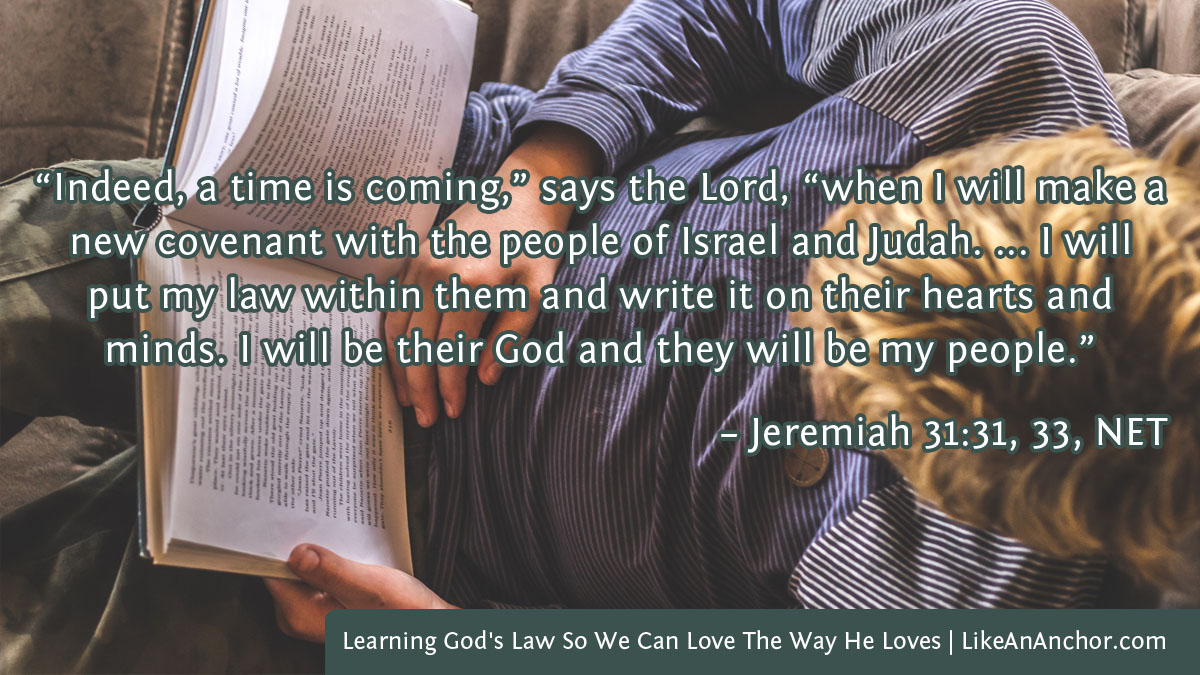
Image of a man reading a book overlaid with text from Jeremiah 31:31, 33, NET version:  “Indeed, a time is coming,” says the Lord, “when I will make a new covenant with the people of Israel and Judah. ... I will put my law within them and write it on their hearts and minds. I will be their God and they will be my people.”
Image by Creative Clicks Photography from Lightstock

No Love Without Law

While listening to a sermon at the Feast of Tabernacles this year, one verse caught my ear in a way I’d never quite thought of before. It’s part of the Olivet prophecy where Jesus answer His disciples’ question, “Tell us, when will these things happen? And what will be the sign of your coming and of the end of the age?” (Matt. 24:3, NET). It’s interesting that rather than directly answering their “when” and “what” question, He gave them warnings and things they’d need to know as the time for His second coming drew closer. One of these warnings concerns the persecution of Jesus’s disciples. That started happening pretty much right away, is still happening today to Christians in many parts of the world, and will keep happening more and more as we get closer to Jesus’s return.

“Then they will hand you over to be persecuted and will kill you. You will be hated by all the nations because of my name. Then many will be led into sin, and they will betray one another and hate one another. And many false prophets will appear and deceive many, and because lawlessness will increase so much, the love of many will grow cold. But the person who endures to the end will be saved. And this gospel of the kingdom will be preached throughout the whole inhabited earth as a testimony to all the nations, and then the end will come.”

Matthew 24:9-14, NET

Today, I want to focus on the line, “because lawlessness will increase so much, the love of many will grow cold.” You might be more familiar with a translation like, “Because iniquity will be multiplied,” but “lawlessness” is the more accurate translation. The Greek word is anomia (G458). It is derived from a (used to make a word negative) and nomos (G3551), which means law. In a Biblical sense, that mostly refers to the Law of God. Therefore, anomia means “the condition of without law” either “because ignorant of it” or “because of violating it” (Thayer G458). It can also be translated “contempt,” “iniquity, wickedness,” or “unrighteousness” because that’s the result of living lawlessly.

This statement from Jesus might seem odd to some. Why would a lack of law mean that there’s no love? Depending on your background, you might think that laws are oppressive and restrictive rather than loving. Or you might already see laws in a more Biblical sense, as guards to keep us from hurting ourselves and others. As Paul says, “the law is holy, and the commandment is holy, righteous, and good” (Rom. 7:12, NET). God reveals His laws to us as an expression of His divine character and a guide for how to live rightly in the world He created. If we obey those commands and laws, we’ll be developing His character in us.

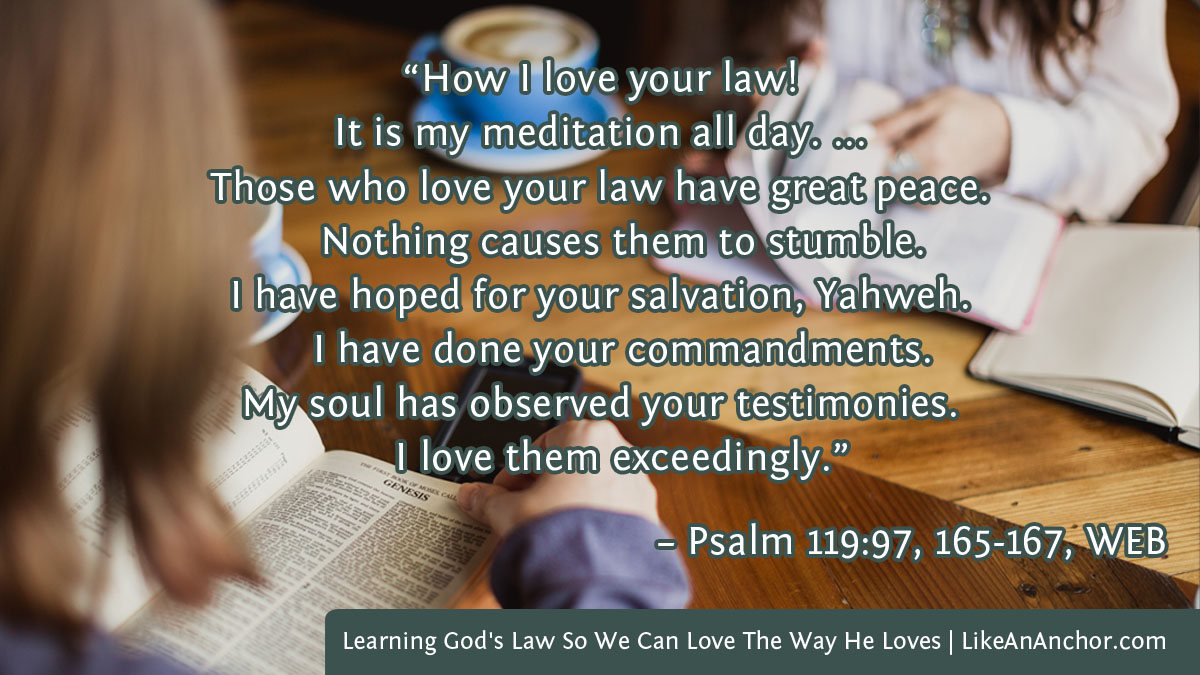
Image of two women Bible studying overlaid with text from Psalm 119:97, 165-167, WEB version:  “How I love your law! It is my meditation all day. ... Those who love your law have great peace. Nothing causes them to stumble. I have hoped for your salvation, Yahweh. I have done your commandments. My soul has observed your testimonies. I love them exceedingly.”
Image by Shaun Menary from Lightstock

Learning to Love Like God

“God is love” (1 John 4:8, 16), and it comes as no surprise that we’re instructed to make His love an integral part of our character. Paul calls love “the more excellent way,” excelling even faith and hope (1 Cor. 12:31-13:13). He also says that if we’re truly loving one another, then we’re fulfilling God’s law.

Owe no one anything, except to love one another, for the one who loves his neighbor has fulfilled the law. For the commandments, “Do not commit adultery, do not murder, do not steal, do not covet,” (and if there is any other commandment) are summed up in this, “Love your neighbor as yourself.” Love does no wrong to a neighbor. Therefore love is the fulfillment of the law.

Romans 13:8-10, NET (BOLD ITALICS IN ORIGINAL TO MARK OT QUOTES)

Over and over throughout scripture, we see God’s love paired with His law. Loving God and loving your neighbor are the two greatest commandments, according to Jesus Himself (Matt. 22:36-40). God gave us His laws because He loves us and He expects us to obey His laws if we love Him. The apostle John expands on this idea, saying that we can tell whether or not we genuinely love God by how well we’re following His commandments.

(My little children, I am writing these things to you so that you may not sin.) But if anyone does sin, we have an advocate with the Father, Jesus Christ the Righteous One, and he himself is the atoning sacrifice for our sins, and not only for our sins but also for the whole world.

Now by this we know that we have come to know God: if we keep his commandments. The one who says “I have come to know God” and yet does not keep his commandments is a liar, and the truth is not in such a person. But whoever obeys his word, truly in this person the love of God has been perfected. By this we know that we are in him. The one who says he resides in God ought himself to walk just as Jesus walked.

1 John 2:1-6, NET
Image of a man studying the Bible with the blog's title text and the words "As we move ever closer to Jesus's return or the end of our lives, we would be wise to consider if our relationship with God's law shows Him our love, or if something else is going on that we might need to repent of and correct."
Image by Anggie from Lightstock

We’re not saved by keeping God’s commandments, but when we have a saving, transforming, relationship with Jesus and the Father we will be keeping their commandments. We’re saved by God’s grace, and then the proper response to that grace is to faithfully keep covenant with God and do as He says. If we don’t want to obey God, then we don’t really love Him or know Him. That might be a hard truth to swallow sometimes, but that’s what John teaches us here because he learned it from Jesus (John 14:15, 21; 15:10-12).

 Everyone who practices sin also practices lawlessness; indeed, sin is lawlessness. And you know that Jesus was revealed to take away sins, and in him there is no sin. Everyone who resides in him does not sin; everyone who sins has neither seen him nor known him. Little children, let no one deceive you: The one who practices righteousness is righteous, just as Jesus is righteous.

1 John 3:4-7, NET

Here once again, we see that word anomia. People who are genuinely part of God’s covenant don’t live lawlessly. As John pointed out earlier in his letter, we might sometimes sin (and when we do, we have Jesus as Advocate to help us repent and return) but we shouldn’t be living habitually sinful lives. One of the key reasons that Jesus came to this world and died was “to set us free from every kind of lawlessness and to purify for himself a people who are truly his, who are eager to do good” (Titus 2;14, NET). We need to take this seriously and not dishonor Him, or treat Him in an unloving way, by living lawless lives.

When Jesus comes back, He will tell the lawless, “I never knew you” (Matt. 7:21-23). That’s certainly not what we want to hear! Rather, we want to be those who’ve responded to His love by loving Him and our fellow Christians so much that we obey God’s word as a result of our transformative relationship with Him. As we move ever closer to Jesus’s return or the end of our lives (whichever comes first), we would be wise to consider whether our relationship with God’s law shows Him our love, or if something else is going on that we might need to repent of and correct.

Jesus warned that “because lawlessness will increase so much, the love of many will grow cold.” We need to be careful that the lawlessness in the world around us doesn’t cool our love, and that we are not living lawlessly ourselves. John treats loving other people and keeping God’s commandments as something we can look at to see if we’re sincerely loving and following God, and we can follow his example when we examine ourselves and study our Bibles. The more we love God, spend time with Him, and internalize His words, the better we’ll know how to love the way that He loves.


Featured image by Pearl from Lightstock

Song Recommendation: “How I Love Thy Law, O Lord” (one of my favorite hymns that my church has in their hymnal)

Keeping The Feast As God’s Covenant Community

If you’re reading this when it posts, then today (Sept. 30, 2023), is the first day of the Feast of Tabernacles (Sukkot). As we made preparations to keep this Feast, I’ve been thinking about a book of the Bible that, at first glance, you might think doesn’t have much to do with the holy days. Usually when talking about God’s holy times, we turn to some place like Leviticus 23, which outlines all the days God says are holy to Him. This year, though, I’ve been thinking about Romans.

I’m sure I’ve mentioned before that Paul’s letter to the Romans is one of my favorite books in the Bible. There’s so much depth to it; I think I could spend a lifetime studying it and not fully understand everything. While reading Romans 10 and 11 a few weeks ago, I sketched out some notes trying to visualize the olive tree grafting analogy that Paul uses when discussing how New Covenant Christians and Gentile believers (those who were not ethnically part of Israel) become part of God’s community of faith, and what happened to the Jewish people who did not accept Jesus as the Messiah. Earlier, I also sketched out a chart trying to illustrate the different ways that Paul speaks to Jewish and Gentile converts about God’s law. I turned one into an infographic and one into a sort of flowchart. These visualizations helped me, and I’m sharing them in hope they might be useful to others as well.

Two Paths to Get to Christ

Often, I think Christians make the mistake of thinking that Christianity was a new religion started by Jesus and that the Jews today are still keeping the faith described in the Old Testament. What we ought to realize is that Jesus came as the next step in God’s plan for His people. He was the promised Messiah, and those who accepted Him continued along the path God laid out for His people from Genesis onward. Assuming you believe that Jesus is the Messiah, then those who didn’t believe in Him are the ones who broke off and went a different direction. That’s what Paul is addressing in this section of Romans. 

Brothers and sisters, my heart’s desire and prayer to God on behalf of my fellow Israelites is for their salvation.  For I can testify that they are zealous for God, but their zeal is not in line with the truth.  For ignoring the righteousness that comes from God, and seeking instead to establish their own righteousness, they did not submit to God’s righteousness. For Christ is the end of the law, with the result that there is righteousness for everyone who believes. 

Romans 10:1-4, NET

Paul was a Jewish man who had zeal for God that originally didn’t line up with the truth. He persecuted Christians at first, but when Jesus dramatically revealed Himself to Paul as the Messiah, Paul aligned His zeal with God’s truth. After that, he wanted all of his fellow Israelites to have a similar awakening. At this point, rather than aligning themselves with God’s truth, the way that they were trying to follow His law involved doing things their own way. Christ brings an end to trying to keep the law as a way to establish your own righteousness.

The Greek word for “end” here can mean the end or completion point, but it also means “the end to which all things relate, the aim, purpose” (Thayer, G5056, 1d). Now, remember that when we’re interpreting Paul we need to keep in mind that, as a faithful apostle, he would not contradict one of Jesus’s teachings. Jesus said, “Do not think that I have come to abolish the law or the prophets. I have not come to abolish these things but to fulfill them” (Matt. 5:17, NET). Here, He’s saying that He came “to fulfil, i.e. to cause God’s will (as made known in the law) to be obeyed as it should be, and God’s promises (given through the prophets) to receive fulfilment” (Thayer, G4137, 2c3). Therefore, Paul is not saying that Jesus got rid of the law. He’s pointing out that we don’t become righteous by keeping the law.

Paul taught both Jewish and Gentile Christians. These two groups had different relationships to the law of God as they came into the church. For Jewish Christians, “the law was our schoolmaster to bring us unto Christ, that we might be justified by faith” (Gal. 3:24, KJV). For Gentile Christians (particularly those who weren’t already “God fearers” who’d aligned themselves with the Jewish faith), they came to Jesus by faith first and learned about God’s laws afterwards. You’ll often see Paul telling his Jewish readers that it’s important to keep God’s law on a heart level now and to understand they can’t make themselves righteous, and teaching his Gentile readers to obey God but not accept extra Jewish traditions they’d added on top of the law.

Chart illustrating the ways Paul outlines for Jewish and Gentile Christians to both enter the New Covenant community with God.
Image by Marissa Martin, created with Canva

For Moses writes about the righteousness that is by the law: “The one who does these things will live by them.” But the righteousness that is by faith says … “The word is near you, in your mouth and in your heart” (that is, the word of faith that we preach), because if you confess with your mouth that Jesus is Lord and believe in your heart that God raised him from the dead, you will be saved. For with the heart one believes and thus has righteousness and with the mouth one confesses and thus has salvation. For the scripture says, “Everyone who believes in him will not be put to shame.” For there is no distinction between the Jew and the Greek, for the same Lord is Lord of all, who richly blesses all who call on him. For everyone who calls on the name of the Lord will be saved.

Romans 10:5-6, 8-13 (bold italics in original to mark OT quotes)

Paul uses quotes from the Old Testament to support his thesis that Jewish and Gentle Christians are part of the same spiritual family. God wants all His people in community together, joined into one covenant relationship with Him. For many of the Gentiles, this is the first time they’ve been in covenant with God. For the Jewish believers, the New Covenant was a promise contained in the Old Covenant. Whichever way they came into the family, they’re now both part of that New Covenant with God.

Grown or Grafted into One Tree

So I ask, God has not rejected his people, has he? Absolutely not! For I too am an Israelite, a descendant of Abraham, from the tribe of Benjamin. God has not rejected his people whom he foreknew! Do you not know what the scripture says about Elijah, how he pleads with God against Israel? “Lord, they have killed your prophets, they have demolished your altars; I alone am left and they are seeking my life!” 

But what was the divine response to him? “I have kept for myself seven thousand people who have not bent the knee to Baal.” So in the same way at the present time there is a remnant chosen by grace. And if it is by grace, it is no longer by works, otherwise grace would no longer be grace. What then? Israel failed to obtain what it was diligently seeking, but the elect obtained it. …

I ask then, they did not stumble into an irrevocable fall, did they? Absolutely not! But by their transgression salvation has come to the Gentiles, to make Israel jealous …  Now I am speaking to you Gentiles. Seeing that I am an apostle to the Gentiles, I magnify my ministry, if somehow I could provoke my people to jealousy and save some of them. For if their rejection is the reconciliation of the world, what will their acceptance be but life from the dead?

Romans 11:1-7, 11, 13-15, NET (bold italics in original to mark OT quotes)

Through His prophets, God revealed that He always intended to open up salvation to all nations after the Messiah came. Even before that, He allowed people from non-Israelite nations to join the covenant community if they really wanted. As Paul was writing, though, this broad preaching of the good news to all the nations was a new and exciting thing.

This doesn’t mean God started a brand new family/community, though. He transitioned His family to a new and better covenant, and welcomed new members in. Those who didn’t want to come with Him into the New Covenant got cut out of the community (at least for a little while). I find this easier to wrap my head around with a visualization. If you’re subscribed to my newsletter, you’ve already seen this infographic. I sent it out on Wednesday to give newsletter readers a sneak peak and to ask for feedback on the design.

Infographic illustrating the "grafted in" analogy Paul uses for how Jewish and Gentile Christians enter the New Covenant community with God.
Image by Marissa Martin, created with Canva

The Things We Do In God’s Family

Image of ___ with the blog's title text and the words "By celebrating God's Feasts, we're honoring Him as His covenant-keeping people."
Image created with Canva

One of the things that stood out to me when I was reading Misreading Scripture with Individualist Eyes by E. Randolph Richards and Richard James was the way they described Paul’s letters discussing Jewish and Gentile believers. One of the things Paul is doing when writing to believers, including in his Romans letter, is telling them they are part of a new community. In collectivist cultures, people get their identity from a group. Before conversion, Jews and Gentiles were part of different communities with different expectations, beliefs, and codes of conduct. Now, though, they are part of God’s covenant community.

When we’re in God’s community as part of His family, there are certain expectations that come with that. For example, we’re expected to treat God’s name with respect and honor Him with our words and conduct. He expects us to come to Him when we need help rather than turn to something else first. We’re to love the Father and Jesus, and Jesus said if we love Him then we will keep His commandments. Most Christians today already know that this includes the 10 Commandments, but those aren’t the only aspects of God’s law that transfer to the New Covenant. They’re more of a summary.

As already mentioned, Jesus said He came to fill the law and the prophets to their fullest extent, not to abolish them (Matt. 5:17) In some ways, more is expected of us in the New Covenant rather than less. We don’t need to do all the sacrifices since “by one offering he [Jesus] has perfected forever those who are being sanctified” (Heb. 10:14, WEB), but we are expected to obey the law on a heart level and not just a letter level (Matt. 5:17-48). God’s laws and commands describe the things that we do as part of God’s family; the things that He expects from people who have a covenant relationship with Him. His Sabbaths and Holy Days are a key part of that for Spiritual Israel today. They are times when He calls for His children to come together, rejoice with each other and with Him, and learn more about Him. That’s what we’ll be doing for the seven days of the Feast of Tabernacles and the Eight Day that follows, just as Jesus did when He kept this Feast (John 7).


Featured image by Claudine Chaussé

A Time To Return

If I asked you to define “repent” or “repentance,” what would you say?

We know it’s the thing you’re supposed to do when you’ve sinned and you’re coming to God asking for forgiveness. But is it just saying you’re sorry?

In English, “repent” means to express regret and remorse. While the Hebrew and Greek words translated “repent” in the Bible include that aspect of regret, the Biblical concept goes a step farther. Biblical repentance involves change. This change is a movement; an alteration in the direction of your heart and your life. The word image contained in both Hebrew and Greek is to turn away from sin and to turn toward God.

Unpopular Repentance

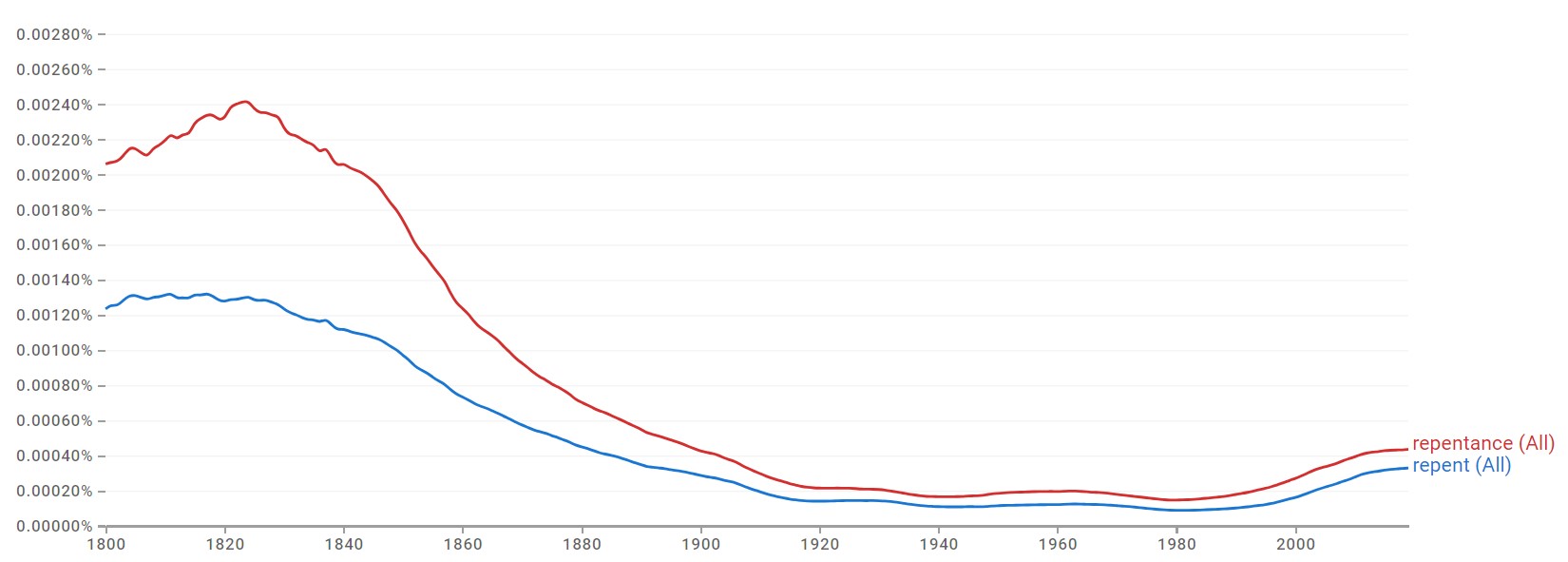
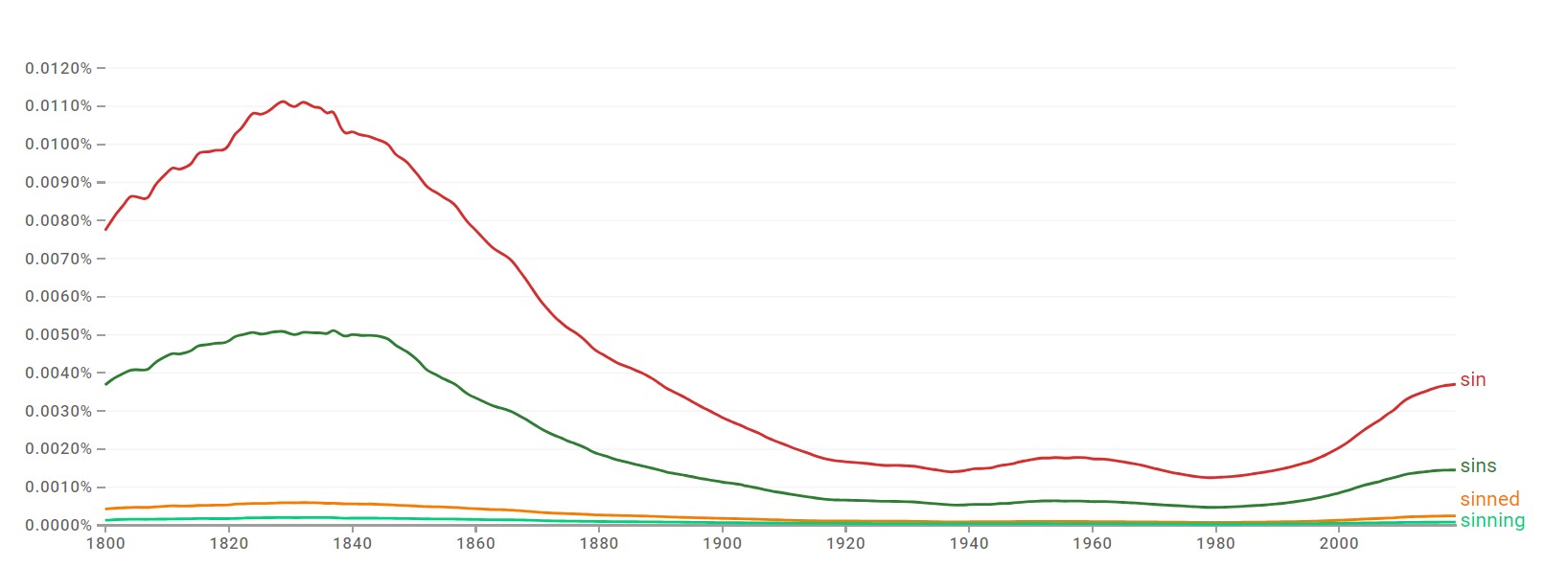
According to Oxford Languages (via Google), “repent” means “feel or express sincere regret or remorse about one’s wrongdoing or sin.” It came into Middle English “from Old French repentir, from re- (expressing intensive force) + pentir (based on Latin paenitere ‘cause to repent’).” There’s also something interesting going on with Google’s tracking for how often this word was used in English-language books between 1800 and 2019.

Evidently, repentance is not a popular idea (though I am intrigued by the recent uptick in usage after that slump in the 1900s). I don’t really think it will surprise any of us that “repent” and “repentance” are used less now than they were in the early 1800s. Repentance is something you need to do after you sin, and sin isn’t something we like to think about either. The more moral relativism takes hold in our society, the less people are willing to acknowledge sin is even a real thing since sin is the transgression of (God’s) absolute laws. The chart for “sin” in English language books looks very similar to the one for repentance.

But what about us today? If we’re sincerely following Jesus and love Him, He says we’ll obey His commandments. Commandments are contained in the law of God (Matt. 22:36, 40). The law and commandments are “holy, righteous, and good” (Rom. 7:12), and it is how God lets people know what sin is (Rom. 7:7-8). John says, “Sin is lawlessness” (1 John 3:4, WEB) or “the transgression of the law” (KJV). Paul further adds that “all have sinned” (Rom. 3:23). When Jesus came to this earth, one of His stated purposes was to call “sinners to repentance” (Luke 5:32), and it’s a message His disciples continued to preach (Acts 2:38; 3:19).

Putting all that together, we see that every human being is guilty of sin. Jesus can fix that problem, though. When sinners repent and follow Him, He takes away their sins (John 1:29; 1 John 3:5). Even after that, though, we still have a responsibility to keep His commandments because we love Him. And if we sin, then we need to repent again.

Returning and Changing

In Greek, one word translated “repent” is metanoeo (G3340). It includes the “regret or sorrow” aspect that is captured by the English word “repent,” but it also involves another step. The root words are meta (G3326: to be among or amidst, or to move toward that position) and noeo (G3539: “to exercise the mind, think, comprehend”) (Zodhiates entry G3340). Metanoeo is distinct from regret (metamelomai [G3338]) and includes “a true change of heart toward God” (Zodhiates). Thayer defines metanoeo as “to change one’s mind for better, heartily to amend with abhorrence of one’s past sins” (Thayer entry G3340). There’s a sense of turning around involved, as if when we sin we are walking away from God and when we repent we turn around and go toward Him again.

There’s another word for repentance in the New Testament as well. Zodhiates writes, “Metanoeo presents repentance in its negative aspect as a change of mind or turning from sin while epistrepho presents it in its positive aspect as turning to God” (Zodhiates entry G3340). He also notes that both of these words “derive their moral content … from Jewish and Christian thought, since nothing analogous to the biblical concept of repentance and conversion was known to the Greeks.” To understand what metanoeo and epistrepho (G1994) meant to early Christians, we need to look back at the Hebrew words expressing the same concepts.

Once again, we have two words that can be translated into English as “repent.” One of those, nacham (H5162) is typically only used of God “repenting” in the sense of “relenting or changing,” like He did when he delayed Nineveh’s destruction in response to their repentance (Theological Wordbook of the Old Testament [TWOT] entry 1344). In that story of Nineveh, we also see the Hebrew word more commonly used for human repentance, shub (H7725).

Jonah began to enter into the city a day’s journey, and he cried out, and said, “In forty days, Nineveh will be overthrown!”

The people of Nineveh believed God; and they proclaimed a fast, and put on sackcloth, from their greatest even to their least. The news reached the king of Nineveh, and he arose from his throne, and took off his royal robe, covered himself with sackcloth, and sat in ashes. He made a proclamation and published through Nineveh by the decree of the king and his nobles, saying, “Let neither man nor animal, herd nor flock, taste anything; let them not feed, nor drink water; but let them be covered with sackcloth, both man and animal, and let them cry mightily to God. Yes, let them turn (shub) everyone from his evil way, and from the violence that is in his hands. Who knows whether God will not turn (shub) and relent (nacham), and turn (shub) away from his fierce anger, so that we might not perish?”

God saw their works, that they turned (shub) from their evil way. God relented (nacham) of the disaster which he said he would do to them, and he didn’t do it.

Jonah 3:4-10, WEB

The basic meaning of shub is to turn or return. It is a Hebrew verb used frequently; “over 1050 times” in the Old Testament. While the Hebrew writers use many word pictures to describe repentance, all “are subsumed and summarized by this one verb shub. For better than any other verb is combines in itself the two requisites of repentance: to turn from evil and to turn to the good” (TWOT 2340). Like the Greek words that would later represent the same concept, Hebrew notions of repentance include both regret and turning away from sin and turning toward God. There’s always a sense of change; the verb shub is so connected with turning and change that it is even used of physical movement and coming back to a people or location (TWOT 2340).

The word shub is particularly important in it’s relation to “the covenant community’s return to God,” and one scholar concludes “there are a total of 164 uses of shub in a covenantal context” (TWOT 2340). Covenants are the way that God makes formal relationships with people; if we’re truly following God then we have made a covenant commitment to Him. Under the terms of a covenant, both parties involved have rights and responsibilities. In relation to repentance, both God and humanity have a role to play. The person repenting goes “beyond contrition and sorrow to a conscious decision of turning to God,” God freely extends His sovereign mercy, and then we continue in a commitment that involves “repudiation of all sin and affirmation of God’s total will or one’s life” (TWOT 2340). That concept is found in the Old Covenant, and is reinforced in the New Covenant (Acts 3:19; 26:17-20; 1 Thes. 1:9).

Trumpet Blasts As A Call to Return

In last week’s post, I talked about observing the Day of Trumpets (Yom Teruah). It is one of God’s special holy days, which He commands His covenant people to keep. It is a Sabbath day of complete rest, a day God calls His people to gather together, and “a memorial announced by loud horn blasts” (Lev. 23:24, WEB); “it is a day of blowing trumpets for you” (Num. 29:1, WEB). We traditionally say that in the New Covenant, the Day of Trumpets pictures the second coming of Jesus Christ, which will be heralded by trumpet blasts (1 Thes. 4:15-18).

We can also see the trumpet blasts as a call to alert us today of the need to return to God. In Jewish tradition, the Sabbath day that falls between Day of Trumpets and Day of Atonement (Yom Kippur) is called Shabbat Shuvah, the Sabbath of Return. As we just learned, shuvah/shub is the Hebrew word for repentance. As we move from Day of Trumpets to Day of Atonement, repentance should be on our minds.

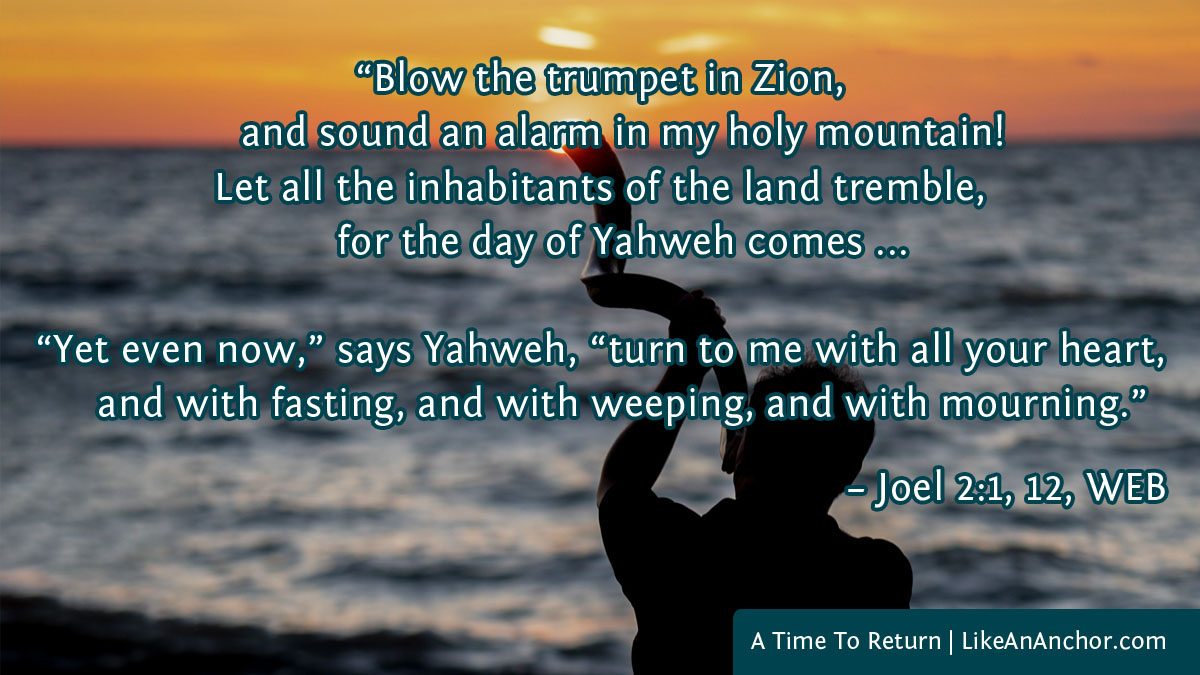
Blow the trumpet in Zion,
    and sound an alarm in my holy mountain!
Let all the inhabitants of the land tremble,
    for the day of Yahweh comes,
    for it is close at hand:
A day of darkness and gloominess,
    a day of clouds and thick darkness.
As the dawn spreading on the mountains,
    a great and strong people;
    there has never been the like,
    neither will there be any more after them,
    even to the years of many generations.

Joel 2:1-2, WEB

As Joel warns, the time before Jesu’s return (the day of Yahweh, or day of the Lord) will be a dark time for the world as a whole. The world is getting worse and worse as His return draws nearer, and Revelation reveals it’s only going to get even worse (like during the soundings of the seven trumpets given to angels; Rev. 8-11). When contemplating the coming of this day, Peter asks a pertinent question: “since all these things will be destroyed like this, what kind of people ought you to be in holy living and godliness?” (2 Pet. 3:11, WEB). He answers by saying that since we look for Jesus’s return, we should “be diligent to be found in peace, without defect and blameless in his sight” and “grow in the grace and knowledge of our Lord and Savior Jesus Christ” (2 Pet. 3:14, 18 WEB). Joel records a similar warning to turn back to following God faithfully.

Yahweh thunders his voice before his army;
    for his forces are very great;
    for he is strong who obeys his command;
    for the day of Yahweh is great and very awesome,
    and who can endure it?
“Yet even now,” says Yahweh, “turn to me with all your heart,
    and with fasting, and with weeping, and with mourning.”
Tear your heart, and not your garments,
    and turn to Yahweh, your God;
    for he is gracious and merciful,
    slow to anger, and abundant in loving kindness,
    and relents from sending calamity.
Who knows? He may turn and relent,
    and leave a blessing behind him,
    even a meal offering and a drink offering to Yahweh, your God.
Blow the trumpet in Zion!
    Sanctify a fast.
    Call a solemn assembly.
Gather the people.
    Sanctify the assembly.

Joel 2:11-16, WEB
Image of four people walking into a church building with the blog's title text and the words "As we're reminded of Jesus's approaching return, God calls us to repentance; to turn away from our own way of doing things and turn toward Him."
Image by Pearl from Lightstock

This year, we will observe the Day of Atonement on September 25, 2023. This is a solemn holy day when God commands us to rest completely and “afflict your souls” (traditionally understood to mean fasting). Reading Joel, I can’t help but notice that the trumpet blasts warning that the Messiah’s return is coming closer and closer also call us to fast and repent. God and the prophet Joel call out to readers, saying, “turn (shub) to Yahweh, your God!”

All of us are getting closer every day either to the end of our lives or to Jesus Christ’s return. One way or another, we have a limited time here on this earth. Keeping the Day of Trumpets and Day of Atonement remind us of that. They also remind us of the wonderful things the Messiah has done and is doing for His people. Because of Jesus’s atoning sacrifice, God graciously removes our sins when we repent, turning our lives around and (re)committing to following Him faithfully. We need that reminder of His awesome mercy, of our total dependence on Him, and of His promise to return and set things on this earth right.


Featured image by Pearl from Lightstock