Most modern Christian churches develop a culture that prioritizes marriage. We know marriage is a good thing and that it’s part of God’s plan for humanity. Marriage pictures the union between Christ and His church. Beyond the spiritual aspects, it’s also held-out to young people as a sort of “prize” for listening to what the Bible says about purity pre-marriage.
Since we think of marriage as such a good thing, we think of the opposite as something negative. Western culture is, on the whole, very binary. If something is good, the opposite is bad. Our minds don’t naturally consider that both could be good in the proper context. With this mindset, singleness is treated as less-desirable and if a single person doesn’t want to marry we think there’s “something wrong” with them. But is this really how God views things?
Seeking Balance
It’s a safe bet all my Christian readers know of the verses discussing marriage in a positive light. The marriage relationship was established at creation and in the New Testament Paul connects it to Christ and the church (Gen. 2:18-24; Eph. 5:22-32). Proverbs 18:22 maintains that “he who finds a wife finds a good thing.” Marriage is certainly seen as a good thing in the Bible. I’m not disputing that and I still hope someday to get married. But I think we make a mistake if we assume marriage’s goodness makes being single a bad thing. Read more →
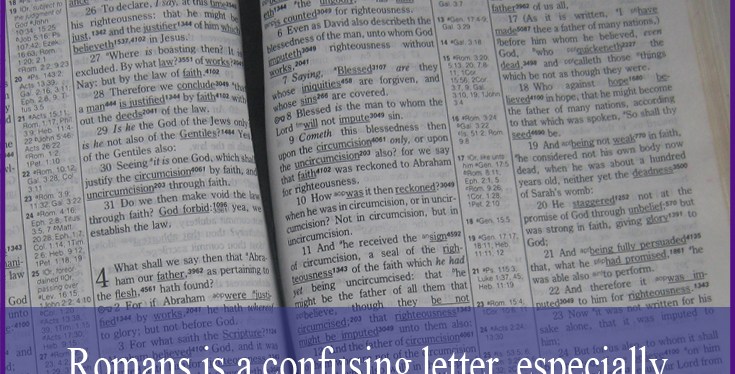
We’re going to talk about all of Romans in one blog post. That looks like a crazy idea as I type it, but I think sometimes when we zero-in on just one section of Paul’s letters we miss the bigger picture of what he’s trying to say. Perhaps there’s merit in studying overall messages as well as minute details.
Romans is a confusing letter, especially when you read pieces out of context. To really get a sense of what Paul is trying to say in any given chapter or verse, we have to read the entire letter. That’s true of any book in the Bible, but I think it’s more true for Romans since Paul connects his arguments so closely. Especially in the first half of the letter, he frequently makes a statement that could lead readers to make an incorrect assumption, then he asks that assumption as a rhetorical question and refutes it.
Also, even though we’ll stay mostly in Romans, it’s important to remember Paul wasn’t writing in a void. Reading Romans (or any other book of the Bible) by itself can lead to misinterpretation. We must frame our understanding of this letter in light of the Old Testament (the only scriptures around for Paul to reference) and the teachings of Jesus (for Paul would never contradict our Lord’s words). Doing that well would take a book instead of a blog post, but last week’s post serves as an good introduction to this one.
Doing The Law
Romans opens with a discussion of “ungodliness and unrighteousness” which brings people under the judgment of God (Rom. 1:16-32). This applies to all people since even if they didn’t receive a special revelation from God (as ancient Israel received God’s Law) they still can see evidence of Him in creation and can be held accountable for aligning with general moral principles God built into the world. Paul then takes his readers to task not, as some assume, for keeping the Law but rather for teaching it and then acting in a way that dishonors God (Rom. 2:1-29). Paul indicates that the more you know about God’s law, the more accountable you are to do things God’s way.
After saying, “not the hearers of the law are just in the sight of God, but the doers of the law will be justified,” Paul shifts to explaining that even if you do keep the Law you’re still “under sin” because we’re not perfect. He also says it is righteous with God to judge the world, which is guilty before Him because the Law gives knowledge of sin and cannot justify us in God’s sight (Rom. 3:1-20).
Hebrews 11 shows that it’s possible to live a life of faith by reminding us of people who’ve done just that. Abel, Enoch, Noah, Rahab, and scores of people there’s no time to name all walked by faith. They compass us about as a great “cloud of witnesses” inspiring us to “run with endurance the race that is set before us” with our eyes fixed on Jesus (Heb. 12:1-2).
I didn’t realize until attending church last Shabbat how well my post that week fit in with the season we find ourselves in now. We’re in the month leading up to God’s fall holy days. Traditionally, as the Rabbi in my Mesisanic group pointed out, this is a season of reflection, self-examination, and teshuva (repentance). We need a determination to pursue godliness if we’re to move forward in our walk with God. Along with that goes a perseverance to use our time on this earth wisely, as the minister in my afternoon church spoke on.
The gift of salvation is freely offered to those who take it. Accepting the gift bring us into a covenant relationship with God. One of the things we’re expected to do as “heirs of the kingdom which He promised to those who love Him” (Jam. 2:5) is grow toward spiritual maturity.
Leaving Sin Behind
We’re not meant to stagnate nor to continue in sin after receiving God’s grace. After opening his letter to the Romans with a discussion on the wickedness of man, Paul shifts his focus from those who’ve rejected God to those readers who think they’re right with God but aren’t. Read more →
One of the most uncomfortable aspects of modern Christianity is the idea of hell. The common notion is that those who aren’t following God (including those who reject Him and those who never knew Him) miss-out on their chance at salvation and are tormented forever in a burning place. Few want to talk about it, many have rejected it, but most don’t agree on an alternative. It’s something Christianity must address, though.
What happens after death for the people who are not followers of Jesus?
For believers, the question “What happens when we die?” has clear answers in scripture. We’re not sure exactly what life in God’s family will be like, but we know that we’ll either be resurrected from the dead (if we died before Jesus’s return) or transformed into spirit beings (if we’re still alive at His return). At that point, “we will be like him, because we will see him just as he is” (1 John 3:2, NET). For other people, things are a bit more ambiguous.
My purpose today isn’t to give a definitive answer, but rather to look at some different readings of scriptures talking about eternal judgement. There are some things we can say with a fairly high degree of certainty, but there are others that I just don’t know the answers to (and I’d rather acknowledge that than take a stance that I’m not reasonably confident lines up with God’s revealed word).
What is “hell”?
The word “hell” is used in the Bible, but not with the same connotation we have for it in English. Western ideas of hell come from Medieval imagery (think Dante’s Inferno). Most uses in the New Testament, though, are translated from the Greek word ghenna. When people of Jesus’s time heard this word they didn’t think of a burning place with a pitchfork-toting devil where eternal souls writhed in torment. They thought of Ghenna–a rubbish heap outside Jerusalem “where the filth and dead animals … were cast out and burned,” which is “a fit symbol of the wicked and their future destruction” (Thayer’s dictionary G1087).
Strong’s dictionary does describe ghenna as a place of “everlasting punishment,” but that imagery wasn’t originally in the Greek language. As we talked about last week, the Bible doesn’t teach humans have immortal souls. Immortality can only come to us as a gift of God, and unless He grants the gift of eternal life we won’t be around for everlasting anything, including torment.
Another word translated “hell” in English Bibles is hades (G86), which originally referred to the Greek god of the underworld but came to mean the grave in general. There’s also one other mention of “hell” in in the New Testament that’s translated from tartaroo (G5020), which was considered a place of eternal torment. The only time it’s used is in 2 Peter 2:4,where it talks about God casting “the angels who sinned … into hell” (NET). Other than that, when we look at what the Bible says about hell, we have to check each verse to see whether it’s talking about hades (the grave) or ghenna (a burning place of destruction).
While the Bible does speak of a burning lake of fire, it doesn’t talk about humans staying there nor going there instantly when they die. After people die, the prevailing Biblical description is that they’ve fallen asleep and are awaiting the resurrection (John 11:11-13; 1 Cor. 15:6, 18, 31; 1 Thes. 4:13-15; 5:10; 2 Pet. 3:4; Dan. 12:2; and many others). Some people — the “firstfruits” that we discussed in last week’s post– will be raised from the dead to eternal life at Jesus Christ’s second coming. The rest of the dead stay asleep until a second resurrection.
Image by MarrCreative from Lightstock
A Second Resurrection
We don’t actually get a whole lot of information about what happens after the first resurrection and the Millennial reign described in Revelation 20:1-6. We are told in the description of the first resurrection that “The rest of the dead did not come to life until the thousand years were finished” (Rev. 20:5, NET). Skipping to the end, we read this:
Then I saw a large white throne and the one who was seated on it; the earth and the heaven fled from his presence, and no place was found for them. And I saw the dead, the great and the small, standing before the throne. Then books were opened, and another book was opened—the book of life. So the dead were judged by what was written in the books, according to their deeds.The sea gave up the dead that were in it, and Death and Hades gave up the dead that were in them, and each one was judged according to his deeds. Then Death and Hades were thrown into the lake of fire. This is the second death—the lake of fire. If anyone’s name was not found written in the book of life, that person was thrown into the lake of fire.
Revelation 20:11-15, NET
At this point in the future, “the devil who deceived them” has already been “thrown into the lake of fire and sulfur, where the beast and the false prophet are too, and they will be tormented there day and night forever and ever” (Rev. 20:10, NET). That’s the only mention of eternal torment, though. The people who follow the devil die in the “second death.” They’ll be consumed, burned-up like the rubbish thrown in ghenna.
Death as the punishment for sin fits with God’s warnings to humanity from the very beginning (Gen. 2:15-17; 3:2-3). God’s message is consistent throughout scripture. If you follow His way, then you will live. If you do not, then you are choosing death.
I call heaven and earth to witness against you today that I have set before you life and death, the blessing and the curse. Therefore choose life, that you may live, you and your descendants, to love Yahweh your God, to obey his voice, and to cling to him; for he is your life, and the length of your days.
Deuteronomy 30:19-20, WEB
This message continues through the old and new testaments. Sin leads to death, but following God results in life (Rom. 6:22-23; 8:5-7; 2 Cor. 2:15-16; 1 John 3:14). God doesn’t control or manipulate us with the threat of everlasting punishment. He sets two very simple choices before us: life forever with Him, or permanent death.
Note: you could argue my reading of everlasting punishment using verses like Matthew 25:41-46 and Mark 9:42-48. For Matthew 25, I would say that just because the fire is everlasting doesn’t mean the people cast in it stay alive, and that the phrase “everlasting punishment” can just as easily be read “punishment that is irreversible” (because they die in the second death, which fits with Rev. 20:15). For Mark 9, where “hell” is translated from ghenna, I really don’t know what the phrase “worm does not die” means. The Hebrew and Greek both refer to maggots/grubs such as would eat dead flesh, which doesn’t make much sense to me with either interpretation–if the people die, why don’t the worms? and if the people don’t die, why does it say “worm does not die” instead of something like “soul does not die”?
Image by Shaun Menary from Lightstock
Readings on Judgement
Last week I spent quite a bit of time talking about N.T. Wright’s teachings on the resurrection. He has comparatively little to say about hell, though. He goes through the Medieval hell symbolism and meaning of Gehenna (p. 177-178), mentions that while final judgement was accepted as part of God’s plan it wasn’t widely discussed in the epistles (p. 177), and covers different modern views on hell (p. 178). What he does state is that “God is utterly committed to set the world right in the end,” and that means there will be no people in His future world who worship “that which is not God as if it were” and who fail “fully to reflect the image of God” (p. 179).
God will condemn evil, and Wright thinks that those who reject God will “cease to bear the divine image at all” and continue to “exist in an ex-human state” (p. 182-183). That, however, ignores his own teaching that people do not inherently have immortal souls and doesn’t address what the Bible says about the lake of fire. I do, however, like the way Wright speaks of a “final condemnation for those who, by their idolatry, dehumanize themselves and drag others down with them” (p. 180). We know God doesn’t desire that any perish (1 Tim. 2:4; 2 Peter 3:9), but there will be people who end up in the lake of fire and this seems a good way of summing up their condition.
The Churches of God that I’ve attended with most of my life venture into more specifics about the final judgement. Their main teachings are well represented in United Church of God’s booklet “What Happens After Death?” In brief, it goes like this: Those who are not the firstfruits will be resurrected to physical life after the Millennium and given a chance to understand God’s word. After a period of time (some say 100 years) they’ll be judged and the ones who’ve refused to repent will die in the lake of fire. The others will live on in God’s kingdom.
This teaching holds great hope, as well as relief for our worries about people who have not yet committed their lives to Jesus. It also relieves us of a sense of urgency to convert people before they die because we believe there’s a time in the future when they’ll be given the chance to know Him. If they aren’t saved in this life, they’ll have an opportunity to escape eternal death in the second resurrection.
There are a few things that this interpretation doesn’t explain, though. One thing that has to do more with implications than accuracy is that lack of urgency to convert people. We know that God is the one who chooses whether to call someone and open their eyes, and that those who do not choose Him now will have an opportunity in the second resurrection. But we should still care about sharing His word with people today. We’re supposed to be like God, and since He “wants all people to be saved and to come to a knowledge of the truth” that should be our desire as well (1 Tim. 2:4, NET).
The time frame of this judgment is also in question. Romans 2:1-16 indicates that all will be judged based on their actions in this life. It talks of God exercising abundant mercy towards those who didn’t know Him and yet lived good lives, but there’s also the promise of “wrath and anger to those who live in selfish ambition and do not obey the truth but follow unrighteousness” (Rom. 2:8, NET). Yet if people are judged as soon as the books are opened in Rev. 20:12, what about the babies, children, and others who never had a chance to do works by which they could be judged? God’s mercy, justice, and love seems to demand they be given a chance to know Him, which implies a time-gap between resurrection and judgement but that is not explicit in the scripture.
I don’t have all the answers. What I do know is that, in the years after Jesus’s original apostle’s death, Christian religion generally adopted a terrifying version of God who tortures unbelievers in hell for all eternity. Even if we don’t understand everything about God’s final plan for those who don’t know Him now, it is time to recapture a vision of God that is more consistent with how He reveals Himself as One who is love, justice, and mercy.
His justice demands recompense for sin, but He also has no desire that anyone perish (or suffer forever) and He will be merciful to everyone. For some, this mercy involves granting salvation because they come to repentance and follow Him with a pure heart. For others, that mercy involves letting them die the final, second death because they can’t be allowed to continue in rebellion against Him. That’s a God we can trust, One Who will keep His promises to reward those who follow Him with life and those who persist in disobedient rebellion with death.
Another thing I think we can say for certain is that it’s best to follow God now if we have that option, not to wait for what seems like a second-chance in the future. The firstfruits do receive a greater reward. If you are faithful to God, He will be faithful to reward you according to His promises. That’s what the church should be teaching–not threatening people with “you’ll burn in hell” but rather encouraging them to pursue God and take hold of the “better promises” and the “better resurrection” that comes with following Him now (Heb. 8:6; 11:35, WEB).
Christians and non-Christians alike typically assume that our religion teaches good Christians go to heaven when they die and bad people, or those who’ve never given their lives to Jesus, go to hell. As more and more Biblical scholars, Christian churches, and individual believers are realizing, though, this isn’t the most accurate picture of what the Bible teaches regarding life after death.
I grew up in churches that taught the resurrection. It’s straight out of the scriptures, but I hadn’t come across other churches teaching something similar until reading a book called Desiring the Kingdom by Catholic theologian James K.A. Smith. In this book, Smith made a comment about Christians not really going to heaven when they die and footnoted it with three book suggestions for further reading. I could only locate one book from that list in the library: Surprised by Hope by New Testament scholar and Anglican bishop N.T. Wright.
Wright’s powerful exegesis on the meaning of the resurrection is inspiring and some of the thoughtful, well-researched ways he diverged from my church’s traditional teachings made me realize there are alternative explanations for a few difficult scriptures that deserve a second look. I also admire his style. Instead of telling people “You’re wrong,” he says, “We’ve been misinformed, and here’s the more wonderful plan God has for us.” That’s what I want to focus on today. The deeper our understanding of what God is actually planning for us, the firmer our hope and faith becomes.
What Happens When We Die?
The idea that human beings have immortal souls does not come from the Bible, It traveled into Christian theology from Greek philosophy, specifically Plato (see “Plato’s Shadow” by Gary Petty for more details). The Bible teaches that God “alone possesses immortality” (1 Tim. 6:16, NET). Immortality is not something inherent to humans. We didn’t even have a chance at eternal life until Jesus Christ broke “the power of death and brought life and immortality to light through the gospel!” (2 Tim. 1:10, NET).
In Hebrew thought and New Testament theology, the soul refers “not to a disembodied entity hidden within the outer shell of a disposable body, but rather to what we would call the whole person or personality” (Wright, p. 28). In Hebrew, the word translated “soul” is nephesh (H5315). It refers to a living thing with breath (Thayer’s Dictionary).
Yahweh God formed man from the dust of the ground, and breathed (naphach) into his nostrils the breath (neshamah) of life; and man became a living soul (nephesh).
Genesis 2:7, WEB
The New Testament does talk about different parts of a human. We have a body — the soma , which is fleshy, physical, and “that which casts a shadow” (Thayer G4983). We have a soul — psuche , the vital force of life and personality (G5590). And we have a spirit — pneuma , the “rational spirit, the power by which the human being feels, thinks, decides” (Thayer G4151). The three can’t really be separated in any useful way, though; they all go together to make us human beings in the image of God.
Now may the God of peace himself make you completely holy and may your spirit (pneuma) and soul (psuche) and body (soma) be kept entirely blameless at the coming of our Lord Jesus Christ.
1 Thessalonians 5:23, NET
So, we are human bodies that God created from dust and breathed into, making us living beings with spirits that can communicate with His Spirit. Ecclesiastes says that, at death, “the dust returns to the earth as it was, and the spirit returns to God who gave it” (Ecc. 12:7, WEB). Wright believes that this spirit is conscious while awaiting the bodily resurrection, but I lean more toward my church’s traditional teaching that this isn’t the case.
While there are a couple verses hinting at the possibility of consciousness after death (Luke 16:19-31; Rev. 6:9-10), the bulk of scripture compares death to sleep (John 11:11-13; 1 Cor. 15:6, 18, 31; 1 Thes. 4:13-15; 5:10; 2 Pet. 3:4; Dan. 12:2; and many others). Furthermore, “in death there is no memory of you” (Ps. 6:5, WEB), “the dead don’t praise Yah” (Ps. 115:17, WEB), and ” the dead don’t know anything” (Ecc. 9:5, WEB). Two scriptures–one in a parable and one in Revelation– that aren’t necessarily clear/straightforward do not seem to be enough evidence to counter the many, many other scriptures describing the dead as unconscious and sleeping.
Image by Matt Vasquez from Lightstock
For The Firstfruits
Eternal life is a gift God promises to those who follow Him now, in this life (we’ll save those who don’t for a follow-up post next week). The promises to believers are spelled out clearly in scripture, and nowhere more clearly than in 1 Corinthians 15. Here in the resurrection chapter, Paul reminded the Corinthians that he declared to them the gospel: “that Christ died for our sins according to the scriptures,and that he was buried, and that he was raised on the third day according to the scriptures, and that he appeared to” the apostles and hundreds of other believers (1 Cor. 15:3-5, NET). Jesus’s resurrection is central to the gospel message.
Paul then addressed a group of people who didn’t believe in the resurrection of the dead. He stated in no uncertain terms that if there is no resurrection the gospel is empty, and “if Christ has not been raised, your faith is useless; you are still in your sins. Furthermore, those who have fallen asleep in Christ have also perished” (1 Cor. 15:17-19, NET). There is no alternative. Either there’s a resurrection of the dead or we have no hope at all; physical death would be permanent.
Paul spent the next few verses talking about how and when we’ll be raised. N.T. Wright summed up the “how” by saying, “the risen Jesus is both the model for the Christian’ future body and the means by which it comes about” (p. 149). The “when” for the resurrection of faithful believers is Jesus Christ’s second coming (1 Thes. 4:13-18; 1 Cor. 15:23). This resurrection is for “the firstfruits”–a select group of people who actively, faithfully followed God during their physical lives. It’s not enough to verbally accept Jesus as your savior; we also have to live like Christians. And so the resurrection chapter also includes the injunction not to be deceived or corrupted, but rather “Sober up as you should, and stop sinning!” (1 Cor. 15:34. NET).
Image by Pearl from Lightstock
A Bodily Resurrection
Paul anticipated one question that many will have about the resurrection when he said, “But someone will say, ‘How are the dead raised? With what kind of body will they come?'” (1 Cor. 15:35, NET). It’s an understandable question, especially today given the confusion about what “soul” actually means. The short answer is given by John: “we will be like him, because we will see him just as he is.” (1 John 3:2, NET). When we’re resurrected, it will be to an existence like God’s.
Paul addresses this question in more depth. He likens our bodies now to “a bare seed” sown in a field with the expectation that it will grow into a mature, flourishing plant (1 Cor. 15:37, NET).We currently have a “natural body” that bears the image of the first human being that God breathed into and made a living being. Those who rise from the dead in the first resurrection will have a “spiritual body” that bears the image of Jesus Christ (1 Cor. 15:42-49).
It is the same with the resurrection of the dead. What is sown is perishable, what is raised is imperishable.It is sown in dishonor, it is raised in glory; it is sown in weakness, it is raised in power;it is sown a natural body, it is raised a spiritual body. If there is a natural body, there is also a spiritual body.
In Greek, the words “natural” and “spiritual” are psychikos and pneumatikos. Wright points out that “Greek adjectives ending in -ikos describe not the material out of which things are made but the power or energy that animates them” (p. 155, emphasis in original). We currently have a body animated by the human soul. We will have a body “animated by God’s pneuma, God’s breath of new life, the energizing power of God’s new creation” (p. 156).
When Jesus rose from the dead, people could touch Him (John 20:27) and eat with Him (John 21:9-13). He told them, “Look at my hands and my feet; it’s me! Touch me and see; a ghost does not have flesh and bones like you see I have” (Luke 24:39, NET). Though He could appear in the middle of a locked room or vanish from sight (Luke 24:30-31, 36), Jesus wasn’t a ghost or a disembodied spirit. His spiritual body was something more than His physical one.
We’re not waiting for an escape from the body, but rather “the redemption of our bodies” (Rom. 8:23, NET). We long “to put on our heavenly dwelling … because we do not want to be unclothed, but clothed, so that what is mortal may be swallowed up by life” (2 Cor. 5:1-5, NET). We’re not waiting to go to heaven when we die — we’re waiting for Christ to come down from heaven to raise His people from their sleep of death and transform us all to have a spiritual life and body like His (1 Cor. 15:51-58). And it doesn’t end there!
Blessed and holy is the one who takes part in the first resurrection. The second death has no power over them, but they will be priests of God and of Christ, and they will reign with him for a thousand years.
Revelation 20:6, NET
We don’t have a ton of information about what happens after the first resurrection, but God does sketch out the final stages of His plan for us. We know that for 1,000 years, those firstfruits who were resurrected from the dead or who were alive and transformed at Jesus’s second coming reign alongside Him in what we call the Millennium (most details about this come from the prophets and Revelation). After that, there will be a resurrection of the remaining dead, a final judgment, Satan’s total defeat, a new heaven and new earth, and God will come to dwell with humanity on earth (Rev. 20-22). It’s an incredible future that God has planned for His creation! Let’s not settle for any teaching that offers less than His glorious plan that He has revealed to us in scripture.
This past week, Boundless.org shared two posts related to Joshua Harris and courtship culture on their Facebook page. One was an NPR interview with Harris and the other was a link to Harris’ call for feedback on the ways I Kissed Dating Goodbye has affected you. It’s a popular topic, since so many people in the churches blame courtship culture for problems in their relationships and hurt in their lives. They say the church’s attitude towards dating and courtship made them feel ashamed of their bodies and their sexual desire, that it set up intimidating expectations for relationships, and it is why they’re still single (or, for some, unhappily married).
The complaints aren’t all directed at courtship culture, either. Another article I saw this week was published by Relevant Magazine and didn’t mention courtship at all. How Christians Ruin Dating is specifically addressing ways that singles in the church feel their fellow Christians are ruining their dating lives. There’s too much obsession with romance, too much gossiping about couples, too much emphasis on marriage. We just need to chill, they argue.
For those of us who are single young adults in the church, there’s no denying that the culture we grew up in influences how we view dating and relationships. But we’re also grown-ups and it’s time to stop blaming the church for all our relationship problems and take responsibility for the choices we’re making. We can’t keep using the argument “Christians ruin dating” as an excuse for not finding relationships. Courtship culture, church gossips, the pressure to get married … those don’t keep us from finding a spouse. We do that when we use the problems surrounding Christian dating as an excuse to not ask someone out, or to turn someone down when they ask us out, or to sabotage potential relationships.Read more →













 Like An Anchor