Women’s Classic Literature Event

Extra post this week because I’m so excited about the Women’s Classic Literature Event hosted by The Classics Club. I’ve read many great classics written by women, and look forward to discovering more over the next year. Even if you’re not part of the Classics Club reading challenge, you’re still welcome to jump on board with this event using the #ccwomenclassics hashtag to share what you’re reading.

A Survey for the Women’s Classic Literature Event

Introduce yourself. Tell us what you are most looking forward to in this event.

  • As a female writer, I’m all for reading literature written by women. I studied English at The Ohio State University, and my undergraduate research project focused on Frances Burney and Mary Wollstonecraft. For this event, I’m most looking forward to seeing my fellow readers discover amazing classics by women writers, and then gathering suggestions from them for my own “to-read” list.

Have you read many classics by women? Why or why not?

  • I have read quite a few. We picked out some for my high school curriculum (homeschooled), then in college I was blessed to take classes from English professors who made sure to teach fine books written by both men and women.

Pick a classic female writer you can’t wait to read for the event, & list her date of birth, her place of birth, and the title of one of her most famous works.

  • Mary Shelley, born 30 August 1797 in London, England. I’ve read some of her mother’s writings, but nothing by her. Frankenstein is Mary Shelley’s most famous work.

Favorite classic heroine? (Why? Who wrote her?)

  • Jane Eyre, written by Charlotte Bronte. I love first-person narrative when it’s well written, and Bronte makes Jane a spectacular narrator. She’s a strong, clever woman and I admire her moral strength and unabashed living out of her Christian faith. (Bonus: Jane’s a fictional example of my INFJ personality type.)

Recommend three books by classic female writers to get people started in this event. (Again, skip over this if you prefer not to answer.)

  • Evelina by Frances Burney. I did my undergraduate research project on Burney, and highly recommend her work to fans of Jane Austen. Evelina is the shortest and most manageable of her novels, so I suggest trying that one out before jumping into the 900+ page Cecelia or Camilla.
  • Jane Eyre by Charlotte Bronte. If you haven’t read this famous classic yet, I hope you will. It’s one of my favorite books of all time, and I love the characters.
  • North and South by Elizabeth Gaskell. I love this book and the BBC adaptation staring Daniela Denby-Ashe and Richard Armitage. The casting is perfect, and my only quibble with the plot adaptation is the ending/proposal scene … but no more on that for fear of spoilers.

Will you be joining us for this event immediately, or will you wait until the new year starts?

  • I’ll probably write about Tenant of Wildfell Hall in November or December.

Do you plan to read as inspiration pulls, or will you make out a preset list?

  • I’ll pull from the women writers already on my Classics Club list, and maybe add a few more as inspiration strikes.

Share a quote you love by a classic female author — even if you haven’t read the book yet.

  • Here’s one I took note of when reading Anne Bronte’s Tenant of Wildfell Hall.
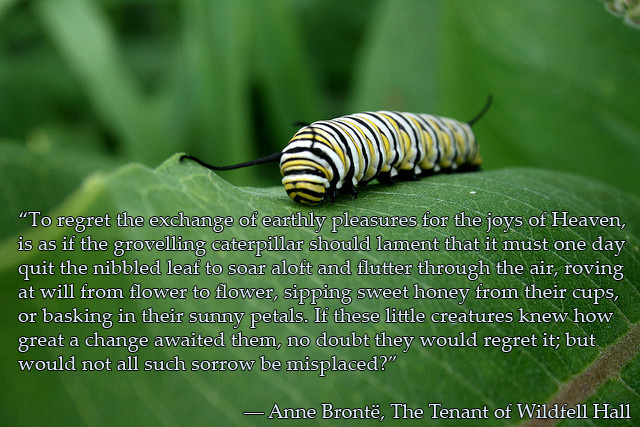
Women’s Classic Literature Event | marissabaker.wordpress.com
caterpillar credit: Eli Duke, CC BY-SA via Flickr

Classics Club — The Iliad

I’m not actually all that far behind on my reading for the Classics Club book challenge — I’m just behind on blogging about the books. Right now, I’m halfway through Anna Karenina, and I recently finished Tenant of Wildfell Hall and The Iliad. Since I also have to write about The Iliad for the high school curriculum I’m building (which my brother is trying out this year), that’s the one I wanted to talk about today.

Usually, I like to read something about the author’s history and the time period framing their writings when I explore a piece of classic literature. Unfortunately, we don’t know much about Homer. There’s even debate about whether or not he’s the one who wrote down the epic poems he (probably) composed. The introduction to the Robert Fagles translation seems to lean toward Homer writing his own poems down once the art of writing was reintroduced to Greece, though it’s all “pure speculation.” I suppose in some way the mystery surrounding these texts makes them even more intriguing.

Having once been told by a nihilistic classmate that nothing original has been written since Homer, I was rather curious to finally read The Iliad. While I can’t say I agree with him, it’s not hard to see The Iliad‘s influence on modern literature, and when I get around to reading The Odyssey (also on my Classics list) I’m sure I’ll notice even more themes that show up in modern plot and characterization.

What intrigued me most, though, was the portrayal of women in The Iliad. Though several women have lengthy passages of dialogue (including Helen and Hector’s wife Andromache), and goddesses play a huge role in the plot, they’re all show in some kind of captivity to men. No matter how strong of a character Andromache is, once she loses Hector she has no social position and no hope of avoiding slavery. Paris stole Helen, and she makes no secret of how badly that has affected her and how little she respects him. Other female characters, like Briseis, are already captives in the Achaean camp. Even the goddesses are under Zeus’s power, and his threats toward Hera starting in Book 1 portray an eyebrow-raising level of domestic abuse on Olympus.

The intriguing part is that Homer doesn’t give the impression that this portrayal of women is entirely okay. He does imply it’s “normal” for that time period, but he takes great care to show the womens’ side of the story more than one might expect in a poem mainly about the wars of gods and men. We see goddesses scheming to get around restrictions of the gods. We get plenty of dialogue from Helen, showing that ten years haven’t simply turned her into a submissive or entirely complicit captive even though her inner turmoil is ignored by both Aphrodite and Paris. Even Briseis — the captive Agamemnon steals from Achilles — has a chance to give her side of the story and make sure no one forgets that she (and by extension the other female captives mentioned as spoils of war or offered as prizes at Patroclus’ funeral games) is a human being.

It makes me miss having University access to databases full of scholarly journals — I’d love to read what people who have the time/resources to study these characters better are writing. I did find one interesting article, though: The Portrayal of Women in the Iliad by S. Farron. He says, “Homer had different attitudes from his characters. He knew that women are complete human beings and constantly emphasized how deep and intense their feelings are.” I’d agree with this writer that Homer was trying to craft real characters, not urge social reform, but it’s still intriguing that he realized women were worth writing well. He treated them as real characters with emotions and thoughts that were relevent to the story, which is more than his male characters did.


Click here to get a copy of The Iliad. Please note that this is an affiliate link. This means that, at no additional cost to you, I will receive a commission if you click on the link and make a purchase.

The Sidney Psalms

I’ve been reading a fascinating book. A wonderful professor introduced me to the writings of Sir Philip Sidney in a 16th Century Lit class, but it wasn’t until I was chatting with a friend about Shakespeare’s influence on the language used in the King James Bible that I remembered Sidney and his sister, Mary Sidney Herbert, Countess of Pembroke, translated the psalms.

The Sidney Psalter contains of 43 psalms translated by Sidney before his death in 1586, which were then edited by Mary when she finished translating the remaining 150 psalms. Though 16th century writers knew the Psalms were poems, it wasn’t until the 18th Century that an English scholar discovered the rules which governed Hebrew poetry. That didn’t stop several writers, including the Sidneys, from trying out translations in meter and rhyme.

According to Hannibal Hamlin (who taught at The Ohio State University and wrote the introduction and notes for the Oxford World Classics edition), the Sidneys stayed close to the original meaning of the psalms and focused their creativity on the poetic form. “The Psalter contains 150 Psalms,” Hamlin writes, “including the 22 sections of the long Psalm 119, and among these 172 poems the Sidney’s repeat only one form (both stanza and meter) exactly.”

I’m so impressed with these translations. They’re the psalms I love, written in a way that reminds me of my favorite Romantic poets (who were undoubtedly influenced by the Sindeys’ writings).

Psalm 23

The Lord, the Lord, my Shepherd is,
And so can never I
Taste misery:
He rests me in green pastures His:
By waters still and sweet,
He guides my feet.

He me revives; leads me the way
Which righteousness doth take,
For his name’s sake:
Yea, though I should through valleys stray
Of death’s dark shade, I will
No whit fear ill.

For Thou, dear Lord, Thou me besettest
Thy rod and thy staff be
To comfort me:
Before me Thou a table settest,
Even when foe’s envious eye
Doth it espy.

Thou oilst my head, Thou fillest my cup;
Nay more, Thou endless good,
Shalt give me food.
To Thee, I say, ascended up,
Where Thou, the Lord of all,
Dost hold thy hall.


Gulliver’s Travels

Gulliver in Lilliput, illustration from a 19th-century edition of Jonathan Swift’s Gulliver’s Travels.

If you don’t count the children’s Great Illustrated Classics version of Gulliver’s Travels, then my first encounter with Jonathan Swift’s writings was “A Modest Proposal.” I loved it. Swift’s type of satire is one reason people are still saying, “The pen is mightier than the sword.” Words are powerful, and if used well they can re-make society, destroy high-ranking people, and quite possibly get the writer in serious trouble.

Gulliver’s Travels was one of the first novels I chose for my Classics Club book list. I’d read excerpts from the Lilliput section when putting together a high school British literature course for my homeschooled brother, but this was the first time I’d read the entire novel.

The first two sections — “A Voyage to Lilliput” and “A Voyage to Brobdingnag” — read most like a fantastical travel-log, and if not for the footnotes in my Norton Critical Edition I would have missed quite a bit of the satire here, because so much of it was specific to Swift’s time period and to certain people in power while he was writing. The last two sections — “A Voyage to Laputa” and “A Voyage to the Country of the Houyhnhnms” — contained more general satire about the human race, which I think translated better to today. Here, we have priceless descriptions of things like lawyers:

I said, there was a Society of Men among us, bred up form their Youth in the Art of proving by Words multiplied for the Purpose that White is Black, and Black is White, according as they are paid. To this Society all the rest of the People are Slaves. For example, if my neighbour has a mind to my cow, he has a lawyer to prove that he ought to have my cow from me.  I must then hire another to defend my right, it being against all rules of law that any man should be allowed to speak for himself.  Now, in this case, I, who am the right owner, lie under two great disadvantages: first, my lawyer, being practised almost from his cradle in defending falsehood, is quite out of his element when he would be an advocate for justice, which is an unnatural office he always attempts with great awkwardness, if not with ill-will.  The second disadvantage is, that my lawyer must proceed with great caution, or else he will be reprimanded by the judges, and abhorred by his brethren, as one that would lessen the practice of the law. …

Gulliver in discussion with Houyhnhnms, 1856 illustration by J.J. Grandville

“It is a maxim among these lawyers that whatever has been done before, may legally be done again: and therefore they take special care to record all the decisions formerly made against common justice, and the general reason of mankind.  These, under the name of precedents, they produce as authorities to justify the most iniquitous opinions; and the judges never fail of directing accordingly.”

By the end of the novel, I didn’t like Gulliver as a character, but as a narrative vehicle for Swift’s satire he was perfect. He’s annoyingly narrow-minded and Anglocentric for much of the narrative, until he completely flips the other direction after living with the Houyhnhnms. It’s a marvelous bit of writing. First, his criticism of the unfamiliar Lilliputian, Brobdingnag, and Laputa cultures highlights what is most laughable or deplorable in our own society. But just when we’re ready to condemn humanity for it’s lack of logic, ridiculous methods of government, insistence on violence, and a whole host of other flaws Swift brilliantly satirizes, Gullliver decides he hates the very people he’s been defending this whole narrative.

Once he’s expelled by the Houyhnhnms, Gulliver would literally rather die than go back to living among humans. He can’t stand the smell, touch, or society of people who lack the Houyhnhnms “Government of Reason.” You might think Swift is saying, along with Gulliver, that people are disgusting and that’s his take-away message. Yet it is Gulliver who has now become ridiculous, and I think Swift finishes this book by satirizing his own narrator’s conclusions about the human race. Just because Swift notices the flaws in society and his fellow man doesn’t mean he abandons all hope for us.


Click here to get a copy of Gulliver’s Travels. Please note that this is an affiliate link. This means that, at no additional cost to you, I will receive a commission if you click on the link and make a purchase.

Far From the Madding Crowd

This is one of those rare books where the last line sums-up my feelings about the rest of the story.

But since ’tis as ’tis, why, it might have been worse, and I feel my thanks accordingly.

In my own words, “Well, the book ended the way it did, and it might have been worse, so I’m glad it’s over.” Though those were my thoughts, this Classics Club selection actually wasn’t a “bad” book. As a fan of British literature, I enjoyed it — the writing style and way Hardy uses description and dialogue is intriguing, as are his depictions of three very different courtships. As someone who reads for pleasure, though, I don’t really like it — none of the characters really captured my sympathy and the plot didn’t hold my attention except in a few parts.

The story follows Bathsheba Everdene, who first catches the eye of farmer Gabriel Oak as a young woman living with her aunt. He proposes marriage, and she turns him down. They meet again with their fortunes reversed — she has inherited a prosperous farm and he is seeking work as a shepherd. As the novel progresses, she is courted by the next-door farmer, confirmed bachelor William Boldwood, and also handsome womanizer Sergeant Frank Troy. The remainder of the novel can basically be summed up as fairly average people making bad decisions and having to live (or in some cases, die) with the consequences. It does have a happy, if somewhat predictable, ending.

If you’re looking for an alternative to seeing Avengers: Age of Ultron this weekend (and you can find a theater playing it), there’s a new film version of Far From The Madding Crowd released May 1st. It stars Carey Mulligan as Bathsheba Everdene, Matthias Schoenaerts as Gabriel Oak, Michael Sheen as William Boldwood, and Tom Sturridge as Frank Troy. My Avengers weekend has been planned for 6 months, but this looks like a good adaptation — I’ll probably see it when it comes out on DVD.


Click here to get a copy of Far From the Madding Crowd. Please note that this is an affiliate link. This means that, at no additional cost to you, I will receive a commission if you click on the link and make a purchase.
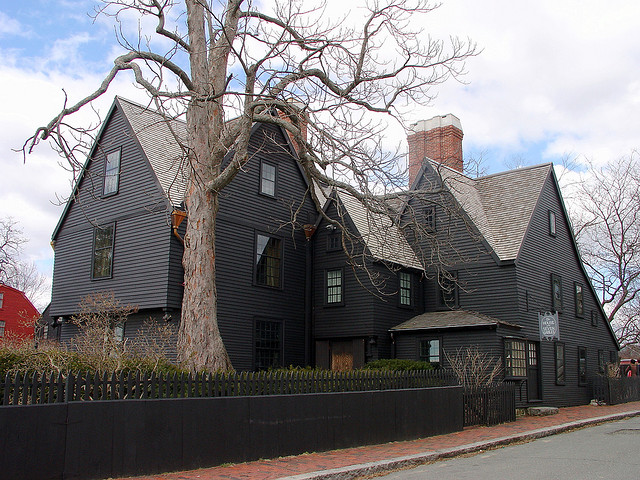
The House of the Seven Gables

 Elizabeth Thomsen, CC BY-NC-SA, via Flicker
Elizabeth Thomsen, CC BY-NC-SA, via Flicker

The House of the Seven Gables by Nathaniel Hawthorn was the book from my first Classics Club book spin. I was supposed to have it finished by January 5. I started it the last week of December, and didn’t finish until January 13. It wasn’t even that long, and I wasn’t reading anything else to distract me. I just found it terribly dull.

I had such high hopes for this book, since I didn’t dislike The Scarlet Letter, and my favorite English professor had told me this was the Hawthorne he taught in his American literature classes (I now half-suspect this was simply to convince students that British literature is more fun than American).

Top Reasons This Book Was Disappointing:

  • The author kept apologizing for his boring characters and plot. Page-space would have been better spent if he’d focused less on apology and more on actually making them interesting.
  • Hawthorn’s limited-omniscient narrator spent one. entire. chapter talking to a corpse. We all knew the character was dead, but the narrative voice just kept calling for him to rise up and get on with his schedule. Only one paragraph of this entire chapter was relevant to the plot.
  • The ending was happy. Usually I like happy endings, but when I’ve been miserable for the entire book, I expect at least a few characters to be miserable as well.

The House of the Seven Gables is a Gothic romance originally published in 1851, and set around the same time. It was the novel Hawthorne published after The Scarlet Letter, and never quite equaled its predecessor’s popularity. It was still plenty popular, though, and I found someone online comparing its reception in America to the UK’s reaction to Jane Eyre, which was published just 4 years earlier (and is a much better book, in case you were wondering).

I felt like this story wasn’t quite sure what it wanted to be. Sometimes it felt like a moral tale, sometimes like a supernatural story, sometimes like a revenge narrative, sometimes a class satire. But the moral is never really a clear part of the story, the apparently “supernatural” is meticulously explained, revenge just sort of happens by chance, and the class satire is only marginally more effective. Obviously it works for some readers, but not for this one.


Click here to get a copy of The House of the Seven Gables. Please note that this is an affiliate link. This means that, at no additional cost to you, I will receive a commission if you click on the link and make a purchase.