What Happened to the Ritual Uncleanness Laws After Jesus’s Sacrifice?

The law God delivered to Israel at Mount Sinai included different types of commands. Efforts to sort them into categories aren’t usually all that helpful, but there are some general observations we can make. It’s clear from reading the Torah that not every command carries the same “weight,” if I can use that imperfect term. For example, some of these laws clearly categorize certain behavior as “sin.” These require repentance and animal sacrifice to cleanse (for example, refusing to act as a witness or swearing a rash oath [Lev. 5:1, 4-6] ). Some sins are serious enough they couldn’t be cleansed that way, and resulted in the perpetrator being cut off from the covenant congregation or even executed unless they were directly forgiven by God (murder, for example, Num. 35:15-34; 2 Sam. 12:7-14). (Note: all sins ultimately result in death without God’s intervention, and in that sense there aren’t “worse” or “better” sins [Rom. 3:23; 6:23; Jam. 2:8-11]).

There are other commands in the law that don’t necessarily involve sin. These regard things that result in a person being “unclean” until a certain time, at which point they might wash or offer a small sacrifice. This “uncleanness” is related to being common or unsanctified–the opposite of being holy and set apart for sacred use. It’s not something we talk about much anymore, but it was very important to God in the Old Testament. So what happened?

When we do talk about this concept, we often refer to it as “ritual uncleanness” to differentiate it from “sinful uncleanness.” I’ve been pondering this concept for years, and I finally want to share a formal Bible study post on the subject. Please just keep in mind as you read that this is a big topic, and the depth of God’s truth is something we could study our whole human lives without learning everything. I might get some things wrong or not explain things the best way (which is why I’ve been reluctant to write on the topic), but I think there’s value in sharing things we’re still learning about so that we can grow and learn together.

What Makes Someone “Unclean”?

First, I do need to point out that there isn’t always a clear-cut division between sin and uncleanness. For example, in Leviticus 5:1-6 it talks about four things that can make a person guilty: refusing to testify as a witness, touching an unclean animal, touching “the uncleanness of man,” and swearing a rash oath. All those things required confession of sin and a trespass offering. This indicates a connection between certain types of uncleanness and sin.

However, there are other things that make someone unclean which have a different outcome. For example, in Leviticus 11 God shares a list of clean and unclean animals. Only the clean animals may be eaten or offered to Him as a sacrifice. For the unclean animals, He says, “By these you will become unclean: whoever touches their carcass shall be unclean until the evening” (Lev. 11:25, WEB). There’s no mention of a sin offering, simply an uncleanness that expires at the end of the day. That sort of uncleanness doesn’t get you into trouble unless you then do something that God tells you not to do while unclean (such as eat of a holy offering [Lev. 7:19-21]).

If you were ritually unclean, you could not enter the holy places (tabernacle or temple) or touch any holy thing until you became clean again (Lev. 12:4; 22:1-6; 2 Chr. 23:18-19). That cleansing might happen at a certain time, or after washing in water, or after offering a sacrifice. Sometimes cleansing involved a combination of those things, as for lepers (Lev. 14) and those with a “discharge” (Lev. 15). The reason for this hyper-focus on ritual cleanliness was God’s holiness and presence among the people.

You shall not make yourselves abominable with any creeping thing that creeps. You shall not make yourselves unclean with them, that you should be defiled by them. For I am Yahweh your God. Sanctify yourselves therefore, and be holy; for I am holy. You shall not defile yourselves with any kind of creeping thing that moves on the earth. For I am Yahweh who brought you up out of the land of Egypt, to be your God. You shall therefore be holy, for I am holy.

Leviticus 11:43-45, WEB

 You shall have a trowel among your weapons. It shall be, when you relieve yourself, you shall dig with it, and shall turn back and cover your excrement; for Yahweh your God walks in the middle of your camp, to deliver you, and to give up your enemies before you. Therefore your camp shall be holy, that he may not see an unclean thing in you, and turn away from you.

Deuteronomy 23:13-15, WEB

There is “a distinction between the holy and the common, and between the unclean and the clean” (Lev. 10:10, WEB). God is holy and clean, and there are things that are part of being human in a post-fall world that are unholy or unclean. Remember, holiness involves “set-apartness” for sacred use (H6944 qodesh, BDB definition). People and things aren’t holy unless God makes them that way, separating them to Himself.
Image of a man reading the Bible overlaid with text from Lev. 20:7-8, WEB version: “Sanctify yourselves therefore, and be holy; for I am Yahweh your God. You shall keep my statutes, and do them. I am Yahweh who sanctifies you.”
Image by Matt Vasquez from Lightstock

Does God Care About Cleanness in the New Testament?

We’re not told exactly why touching certain animals, a woman being on her period, or a man having leprosy make someone “unclean” in the ceremonial sense. But we do know that up to the time of Jesus, these ritual cleanliness laws were enforced. In one case, “ten men who were lepers met” Jesus, but “stood at a distance” as they cried out, “Jesus, Master, have mercy on us!” (Luke 17:12, WEB). Jesus told them to go show themselves to the priest, as the Law instructed so they could be declared ceremonially clean after being cured of leprosy.

But there was something different about Jesus. He didn’t seem concerned with the fact that they were ritually unclean. He even touched some of the lepers He healed (Matt. 8:3) and He let a bleeding woman touch Him (Luke 8:43-48). He could cleanse someone in an instant, from sin or from ritual impurity.

Today, we don’t tell a woman on her period that she can’t come before God’s presence in prayer or go to church, or tell her husband that if he touches any surface she does that he’s similarly restricted. And we’re right to do so, but why is that? What changed from the Old to New Testament that the things making people ritually unclean no longer seem to matter to God when they mattered so much before?

The interesting thing is, cleanliness does still matter to God. In the Greek, we often see the word “holy” used to translate the word hagios, where the “fundamental idea is separation, consecration, devotion to the service of Deity, sharing in God’s purity” (G40, Zodhiates). The word is also sometimes translated “saint,” on the assumption that all of God’s people are holy (Rom. 1:7; 15:25-26; 1 Cor. 1:2; 3:17; Heb. 3:1). In 1 Corinthians 7:14, hagios is contrasted with the word koinos, common, defiled, or “Levitically unclean” (G2839, Thayer).

And if a woman has a husband who is not a believer and he is happy to live with her, she should not divorce him. For the unbelieving husband is sanctified because of the wife, and the unbelieving wife because of her husband. Otherwise your children are unclean, but now they are holy. 

1 Corinthians 7:13-14, NET

Notice that things here work differently than they did in the Old Testament. Then, if one of the holy people interacted with an unclean thing they became temporarily unclean. Now, if one of the holy people is married to an unbeliever, “the believer is not defiled by the unbeliever” (G37, Zodhiates). Rather, the unbeliever is sanctified by their association with the believer so that the children might be holy to God. Something changed between the Old and New Testament/Covenant so people set apart as holy to God aren’t defiled by “common” things. In at least some cases, they can even sanctify someone who isn’t one of God’s holy people.

Image of several Bibles on a table as people study together, overlaid with text from Acts 10:14-15, 28, WEB version:  But Peter said, “Not so, Lord; for I have never eaten 
anything that is common or unclean.”
A voice came to him again the second time, “What God has cleansed, you must not call unclean.” ...

[Peter] said to them, “You yourselves know how it is an 
unlawful thing for a man who is a Jew to join himself or come to one of another nation, but God has shown me that I shouldn’t call any man unholy or unclean.”
Image by Inbetween from Lightstock

What Changed With Jesus’s Sacrifice?

Of course, the big change between Old and New Covenant happened with Jesus’s sacrifice. That sacrifice provided a different type of cleansing than the one provided by the washings, sacrifices, and rituals of the Old Covenant.

For the law possesses a shadow of the good things to come but not the reality itself, and is therefore completely unable, by the same sacrifices offered continually, year after year, to perfect those who come to worship. For otherwise would they not have ceased to be offered, since the worshipers would have been purified once for all and so have no further consciousness of sin? But in those sacrifices there is a reminder of sins year after year. For it is impossible for the blood of bulls and goats to take away sins. …

 Therefore, brothers and sisters, since we have confidence to enter the sanctuary by the blood of Jesus, by the fresh and living way that he inaugurated for us through the curtain, that is, through his flesh, and since we have a great priest over the house of God, let us draw near with a sincere heart in the assurance that faith brings, because we have had our hearts sprinkled clean from an evil conscience and our bodies washed in pure water. 

Hebrews 10:1-4, 19-22, NET

Sacrifices couldn’t perfect or purify people. But Jesus can, and because of Him we can confidently enter the holy sanctuary. Remember, unclean things can’t come into God’s presence. But God’s not interested in leaving barriers between Him and His people anymore. Jesus’s death tore the veil in the physical temple separating the Holy of Holies from the rest of the temple, and now the whole body of believers is the holy temple of God. Also, we can now enter God’s presence directly through Jesus in prayer. When we’re living in Him, we don’t have to worry about being ritually unclean and if we become sinfully unclean, we can still come straight to God and seek forgiveness (Heb. 4:14-16; 1 John 2:1-6).

Blessed is the God and Father of our Lord Jesus Christ, who has blessed us with every spiritual blessing in the heavenly realms in Christ. For he chose us in Christ before the foundation of the world that we should be holy and blameless before him in love. He did this by predestining us to adoption as his legal heirs through Jesus Christ, according to the pleasure of his will— to the praise of the glory of his grace that he has freely bestowed on us in his dearly loved Son. In him we have redemption through his blood, the forgiveness of our offenses, according to the riches of his grace that he lavished on us in all wisdom and insight.

Ephesians 1:3-8, NET

And you were at one time strangers and enemies in your minds as expressed through your evil deeds, but now he has reconciled you by his physical body through death to present you holy, without blemish, and blameless before him— if indeed you remain in the faith, established and firm, without shifting from the hope of the gospel that you heard. 

Colossians 1:21-23, NET

Jesus’s sacrifice is what washes us clean from all impurity, including ritual uncleanness and sinful unholiness. In both Ephesians and Colossians, Paul points out that the Father chose to make us holy–part of the saints–and did that through Jesus Christ. We are holy, blameless, blemish-free, and washed clean, and we’ll stay that way “if indeed we remain in the faith.”

Do We Have A Role In Keeping Clean?
Image of two people's clasped hands, overlaid with blog's title text and the words, "In the past, uncleanness could separate people from contact with God. Jesus washes that away, bringing us into closer relationship."
Image by Jantanee from Lightstock

Because of Jesus’s sacrifice, we don’t have to worry about the things related to ritual uncleanness anymore. Jesus makes us pure, holy, and washed clean. But as mentioned previously, some uncleanness comes from sin rather than simply from association with common things. Sin is a serious thing; it separates people from God (Is. 59:1-2). God does not want separation between us, so He’s working to make us holy but we also still need to honor God’s laws, avoid the type of uncleanness that comes from sin, and repent as soon as we become aware that we’ve missed the mark (1 John 1:5-10; 2:1-6).

 This I say therefore, and testify in the Lord, that you no longer walk as the rest of the Gentiles also walk, in the futility of their mind, being darkened in their understanding, alienated from the life of God because of the ignorance that is in them, because of the hardening of their hearts. They, having become callous, gave themselves up to lust, to work all uncleanness with greediness. But you didn’t learn Christ that way, if indeed you heard him, and were taught in him, even as truth is in Jesus: that you put away, as concerning your former way of life, the old man that grows corrupt after the lusts of deceit, and that you be renewed in the spirit of your mind, and put on the new man, who in the likeness of God has been created in righteousness and holiness of truth. …

Be therefore imitators of God, as beloved children. Walk in love, even as Christ also loved us and gave himself up for us, an offering and a sacrifice to God for a sweet-smelling fragrance. But sexual immorality, and all uncleanness or covetousness, let it not even be mentioned among you, as becomes saints; nor filthiness, nor foolish talking, nor jesting, which are not appropriate, but rather giving of thanks. Know this for sure, that no sexually immoral person, nor unclean person, nor covetous man, who is an idolater, has any inheritance in the Kingdom of Christ and God.

Ephesians 4:17-24; 5:1-5, WEB

Here, “uncleanness” is translated from akathartos (G169). It means “not cleansed, unclean” in a ceremonial or moral sense (Thayer). It is an antonym of katharizo (G2511), “to make clean” physically, morally, or “in a levitical sense” (Thayer). Just a little later in the letter to the Ephesians, Paul says that Christ sanctified (hagiazo [G37], to make holy) and cleansed (katharizo) the church “with the washing of the water by the word, so that he may present the church to himself as glorious—not having a stain or wrinkle, or any such blemish, but holy and blameless” (Eph. 5:25-27, NET).

In the past, ritual uncleanness meant someone following God could not enter the holy places or touch any holy thing. The Father and Jesus erased that distance between Them and Their people by making us holy things that aren’t defiled by the commonness of the world. They also washed away the sins that distance us from God. The sins They’ve already washed can’t come back, but that doesn’t mean that we should go wallow in the filthiness of sin because Jesus cleaned us up. We don’t need to worry about ritual uncleanness, but we do need to make sure if we participate in sin that we repent and come back to Him for spiritual renewal and assistance to grow and change.

People often criticize Christians who still value God’s law by saying things like, “You pick and choose which ones to follow” or “The law was done away with!” I’ve addressed the latter argument in other posts, and I think this study on ritual uncleanness vs. sinful uncleanness helps answer the first criticism. There are some rules in the Old Covenant that don’t apply anymore because they were legal codes for ancient Israel. There are others that we don’t need to follow anymore because we don’t need to worry about ritual uncleanness. Then there are others that are part of God’s Law (which is connected to, but not exactly the same as the Old Covenant) and which both pre-date the Old Covenant (for example, Noah new about clean and unclean meat animals [Gen. 7:2; 8:20]) and which continue into the New Covenant (for example, the two greatest commandments and all the others that depend on them [Mark 12:28-34; Rom. 13:8-10]). Basically, we know we’re not under the Old Covenant; we’re under the New Covenant and in that covenant God makes us holy and writes His law inside our hearts (Heb. 8:6-13; 10:8-18). We still study God’s law to understand what He’s written inside us and we follow His law to honor Him and because it helps teach us how to be like Him.


Featured image by Pearl from Lightstock

Washed Clean by Jesus

I read a chapter in my Bible each night before bed, and I recently finished Exodus and moved into Leviticus. This book is full of God’s laws and instructions for His people Israel, and much of it has to do with ceremonial uncleanness.

Those parts of the Torah might not seem as if they have anything to do with us today. There isn’t a temple building anymore or a priesthood conducting animal sacrifices. We don’t worry about doing things that might make us unclean until evening or take turtledoves and lambs to the temple to ask God to pass over our sins. But the fact that we don’t have to worry about that anymore means something changed, and that something isn’t God. He’s the same yesterday, today, and forever (Mal. 3:6; Heb. 13:8). He’s still just as holy as He was in the Old Testament. What’s changed is something having to do with our holiness and God’s relationship with us.

This “something” is that Jesus’s sacrifice cleanses us from our sins. The fact that we say “cleanses” us from sin, though, points to the same problem Leviticus was trying to deal with. God is holy, but holiness is not the default state of human beings. Sins (and even things that aren’t sin which once resulted in ceremonial uncleanness) would separate us from God if there wasn’t a way of washing us. I think this is why the New Testament writers spend so much time talking about cleanliness and holiness. When they described what Jesus is doing in us, they’re working with this background knowledge that God didn’t allow unclean people into His temple.

Uncleanness and Sin

In the Old Covenant law, people became ritually unclean in several ways. One was by sinning, which required sacrifices offered as atonement even though they couldn’t actually remove sin. There were also ways to become ritually unclean without sinning, such as by touching animal carcasses or dead bodies, contracting leprosy, having a baby, and having sex (Lev. 5:2;12:2; 13:3, 44-45; 15:1-33). All sin made people unclean, but not all the ways to become unclean involved sin.

Even though many of the things that resulted in ritual uncleanness weren’t sins, they could still disqualify you from entering the temple or eating of the holy things (Lev. 7:19-21; Chr. 23:18-19; Rev. 21:23-27). Because God is holy, His people had to “make a distinction between the holy and the common, and between the unclean and the clean” so they wouldn’t die by defiling God’s dwelling place with their uncleanness (Lev. 10:10-11; 15:31). God is still holy today, but the process for making us clean is much more lasting and complete.

For if the blood of goats and bulls, and the ashes of a heifer sprinkling those who have been defiled, sanctify to the cleanness of the flesh, how much more will the blood of Christ, who through the eternal Spirit offered himself without defect to God, cleanse your conscience from dead works to serve the living God?

Hebrews 9:13-14, WEB

Washed by Jesus

Jesus spent quite a bit of time during his earthly ministry engaging in debate with the religious leaders of His day. One thing in particular that He pointed out to them was that their efforts to be clean had gotten off-track. It wasn’t the outward cleanliness that mattered the most, but the holiness of the heart (Matt. 23:25-27; Luke 11:40-42). This doesn’t mean we ignore the outside, but outward things aren’t our focus; the outside becomes clean as a result of the cleaning happening inside us.

In John’s account of Jesus’s final Passover, he mentions that “many people went up to Jerusalem from the rural areas before the Passover to cleanse themselves ritually” (John 11:54-56). This is a detail I’ve overlooked in the past; it just seems like a note explaining something about the culture at the time. But a short time later at Passover, Jesus has this conversation with Peter:

Peter said to him, “You will never wash my feet!”

Jesus answered him, “If I don’t wash you, you have no part with me.”

Simon Peter said to him, “Lord, not my feet only, but also my hands and my head!”

Jesus said to him, “Someone who has bathed only needs to have his feet washed, but is completely clean. You are clean, but not all of you.” For he knew him who would betray him, therefore he said, “You are not all clean.”

John 13:8-11, WEB

We are clean in every sense–ritually and in terms of forgiveness for sin–if Jesus Christ washes us. Paul emphasizes this in one of his letters, saying “Christ also loved the assembly, and gave himself up for it;  that he might sanctify it, having cleansed it by the washing of water with the word, that he might present the assembly to himself gloriously, not having spot or wrinkle or any such thing; but that it should be holy and without defect” (Eph. 5:25-27, WEB).

Jesus’s sacrifice mediates a new covenant that involves more immediate and lasting cleansing than was ever available under the old covenant (Heb. 9:13-15, 22-24; 10:1-14). Instead of making it possible for us to walk inside a physical temple dedicated to God, Jesus’s cleansing makes us part of God’s undefiled spiritual temple (1 Cor. 3:16-17; 6:16-20; 2 Cor. 6:15-18). It goes beyond just being allowed to visit God. We actually get to be part of His dwelling place.

Image of a waterfall, with text from 2 Cor. 6:16-18, NET version: "For we are the temple of the living God, just as God said, ‘I will live in them and will walk among them, and I will be their God, and they will be my people.’ Therefore ‘come out from their midst, and be separate,’ says the Lord, ‘and touch no unclean thing, and I will welcome you, and I will be a father to you, and you will be my sons and daughters,’ says the All-Powerful Lord.”
Image by David Mark from Pixabay

Dwelling in the Clean Vine

Becoming clean is something that Jesus does to us. Staying clean is something we’re involved in. It’s part of a lifelong process of becoming holy the way that God is holy (Matt. 5:48; 1 Pet. 1:15-16). We need to “cleanse ourselves from all defilement of flesh and spirit, perfecting holiness in the fear of God” (2 Cor. 7:1, WEB). We’re actively involved in the process of sanctification because we choose what behaviors shape the sort of people we are (1 Cor. 5:6-8; 2 Tim. 2:20-21).

“I am the true vine, and my Father is the farmer. Every branch in me that doesn’t bear fruit, he takes away. Every branch that bears fruit, he prunes, that it may bear more fruit. You are already pruned clean because of the word which I have spoken to you. Remain in me, and I in you. As the branch can’t bear fruit by itself unless it remains in the vine, so neither can you, unless you remain in me. …

“In this my Father is glorified, that you bear much fruit; and so you will be my disciples. Even as the Father has loved me, I also have loved you. Remain in my love. If you keep my commandments, you will remain in my love; even as I have kept my Father’s commandments, and remain in his love.”

John 15:1-4, 8-10 WEB

The way we stay clean is by staying firmly attached to Jesus and following Him. Under the Old Covenant, we could have become “unclean” in all sorts of ways and becoming clean again involved the passage of time and/or ritual washing or sacrifice (depending on how you became unclean). Now under the New Covenant, Jesus washes us clean all the time so long as we’re sticking close to Him.

Staying in God’s Presence

Jesus doesn’t let anything that could make us “unclean” stand in the way of us getting into God’s presence. The relationship we have with God isn’t cut off if we touch an unclean animal or become seriously ill; there’s no more ritual uncleanness to worry about. However, God still cares about the way we live our lives.

Just like there was a difference between ritual uncleanness and law-breaking sin in the Old Testament, there’s a similar difference today. The first doesn’t matter at all anymore–Jesus takes care of washing us from any ritual uncleanness. The second doesn’t have to matter, but still could. Jesus’s sacrifice washes sins away as easily as any other uncleanness, but in this case we’re also supposed to stop sinning after we’re washed clean and repent if we make a mistake.

Do you not know that you are God’s temple and that God’s Spirit lives in you? If someone destroys God’s temple, God will destroy him. For God’s temple is holy, which is what you are.

1 Corinthian 3:16-17, NET

The word translated “destroy” here is phtheirō (G5351), and it can also mean “corrupt” or “defile,” though most modern translations use “destroy” (see Thayer’s Dictionary and KJV translation). I wonder if Paul was thinking about the effect that uncleanness had in the Old Testament when he wrote this. If something that was holy touched something that was unclean, then the holy didn’t sanctify the unclean–the holy thing became corrupted (Haggai 2:11-14). God doesn’t want that happening in His temple (i.e. the church body of believers).

If you look back at Jesus’s words in John 15, you see that remaining in Him involves keeping His Father’s commandments. Jesus washes us from sins as well as from ritual uncleanness, but we’re still not supposed to do things that would defile us. If we do realize we’ve sinned, then we’re supposed to repent and ask for forgiveness so He can wash those sins away again just like He did the first time we were sanctified (1 Cor. 6:9-11). The cleanness of our souls should matter to us because one of our chief desires should be to dwell in the presence of God (Psalm 16:11; 140:13), and He doesn’t have close relationships with people who won’t let Him wash them (as Jesus told Peter in John 13:8-11). So let’s stay close to God, repenting if we sin and continually praising Him for cleansing and making us holy so we can dwell with Him.

Featured image by jplenio from Pixabay

Don’t Be Something Jesus Would Throw Out Of His Father’s Temple

Let’s take a trip back to the early 1st century. It’s a few days before Passover and the Jews are heading to Jerusalem for the Feast. As they travel, they sing the songs of ascent like they do every year. On this particular year, though, there’s an extra level of excitement. A man named Yeshua (Jesus) arrived on the scene a few years ago and many think he could be the Messiah. He’s even riding into Jerusalem on a donkey’s colt, as Zechariah said the Messiah would.

Hoshiya-na! Baruch haba B’Shem Adonai!” they call. Save us now! Blessed is He who comes in the name of the Lord!

As Yeshua rides in, the people spread their garments in the way. They also cut palm branches as if they were here for the Feast of Tabernacles instead of the Passover and the Feast of Unleavened Bread. They’re expecting the Messiah to kick the Romans out, redeem Israel, and restore the kingdom. They’re hoping for the fulfillment of Tabernacles — the Messiah, son of David, ruling in power and might.

Instead, this Yeshua turns his donkey toward the temple. Once there, he “drove out all of those who sold and bought in the temple, and overthrew the money changers’ tables and the seats of those who sold the doves.” Instead of driving the pagans out of Jerusalem, he drove corruption out of God’s house, saying, “My house shall be called a house of prayer,’ but you have made it a den of robbers!” Read more

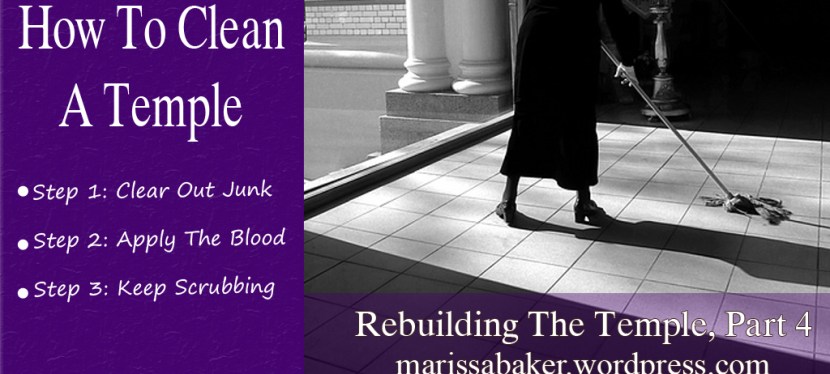
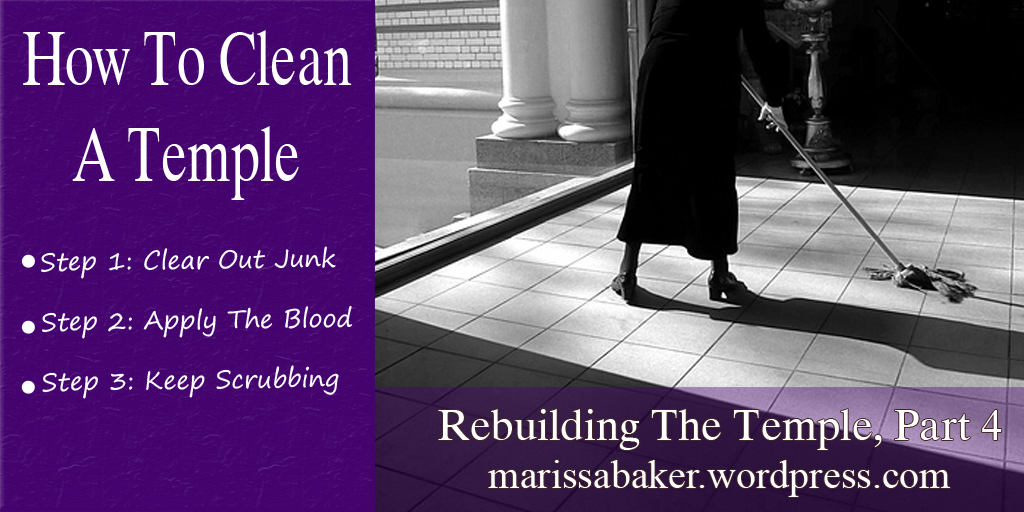
How To Clean A Temple

We’ve talked about how to build up spiritual temples and the fact that the churches today need a good temple cleaning, but not much about the practical how-to for cleaning temples. Back when there was a physical temple standing, God gave specific instructions about how to purify the temple and clean it when things got dirty. You couldn’t just throw some soapy water across the floor and say, “Clean!” Today, we are the temple of God, and He has set in place ways of cleaning us out as well.

How To Clean A Temple| marissabaker.wordpress.com

Step One: Clear Out Junk

One of the most complete Old Testaments accounts we have of cleansing a temple took place in the days of king Hezekiah.

In the first year of his reign, in the first month, he opened the doors of the house of the Lord and repaired them. Then he brought in the priests and the Levites, and gathered them in the East Square, and said to them: “Hear me, Levites! Now sanctify yourselves, sanctify the house of the Lord God of your fathers, and carry out the rubbish from the holy place. For our fathers have trespassed and done evil in the eyes of the Lord our God; they have forsaken Him, have turned their faces away from the dwelling place of the Lord, and turned their backs on Him. They have also shut up the doors of the vestibule, put out the lamps, and have not burned incense or offered burnt offerings in the holy place to the God of Israel. (2 Chr. 29:3-7)

And they gathered their brethren, sanctified themselves, and went according to the commandment of the king, at the words of the Lord, to cleanse the house of the Lord. Then the priests went into the inner part of the house of the Lord to cleanse it, and brought out all the debris that they found in the temple of the Lord to the court of the house of the Lord. And the Levites took it out and carried it to the Brook Kidron.
Now they began to sanctify on the first day of the first month, and on the eighth day of the month they came to the vestibule of the Lord. So they sanctified the house of the Lord in eight days, and on the sixteenth day of the first month they finished.
Then they went in to King Hezekiah and said, “We have cleansed all the house of the Lord, the altar of burnt offerings with all its articles, and the table of the showbread with all its articles. Moreover all the articles which King Ahaz in his reign had cast aside in his transgression we have prepared and sanctified; and there they are, before the altar of the Lord.” (2 Chr. 29:15-19)

I find it very interesting that, in addition to purifying the house and cleansing it (presumably with water and blood) the priests had to carry out debris and rubbish. There were things inside the temple defiling it that needed to be thrown out before the other purification could take place.

This puts me in mind of two incidents that took place during Jesus’ ministry. In several Bibles I’ve read, the section heading here reads “Jesus Cleanses The Temple.”

Now the Passover of the Jews was at hand, and Jesus went up to Jerusalem. And He found in the temple those who sold oxen and sheep and doves, and the money changers doing business. When He had made a whip of cords, He drove them all out of the temple, with the sheep and the oxen, and poured out the changers’ money and overturned the tables. And He said to those who sold doves, “Take these things away! Do not make My Father’s house a house of merchandise!” Then His disciples remembered that it was written, “Zeal for Your house has eaten Me up.” (John 2:13-17)

This happened in John chapter 2, at the first Passover during Jesus’ ministry. That means one of the very first things He did as part of His ministry was throw certain things and people out of God’s temple. It was a pivotal moment, and it didn’t just happen once. A very similar incident occurs right before His last Passover.

Then Jesus went into the temple of God and drove out all those who bought and sold in the temple, and overturned the tables of the money changers and the seats of those who sold doves. And He said to them, “It is written, ‘My house shall be called a house of prayer,’ but you have made it a ‘den of thieves.’” (Matt. 21:12-13)

Look how important this was to Jesus. He made a whip to drive out sheep, oxen and people. He poured the exchangers’ money onto the floor, and threw tables over. He probably raised His voice as He ordered out people who’d made His father’s house a vehicle for personal gain. He spent the time leading up to two Passovers before His sacrifice, which fulfilled all the blood sacrifices of the Old Testament, throwing defiling elements out of the temple.

Is there anything that needs thrown out of our lives before God can really start to work with us? The temple today is in our minds, so that’s where we need to look. Anything inside us that is crowding God out of His temple must be thrown out. Jesus can help with that if we ask Him, but – like the priests in Hezekiah’s day – we have to be willing to carry out the rubbish and dump it somewhere it won’t come back.

Step Two: Apply The Blood

Back in the Old Testament, the physical temple had to be cleaned and purified before God would put His presence there. Even when the first tabernacle was built and things started out exactly as God commanded, purification was a daily necessity. I suspect this was because people were involved, and no matter how hard we try we still can’t keep things clean enough for God on our own.

And you shall offer a bull every day as a sin offering for atonement. You shall cleanse the altar when you make atonement for it, and you shall anoint it to sanctify it. (Ex. 29:36)

As Israel fell into sin, the temple was often neglected. Throughout history, it was forgotten by Israel, defiled with idols, and ravaged by conquers. Whenever Israel came back to God, the temple needed fresh purification.

Thus says the Lord God: “In the first month, on the first day of the month, you shall take a young bull without blemish and cleanse the sanctuary. The priest shall take some of the blood of the sin offering and put it on the doorposts of the temple, on the four corners of the ledge of the altar, and on the gateposts of the gate of the inner court. And so you shall do on the seventh day of the month for everyone who has sinned unintentionally or in ignorance. Thus you shall make atonement for the temple. (Ezk. 45:18-20)

The animal sacrifices used to purify the physical temple were a stand-in pointing to how Jesus’s sacrifice would purify His people. “It is not possible that the blood of bulls and goats could take away sins,” but Jesus was able with one offering” to have “perfected forever those who are being sanctified” (Heb. 10:4, 14).

Remember that the tabernacle and then the temple layouts were divided into different sections. In the book of Hebrews, it talks about how there was a main section of the tabernacle where the priests served throughout the year, and then the Holy of Holies which the high priest could only enter once a year on the Day of Atonement (Yom Kippur).

Now when these things had been thus prepared, the priests always went into the first part of the tabernacle, performing the services. But into the second part the high priest went alone once a year, not without blood, which he offered for himself and for the people’s sins committed in ignorance; the Holy Spirit indicating this, that the way into the Holiest of All was not yet made manifest while the first tabernacle was still standing. It was symbolic for the present time in which both gifts and sacrifices are offered which cannot make him who performed the service perfect in regard to the conscience — concerned only with foods and drinks, various washings, and fleshly ordinances imposed until the time of reformation. (Heb. 9:6-10)

What’s really interesting is that in the Greek, there’s one word to describe the entire temple complex and another word to describe the inner sanctuary or Holy of Holies. It’s this second word, naos, which is used when talking about us as the temple of God. The book of Hebrews tells us there is a spiritual version of the Holy of Holies in heaven, where Christ presented His blood to atone for our sins, but each Christian today is also a type of spiritual Holy of Holies.

And according to the law almost all things are purified with blood, and without shedding of blood there is no remission. Therefore it was necessary that the copies of the things in the heavens should be purified with these, but the heavenly things themselves with better sacrifices than these. For Christ has not entered the holy places made with hands, which are copies of the true, but into heaven itself, now to appear in the presence of God for us; not that He should offer Himself often, as the high priest enters the Most Holy Place every year with blood of another — He then would have had to suffer often since the foundation of the world; but now, once at the end of the ages, He has appeared to put away sin by the sacrifice of Himself. (Heb. 9:22-26)

The high priest was the only one ever allowed into the Holy of Holies, just as Jesus Christ was the only one who could clean the spiritual temple. The law requires blood purification of holy things, and Jesus is the only one who’s blood is precious enough to cleans a polluted spiritual temple. Accepting Him as our Savior and asking Him to wash away our sins is a vital step in cleaning the spiritual temple.

Step Three: Keep Scrubbing

As the great High Priest over the church today, Jesus is the only one with a right to come into the temple and clean it out. We can help as best we can, but we must never forget that He’s the one doing the cleansing. It was His sacrifice that removed sin once and for all, and He’s the one continually working to clean His people.

looking for the blessed hope and glorious appearing of our great God and Savior Jesus Christ, who gave Himself for us, that He might redeem us from every lawless deed and purify for Himself His own special people, zealous for good works. (Tit. 2:13-14)

John the Baptist testified of Jesus Christ that He would baptize His people “with the Holy Spirit and fire” (Luke 3:16). When we accept Jesus Christ as our savior and are baptized in His name, we’re washed with His blood and covered in the spirit of God. That’s just the beginning of our purification process, though.

Husbands, love your wives, just as Christ also loved the church and gave Himself for her, that He might sanctify and cleanse her with the washing of water by the word, that He might present her to Himself a glorious church, not having spot or wrinkle or any such thing, but that she should be holy and without blemish. (Eph. 5:25-27)

The church today is God’s temple – His personal dwelling place – and we must do all we can to set it to rights by working on ourselves individually and collectively under the Headship of our High Priest Jesus Christ. The closer we draw to Christ and the more we point others to Him, the cleaner this temple will get.

Back in the Old Testament, the priests were assisted by Levites whose “duty was to help the sons of Aaron in the service of the house of the Lord, in the courts and in the chambers, in the purifying of all holy things and the work of the service of the house of God” (1 Chr. 23:28). This was supposed to keep happening on a continual basis. In much the same way, we have to continue repenting when we fall short and continue submitting to the refining process Christ is accomplishing in our lives.

How To Clean A Temple| marissabaker.wordpress.com

credits for photos used in blog images: