The Power of Fiction

The Power of Fiction | marissabaker.wordpress.com
bg image: “mountain of books” by Ginny, CC BY-SA

Fiction affects society, for good or ill, often as much or more than real-life situations. If Charles Dickens had lectured about the plight of real-life orphans in London, would it have had the same effect as writing Oliver Twist? Or to use an example I see as very negative, would as many people have been obsessed with an essay about BDSM as they were with 50 Shades of Gray?

Fiction is powerful. We talked about this a couple weeks ago, but all in a positive light since I was arguing that fiction has value. It can also have a more negative influence as well, which is why I think both writes and readers have a responsibility to self-censor. It’s not up to someone to tell writers not to write a certain kind of book or discuss a specific topic, or to tell readers what they can and cannot read. But it is a good idea (particularly if you’re a Christian) to think carefully about the reading and writing choices we make.

Writer Responsibility

On March 31, 1750, Samuel Johnson published what has become one of the most famous statements in regards to the potential of fiction. While I don’t agree with his arguments against imaginative invention of the fantastic (I write fantasy, after all), this passage intrigues me:

if the power of example is so great as to take possession of the memory by a kind of violence, and produce effects almost without the intervention of the will, care ought to be taken that, when the choice is unrestrained, the best examples only should be exhibited; and that which is likely to operate so strongly should not be mischievous or uncertain in its effects.”

I think what Johnson is saying is that authors have a responsibility not to use the power they weld to influence their readers negatively. Responsible authors exercise a form of self-censorship, which doesn’t necessarily mean they shouldn’t talk about complex or even “bad” ideas. But fiction can be enormously influential, and authors should be conscious of the fact that what they are writing has the potential to fill their readers’ minds.

Writers of fiction set out to create a story that draws readers in, and once this happens the readers are under the writer’s influence. Johnson thought that, “the best examples only should be exhibited” so that there is nothing “mischievous or uncertain” in fiction’s effect. I don’t think we need to go that far, but we should be mindful of the power we have to influence readers.

Reader Responsibility

As readers, we should also be mindful of what we expose our minds to, remembering that we’re giving our reading material the opportunity to change or influence our thinking. I came across a great article titled “Self Censorship Better Than Book Banning” a few weeks ago about teaching your children how to make good decisions about their reading material instead of trusting the schools or government to ban “inappropriate” books (which will be defined differently for each individual).

This is pretty much what my mother did, though I wasn’t required to talk about every book with her after reading it (I usually did anyway, so she didn’t really need a rule). The only time I remember my mother taking away a book was when I broke down sobbing one day and confessed that I was having trouble dealing with the main character losing her father to cancer. There were a few other books that she strongly recommended I give up, and I usually (eventually) agreed with her. Harry Potter was “banned” in our house when it first came out, and that’s the only book I can remember being specifically told not to read.

It seems to have worked for the most part. There are books I wish I hadn’t read (and a few I’m sure that I really I shouldn’t have been reading), but for the most part I’m glad I had that freedom. It helped teach me to think for myself, which, to reference John Keating from Dead Poets Society, is the goal of good education.
Why Write Fiction?

“Why would you write fiction? Isn’t it just a bunch of lies?”

It’s been a while since someone asked me that question, but I can re-play the scene clearly. They look smug, like they’d just discovered a great argument against writing and reading fiction. Fiction is not true, and so therefore it is not good. Why make-up stories when there are plenty of good, wholesome things, people, and events that already exist? In fact, why tell stories at all, especially fantasy stories? They just give children unrealistic expectations of the world, and adults an excuse to ignore reality.

Obviously, since I’m still writing and reading fiction, I don’t buy into these arguments. But why?

Escape

Probably the simplest reason for writing fiction is to escape. Much of fiction — both good and bad — falls into this category. Sometimes life isn’t any fun, and reading and writing fiction gives us a way to escape for a while without actually leaving our location or situation. This can be as simple as diving into Middle Earth while waiting for the clothes to finish drying at the laundromat. Would you rather stare at your t-shirts spin, or canoe down the Rauros with the Fellowship of the Ring?

Connect

In a New York Times article, ‘Why Write Novels at All?’ Garth Risk Halberg talks about the idea that “the deepest purpose of reading and writing fiction is to sustain a sense of connectedness, to resist existential loneliness.” Now we’re getting closer to the reason I write fiction. Escape is all well and good, but what are you escaping to? It’s not enough to just take off for Narnia — we have to find Aslan there or the journey means nothing.

We write to share who we are and what we think, and we read to connect with something outside us. Usually this is a new world or characters, but if we’re very lucky we’ll also sense the author as they bleed through the pages of their work. This connectedness is one of the chief arguments for reading and writing, since it carries over into “real” life: people who read fiction are more emphatic than non-readers.

Think

Let’s say you have something you want to say about a controversial topic. We’ll use abortion as an example, and say you’re on the pro-life side. If you write an article telling people that abortion is bad, only the people who already agree with you are going to like it. If you tell a true story about a baby who survived an abortion or a mother whose life was ruined by an abortion, it will affect more people but you’ll still lose a large number of your readers.

Why Read Fiction?  | marissabaker.wordpress.com
Photo credit: Easa Shamih, CC BY, via Flickr

Now suppose you write a story where you climb inside the head of a character and show what they are struggling with as she decides whether or not to have an abortion. You don’t just put your words in the character’s mouth – you imagine yourself in her shoes, and realize that she has real reasons to consider both options. You sympathize with her, and whatever your readers believe they sympathize with her too. Your ideas will filter through in decisions you make about how see feels when she sees the baby on an ultrasound, or whether or not she keeps the child at the end of the story. You can let readers know what you think, but you don’t shove your ideas down their throat. You give them a chance to feel with you, and let them think for themselves.

Obviously, I think of the writer of novels and stories and plays as a moral agent. In my view, a fiction writer whose adherence is to literature is, necessarily, someone who thinks about moral problems: about what is just and unjust, what is better or worse, what is repulsive and admirable, what is lamentable and what inspires joy and approbation. This doesn’t entail moralizing in any direct or crude sense.

Serious fiction writers think about moral problems practically. They tell stories. They narrate. They evoke our common humanity in narratives with which we can identify, even though the lives may be remote from our own. They stimulate our imagination. The stories they tell enlarge and complicate—and, therefore, improve—our sympathies. They educate our capacity for moral judgment. ” – Susan Sontag, from a speech at the Los Angeles Public Library

This sort of literature may or may not be an escape for your readers, but should definitely let them connect with something or someone. It should make them think. It should give them a chance to “meet” types of people thy might never come in contact with in their real lives, to question ideas that they take for granted, to consider what is and is not moral. Fiction lets us talk about things that are uncomfortable to discuss in real life, or give a new perspective on issue too charged in reality to have a dialogue about. It lets us ask “what if?” and run with the potential answers before actually changing the world. Yet.

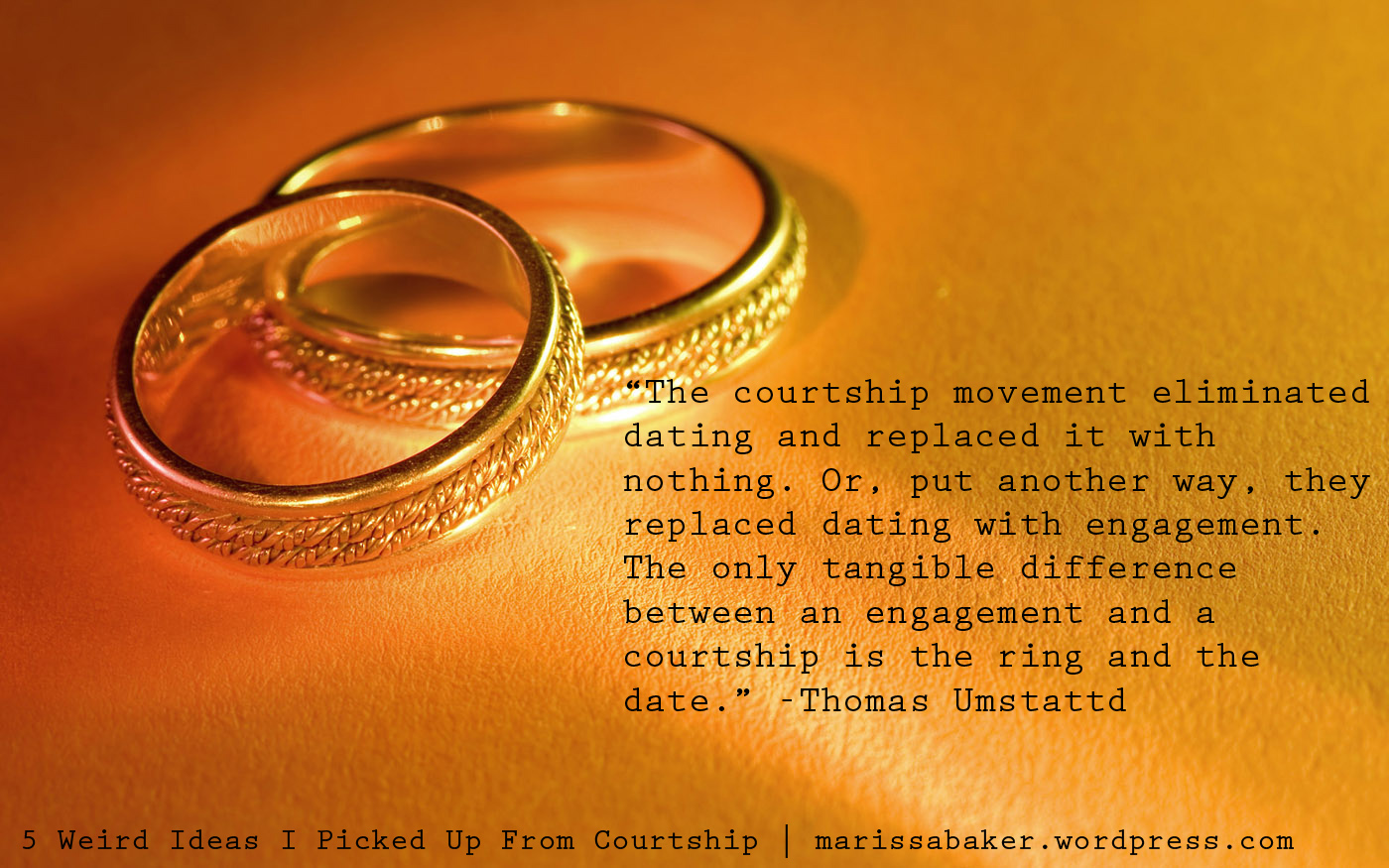
5 Weird Ideas I Picked Up From Courtship

If you grew up in a conservative Christian setting or the home-school community of the late 1990s and early 2000s, you mostly likely read I Kissed Dating Goodbye by Joshua Harris. After its release in 1997, it quickly became the go-to book in the courtship-vs-dating debate. If your friends didn’t hand it to you with an enthusiastic, “You have to read this book,” your mom probably thought it “would be good for you.” Or maybe you just picked it up on your own because of that suave guy on the cover tipping his hat (you know what I’m talking about, girls).

When I first read this book as a very “Christian” never-been-kissed teenager, all this courtship stuff seemed like a good idea. I mean, who doesn’t want a relationship guaranteed to lead to true love while keeping both God and your parent’s happy? The problem is, courtship doesn’t reliably work, and it gives you some pretty weird ideas to carry around if you eventually start trying to date like a semi-normal person.

Never Be Alone With A Guy

After reading I Kissed Dating Goodbye, my teenage self wrote up a list of things I would and wouldn’t do now that I knew the “right” way to interact with guys. Number 4 on my list was “ I will not put myself in a potentially compromising situation by being alone with a guy unless there are other people in the near vicinity.”

For us girls, this idea makes interacting with both married and single men awkward because you just know if you’re alone with them for any length of time you’re practically forcing them to have impure thoughts about you. This simply isn’t true (for one thing, people are responsible for their own feelings and thoughts), but having that idea in the back of your mind can make you feel guilty even in completely innocent situations.

Brothers, Not Boyfriends

That cute guy you walked past at the supermarket? the coworker who smiles at you every morning? They are not potential dating material–you’re are supposed to treat every man you meet just like you would your brother. If you start to even think about him as a potential boyfriend, you need to get your thoughts under control because you’re defrauding him and his future wife (who probably won’t be you). And courtship says the same thing to guys as well–think of every woman you meet as your sister until you’re ready to get married to her.

There are several problems with this idea. 1) Even after being told how “wrong” this is, you might still wonder (even briefly) if every attractive man or woman you meet is “the one.” The only difference is you feel guilty about it. 2) I’m perfectly comfortable leaning against my brother’s shoulder, looping my arm through his, going to him when I need help with something, and laughing and talking freely with him. That’s okay, because he actually is my brother. If I treat another guy like that, he’ll think I’m flirting and people will ask if we’re dating. 3) if you really do succeed in thinking of all your friends in a completely unromantic way, you’re less likely to pursue a romance.

Dad Has To Approve

Ideally in courtship, a man will decide he wants to pursue a relationship with a girl he is friends with, and then he will ask her father for permission to court her. As a young teen, having parental approval before you go out on a date makes sense when you have involved, caring parents. But courtship extends this principle to any age, and it becomes more and more impractical as you get older.  If a girl plans to move out of her parent’s house, go to school, or work outside their home, she’ll end up interacting with men who’ve never even met her parents and who haven’t heard of courtship. Have fun trying to explain to a really great guy who just asked you out for coffee that he needs to talk with your dad first because there’s no such thing as a casual date.

Personally, I have a good relationship with both my parents and I want them to approve any man I marry or even seriously date. However, they haven’t met all the guys I know, and I’d be comfortable going out with a guy who hasn’t met my parents but is respected by our mutual friends. Other girls don’t have a good relationship–or any relationship–with their parents. Courtship gives the impression that if her father is not in the picture, the guy better hope there’s a male authority figure in her life to talk to because heaven forbid she make up her own mind about something like this.

courtship

First Comes Courtship, Then Comes Marriage

Up until a couple is officially courting, they aren’t supposed to be alone or interact romantically in any way. Groups outings are the rule. Then as soon as they’re courting, they are set on the fast-track to marriage (it’s basically like an engagement, which makes proposals almost a moot point). Either you’re “just friends,” or you’re “exploring the possibility of marriage.” There’s no in between.

This brings us to a problem with courtship that underlies all the ones we’ve talked about already–courtship assumes that every interaction between men and women is extremely weighty and romantically charged. You can’t go on a casual date hoping to get to know someone better because courtship tells you  there’s no such thing as a “casual date.” You’re either friends, or you’re on the road to marriage.

Most people I know who’ve bought into the idea of courtship don’t actually get to the courtship part. It’s too intimidating of a commitment. When you leave courtship and try to date normally, though, you still have this idea that if a guy asks a girl out, that must mean he’s thinking of marrying her someday. It’s a really weird headspace to be in.

No Touching!

Courtship rules say absolutely no physical intimacy before you’re married. Depending on who you talk to, this even includes hand holding, hugs, or a quick kiss. Also, they add in the idea of “emotional sex” so that even having feelings for someone becomes wrong. Now, I do believe that God intends His people to save sex until marriage, but going to this extreme is a recipe for–you guessed it–more guilt.

People have written whole articles about how the teachings of physical and emotional purity from courtship books like I Kissed Dating Goodbye actually damage healthy relationships. You second-guess every hand-hold and shoulder touch, wondering if you’re sending the “wrong message.” You’re scared to fall in love because you don’t want to give pieces of your heart away to someone you might not marry, as if caring about someone leaves you with less capacity to care about someone else later (I wrote a whole post addressing this idea).

So what’s the alternative? The Christian community ran away from worldly dating for a reason, and problems like shallow short-term relationships and accelerated intimacy are still there. But courtship didn’t give us a viable alternative. Instead, I rather like the idea of going back to a more old-fashioned version of dating (as suggested by Thomas Umstattd, whom I also linked to in the intro). Debra Fileta supports a similar idea in her book and website True Love Dates. It’s not perfect, and I don’t think relationships will every be easy, but at least it sounds better than courtship!