The Necessity of Godly Conflict Resolution and Forgiveness

What is your first reaction when someone else makes you feel hurt, confused, or belittled? Where does your mind go if you observe someone doing something you think they shouldn’t, or going somewhere you don’t expect them, or not being where you think they should be?

For many of us, our first reaction is to assume something bad. They were trying to hurt us or put us down. They’re slacking on their duties, they don’t value their commitments, they’re trying to get away with something. For others among us, assuming positive intent comes more naturally and we’re inclined to give people a little more grace.

Whatever our default response, we need to learn how to assume positive intent. Psychologists counsel that assuming positive intent is a great way to move forward constructively from disputes. It’s a concept that’s often related to resolving conflicts in a work environment, but it works in other relationships as well. Brené Brown counsels people to approach all our interactions with the assumption that the other person is doing the best they can.

Positive intention isn’t just a new psychology trend. It’s linked with the philosophical notion of charity, which is also a Christian virtue. When you have the option to interpret a situation negatively or positively, assuming positive intent means you choose the more charitable or love-inspired option.

I started to write about this idea in last week’s post as part of the “Do Not Forsake Each Other” section, but I quickly realized there was way too much to say to fit in a concluding paragraph. Even in the church, I think we’re often too quick to jump to conclusions about peoples’ behavior. We may complain about, expose, ridicule, and cut them out of our lives without so much as a conversation to try and resolve our differences. That’s not how things are supposed to be. There has to be a better way.

Image of a group of people holding hands in a circle overlaid with text from Ephesians 4:31-32, NET version:  “Get rid of all bitterness, rage and anger, 
brawling and slander, along with every form of malice. Be kind and compassionate to one another, forgiving each other, just as in Christ God forgave you.”
Image by Claudine Chaussé from Lightstock

A Way Beyond Compare

In Paul’s first letter to the Corinthians, he addresses their desire for spiritual gifts. It’s a good desire, since gifts used rightly benefit the entire church body. But Paul is also concerned that the way they’re approaching gifts might lead to conflicts and people thinking that one person’s gift or role is better than another’s. So he makes sure that they know there’s a better way.

But you should be eager for the greater gifts. And now I will show you a way that is beyond comparison.

If I speak in the tongues of men and of angels, but I do not have love, I am a noisy gong or a clanging cymbal. And if I have prophecy, and know all mysteries and all knowledge, and if I have all faith so that I can remove mountains, but do not have love, I am nothing. If I give away everything I own, and if I give over my body in order to boast, but do not have love, I receive no benefit.

Love is patient, love is kind, it is not envious. Love does not brag, it is not puffed up. It is not rude, it is not self-serving, it is not easily angered or resentful. It is not glad about injustice, but rejoices in the truth. It bears all things, believes all things, hopes all things, endures all things.

Love never ends. But if there are prophecies, they will be set aside; if there are tongues, they will cease; if there is knowledge, it will be set aside. For we know in part, and we prophesy in part, but when what is perfect comes, the partial will be set aside. When I was a child, I talked like a child, I thought like a child, I reasoned like a child. But when I became an adult, I set aside childish ways. For now we see in a mirror indirectly, but then we will see face to face. Now I know in part, but then I will know fully, just as I have been fully known. And now these three remain: faith, hope, and love. But the greatest of these is love.

1 Corinthians 12:31-13:13, NET

This is how we’re supposed to interact with each other. Without love guiding our actions, all the good things we do are empty. In the King James Bible, “love” was translated “charity.” It’s from the Greek word agape, or “brotherly love, affection, good will, love, benevolence” (Thayer’s dictionary, entry G26). This is the same word Peter used in his letter when he wrote, “Above all keep your love for one another fervent, because love covers a multitude of sins” (1 Pet. 4:8, NET).

Peter doesn’t mean that love ignores sins or says they’re okay. The full Proverb that he quoted says, “Hatred stirs up strife, but love covers all wrongs” (Prov. 10:12, WEB). There’s a stark contrast between how love handles things and the type of reaction that generates dissention, disagreement, strife, and broken relationships. The NET study note on Proverbs 10:12 says, “Love acts like forgiveness. Hatred looks for and exaggerates faults, but love seeks ways to make sins disappear.” Love is the way God interacts with us, and it’s how He wants us to interact with each other.

If we are patient and kind, avoiding envy, bragging, pride, rudeness, selfishness, anger, and resentment, then we’ll be acting in love and assuming positive intent on the part of people we interact with. Rather than looking for reasons to find fault or jumping on people the moment we spot what might be a sin, we should try to find ways to resolve things peaceably.
Image of two men at a table overlaid with text from 2 Timothy 2:22-25, NET version:  “But keep away from youthful passions, and pursue righteousness, faithfulness, love, and peace, in company with others who call on the Lord from a pure heart. But reject foolish and ignorant controversies, because you know they breed infighting. And the Lord’s slave must not engage in heated disputes but be kind toward all, an apt teacher, patient, correcting opponents with gentleness.”
Image by Claudine Chaussé from Lightstock

When We’re Tempted to Give Up on Church

All too often, we see churches that are full of rifts and squabbles between the members and misunderstandings or even abuses of power from the ministry. There are times when we need to discontinue fellowship with someone because they are sinful and toxic, and times when accusations must be brought against those in ministry (1 Cor. 5:9-13; 1 Tim. 5:19-20). I don’t want to downplay those serious issues, but (as I mentioned in last week’s post) I suspect they’re less common than situations where pride, selfishness, impatience, and miscommunication are getting in the way of godly conflict resolution.

On the one hand, I understand why some people want to move away from organized church groups and how some develop antagonistic relationships with ministry. As an older teen and in my early 20s, there were several times I wanted to walk away from church even though I didn’t want to abandon my relationship with God. I found myself nodding along when people said that nothing was going to change until all the old ministers died off. I’d get irritated or even outraged when I heard of situations where a minister imposed stupid rules like no colorful socks at church or did something that seemed unbiblical like telling people not to host private Bible studies. I’ve felt stifled by church traditions, alone in congregations, and irritated that some people and/or rules seemed to get in the way of how I want to experience God.

But then I started listening to people more carefully. I heard more about behind-the-scenes reasons for some of the seemingly arbitrary rules in certain congregations. I built relationships with people in the ministry who are truly, deeply committed to doing things God’s way. I joined a small women’s group at church and learned more about their experiences and viewpoints. I don’t always agree with or understand the reasoning of everyone I encounter at church, but I believe that on the whole both ministers and my fellow church members have positive intentions. We all want to follow Jesus, honor God, and contribute positively to His church.

And he himself gave some as apostles, some as prophets, some as evangelists, and some as pastors and teachers, to equip the saints for the work of ministry, that is, to build up the body of Christ, until we all attain to the unity of the faith and of the knowledge of the Son of God—a mature person, attaining to the measure of Christ’s full stature. So we are no longer to be children, tossed back and forth by waves and carried about by every wind of teaching by the trickery of people who craftily carry out their deceitful schemes. But practicing the truth in love, we will in all things grow up into Christ, who is the head. From him the whole body grows, fitted and held together through every supporting ligament. As each one does its part, the body builds itself up in love.

Ephesians 4:11-16, NET

This is how the church is supposed to work. It doesn’t always look like this, but that’s what we should all be working toward. And I think it will go a long way toward making the church more like this if we learn to assume positive intent on the part of other people. When you assume positive intent, you talk with people about your concerns instead of jumping to the conclusion that they’re intractable, malicious, or stupid. And we need to be able to talk with people to build real relationships and resolve conflicts.
Image of three smiling women overlaid with text from Ephesians 5:18-21, NET version:  “be filled by the Spirit, speaking to one another in psalms, hymns, and spiritual songs, singing and making music in your hearts to the Lord, always giving thanks to God the Father for all things in the name of our Lord Jesus Christ, and submitting to one another out of reverence for Christ.”
Image by Pearl from Lightstock

The Necessity of Godly Conflict Resolution

Matthew 18 is an interesting chapter. In some Bibles, it’s divided up into four different headings but the whole thing is part of Jesus’s answer to a questions the disciples asked. They came to Him and said, “Who is the greatest in the kingdom of heaven?” (Matt. 18:1, NET).

He called a child, had him stand among them, and said, “I tell you the truth, unless you turn around and become like little children, you will never enter the kingdom of heaven! Whoever then humbles himself like this little child is the greatest in the kingdom of heaven.”

Matthew 18:2-3, NET

“Who will be greatest?” is not the right question to ask. That attitude needed to be turned around if they wanted to get into the kingdom of heaven. As Jesus goes on, He warns them against causing one of the “little ones” who believe in Him to sin. It would be better to cut off your own hand or foot than to be a stumbling block to yourself or others.

He then hammers the point home with the parable of the lost sheep. God is like a shepherd who notices if just one little lamb wanders off, and He cares deeply about keeping all His people in His flock. With that background information about how important it is to God that His flock stays together and the members don’t cause each other to stumble and sin, Jesus immediately goes into addressing Christian conflict resolution.

“In the same way, your Father in heaven is not willing that one of these little ones be lost.

“If your brother sins, go and show him his fault when the two of you are alone. If he listens to you, you have regained your brother. But if he does not listen, take one or two others with you, so that at the testimony of two or three witnesses every matter may be established. If he refuses to listen to them, tell it to the church. If he refuses to listen to the church, treat him like a Gentile or a tax collector.

Matthew 18:14-15, NET (bold italics in original, marking a quotation from Deut 19:15)

The first step Jesus gives for resolving disputes in a godly way is much easier if you assume positive intent. Ideally, this first step is where it starts and stops. Something comes up, you go to your brother or sister in Christ and talk about it, and you mend the relationship. And yet, this is the step that is most often skipped. We often want to jump ahead to the “take one or two others with you” or “tell it to the church” steps, but that’s not the way to practice truth in love or build up the body (as Paul told us to do in Ephesians).

At this point in the conversation, Peter had a question. He came to Jesus and asked, “Lord, how many times must I forgive my brother who sins against me? As many as seven times?” Jesus told Him he must be willing to forgive way more than that, and then illustrated His point with a parable.

Image of clasped hands with the blog's title text and the words "Let's each commit to doing our part to live peacefully with brothers and sisters in the faith, assume positive intent as we navigate our relationships, and refuse to give up on fellowshipping together as part of God's church."
Image by Jantanee from Lightstock

“For this reason, the kingdom of heaven is like a king who wanted to settle accounts with his slaves. As he began settling his accounts, a man who owed 10,000 talents was brought to him. Because he was not able to repay it, the lord ordered him to be sold, along with his wife, children, and whatever he possessed, and repayment to be made. Then the slave threw himself to the ground before him, saying, ‘Be patient with me, and I will repay you everything.’ The lord had compassion on that slave and released him, and forgave him the debt. After he went out, that same slave found one of his fellow slaves who owed him 100 silver coins. So he grabbed him by the throat and started to choke him, saying, ‘Pay back what you owe me!’ Then his fellow slave threw himself down and begged him, ‘Be patient with me, and I will repay you.’ But he refused. Instead, he went out and threw him in prison until he repaid the debt. When his fellow slaves saw what had happened, they were very upset and went and told their lord everything that had taken place. Then his lord called the first slave and said to him, ‘Evil slave! I forgave you all that debt because you begged me! Should you not have shown mercy to your fellow slave, just as I showed it to you?’ And in anger his lord turned him over to the prison guards to torture him until he repaid all he owed. So also my heavenly Father will do to you, if each of you does not forgive your brother from your heart.”

Matthew 18:23-35, NET

This is serious stuff. Forgiveness from God is among the most precious gifts we receive. Our eternal lives depend on it. So when Jesus says the way we treat each other is so important that God’s forgiveness of us depends on our forgiveness of others, we need to sit up and pay attention. Forgiveness and conflict resolution among God’s people isn’t just God’s preference. It’s an imperative affecting our salvation.

God wants peace among His people and He intends for us to grow together as a whole church (i.e. followers of God who may attend different congregations but are united under the Head of the church, Jesus Christ), not simply as isolated individuals. We are admonished to “take thought of how to spur one another on to love and good works, not abandoning our own meetings, as some are in the habit of doing, but encouraging each other” (Heb. 10:23-25). There are times when it’s physically impossible to get together with other believers, and God understands that. But if you can gather with other believers and be part of a local church–or even set up something like virtual Bible studies, if you can’t meet in person–it’s far better to do that than to try to live as a solitary Christian. Let’s each commit to doing our part to live peacefully with all people–especially those who are brothers and sisters in the faith–, assume positive intent as we navigate our relationships, and refuse to give up on fellowshipping together as part of God’s church.


Featured image by Shaun Menary from Lightstock

Do Not Forsake

We’re likely all familiar with God’s promises that He won’t forsake us. Yet we also know that even Jesus cried out, “My God, my God, why have you forsaken me?” when He hung on the cross (Matt. 27:46, WEB). While God always keeps His promises–including the one not to leave or forsake us–sometimes we still feel like we’re abandoned.

Our worries about this can become worse when we read of times when God said He has or will forsake certain people. He warned ancient Israel about the consequences of forsaking Him early in their relationship, and He later bemoaned the fact that His people did forsake Him. Their choice to abandon God led to a rift in that relationship. He never breaks covenant and isn’t the first to forsake a relationship, but human actions to move away from Him can result in distance from God.

Like the covenant God made with Israel, our relationship with Him is a reciprocal one–we need to stay faithful and involved in the relationship if we want to stay close to God. As we think about the importance of not abandoning our relationship with God, there’s a collective as well as individual responsibility. We’re not supposed to abandon our individual relationships with God, but we’re also not supposed to forsake the fellowship of other believers. I think the instruction to stay committed to your relationship with God’s church is closely tied to the responsibility to not abandon God Himself.

Lord, Do Not Forsake Us

One of the things that we find in the Psalms is snapshots of different seasons we can go through in our relationships with God. Thinking of the Psalms as windows into the many different ways Godly people can relate to God is a helpful approach since we’re not going to resonate with every single Psalm at the same time. Some Psalms speak of times when the writer was confident and bold in their walk with God. Some picture times of peace and contentment in relation to God. Others show what it can be like during times of wrestling and struggle, uncertain of what God is doing and why He seems distant.

My God, my God, why have you forsaken me? Why are you so far from helping me, and from the words of my groaning?

Psalm 22:1, WEB

Do not reject me. Do not push your servant away in anger. You are my deliverer. Do not forsake or abandon me, O God who vindicates me.

Psalm 27:9, NET

Don’t reject me in my old age. Don’t forsake me when my strength fails.

Psalm 71:9, WEB

It’s not unusual to feel that God has forsaken us; even Jesus quoted Psalm 22 when He hung on the cross. It’s also acceptable to plead with Him not to forsake us, as the Psalmists do here and in other passages (Psalm 38:21; 71:18; 119:8; 138:8). People who trust and love God may still cry out to Him, “Do not forsake us.”

God preemptively answered these cries with many promises that He will not forsake us. One of these promises appeared in the Torah and would have been familiar to the psalmists. However, it was followed by a warning that if ancient Israel forsook God first, then He would forsake them in the sense that He would not dwell among them and save them from their enemies (Deut. 31:1-8, 16-17). Perhaps the psalmists were thinking of the reciprocal nature of faith and covenants when they prayed, reminding God that they haven’t forsaken Him and so He had no reason to forsake them.

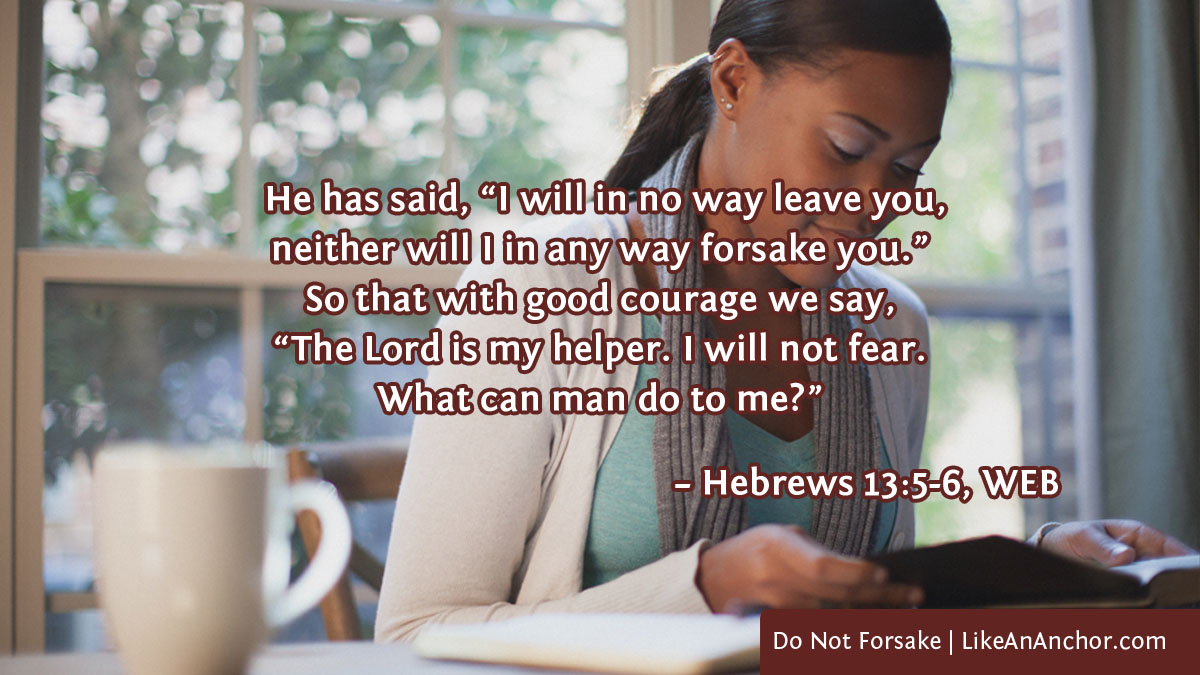
Image of a woman reading the Bible overlaid with text from Hebrews 13:5-6, WEB version:   He has said, “I will in no way leave you, neither will I in any way forsake you.” So that with good courage we say, “The Lord is my helper. I will not fear. What can man do to me?"
Image by Pearl from Lightstock

Do Not Forsake the Lord

We humans tend to be self-focused, and it’s no surprise that we’re preoccupied with making sure God and the people we care about don’t forsake us. But we also need to be aware that those we’re in relationship with have similar expectations. God echoes the sentiment of “Do not forsake Me” back to us when He bemoans the rift in relationship that happened when His people forsook Him.

Yet you have forsaken me and served other gods. Therefore I will save you no more.

Judges 10:13, WEB

Yahweh is with you, while you are with him; and if you seek him, he will be found by you; but if you forsake him, he will forsake you.

2 Chronicles 15:2,WEB

For my people have committed two evils: they have forsaken me, the spring of living waters, and cut out cisterns for themselves: broken cisterns that can’t hold water.

Jeremiah 2:13, WEB

There are consequences for forsaking relationship with God, even including being forsaken by Him. That’s a sobering thought. We know sins can separate us from God (Isaiah 59:1-2), and unrepented sin on top of unrepented sin can even lead to God forsaking temporarily, the way He did with ancient Israel.

For Yahweh has called you as a wife forsaken and grieved in spirit,
even a wife of youth, when she is cast off,” says your God.
“For a small moment I have forsaken you,
but I will gather you with great mercies.
In overflowing wrath I hid my face from you for a moment,
but with everlasting loving kindness I will have mercy on you,” says Yahweh your Redeemer.

Isaiah 54:6-8, WEB

I don’t think of this so much as God abandoning the relationship (He is never the one who breaks covenants), but as us pulling away so far that He isn’t close to us anymore. And if we break covenant with Him, restoring the relationship requires something drastic (i.e. Jesus Christ’s sacrifice removing our sins). Thankfully, God in His mercy set things up so we can repent and turn back to Him, restoring relationship when we ask for forgiveness, change, and live in obedient harmony with Him.

Do Not Forsake Each Other

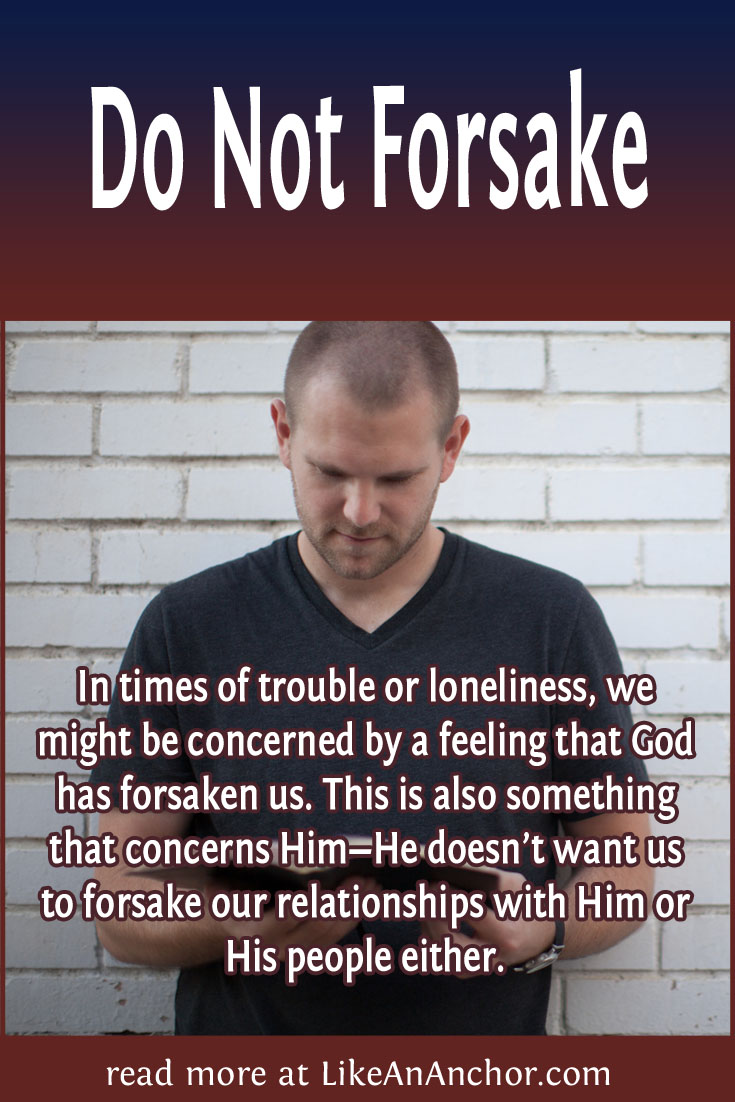
Image of an man reading the Bible with the blog's title text and the words "In times of trouble or loneliness, we might be concerned by a feeling that God has forsaken us. This is also something that concerns Him—He doesn’t want us to forsake our relationships with Him or His people either."
Image by Anggie from Lightstock

I heard an analogy once on a Christian radio station that has stuck with me for years. If your spouse said, “Darling, I love your head but I could do without your body,” would you feel loved? That’s essentially what we’re saying to God if we say, “Hey, I like Jesus but I could really do without all these Christians.”

And God put all things under Christ’s feet, and gave him to the church as head over all things. Now the church is his body, the fullness of him who fills all in all.

Ephesians 1:22-23, NET

We need to hold fast to the Head, Jesus Christ, but we do so as part of a collective body. The body/church is supposed to all hold on to Jesus Christ together and grow together (Eph. 2:20-23; 4:11-16). We have individual relationships with God and we work on our own salvation with His help, but it’s always in the context of the larger house, temple, or body (NT writers use various analogies) that God is building. It’s all of us together that make up the temple of God. We need each other.

 Let’s consider how to provoke one another to love and good works, not forsaking our own assembling together, as the custom of some is, but exhorting one another, and so much the more as you see the Day approaching.

Hebrews 10:24-25, WEB

This is a direct instruction not to forsake each other. There are times when not assembling is unavoidable–health issues, lack of transportation, extreme distance, and persecutions can all make it impossible for some people to regularly gather with other believers. But if we don’t gather with others in the church–the body of Jesus Christ–it shouldn’t be by our own choice. We should never be the thing that stands in the way of fellowshipping with God’s people.

That said, I also want to acknowledge there are times when we need to discontinue fellowship with someone because they are sinful and toxic, and times when legitimate accusations must be brought against those in ministry (1 Cor. 5:9-13; 1 Tim. 5:19-20). I don’t want to downplay those serious issues, but I suspect they’re less common than situations where pride, selfishness, impatience, and miscommunication are getting in the way of godly conflict resolution and relationship restoration.

 Love must be without hypocrisy. Abhor what is evil, cling to what is good. Be devoted to one another with mutual love, showing eagerness in honoring one another. Do not lag in zeal, be enthusiastic in spirit, serve the Lord. Rejoice in hope, endure in suffering, persist in prayer. Contribute to the needs of the saints, pursue hospitality. Bless those who persecute you, bless and do not curse. Rejoice with those who rejoice, weep with those who weep. Live in harmony with one another; do not be haughty but associate with the lowly. Do not be conceited. Do not repay anyone evil for evil; consider what is good before all people. If possible, so far as it depends on you, live peaceably with all people.

Romans 12:9-17, NET

As I read this, I feel convicted. There are several of these things that I neglect to do regularly and some instructions that I’ve even acted in opposition to (e.g. being reluctant to honor others instead of eager, or unwilling to bless those who’ve hurt me). But can you imagine how much different our lives, relationships, and churches would look if we all really followed Paul’s instructions here? It would be such a wonderful transformation, and getting to that point starts with each of us committing to living this out as far as depends on us.

God promises not to forsake us. He expects a similar commitment from us. He knows we’re not perfect, but we must do our best to remain faithfully committed to Him and fellowship with other believers if at all possible (and repent, ask for forgiveness, and change when we miss the mark). With God’s help, we can live securely in harmony with the Father, Jesus Christ, and the family they are building.


Featured image by Shaun Menary from Lightstock

Loving Christ’s Body

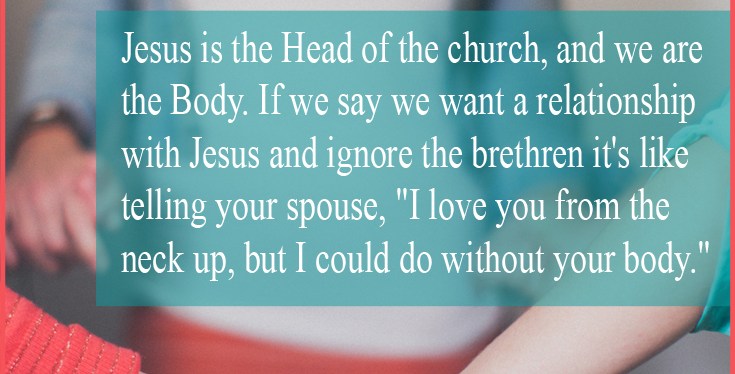
Not too long ago, I heard an analogy on a Christian radio station that stuck with me. It was a pastor trying to convince listeners they need a church to fellowship with. He said that since the church is Jesus Christ’s body and He is the Head, if we say we want a relationship with Jesus and ignore the brethren it’s like telling your spouse, “I love you from the neck up, but I could do without your body.”

Loving Christ's Body | marissabaker.wordpress.com

Vital Commandments

This analogy is not an exaggeration. John’s writings make very clear the high value Jesus puts on love among believers. If we can’t love our brethren, we’re actually incapable of loving God. Read more

Lies That Isolate Us

Lies That Isolate Us | marissabaker.wordpress.com We know how important a relationship with God is to our Christian walk, and last week we talked about how important it is for us to also have relationships with other believers. For some of you, that comes fairly easily — you have a church home where you feel welcome, and good friends who share your faith. Many of you feel much more isolated, through. Maybe there aren’t any options for fellowship in your area, but if you’re online reading this blog post you have at least one way to connect with fellow believers, if we’re willing to take advantage of it. Peter describes our “adversary the devil” as a “roaring lion” who walks about “seeking whom he may devour” (1 Pet. 5:8). When predators like lions hunt herd animals (like the sheep we’re so often compared to in scripture), they try to isolate one before going in for the kill. One of the tools our adversary uses to do this to us if the lies we tell ourselves that keep us from seeking out fellowship — things like “I’m not good enough,” or “I have nothing to offer,” or “No one values me.”

Let Them Love You

No matter how true these thoughts feel, they are not an accurate reflection of how God sees us. You say, “I have no value,” God says you’re so valuable that Jesus traded His own life to save you.

But God demonstrates His own love toward us, in that while we were still sinners, Christ died for us. (Rom. 5:8)

Jesus Christ’s was the most valuable human life ever, and that’s the price He and His Father paid for you. They didn’t do this because they “had to.” They did it because they thought you were worth it. Paul tells us that “Christ Jesus came into the world to save sinners, of whom I am chief,” and He came to save you as well (1 Tim. 1:15).

 Greater love has no one than this, than to lay down one’s life for his friends. You are My friends if you do whatever I command you. (John 15:13-14)

Jesus said this to His disciples, but He meant it for us as well. He died for you because He cares about you, and if you’re following His commandments you have the right to claim friendship with Him as well.

In this the love of God was manifested toward us, that God has sent His only begotten Son into the world, that we might live through Him. In this is love, not that we loved God, but that He loved us and sent His Son to be the propitiation for our sins. Beloved, if God so loved us, we also ought to love one another. (1 John 4:9-11)

Because of the love of God for us, we as His followers should have love for each other. This applies to us having and showing love, but also to us receiving love. You should be able to walk into a group of people who are following God and find love and companionship there. Sure there’ll be a few bad apples in most groups, but don’t focus on them — there’s usually more good people there who will love and befriend you if you give them the chance.

Accept Your Gifts

God loves, values and wants you, and He expects people following Him to love you as well. And that’s not where it ends. You might think you have nothing to offer God or a church group, but God tells us we’re each necessary to His family. God sees value in every life, and it is His desire for “all men to be saved and to come to the knowledge of the truth” (1 Tim. 2:4). He doesn’t give up on people, and He can work with anyone who seeks Him, including you. In fact, if you turn your back on Him, you’re depriving His family of someone He thought was important enough to call into relationship with Him. You’re not doing anyone a favor by “getting out of the way” or thinking they don’t need you.

But the manifestation of the Spirit is given to each one for the profit of all (1 cor. 12:7)

You might think it seems like everyone except for you has a spiritual gift, but God doesn’t say He makes exceptions in this. You do have gifts (click here to start discovering them), and He did have a reason for inviting you into His church.

For in fact the body is not one member but many. If the foot should say, “Because I am not a hand, I am not of the body,” is it therefore not of the body? And if the ear should say, “Because I am not an eye, I am not of the body,” is it therefore not of the body? If the whole body were an eye, where would be the hearing? If the whole were hearing, where would be the smelling? But now God has set the members, each one of them, in the body just as He pleased. (1 Cor. 12:14-18)

This is one reason that comparing ourselves among ourselves is not wise (2 Cor. 10:12). There is a wide range of available gifts, and you will fit much more comfortably into the body if you recognize your value and discover your gifts rather than trying to mimic other people. You are needed in your own unique way. If God wanted everyone to be the same, He wouldn’t have created so much variety.

And the eye cannot say to the hand, “I have no need of you”; nor again the head to the feet, “I have no need of you.” No, much rather, those members of the body which seem to be weaker are necessary. And those members of the body which we think to be less honorable, on these we bestow greater honor; and our unpresentable parts have greater modesty, but our presentable parts have no need. But God composed the body, having given greater honor to that part which lacks it, that there should be no schism in the body, but that the members should have the same care for one another. (1 Cor. 12:21-25)

God doesn’t want you to feel like you don’t fit in the body, and He doesn’t want anyone else to tell you that you don’t fit. His goal is unity, mutual respect, and genuine concern between members of His church. That’s what He wants for you, whether or not you think you deserve it. The truth is, none of us are “good enough” for God. That’s why Jesus had to die for us. Once we accept that sacrifice and repent, though, God does not intend for us to wallow in inferiority. He wants us to take the amazing gifts and opportunities He gives us and use them boldly. He wants us to take our place in His church and stop sabotaging ourselves with lies that keep us away from Him and from our brethren.

Pilgrims

I’m back! and the flu which was the reason for my blogging hiatus has indirectly inspired this newest post. Since I had to stay home from church services, I had the chance to watch a DVD sermon we’d just got in the mail (you can listen to “My Burden Is Light” on this website, if anyone’s interested).

In this sermon, he talked about getting rid of the old man and removing sin from our lives so we are not weighed down with excess spiritual baggage as we make our pilgrimage toward the kingdom of God. This sparked a thought I’ve been mulling over for the past few days.

I don’t know how you think about being “strangers and pilgrims on the earth” (Heb. 11:13), but I’ve always thought more about being separate from the world and making a pilgrimage out of darkness than I have about the obvious flip-side of this statement. To be making a pilgrimage out of something, there must be a destination that we are making a pilgrimage toward. In much the same way, when we become a stranger to this world, we experience a change that makes us no longer strangers to God.

At that time ye were without Christ, being aliens from the commonwealth of Israel, and strangers from the covenants of promise, having no hope, and without God in the world: but now in Christ Jesus ye who sometimes were far off are made nigh by the blood of Christ. (Eph. 2:12-13).

Because of His redemptive work, we are “no more strangers and foreigners, but fellowcitizens with the saints, and of the household of God” (Eph. 2:19). Coming out of this world and becoming strangers to it is what we must do once we have received the gift of forgiveness that allows fellowship with God.

When we are separate from the world in how we think and behave we, like those in the Faith Chapter, “declare plainly that [we] seek a country” (Heb. 11:14). Do our lives show that we are friends of God and strangers to the world’s ways? Do we proclaim with our actions that our sense of belonging is with God, and not with this world?