The Bookshelf Tag

I was going to skip having a post today because of my busy weekend, and then I saw Carissa’s post with this tag. The original tag comes from Raindrops On Roses and Whiskers On Kittens. Since I love my books so much (as you will know by the end of this post if you didn’t already), I thought it would be fun to write about them.

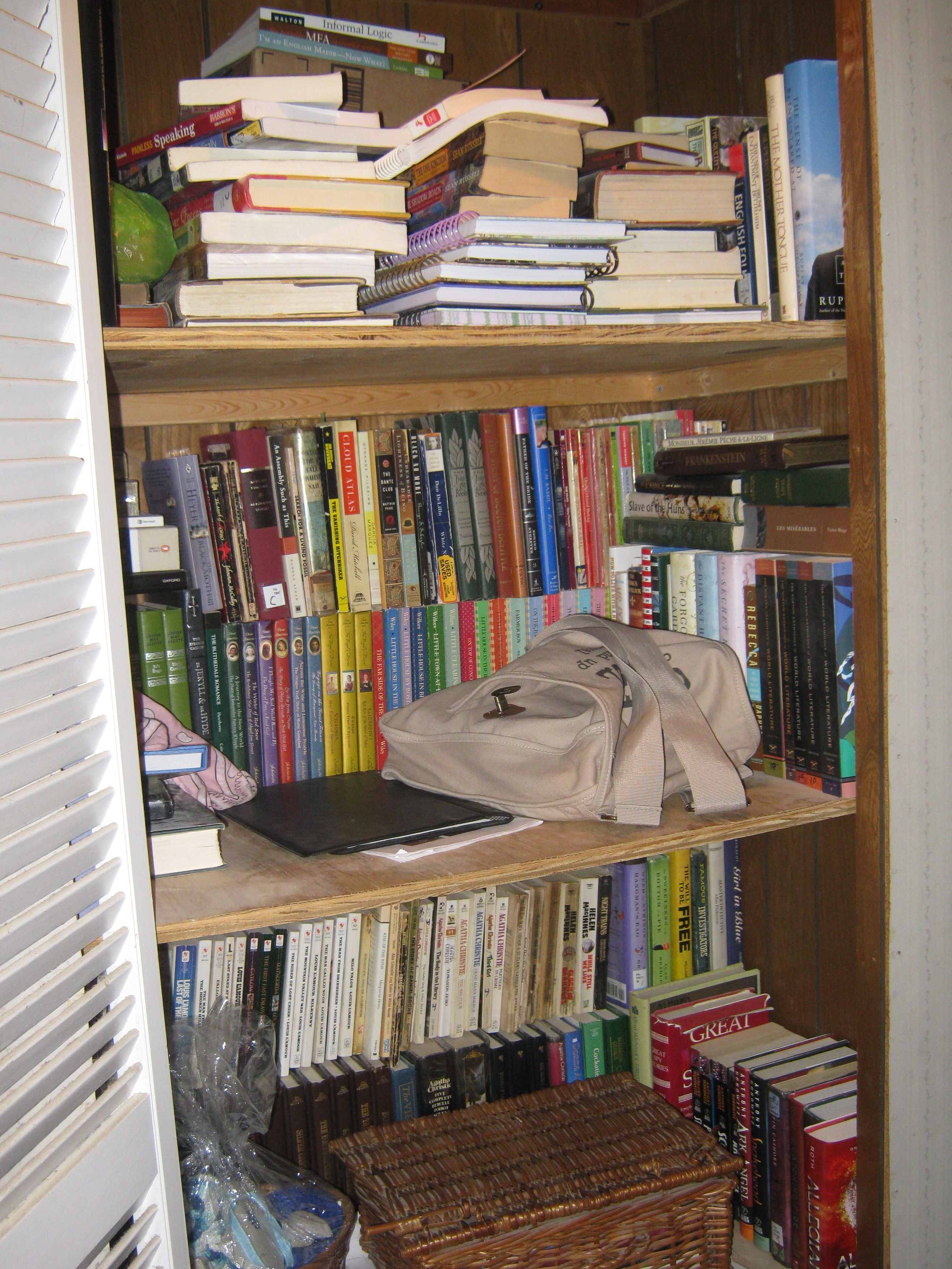
Describe your bookshelf (or wherever it is you keep your books-it doesn’t actually have to be a shelf!) and where you got it from:

The Bookshelf Tag | marissabaker.wordpress.comI have multiple book shelves. My computer desk has books on the shelves, then there’s a book shelf next to that and books in the china cabinet as well. One of the closets in my bedroom is a bookshelf, there’s 16-feet of shelf space above my sister’s bed, I have more books a dresser and cabinet that I think were designed for clothes, and a few crates of books in another closet. In total, I have 1,075 books that are on my master list of books I own (I recently cleaned out the book shelves — it was closer to 1,200 a few months ago).

Do you have any special or different way of organizing your books?

I have them loosely organized by subject. The system doesn’t make much sense to anyone else, but it rarely takes me more than 30 seconds to find any book I’m looking for.

What’s the thickest (most amount of pages) book on your shelf?The Bookshelf Tag | marissabaker.wordpress.com

I’m not checking the page count, but I’m guessing The Riverside Shakespeare has all the others beat.

What’s the thinnest (least amount of pages) book on your shelf?

I have quite a few thin books, so I’m going to go with the thinnest on the shelves around my computer. It’s The 38 Most Common Fiction Writing Mistakes (and how to avoid them) by Jack M. Bickham.

Is there a book you received as a birthday gift?

Several, including Ender’s Game by Orson Scott Card and some of Regina Doman’s fairy tale retellings.

What’s the smallest (height and width wise) book on your shelf?

Robin’s Country by Monica Furlong.

What’s the biggest (height and width wise) book on your shelf?

For width it’s The Riverside Shakespeare again, but for height is The Anglo-Saxon Chronicles as translated and collated by Anne Savage.

Is there a book from a friend on your shelf?

Yes. Friends give me books fairly regularly 🙂

Most expensive book?

They aren’t the most valuable books I own, but my hardcover copies of The Lord of the Rings are probably the ones I spent the most money on.

The last book you read on your shelf?

I own and am currently reading Far From the Madding Crowd by Thomas Hardy.

Of all the books on your shelf, which was the first you read?

I have no idea. Maybe one of the Hardy Boy or Nancy Drew books? Of the ones just out here by my desk it was probably Around the World in 80 Days by Jules Verne.

Do you have more than one copy of a book?The Bookshelf Tag | marissabaker.wordpress.com

Yes. I have reading copies and display copies for The Lord of the Rings and The Chronicles of Narnia, and I have several versions of some of my favorite classics like Pride and Prejudice.

Do you have the complete series of any book series?

Yes. I probably have more complete series than I do incomplete series.

What’s the newest addition to your shelf?

Shadow of the Giant by Orson Scott Card. I’ve been looking for a nice copy, and finally got one through Paperback Swap.
The Bookshelf Tag | marissabaker.wordpress.comWhat’s the most recently published book on your shelf?

I think it’s Allegiant by Veronica Roth.

The oldest book on your shelf (as in, the actual copy is old)?

An 1895 edition of Ivanhoe that I picked up at a little shop in Wisconsin.

A book you won?

I won an English Book Award my last year at The Ohio State University, and was given Equivocal Beings: Politics, Gender and Sentimentality in the 1790s by Claudia L. Johnson, The Iron Pen: Frances Burney and the Politics of Women’s Writing by Julia Epstein, and The Swerve: How The World Became Modern by Stephen Greenblatt.

A book you’d hate to let out of your sight (aka a book you never let someone borrow)?

I’m pretty good about loaning books if people ask and I trust them, but I probably wouldn’t give out my nice copies of The Lord of the Rings or books with sentimental value like my mother’s copy of Freckles by Gene Stratton Porter (technically it’s still hers, but I swiped it from her bookshelf).

Most beat up book?
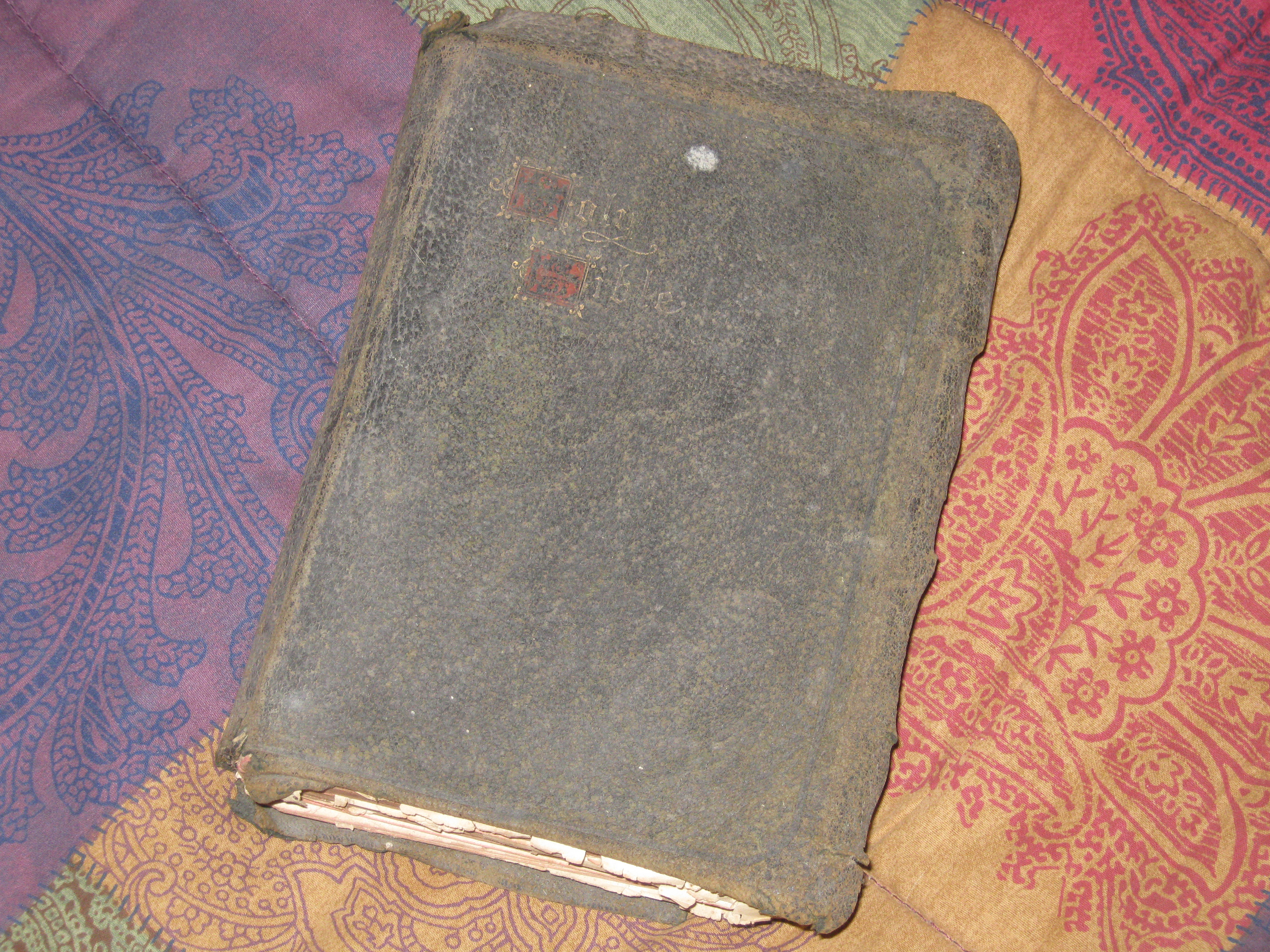
The Bookshelf Tag | marissabaker.wordpress.comA 1901 King James Bible we found in my grandparent’s house after Grandma died. It’s so fragile I’m scared to open it, but I love it.

Most pristine book?

That’s easy — my gorgeous blue Barns and Noble edition of  The Arabian Nights is still in it’s shrink-wrap plastic.

A book from your childhood?

So many — I have most of the original Hardy Boys, Nancy Drew, and Tom Swift Jr. books.

A book that’s not actually your book?

Well, technically some of them may or may not belong to my sister …

A book with a special/different cover (e.g. leather bound, soft fuzzy cover etc.)?

Several of my Louis L’Amour books are leatherette bound, and my copy of The Hobbit has a lovely green cover with green speckles on the page edges.

Book that’s been on your shelf the longest that you STILL haven’t read?

Maybe my collection of Sherlock Holmes. I’ve read several stories from it, but not all of them. Or perhaps it’s one of my Charles Dickens books like Oliver Twist or David Copperfield.The Bookshelf Tag | marissabaker.wordpress.com
Any signed books?

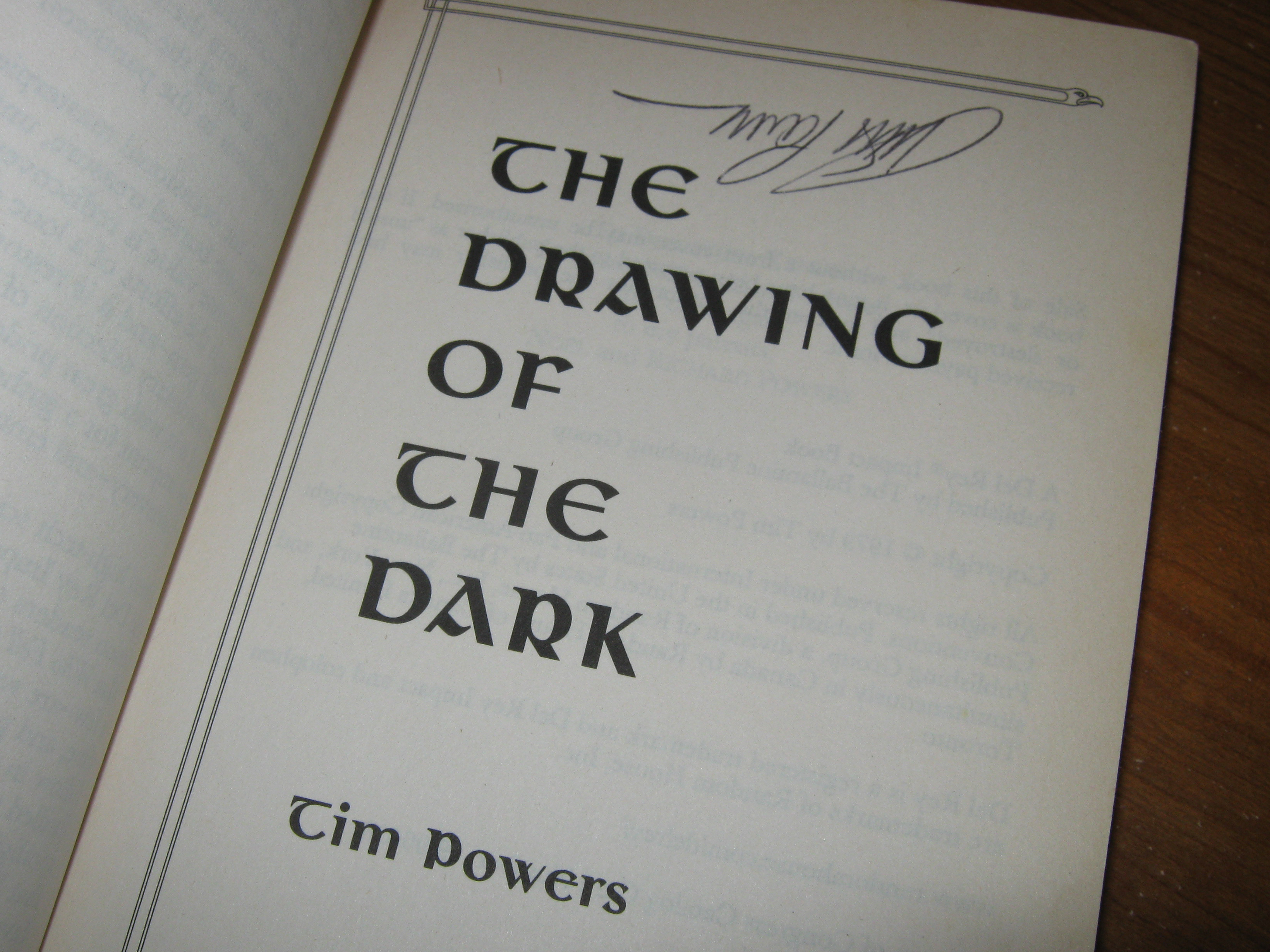
My copy of The Drawing of the Dark by Tim Powers is signed up-side-down on the title page. I got it through Paperback Swap and wonder why someone who went to a book signing got rid of the book.

The Power of Fiction

The Power of Fiction | marissabaker.wordpress.com
bg image: “mountain of books” by Ginny, CC BY-SA

Fiction affects society, for good or ill, often as much or more than real-life situations. If Charles Dickens had lectured about the plight of real-life orphans in London, would it have had the same effect as writing Oliver Twist? Or to use an example I see as very negative, would as many people have been obsessed with an essay about BDSM as they were with 50 Shades of Gray?

Fiction is powerful. We talked about this a couple weeks ago, but all in a positive light since I was arguing that fiction has value. It can also have a more negative influence as well, which is why I think both writes and readers have a responsibility to self-censor. It’s not up to someone to tell writers not to write a certain kind of book or discuss a specific topic, or to tell readers what they can and cannot read. But it is a good idea (particularly if you’re a Christian) to think carefully about the reading and writing choices we make.

Writer Responsibility

On March 31, 1750, Samuel Johnson published what has become one of the most famous statements in regards to the potential of fiction. While I don’t agree with his arguments against imaginative invention of the fantastic (I write fantasy, after all), this passage intrigues me:

if the power of example is so great as to take possession of the memory by a kind of violence, and produce effects almost without the intervention of the will, care ought to be taken that, when the choice is unrestrained, the best examples only should be exhibited; and that which is likely to operate so strongly should not be mischievous or uncertain in its effects.”

I think what Johnson is saying is that authors have a responsibility not to use the power they weld to influence their readers negatively. Responsible authors exercise a form of self-censorship, which doesn’t necessarily mean they shouldn’t talk about complex or even “bad” ideas. But fiction can be enormously influential, and authors should be conscious of the fact that what they are writing has the potential to fill their readers’ minds.

Writers of fiction set out to create a story that draws readers in, and once this happens the readers are under the writer’s influence. Johnson thought that, “the best examples only should be exhibited” so that there is nothing “mischievous or uncertain” in fiction’s effect. I don’t think we need to go that far, but we should be mindful of the power we have to influence readers.

Reader Responsibility

As readers, we should also be mindful of what we expose our minds to, remembering that we’re giving our reading material the opportunity to change or influence our thinking. I came across a great article titled “Self Censorship Better Than Book Banning” a few weeks ago about teaching your children how to make good decisions about their reading material instead of trusting the schools or government to ban “inappropriate” books (which will be defined differently for each individual).

This is pretty much what my mother did, though I wasn’t required to talk about every book with her after reading it (I usually did anyway, so she didn’t really need a rule). The only time I remember my mother taking away a book was when I broke down sobbing one day and confessed that I was having trouble dealing with the main character losing her father to cancer. There were a few other books that she strongly recommended I give up, and I usually (eventually) agreed with her. Harry Potter was “banned” in our house when it first came out, and that’s the only book I can remember being specifically told not to read.

It seems to have worked for the most part. There are books I wish I hadn’t read (and a few I’m sure that I really I shouldn’t have been reading), but for the most part I’m glad I had that freedom. It helped teach me to think for myself, which, to reference John Keating from Dead Poets Society, is the goal of good education.

Fictional MBTI – Cinderella (ISFJ)

I had two Myers-Briggs-related thoughts while watching Disney’s new live-action Cinderella last Sunday. 1) she’s a perfect example of an ISFJ, and 2) she’s a perfect example of why people mistake ISFJs for INFJs and vice versa.

Usually when we talk about fictional ISFJs we talk about men — Samwise Gamgee, John Watson, Steve Rodgers … and they are all very good examples of ISFJs in fiction. But in real life, ISFJ women outnumber ISFJ men, so it seems odd not to have a woman on the list of famous fictional ISFJs. I think Cinderella is a great example of an ISFJ, and here’s why.

Why ISFJ?

Fictional MBTI - Cinderella (ISFJ) marissabaker.wordpress.comCinderella, like other ISFJs, leads with a process called Introverted Sensing (Si). Dr. A.J. Drenth considers it one of the “least understood of the eight Myers-Briggs functions,” and David Keirsey chategorized them with the Guardian types (SJs). All Guardians use Si as their their first or second function.
They are more concerned with ensuring their beliefs and behaviors are consistent with an existing standard than they are in formulating their own set of standards. In many ways, they are dependent on what has already been already been tried and established, systems of thought that grant them a sense of consistency and security. –Dr. Drenth

Read more

Why Write Fiction?

“Why would you write fiction? Isn’t it just a bunch of lies?”

It’s been a while since someone asked me that question, but I can re-play the scene clearly. They look smug, like they’d just discovered a great argument against writing and reading fiction. Fiction is not true, and so therefore it is not good. Why make-up stories when there are plenty of good, wholesome things, people, and events that already exist? In fact, why tell stories at all, especially fantasy stories? They just give children unrealistic expectations of the world, and adults an excuse to ignore reality.

Obviously, since I’m still writing and reading fiction, I don’t buy into these arguments. But why?

Escape

Probably the simplest reason for writing fiction is to escape. Much of fiction — both good and bad — falls into this category. Sometimes life isn’t any fun, and reading and writing fiction gives us a way to escape for a while without actually leaving our location or situation. This can be as simple as diving into Middle Earth while waiting for the clothes to finish drying at the laundromat. Would you rather stare at your t-shirts spin, or canoe down the Rauros with the Fellowship of the Ring?

Connect

In a New York Times article, ‘Why Write Novels at All?’ Garth Risk Halberg talks about the idea that “the deepest purpose of reading and writing fiction is to sustain a sense of connectedness, to resist existential loneliness.” Now we’re getting closer to the reason I write fiction. Escape is all well and good, but what are you escaping to? It’s not enough to just take off for Narnia — we have to find Aslan there or the journey means nothing.

We write to share who we are and what we think, and we read to connect with something outside us. Usually this is a new world or characters, but if we’re very lucky we’ll also sense the author as they bleed through the pages of their work. This connectedness is one of the chief arguments for reading and writing, since it carries over into “real” life: people who read fiction are more emphatic than non-readers.

Think

Let’s say you have something you want to say about a controversial topic. We’ll use abortion as an example, and say you’re on the pro-life side. If you write an article telling people that abortion is bad, only the people who already agree with you are going to like it. If you tell a true story about a baby who survived an abortion or a mother whose life was ruined by an abortion, it will affect more people but you’ll still lose a large number of your readers.

Why Read Fiction?  | marissabaker.wordpress.com
Photo credit: Easa Shamih, CC BY, via Flickr

Now suppose you write a story where you climb inside the head of a character and show what they are struggling with as she decides whether or not to have an abortion. You don’t just put your words in the character’s mouth – you imagine yourself in her shoes, and realize that she has real reasons to consider both options. You sympathize with her, and whatever your readers believe they sympathize with her too. Your ideas will filter through in decisions you make about how see feels when she sees the baby on an ultrasound, or whether or not she keeps the child at the end of the story. You can let readers know what you think, but you don’t shove your ideas down their throat. You give them a chance to feel with you, and let them think for themselves.

Obviously, I think of the writer of novels and stories and plays as a moral agent. In my view, a fiction writer whose adherence is to literature is, necessarily, someone who thinks about moral problems: about what is just and unjust, what is better or worse, what is repulsive and admirable, what is lamentable and what inspires joy and approbation. This doesn’t entail moralizing in any direct or crude sense.

Serious fiction writers think about moral problems practically. They tell stories. They narrate. They evoke our common humanity in narratives with which we can identify, even though the lives may be remote from our own. They stimulate our imagination. The stories they tell enlarge and complicate—and, therefore, improve—our sympathies. They educate our capacity for moral judgment. ” – Susan Sontag, from a speech at the Los Angeles Public Library

This sort of literature may or may not be an escape for your readers, but should definitely let them connect with something or someone. It should make them think. It should give them a chance to “meet” types of people thy might never come in contact with in their real lives, to question ideas that they take for granted, to consider what is and is not moral. Fiction lets us talk about things that are uncomfortable to discuss in real life, or give a new perspective on issue too charged in reality to have a dialogue about. It lets us ask “what if?” and run with the potential answers before actually changing the world. Yet.

Ficitonal MBTI – Sherlock Holmes (INTP)

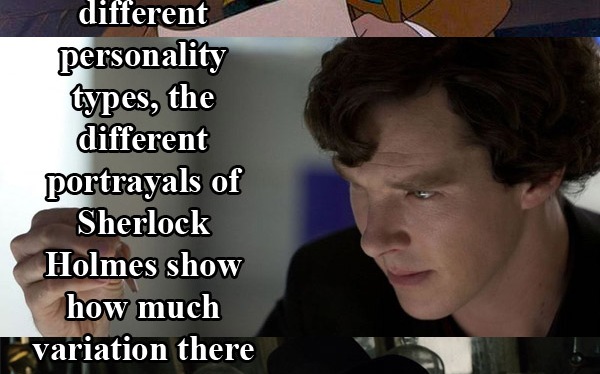
In the world of fictional typology, Sherlock Holmes is typically cited either as the perfect example of an INTP or as a notoriously difficult charter to type. Some writers say this difficulty is because the character displays aspects of several different types (including INTJ and ISTP) due to the writers’ ignorance of Myers-Briggs theory.

While this may be partly true, I think we can pin-down a single best-fit type for most portrayals of Sherlock Holmes in film and television (I’m not covering the original stories in this post). Rather than showing several different personality types, the different portrayals of Sherlock Holmes show how much variation there can be within a single personality type.Ficitonal MBTI - Sherlock Holmes (INTP) | marissabaker.wordpress.com

INTP Traits

The personality type that fits most film and movie portrayals of Sherlock best is INTP. The function stack for this type is this:

  1. Introverted Thinking (Ti)
  2. Extroverted Intuition (Ne)
  3. Introverted Sensing (Si)
  4. Extroverted Feeling (Fe)

This means that Sherlock first approaches the world with a judging attitude that is focused inward and relies on impersonal analysis. Ti prefers to internalize observations and work with abstract ideas. It “values facts chiefly as illustrative proofs of the idea,” and rejects things that seem irrelevant (Myers, Gifts Differing, p.78). This would explain why BBC’s Sherlock didn’t bother to remember that the earth goes around the sun. Read more

The INFJ Writer

I’m sure I read somewhere that David Keirsey originally called the INFJ personality type “The Writer” instead of “The Counselor,” but I can’t find the article now. Nevertheless, it does seem that quite a few INFJs are attracted to writing. Even if they aren’t working as writers or typing away at a novel, they probably keep a journal/diary and are often more comfortable with written communication than they are with speaking. I’m a fairly typical example of INFJs in this regard — I write a blog (obviously), keep a journal, work as a writer, prefer writing e-mails to taking on the phone, and write fiction.

Speaking of writing fiction …

Winner-2014-Web-BannerI won NaNoWriMo! I’m particularly pleased with myself for conquering the 50,000 words a day early in spite of having pneumonia in November. Anyway, back to INFJ writers.

Imaginative Fiction

There’s an INFJ profile written by Dr. A.J. Drenth (which no longer appears on his website, but you can read it here) that has this to say about INFJs:

Although INFJs are commonly drawn to music, visual arts, design, or architecture, writing may well be this type’s signature creative talent. Adept at channeling their right-brain creativity into a fluid and engaging left-brain storyline, INFJs are unmatched in their feel for and creative use of the written word.

from INFJ Doodles

This creative aspect of our writing  talent seems to be tied to an INFJ’s primary function — Introverted Intuition (Ni). Intuitive types prefer possibility to actuality, future to the present, intuition to fact, and improvement over the status quo. When intuition is introverted, as for INFJs, the focus is mostly on an internal world where our minds tinker with “ideas, perspectives, theories, visions, stories, symbols, and metaphors” (Dr. A.J. Drenth, Introverted Intuition).

Even INFJs who don’t write typically have an affinity for stories and a “rich inner life.” We tend to live in a world of possibilities, and I find that one way to keep my fantasy life anchored in reality is to turn those ideas into stories and write them down. It’s weakness/temptation for INFJs to never move their ideas from possibility to reality. With creative writing, I can set my imagination loose and tell myself there’s a practical application for it as well.

INFJs as Writers

It’s hard to type people when you don’t know them, but there are some famous writers that we can guess were INFJs. Keirsey lists Emily Bronte and Emily Dickenson as “Counselor” types. Another list of famous INFJs adds writers like Chaucer, Dante Alighieri, Fyodor Dostoevsky, and Nathaniel Hawthorne. A forum discussion suggests Madeleine L’Engle, Antoine de Saint-Exupery, Lois Lowry, Ursla LeGuin, Franz Kafka, and several others could be added to the list.

my latest novel, laid-out in Post-It notes above my bed
my latest novel, laid-out in Post-It notes above my bed, with a different color for each point-of-view character

Now, the fact that many INFJs gravitate towards writing doesn’t mean that it’s always easy for us. I’m not sure how many stories I started and abandoned before finally finishing my first novel in 2011. It was for NaNoWriMo, and I needed that deadline to keep myself writing. It’s so easy to build the story in my head, and then lose interest in writing it down once I think I know how it ends.

Though knowing the end makes me lose interest in the story, I also need some kind of outline to keep me on track. I’ve discovered sticky notes on the wall is my new favorite way to plot-out novels. They can be removed or rearranged as needed, and you don’t need to have them all there to start writing. For my NaNo novel this year, I began with only half the plot laid-out, and added more scenes as I wrote and the direction of the story became clear.

Further Reading

Why INFJs Have Trouble Writing by Lauren Sapala

The INFJ Writing Personality: Eloquent Vision by Andrea J. Wenger