
Psalm 25: A Friendship Covenant With God

I love reading through Psalms, as I’m sure many of you do. They’re among the most beloved passages of scripture. You probably have several at least partly memorized. Many are set to music, and people of God have been singing them for thousands of years. As familiar as they are, there’s still more to learn from them. As we read the Psalms, we might notice something we hadn’t thought of before or the Lord might grant us a deeper understanding of truths we’ve read over and over.

Today, I want to look at one of David’s psalms. We don’t know when he wrote Psalm 25, but there is a note that tells us he was the author. From the psalm itself, we can assume that David was facing some sort of trouble when he wrote it because he asks God for help. It’s not one of the more desperate sounding psalms, though; David seems to have peace in this trouble and confidence that God will hear His prayer and respond.

To you, Yahweh, I lift up my soul.
My God, I have trusted in you.
    Don’t let me be shamed.
    Don’t let my enemies triumph over me.
Yes, no one who waits for you will be shamed.
    They will be shamed who deal treacherously without cause.

Psalm 25:1-3, WEB

In these opening lines, we see David coming to Yahweh (God’s proper name, see Ex. 3:14-15) in prayer. In a respectful, conversational poem, David states his trust, makes a request, and says that he knows Yahweh responds to these types of prayers from His people. David was confident that God can be counted upon to keep His promises, and he also knew that God wants us to ask Him for things. Prayer keeps lines of communication open and builds relationship, even though God already knows exactly what we need.

Forgiveness and Faithfulness

I find it interesting that even though David opens the prayer with a specific request (“Don’t let me be shamed. Don’t let my enemies triumph over me”), he immediately shifts from asking for deliverance to asking for instruction. He wants God to teach him because he’s confident in the God of his salvation.

Show me your ways, Yahweh.
    Teach me your paths.
Guide me in your truth, and teach me,
    For you are the God of my salvation,
    I wait for you all day long.

Psalm 25:4-5, WEB

David doesn’t spend the whole prayer asking for God to rescue him from a physical situation. The bulk of the psalm is spent on discussing relationship. There’s teaching, and covenant-keeping, and claiming the Lord as “my God.” David also discusses his sin, likely because that damages relationship with God. Jesus hadn’t died for our sins yet when this psalm was written, but David knew about the promised Messiah (Acts 2:22-31) and he knew that God is merciful and gracious to forgive. Then, as now, God deeply desires a relationship with His people and He is eager to forgive sins and mend broken relationships if only we’ll turn to Him.

Yahweh, remember your tender mercies and your loving kindness,
    for they are from old times.
Don’t remember the sins of my youth, nor my transgressions.
    Remember me according to your loving kindness,
    for your goodness’ sake, Yahweh.
Good and upright is Yahweh,
    therefore he will instruct sinners in the way.
He will guide the humble in justice.
    He will teach the humble his way.
All the paths of Yahweh are loving kindness and truth
    to such as keep his covenant and his testimonies.
For your name’s sake, Yahweh,
    pardon my iniquity, for it is great.

Psalm 25:6-11, WEB

If you read my new Armor of God study guide or a blog post that mentioned battle prayers of Biblical kings, you might remember that these types of prayers acknowledge God’s power to help, make a request for help, and claim the Lord as their God (2 Chr. 14:9-12; 20:5-12; Is. 37:14-20). The praying person may also remind God of His previous faithfulness, asking that He will continue to guard the people He made a covenant with. We see those elements in David’s battle prayer as well, alongside his request for instruction and restored relationship.
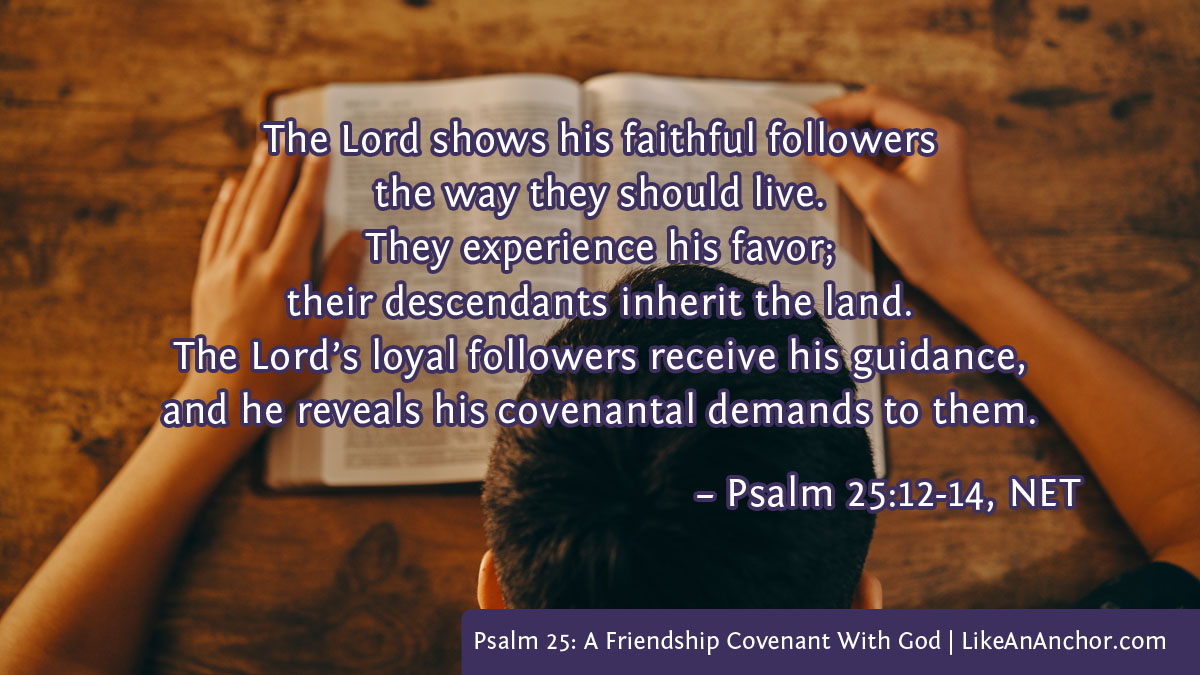
Image of a man reading the Bible, overlaid with text from Psalm 25:12-14, NET version: "The Lord shows his faithful followers the way they should live. They experience his favor; their descendants inherit the land. The Lord’s loyal followers receive his guidance, and he reveals his covenantal demands to them."
Image by Matt Vasquez from Lightstock

Covenant Kindness

Earlier in the psalm, when David prays, “Yahweh, remember your tender mercies and your loving kindness,” the phrase “loving kindnesses” is translated from the Hebrew word chêsêd (H2617). It’s challenging to translate this into English. Often translators choose words like “kindness” or “mercy,” but those miss the word’s deep connection with covenants. There is scholarly argument over whether chesed is faithfulness to covenant obligations, or mercy/kindness as a character trait of God that underlies His covenants, but either way this word is inextricably linked in scripture to the formal relationships God makes with people (Theological Wordbook of the Old Testament entry 698).

What man is he who fears Yahweh?
    He shall instruct him in the way that he shall choose.
His soul will dwell at ease.
    His offspring will inherit the land.
The friendship of Yahweh is with those who fear him.
    He will show them his covenant.

Psalm 25:12-14, WEB

In this psalm, David delights in God’s goodness and faithfulness to the covenant, and also asks for God’s gracious forgiveness so David could be counted as one who keeps covenant with God. Even the most faithful human beings–David himself being called a man after God’s own heart–miss the mark. We sin, which damages relationship and breaks covenant agreements with God. That’s one reason He planned on a New Covenant through Jesus Christ; He knew the Old Covenant wasn’t enough on its own to fix humanity’s rebellion and establish eternal relationships (Heb. 8:6-12). It is His grace that makes it possible for us to keep covenant with Him, and Jesus’s sacrifice that makes it possible for us to be considered righteous.

Verse 14–the one about friendship and covenants–is the one that made me want to look at this psalm more closely. When we receive grace, we have a responsibility to live faithfully with God as His loyal friends. In this psalm, David connects friendship with God to hearing Him and heeding His instructions. Friends of God like Abraham, David, and Jesus’s disciples share a special relationship with God (Isa. 41:8; James 2:23; John 15:14). There’s something precious about loving God in this way, and sharing a covenant relationship with Him.

Emotional Plea for Aid

As David wraps up this psalm, he returns to his plea to God for deliverance from enemies. He’s still confidently looking to God, but he admits to being “desolate and afflicted” with a troubled heart. I like these sorts of psalms, because they reassure me that God wants us to express our honest emotions in our prayers.

My eyes are ever on Yahweh,
    for he will pluck my feet out of the net.
Turn to me, and have mercy on me,
    for I am desolate and afflicted.
The troubles of my heart are enlarged.
    Oh bring me out of my distresses.
Consider my affliction and my travail.
    Forgive all my sins.
Consider my enemies, for they are many.
    They hate me with cruel hatred.
Oh keep my soul, and deliver me.
    Let me not be disappointed, for I take refuge in you.
Let integrity and uprightness preserve me,
    for I wait for you.
God, redeem Israel
    out of all his troubles.

Psalm 25:15-22, WEB

As I write this blog post, there’s war in Israel following recent terrorist attacks. Around the world, “More than 360m Christians suffer high levels of persecution and discrimination for their faith” and 5,621 were killed for their faith last year (Open Doors World Watch List 2023). Even those of us not facing physical persecution fight spiritual battles that take many forms. We can think of many reasons we might want to pray this prayer alongside David today.

While we pray for deliverance for ourselves and God’s people, we can also follow David’s example of focusing not only on our immediate physical needs but also our spiritual ones. We can pray for rescue from enemies and from our own sins. We can pray for God’s friendship, express respect for His covenant and His teachings, and praise Him for the deliverance we confidently expect.


Featured image by Pexels from Pixabay

Lies That Isolate Us

Lies That Isolate Us | marissabaker.wordpress.com We know how important a relationship with God is to our Christian walk, and last week we talked about how important it is for us to also have relationships with other believers. For some of you, that comes fairly easily — you have a church home where you feel welcome, and good friends who share your faith. Many of you feel much more isolated, through. Maybe there aren’t any options for fellowship in your area, but if you’re online reading this blog post you have at least one way to connect with fellow believers, if we’re willing to take advantage of it. Peter describes our “adversary the devil” as a “roaring lion” who walks about “seeking whom he may devour” (1 Pet. 5:8). When predators like lions hunt herd animals (like the sheep we’re so often compared to in scripture), they try to isolate one before going in for the kill. One of the tools our adversary uses to do this to us if the lies we tell ourselves that keep us from seeking out fellowship — things like “I’m not good enough,” or “I have nothing to offer,” or “No one values me.”

Let Them Love You

No matter how true these thoughts feel, they are not an accurate reflection of how God sees us. You say, “I have no value,” God says you’re so valuable that Jesus traded His own life to save you.

But God demonstrates His own love toward us, in that while we were still sinners, Christ died for us. (Rom. 5:8)

Jesus Christ’s was the most valuable human life ever, and that’s the price He and His Father paid for you. They didn’t do this because they “had to.” They did it because they thought you were worth it. Paul tells us that “Christ Jesus came into the world to save sinners, of whom I am chief,” and He came to save you as well (1 Tim. 1:15).

 Greater love has no one than this, than to lay down one’s life for his friends. You are My friends if you do whatever I command you. (John 15:13-14)

Jesus said this to His disciples, but He meant it for us as well. He died for you because He cares about you, and if you’re following His commandments you have the right to claim friendship with Him as well.

In this the love of God was manifested toward us, that God has sent His only begotten Son into the world, that we might live through Him. In this is love, not that we loved God, but that He loved us and sent His Son to be the propitiation for our sins. Beloved, if God so loved us, we also ought to love one another. (1 John 4:9-11)

Because of the love of God for us, we as His followers should have love for each other. This applies to us having and showing love, but also to us receiving love. You should be able to walk into a group of people who are following God and find love and companionship there. Sure there’ll be a few bad apples in most groups, but don’t focus on them — there’s usually more good people there who will love and befriend you if you give them the chance.

Accept Your Gifts

God loves, values and wants you, and He expects people following Him to love you as well. And that’s not where it ends. You might think you have nothing to offer God or a church group, but God tells us we’re each necessary to His family. God sees value in every life, and it is His desire for “all men to be saved and to come to the knowledge of the truth” (1 Tim. 2:4). He doesn’t give up on people, and He can work with anyone who seeks Him, including you. In fact, if you turn your back on Him, you’re depriving His family of someone He thought was important enough to call into relationship with Him. You’re not doing anyone a favor by “getting out of the way” or thinking they don’t need you.

But the manifestation of the Spirit is given to each one for the profit of all (1 cor. 12:7)

You might think it seems like everyone except for you has a spiritual gift, but God doesn’t say He makes exceptions in this. You do have gifts (click here to start discovering them), and He did have a reason for inviting you into His church.

For in fact the body is not one member but many. If the foot should say, “Because I am not a hand, I am not of the body,” is it therefore not of the body? And if the ear should say, “Because I am not an eye, I am not of the body,” is it therefore not of the body? If the whole body were an eye, where would be the hearing? If the whole were hearing, where would be the smelling? But now God has set the members, each one of them, in the body just as He pleased. (1 Cor. 12:14-18)

This is one reason that comparing ourselves among ourselves is not wise (2 Cor. 10:12). There is a wide range of available gifts, and you will fit much more comfortably into the body if you recognize your value and discover your gifts rather than trying to mimic other people. You are needed in your own unique way. If God wanted everyone to be the same, He wouldn’t have created so much variety.

And the eye cannot say to the hand, “I have no need of you”; nor again the head to the feet, “I have no need of you.” No, much rather, those members of the body which seem to be weaker are necessary. And those members of the body which we think to be less honorable, on these we bestow greater honor; and our unpresentable parts have greater modesty, but our presentable parts have no need. But God composed the body, having given greater honor to that part which lacks it, that there should be no schism in the body, but that the members should have the same care for one another. (1 Cor. 12:21-25)

God doesn’t want you to feel like you don’t fit in the body, and He doesn’t want anyone else to tell you that you don’t fit. His goal is unity, mutual respect, and genuine concern between members of His church. That’s what He wants for you, whether or not you think you deserve it. The truth is, none of us are “good enough” for God. That’s why Jesus had to die for us. Once we accept that sacrifice and repent, though, God does not intend for us to wallow in inferiority. He wants us to take the amazing gifts and opportunities He gives us and use them boldly. He wants us to take our place in His church and stop sabotaging ourselves with lies that keep us away from Him and from our brethren.

The Second Greatest Commandment

Our relationship with God is the most important thing in our lives. How we stand in relationship with God determines whether or not we’re in His family and included as part of Christ’s church. It is not, however, the only important relationship.

Jesus said to him, “‘You shall love the Lord your God with all your heart, with all your soul, and with all your mind.’ This is the first and great commandment. And the second is like it: ‘You shall love your neighbor as yourself.’ On these two commandments hang all the Law and the Prophets.” (Matt. 22:37-40)

If we ignore the second commandment, then we’re not keeping the first one very well. Christ said, “If you love Me, keep My commandments” (John 14:15), so if we’re truly in a good relationship with God, we also have to be cultivating good relationships with other people.

From Death To Life

In the Greek, “neighbor” refers to anyone in your sphere of influence. If you know about them or are near them, they are your neighbor. For now, though, let’s focus on loving people we meet within the church. Sometimes it seems like they are the ones we have the hardest time getting along with, perhaps because we expect so much more from them than from people “out there” in the world. We’re less inclined to cut them some slack for being human.

A new commandment I give to you, that you love one another; as I have loved you, that you also love one another. By this all will know that you are My disciples, if you have love for one another.” (John 13:34-35)

If love is how people are supposed to identify Jesus’s followers, then I’m afraid there are far too may of us hiding our identities. I know many loving individuals who proclaim by their actions that they are true disciples, but loving churches seem few and far between.

The Second Greatest Commandment | marissabaker.wordpress.comChristian denominations are rife with division, disagreements, and fighting. It seems like there’s always someone with a new doctrine or a better way to run things, followed by arguments and people taking sides in a divided congregation. If we were all walking in the light, there would be love and not division (1 John 2:9-11). But we’re not always perfect, and it’s so easy to stumble right along with divisive people in an unloving reaction to their lack of love. We can’t control other people, but we are each responsible for how we respond to them, including those who really have done something wrong.

In this the children of God and the children of the devil are manifest: Whoever does not practice righteousness is not of God, nor is he who does not love his brother. For this is the message that you heard from the beginning, that we should love one another …. We know that we have passed from death to life, because we love the brethren. He who does not love his brother abides in death. Whoever hates his brother is a murderer, and you know that no murderer has eternal life abiding in him. (1 John 3:1-11, 14-15)

“We have passed from death to life because we love the brethren” — that’s how important love is. If we hate instead of love, we don’t get eternal life. Even brethren who have stumbled and fallen away from the faith still need and deserve our love, since they still come under the neighbor category or even “love your enemies” (Matt. 5:44).

Vital Friendships

We’ve talked about loving people because we have to, but there should also be people in our lives who we love because we want to — family and friends with whom we share common interests and who will be there for us as we go through life. We need other people, especially friends in the faith who will build us up and help us in our Christian walk. Jesus had 12 disciples who were closer than His other followers, as well as friends like Martha, Mary and Lazarus. When He sent people out to preach, He sent them in pairs (Luke 10:1). Paul also traveled with other believers, including Barnabus (Acts. 13:2), Silas (Acts 15:40) and Timothy (Acts 16:1-4).

And let us consider one another in order to stir up love and good works, not forsaking the assembling of ourselves together, as is the manner of some, but exhorting one another, and so much the more as you see the Day approaching. (Heb. 10:24-25)

“All you need is God” is true to a certain extent, but it is also true that God is the one who tells us it’s not good to lack human companionship. He is the source of our strength and our life, and He can sustain us through times when we have no friends or believers to fellowship with, but He also supplies our need for people around us because He knows friends and brethren are good for us.

Beloved, let us love one another, for love is of God; and everyone who loves is born of God and knows God. He who does not love does not know God, for God is love. (1 John 4:7-8)

The Second Greatest Commandment | marissabaker.wordpress.comI know people who say they don’t need friends because they have God, and people who stopped fellowshipping with brethren because no one agreed with their particular view of the sacred calendar. I am frightened for these people, because the God they say is all they need tells them in His Bible that they also need relationships with other believers.

If someone says, “I love God,” and hates his brother, he is a liar; for he who does not love his brother whom he has seen, how can he love God whom he has not seen? And this commandment we have from Him: that he who loves God must love his brother also. (1 John 4:20-21)

One of the ways we demonstrate our love for God is by loving other people, and we can’t do that if we deliberately isolate ourselves. It’s one thing to have no one else around who shares your faith, and if that’s the case I pray and believe that God will supply your need for fellowship. But it’s another thing entirely to avoid other people, no matter how tempting it might be for some of us introverts or for those of us who have been hurt by past associations with church goers. But if we aren’t around other people, then how can we keep the commandment to love our brethren? If we isolate ourselves, how will we keep the second greatest commandment?

God’s Friends

Disney explains Greek words for love, by Blair a.k.a. GraphiteDoll

When we talk about love in the bible, the word we’re usually discussing is agape. It’s one of several Greek words for love, and is typically described as “godly” or “unconditional” love. There’s also storge (family love), eros (romantic love), and phileo (friendly love).

Agape is an amazing kind of love. It’s the one spoken of in 1 Corinthians 13 and the word used in the phrase “God is love. ” Most times when the word “love” appears in the New Testament, it is translated from a form of agape.

But the other kinds of love are amazing as well, and I think we can overlook the importance of phileo in our fixation with agape (storge and eros are not found in scripture).

Friend of God

Philos (G5384) is the root word for a whole family of words having to do with love. It’s basic meaning is “friend” — someone who is dear, a beloved companion. The derivative phileo is the form more often translated “love.” It means “to have affection for someone.” Zodhiates notes that it is rarely used of man’s love toward God, but is used of the disciples’ love for Jesus. Both agape and phileo are used of God’s love toward man. Simply put, phileo involves adopting someone’s interests as yours.

the Father Himself loves you, because you have loved Me, and have believed that I came forth from God. (John 16:27)

Disney explains Greek words for love, by Blair a.k.a. GraphiteDoll

By using the word phileo in this passage instead of agape, Christ is telling us that God feels affection for us. He is fond of those who love His Son, and He has shared interests with us.

A chapter earlier, Jesus tells His disciples, “You are My friends if you do whatever I command you” (John 15:14). That word is philos. The disciples would have known about the connection between these two words, and I suspect what Christ was telling them was that they could be friends with the Father as well as with Him, just as Abraham was.

And the Scripture was fulfilled which says, “Abraham believed God, and it was accounted to him for righteousness.” And he was called the friend of God. (James 2:23)

James tells us that Abraham was called God’s friend after “he offered Isaac his son on the altar.” That situation was an example of works and faith going together in a way that perfected Abraham’s faith (James 2:21-22). At that point, Abraham had faithfully demonstrated for years that his interests were in line with God’s plan.

Abraham is not the only person in the Bible who God treated as a friend. We’re told “the Lord spoke to Moses face to face, as a man speaks to his friend” (Ex. 33:11). God called David “a man after My own heart, who will do all My will” (Acts 13:22). As their interests lined up with God’s and they moved in the direction God was leading, they became His friends. Christ’s friendship with His disciples followed much the same pattern, and that is the kind of relationship we are now offered with God the Father and with Jesus Christ.

Necessity of Brotherly Kindness

In most places where we are instructed by God to love other people, the word is agape or agapao. But there are a few places where a form of phileo is used instead.

Be kindly affectionate to one another with brotherly love, in honor giving preference to one another (Rom. 12:10)

Believers are to have this kind of love for one another. If the church is unified in Christ, then the members will share the same goals and interests, because they are also His goals and interests. The brethren will be friendly to one another, and love each other like friends who are closer than family.

 But also for this very reason, giving all diligence, add to your faith virtue, to virtue knowledge, to knowledge self-control, to self-control perseverance, to perseverance godliness, to godliness brotherly kindness, and to brotherly kindness love. For if these things are yours and abound, you will be neither barren nor unfruitful in the knowledge of our Lord Jesus Christ. (2 Pet. 1:5-8)

Disney explains Greek words for love, by Blair a.k.a. GraphiteDoll

Both “brotherly kindness” and agape are necessary for us to become the opposite of barren and unfruitful. We must set our hearts on right things, and focus on being friends of God rather than of the world, for whoever “wants to be a friend of the world makes himself an enemy of God” (James 4:4).

The necessity for a friendly kind of love between brethren is made plain not only by verses discussing phileo between believers, but also by verses like Philippians 2:1-4 and Ephesians 4:1-7 that talk about how we should be like-minded and care for one another. Other instructions for us to have phileo hearken back to our discussion about being friends with God. Turns out, having this kind of affection for our Creator is not optional.

If anyone does not love the Lord Jesus Christ, let him be accursed. O Lord, come! (1 Cor. 16:22)

The King James reads, “If any man love not the Lord Jesus Christ, let him be Anathema Maranatha.” The word anathema (G331) means something accursed, or given up to destruction. It does not “denote punishment intended as disciple but being given over or devoted to divine condemnation” (Zodhiates). Maran-atha (G3134) is an Aramaic word which literally means “our Lord has come.” Taken together, it tells us that someone who does not love, phileo, Jesus Christ will be judged at the Lord’s coming, and probably not in the way they were hoping (Matt. 7:21-23). It could probably be translated, “If anyone does not love the Lord Jesus Christ, let him be set aside for condemnation when the Lord returns.”

Add Agape

As vital as phileo is in our relationship with the God-family, it is not enough by itself. We must have phileo, but we must also add agape, as we saw in 2 Peter 1:5-8.

Probably one of the most discussed passages where both phileo and agape are used is in John 21. Here, we find a conversation between Jesus and Peter, after Peter had seen the resurrected Lord and then went back to fishing. In the following quote, I’ve replaced the English word “love” with the Greek word it’s translated from, so you can see which one is used when.

So when they had eaten breakfast, Jesus said to Simon Peter, “Simon, son of Jonah, do you agapao Me more than these?” He said to Him, “Yes, Lord; You know that I phileo You.” He said to him, “Feed My lambs.”

He said to him again a second time, “Simon, son of Jonah, do you agapao Me?” He said to Him, “Yes, Lord; You know that I phileo You.” He said to him, “Tend My sheep.”

He said to him the third time, “Simon, son of Jonah, do you phileo Me?” Peter was grieved because He said to him the third time, “Do you phileo Me?” And he said to Him, “Lord, You know all things; You know that I phileo You.” Jesus said to him, “Feed My sheep. (John 21:15-17)

Disney explains Greek words for love, by Blair a.k.a. GraphiteDoll

Usually, when I hear people talk about this verse, it’s in the context of agapao being a much higher form of love than phileo. They say Peter just wasn’t quite able to measure up to that kind of love — that he kept falling short of what Christ was asking. From Peter’s perspective, though, I don’t think that was the case. He responded to Christ’s question about agapao by saying, “Yes.” Perhaps what he meant when he added phileo was, “Of course I have agape love for you. You know that — I love you like a brother. We’re friends.”

And yet, Peter had denied Jesus three times just a few days ago (John 18:15-18, 25-27). I think Peter initially thought phileo was a better kind of love because of how much it involves emotions, but phileo needs agape added to it. Agape is the kind of love that keeps loving when feelings are gone or when they are crowded out by fear. Peter did learn this lesson, for it’s in his epistle that we are told to add agapao to our brotherly kindness.

We need to learn similar lessons today. Our love for God and our fellow believers does need an element of emotion and feeling — we need to be friends with them. Our love also needs to be stable and unconditional — we need to act with love even when we don’t feel in love. Both are needed to maintain a friendship with God.