Feminism constantly tells women we have no reason to be ashamed of our bodies, our desires, our gender, our career goals – of anything really. We can do and be whatever we want and nothing should hold us back. It sounds good in theory, but like many things humans do it can be taken to extremes.
Take the Women’s March from a few weeks ago as an example. If you want to march around with what one blogger I follow delicately called a pink taco on your head I won’t stop you. But those of us who don’t do things like that aren’t any less “women” than you are, nor are we less interested in being treated with dignity, respect, and equality. In fact, that’s a big reason we express our notions of feminism (and femininity) in different ways.
Today, I’m going to take society’s claim that there’s no need to feel shame about the kind of woman you are to heart and say I’m not ashamed of modesty. Depending on your background this word may have provoked a strong reaction. Perhaps you think modesty is a repressive, old-fashioned list of rules telling women how not to dress and act. Or maybe you think modesty sounds safe – a way to hide from attention you don’t want any more. But modestly is about so much more than a set of rules for covering yourself up. It’s more powerful and – dare I say it? – sexy than we often think.
Let’s start with a working definition of modesty: Modesty is concealing what you do not want everyone to know or see so that you can reveal yourself only to someone you trust. It’s typically associated with the idea of sex and how much skin you show, but it has to do with other things as well. For example, you might also exercise modesty by not calling undue attention to yourself or by reserving certain parts of your personality for people you know well. Read more →
When people in the Christian churches talk about gender roles, it often ends up being a discussion about women and submission. If you’ve been keeping up with these discussions even a little, you’ve surely learned that good Christian women should view their role as a blessing. You’ve been told that submission isn’t a dirty word, but rather part of God’s ordained order for the church and the family. When we submit, we’re following the example of Jesus Christ and putting ourselves under His authority.
Even though I still hear ministers joke about how discussing submission will get them in trouble, I actually talk with very few women in the churches today who haven’t embraced, or at least acknowledge, the value of being a virtuous woman with a meek and gentle spirit. We might disagree on exactly what it looks like and we all still have much to learn about being godly women (though it really should be simple — a godly woman is a woman who’s following God), but we have a pretty good idea what our gender role is.
We talk about men’s roles in the church far less often (at least from what I’ve heard and seen). Women hear “submission is a good thing. It’s not always easy but it’s part of God’s plan and sometimes you just have to do it.” But how often do men hear, “leadership is a good thing. It’s not always easy but it’s part of God’s plan and sometimes you just have to do it”?
I wonder if one reason we overlook this is because we don’t understand why men might not want to take on their role as head, lover, provider, and protector. We might think, Why wouldn’t men want to be the ones in charge? Isn’t it much easier to “love your wife” than “submit to your husband”? They should be thankful they get to be leaders in the family and that they’re the ones who hold public ministry positions. After all, that’s the role everyone wants. That’s why we have to talk about submission for woman so much, because otherwise she’d be trying to steal men’s role, right?
But maybe that’s not an accurate viewpoint. Maybe both genders are tempted to shirk the responsibilities God has given us and avoid living up to His expectations. Maybe this is a human struggle we all share, and which also impacts how we live as godly men and women.
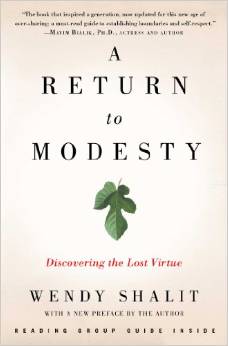
I mentioned a couple weeks ago that I recently read a book called A Return to Modesty: Discovering the Lost Virtue by Wendy Shalit. One of the first things she tackles in this book is the “polarized debate about sex,” particularly between the conservatives and the feminists.
She challenges conservatives to “take the claims of feminists seriously,” because you can dismiss however many studies and stories you like as “exaggeration” but the fact remains that “a lot of young women are very unhappy …. I want conservatives to really listen to these women, to stop saying boys will be boys, and to take what these women are saying seriously.”
To the feminists, Shalit writes, “I want to invite them to consider whether the cause of all this unhappiness might be something other than the patriarchy.” We’ve gotten rid of that just about as much as possible, and things have gotten worse rather than better. Perhaps men aren’t the enemy.
This book was published in 1999. That was almost 16 years ago, and we are still dealing with the exact same issues. On the one side, we see conservative Rush Limbaugh respond to a street harassment video by describing it as not a big deal because the men were just being polite. On the other side, there are still rants about patriarchy on Jezebel.com (language/content warning).
But just a little over two months ago Emma Watson, British actress and UN Women Goodwill Ambassador, gave a speech about feminism where her vision for gender equality sounded remarkably similar to ideas Wendy Shalit arrives at while defending the power of modesty. Are we starting to find common ground, and is there hope for a peaceful resolution to “the war between the sexes”?
A Trip to the 18th Century
It might seem odd to take a 3-century detour when talking about issues in modern culture. But when I started reading Francis Burney’s novels Cecelia (1782) and Camilla (1796) as part of an independent study my junior year of college, I was struck by how the gender issues facing those heroines were so remarkably like what women in my church regularly complain about. Where are the “real men?” we ask, looking around and seeing adult men who act like overgrown boys and have little interest in committing to marriage. We typically blame feminism, for telling boys that it was wrong to be “masculine” and to stop oppressing girls by taking care of them.
Portrait of Francis Burney by her relative Edward Burney
A contemporary of Burney, Mary Wollstonecraft wrote a book called A Vindication of the Rights of Women (1792), which is often considered one of the first feminist writings. When you actually read her book, however, it becomes clear that she is arguing for arguing for a reexamination, not a dismissal, of the traditional roles between men and women. She believes men and women are equal in God’s eyes, but that argument doesn’t mean they don’t both have distinct roles to fill.
Both these writers were responding to a moment called “sentimentality,” which encouraged men to indulge their emotions and abandon their traditional roles of protectors and providers. The result was something like what we see today — when men are no longer encouraged to protect or respect women, more and more women are victimized. That’s where we made our mistake, both in the 18th and the 20th/21st centuries. We thought men would treat women better if we told them to stop being manly, when in fact the opposite is true.
HeForShe
When Emma Watson introduced her talk about gender equality and the #HeForShe campaign, she first addressed issues people have with the word “feminism.”
the more I spoke about feminism, the more I realized that fighting for women’s rights has too often become synonymous with man-hating. If there is one thing I know for certain, it is that this has to stop. For the record, feminism by definition is the belief that men and women should have equal rights and opportunities. It is the theory of political, economic and social equality of the sexes.
One of the key points of Watson’s speech is that both men and women must be working together if we are ever to achieve a gender equality that benefits and protects both men and women.
How can we effect change in the world when only half of it is invited or feel welcome to participate in the conversation? Men, I would like to take this opportunity to extend your formal invitation. Gender equality is your issue, too. Because to date, I’ve seen my father’s role as a parent being valued less by society, despite my need of his presence as a child, as much as my mother’s. I’ve seen young men suffering from mental illness, unable to ask for help for fear it would make them less of a man. …
If men don’t have to be aggressive in order to be accepted, women won’t feel compelled to be submissive. If men don’t have to control, women won’t have to be controlled. Both men and women should feel free to be sensitive. Both men and women should feel free to be strong.
When we turn issues of gender into a “battle of the sexes” instead of a friendly discussion or a cause to work on together, both men and women lose the battle. You can’t build peaceful relations on a foundation of strife.
Courteous Men
Wendy Shalit discusses essentially the same issue, though she comes from the perspective of restoring part of the traditional gender roles (I suspect Burney and Wollstonecraft would both approve). Rather than pushing for an increasingly “nonsexist” approach to raising boys (in this example), she argues for “a good dose of sexist upbringing: how to relate as a man to a woman.”
Today we want to pretend there are no differences between the sexes …. We try to cure them of what is distinctive instead of cherishing these differences and directing them towards each other in a meaningful way. We can never succeed in curing men and women of being men and women, however, and so these differences emerge anyway — only when they do, the emerge in their crudest, most untutored form (p.153).
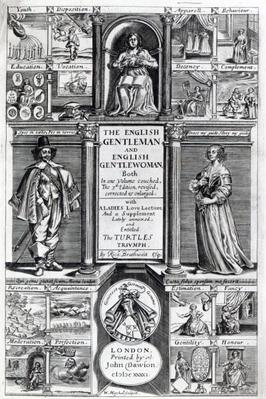
She also goes back to a previous century to illustrate her arguments, all the way to 1630 and 1631 — the years Richard Brathwait’s The English Gentleman and The English Gentlewoman were published. Shalit’s reading of these texts is that there was a “link between male obligation and female modesty” where men attained “perfection” by treating women with respect (p.99-102). In this century, men were not compelled to respect women by an outside authority — they were taught that this was the only way for real men to behave.
The argument from external authority labels a man as evil if he date-rapes or sexually harasses a woman. From the standpoint of modesty, he is behaving abominably, but more crucially, he is really missing the whole point. He hasn’t understood what it means to be a man (p.104).
The feminists who see patriarchy as oppressive balk at this idea, but Shalit assures them, “I doubt that if men are taught to relate courteously to women, women would be suddenly thrown out of all the professions, as some contend. Maybe, on the contrary, it would be much easier for the sexes to work together.” Isn’t this, at its core, what Emma Watson’s brand of feminism is asking for? men and women who can work together toward common goals with mutual respect. Isn’t that something we all want?


 Like An Anchor