There are so many encouraging Bible passages, and many of them also give us hints as to what we should focus on to maintain a correct mindset as we do our best to live godly lives. It is easy for our perspective to shift away from how God sees things to a narrower, world-focused view if we are not vigilant about holding onto the vision He gives us. Scriptures that mention the rewards God has in store for those who maintain their focus on Him can also help us figure out how to maintain that focus. Today, I want to look at one such passage in Hebrews.
Hebrews 6 begins by saying that we need to progress beyond the foundational principles of faith (“repentance from dead works, of faith toward God, of the teaching of baptisms, of laying on of hands, of resurrection of the dead, and of eternal judgment.” [Heb. 6:1-2, WEB]). Once we’re solid on the foundations, we’re supposed to keep learning and growing. With that reminder, the author of Hebrews then delivers one of the most sobering warnings in the entire Bible.
For it is impossible in the case of those who have once been enlightened, tasted the heavenly gift, become partakers of the Holy Spirit, tasted the good word of God and the miracles of the coming age, and then have committed apostasy, to renew them again to repentance, since they are crucifying the Son of God for themselves all over again and holding him up to contempt.
Hebrews 6:4-6, NET
That’s a frightening thing to think about. Our salvation is securely assured on God’s side of things, but we can still “lose” it in the sense that we can choose to utterly reject the gifts that God has given us. Most warnings in the Bible don’t just stand on their own, though. Whenever you see a “something horrible will happen if you do this” statement, there’s almost always a “but something wonderful will happen if you do this” statement close by to give us guidance and encouragement.
But in your case, dear friends, even though we speak like this, we are convinced of better things relating to salvation. For God is not unjust so as to forget your work and the love you have demonstrated for his name, in having served and continuing to serve the saints. But we passionately want each of you to demonstrate the same eagerness for the fulfillment of your hope until the end, so that you may not be sluggish, but imitators of those who through faith and perseverance inherit the promises.
Hebrews 6:9-12, NET
This is the section of scripture that caught my eye a couple weeks ago and inspired today’s study. There’s a lot of encouragement here. God is not unjust, nor does He ignore and forget the things that we do to serve Him and His people. We don’t need to worry that we won’t be good enough for Him so long as we keep trying. He only rejects those who fully understood His gifts and yet contemptuously reject Him, not those who are struggling. It is better, though, to “not be sluggish,” and so the writer of Hebrews warns us and then urges us onward.
There are two specific things the author of Hebrews seeks: “we passionately want each of you to demonstrate the same eagerness for the fulfillment of your hope until the end” and to be “imitators of those who through faith and perseverance inherit the promises.” Those are the two things I want to focus on today.
Eager for Hope
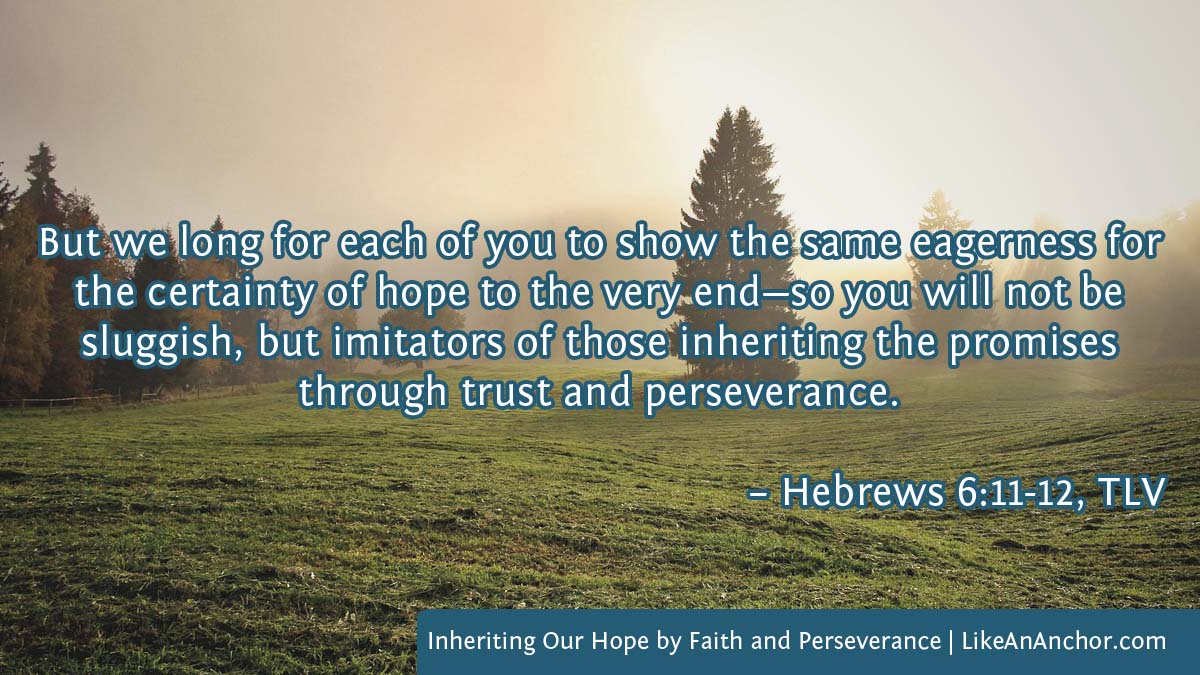
We passionately want each of you to demonstrate the same eagerness for the fulfillment of your hope until the end, so that you may not be sluggish, but imitators of those who through faith and perseverance inherit the promises.
Hebrews 6:11-12, NET
Laundry, dishes, going to work, cleaning the toilet, scooping cat litter, cooking meals, reading depressing news stories–it can all pile up until it starts to feel like that’s the only thing going on in your life with a few windows for hobbies, Bible study, and friends. But we need to remember that the day-to-day things are not actually the most important things in our lives. When we follow God, we have a hope for the future that contextualizes everything else.
For we know that the whole creation groans and suffers together until now. Not only this, but we ourselves also, who have the firstfruits of the Spirit, groan inwardly as we eagerly await our adoption, the redemption of our bodies. For in hope we were saved. Now hope that is seen is not hope, because who hopes for what he sees? But if we hope for what we do not see, we eagerly wait for it with endurance.
Romans 6:22-25, NET
The groaning and suffering is temporary. The redemption of our bodies will be just the start of our eternity in God’s family. We ought to remember that, and eagerly anticipate the fulfillment of our hope. When we can look ahead, we can more easily hold on to the joy and peace that God offers to His people.
Faith and Perseverance
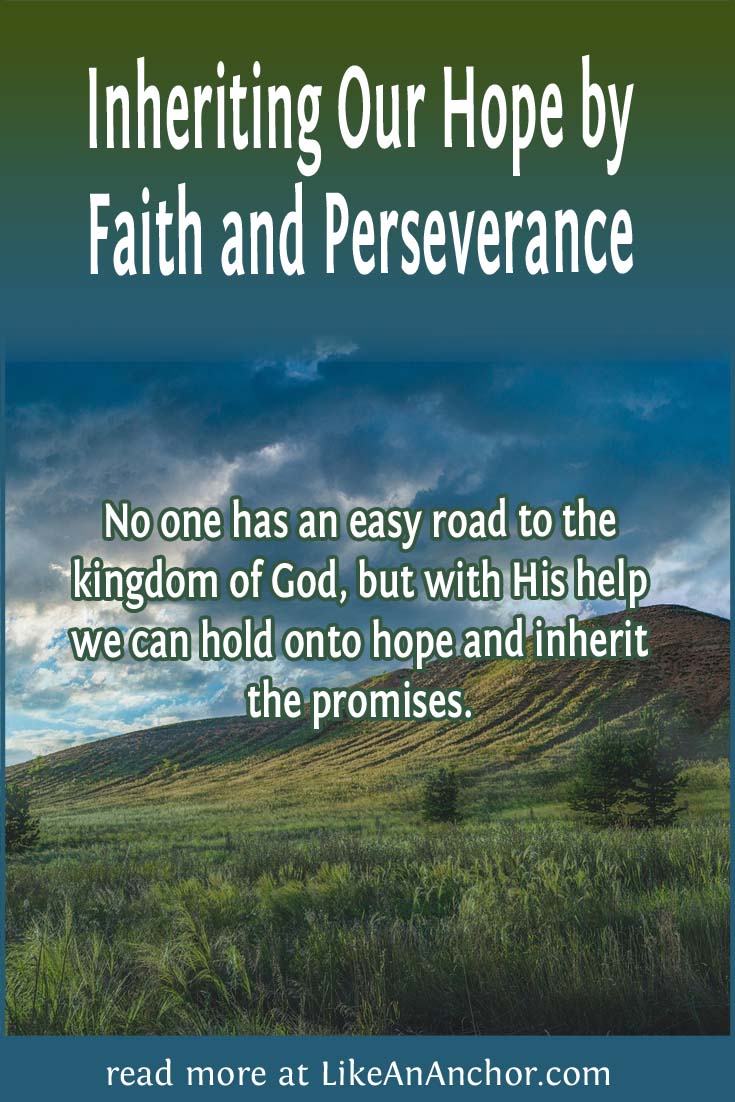
We passionately want each of you to demonstrate the same eagerness for the fulfillment of your hope until the end, so that you may not be sluggish, but imitators of those who through faith and perseverance inherit the promises.
Hebrews 6:11-12, NET
We inherit God’s promises through faith and perseverance. Faith in scripture is a very active thing; we don’t just passively have faith, we demonstrate it by our actions and it transforms our lives. When our faithfulness, steadfastness, and trustworthiness in relation to the covenant commitment we’ve made to follow God is tested, that testing produces endurance or perseverance.
My brothers and sisters, consider it nothing but joy when you fall into all sorts of trials, because you know that the testing of your faith produces endurance. And let endurance have its perfect effect, so that you will be perfect and complete, not deficient in anything.
James 1:2-4, NET
Perseverance and endurance are closely related concepts. In Greek, it’s makrothumia (G3115) and hupomone (G5281). Makrothumia, used in Hebrews 6, means “patience, endurance, constancy, steadfastness, perseverance” (Thayer’s definition). It is also translated “longsuffering” in some verses. Hupomone, used in James 1 and 1 Timothy 6, carries the idea of “steadfastness, constancy, endurance.” It is “characteristic of a man who is not swerved from his deliberate purpose and his loyalty to faith” no matter what he is called upon to endure. (Thayer’s definition). The words are very similar, and together provide a picture of the type of commitment we must develop as part of our faith in God.
But you, as a person dedicated to God … pursue righteousness, godliness, faithfulness, love, endurance, and gentleness. Compete well for the faith and lay hold of that eternal life you were called for and made your good confession for in the presence of many witnesses.
1 Timothy 6:11-12, NET
As we commit ourselves to following God and enduring to the end, keeping our hope for the future at the forefront of our mind helps contextualize everything else going on in our lives. It also helps to remember that people of faith who have gone before us also had to inherit the promises through faith and perseverance. No one has an easy road to the kingdom of God. But with His help and by holding onto a right perspective on what’s going on, we can also eagerly hold onto hope and inherit the promises.
Featured image by Aria Film from Pixabay

Song Recommendation: “By Faith” by Keith and Kristyn Getty













 Like An Anchor