May Your Will Be Done on Earth as It Is in Heaven

After writing about the phrases “Hallowed Be Your Name” and “May Your Kingdom Come” from Jesus’s model prayer, I think it might be good to just keep going and study the whole prayer line-by-line. I wasn’t going to continue this study because I’m pretty sure I know what Jesus means by “may your will be done,” but then I remembered what Paul said: “If someone thinks he knows something, he does not yet know to the degree that he needs to know” (1 Cor. 8:2, NET). We need to beware of intellectual pride that makes us think there’s nothing more to learn from “basic” concepts about God that we’ve already “mastered.” There’s always more to learn where God is concerned.

Prioritizing God’s Will

We find versions of Jesus’s model prayer in two gospels. In Matthew, it’s part of the Sermon on the Mount when He’s talking about good and bad examples for how to pray (Matt. 6:5-15). In Luke, He uses this prayer to respond to a disciple’s request that Jesus teach them to pray (Luke 11:1-13). You don’t have to repeat this prayer word-for-word to pray correctly, but it’s a very helpful outline for our own prayers.

So pray this way:
Our Father in heaven, may your name be honored,
may your kingdom come,
may your will be done on earth as it is in heaven.
Give us today our daily bread,
and forgive us our debts, as we ourselves have forgiven our debtors.
And do not lead us into temptation, but deliver us from the evil one

Matthew 6:9-13, NET

Submitting to God’s will isn’t the very first thing in the prayer, but it is in the first half. It comes before other, more personal requests but after the proper acknowledgement of God’s holiness and the request that His kingdom come. I’m not sure how important the order is, but it strikes me as interesting that Jesus put the Father’s will before other, more individual requests like daily bread or personal deliverance. That’s a priority list Jesus modeled in His own life.
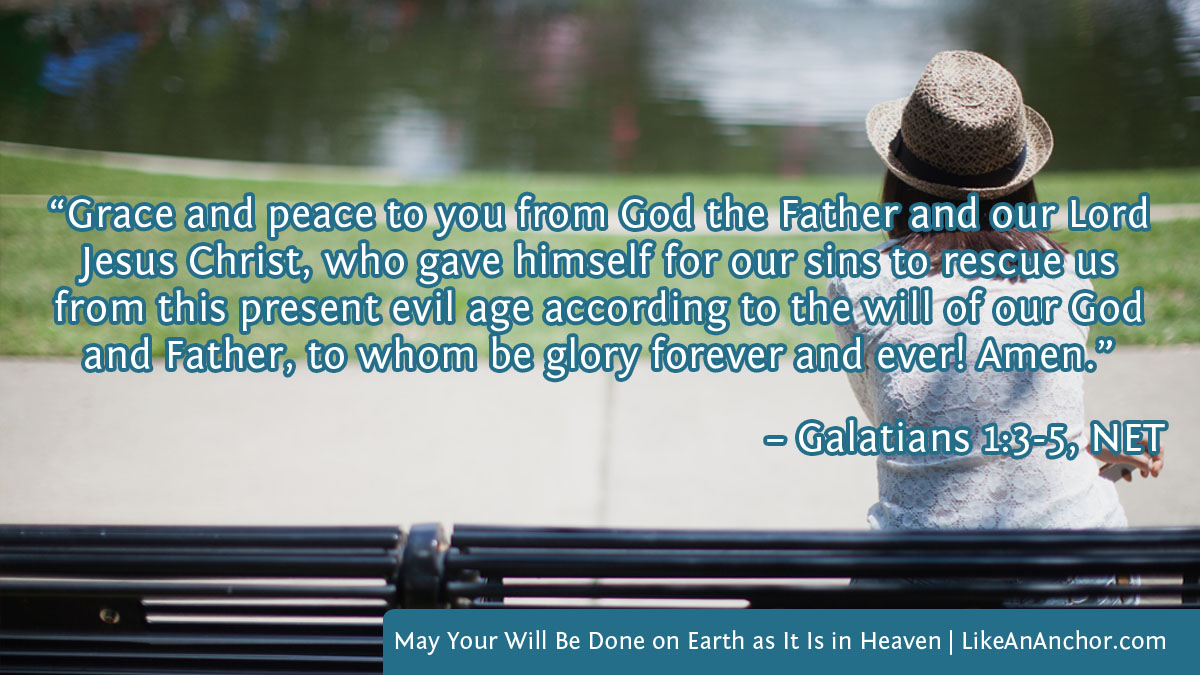
Image of a woman sitting on a park bench overlaid with text from Gal. 1:3-5, NET version: “Grace and peace to you from God the Father and our Lord Jesus Christ, who gave himself for our sins to rescue us from this present evil age according to the will of our God and Father, to whom be glory forever and ever! Amen.”
Image by Anggie from Lightstock

Jesus and the Father’s Will

Remember, it’s our Father that we’re talking with here. We come before God not as some distant petitioners, but as His own children. There’s a relationship established before we even get to this prayer, and it’s the same type of relationship that Jesus has with the Father (John 16:27; 17:23; 1 John 3:1-2).

Before Jesus’s death, He prayed, “My Father, if possible, let this cup pass from me! Yet not what I will, but what you will” (Matt. 26:39, NET; see Matt. 26:36-46; Mark 14:32-42; Luke 22:39-46). This wasn’t the first time He’d prioritized the Father’s will. Doing the Father’s will was one of His main focuses in life, as John records several times in his gospel.

Jesus said to them, “My food is to do the will of the one who sent me and to complete his work.”

John 4:34, NET

“I can do nothing on my own initiative. Just as I hear, I judge, and my judgment is just, because I do not seek my own will, but the will of the one who sent me.”

John 5:30, NET

“For I have come down from heaven not to do my own will but the will of the one who sent me.”

John 6:38, NET

I imagine with this focus that the model prayer and the prayer in Gethsemane were not the only times Jesus prayed, “may your will be done.” It was likely at the forefront of His mind frequently, whether He was formally praying at the time or not. And since we’re supposed to become like Jesus, doing the Father’s will should be a priority for us as well.

“Not everyone who says to me, ‘Lord, Lord,’ will enter into the kingdom of heaven—only the one who does the will of my Father in heaven.”

Matthew 7:21, NET

“For whoever does the will of my Father in heaven is my brother and sister and mother.”

Matthew 12:50, NET

Jesus has a close, personal, familial relationship with people who do the Father’s will. Additionally, only those who do His will can enter the kingdom of heaven. The emphasis that Jesus placed on following His Father’s will and the way He talked about it as a requirement for us reveals just how important it is that we do this. We need to align ourselves with God’s will, as Jesus did, if we want to spend forever in His family.

Image of an open Bible by a notebook overlaid with text from 1 John 2:17, NET version:  “And the world is passing away with all its desires, but the person who does the will of God remains forever.”
Image by Alyssa Marie from Lightstock

What Is God’s Will?

When Jesus talked about God’s will, He often emphasized how it relates to God’s overall plan. The Father is making a family, and it’s His will that as many people as possible receive salvation and eternal life (John 6:38-40; Matt. 11:25-27; 18:14). That gives us an overall view of God’s will, desire, and purpose. But it still doesn’t tell us what it means for us to do God’s will.

 “What do you think? A man had two sons. He went to the first and said, ‘Son, go and work in the vineyard today.’ The boy answered, ‘I will not.’ But later he had a change of heart and went. The father went to the other son and said the same thing. This boy answered, ‘I will, sir,’ but did not go. Which of the two did his father’s will?” They said, “The first.” Jesus said to them, “I tell you the truth, tax collectors and prostitutes will go ahead of you into the kingdom of God!”

Matthew 21:28-31, NET

Jesus shared this parable shortly before His death. He “entered the temple courts” and “the chief priests and elders of the people came up to him as he was teaching” to question Him and challenge His authority (Matt. 21:23, NET). These were the religious leaders, the people who probably thought they were doing God’s will better than anyone else and living more righteous lives. But as Jesus pointed out several other times, thinking you’re righteous isn’t the same thing as actually living by God’s words (Matt. 5:17-20; 23:1-3). If you want to do the father’s will, then you actually need to follow His commands.

Image of a man praying, overlaid with blog's title text and the words, "As God shares deeper understanding of His will with us, we’ll learn to do His will and align ourselves with what He's doing to accomplish His will."
Image by Shaun Menary from Lightstock

There are several things that Paul, Peter, and John describe as “God’s will” for us in their writings. It was God’s will that Jesus save us from our sins (Gal. 1:4; Eph. 1:11). It’s His will that we obey Him from the heart, become holy, give thanks always, do good, and live in accordance with His ways rather than fleshy human desires (Eph. 6:6; 1 Thess. 4:3; 5:18; 1 Pet. 2:15; 4:2). Sometimes, it’s in accordance with His will that we suffer even while doing good (1 Pet. 3:17; 4:19). But we also know that it’s His will that we’ll grow, mature, and “receive the promise” of eternal life if we align ourselves with His will (Col. 4:12; 1 John 2:17; Heb. 10:36).

Therefore I exhort you, brothers and sisters, by the mercies of God, to present your bodies as a sacrifice—alive, holy, and pleasing to God—which is your reasonable service. Do not be conformed to this present world, but be transformed by the renewing of your mind, so that you may test and approve what is the will of God—what is good and well-pleasing and perfect.

Romans 12:1-2, NET

The will of God isn’t just one thing. It includes all His desires and plans, for the universe and for us. In some ways it’s very simple–it’s God’s will to save humanity and doing His will involves following Him. In other ways, it’s something complex enough we can spend our whole lives learning to understand. Developing knowledge of His will and doing His will are key parts of our ongoing Christian walk.

For this reason we also, from the day we heard about you, have not ceased praying for you and asking God to fill you with the knowledge of his will in all spiritual wisdom and understanding, so that you may live worthily of the Lord and please him in all respects—bearing fruit in every good deed, growing in the knowledge of God, being strengthened with all power according to his glorious might for the display of all patience and steadfastness, joyfully giving thanks to the Father who has qualified you to share in the saints’ inheritance in the light. 

Colossians 1:9-12, NET

Look at why Paul says he asked God to fill people with “the knowledge of His will.” It’s so that we can “live worthily of the Lord,” please Him, bear fruit, do good deeds, grow “in the knowledge of God,” receive strength, display “patience and steadfastness,” and “joyfully give thanks.” As God shares deeper understanding of His will with us and we learn to pray “may your will be done on earth as it is in heaven,” our lives will be transformed. We will “live out the message ” rather than “merely listen to it” (James 1:22, NET). We’ll align ourselves with what He’s doing to accomplish His will. We’ll even be doing His will, helping fulfill the prayer “may your will be done on earth” as we live our lives in accordance with His will


Featured image by Claudine Chaussé from Lightstock

The Rightness of Trusting God’s Will Even When It’s Scary

One of the most astonishing statements in all of scripture was made on Passover evening nearly 2000 years ago, on the night in which Jesus was betrayed. Knowing exactly what was about to happen, Jesus still prayed “not my will but yours be done” (Matt. 26:36-46; Luke 22:39-46). This is the ultimate example of meekness–power submitted to the will of God. Jesus could have asked His Father for “more than twelve legions of angels” to free Him from the arresting mob if He’d wanted to(Matt. 26:51-45). Instead, He said, “Father, if this cup cannot be taken away from me unless I drink it, your will must be done” (Matt. 26:42).

Scripture describes Jesus as being “anguished and distressed” and feeling “deeply grieved” in His soul. Emotionally, that sounds like just about as bad as it can get for a human being. Yet even in such a dire situation, He prayed for God’s will to be done. I suspect He even prayed that in part because of the dire situation, using His conviction that God can be trusted and that His will is best to carry Him through what lay ahead.

For us today, who’ve committed to following Jesus’s example, “Your will be done” should also be our prayer during times of testing and trouble (as well as in good times). That’s not always easy to say, though. We might even be afraid or reluctant to pray for God’s will to be done, especially when the future seems uncertain. It comes down to an issue of trust and perspective.

God Knows Best

I often think about the spiritual implications of my struggles with anxiety. If I give in to catastrophizing and fear, what does that say about my level of (mis)trust in God? Connecting that idea to today’s post, it seems that whether or not we want to pray, “Your will be done,” is often tied-in to all those fears and worries. Is God really good all the time? Does He care enough to make this situation work out for me? What if praying for His will means I don’t get what I want or need?

I think we need to reject shaming people (including ourselves) for weaknesses and fears, and rather encourage each other to keep choosing trust and faith over and over again. Anxieties are “afflictions, not sins” (to quote C.S. Lewis), though they can lead us into sin if we let them. Overcoming fear is an ongoing process and it involves conscious choice, including the choice to trust that God knows what He’s doing.

We know that we should pray for God’s will to be done, but we’re often afraid to. Why? Because we do not trust that His will is best for us. We think His agenda and ours are by nature at odds with one another.

Because of our corruption, they may in fact be at odds. But if we could see the whole picture, we would understand that it is our own will that falls short of fulfilling our well-being, not His.

CHRIS TIEGREEN, 365 POCKET DEVOTIONS, DAY 114

It’s often easy to pray, “May your kingdom come, may your will be done on earth as it is in heaven” (Matt. 6:10, NET). When it’s less personal, sometimes it’s easier to wrap our minds around the idea that God changing things and making them better is a good thing (especially when it’s becoming more and more clear how much suffering and corruption is in the world). But it’s often harder to pray, “May your will be done (not mine)” in very personal situations that affect us immediately and directly (especially if we have a preferred outcome in mind). And yet that’s exactly what Jesus did, and what His disciples do.

His Good Plans Will Come to Pass

Paul’s a great example of one of Jesus’s disciples who submitted his own will and plans for his life to God. He started out by persecuting those who believed in Jesus the Messiah, then completely changed his life in response to God making His will known. That cost Paul greatly in terms of physical things, but also blessed him richly in terms of spiritual things.

I’m pretty sure I’ve written before about Paul’s view on trials–“that our present sufferings cannot even be compared to the coming glory that will be revealed to us” (Rom. 8:18, NET). It might not seem at first as if he’s talking about God’s will here, but he is. Going back to Romans 7:14-21, we find Paul describing the struggle between his unspiritual self and the spiritual law of God–his will versus God’s will. Next, Romans 8:1-17 talks about the leading of God’s spirit and Him saving us from sin, which is something He desires/wills for all people (1 Tim. 2:4; 2 Pet. 3:9). Then, Paul describes a struggle in creation, which was not willingly “subjected to futility … in hope,” but as part of God’s will for adopting children into His family (Rom. 8:19-26).

And he who searches our hearts knows the mind of the Spirit, because the Spirit intercedes on behalf of the saints according to God’s will. And we know that all things work together for good for those who love God, who are called according to his purpose …. What then shall we say about these things? If God is for us, who can be against us?

Romans 8:27-28, 31, NET

God has a plan. It’s a good plan. And because He’s the all-powerful Creator and Sustainer of the universe, His good plans for each of us and the whole of creation will come to pass. When we keep this in mind, there’s no need for us to fearfully grasp for control or to worry and fret about the future (Matt. 6:25-34).

We Follow in Christ’s Footsteps

I recently started reading C.S. Lewis’s collection of passages from George MacDonald’s writings. One of the quotes which caught my eye says that because God “is against sin,” sometimes it also feels as if He is against the things that we want, strive for, and dream about. Which might actually be the case, if we’re still living lives influenced by sin, but God is never against us. When God is against someone’s sinful desires,” He is altogether and always for them” (Unspoken Sermons, First Series, The Consuming Fire). God is for us, and sometimes that means showing us that the things we want aren’t good for us. MacDonald also said that God’s “wrath will consume what they call themselves so that the selves God made shall appear” (same source). Coming to the Light isn’t always a comfortable process, but it is always good for us.

What these quotes make me think of is the fact that because God’s will and His love always work for good in the end, sometimes the immediate result of submitting to His will is painful, as it was for Jesus. Jesus knew, though, that His suffering was part of God’s plan to bring about good for the whole world, and things happened exactly as the Father purposed (Acts 4:27-28). Jesus prayed for God’s will knowing with absolute certainty “that the Father had handed all things over to him, and that he had come from God and was going back to God” (John 13:3, NET). We also know that He focused on “the joy set out for him” when “he endured the cross, disregarding its shame,” and that He “has taken his seat at the right hand of the throne of God” (Heb. 12: 2, NET). Following His example, we can also pray for God’s will to be done knowing that God has good things in store for us and for the entire world.

Thinking about Jesus’s trust in His Father also adds another layer to how we can understand the verse, “Endure your suffering as discipline; God is treating you as sons” (Heb. 12:7, NET). Jesus did not need to be disciplined in order to correct bad behavior (since He never sinned), but He certainly suffered. Scripture is clear that following in His footsteps will involve suffering (sometimes from the world, sometimes as an attack from spiritual evil, and sometimes as part of God’s refining process that’s meant to strengthen us and help us grow). When we suffer, we know that we’re not going through anything that Jesus wasn’t willing to go through as well; God is not treating us any differently than He did His only begotten son. We also know that we can look forward to the same goal that Jesus focused on–the goal of eternal life together with God, as a family. We can also pray “your will be done” knowing that God is faithful, that He knows what He’s doing, and that He will work things out for good in the end.

Featured image by Jantanee via Lightstock