One of the interesting, seemingly contradictory, things about Christianity is that it is both very simple and deeply complex. The basics of following God are easily grasped once He opens your mind to understand, and at the same time there’s so much depth to His truth that you’ll never exhaust the possibility for learning more.
At its most basic, God’s way is simple and it’s all contained in the Bible. We can read the scriptures and see that God created all things, He wants a relationship with people, and that under the Law governing the universe people deserve a death-penalty for sins, but that Jesus Christ died in our place so that we could live forever as part of God’s family. All we have to do is repent (turn away from) our sins (which we can recognize as sin by comparing our actions to God’s law), believe in Jesus as the Messiah and Son of God, and commit to following Him the rest of our lives.
Then, we have the rest of our lives to study the Bible, learn about the culture and languages it was written in, pray to and talk with God, and figure out just what’s involved in following Him for the rest of our lives. We get to experience the same feeling Paul did when He wrote, “Oh, the depth of the riches and wisdom and knowledge of God! How unsearchable are his judgments and how unfathomable his ways!” (Rom. 11:33, NET). As we dive deeper into those riches, though, we need to be careful we don’t get distracted from the foundations of our faith.
Remember The Foundations
I did a study 10 years ago (can’t believe it’s been that long!) on the concepts the author of Hebrews calls foundational: “repentance from dead works, of faith toward God, of the teaching of baptisms, of laying on of hands, of resurrection of the dead, and of eternal judgment” (Heb. 6:2-3, WEB). Those are core doctrines of Christianity. Repentance is what you’re supposed to do when you first enter a relationship with God, and involves turning away from your sins. Faith is key to the next step: actively believing (or faith-ing) in Jesus Christ and accepting His sacrifice. Baptism is when we commit to God in covenant, and there’s an ongoing aspect as well. Laying on of hands is linked with setting us apart for God (along with a few other things). Understanding the resurrection of the dead and eternal judgement aligns our perspective for the future with God’s plan.
We need to be careful not to forget the simple foundations as we continue our Christian walk. Sure we want to learn more about what God expects of us when we’re in a relationship with Him and how to follow Him whole-heartedly, but that doesn’t mean we should forget that repentance, belief, and commitment are the core things (Mark 16:16; Acts 2:38; 16:31; 19:4; Romans 10:9). Following God isn’t hard (Matt. 11:30). It can be challenging to stick with it, but figuring out what God wants or how to follow Him isn’t complicated.
Image by Inbetween from Lightstock
Appreciate The Depth
I am very thankful that God both keeps things simple and invites us to keep learning and growing. I would get so discouraged if God kept changing the requirements, expected perfection with no slips, or hid something that’s key to pleasing Him and earning the rewards He promised. At the same time, I’d get so bored if there wasn’t more to learn and discover in the Bible.
Ironically, the most famous verse talking about “simplicity in Christ” is one of the places that we can dig deeper and learn something that isn’t immediately apparent (at last in English translations). Let’s start by looking at the verse in two different translations.
But I am afraid that somehow, as the serpent deceived Eve in his craftiness, so your minds might be corrupted from the simplicity that is in Christ.
2 Cor. 11:3, WEB (bold added)
But I am afraid that just as the serpent deceived Eve by his treachery, your minds may be led astray from a sincere and pure devotion to Christ.
2 Corinthians 11:3, NET (bold added)
Already, just looking at this verse in two different translations shows us there’s something more to learn. One says “simplicity that is in Christ” and one says “sincere and pure devotion to Christ.” The NET has a footnote on their translation pointing out that most manuscripts don’t have “and pure,” but several early ones do and that provides strong evidence that the original letter included both haplotētos (“sincerity”) and hagnotētos (“purity”) (NET translation comment on 2 Cor. 11:3). It doesn’t change the meaning much, but it does give us something to think about.
Then we have the difference between “simplicity” and “sincerity.” We often look at the Greek and Hebrew behind the English translation when trying to puzzle out a meaning, but I think we often forget that English words can also change meanings over time or have multiple meanings. In the Oxford English Dictionary, “There are 13 meanings … for the noun simplicity, three of which are labelled obsolete” (it’s behind a paywall, though, so we can’t access those definitions). Perhaps the meaning of “simplicity” has changed since 1611 when translators used it in the King James Version. Even today, though, there are four common meanings: 1) “the state of being simple, uncomplicated, or uncompounded,” 2) “lack of subtlety or penetration,” 3) “freedom from pretense or guile,” and 4) “directness of expression.” In this case, it’s the English word “simple” that has multiple meanings and leads to confusion, not the Greek or Hebrew words.
Following With Sincerity
Image by Anggie from Lightstock
Most people I’ve heard talk about this verse assume that “simple” means “uncomplicated.” But the fact that another translation used “sincerity” indicates that perhaps we should read “simple” as meaning “freedom from pretense.” A Greek dictionary confirms that we’re on the right track with this interpretation. Thayer defines haplotes (G572) as ” singleness, simplicity, sincerity, mental honesty,” including “the virtue of one who is free from pretense and hypocrisy.” So this verse isn’t actually talking about how easy it is to follow Christ. It’s about following Him with integrity and devotion, which also fits the context better.
I wish that you would be patient with me in a little foolishness, but indeed you are being patient with me!For I am jealous for you with godly jealousy, because I promised you in marriage to one husband, to present you as a pure virgin to Christ. But I am afraid that just as the serpent deceived Eve by his treachery, your minds may be led astray from a sincere and pure devotion to Christ. For if someone comes and proclaims another Jesus different from the one we proclaimed, or if you receive a different spirit than the one you received, or a different gospel than the one you accepted, you put up with it well enough!
2 Corinthians 11:1-4, NET
Here, Paul’s focus isn’t on how uncomplicated or easy Christianity is. He’s concerned about his readers being lured away by people who spread false teachings. He doesn’t want us to become like those who “will not tolerate sound teaching. Instead, following their own desires, they will accumulate teachers for themselves, because they have an insatiable curiosity to hear new things.And they will turn away from hearing the truth” (2 Tim. 4:3-4, NET). There is plenty of depth within God’s truth to satisfy our desire to learn without us running off after some counterfeit teaching that adds to or takes away from God’s word (Deut. 4:2; Prov. 30:5-6; Ecc. 3:14; Rev. 22:18-19).
As we progress in our Christian walks, we need to be on guard against several dangers in relation to the knowledge that we’re given. We might become haughty, thinking we understand everything and that there’s nothing new for us to learn, when in reality we’re someone who “does not yet know to the degree that he needs to know” (1 Cor. 8:2, NET). On the other hand, we might become discontent with the basics of God’s way and start adding things on, having “itching ears” that seek out whatever new thing or controversy catches our attention (1 Tim. 6:3-4; 2 Tim. 4:2-4). We must guard ourselves, neither straying from the foundations of God nor forgetting there is always more to learn from Him.
We all know John 3:16. Even non-Christians know this verse. It’s displayed and quoted perhaps more than any other part of the Bible.
But do you know where it is, contextually? I’m fairly good at remembering where scriptures are, but it’s easy to get your memories mixed up and if I’d had to guess, I might have said it’s in one of Jesus’s many addresses to crowds of people. It’s actually part of his answer to a question Nicodemus asked when he came to Jesus privately, at night after the crowds were gone.
Knowing the context doesn’t change the profound truth that “God so loved the world, that he gave his one and only Son, that whoever believes in him should not perish, but have eternal life” (John 3:16, WEB). But it does enhance our understanding of Jesus’s point if we know what else Jesus said when He made this statement.
Image by Inbetween from Lightstock
Setting the Stage
Unlike other gospel writers, John begins not with Jesus’s human birth but with pre-Creation. He establishes Jesus’s divinity before anything else (John 1:1-18), then goes into John the Baptist’s testimony about Jesus (John 1:19-26), and the first disciples gathering to Jesus (John 1:27-51). Then he records Jesus’s first miracle (John 2:1-11), then the first Passover during Jesus’s ministry, when He cleared those buying and selling out of the temple and began attracting attention from the religious leaders (John 2:12-25). Then, while Jesus is in Jerusalem for Passover, we come to the conversation we’re studying today.
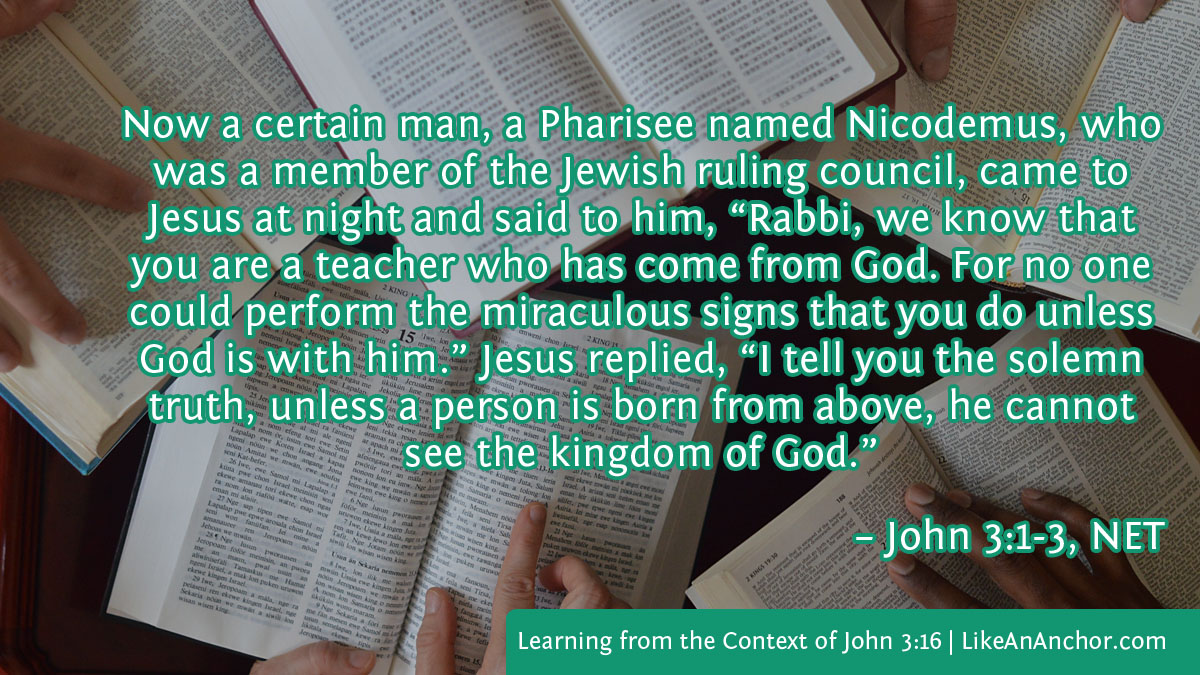
Now a certain man, a Pharisee named Nicodemus, who was a member of the Jewish ruling council,came to Jesus at night and said to him, “Rabbi, we know that you are a teacher who has come from God. For no one could perform the miraculous signs that you do unless God is with him.” Jesus replied, “I tell you the solemn truth, unless a person is born from above, he cannot see the kingdom of God.”Nicodemus said to him, “How can a man be born when he is old? He cannot enter his mother’s womb and be born a second time, can he?”
John 3:1-4, NET
We learn several things about Nicodemus in this introduction. First, he was a Pharisee, a member of an influential religious and political group whose members “were strict and zealous adherents to the laws of the OT and to numerous additional traditions” (NET footnote on John 1:24). In addition, he was “a member of the Sanhedrin, the highest legal, legislative, and judicial body among the Jews” (NET footnote on John 3:1). He was an expert in the scriptures and how to interpret them. It was enough to recognize Jesus as a teacher sent by God, based on the miracles He performed, and to prompt him to come to speak with Jesus privately to learn more. I have to wonder if he might have suspected Jesus to be the Messiah, but came privately because he didn’t want others to know what he was thinking.
As is often the case, Jesus jumped right in with a statement that doesn’t seem like a logical reply to the other person’s remark, but which starts the conversation that they need to have with Him. In this case, one of the words He uses has a double meaning in Greek. When Jesus says, “unless a person is born from above,” the word translated “from above” (anōthen) can also mean “again” (NET footnote on John 3:3). Nicodemus seems to assume Jesus meant the second meaning, since he asks if a man can be born from his mother a second time.
Jesus answered, “I tell you the solemn truth, unless a person is born of water and spirit, he cannot enter the kingdom of God. What is born of the flesh is flesh, and what is born of the Spirit is spirit. Do not be amazed that I said to you, ‘You must all be born from above.’ The wind blows wherever it will, and you hear the sound it makes, but do not know where it comes from and where it is going. So it is with everyone who is born of the Spirit.”
Nicodemus replied, “How can these things be?”Jesus answered, “Are you the teacher of Israel and yet you don’t understand these things?”
John 3:5-10, NET
I often marvel at how much people in New Testament times knew based just on reading the Old Testament. I’m not sure if I could have read those scriptures and realized what signs to look for to recognize the promised Messiah (of course, the main thing it would have depended on is if God decided to open my eyes). But here, Jesus is marveling at the fact that Nicodemus was a “teacher of Israel” and didn’t understand that someone would need to be born of the spirit. He should have known this already, at least in part, just like he should have been able to recognize from the law, prophets, and psalms that Jesus is the promised Messiah (Luke 24:44; John 5:39). Jesus doesn’t hold Nicodemus’s lack of knowledge against him, though. He continues the conversation and reveals more of God’s amazing plan.
Image by Shaun Menary from Lightstock
Earthly and Heavenly Things,
Jesus answered, “Are you the teacher of Israel and yet you don’t understand these things?I tell you the solemn truth, we speak about what we know and testify about what we have seen, but you people do not accept our testimony. If I have told you people about earthly things and you don’t believe, how will you believe if I tell you about heavenly things?No one has ascended into heaven except the one who descended from heaven—the Son of Man.Just as Moses lifted up the serpentinthe wilderness, so must the Son of Man be lifted up,so that everyone who believes in him may have eternal life.”
John 3:10-15, NET (italics mark an allusion to Num 21:5-9)
I find this part a little confusing. When Jesus said, “we speak,” who is “we”? I’m not sure if He’s referring to Him and His disciples or to Him and His Father. And what did He mean, “I have told you people about earthly things and you don’t believe?” Their conversation up to this point is about spiritual rebirth and resurrection, but is that an earthly thing? Or is He referring to something that happened earlier during Passover, like rebuking people for making the temple a marketplace?
We’re not the first to ask these questions. The NET translators have an extensive footnote on John 3:12. They suggest that, since it’s most logical to assume Jesus is speaking of what He just told Nicodemus, that “earthly things are not necessarily strictly physical things, but are so called because they take place on earth, in contrast to things like v. 16, which take place in heaven.” This would make “the necessity of a regenerating work from above, by the Holy Spirit” an “earthly thing,” but God’s love motivating His plans a “heavenly thing.”
Maybe we could think about it like this: the “earthly things” are related to what God is doing here on earth. Being “born of water and spirit” sounds like something that begins with baptism. The process of being born into God’s family as spirit beings starts now, during the physical lives of those who commit to following Him. It’s a process initiated by something God in heaven chose to do, a “heavenly thing” that’s described in the next part of this conversation.
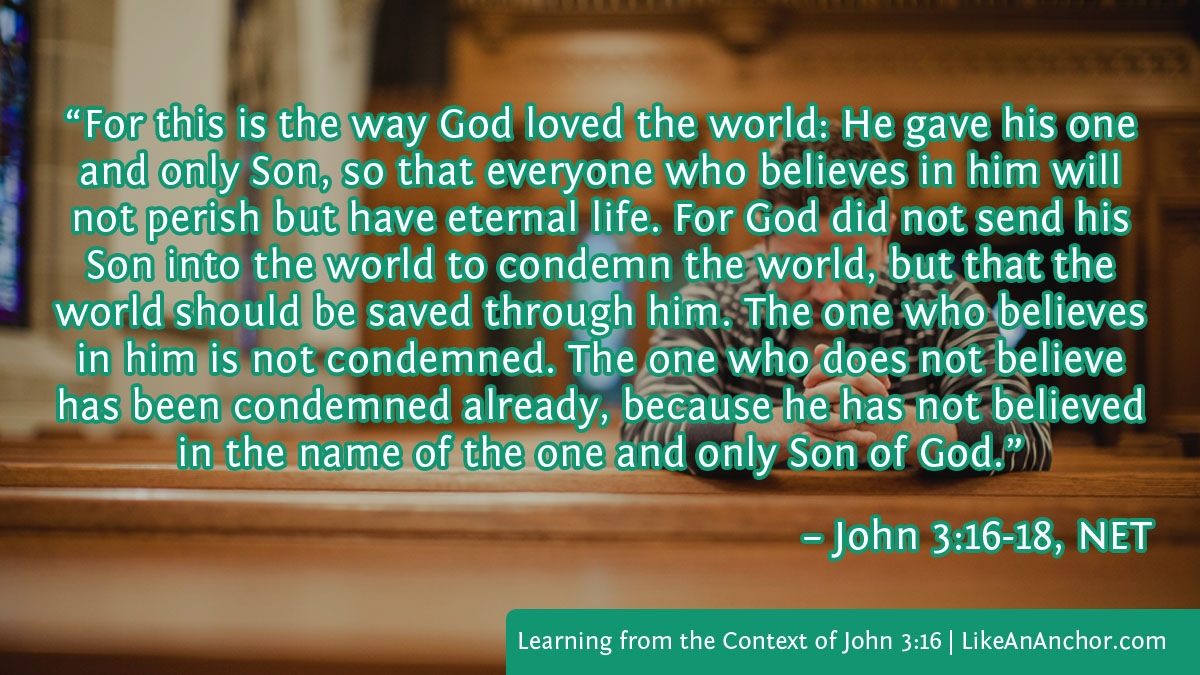
“For this is the way God loved the world: He gave his one and only Son, so that everyone who believes in him will not perish but have eternal life.For God did not send his Son into the world to condemn the world, but that the world should be saved through him. The one who believes in him is not condemned. The one who does not believe has been condemned already, because he has not believed in the name of the one and only Son of God.”
John 3:16-18, NET
We don’t have record of Nicodemus saying anything after verse 9, but I have to wonder what he was thinking at this point. Was he struck with awe at the revelation that God had sent His own Son to earth as the promised Messiah? Did he understand what Jesus was telling him here? Or did he walk away confused, unsure what it meant for God to give His son to save the world? We don’t know, but he does speak up for Jesus when other Pharisees tried to arrest Him (John 7:45-52) and he helped Joseph of Arimathea bury Jesus after His crucifixion (John 19:38-40). It seems logical to assume Nicodemus became one of Jesus’s disciples, though perhaps not very openly.
Life in the Son
Image by Lamppost Collective from Lightstock
We’re here to look at John 3:16, one of the most famous Bible verses. It shows up near the middle of Jesus’s conversation with Nicodemus. We’ve already looked at the lead-up to this verse and the discussion of being born from above/again. Now, let’s look at how Jesus concludes this discussion.
“For this is the way God loved the world: He gave his one and only Son, so that everyone who believes in him will not perish but have eternal life.For God did not send his Son into the world to condemn the world, but that the world should be saved through him. The one who believes in him is not condemned. The one who does not believe has been condemned already, because he has not believed in the name of the one and only Son of God. Now this is the basis for judging: that the light has come into the world and people loved the darkness rather than the light, because their deeds were evil. For everyone who does evil deeds hates the light and does not come to the light, so that their deeds will not be exposed. But the one who practices the truth comes to the light, so that it may be plainly evident that his deeds have been done in God.”
John 3:16-21, NET
It might seem a little weird to read about judgement and condemnation right after reading that Jesus came to save the world. But it really does fit very neatly into a whole-Bible understanding of the plan of God. When people choose sin (as all do [Rom. 3:23]) the natural consequences of that is death (Deut. 30:15-19; Rom. 5:12-15; 6:23). God’s justice and righteousness specifies that there is a consequence for sins. He also has the right to judge His creation. Now that the Light has come into the world, it is time for people to repent and change before the judgment (Acts 17:30-31).
When God judges, He doesn’t want to condemn. That’s one possible outcome, but that’s not His goal. God loves (agape) everyone and wants them to come to repentance, receive salvation, and gain eternal life (1 Tim. 2:1-4; 2 Pet. 3:8-9). That is made possible through Jesus and because of His and the Father’s love: “for God so loved the world, that he gave his one and only Son, that whoever believes in him should not perish, but have eternal life” (John 3:16, WEB). This incredible truth ought to prompt us to believe in Jesus, practice the truth, and come to the light to walk with our God.
Love is a central theme in the Bible. It’s inarguably one of the most important things in scripture, because “God is love” and He presents love not only as central to His character but to our Christian walk as well.
You might have heard that there are multiple Greek words for love. Eros is love that desires. Philia is friendship love. Storge is family love. Agape is selfless love. Only philia and agape appear in the Bible (except for storge in a few derivative or compound words), but this still makes English translation challenging since we only have one word for love. Some Bible versions try to deal with this by translating agape as charity (KJV) or philia as “brotherly kindness” (certain WEB verses, for example). In many cases, though, both are simply translated “love.”
While the brief definitions I gave in the previous paragraph are correct, they’re incomplete. Pages of dictionaries, a plethora of scholarly papers, and numerous books have been written trying to define Christian love and tease out the differences between philia and agape. In many cases, these definitions focus on agape, often because the authors see philia as a lesser sort of love. It is true that agape is used far more often than philia in scripture. However, this does not mean that agape is a higher form of love, that it’s never used negatively, or that it doesn’t overlap in meaning with philia. Both words are important and both are used of God’s love for us, our love for God, and love between people.
Image by Jantanee from Lightstock
What is the Historical Context for Agape?
The Bible writers didn’t invent a new word for love when they used agape, but finding out what the word meant in pre-Christian writings has been a challenge (if anyone knows of good sources on this, please send them to me!). In Classical Greek, the focus was more on eros (particularly for Plato) and philia (particularly for Aristotle) (Holst, 2021). The only sources I’ve found on how the word was used before Christianity are Biblical Greek dictionaries.
Thayer’s Greek Lexicon, originally published in 1889, stated that the word form agape is “a purely Biblical and ecclesiastical word” (Greek 26. Agapé, n.d.). He states that “secular authors” including Aristotle and Plutarch used the form agapasis, and he does “not remember to have met with it” in the Jewish writers Philo and Josephus. Agape does appear in the Septuagint (the Greek translation of the Hebrew Old Testament that dates from the 3rd to 1st centuries B.C.), which provides some background for how Jesus and other NT writers (particularly Paul, John, Peter, and Jude) use the word.
According to a search of the Greek Septuagint with Strong’s numbers in the Bible software program eSword, agape appears 15 times in 14 verses in the Old Testament (2 Sam. 13:15; Ecc. 9:1, 6; Song 2:4-5, 7; 3:5, 10; 5:8; 7:7; 8:4, 6-7; Jer. 2:2). In these verses, agape is used for human love, including romantic love. The root word of agape, agapao, appears 209 times in 196 verses as the main word for “love” in the Greek Old Testament. This includes the love of God for us (for example, Deut. 4:37; 7:13; Prov. 3:12; Is. 43:4; Mal. 1:2) and the love we’re supposed to have for God (for example, Deut. 6:5; 10:12; Prov. 15:9 Is. 56:6). Its usage is not, however, confined to Godly love. It’s used much the same way that the English word “love” is today, with a range of meaning depending on context.
The modern Christian understanding of agape is heavily influenced by Swedish theologian Anders Nygren, who began publishing his multi-part work Eros and Agape in 1930. For Nygreen, eros was central to Greek society and stood in sharp contrast to the Christian agape, which was an utterly unique type of love (Grant, 1996; Holst, 2021). Nearly every paper I’ve found on the topic of agape cites Nygren’s work, either in passing or in a direct response to his claims. Nygren ignored philia entirely, and claimed that agape is a type of love that originates with God alone and involves His “pure, unmotivated love for human beings” (Holst, 2021, p. 55). Following in Nygren’s footsteps, I often hear agape defined as the highest love. Other loves are often minimized as emotional and unstable. As we’ll see, this is a skewed reading of the Biblical texts.
What is the Historical Context for Philia?
There’s more historical information about philia. For Aristotle, philia “is the human good which nobody would choose to live without” (Holst, 2021, p. 56). He devoted two books to the subject of philia, typically translated “friendship,” and it is central to his code of ethics. For Aristotle, friendship is a virtue linked with justice and trust. It also has to do with understanding the virtuous self in relation to community with others.
In the Septuagint, philia appears 9 times, all in Proverbs. The related word philos appears 27 times. These words are used to describe romantic, friendly, and familial love, love for things, and the actions of kissing or embracing (e.g. Gen. 27:14; 37:4; 50:1; Prov. 7:18; 8:17; 10:12; 29:3; Hos. 3:1). In the Septuagint, at least, philia is a slightly more specific word for love than agape. It’s still used in a variety of ways, but it is used for affectionate and friendly love rather than used more generally for all types of love as agapao is.
Though philia is mostly connected to friendships, it’s not only for people who are already close friends but also for guests because hospitality “lays the basis for all friends to begin to trust each other” (Holst, 2021, p. 65). It is in this dynamic of “guest friendship” that Holst (2021) argues philia enhances our understanding of agape because both involve relating to other people. Economist Luigino Bruni (2010) borrows the phrase “l’inconditionnalité conditionnelle” (conditional unconditionality) from sociologist Alain Caillé to describe philia as something that takes a first step toward friendship unconditionally, but is then “conditional” upon the other person responding (p. 400-01). We shall return to this idea later.
Image by WhoisliketheLord Studio from Lightstock
What About Love for God?
Nygren’s definition of agape fits with the way that I hear people talk about agape in church today, save for one thing. For him, “agape toward God is impossible. Agape is of God. The human response to God is faith” (Grant, 1996, 6). Nygren apparently based this assumption on Paul’s writings and ignored the gospels and John’s letters completely. This aspect of Nygren’s stance on agape is similar to Aristotle’s view on philia. For Aristotle, philia can only exist between two equals, making friendship between humans and a god impossible (Bruni, 2010).
In examining the Bible as a whole, it becomes clear that not only are people capable of loving God, but that we are required to do so. But what sort of love can we have for God? In the Septuagint, agapao is the word for “love” that’s used to describe God’s love for us and our love for God. In the New Testament, agape, agapao, and philia are all used for godly love. For example, God the Father loves the Son with both agape (John 3:35) and phileo (John 5:20). Our love for God is typically identified as agape, but also (far more rarely) as philia (John 16:27; 1 Cor. 16:22).
There’s an exchange between Peter and Jesus that’s often cited to clarify the difference between agape and philia. It takes place after Jesus’s arrest, Peter’s denial of Jesus, and Jesus’s death and resurrection. Here is that passage in the Amplified Bible, which takes care to clarify which type of love Jesus and Peter are referring to.
So when they had finished breakfast, Jesus said to Simon Peter, “Simon, son of John, do you love Me more than these [others do—with total commitment and devotion]?” He said to Him, “Yes, Lord; You know that I love You [with a deep, personal affection, as for a close friend].” Jesus said to him, “Feed My lambs.” Again He said to him a second time, “Simon, son of John, do you love Me [with total commitment and devotion]?” He said to Him, “Yes, Lord; You know that I love You [with a deep, personal affection, as for a close friend].” Jesus said to him, “Shepherd My sheep.” He said to him the third time, “Simon, son of John, do you love Me [with a deep, personal affection for Me, as for a close friend]?” Peter was grieved that He asked him the third time, “Do you [really] love Me [with a deep, personal affection, as for a close friend]?” And he said to Him, “Lord, You know everything; You know that I love You [with a deep, personal affection, as for a close friend].” Jesus said to him, “Feed My sheep.”
John 21:15-17, AMP
When I hear a minister in the churches I attend talk about this passage, they usually make it sound like Peter just couldn’t measure up to the type of love that Jesus demanded. Agape is a higher form of love than philia, they say, and Peter missed the mark. But Spiros Zodhiates (1992) has a different reading. He says that claiming friendship, philia, with Jesus “was an upgrading by Peter of his devotion to Christ” (p. 65). Peter had denied knowing Jesus, much less being friends with Him, and “the Lord did not accept Peter’s self-upgraded love from agape (26) to philia (5373), friendship” (Zodhiates, 1992, p. 65). It is presumptuous to declare ourselves God’s friends, though He can make that claim on us (Luke 12:4; John 15:13-15; James 2:23).
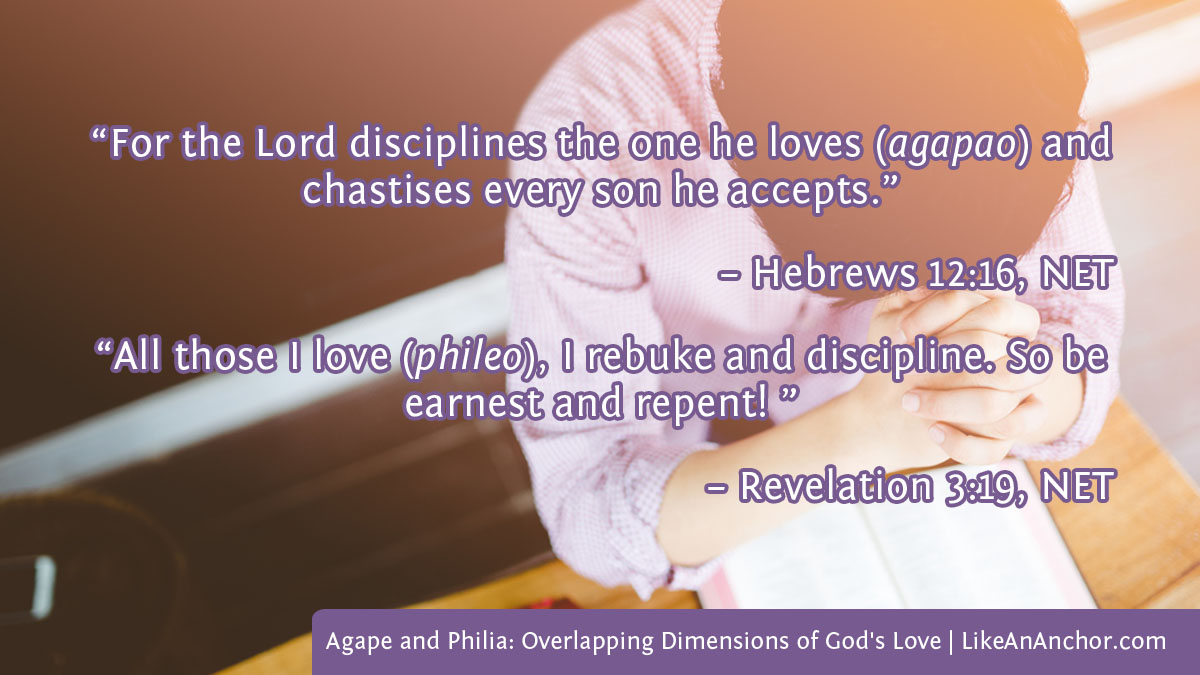
These two different readings illustrate the different ways that we can look at the relationship between agape and philia. We can read one as a greater love and one as a lesser love, or we can read them as different types of love. Zodhiates (1992) notes that scholars often produce “strained and awkward interpretations” when they try to draw rigid distinctions between the two words (p. 1445). There are differences, but there is also a lot of overlap between these two Biblical words for love. They are even used interchangeably in certain contexts. For example, in the phrase, “disciple whom Jesus loved,” John uses the word phileo in John 20:2 and agapao in John 21:7. Similarly, when two different authors talk about God correcting those he loves, one uses agapao (Heb. 12:6) and one uses phileo (Rev. 3:19). It really doesn’t seem useful to say one is better or worse than the other or even to draw too many distinctions between the two. They are both powerful ways to love.
Conditionality in Relation to Agape and Philia
While there is a lot of commonality between agape and phlia, including contexts where they are interchangeable, there are also some differences we can look at. I want to return to this idea of “unconditional conditionality” related to philia. Though Bruni (2010) is writing about eros, philia, and agape as categories of economic reciprocity, his analysis of the terms in relation to social-historical context and scripture provides insight into the nuances of meaning. For philia, the one who moves to initiate the friendship initially does so unconditionally, without underlying motives (Bruni, 2010, p. 399-400). If, however, the other person does not respond, the friendship is interrupted. In the same way, Jesus places a condition upon His philia: “You are my friends (philos) if you do what I command you” (John 15:14, NET). Similarly, God the Father’s philia for human beings happens because of how they feel about the Son: “the Father himself loves (phileo) you, because you have loved (phileo) me and have believed that I came from God” (John 16:27, NET). We can have friendship-love with God only when we respond to His unconditional offer and reciprocate with trust, love, and loyalty.
In contrast, agape for Bruni (2010) is unconditional, relational, potentially universal, and expects nothing in return (p. 403). He bases his definition on the way that agape works in Christian communities, citing another Greek word koinonia to describe the fellowship present in a body of believers led by Jesus, who epitomized agape (p. 404). The parable of the unforgiving slave (Matthew 18:23-35) provides for Bruni an example that hints at the reciprocal expectations of a philia relationship (philia serving as an ethical framework for relationships in Greek society [Holst, 2021]) but then supersedes them with the agapic expectation to freely receive gifts from God and then freely give to others (Bruni, 2010, p. 405).
For this is the way God loved (agapao) the world: He gave his one and only Son, so that everyone who believes in him will not perish but have eternal life.
John 3:16, NET
God’s agape isn’t dependent on human response. We’re supposed to respond to His love, but He is agape, expresses agape, and is motivated by agape regardless of how people react to Him. When Jesus told His followers to “love (agapao) your enemy,” He followed it by saying this is part of being like our “Father in Heaven, since he causes the sun to rise on the evil and the good, and sends rain on the righteous and the unrighteous” (Matt. 5:44-45, NET). God also demonstrated His agape for His enemies when Jesus died for us while we were still sinners alienated from and opposed to God (Rom. 5:6-11).
God the Father and Jesus Christ are going to have love that is unconditional, benevolent, and wants what’s best for you regardless of your response to Him. They’ve already demonstrated their agape for everyone by Jesus dying to make reconciliation possible. This universal love does not, however, mean that we don’t have a role to play. We still need to repent, believe, and commit to God if we want to receive the salvation that He offers and to fully participate in His love. There’s a relational aspect to both philia and agape that helps explain the overlaps in meaning between the two words.
Image by Pearl from Lightstock
The Dimension of Emotion
One of the criticisms I hear leveled at philia is that it’s an emotional love, unlike the purportedly more rational and stable agape. This is not a weakness of philia, but it is a characteristic. According to Thayer’s lexicon, Christ tells us to agape, not philia, our enemies “because love as an emotion cannot be commanded, but only love as a choice” (Greek 5368. Phileó, n.d.). This is not, however, the whole story. There are certain people that we are required or encouraged to have philia for as well as agape.
Paul wrote, “If any man doesn’t love (phileo) the Lord Jesus Christ, let him be cursed,” or “anathema” (1 Cor. 16:22, WEB). We must have emotional, friendly, affectionate love for Jesus as well as unconditional, committed love. Far more often, though, the command to love God is expressed with agape. The most important commandment is “Love (agapao) the Lord your God with all your heart, with all your soul, with all your mind, and with all your strength.’ The second is: ‘Love your neighbor as yourself’” (Mark 12:30-31, NET).
We also must have both philia and agape love for other people in the church. The compound word philadelphia (love+brother) is often translated “brotherly kindness” or “brotherly love.” It’s something that we’re commanded to have for our brethren, the other people in God’s church with whom we share fellowship (koinonia) (Rom. 12:10; 1 Thes. 4:9; Heb. 13:1; 1 Pet. 1:22; 3:8). Unlike our enemies, with whom we are not required to share mutual interests or affection, our brothers and sisters in Christ are people that we are supposed to care about.
The Vast Importance of Love
Thus far, I’ve focused a lot on philia because I think it’s often overlooked or minimized in discussions of Biblical love. Both philia and agape are part of faith; character traits that we must add on to the foundation of our commitment to God (2 Pet. 1:5-7). But I want to be careful that examining the importance of philia doesn’t minimize the importance of agape.
Forms of the word agape are used 535 times in the New Testament (eSword search for G25, G26, G27 [agapao, agape, agapetos) in contrast to forms of the word philia appearing 55 times (eSword search for G5384, G5360, G5373 [philos, phileo, philia]). Those numbers don’t include the times philia is part of a compound word (like philadelphia/philadelphus [G5360/G5361, used 7 times), but uses of agape still outnumber philia by quite a wide margin. It’s also the word used in some of the most pivotal discussions of love in the Bible, such as 1 John 2-5.
Image by Lamppost Collective from Lightstock
Dear friends, let us love one another, because love is from God, and everyone who loves has been fathered by God and knows God. The person who does not love does not know God, because God is love. By this the love of God is revealed in us: that God has sent his one and only Son into the world so that we may live through him. In this is love: not that we have loved God, but that he loved us and sent his Son to be the atoning sacrifice for our sins.
Dear friends, if God so loved us, then we also ought to love one another. No one has seen God at any time. If we love one another, God resides in us, and his love is perfected in us. … We love because he loved us first.
If anyone says “I love God” and yet hates his fellow Christian, he is a liar, because the one who does not love his fellow Christian whom he has seen cannot love God whom he has not seen. And the commandment we have from him is this: that the one who loves God should love his fellow Christian too.
1 John 4:11-16, 19-21, NET
Every time “love” appears in 1 John, it’s translated from a form of the word agape. Here we see that God is love, that He loves us, that we can love in the same way because of Him, and that if we really love Him we’ll love all of His people as well. We see that godly agape is enabled by God; i.e. we love because He loved.
We should note here that there are also ungodly expressions of agape (Luke 11:43; John 3:19; 12:43; 1 John 2:15), which is why it’s inaccurate to simply define agape as “godly love.” There are even passages that talk about the agape of God in contexts where a clarification likely wouldn’t be necessary if agape was always “of God” (Rom. 5:5; 8:39; 2 Thes. 3:5; 1 John 2:5; 3:17; Jude 1:21). With this caveat, we can say that the New Testament writers almost exclusively focus on the godly version that’s defined in 1 Corinthians 13.
Love is patient, love is kind, it is not envious. Love does not brag, it is not puffed up. It is not rude, it is not self-serving, it is not easily angered or resentful. It is not glad about injustice, but rejoices in the truth. It bears all things, believes all things, hopes all things, endures all things. Love never ends.
1 Corinthians 13:4-8, NET
We have no such Biblical definition for philia, perhaps because friendly, affectionate love is much easier to understand (and more often explored in secular writings of the time) than unselfish, unconditional love. Paul also tells us in this passage that agape is absolutely essential to the Christian walk, and that it’s even more important than hope and faith (1 Cor. 13:1-3, 13). There are broad definitions we can give for philia and agape, including certain general distinctions between the two, that have an historical, scholarly, and most important biblical basis. What we must not do, however, is make the claim that agape is the highest or only form of godly love just because it sounds good (see Truth Be Told podcast episode, “It’ll Preach, But Is It True?). Philia and agape together—along with related words used by Biblical writers—help us understand God’s incredible love for us. There are some differences between the two, and agape is highlighted as a chief Christian virtue, but the two words also overlap quite a bit, especially in the context of godly love.
References
Bruni, L. (2010). Éros, Philia et Agapè. Pour une théorie de la réciprocité, plurielle et pluraliste [Eros, Philia and Agape. For a Theory of Reciprocity, Plural and Pluralist]. In La gratuité: Eloge de l’inestimable (pp. 389–413). Revue du M.A.U.S.S.
Grant, C. (1996). For the Love of God: Agape. The Journal of Religious Ethics, 24(1), 3–21.
Holst, J. (2021). Philia and Agape: Ancient Greek Ethics of Friendship and Christian Theology of Love. In S. Hongladarom & J. J. Joaquin (Eds.), Love and Friendship across Cultures: Perspectives from East and West (Singapore, pp. 1–191). Springer Nature Singapore. https://doi.org/10.1007/978-981-33-4834-9
Zodhiates, S. (Ed.). (1992). The Complete WordStudy Dictionary: New Testament. AMG Publishers.
Featured image by Lamppost Collective from Lightstock
I’ve missed a couple weeks of blogging since our daughter was born, but I’m hoping to get back to weekly posts soon. For now, bi-weekly might be more doable (we’ll see how things go). Today’s post is our final study of Jesus’s model prayer. We’ve been focusing on the version in Matthew, which is part of the Sermon on the Mount where He’s talking about good and bad examples for how to pray (Matt. 6:5-15). There’s also a near-identical prayer recorded in Luke, where Jesus responded to a disciple’s request that Jesus teach them to pray (Luke 11:1-13).
So pray this way: Our Father in heaven, may your name be honored, may your kingdom come, may your will be done on earth as it is in heaven. Give us today our daily bread, and forgive us our debts, as we ourselves have forgiven our debtors. And do not lead us into temptation, but deliver us from the evil one.
Matthew 6:9-13, NET
Luke’s version is a little shorter than the one in Matthew, and the final line there simply reads, “And do not lead us into temptation” (see NET footnotes on manuscript evidence for a shorter reading in Luke). Whichever recorded version we’re looking at, we can think of this prayer as a helpful outline for our own prayers. And if we want to include this “do not lead us into temptation” sentiment when we pray, it’s helpful to understand what it does (and doesn’t) mean.
Image by Claudine Chaussé from Lightstock
Do Not Lead Us Into Temptation
The last line of this prayer is a little tricky to interpret, at least at first glance, in light of other scriptures. James 1:13 says, “Let no one say when he is tempted, ‘I am tempted by God,’ for God cannot be tempted by evil, and he himself tempts no one” (NET). The English translation of Matthew 6, at least, makes it appear that Jesus is advising us to pray against something (God leading us into temptation) that wouldn’t happen anyways. Looking at another piece of prayer advice that He gave his disciples helps clear this confusion up.
Then they went to a place called Gethsemane, and Jesus said to his disciples, “Sit here while I pray.” …Then he came and found them sleeping, and said to Peter, “Simon, are you sleeping? Couldn’t you stay awake for one hour? Stay awake and pray that you will not fall into temptation. The spirit is willing, but the flesh is weak.”
Mark 14:32, 37-38, NET
This is actually very similar to what Jesus told his disciples to pray in the model prayer. Both verses use the same Greek word for temptation, periasmos (G3986). This word involves putting something to the test. It’s “an experiment, attempt, trial, proving” that can include an internal or external “enticement to sin” for the purpose of making a “trial of man’s fidelity, integrity, virtue, constancy” (Thayer). In both cases, Jesus advised them to pray that this didn’t happen. Testing isn’t a pleasant experience. God will let it happen sometimes, though, when it’s for our good and when He knows we could succeed.
My brothers and sisters, consider it nothing but joy when you fall into all sorts of trials (periasmos), because you know that the testing of your faith produces endurance. …
Happy is the one who endures testing (periasmos), because when he has proven to be genuine, he will receive the crown of life that God promised to those who love him.Let no one say when he is tempted, “I am tempted by God,” for God cannot be tempted by evil, and he himself tempts no one. But each one is tempted when he is lured and enticed by his own desires.Then when desire conceives, it gives birth to sin, and when sin is full grown, it gives birth to death. Do not be led astray, my dear brothers and sisters.
James 1:2-3, 12-16, NET
Testing serves a purpose. It can strengthen our faith, provided that we overcome the test and not give into the temptation to sin. The NET footnote on Matthew 6:13 says “The request do not lead us into temptation is not to suggest God causes temptation, but is a rhetorical way to ask for his protection from sin.” In other words, we might see this as a prayer that we not be tested but we can also see it as a prayer that if we’re tested, we won’t fail the test.
So let the one who thinks he is standing be careful that he does not fall. No trial (periasmos) has overtaken you that is not faced by others. And God is faithful: He will not let you be tried beyond what you are able to bear, but with the trial (periasmos) will also provide a way out so that you may be able to endure it.
1 Corinthians 10:12-13, NET
When God allows tests and trials, He intends for us to successfully overcome them and prove the genuineness of our faith. If we couldn’t endure the test, He wouldn’t let it happen. We need to be cautious and humble, though, and not just assume we’ve hit a point in our spiritual growth where we won’t be tempted or that we won’t fall if tempted. I think that’s also what Jesus is hinting at in the model prayer. Our prayers should include an acknowledgment that we need God’s help “delivering us from evil” to avoid sin and overcome tests when they do come.
Deliver Us From the Evil One
Image by Pearl from Lightstock
Depending on the translation you’re reading, the end of Matthew 6:13 might read “deliver us from evil” or “deliver us from the evil one.” The Greek word poneros (G4190) can mean evil in a general sense, but here “it is most likely personified since it is articular (τοῦ πονηροῦ, tou ponērou)” (NET footnote). You can see other examples of this word being personified and standing in for the devil in Matt. 13:19, 38; John 17:15; 1 John 2:13-14. One of those examples is from the prayer that Jesus prayed right before his death.
I am no longer in the world, but they are in the world, and I am coming to you. Holy Father, keep them safe in your name that you have given me, so that they may be one just as we are one. … I have given them your word, and the world has hated them, because they do not belong to the world, just as I do not belong to the world.I am not asking you to take them out of the world, but that you keep them safe from the evil one.
John 17:11, 14-15, NET
Jesus told us to pray for deliverance from evil, and he modeled that by praying the Father would keep us safe from the evil one. Jesus’s followers later wrote about God faithfully delivering us from evil people, evil deeds, and the evil one, or Satan (2 Thes .3:2-3; 2 Tim. 4.18; 1 John 5:18-19). We are also counseled to take up the armor of God to provide defense against the evil one.
Clothe yourselves with the full armor of God, so that you will be able to stand against the schemes of the devil. For our struggle is not against flesh and blood, but against the rulers, against the powers, against the world rulers of this darkness, against the spiritual forces of evil in the heavens. For this reason, take up the full armor of God so that you may be able to stand your ground on the evil day, and having done everything, to stand.Stand firm therefore, by fastening the belt of truth around your waist, by putting on the breastplate of righteousness, by fitting your feet with the preparation that comes from the good news of peace,and in all of this, by taking up the shield of faith with which you can extinguish all the flaming arrows of the evil one.
Ephesians 6:11-16, NET
I have a whole book on the armor of God (Like An Anchor Study Guide: Armor of God), so we won’t go into it in too much detail in this post. But if we’re going to pray “do not lead us into temptation, but deliver us from the evil one,” we need to have some understanding of what sort of evil we’re praying to be delivered from and that includes knowledge of the fight that we’re in. “The whole world lies in the power of the evil one” (1 John 5:19), but we are people of God whom God protects, promises to strengthen against temptations, and delivers from the devil.
Quick note for those wondering why there isn’t going to be another post titled “For yours is the Kingdom, the power, and the glory forever:” manuscript evidence suggests that this phrase was added at some point, possibly for use in church liturgy (NET footnote on Matt. 6:13). Since it likely wasn’t part of the original prayer, I decided not to include it in this blog series.
Today’s post is our 5th on Jesus’s model prayer. If you need/want to catch up on the previous posts, here are the links: “Hallowed Be Your Name,” “May Your Kingdom Come,” “May Your Will Be Done On Earth As It Is In Heaven,” and “Give Us Today Our Daily Bread.” As mentioned in those posts, we find versions of Jesus’s model prayer in two gospels. We’ve been focusing on the one in Matthew, which is part of the Sermon on the Mount when He’s talking about good and bad examples for how to pray (Matt. 6:5-15). There’s also a near-identical one in Luke, where Jesus responds to a disciple’s request that Jesus teach them to pray (Luke 11:1-13).
So pray this way: Our Father in heaven, may your name be honored, may your kingdom come, may your will be done on earth as it is in heaven. Give us today our daily bread, and forgive us our debts, as we ourselves have forgiven our debtors. And do not lead us into temptation, but deliver us from the evil one
Matthew 6:9-13, NET
We can think of this prayer as a helpful outline for our own prayers. We’re not locked into repeating it word-for-word; He’s showing us the way to pray rather than giving us a specific prayer to recite (though there can be a time and place for that, too, just like we can read or sing psalms other people wrote at times when we can’t think of what to say or the psalms/prayers speak to our own situations). In this post, we’re looking at the second personal request that’s part of the model prayer: “forgive us our debts, as we ourselves have forgiven our debtors.”
Image by Jantanee from Lightstock
Forgiving Debts
“Forgive us our debts, as we ourselves have forgiven our debtors” is the only point in this prayer that Jesus explains in more detail. Right after wrapping up the outline, He adds this:
“For if you forgive others their sins, your heavenly Father will also forgive you. But if you do not forgive others, your Father will not forgive you your sins.”
Matthew 6:14-15, NET
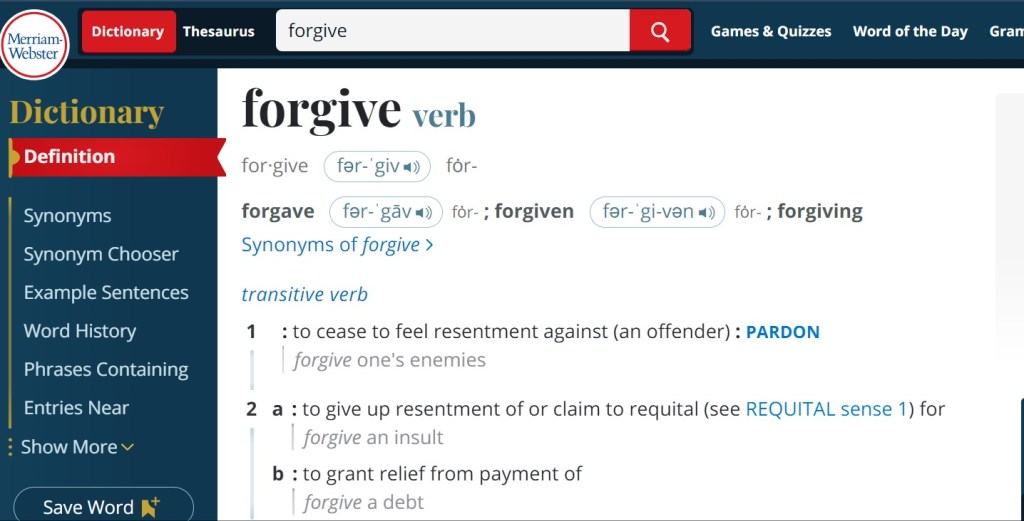
There are two different Greek words used here, which is reflected in the English translations “debts” and “sins.” In the prayer, the word used is opheilema, which means “that which is owed” as “a debt” (Thayer’s Dictionary, entry G3783). It’s metaphorically used of sins. “Debtors” is the related word opheiletes, which as you might guess means the person who owes something to another (Thayer; G3781). This word for debtor is also used in Matthew 18, which we’ll be looking at in a moment.
“Sin” is translated from paraptoma, which means “to fall beside or near” or “a lapse or deviation from truth and uprightness” (Thayer; G3900). When it appears in the New Testament it’s translated with English words like “trespass,” “offense,” “fault,” or “sin.” Interestingly, this still isn’t the most commonly used Greek word for sin. That would be hamartia, which means “to miss the mark” or “that which is done wrong, sin, and offense, a violation of the divine law” (Thayer; G266). Harmartia is the word used for “sin” in the version of Jesus’s model prayer that Luke records (Luke 11:4).
Despite the different words, “forgive us our debts, as we ourselves have forgiven our debtors” is clearly connected with “forgive others their sins” so your Father will forgive you. Jesus uses parallel wording to make the connection, and the word for “forgive” is the same in both cases. It’s translated from aphiemi, which means “to let go, give up a debt, forgive, to remit” (Thayer; G863). When we sin, it’s like we owe God something because we messed up. When Jesus died, He paid the penalty in our place, remitting our debts. We need to understand this sin-debt analogy if we’re going to make sense of what’s going on in this part of the model prayer.
Image by MarrCreative from Lightstock
The Necessity of Forgiveness
It might feel kind of weird to think that God’s forgiveness of us is conditional on our forgiveness of others. We like to think of His forgiveness and grace as something freely given that we don’t need to do anything in order to receive. But though we can’t do anything to earn His grace or forgiveness, there are some things we can do to reject them. Later in Jesus’s ministry, He shares a parable that sheds light on the connection between us forgiving others and us receiving forgiveness from God.
Then Peter came to him and said, “Lord, how many times must I forgive my brother who sins against me? As many as seven times?”Jesus said to him, “Not seven times, I tell you, but seventy-seven times!
“For this reason, the kingdom of heaven is like a king who wanted to settle accounts with his slaves.As he began settling his accounts, a man who owed 10,000 talents was brought to him. Because he was not able to repay it, the lord ordered him to be sold, along with his wife, children, and whatever he possessed, and repayment to be made. Then the slave threw himself to the ground before him, saying, ‘Be patient with me, and I will repay you everything.’ The lord had compassion on that slave and released him, and forgave him the debt.
Matthew 18:21-27, NET
This is mercy. The man was an opheiletes, a debtor, who was incapable of repaying what he owed. Just one talent was “equal to 6,000 denarii. One denarius was the usual day’s wage for a worker” (NET footnote on Matt. 18:24). That means for a typical worker at the time, 10,000 talents was equal to 60,000,000 day’s wages, or about 164,384 years of work. A slave could never dream of repaying that, just like human beings can never do enough to make up for the sins we’ve committed against God (Rom. 3-6). As readers or listeners, we’re supposed to appreciate just what an incredible gift this lord gave the slave.
After he went out, that same slave found one of his fellow slaves who owed him 100 silver coins. So he grabbed him by the throat and started to choke him, saying, ‘Pay back what you owe me!’Then his fellow slave threw himself down and begged him, ‘Be patient with me, and I will repay you.’But he refused. Instead, he went out and threw him in prison until he repaid the debt. When his fellow slaves saw what had happened, they were very upset and went and told their lord everything that had taken place. Then his lord called the first slave and said to him, ‘Evil slave! I forgave you all that debt because you begged me! Should you not have shown mercy to your fellow slave, just as I showed it to you?’ And in anger his lord turned him over to the prison guards to torture him until he repaid all he owed. So also my heavenly Father will do to you, if each of you does not forgive your brother from your heart.”
Matthew 18:28-35, NET
The fellow slave owed only 100 silver coins, or denarii, so about 3 months’ pay (NET footnote on Matt. 18:28). It’s a real debt, but compared to what the first slave owed the lord it’s a tiny sum. The difference between what the slave was forgiven and what he refused to forgive is enormous. We can see how ridiculous he’s being. But it’s just as ridiculous if we refuse to forgive another human being’s offenses against us after God has forgiven our offenses against Him.
It’s not just crazy for us to hold on to a tiny debt someone owes us when God has forgiven us a huge debt against Him. It’s dangerous. Jesus doesn’t leave room for ambiguity in interpreting this parable. The lord takes back His forgiveness, and Jesus says, “So also my heavenly Father will do to you, if each of you does not forgive your brother from your heart.” It’s exactly like He said after sharing the model prayer: “if you forgive others their sins, your heavenly Father will also forgive you. But if you do not forgive others, your Father will not forgive you your sins” (Matt. 6:14-15, NET). There’s an “if” in these verses, making forgiveness conditional. We need to show forgiveness if we want to receive forgiveness.
How To Let Go
Earlier, I said that aphiemi, the Greek word translated “forgive” means “to let go, give up a debt, forgive, to remit” (Thayer; G863). That’s the sense in which it usually applies to forgiveness. But it’s a complex word, and it can also mean “to send away,” “yield up,” “let alone, let be,” or “to leave, go away from one.” If we forgive, we stop holding on to the sins, offenses, debts, and trespasses of other people. We “let it alone,” send away our resentment, and walk away from what we might be owed. It’s much the same thing as our English definition of forgiveness.
Notice that none of the things involved with forgiveness require the other person to take action. We can grant forgiveness–let go of resentment and yield any claim to payment owed us–without the other person asking for it. In fact, we should forgive as soon as possible regardless of the other person because we want God to respond positively when we ask Him to forgive us.
Image by Shaun Menary from Lightstock
One of the things I’ve struggled with related to forgiveness is how to tell if I’ve actually forgiven someone. Some things are relatively easy to forgive, and you might legitimately forget them when you release the debt. There are others, though, that can still color your perception of a person even if you don’t feel resentment or think they owe you something. In certain situations, that can be okay. It’s not always safe to reconcile or restore a relationship, but it’s always right to let go of resentment and the feeling that someone who hurt us owes us for something.
“If your brother sins, go and show him his fault when the two of you are alone. If he listens to you, you have regained your brother. But if he does not listen, take one or two others with you, so that atthe testimony of two or three witnesses every matter may be established.If he refuses to listen to them, tell it to the church. If he refuses to listen to the church, treat him like a Gentile or a tax collector.
Matthew 18:15-17, NET
This short formula for Christian reconciliation comes before Peter’s question about forgiveness and Jesus’s parable about the unforgiving slave. Ideally, we should reconcile if there’s an issue with a “brother” or “fellow believer.” The primary goal is reconciliation and restored relationship. But if that doesn’t work after repeated attempts, you don’t “associate with such a person” (NET footnote on Matt. 18:17). It’s our responsibility to try to reconcile, especially with a fellow believer, but regardless of how that goes we have an obligation to forgive and “live peaceably with all people” (Rom. 12:18, NET; see Rom. 12:16-21).
The conditionality of forgiveness from God should prompt us to extend forgiveness to others. But I don’t think He wants that to be the main reason why we forgive (just like the threat of punishment shouldn’t be the main reason we obey His laws). When we realize what a great debt God forgives us, we should want to forgive others. Similarly, as recipients of God’s great mercy, we should be eager to show mercy to others. Like forgiveness, there’s a reciprocity involved in mercy: “Blessed are the merciful, for they will be shown mercy” (Matt. 5:7, NET) and “For judgment is merciless for the one who has shown no mercy” (James 2:13, NET). One of our main goals as Christians is to become like God. That involves learning to be loving, merciful, and forgiving just the same way that He is. When we pray, “Forgive us our debts, as we ourselves have forgiven our debtors,” we acknowledge that we have an essential role to play in giving and receiving forgiveness.
Years ago when I first studied the topic of “praise,” I remember I immediately wanted to do a follow-up study on “worship.” That’s what I’m doing again this week. We often use “praise and worship” as a connected idea, almost as if they’re the same thing or they’re simply the label for the time during church services when we sing songs to God. But I remember from my last studies on worship that worship in the Bible is a different thing from praise. They can be connected, but they’re distinct ideas.
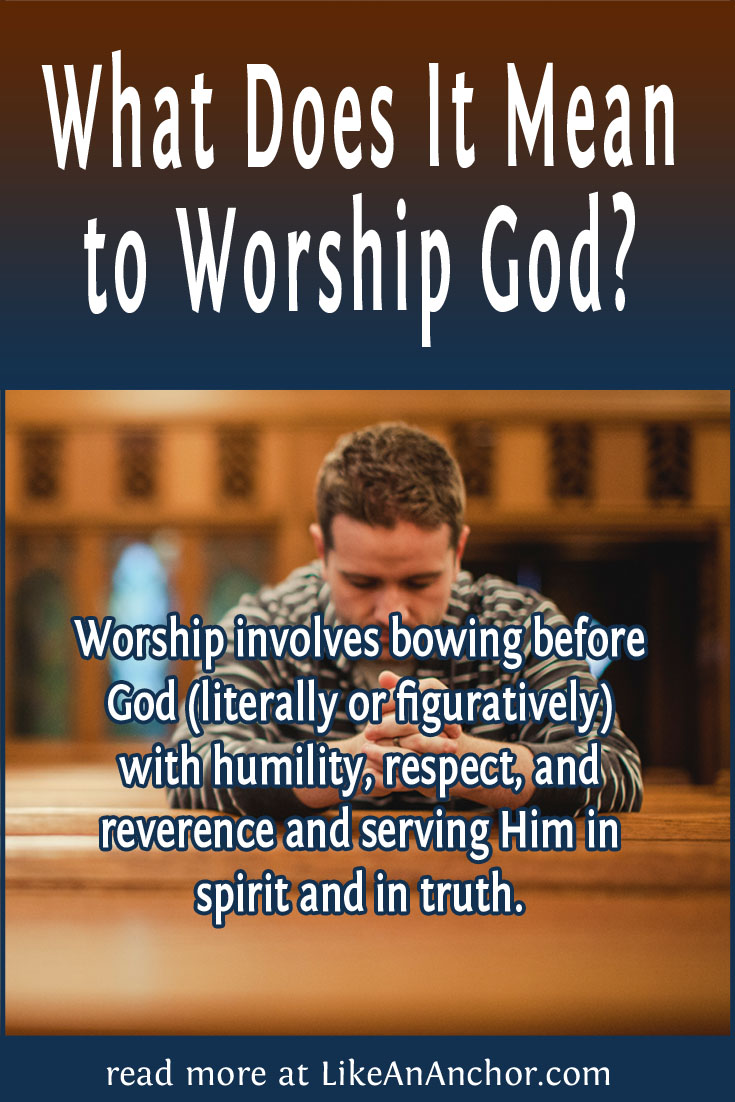
Praise, as we saw in last week’s post, involves acknowledgement of something God is or does. It includes the ideas of glorifying God, confessing His greatness, blessing and thanking Him, and lifting up His greatness and mighty deeds. In many cases, praise is public, communal, and enthusiastic. It often involves music and singing. Worship, on the other hand, involves bowing before God with humility, respect, and reverence as you offer service to Him. Praise and worship may occur together, but not necessarily.
Worship Words
As usual here on this blog, I like to start topical studies by looking at the Hebrew and Greek words used in the Bible. We’ll also compare them to the English definition, to see where there might be differences that could affect our understanding.
In English, “worship” as a noun means “the feeling or expression of reverence and adoration for a deity.” As a verb (action), it means “show reverence and adoration for (a deity); honor with religious rites” (Google and Oxford Languages). That matches the Hebrew and Greek meanings pretty well, but it’s missing a few points about how we show that reverence, adoration, and honor. We don’t really bow much anymore (at least in modern Western culture), but that sign of humble recognition that we’re entering the presence of someone far superior to us is key to understanding worship in the scriptures.
In Hebrew, “worship” is usually translated from sachah (H7812). This word appears 172 times in the Hebrew Bible, and you can translate it “bow down” or “worship.” Occasionally, English translators may use words like “obeisance” or “reverence” as well. Basically, the word means “to bow down, prostrate oneself” as “before a superior in homage” and “before God in worship” (Brown, Driver, Briggs [BDB]). Strangely (considering how much time they devote to words translated “praise”), the Theological Wordbook of the Old Testament (TWOT) has little to say about sachah. They simply say that the word can mean to “depress” or “weigh down” someone or something, as well as “‘to prostrate oneself’ or ‘to worship'” (TWOT 2360). The meaning seems to be fairly straightforward. There’s also a similar Chaldean word used in the book of Daniel that means to prostrate or “fall down” in worship (H5657; segid).
In the modern NET Bible, the translators sometimes render the Hebrew words abad (H5647; “serve” in KJV) and yare (H3372; “fear” in KJV) as “worship.” They’ll also translate whole phrases like “set their hearts to seek” or “call on the name” as “worship.” The NET isn’t my preferred translation for the Old Testament (I think they sometimes lose the important, poetic word pictures of Hebrew by reducing them to a single English word), but abad is an important word to look at when we’re studying worship. It blends the meanings of several roots, including “to do or make” and “to worship, obey” (TWOT 1553). It involves service offered to someone, often a king or deity. In a proper sense, it includes the “joyous and liberating experience” of serving the one true God (TWOT). Our worship can include obedient service as well as humble and reverent bowing before God.
In Greek, “worship” can be translated from a wide variety of different words. In the KJV, translators chose “worship” to represent all of these words: proskuneo (G4352; prostrate/worship), sebomai (G4576; revere/adore/worship), doxa (G1391; glory), latreuo (G3000; minister/serve), eusebeo (G2151; be pious toward/respect), therapeuo (G2323; wait upon, worship), threskeia (G2356] ceremonial observance/religion), and also a few single-use derivatives of those words (note: worship is not the only translation for most of these words [e.g. doxa is typically translated “glory”]). Most often (54 out of 73 verses), “worship” comes from proskuneo. The NET also translates these words as “worship,” and they translate latreuo as worship more often than the KJV does (which typically uses “service”).
Taking the Hebrew and Greek together, the ideas that come into the English language as “worship” typically involves either 1) prostration and bowing down before God, and/or 2) service given to God. It also includes nuances of respect, adoration, and reverence. With that background, let’s look at how these words (particularly the Hebrew sachah and abad and the Greek proskuneo and latreuo) are used by Bible writers.
Image by WhoisliketheLord Studio from Lightstock
Kneeling in Worship
The earliest record we have of worship comes from Abraham, the Friend of God (Isa. 41:8; Jam. 2:23). When “Yahweh appeared to” Abraham before the destruction of Sodom and Gomorrah, Abraham “ran to meet them from the tent door, and bowed himself to the earth” (Gen. 18:1-2, WEB). Here, “bowed himself” is translated from sachah. Abraham also used this word when God commanded him to sacrifice Isaac, explaining to his servants, “We will worship, and come back to you” (Gen. 22:5, WEB). Just in these examples, we see that worship involves humility, respect, and actions that serve God obediently. Sachah may involve literal bowing, but not always.
Oh come, let’s worship (sacha) and bow down (kara). Let’s kneel (barak) before Yahweh, our Maker, for he is our God. We are the people of his pasture, and the sheep in his care.
Psalm 95:6-7
Here, “worship” is translated from sachah. It’s paired with kara (H3766) and barak (H1288). Kara specifies literal bending and bowing. It’s used 36 times in scripture, and at least 13 are for bowing to the knees and bending the back in worship (TWOT 1044). Barak is one of the words that we looked at last week; it is more typically translated “bless” and can be translated “praise” in some contexts. The use of these three words together makes it clear sachah isn’t always synonymous with kneeling (there wouldn’t be need for another word to clarify it if that was the case). Worship always involves the attitude of humbly prostrating oneself before God, but doesn’t always mean literally falling to your knees (though it can and often does include that).
Like Hebrew, Greek also has separate words for “bow/kneel” than the word for “bow/worship.” One of them is kampto (G2578), which Paul uses to talk about one of his prayers (Eph. 3:14-19) and to express the proper reaction people should have–and eventually all will have–to Jesus the Messiah.
As a result God highly exalted him and gave him the name that is above every name, so that at the name of Jesus every knee will bow (kampto) —in heaven and on earth and under the earth— and every tongue confess that Jesus Christ is Lord to the glory (doxa) of God the Father.
Philippians 2:9-11, NET
You’ll see something similar in the gospels, too, where people “bow down” and “worship” Jesus. The same thing is happening before God’s throne in heaven (Matt. 2:11; Rev. 5:14; 19:4). In these verses, the words are pipto (G4098; literally “fall down”) and proskuneo (G4352; worship). Zodhiates says that proskuneo comes from a root meaning to kiss, which references an “ancient oriental mode of salutation … when one was much inferior, he fell upon his knees and touched his forehead to the ground or prostrated himself, throwing kisses at the same time toward the superior” (The Complete Wordstudy Dictionary: New Testament, entry 4352). This isn’t necessarily literally happening in the New Testament (though, as we’ve seen, people do fall down or bow before God as well as worship), but it’s a custom underlying the action of showing reverence, adoration, and worship to a deity.
Image by Jantanee from Lightstock
Service As Worship
31 times in the Old Testament, you’ll find sachah and abad in the same verse. Over and over again, God’s people are warned not to bow down to, worship, or serve any other gods (Ex. 20:5; Deut. 11:16; 2 Kings 17:34-35). Doing so violates the covenant ancient Israel made with Yahweh (Josh. 23:16; Jer 22:9). Jesus reiterated the importance of worshiping and serving God alone during His confrontation with Satan following His baptism.
Again, the devil took him to a very high mountain, and showed him all the kingdoms of the world and their grandeur.And he said to him, “I will give you all these things if you throw yourself to the ground and worship me.” Then Jesus said to him, “Go away, Satan! For it is written: ‘You are to worship the Lord your God and serve only him.’”
Here, because Jesus is quoting from the Old Testament, we can see how he aligned the Hebrew and Greek words for worship. We’re to worship (Greek proskuneo; Hebrew yare) God and serve (Greek latreuo; Hebrew abad) Him. Like the Hebrew abad, the Greek verb latreuo (noun form latreia) involves serving someone greater than you. The root word means “one hired,” indicating this service is voluntary and involves some kind of reward. When worshipping God, it’s not a transactional hiring process, but there are great rewards for those who faithfully serve Him.
Therefore I exhort you, brothers and sisters, by the mercies of God, to present your bodies as a sacrifice—alive, holy, and pleasing to God—which is your reasonable service (latreia).
Romans 12:1, NET
Presenting our entire lives to God as if we’re serving in His temple offering ourselves as a sacrifice to Him is a reasonable service. Reading Hebrews can provide a fascinating study of latreuo. It’s used of temple service under the Old Covenant, which was commanded as part of worshiping God but couldn’t make the worshippers perfect the way that Jesus’s sacrifice does (Heb. 9:1, 6, 9; 10:2). Because of what Jesus did, “the blood of Christ” cleans “your conscience from dead works to serve the living God” (Heb. 9:14, WEB). I said earlier this service isn’t a transactional hiring process, but it is a reciprocal relationship. When we accept Jesus’s sacrifice, we’re supposed to respond with worship and service.
So since we are receiving an unshakable kingdom, let us give thanks, and through this let us offer worship (latreuo) pleasing to God in devotion and awe. For our Godis indeed a devouring fire.
Hebrews 12:28-29, with a quotation from Deut 4:24; 9:3.
The Bible gives us a few concrete examples of what this service looks like. Anna the prophetess served God by staying in the temple, fasting, and praying (Luke 2:36-37). Paul served God by following Jesus, believing in the law and the prophets, worshiping in the spirit, and preaching the gospel (Acts 24:10-14; Rom. 1:9; Phil. 3:3). Serving God voluntarily and wholeheartedly is a key aspect of how we worship Him.
Spirit and Truth
Image by Shaun Menary from Lightstock
Returning to the Greek word most often translated worship, proskuneo (G4352), we can fill in a little more of our picture of what it means to worship. In the gospels, people worshiped when they learned that Jesus is the Messiah (Matt. 2:1-2, 11; 14:33; John 9:38). People also worshiped when they ask Jesus for something (Matt. 8:2; 9:18; 15:25). We can continue both these practices today, worshiping Jesus and the Father as we recognize who they are and what they do, and also approaching them with our requests in a humble, worshipful way.
“But a time is coming—and now is here—when the true worshipers will worship the Father in spirit and truth, for the Father seeks such people to be his worshipers.God is spirit, and the people who worship him must worship in spirit and truth.”
John 4:23-24, NET
This conversation that Jesus has with a Samaritan woman is probably the most direct discussion anyone in the Bible has about how we’re supposed to worship. Most of the time, we see examples of people worshipping or instruction to worship God without a specific explanation of how to do that. Here, Jesus gives us a “must” statement for how we need to worship God.
Thoroughly examining what it means to do something in spirit and truth could fill at least one more whole blog post. But I think the easiest way to understand it is to think about Paul’s letters that contrast walking in the flesh to walking in the spirit (e.g. Romans 8). Lives transformed by God are spirit-led, and that should affect our worship as well. For the “truth” aspect, I think of the letter where Paul said we should be “practicing the truth in love” (Eph. 4:15, NET). In this passage, truth is a verb. We don’t think of “truthing” as an action in English, but it is here. The NET notes that we can think of it as “being real or truthful in both conduct and speech” (footnote on Eph. 4:15).
Worship involves bowing before God (literally or figuratively) with humility, respect, and reverence. It also involves the service that you offer to Him. All of this must be done in spirit and in truth for it to qualify as true worship in our New Covenant relationship with God the Father and Jesus the Son.




















 Like An Anchor