Inheriting Covenants: Revisited

I’ve been thinking about covenants a lot lately, especially the topic of which covenants transfer to us today and how that happens. I think of this as the topic of “inheriting covenants,” the title of a blog post I wrote way back in 2016. When I realized how long ago I wrote that post, I wanted to revisit the topic. As we grow in our walk with God, we should gain a deeper appreciation and understanding of His word. It’s good to go back sometimes and revisit topics we thought we understood well. As Paul said, “If someone thinks he knows something, he does not yet know to the degree that he needs to know” (1 Cor. 8:2, NET). There’s so much depth to God’s word; so much to learn as we grow.

Defining Covenants

Let’s start with the basics. In Hebrew, the word for “covenant” is berith (H1285). In Greek, for the New Testament, the word is diatheke (G1242). These words don’t mean exactly the same thing, and so it can be challenging for us today to figure out what the Biblical writers meant by covenants and how they worked. Also, most of our lives aren’t based on covenants today; in the U.S., I’ve rarely heard that word used outside of a religious context. We need to do some linguistic and historical research to understand covenants, which are so important to the Biblical world and God’s ongoing relationships with humanity.

The Theological Wordbook of the Old Testament (TWOT) notes that “Apart from blood ties the covenant was the way people of the ancient world formed wider relationships with each other” (entry 282a). Covenants have to do with establishing relationship. They were binding agreements between two parties that people in the ancient world took very seriously; “There is no firmer guarantee of legal security peace or personal loyalty than the covenant” (Behm, qtd. in TWOT). When God made a covenant with His people, we was binding Himself in relationship to them in the most reliable way possible. Like other covenants, the ones between God and humanity include both expectations and promises. Covenant documents between people survive to the present day, and the format of them has many similarities with God’s Ten Commandments and the book of Deuteronomy (Klein, ref. in TWOT).

In Greek, diatheke means testament, as in “the last disposition which one makes of his earthly possessions after his death,” or a covenant agreement (Thayer). According to Spiros Zodhiates, dispensation/testament is always the usage in classical Greek (The Complete WordStudy Dictionary of the New Testament, entry 1242). New Testament writers picked this word to use for covenants. That might seem odd at first, but Zodhiates proposes a definition of covenant that covers both the unilateral enactment of diatheke and the established relationship of berith. He writes that what we describe as a covenant “is a divine order or agreement which is established without any human cooperation and springing from the choice of God Himself whose will and determination account for both its origin and its character” (entry G1242, section IV).

Indeed, we always see God as the initiator of covenants and, by necessity, the relationship established by a covenant with God is always one where He is the superior party. God calls us His friends, but that is a gracious choice on His part; we are by no means His equals nor can we make demands of Him. We either choose to accept the covenants He offers, or we reject relationship with Him. We don’t get the chance to insert our own demands into the covenant; we trust that we’re more than adequately protected and provided for by His promises.

Image of a woman reading the Bible overlaid with text from Jeremiah 31:31, 33, NET version: "Indeed, a time is coming," says the Lord, "when I will make a new covenant with the people of Israel and Judah. ... I will put my law within them and write it on their hearts and minds. I will be their God and they will be my people."
Image by Matt Vasquez from Lightstock

Key Covenants

There are four main covenants that God made with human beings that are recorded in the Old Testament writings: the Noahic Covenant, the Abrahamic Covenant, the Sinai Covenant, and the Davidic Covenant. There are other covenants mentioned, but those are the big ones. The BibleProject has a great summary of these on YouTube:

With the exception of the Noahic Covenant, the covenants God made with people included expectations for God’s human covenant partners. God kept up His covenant promises, but people broke the covenants with God. That put us under a death-penalty; a curse (Rom. 3:23; 5:12; Gal. 3:10). Then Jesus came along. As a human being, He was a physical descendant of Abraham, an Israelite heir of the covenants with God, and a man in the lineage of David (Acts 2:29-31). He was born into the physical position of an heir to all these key covenants. He also came as God in the flesh, so He can see covenants from both sides and keep covenant perfectly both as God and human.

Prior to Jesus Christ coming to this earth, all except the Noahic Covenant were linked to Abraham’s descendants. The Sinai Covenant was with all of physical Israel and included a fuller revelation of God’s law and expectations. The Davidic covenant was more specific, applying to one line of the tribe of Judah. It was possible for a stranger to join themselves to Israel and become part of the Abrahamic and Sinai Covenants with God, as Rahab and Ruth did, but it was apparently quite rare and more often than not was discussed in a prophetic context (Is. 56:6-7).

That also changed with Jesus’s coming. In the New Testament, Paul writes to Gentile believers that they were “alienated from the citizenship of Israel and strangers to the covenants of promise, having no hope and without God in the world” until the time of their conversion. They were not previously heirs to the covenants, “But now in Christ Jesus you who used to be far away have been brought near by the blood of Christ” (Eph. 2:12-13, NET). This is a fulfillment of a promise that God delivered through His prophets; a promise to make a better New Covenant with the people of Israel and the spiritual descendants of Abraham.

A Question of Inheritance
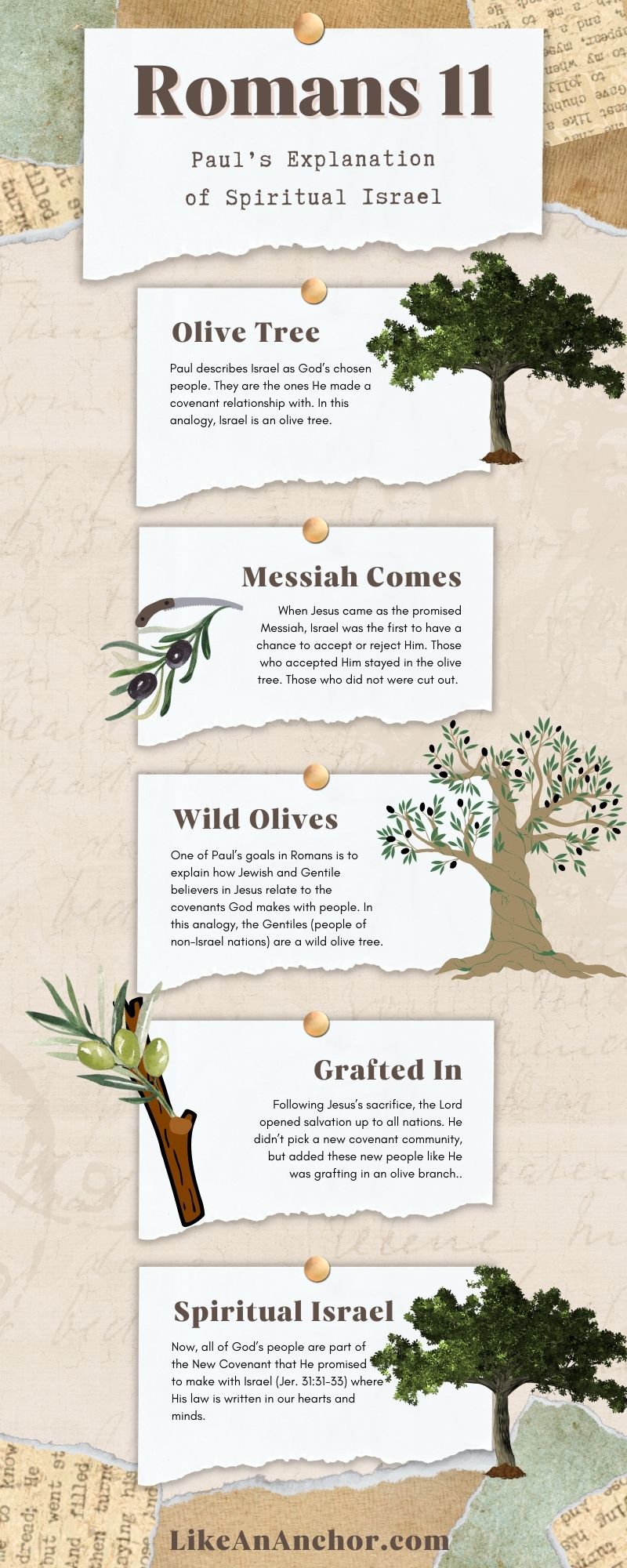
Infographic illustrating the "grafted in" analogy Paul uses for how Jewish and Gentile Christians enter the New Covenant community with God.

I usually go to Romans when I want to discuss covenants, which is where we were a couple weeks ago when I shared an infographic illustrating how all God’s people become spiritual Israel. Today, though, we’re going to spend some time in Galatians.

In this letter, Paul writes to a group of churches with the expressed purpose of countering distorted gospels (Gal. 1:6-8). He wants to ensure that they follow the pure gospel that he receive, not some distortion arising from human reasoning (Gal. 1:1, 11-12, 15-24). That’s the perspective Paul’s coming from when he discusses covenants in this letter.

It appears that the Galatian believers had been deceived by a person or group who told them they needed to keep the whole Jewish law in order to be saved. The Galatians were worried that the male believers needed to be circumcised, that they had to keep the whole Old Covenant law, and that they additionally had to keep Jewish additions to God’s law. Paul reminds them that it is Jesus’s faithfulness that brings us righteousness and justification, not our own efforts. That doesn’t mean we break God’s law; Christ in us most certainly does not encourage sin. But He also didn’t save us and give us the Spirit so that we could then save ourselves by our own efforts. Rather, we’re following the example of Abraham.

Just as Abraham believed God, and it was credited to him as righteousness, so then, understand that those who believe are the sons of Abraham. And the scripture, foreseeing that God would justify the Gentiles by faith, proclaimed the gospel to Abraham ahead of time, saying, “All the nations will be blessed in you.” So then those who believe are blessed along with Abraham the believer. 

Galatians 3:6-9, NET (bolt italics mark quotes from the Old Testament)

Here, Paul quotes from the record in Genesis of God cutting a covenant with Abraham (Gen. 15). This covenant is one of inheritance and blessing. We learn more about it in Genesis 17 and 18, which Paul also quotes. If you read that section, you’ll notice that God’s covenant with Abraham included people following the Lord’s way and doing what is right. But, as Paul emphasizes, the promises come to Abraham and his descendants because God is faithful, not because they kept the Law that God later shared as part of the Sinai Covenant or because they observed Jewish traditions added later.

God does want people to follow His law (it defines sin and, since sin is not consistent with God’s character, it damages relationships between us and Him). But God also knows that all people sin. It is very, very good for us that He upholds His part of covenants even when people aren’t faithful, because one of those covenant promises was that God would send Jesus as the Messiah. That’s how we inherit the Abrahamic Covenant promises: through Jesus Christ.

 Brothers and sisters, I offer an example from everyday life: When a covenant has been ratified, even though it is only a human contract, no one can set it aside or add anything to it. Now the promises were spoken to Abraham and to his descendant. Scripture does not say, “and to the descendants,” referring to many, but “and to your descendant,” referring to one, who is Christ. What I am saying is this: The law that came 430 years later does not cancel a covenant previously ratified by God, so as to invalidate the promise. For if the inheritance is based on the law, it is no longer based on the promise, but God graciously gave it to Abraham through the promise.

Galatians 3:15-18, NET (bolt italics mark quotes from the Old Testament)

A few verses later, Paul says that the Law was “added because of transgressions, until the arrival of the descendant to whom the promise had been made” (Gal. 3:19, NET). He also says the law was a guard to keep us safe and a “tutor to bring us to Christ, that we might be justified by faith” (Gal. 3:24, WEB). The law defines sin for us and reveals the penalties for breaking God’s covenant law. As transgressors of the covenant, we deserved to inherit the curses contained in the covenanting words (Deut. 11:26-32; 27:1-28:68). The only one who perfectly kept God’s covenant was Jesus Christ, and so He’s the only one who truly deserved to inherit all the promises. When He died, He “willed” those promises to us. We inherit the Abrahamic Covenant alongside Him, and through Him we’re brought into the New Covenant that God long ago promised would replace the Old (Sinai) Covenant (Jer. 31:31-34; Heb. 8).
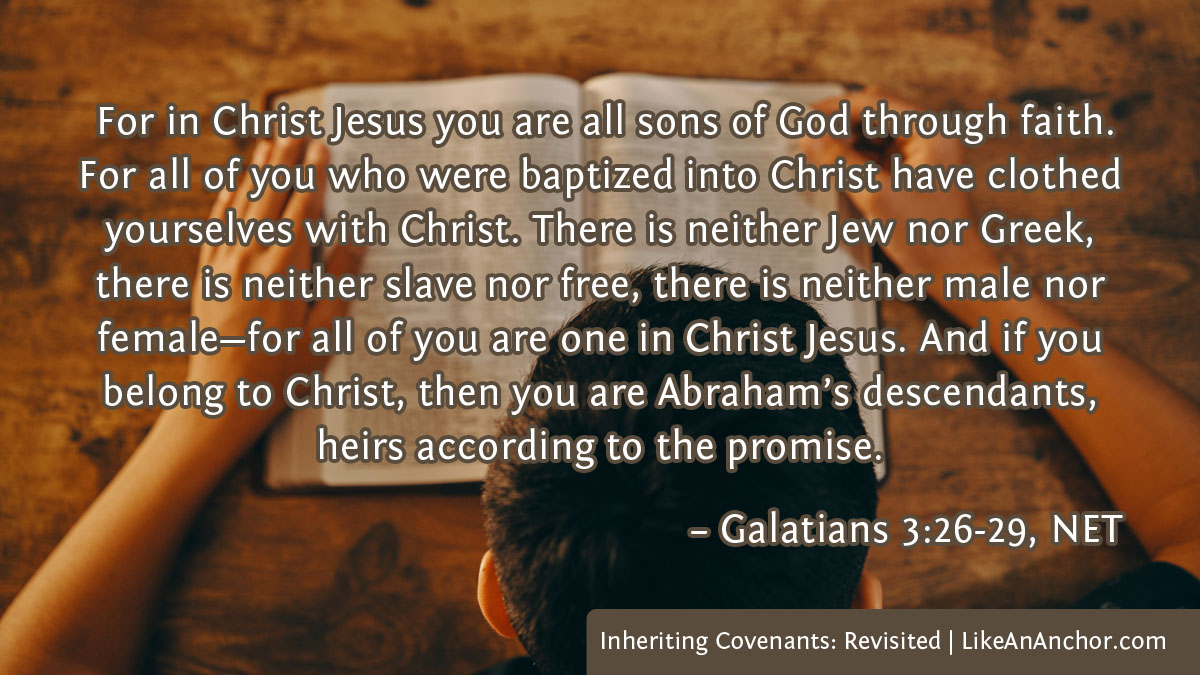
Image of a man reading the Bible overlaid with text from Galatians 3:26-29, NET version:  " For in Christ Jesus you are all sons of God through faith. For all of you who were baptized into Christ have clothed yourselves with Christ. There is neither Jew nor Greek, there is neither slave nor free, there is neither male nor female—for all of you are one in Christ Jesus. And if you belong to Christ, then you are Abraham’s descendants, heirs according to the promise."
Image by Matt Vasquez from Lightstock

Promises Through Jesus

I find it so fascinating that the New Testament writers use the fact that the Greek word for covenant also means last will and testament to connect the idea of covenant inheritance to our adoption as God’s children (Gal. 3:26-4:7; Rom. 8:14-17). The author of Hebrews spends quite a bit of time explaining this concept, particularly the transition from Old to New Covenant.

 And so he [Jesus] is the mediator of a new covenant, so that those who are called may receive the eternal inheritance he has promised, since he died to set them free from the violations committed under the first covenant. For where there is a will, the death of the one who made it must be proven. For a will takes effect only at death, since it carries no force while the one who made it is alive. 

Hebrews 9:15-17
Image of a man and woman reading the Bible together, overlaid with blog's title text and the words, "Jesus makes all who believe in and fellow Him heirs of God's covenant promises."
Image by Anggie from Lightstock

As the Word of God, Jesus is (almost certainly) the God-being who delivered the first covenants in the Old Testament. Then, as the original testator, He died so we can be freed from the Old Covenant and join Him in a New Covenant (Jer. 31:32-34; Rom 7:1-4). At the same time, as a human heir to all the covenants (and the only person who kept humanity’s side of the covenant bargain, since He never sinned), Jesus died to take on Himself the penalty we earned for breaking the covenant, purify us with His blood, and bring us into a new covenant (Heb. 9:18-28). Yet another layer is that He inherits all the promises, wills them to us at His death, then rises again to inherit as well (Eph. 1:3-21).

We were also assigned an inheritance in him, having been foreordained according to the purpose of him who does all things after the counsel of his will, to the end that we should be to the praise of his glory, we who had before hoped in Christ. …

For this cause I also …  don’t cease to give thanks for you, making mention of you in my prayers, that the God of our Lord Jesus Christ, the Father of glory, may give to you a spirit of wisdom and revelation in the knowledge of him, having the eyes of your hearts enlightened, that you may know what is the hope of his calling, and what are the riches of the glory of his inheritance in the saints, and what is the exceeding greatness of his power toward us who believe, according to that working of the strength of his might which he worked in Christ, when he raised him from the dead

Ephesians 1:11-12, 15-20, WEB

It’s amazing to me that God invites us to be covenant partners with Him and participate in the relationships that He’s been building with humanity since the world began (the word “covenant” isn’t used in the creation story, but the words of His promises to Adam and Eve are covenant-like, and some call it the Adamic Covenant). People often say that God wants a personal relationship with you, and covenants are the way that the Bible describes that relationship. They’re so important to understanding our role in God’s plan and His family, and I don’t think we talk about them enough. The more deeply and completely we understand covenants, the better we’ll understand God and the relationship He wants to have with us.


Featured image by falco from Pixabay

A Time To Return

If I asked you to define “repent” or “repentance,” what would you say?

We know it’s the thing you’re supposed to do when you’ve sinned and you’re coming to God asking for forgiveness. But is it just saying you’re sorry?

In English, “repent” means to express regret and remorse. While the Hebrew and Greek words translated “repent” in the Bible include that aspect of regret, the Biblical concept goes a step farther. Biblical repentance involves change. This change is a movement; an alteration in the direction of your heart and your life. The word image contained in both Hebrew and Greek is to turn away from sin and to turn toward God.

Unpopular Repentance

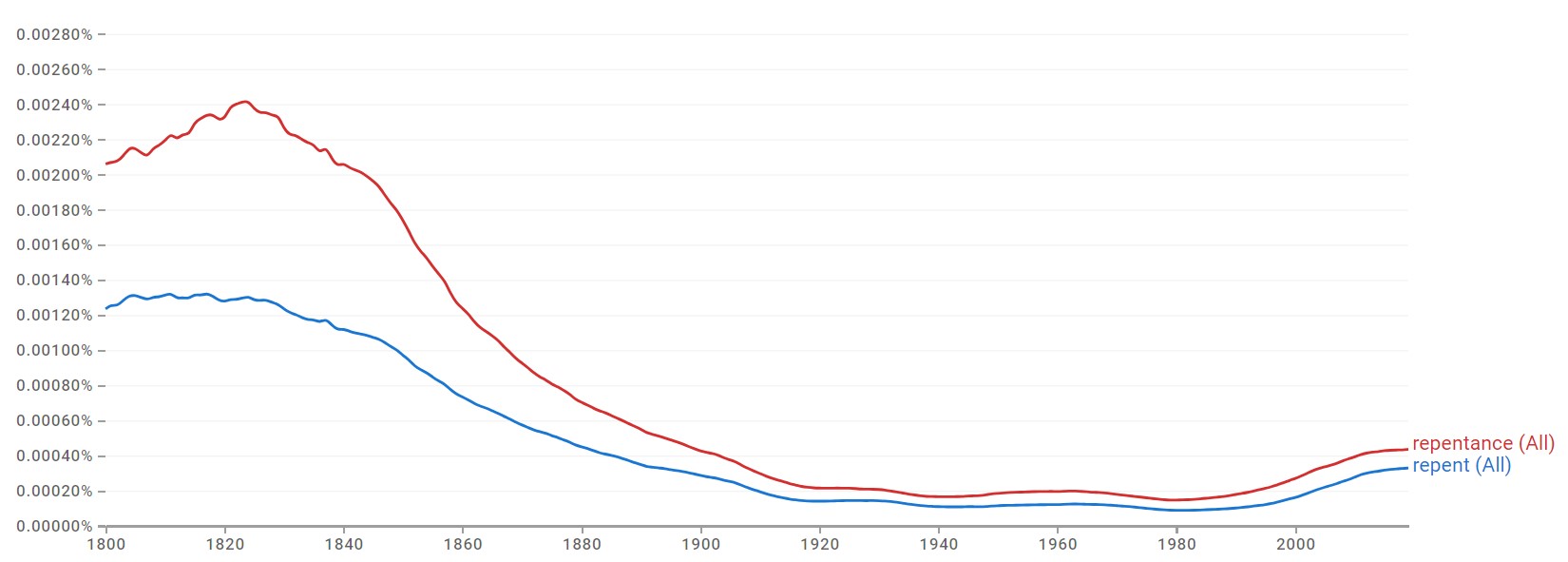
According to Oxford Languages (via Google), “repent” means “feel or express sincere regret or remorse about one’s wrongdoing or sin.” It came into Middle English “from Old French repentir, from re- (expressing intensive force) + pentir (based on Latin paenitere ‘cause to repent’).” There’s also something interesting going on with Google’s tracking for how often this word was used in English-language books between 1800 and 2019.

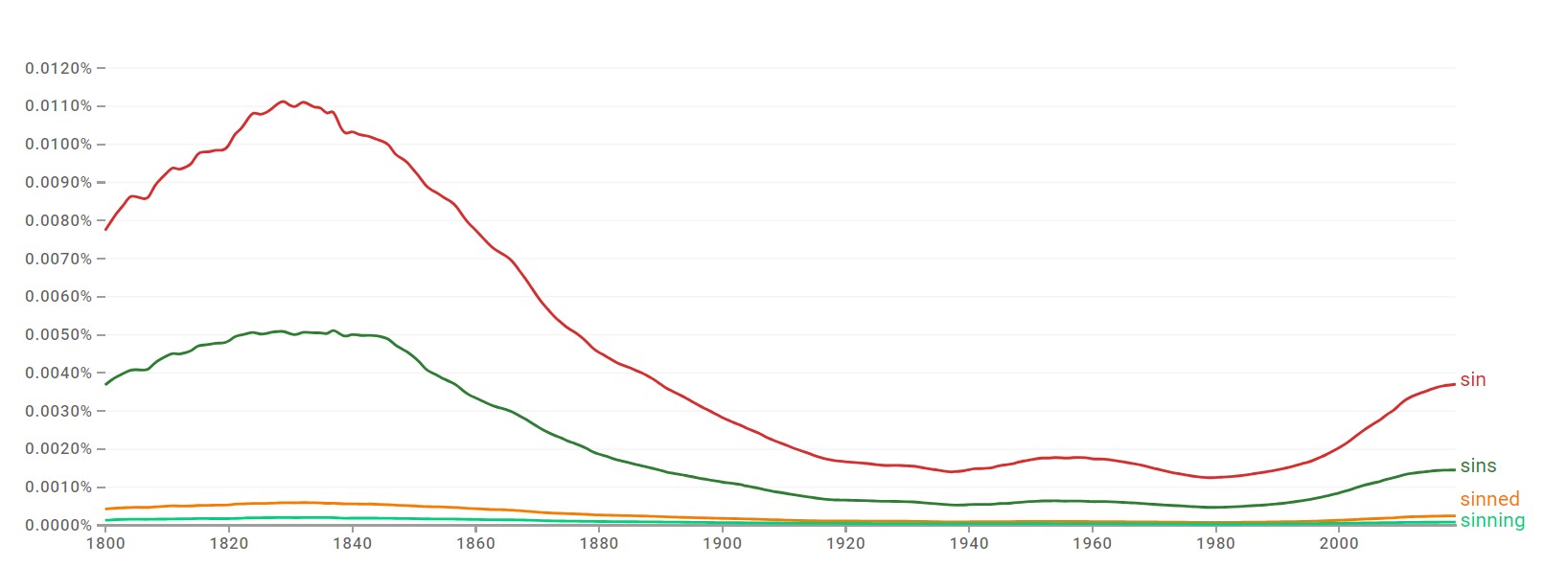
Evidently, repentance is not a popular idea (though I am intrigued by the recent uptick in usage after that slump in the 1900s). I don’t really think it will surprise any of us that “repent” and “repentance” are used less now than they were in the early 1800s. Repentance is something you need to do after you sin, and sin isn’t something we like to think about either. The more moral relativism takes hold in our society, the less people are willing to acknowledge sin is even a real thing since sin is the transgression of (God’s) absolute laws. The chart for “sin” in English language books looks very similar to the one for repentance.

But what about us today? If we’re sincerely following Jesus and love Him, He says we’ll obey His commandments. Commandments are contained in the law of God (Matt. 22:36, 40). The law and commandments are “holy, righteous, and good” (Rom. 7:12), and it is how God lets people know what sin is (Rom. 7:7-8). John says, “Sin is lawlessness” (1 John 3:4, WEB) or “the transgression of the law” (KJV). Paul further adds that “all have sinned” (Rom. 3:23). When Jesus came to this earth, one of His stated purposes was to call “sinners to repentance” (Luke 5:32), and it’s a message His disciples continued to preach (Acts 2:38; 3:19).

Putting all that together, we see that every human being is guilty of sin. Jesus can fix that problem, though. When sinners repent and follow Him, He takes away their sins (John 1:29; 1 John 3:5). Even after that, though, we still have a responsibility to keep His commandments because we love Him. And if we sin, then we need to repent again.

Returning and Changing

In Greek, one word translated “repent” is metanoeo (G3340). It includes the “regret or sorrow” aspect that is captured by the English word “repent,” but it also involves another step. The root words are meta (G3326: to be among or amidst, or to move toward that position) and noeo (G3539: “to exercise the mind, think, comprehend”) (Zodhiates entry G3340). Metanoeo is distinct from regret (metamelomai [G3338]) and includes “a true change of heart toward God” (Zodhiates). Thayer defines metanoeo as “to change one’s mind for better, heartily to amend with abhorrence of one’s past sins” (Thayer entry G3340). There’s a sense of turning around involved, as if when we sin we are walking away from God and when we repent we turn around and go toward Him again.

There’s another word for repentance in the New Testament as well. Zodhiates writes, “Metanoeo presents repentance in its negative aspect as a change of mind or turning from sin while epistrepho presents it in its positive aspect as turning to God” (Zodhiates entry G3340). He also notes that both of these words “derive their moral content … from Jewish and Christian thought, since nothing analogous to the biblical concept of repentance and conversion was known to the Greeks.” To understand what metanoeo and epistrepho (G1994) meant to early Christians, we need to look back at the Hebrew words expressing the same concepts.

Once again, we have two words that can be translated into English as “repent.” One of those, nacham (H5162) is typically only used of God “repenting” in the sense of “relenting or changing,” like He did when he delayed Nineveh’s destruction in response to their repentance (Theological Wordbook of the Old Testament [TWOT] entry 1344). In that story of Nineveh, we also see the Hebrew word more commonly used for human repentance, shub (H7725).

Jonah began to enter into the city a day’s journey, and he cried out, and said, “In forty days, Nineveh will be overthrown!”

The people of Nineveh believed God; and they proclaimed a fast, and put on sackcloth, from their greatest even to their least. The news reached the king of Nineveh, and he arose from his throne, and took off his royal robe, covered himself with sackcloth, and sat in ashes. He made a proclamation and published through Nineveh by the decree of the king and his nobles, saying, “Let neither man nor animal, herd nor flock, taste anything; let them not feed, nor drink water; but let them be covered with sackcloth, both man and animal, and let them cry mightily to God. Yes, let them turn (shub) everyone from his evil way, and from the violence that is in his hands. Who knows whether God will not turn (shub) and relent (nacham), and turn (shub) away from his fierce anger, so that we might not perish?”

God saw their works, that they turned (shub) from their evil way. God relented (nacham) of the disaster which he said he would do to them, and he didn’t do it.

Jonah 3:4-10, WEB

The basic meaning of shub is to turn or return. It is a Hebrew verb used frequently; “over 1050 times” in the Old Testament. While the Hebrew writers use many word pictures to describe repentance, all “are subsumed and summarized by this one verb shub. For better than any other verb is combines in itself the two requisites of repentance: to turn from evil and to turn to the good” (TWOT 2340). Like the Greek words that would later represent the same concept, Hebrew notions of repentance include both regret and turning away from sin and turning toward God. There’s always a sense of change; the verb shub is so connected with turning and change that it is even used of physical movement and coming back to a people or location (TWOT 2340).

The word shub is particularly important in it’s relation to “the covenant community’s return to God,” and one scholar concludes “there are a total of 164 uses of shub in a covenantal context” (TWOT 2340). Covenants are the way that God makes formal relationships with people; if we’re truly following God then we have made a covenant commitment to Him. Under the terms of a covenant, both parties involved have rights and responsibilities. In relation to repentance, both God and humanity have a role to play. The person repenting goes “beyond contrition and sorrow to a conscious decision of turning to God,” God freely extends His sovereign mercy, and then we continue in a commitment that involves “repudiation of all sin and affirmation of God’s total will or one’s life” (TWOT 2340). That concept is found in the Old Covenant, and is reinforced in the New Covenant (Acts 3:19; 26:17-20; 1 Thes. 1:9).

Trumpet Blasts As A Call to Return

In last week’s post, I talked about observing the Day of Trumpets (Yom Teruah). It is one of God’s special holy days, which He commands His covenant people to keep. It is a Sabbath day of complete rest, a day God calls His people to gather together, and “a memorial announced by loud horn blasts” (Lev. 23:24, WEB); “it is a day of blowing trumpets for you” (Num. 29:1, WEB). We traditionally say that in the New Covenant, the Day of Trumpets pictures the second coming of Jesus Christ, which will be heralded by trumpet blasts (1 Thes. 4:15-18).

We can also see the trumpet blasts as a call to alert us today of the need to return to God. In Jewish tradition, the Sabbath day that falls between Day of Trumpets and Day of Atonement (Yom Kippur) is called Shabbat Shuvah, the Sabbath of Return. As we just learned, shuvah/shub is the Hebrew word for repentance. As we move from Day of Trumpets to Day of Atonement, repentance should be on our minds.

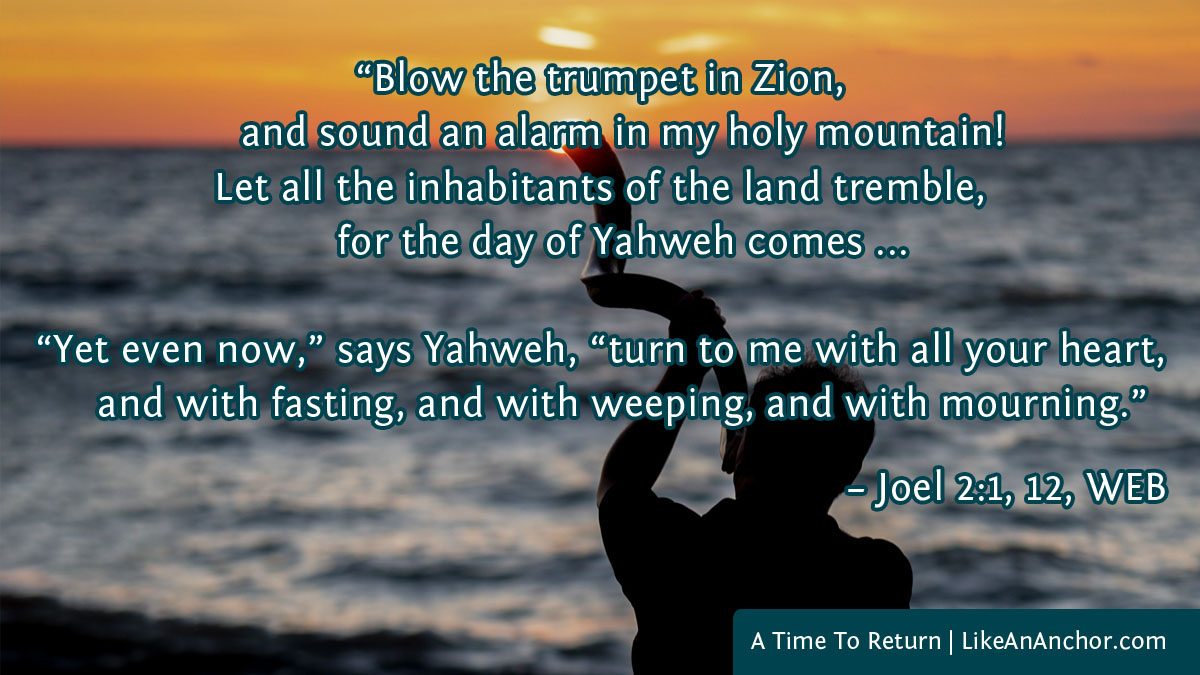
Blow the trumpet in Zion,
    and sound an alarm in my holy mountain!
Let all the inhabitants of the land tremble,
    for the day of Yahweh comes,
    for it is close at hand:
A day of darkness and gloominess,
    a day of clouds and thick darkness.
As the dawn spreading on the mountains,
    a great and strong people;
    there has never been the like,
    neither will there be any more after them,
    even to the years of many generations.

Joel 2:1-2, WEB

As Joel warns, the time before Jesu’s return (the day of Yahweh, or day of the Lord) will be a dark time for the world as a whole. The world is getting worse and worse as His return draws nearer, and Revelation reveals it’s only going to get even worse (like during the soundings of the seven trumpets given to angels; Rev. 8-11). When contemplating the coming of this day, Peter asks a pertinent question: “since all these things will be destroyed like this, what kind of people ought you to be in holy living and godliness?” (2 Pet. 3:11, WEB). He answers by saying that since we look for Jesus’s return, we should “be diligent to be found in peace, without defect and blameless in his sight” and “grow in the grace and knowledge of our Lord and Savior Jesus Christ” (2 Pet. 3:14, 18 WEB). Joel records a similar warning to turn back to following God faithfully.

Yahweh thunders his voice before his army;
    for his forces are very great;
    for he is strong who obeys his command;
    for the day of Yahweh is great and very awesome,
    and who can endure it?
“Yet even now,” says Yahweh, “turn to me with all your heart,
    and with fasting, and with weeping, and with mourning.”
Tear your heart, and not your garments,
    and turn to Yahweh, your God;
    for he is gracious and merciful,
    slow to anger, and abundant in loving kindness,
    and relents from sending calamity.
Who knows? He may turn and relent,
    and leave a blessing behind him,
    even a meal offering and a drink offering to Yahweh, your God.
Blow the trumpet in Zion!
    Sanctify a fast.
    Call a solemn assembly.
Gather the people.
    Sanctify the assembly.

Joel 2:11-16, WEB
Image of four people walking into a church building with the blog's title text and the words "As we're reminded of Jesus's approaching return, God calls us to repentance; to turn away from our own way of doing things and turn toward Him."
Image by Pearl from Lightstock

This year, we will observe the Day of Atonement on September 25, 2023. This is a solemn holy day when God commands us to rest completely and “afflict your souls” (traditionally understood to mean fasting). Reading Joel, I can’t help but notice that the trumpet blasts warning that the Messiah’s return is coming closer and closer also call us to fast and repent. God and the prophet Joel call out to readers, saying, “turn (shub) to Yahweh, your God!”

All of us are getting closer every day either to the end of our lives or to Jesus Christ’s return. One way or another, we have a limited time here on this earth. Keeping the Day of Trumpets and Day of Atonement remind us of that. They also remind us of the wonderful things the Messiah has done and is doing for His people. Because of Jesus’s atoning sacrifice, God graciously removes our sins when we repent, turning our lives around and (re)committing to following Him faithfully. We need that reminder of His awesome mercy, of our total dependence on Him, and of His promise to return and set things on this earth right.


Featured image by Pearl from Lightstock

Jesus as the Originator and Trailblazer: A Study of Archegos

I’ve heard countless sermons, Bible studies, and seminars. While many were good and beneficial, only a few still stand out in my mind years later. One of those was a message on the Greek word archegos (G747 ἀρχηγός). This word only shows up four times in the New Testament, but because it describes Jesus Christ it’s a word with great significance. Its root words are used more often–58 times for arche (G746 ἀρχή) and 71 times for ago (G71 ἄγω)–and they can provide additional clues as to the meaning and depth of archegos.

According to Spiros Zodhiates’ The Complete WordStudy Dictionary: New Testament, archegos is a noun derived from arche, beginning or rule, and ago, to lead. It means “originator, founder, leader, chief, first, prince, as distinguished from simply being the cause. One may be the cause of something but not the beginning” (entry 747). In other words, the archegos is the reason something begins and the one who begins it. Thayer’s Greek dictionary adds that archegos also means “one that takes the lead in any thing and thus affords an example, a predecessor in a matter, pioneer.” Once the thing is begun, the archegos models how to continue forward.

Image of sunrise over a green wheat field overlaid with text from Acts 3:14-15, TLV version:  “But you rejected the Holy and Righteous One and asked for a murderer to be granted to you. You killed the Author of life—the One God raised from the dead! We are witnesses of it.”
Image by KBCH from Pixabay

Archegos of Life

The first time archegos appears in the New Testament is in Acts. Peter and John were going into the temple and a lame man asked them for help. Peter locked eyes with him and said, “I have no silver or gold, but what I do have I give you. In the name of Jesus Christ the Nazarene, stand up and walk!” (Acts 3:6, NET). The man was miraculously healed, and naturally this attracted a throng of people marveling at what just happened. Peter takes this moment to share the gospel (Acts 3:1-11).

When Peter saw this, he declared to the people, “Men of Israel, why are you amazed at this? Why do you stare at us as if we had made this man walk by our own power or piety? The God of Abraham, Isaac, and Jacob, the God of our forefathers, has glorified his servant Jesus, whom you handed over and rejected in the presence of Pilate after he had decided to release him. But you rejected the Holy and Righteous One and asked that a man who was a murderer be released to you. You killed the Originator (archegos) of life, whom God raised from the dead. To this fact we are witnesses!”

Acts 3:12-15, NET

Here, the NET translates archegos as “Originator.” Some of the other common translation choices include Prince and Author, with other words like Source, Lord, and “one who made” also showing up in a few versions. Whichever translation you go with, this is a stunning statement. People killed the great Ruler who made life possible and enacted its beginning. To get more depth on this title for Jesus, and what it means for us and Peter’s listeners, we can turn to the letter to Laodicea in Revelation. Here’s a quote from Zodihiates explaining how the two verses relate:

“Jesus Christ is called the archegos of life (Acts 3:15) because He is he arche, the beginning or originator of God’s creation. This excludes Him from Himself being a product of that beginning.”

Zodhiates, The Complete WordStudy Dictionary: New Testament, entry G747

Other verses in the New Testament identify Jesus (or The Word, as He was known back then) as the God through whom all things were made (John 1:1-4; Eph. 3:9; Col. 1:15-16). In other words, He is the originator or cause of creation. That includes the creation of human life. It is therefore all the more hard-hitting when Peter confronts his listeners in Acts with killing Jesus when He says they killed the One who was the very source of all life. And it makes us appreciate Jesus’s sacrifice more when we gain a deeper realization of how powerful and wonderful He is, and what He sacrificed to save the people He and His Father worked together to create.

Image of a mountaintop overlaid with text from Acts 5:31, WEB version:  “God exalted him with his right hand to be a Prince and a Savior, to give repentance to Israel, and remission of sins.” version:
Image by Dan Fador from Pixabay

Archegos and Savior

The second time archegos shows up in Acts is when Peter and the other apostles are called before the council and high priest to answer charges for spreading the gospel. In this verse, most translations choose Prince or Leader for archegos, though a few use Ruler.

But Peter and the apostles replied, “We must obey God rather than people. The God of our forefathers raised up Jesus, whom you seized and killed by hanging him on a tree. God exalted him to his right hand as Leader (archegos) and Savior, to give repentance to Israel and forgiveness of sins. And we are witnesses of these events, and so is the Holy Spirit whom God has given to those who obey him.”

Acts 5:29-32, NET

The clue here for how to translate archegos seems to be God’s action of exalting Jesus. In this case, translators lean toward the aspect of meaning having to do with authority and ruling. But like other English words, “leader” or “prince” don’t fully capture the nuances of this Greek word. We can also keep the originator and trailblazer aspects of the word in mind, though the primary meaning here has to do with God exalting him to a position of power.

Notice the exaltation is linked to Jesus’s role as savior. This holds true in Philippians as well, where Paul writes, “He humbled himself, by becoming obedient to the point of death—even death on a cross! As a result God highly exalted him and gave him the name that is above every name (Phil. 2:8-9, NET). Paul continues on to say that as a natural consequence of what Jesus did and His exaltation as Lord, you should “continue working out your salvation with awe and reverence, for the one bringing forth in you both the desire and the effort—for the sake of his good pleasure—is God (Phil. 2:12-13, NET). Archegos is not used in this letter, but I think it helps us see how Jesus’s role as Ruler and Savior also relate to Him as the Originator of life and the one blazing a trail for us to follow. 

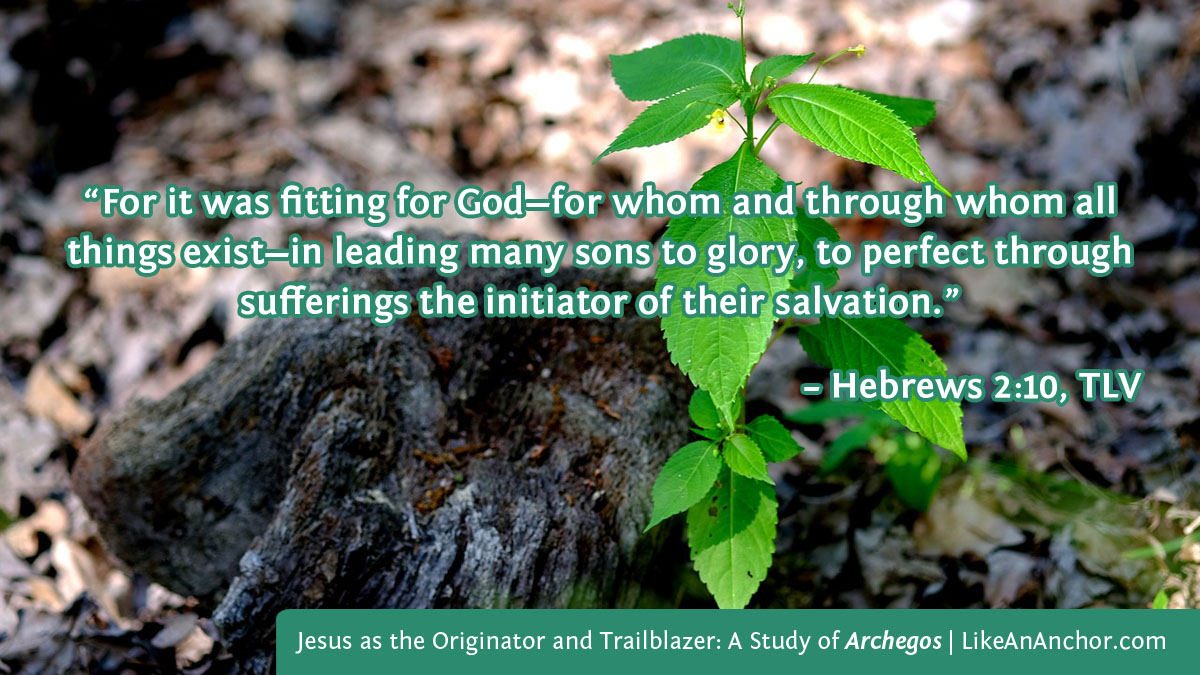
Image of a tree sprouting in the forest overlaid with text from Heb. 2:10, TLV version:  “For it was fitting for God—for whom and through whom all things exist—in leading many sons to glory, to perfect through sufferings the initiator of their salvation.”
Image by Holger Schué from Pixabay

Archegos of Their Salvation

Hebrews is the only other New Testament book that uses the word archegos. Here, translators’ word choices include Captain, Author, Creator, Pioneer, Founder, Source, Originator, Leader, and Champion. This verse once again links Jesus’s role as archegos with salvation.

but we see Jesus, who was made lower than the angels for a little while, now crowned with glory and honor because he suffered death, so that by God’s grace he would experience death on behalf of everyone. For it was fitting for him, for whom and through whom all things exist, in bringing many sons to glory, to make the pioneer (archegos) of their salvation perfect through sufferings. For indeed he who makes holy and those being made holy all have the same origin, and so he is not ashamed to call them brothers and sisters

Hebrews 2:9-11, NET (bold italics mark a quotation from Ps. 8:5)

Once again, we’re reminded that Jesus is the originator of life, since He is the one “for whom and through whom all things exist.” He’s also the Author of eternal life, pioneering the way for people to go from physical, temporary human life to eternal, spiritual life after salvation. This is a process. He is bringing many sons to glory and making His brothers and sisters holy.

Also, notice that God the Father made Jesus “perfect through suffering.” The Greek word translated “perfect” is teleioo (G5048
τελειόω). It means that something or someone has been perfected, completed, or accomplished. For Jesus, this process is complete. He “has been raised from the dead, the firstfruits (aparchē) of those who have fallen asleep” ( 1 Cor. 15:20, NET). Now, just as His Father brought Him to perfection, He’s continuing to bring to completion the process of salvation that He began in us.

Image of clouds with sunlight behind them overlaid with text from Heb. 12:1-2, NET version:  “Therefore, since we are surrounded by such a great cloud
of witnesses, we must get rid of every weight and the sin that clings so closely, and run with endurance the race set out for us, keeping our eyes fixed on Jesus, the pioneer and perfecter of our faith.”
Image by RÜŞTÜ BOZKUŞ from Pixabay

Archegos of Faith

As the letter of Hebrews continues, the author dives deep into Jesus’s roles and the meaning of the New Covenant. As the letter draws to a close, we find the famous faith chapter (Heb. 11) followed by this statement:

Therefore, since we are surrounded by such a great cloud of witnesses, we must get rid of every weight and the sin that clings so closely, and run with endurance the race set out for us,  keeping our eyes fixed on Jesus, the pioneer (archegos) and perfecter of our faith. For the joy set out for him he endured the cross, disregarding its shame, and has taken his seat at the right hand of the throne of God.

Hebrews 12:1-3, NET (italics mark an allusion to Ps. 110:1)
Image of a woman reading the Bible outdoors with the blog's title text and the words "Knowing Jesus as the Originator and Trailblazer of life, salvation, and faith provides incredible encouragement."
Image by StockSnap from Pixabay

Here, translations for archegos include Author, Leader, Pioneer, Initiator, Source, Originator, “one who began,” and “the champion who initiates.” I don’t know of any translation using “trailblazer” (though “pioneer” carries a very similar idea), but that’s what I think of when I read this verse. He went first to blaze the trail and leave a clearly marked path behind Him so we could follow. I’d like to quote Zodhiates’s dictionary again to help us understand what’s going on in this verse grammatically.

“This may mean that Jesus is the one who initiates (and completes) faith in the souls of men. However, because faith is actually articular (tes pisteos) it may be best to understand it objectively referring to what is believed. In the context faith is treated as a way of life. The author summons a ‘cloud of witnesses’ whose lives testify to the reward of faith. Jesus stands as the chief witness for it was He who blazed the trail and gave us the ideal model of ‘the faith.'”

Zodhiates, The Complete WordStudy Dictionary: New Testament, entry G747

We can think of Jesus not only as the starting place for our faith, but as the one who provides a model of faithful life for us to imitate. As we examine the phrase “archegos … of our faith,” it adds another layer of meaning to our ongoing study of faith this year (see “Relational Faith: A Book Review and Theological Reflection“). You might recall we’ve been defining faith as “active loyalty, trust, hope, knowledge, and persuasion … within the new covenant brought about through Christ’s Atonement” (Schmidt, Relational Faith, p. 11). As we follow the Archegos of faith, we’re to do the same type of faithful actions and demonstrate the same loyalty to Jesus as He showed to His Father.

Also notice that Jesus is described as the “perfecter.” This is the Greek word teleiotes (G5051 τελειωτής). It’s the word for the one who brings something or someone to the state of perfect completion described by teleioo. Just like the Father perfected Jesus, bringing His trailblazing walk of faith to full completion and resurrected life, Jesus is doing the same as He (and the Father) work in us today.

I am sure of this very thing, that the one who began (enarchomai) a good work in you will perfect (epiteleō) it until the day of Christ Jesus.

Philippians 1:6, NET

Here in Philippians, “began” and “perfect” are translated from words derived from arche and teleo. Knowing Jesus as the Originator and Trailblazer of life, salvation, and faith provides incredible encouragement. He does not leave things unfinished. Together with His Father, He began a good work starting with the origin of life, He pioneered the path of faith for us to follow, and He has the ruling power to bring salvation to full completion. All of that is encompassed in this title, Archegos. And I hope that learning more about Jesus as the Archegos will awe and encourage you, as it has for me over many years.


Featured image by Peter H from Pixabay

Witnesses in the Book of Acts

Last week, in a post titled “Witness,” I walked through a word study of the Greek word martus and its derivatives. One of my readers extended that study with a fascinating comment he shared on Facebook (click here to read it). He pointed out that, like in Greek, the word for “witness” and “martyr” in Arabic are the same and have layers of meaning. He also suggested that the witness-martyr connection may have originated with Stephen being killed after his witness (Acts 6-7).

Today, I’d like to continue our study of “witness” by looking more closely at Acts. I also want to dig into the Hebrew uses of “witness” in the Old Testament at some point, but we closed on a new house last Monday, I have to be moved out of my apartment halfway through next week, and then I’m getting married so time hasn’t been an abundant commodity right now. Hopefully we can keep digging into that in the weeks to come.

If you’re reading this post on the Saturday it went live, then tomorrow is Pentecost. “Witness” is used in connection with that holy day, so coupled with the comment on last week’s post I had two reasons for focusing on the book of Acts in today’s study.

Witnessing to Jesus

The book of Acts picks up near the end of the 40 days that Jesus spent on earth with His disciples after His resurrection. When He ascended to heaven, there were still 10 days left in the 50-day count from the wave sheaf day (first Sunday after Passover) until Pentecost.

While he was with them, he declared, “Do not leave Jerusalem, but wait there for what my Father promised, which you heard about from me. For John baptized with water, but you will be baptized with the Holy Spirit not many days from now.”

So when they had gathered together, they began to ask him, “Lord, is this the time when you are restoring the kingdom to Israel?” He told them, “You are not permitted to know the times or periods that the Father has set by his own authority. But you will receive power when the Holy Spirit has come upon you, and you will be my witnesses in Jerusalem, and in all Judea and Samaria, and to the farthest parts of the earth.” After he had said this, while they were watching, he was lifted up and a cloud hid him from their sight.

Acts 1:4-9, NET

There are a few key things Jesus told them here. First, He told them to stay in Jerusalem for the baptism of the Holy Spirit. Next, He told them they don’t need to (and indeed aren’t permitted to) know the Father’s timeline for His plan. Rather, they’re going to receive power and then act as “my witnesses.”

Being a witness to Jesus was a vital part of this commission. When the disciples “proposed two candidates” to replace Judas Iscariot as a 12th apostle, the key qualification was that he be “one of the men who have accompanied us during all the time the Lord Jesus associated with us, beginning from his baptism by John until the day he was taken up from us—one of these must become a witness of his resurrection together with us” (Acts 1:15-26, NET). In this case, “witness” was very literal. To be counted among the 12 apostles, the chosen man had to be able to give eye-witness testimony to Jesus’s life, death, and resurrection.

Peter’s Pentecost Witness

You can read all about the pivotal Pentecost after Jesus’s resurrection in Acts 2. The Holy Spirit rushed in like a violent wind, settling on each of the gathered believers as tongues of fire. The sound drew a crowd, who marveled at the spirit-filled disciples speaking in all the native languages represented in the crowd. As the crowd wondered what was going on, Peter spoke to the people.

But Peter stood up with the eleven, raised his voice, and addressed them: “You men of Judea and all you who live in Jerusalem, know this and listen carefully to what I say. …

“Men of Israel, listen to these words: Jesus the Nazarene, a man clearly attested to you by God with powerful deeds, wonders, and miraculous signs that God performed among you through him, just as you yourselves know—this man, who was handed over by the predetermined plan and foreknowledge of God, you executed by nailing him to a cross at the hands of Gentiles. But God raised him up, having released him from the pains of death, because it was not possible for him to be held in its power. …

“This Jesus God raised up, and we are all witnesses of it. So then, exalted to the right hand of God, and having received the promise of the Holy Spirit from the Father, he has poured out what you both see and hear. … Therefore let all the house of Israel know beyond a doubt that God has made this Jesus whom you crucified both Lord and Christ.”

Acts 2:14, 22-24, 32-33, 36, NET

I know I said at the beginning that we weren’t going to have time to get into the Old Testament in this post, but I would like to reference one of God’s laws regarding witnesses: “A single witness may not testify against another person for any trespass or sin that he commits. A matter may be legally established only on the testimony of two or three witnesses” (Deut. 19:15, NET).

God set up a system where one witness’s testimony couldn’t be used as the basis for a court case, but if two or three witnesses agreed that meant something significant. Here in Acts, Peter is standing up not as a single eyewitness, but as one of 12 men who defined themselves as witnesses of Jesus’s life, death, and resurrection. And they weren’t the only ones there. As we discussed in our post about “The Women At Pentecost,” it seems there were at least 120 believers gathered–60 times the number of witnesses legally required to treat a matter seriously.

Image of people holding hands as they pray overlaid with text from Acts 4:31, 33, NET version:  “When they had prayed, the place was shaken where they were gathered together. They were all filled with the Holy Spirit, and they spoke the word of God with boldness. ... With great power, the apostles gave their testimony of the resurrection of the Lord Jesus. Great grace was on them all.”
Image by Claudine Chaussé from Lightstock

Stephen’s Witness

As the book of Acts goes on, we see the disciples continuing to share their eye-witness testimony (Acts 3:11-15; 4:33; 5:27-32; 10:34-43; 13:29-31). They spoke to crowds of people, before Jewish courts, and to gentile converts. Later, God added Paul as another apostle and witness (Acts 23:11; 26:16). The single most well-known story of witness in Acts doesn’t come from any of the apostles, though. It comes from a man named Stephen.

Up until this point, the witnesses mentioned in Acts are all numbered among the 12 disciples/apostles. Then here’s Stephen, one of seven men chosen to make sure that both the Greek-speaking and Hebraic widows received support. These seven men “were well-attested” (literally, they received a good witness from others) and full of God’s spirit (Acts 6:1-5, NET).

If you read my book review for Relational Faith, you might remember that the same Greek word translated “faith” is also translated “persuasion” in the context of Aristotle’s Rhetoric. Given that Stephen’s well-spoken words were what people went after him for, I find it interesting that we’re told he was “a man full of faith and of the Holy Spirit.” He’s going to be using his faith as the basis for persuasive rhetoric when he gives his witness before the council.

Now Stephen, full of grace and power, was performing great wonders and miraculous signs among the people. But some men from the Synagogue of the Freedmen (as it was called), both Cyrenians and Alexandrians, as well as some from Cilicia and the province of Asia, stood up and argued with Stephen. Yet they were not able to resist the wisdom and the Spirit with which he spoke.

Acts 6:8-10, NET

These people couldn’t handle the fact that Stephen was speaking so boldly and wisely or that he was so full of God’s power that he was performing wonders and miracles. So they conspired against him, brought him before the council, and even had false witnesses testify against him.

They brought forward false witnesses who said, “This man does not stop saying things against this holy place and the law. For we have heard him saying that Jesus the Nazarene will destroy this place and change the customs that Moses handed down to us.”

Acts 6:14-15, NET

The false witnesses say one thing, and now the high priest invites Stephen to answer the question, “Are these things true?” (Acts 7:1, NET). Stephen replies by summarizing God’s plan in a powerful sermon. He starts with God calling Abraham and making a covenant with him, reminds his listeners of how the Israelites ended up in Egypt, and finally comes to Moses.

When he saw one of them being hurt unfairly, Moses came to his defense and avenged the person who was mistreated by striking down the Egyptian. He thought his own people would understand that God was delivering them through him, but they did not understand.

Acts 7:24-25, NET

The phrasing Stephen uses here is very similar to how John describes Jesus Christ: He came to His own people as savior but most didn’t recognize or receive Him (John 1:10-12). Stephen is going to circle back to this connection as well. He continues with the story of Moses fleeing Egypt, then returning when God told him to lead the people out of slavery. He recaps the Exodus story, then reminds his hearers of a quote they no doubt recognized: “This is the Moses who said to the Israelites, ‘God will raise up for you a prophet like me from among your brothers” (Acts 7:37, quoting Deut. 18:15).

As Stephen continues, he reminds his listeners that despite the powerful Exodus deliverance, their ancestors didn’t faithfully obey God. They even “had the tabernacle of testimony in the wilderness” and they still weren’t faithful (Acts 7:44, NET; “testimony” is the same Greek word as “witness”). At this point, Stephen shifts from history to explication. He reminds the people that even though “Solomon built a house for him … the Most High does not live in houses made by human hands” (Acts 7:47-48, NET). And just like their ancestors tried to put God in a box and go about their lives without really following him, so Stephen’s listeners are doing by rejecting Jesus as the Messiah.

“You stubborn people, with uncircumcised hearts and ears! You are always resisting the Holy Spirit, like your ancestors did! Which of the prophets did your ancestors not persecute? They killed those who foretold long ago the coming of the Righteous One, whose betrayers and murderers you have now become! You received the law by decrees given by angels, but you did not obey it.”

When they heard these things, they became furious and ground their teeth at him. 

But Stephen, full of the Holy Spirit, looked intently toward heaven and saw the glory of God, and Jesus standing at the right hand of God. “Look!” he said. “I see the heavens opened, and the Son of Man standing at the right hand of God!” 

But they covered their ears, shouting out with a loud voice, and rushed at him with one intent.  When they had driven him out of the city, they began to stone him, and the witnesses laid their cloaks at the feet of a young man named Saul. 

They continued to stone Stephen while he prayed, “Lord Jesus, receive my spirit!”  Then he fell to his knees and cried out with a loud voice, “Lord, do not hold this sin against them!” When he had said this, he died. 

Acts 7:51-60, NET

The false witnesses claimed that Stephen was preaching against the temple and the law, saying Jesus would change Moses’s commands. Stephen says no, what’s actually happening is that his accusers were rejecting salvation and God’s sovereignty just as Israel did in the past when they rejected Moses and refused to stay faithful to God. What a powerful, convicting message for Stephen to deliver. What an incredible gift for him to be able to witness “the glory of God, and Jesus standing at the right hand of God.” And what violent, hideous backlash when his true witness exposed not only the lies of the false witnesses but the hypocrisy of every Jewish person who claimed to know God yet rejected Jesus.

An Example for Us

Image of a man praying with an open Bible with the blog's title text and the words "In the book of Acts, we see examples 
of Jesus’s followers acting as witnesses to His life, death, resurrection, and teachings. What can we learn from that example today?"
Image by Jantanee from Lightstock

When I read Stephen’s story, I can’t help but think of Jesus’s words when His disciples asked Him about the signs of the end times.

“You must watch out for yourselves. You will be handed over to councils and beaten in the synagogues. You will stand before governors and kings because of me, as a witness to them. First the gospel must be preached to all nations. When they arrest you and hand you over for trial, do not worry about what to speak. But say whatever is given you at that time, for it is not you speaking, but the Holy Spirit. Brother will hand over brother to death, and a father his child. Children will rise against parents and have them put to death. You will be hated by everyone because of my name. But the one who endures to the end will be saved.” 

Mark 13:9-13, NET

What happened to Stephen was just the first in a long history of this exact thing that Jesus warned about. It’s happened to people throughout history who were dragged before secular and religious courts to answer for their faith. It’s happening today to Christians around the world who are hated and persecuted. And it could happen to us as well.

As sobering and even frightening as this warning is, there is also a key piece of encouragement. Jesus says that if we’re ever in a position where we need to witness the way He talked about in the gospels or the way Stephen did in Acts, we don’t need to worry about what to say. The powerful, eloquent sermon that Stephen preached which was exactly what his listeners needed to hear (though they refused to admit it) didn’t just come from Stephen; it was a product of the Holy Spirit inside him. We who follow God faithfully have that same spirit today and we can also trust that Jesus will help us and guide us in whatever circumstances that we’re called to witness about Him.


Featured image by WhoisliketheLord Studio from Lightstock

Song Recommendation: “I Refuse” by Josh Wilson

Witness

What does “witness” mean for Christians?

Most of my life has been spent in churches that don’t talk much about witnessing or sharing your testimony. I remember thinking it was so strange the first time I was in a congregation where they paused halfway through the service for people to talk about what God had done in their lives the previous week. It was strange, but also encouraging to hear how God protected, blessed, and answered prayers.

When I started attending a Messianic congregation, sharing your witness seemed a part of many people’s everyday lives. If someone had a testimony to share, there was time during most services to do that. Sometimes, those testimonies were about opportunities someone had during the week to pray with a police officer, share their faith with a neighbor, or a similar encounter. I liked hearing these stories, and it seemed a good thing to include in church.

At that point, I started to wonder why we don’t do this in my other congregations. So I asked. It seemed the consensus was that we should share the work that God is doing in our lives, but the middle of church services isn’t the place to do that; it disrupts the format and, depending on the person sharing, it can take quite a bit of time. We should share in conversations, people said, rather than as part of the service. And this seemed a reasonable response, particularly since there were a few times when the congregations I attended that did offer time to share your testimony had to take the mic away from someone and get things back on track.

After pondering the question, it seemed these were just two different ways of doing something. One didn’t seem better or worse than the other; rather, it came down to how the leadership in that congregation decided to manage church service format. I’m ashamed to say I’d never thought to study into this topic in all the years I’ve been noticing the different ways people talk about witness/testimony. I’m only just now looking into it after hearing someone say that “witness” in the New Testament is translated from a noun (person, place, or thing) rather than a verb (action). I’d been studying and teaching English grammar at the time, and it made me curious about how the word is used.

Image of a man reading the Bible overlaid with text from 2 Tim. 1:6-8, NET version:  “Because of this I remind you to rekindle God’s gift that you possess through the laying on of my hands. For God did not give us a Spirit of fear but of power and love and 
self-control. So do not be ashamed of the testimony about our Lord or of me, a prisoner for his sake, but by God’s power accept your share of suffering for the gospel.”
Image by Creative Clicks Photography from Lightstock

Background Definitions

When you think about Christian witness today, you probably think about things like telling the person next to you on the airplane about Jesus, or about the people who go door-to-door and leave books and pamphlets about their churches. You might also think about living your life as a witness or about the type of testimony-sharing I talked about in the introduction to this post. If you do a Google search for “what does Christian witness mean” you get results like this:

  • “For Christians, witnessing is sharing your personal experience with Jesus.” (Jesus Film Project)
  • “To be a witness to Christ is to demonstrate by our words, actions and attitude the sacred mystery that we have ‘seen’, heard and believe in our hearts about the Lord who has forgiven us of our sins and offered us eternal life.” (Diocese of Bridgeport)
  • “as Christians, we are called to be witnesses for Christ who present a testimony about the truth that we have experienced and heard.” (Raising Everyday Disciples)
  • “Christian witnessing is merely sharing our heartfelt faith in Christ – what He’s personally done to change our individual lives! We’re not called to argue or debate anyone into heaven. We’re merely called to share!” (All About GOD).

There are several things emphasized in definitions like this. Christians are described as “witnesses to Christ” (noun) who engaged in the act of witnessing (verb) by sharing their experiences and faith. If you read the full articles linked, you’d see several link this idea to courtroom witnesses who testify (which is why you’ll also hear people talk about giving their Christian testimony).

That same Google search also turned up an article from Olive Tree Blog, where they walk through a word study on the Greek word translated “witness” using the Olive Tree app. In Greek, the word is martus. It is translated “witness,” “martyr,” or “record.” Which is kind of surprising, since in English we think of a witness and a martyr as two completely different things. If they’re the same, though, that indicates a much more serious and involved thing than “merely sharing our heartfelt faith in Christ.”

A Linguistic Rabbit Hole

As I mentioned, I started this study after hearing that “witness” in the Bible is translated from a noun (person, place, or thing) rather than a verb (action). That led me down a rabbit hole as linguistically complicated as the grammar class I had to take as part of my master’s in rhetoric and writing degree.

In Greek, the root word for “witness” is a noun. Other nouns derive from that, such as the ones for “false witness” and masculine and feminine forms of “witness.” It’s also the root for several verbs, including “to be a witness,” “to testify emphatically,” and “to witness against.” I had to draw a chart to keep them all straight, and so I decided to make a more polished version to share here and hopefully help you visualize these related words as well.

The image shows a mind map chart showing the Greek word "martus" (Strong's number G3144) and related derivative words.

Part of the reason there are so many is because Strong’s numbering system treats different genders of the same noun as separate words, but it’s also because there are so many variations of the word forms. In English, for example, we have “false” and “witness” as separate words, but in Greek they’re a compound word, “falsewitness” and so that gets its own number.

That was a very meandering way to answer the question, “Are there Greek verbs for the word ‘witness’?” And the short version of the answer is, yes there are. But the context for the statement that prompted this study is that Christians are told in the Bible to “be a witness” rather than to go around “witnessing.” I still want to dive into that topic a little more, because depending on how the noun and verb forms of “witness” are used, that statement could still be correct.

Image of a woman reading the Bible overlaid with text from John 3:31-34, 36, NET version:  “The one who comes from heaven is superior to all. He
testifies about what he has seen and heard, but no one 
accepts his testimony. The one who has accepted his 
testimony has confirmed clearly that God is truthful. For the one whom God has sent speaks the words of God, for he does not give the Spirit sparingly. ... The one who believes in the Son has eternal life. The one who rejects the Son will not see life, but God’s wrath remains on him.”
Image by Pearl from Lightstock

A Witness (noun)

The noun forms of martus and its derivatives are used 97 times in the New Testament (eSword search of KJV+Strong’s numbers for G3141, G3142, G3144, G5571, and G5575). Obviously that’s too many to go through them all individually, but here’s a summary of how martus is used in its noun forms (excluding “false witnesses” since I want to focus on understanding what we’re supposed to do):

Though I sorted these into bullet points, there’s a lot of overlap. It’s often hard to tell if the writer is talking about followers of Jesus sharing the gospel or of receiving Jesus’s testimony (e.g. ” When he opened the fifth seal, I saw underneath the altar the souls of those who had been killed for the Word of God, and for the testimony of the Lamb which they had” [Rev 6:9]). John the Baptist indicates that Jesus’s testimony is something that we receive from Him; he said, “The one who has accepted his testimony has confirmed clearly that God is truthful” (John 3:33, NET). In Revelation especially, witness/testimony is spoken of as something that we have.

We also have verses explicitly linking “the testimony of our Lord” with “the Good News” or “gospel” (Matt. 24:14; 2 Tim. 1:8, WEB). If you go through all the uses of these martus-linked words, you’ll notice they’re often used in connection to Jesus. “Faithful and True Witness” is even one of Jesus’s titles (Rev. 1:15; 3:14). The focus when using these words is often on “the testimony of Jesus” or the “witness of the Lord.” If you’re going to act as a witness in the Christian sense, you’re talking about your first-hand experiences with Jesus. If you’re going to share the testimony of the Lord, you’re passing on the Good News that He brought.

Stephen’s and Paul’s story also help illustrate the many ways “witness” can be used. During the sermon he preached, Stephen linked the word witness with the tabernacle, saying, “Our fathers had the tabernacle of the testimony in the wilderness” (Acts 7:44, WEB). The legal witnesses against Stephen, who stoned him, laid their cloaks down at Paul’s feet (Acts 7:58). Later, God calls Paul and sends Ananias to say, “you will be a witness for him [Jesus] to all men of what you have seen and heard” (Acts 22:15, WEB). Paul reminds God that, “When the blood of Stephen, your witness, was shed, I also was standing by, and consenting to his death, and guarding the cloaks of those who killed him” (Acts 22:20, WEB), but God still chose Paul to share “testimony concerning me” (Acts 22: 18, WEB). Just in this one story, we have witness in the legal sense, in a holy sense linked with the tabernacle where God’s presence appeared, and in reference to someone called to act as a witness sharing the testimony of Jesus.

Image of four people studying the Bible overlaid with text from Heb. 12:1-2, NET version:  “Therefore, since we are surrounded by such a great cloud of witnesses, we must get rid of every weight and the sin that clings so closely, and run with endurance the race set out for us, keeping our eyes fixed on Jesus, the pioneer and perfecter of our faith. For the joy set out for him he endured the cross, disregarding its shame, and has taken his seat at the right hand of the throne of God.”
Image by Ben White from Lightstock

Witnessing (verb)

The verb forms of martus and its derivatives are used 98 times in the New Testament (eSword search of KJV+Strong’s numbers for G1957, G2649, G3140, G3143, G4828, G4901, and G5576). Here’s a summary of the ways it appears as a verb in the New Testament:

Witnessing is something that people do. It’s linked with teaching and sharing God’s words, but more often it’s connected to witnessing about Jesus. Also, if you cross-reference the noun and verb lists, you’ll see that there’s a lot of overlap. For example, our conscience has a testimony (2 Cor. 1:12) and our conscience/spirit can testify (Rom. 2:15; 8:16; 9:1). There was a lot of emphasis on being a witness of Jesus and having His testimony in the noun verses, and now here in the verb verses we see Jesus testifying and people witnessing about Jesus. Nothing really shocking here; it works a lot like the noun and verb forms of witness or testimony/testify in English.

What I would like to make note of here is the way testify/witness is used in Hebrews 11. This section on faith opens with these words: “Now faith is assurance of things hoped for, proof of things not seen. For by this, the elders obtained testimony” (Heb. 11:1-2, WEB). “Obtained testimony” is translated from one word, martureo. As we go through the chapter, we see that the faithful actions people took gave testimony about them.

By faith, Abel offered to God a more excellent sacrifice than Cain, through which he had testimony given to him that he was righteous, God testifying with respect to his gifts; and through it he, being dead, still speaks.

By faith, Enoch was taken away, so that he wouldn’t see death, and he was not found, because God translated him. For he has had testimony given to him that before his translation he had been well pleasing to God. …

These all, having had testimony given to them through their faith, didn’t receive the promise, God having provided some better thing concerning us, so that apart from us they should not be made perfect.

Therefore let’s also, seeing we are surrounded by so great a cloud of witnesses, lay aside every weight and the sin which so easily entangles us, and let’s run with perseverance the race that is set before us, looking to Jesus, the author and perfecter of faith, who for the joy that was set before him endured the cross, despising its shame, and has sat down at the right hand of the throne of God.

Hebrews 11:4-5, 39-40; 12:1-2 WEB

When the Bible writers discuss testimony, it’s often in the context of how other people would testify about us and what sort of testimony God would give about our lives. Are we living with integrity? Have we heard and taken seriously the testimony we “hear” from and about Jesus in the scriptures? Does our own conscience testify well of us? Are we prepared to give witness/testimony about Jesus when we can/should?

Wrapping Up

Image of three women talking and holding Bibles, with the blog's title text and the words "What does the New Testament say about “witness” both as something that are are and as something that we do?"
Image by Shaun Menary from Lightstock

Earlier, I mentioned an article about the Greek root word for witness (martus) from the Olive Tree Blog. In this analysis, they show how martus is linked with both seeing and speaking, as well as the course of our lives. I like how that writer sums it up:

From what I gathered from the above verses, we as Christians must:

  1. Open our eyes and martus (see) the workings of God around us.
  2. Open our mouths and martus (attest) the Good News to our neighbor.
  3. Open our hearts to the possibility of becoming a martus (martyr), socially, financially, or physically.
Olive Tree Blog, “What Does it Mean to be Christ’s Witness?”

Interestingly, there aren’t direct commands for Christians in general to go out and witness (though a few people, like the original 12 disciples and Paul are instructed to share the testimony of Jesus). Most of the time, if someone in the New Testament is a witness or they are witnessing, then it’s talking about the apostles who were eye-witnesses of Jesus or it’s Paul.

For those of us who aren’t apostles, we might all be called on to act as a witness or martyr if we’re facing persecution (Luke 21:10-19). We also act as witnesses to each other, attesting to what we’ve seen God do in our lives and showing a positive example of living in the faith. Paul also talks about Christians testifying to the character they see in fellow believers (note that the times when Paul calls on people to witness to other people, it’s in a positive sense rather than testifying against each other).

Circling back to where we began, it seems that I was right that it doesn’t really matter whether we share a witness/testimony with our fellow Christians during formal church services or in personal conversations. The Bible doesn’t come down on that either way. What matters more is that we are involved enough in each others lives to be witnesses to and for each other. We also want to make sure the emphasis stays on God and Jesus when we witness, rather than getting focused on our personal stories. “Witness” in the Bible isn’t sharing your personal story; it’s sharing the testimony of Jesus–the words that He spoke and the Good News that He came to share. I don’t think there’s anything necessarily wrong with sharing your story, but we need to make sure it doesn’t become about us (i.e. it’s not “my testimony” that’s the focus, but “the testimony of our Lord”).


Featured image by Shaun Menary from Lightstock

How I Bible Study: Tips, Recommendations, and Resources

I’ve been going back and forth on making a post like this for quite some time now. There isn’t one right formula for studying your Bible, and I’m not saying there is. As long as you’re reading God’s word, praying for His guidance, and working to know Him better then you can have a productive study. I don’t want to imply the way I study is the “right” or “best” way. But a few people have asked me to recommend Bible study resources, and I also realized that some of the study tools I use to help me understand the Greek and Hebrew behind our English translations aren’t familiar to everyone.

In this post, I’ll go through resources I use frequently and highly recommend. If you have other resources that you like to use, I’d love to learn about them. Please leave a comment so everyone reading can benefit from the recommendations 🙂

Disclaimer: Some of the links on this page are affiliate links (marked with an *). This means that if the resource I mention is available for purchase on Amazon, I provide a link and if you use that link to make a purchase I will receive a commission (at no additional cost to you).

Background Reading

Whenever I’m reading a text, I like to ask myself contextual questions. When was this written? Who was it written for? What culture(s) influenced the writer? When reading the Bible, the ultimate author behind the text is God, but He used human beings who were influenced by the world they lived in. Modern, Western Christians often think of Christianity as a Western/European religion and either don’t think about or misunderstand the ancient Eastern cultural context. This can lead to misinterpretations of the Bible and misunderstandings about underlying concepts such as how language works.

Misreading Scriptures with Western Eyes (coupled with attending a Messianic congregation for several years) fundamentally changed how I read the Bible, I think very much for the better. The modern world, particularly modern Western culture, is not very similar to the Biblical world. While God’s message is simple enough for a child to understand and His word can speak to everyone where they are, it’s also full of riches so deep we’ll never reach the bottom. Familiarizing yourself with the cultural context is key to understanding the Bible on a deeper level. These are my two favorite books I’ve found so far on that topic:

Digital Tools

There are three free digital resources that I use to support a deeper study of God’s word. These tools provide a variety of Bible translations, the ability to compare those translations, resources for studying the Greek and Hebrew behind our English translations, and a variety of commentaries. I use all of these tools to varying degrees, depending on exactly what I’m trying to study.

  • MySword app–this is a free-to-download Android app. I use this app on my phone as my Bible when at church, traveling, and often when studying at home. It makes it easy to compare translations, look up words in a dictionary, and do pretty robust word studies all in the palm of your hand. It’s also a great supplement to the language tools I’ll talk about in the next section.
    • The search tool for MySword is pretty good, and you can search for Greek and Hebrew words by searching for the Strong’s number in translations that include those. However, the free version of MySword doesn’t include all the search tools that eSword has and it limits you to 100 results.
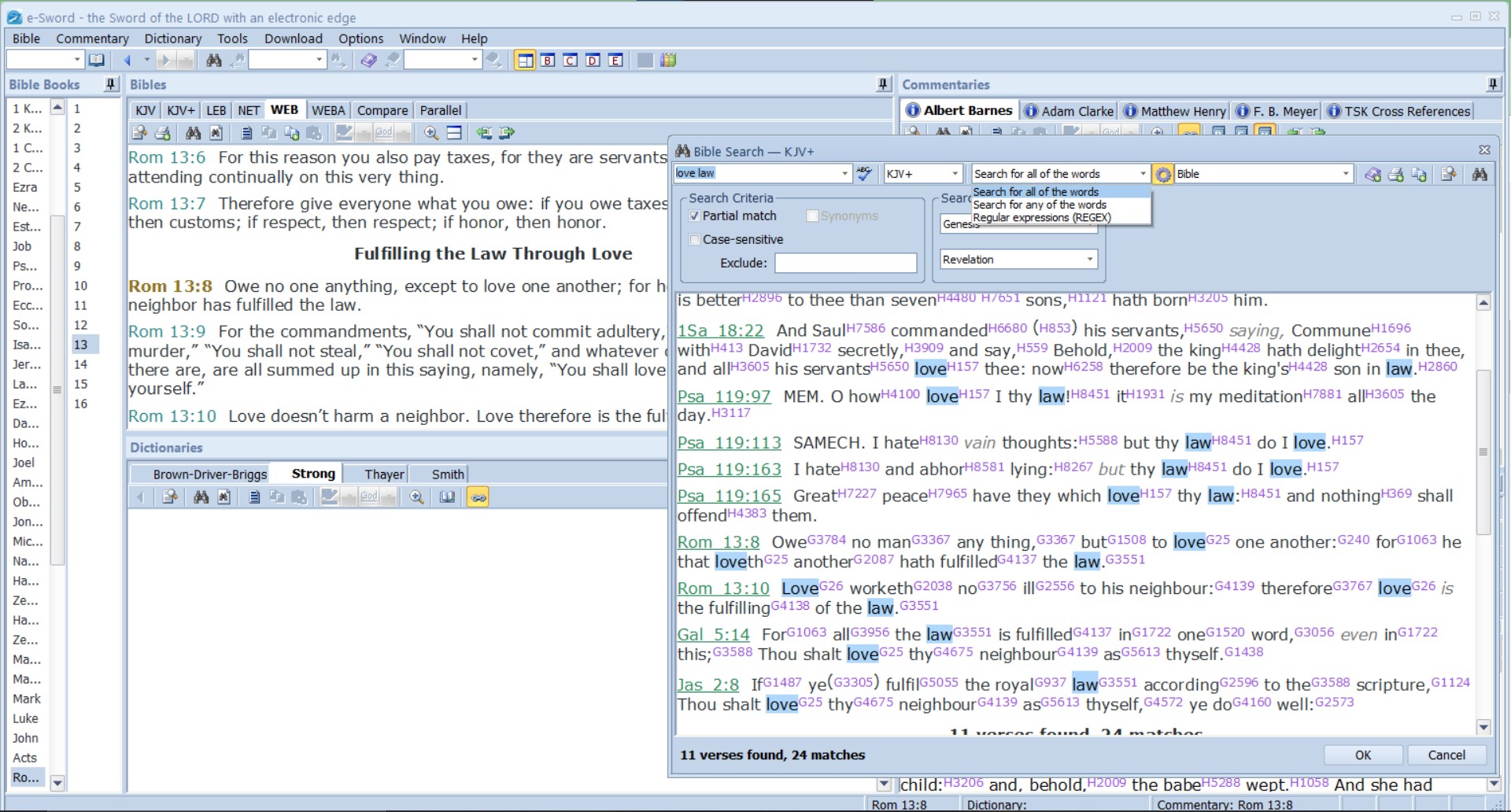
  • eSword for PC–a free-to-download Bible study program. I mostly use this one if I want to search for specific words or topics in the Bible. The search tools are robust (even more so than MySword) and make it easy to search for parts of words, whole words, and Greek and Hebrew words (by searching for the Strong’s number). You can also have a Bible, dictionary, commentary, and your own notes all open on the same screen.
  • BibleGateway–an online resource that makes comparing Bible translations very simple. It’s the easiest tool I’ve found for looking at multiple translations side-by-side and doing full text searches of more than one translation at the same time. I use it all the time when writing my blog posts for this site. One thing I like about this website compared to MySword or eSword is that it includes full footnotes (very handy with translations like NET).
screenshot of eSword Bible program showing search tools using the example  of searching for partial matches to the words "love law"
Screenshot showing eSword search tool

Language Tools

I’ve done some formal study of Greek–enough to recognize words, understand basic grammar, and read it a little–but not much for Hebrew. The tools I use to study the Bible’s original languages aren’t a perfect substitute for really learning the languages, but I think they do make it easier for someone with a basic understanding of how language works (something any of us can learn relatively easily) to get a deeper look into the nuances of the Bible without devoting their lives to a study of ancient languages.

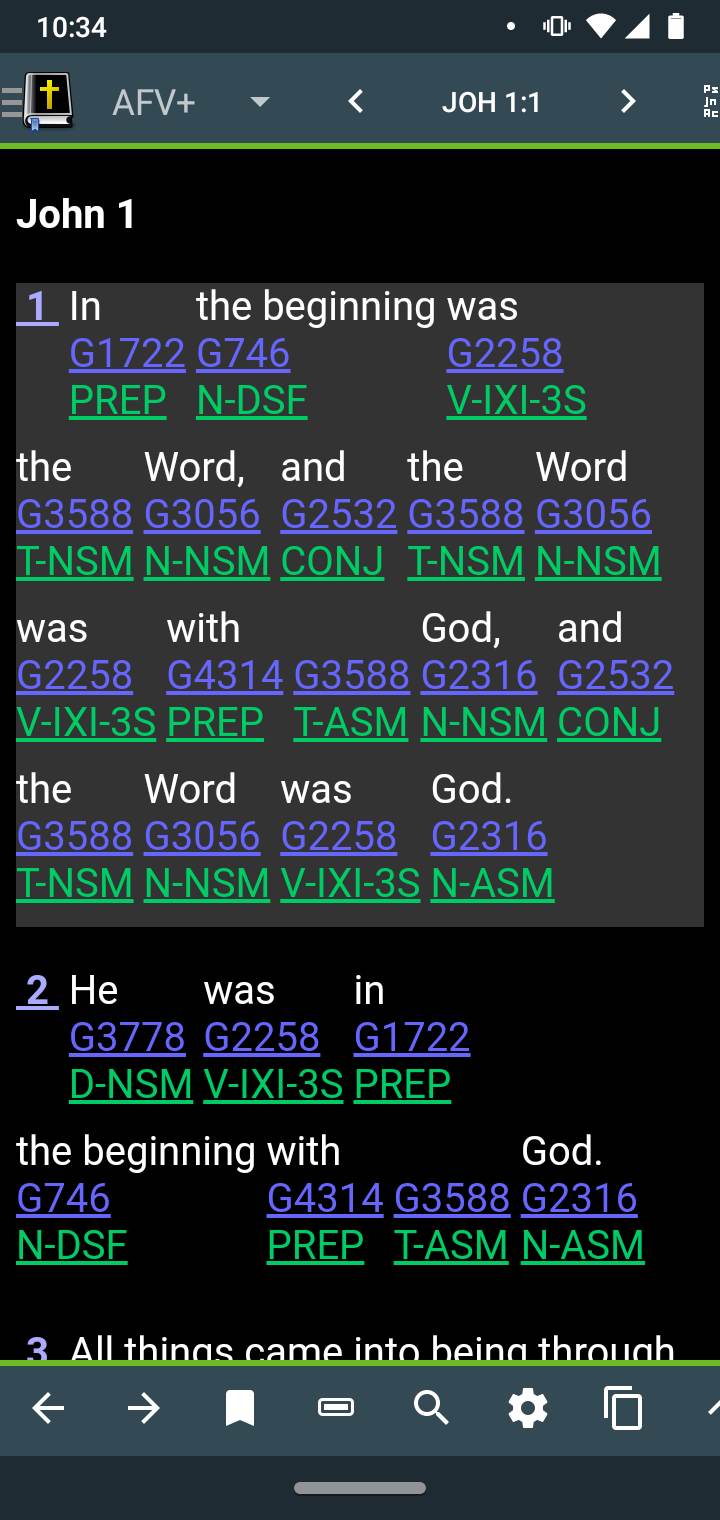
In both eSword and MySword, I recommend Thayer’s Dictionary for Greek and Brown-Driver-Briggs (BDB) for Hebrew. Both of these digital tools offer downloadable modules that link those dictionaries to Strong’s numbers. For any Bible translation that includes Strong’s numbers, you can click on that number and go right to the dictionary. Some of the translations also offer codes that give you more insight into how the word is used. For example, here’s what John 1:1 looks like in the MySword module for A Faithful Version with Strong’s numbers and Morphology (AFV+) if you click on more detail for the word translated “Word.”

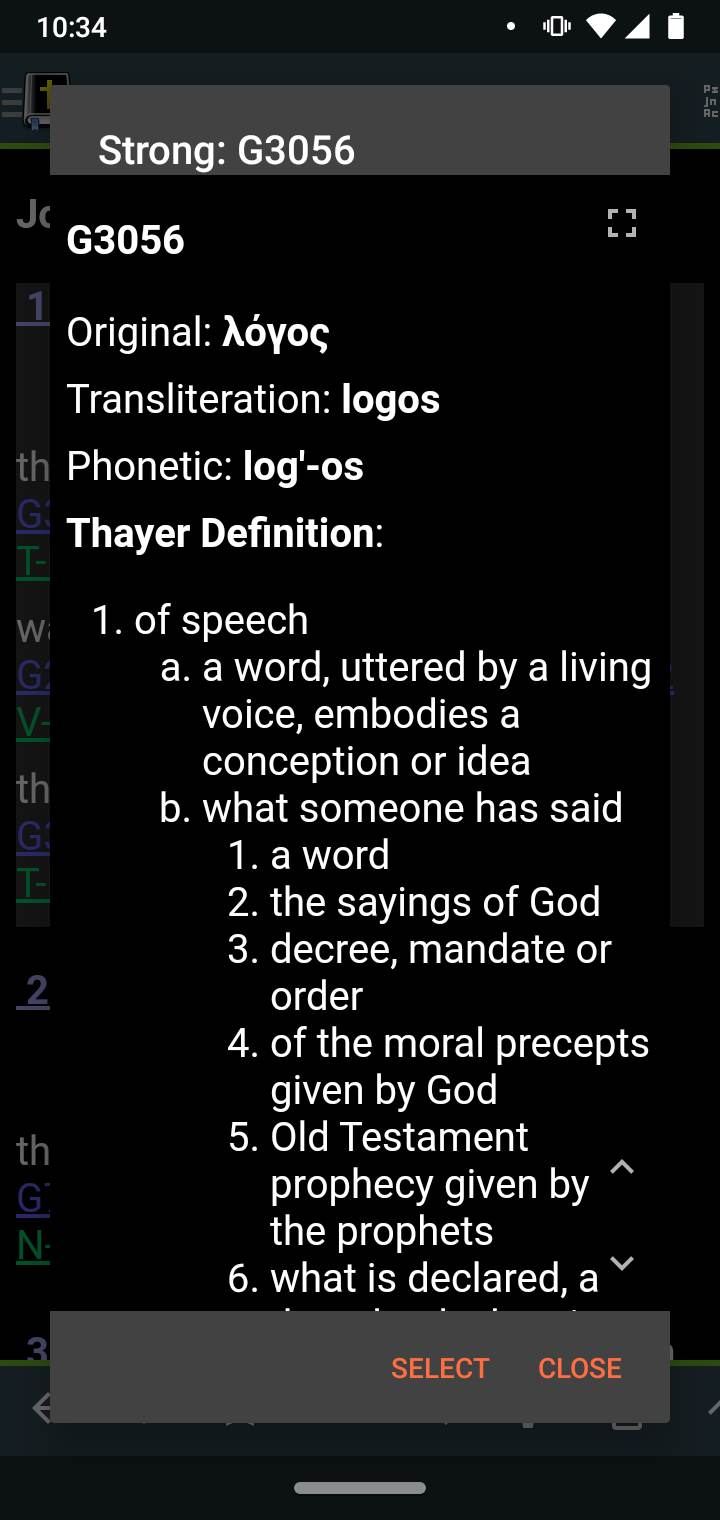
I don’t read AFV+ much just because all those codes can get confusing to look at, but it is great for looking up the nuances behind a translation. If you click on the Strong’s number (G3056), it takes you to Thayer’s dictionary. I don’t have this in the screenshot, but if you scrolled down it would also provide Strong’s definition and a list of all the places this word is used in the New Testament (you could also search for G3056 in the AFV+ or other Strong’s coded translation to see all the places its used).

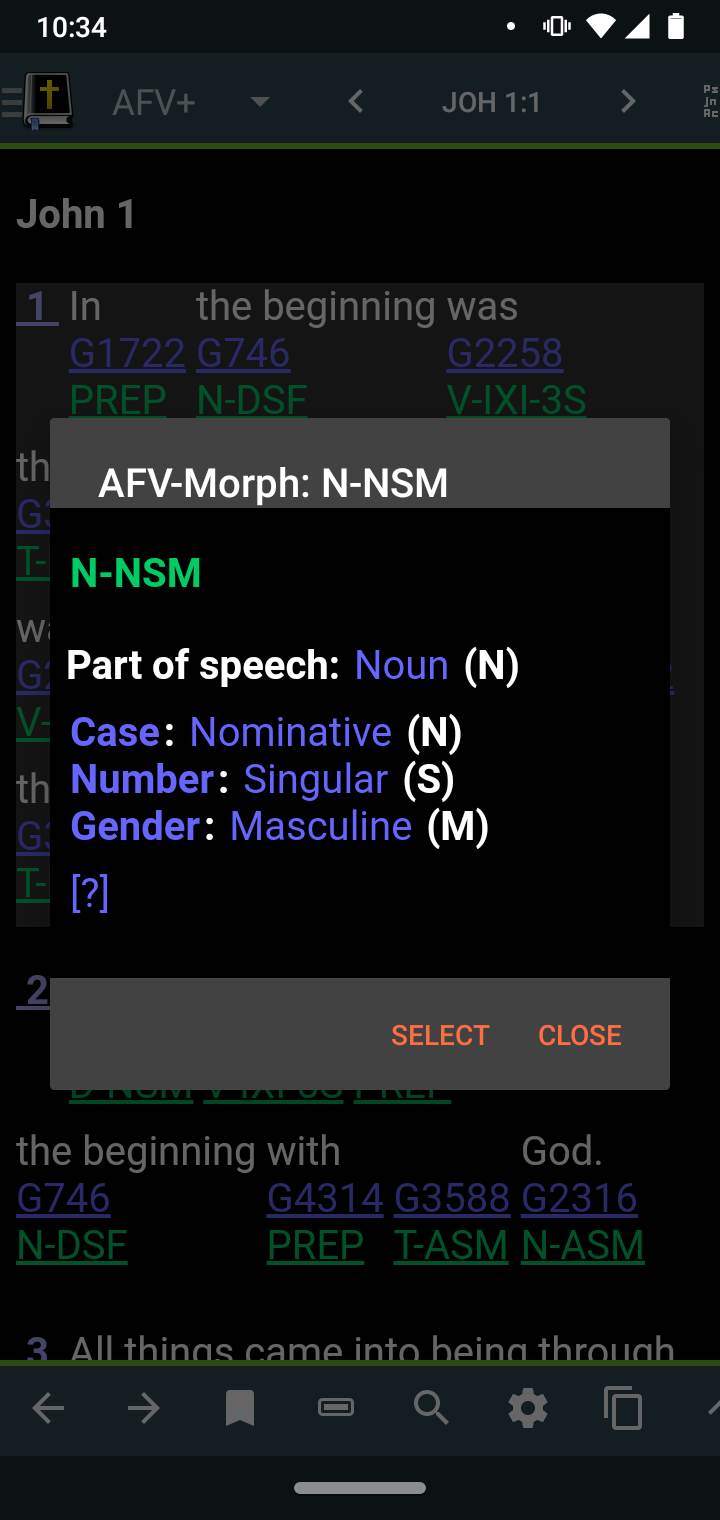
If you click on the morphology link (N-NSM) this translation shows you linguistic information for the word. Logos is a noun, and here it’s in the nominative case (identifying logos as the subject of the sentence), singular in number, and masculine gender (Greek has gendered nouns much like French or German). I use this tool most often to look up whether a word is singular or plural since you can’t always tell in English (e.g. when Paul says “you are the temple of God,” “you” is plural in the Greek but ambiguous in English).

Hebrew and Greek Dictionaries

In addition to these digital language tools, I also have two print dictionaries that I really like. These provide more complete definitions than the tools in eSword or MySword and also help you understand how different words relate to each other.

  • The Complete WordStudy Dictionary: New Testament* by Spiros Zodhiates—my favorite Greek dictionary. It uses Strong’s numbering system and is simple to use.
  • Theological Wordbook of the Old Testament* (TWOT) by Laird R. Hariss, Gleason L. Archer, Jr., and Bruce K. Waltke — my favorite Hebrew dictionary. Rather than being tied to Strong’s numbers, this dictionary groups Hebrew words by their root, which provides a much deeper look at the nuances of the Hebrew language. The different numbering system can make this one a bit more challenging to use, but in MySword the BDB dictionary module makes things easy by telling you where to look up the word in TWOT.

Google Is Your Friend

Another general tool that I use a lot is a simple Google search. Don’t know what the Genitive Case is in Greek? There are language-learning tools to help you understand Greek grammar. Partly remember a verse but can’t find it in eSword, MySword, or BibleGateway? Try Googling the words you remember with the word “Bible” and it’ll help you figure out if it’s in a translation you hadn’t thought of or if it’s a quote from something else. Suddenly need an interlinear version of the Septuagint? I recently found one on StudyLight.org. We’re fortunate to live in a time when we have access to Bible Study tools people even just a few decades before could only dream about or could only access in specialized print books.

Finding Study Topics

Most of my Bible studies end up on this blog. That means I’m usually looking at specific topics when I study, so being able to search the Bible effectively, look up Hebrew and Greek words, and compare translations is super helpful. It’s also helpful to be listening to and reading things that prompt Bible-related ideas that can turn into studies which then show up here on my blog. Here are some of my favorite Christian resources for inspiring new studies:

Final Thoughts

As I mentioned before, not everyone Bible studies the same way, and that’s okay. We have different spiritual temperaments and different ways we most easily connect with God and His word. Some might spend more time reading whole books rather than focusing on topics. Some might find the most value in picking one verse and meditating on it for their whole study time. Others could read, then search for ways to put those lessons into real-world action. And I’m sure there are way more study styles than I could list here.

I like Gary Thomas’s book Sacred Pathways* as a tool to describe those temperaments (you can read my full review by clicking here). I most closely align with what he calls the “Contemplative” and “Intellectual” temperaments, and I suspect others with similar ways of relating to God will be the ones that find this post most useful (if they haven’t already tracked down similar resources of their own). Still, I hope some of these tools and resources will be helpful for you whatever your spiritual temperament. And I hope you’ll share some of your own favorite resources in the comments.

Featured image by StartupStockPhotos from Pixabay