Under His Wings

The Rabbi in my local Messianic congregation recently gave a series of teachings on the Lord’s “secret place” of safety where His people abide and dwell (Ps. 91). It has been excellent food for thought, and I thought it would be interesting to study one of the Hebrew words that the Rabbi didn’t focus on.

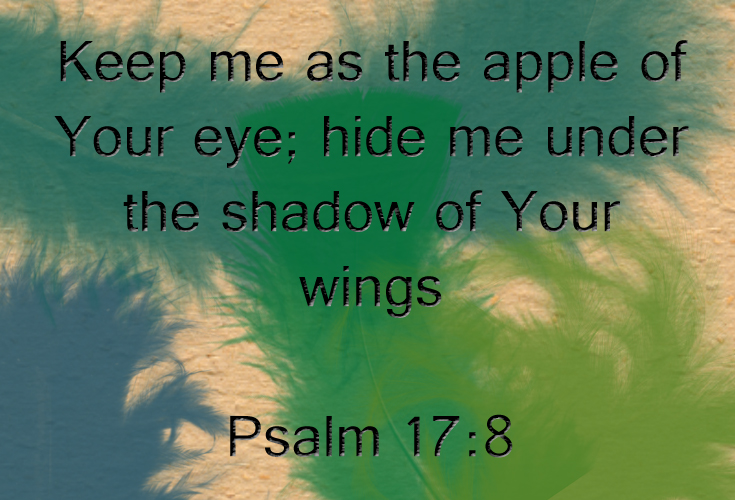
He shall cover you with His feathers, and under His wings you shall take refuge; His truth shall be your shield and buckler. (Ps. 91:4)

The word I want to look at is “wings,” from the Hebrew kanap (H3671). I knew from my Pentecost study on Ruth that this word could also mean the edge of a garment, but I hadn’t spent much time with it before.

Meaning of Kanap
Under His Wings | marissabaker.wordpress.com
feather images from LunaNYXstock

By the way … can anyone recommend a good Hebrew dictionary? I’m not entirely happy with Baker and Carpenter’s The Complete WordStudy Dictionary of the Old Testament. Nevertheless, that’s the one I have, so it’ll have to do for now. Here’s what they have to say about kanap.

A common noun for a wing, the skirt or corner of a garment. It has the basic sense of the outer edges, corners, or extremities of something … The idiom to spread (one’s) wings over means to take to wife … God is often noted as providing a shadow of protection for His people under His wings.

The book of Ruth provides examples of both the idiomatic sense, to marry, and the use of kanap in reference to God’s protection. Boaz tells Ruth,

The Lord repay your work, and a full reward be given you by the Lord God of Israel, under whose wings you have come for refuge. (Ruth 2:12)

Later, Ruth asks Boaz to be her redeemer by saying,

I am Ruth, your maidservant. Take your maidservant under your wing, for you are a close relative.(Ruth 3:9)

Protective Covering

Use of this word to describe God’s involvement with His people covers pretty much all of history, from Deuteronomy 32:11 which describes God leading Jacob as an eagle who spreads her wings over her young, to a prophecy in Malachi which reads,

But to you who fear My name the Sun of Righteousness shall arise with healing in His wings; and you shall go out and grow fat like stall-fed calves.(Mal. 4:2)

The Psalms show that this kind of active protection and help (Ex. 19:4) is available to all God’s peple who pray to Him and abide in Him.

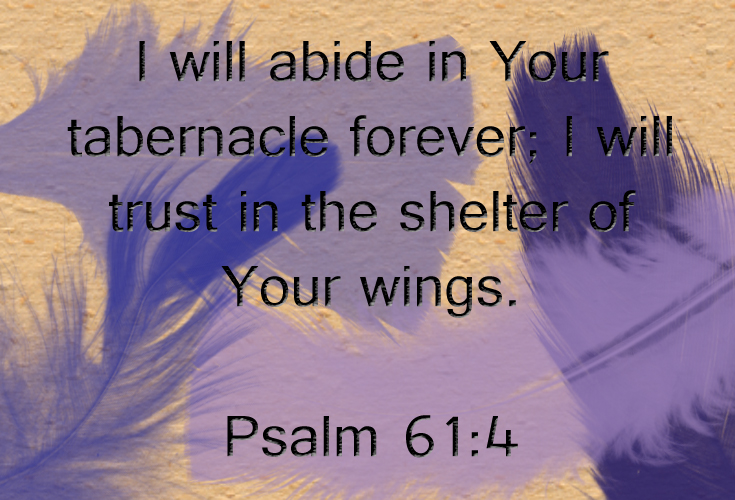
How precious is Your lovingkindness, O God! Therefore the children of men put their trust under the shadow of Your wings. (Ps. 36:7)
Under His Wings | marissabaker.wordpress.com
feather images from LunaNYXstock

It’s a beautiful cycle: God’s loving kindness inspires trust, trust makes us stay close to God and abide under His wings, where He gives more proof of His mercy and love, which in turn makes us trust Him even more.

Be merciful to me, O God, be merciful to me! For my soul trusts in You; and in the shadow of Your wings I will make my refuge, until these calamities have passed by. (Ps. 57:1)

Trust in God is never misplaced. When He wraps His covering of protection around us, we can be assured of abundant help.

Because You have been my help, therefore in the shadow of Your wings I will rejoice. (Ps. 63:7)

We see this analogy continuing in the New Testament as well. Remember this Hebrew word can mean the edge of a garment as well as wings? In the gospels, simply touching the edge of Christ’s garment in a spirit of faith was enough to heal physical ailments (Matt. 9:20-22).

Wherever He entered, into villages, cities, or the country, they laid the sick in the marketplaces, and begged Him that they might just touch the hem of His garment. And as many as touched Him were made well. (Mark 6:56)

Under His Wings

There’s also a far more sobering New Testament continuation of this analogy with wings. It follows one of Jesus’ confrontations with the scribes and Pharisees.

O Jerusalem, Jerusalem, the one who kills the prophets and stones those who are sent to her! How often I wanted to gather your children together, as a hen gathers her chicks under her wings, but you were not willing! (Matt. 23:37)

Both “wanted” and “willing” in this verse are translated from the Greek word thelo (G2309). It “indicates not only willing something, but also pressing on to action. … Thelo, therefore, means to will as the equivalent to purpose, to be decided upon seeing one’s desire to its execution” (Zodhiates). Christ isn’t saying a ho-hum, “oh, it would have been nice to gather you, but you didn’t like that idea.” This word is much more focused. It shows Christ reaching out with a longing and an intention to help His people, and it shows them purposing in their hearts to actively reject Him. No wonder He wept over Jerusalem in Luke 19:41. This was not at all the relationship God wanted with His people.

In Ezekiel 16, we find a narrative where God is speaking to Jerusalem to reproach her for her unfaithfulness. It begins with a reminder that she was unwanted and despised until He took pity on her (verses 1-7).

 “When I passed by you again and looked upon you, indeed your time was the time of love; so I spread My wing over you and covered your nakedness. Yes, I swore an oath to you and entered into a covenant with you, and you became Mine,” says the Lord God. (Ezk 16:8)

God took notice of Jerusalem, and made a marriage covenant with her, covering her with the boarders of His garment and protecting her in the shadow of His wings. And then she chose to reject Him.

Your fame went out among the nations because of your beauty, for it was perfect through My splendor which I had bestowed on you,” says the Lord God. “But you trusted in your own beauty, played the harlot because of your fame, and poured out your harlotry on everyone passing by who would have it.” (Ezk 16:14-15)

The sobering truth is that we can also reject God’s covering protection. We can push Him away, batting aside the wings stretched out to shelter us, and run the opposite direction. I can partly understand a hesitancy to step into a close relationship with God. He wants to know us more intimately than anyone else ever can, and that can be intimidating. But to leave Him after tasting of the good fruits of being in a relationship with God boggles my mind right now. And yet that’s exactly what Israel did again and again.

Paul says the stories of Israel’s disobedience were “written for our admonition” (1 Cor. 10:11). If we need to be admonished by their example, then that must mean there’s a chance that we might do the same things they did. We need to be warned against rejecting God, and on guard against straying away from Him. Going back to Psalm 91 and reading the first few verses, it reminds us of the necessity for dwelling and abiding in close relationship with God. Only when we actively choose to walk into His outstretched arms can we take part in the wondrous relationship He offers us.

He who dwells in the secret place of the Most High shall abide under the shadow of the Almighty.  I will say of the Lord, “He is my refuge and my fortress; my God, in Him I will trust.” Surely He shall deliver you from the snare of the fowler and from the perilous pestilence. He shall cover you with His feathers, and under His wings you shall take refuge; His truth shall be your shield and buckler. (Ps. 91:1-4)


Rooted In The Lord

After finishing last week’s Bible study, I opened my Bible at random and found myself in Jeremiah 17. Usually when I’m in this section of scripture it’s to quote verse 5 — “Cursed is the man who trusts in man” — or verses 9 and 10 — “The heart is deceitful above all things, and desperately wicked.” But this time a different verse caught my eye.

Nestled in between these warnings against trusting in ourselves or other people is a lovely picture of what it looks like to trust in God.

Blessed is the man who trusts in the Lord, and whose hope is the Lord. For he shall be like a tree planted by the waters, which spreads out its roots by the river, and will not fear when heat comes; but its leaf will be green, and will not be anxious in the year of drought, nor will cease from yielding fruit. (Jer. 17:7-8)

This word translated “blessed” is baruch, the same word I wrote about in connection with the phrase “Baruch Hashem” — “bless the name [of the Lord].” In this context, it means to receive a blessing from God. The nature of this blessing is explained in verse 8, but first there are two prerequisites.

Trust and Hope

The verses we’re talking about start out by saying, “Blessed is the man who trusts in the Lord.” The Psalms also have quite a lot to say about this idea —  both the necessity of trusting in God and the fact that He doesn’t disappoint those who do trust in Him.

Those who trust in the Lord are like Mount Zion, which cannot be moved, but abides forever. As the mountains surround Jerusalem, so the Lord surrounds His people from this time forth and forever. (Ps. 125:1-2)

This verse uses the example of Jerusalem to show how God protects His people. But Jerusalem has been a war-zone off-and-on for hundreds of years — what sort of protection is this?

God does not promise to shield us from every harm. We are in a battle, and “we do not wrestle against flesh and blood, but against principalities, against powers, against the rulers of the darkness of this age, against spiritual hosts of wickedness in the heavenly places.” Trusting in God doesn’t mean we won’t have to battle. It means we have a hope of winning the battle using His strength and His armor (Eph. 6:10-18).

Speaking of hope, the next part of the verse in Jeremiah reads, “and whose hope is the Lord” (Jer. 17:7). Hope is an integral part of being a Christian. It’s listed with faith and love in 1 Corinthians 13:13. It’s connected with Christ’s indweling presence in Colossians 1:27. Hebrews 6:18-19 calls our hope “an anchor of the soul, both sure and steadfast.”

For we were saved in this hope, but hope that is seen is not hope; for why does one still hope for what he sees? But if we hope for what we do not see, we eagerly wait for it with perseverance. (Rom. 8:24-25)

Hope’s even a part of our salvation process, described here in Romans much the same way faith is described in Hebrews 11:1. “Hope” in the Greek is elpis, (G1680), and it means “desire of some good will with expectation of attaining it.” That definition brings us right back to the idea of trust. We trust in God because we believe and have hope that He will be with us, and our sure expectation of that hope increases our trust.

Planted by the Water

Even before getting to a more thorough description of this person who is blessed by God, the words “trust” and “hope” are already giving us an idea of someone being firmly attached to God. They imply a focus on God, and an act of clinging fast to Him. Fittingly, the next phrase is, “he shall be like a tree planted by the waters.”

First, note that this person is “planted,” not growing there naturally or by chance. All of us who hope and trust in God have been personally selected by Him and purposefully “planted” into His family beside “the waters.” This isn’t physical water we’re talking about, any more than it’s a literal tree. This is what Jesus described as “living water” (John 4:10).

Jesus answered and said to her, “Whoever drinks of this water will thirst again, but whoever drinks of the water that I shall give him will never thirst. But the water that I shall give him will become in him a fountain of water springing up into everlasting life.” (John 4:13-14)

God is the source of the living, life-giving water that we need to flourish where He has planted us. If we forsake “the fountain of living waters,” we end up in a state opposite that of blessedness (Jer. 2:13). But if we stay close to Him, we will grow and thrive.

For I will pour water on him who is thirsty, and floods on the dry ground; I will pour My Spirit on your descendants, and My blessing on your offspring; they will spring up among the grass like willows by the watercourses. (Is. 44:3-4)

Willow trees have strong, fast-growing root systems that love water. When planted by a water source, the roots grow so quickly and densely that they actually help hold the banks of a stream or pond in place. That’s how firmly we must be attached to the source of Living Water. That’s also the next thing mentioned in Jeremiah, as the blessed person is compared to a tree that “spreads out its roots by the river” (Jer. 17:8).

As you therefore have received Christ Jesus the Lord, so walk in Him,  rooted and built up in Him and established in the faith, as you have been taught, abounding in it with thanksgiving. (Col. 2:6-7)

When Heat Comes

This tree, firmly rooted by the Living Water, is next described as having no “fear when heat comes, but its leaf will be green.” When I think of “heat” in the Bible, my mind usually goes to the idea of fiery trials. We’re going through a refining process that involves heating us up and seeing how we react so bad things can be purged away and we can become pure.

Now if anyone builds on this foundation with gold, silver, precious stones, wood, hay, straw, each one’s work will become clear; for the Day will declare it, because it will be revealed by fire; and the fire will test each one’s work, of what sort it is. (1 Cor. 3:12-13)

Walking through metaphorical fire is an inescapable aspect of being Christian (1 Pet. 4:12-13). If we’re firmly founded — or rooted — on Jesus Christ, though, passing through fire is not disastrous for us. In fact, it can draw us closer to Him and refine us to be more like He is. He doesn’t just abandon us “when heat comes.” He says, “Fear not, for I have redeemed you … when you walk through the fire, you shall not be burned, nor shall the flame scorch you” (Is. 43:1, 2). Like the bush God spoke to Moses in, we can be in the midst of fire and still be green and flourishing because the Lord is in us (Ex. 3:2).

Yielding Fruit

The phrase “will not be anxious in the year of drought” had me a bit puzzled (Jer. 17:8). Drought means a lack of water, which in this analogy we’ve been describing as the Holy Spirit poured out through Jesus Christ. So, does the mention of “drought” mean that something is going to happen that makes God’s Spirit generally unavailable, but will not affect those who are already firmly rooted in God?

“Behold, the days are coming,” says the Lord God, “That I will send a famine on the land, not a famine of bread, nor a thirst for water, but of hearing the words of the Lord. They shall wander from sea to sea, and from north to east; they shall run to and fro, seeking the word of the Lord, but shall not find it. “In that day the fair virgins and strong young men shall faint from thirst.” (Amos 8:11-13)

This is the first scripture that finally came to mind for this idea of drought. In the United States, we’re used to living in a country where we can pick up a Bible in most stores, search translations and commentary online, and find a plethora of Christian churches to visit. But that hasn’t been the norm for most of history, or most of the world, and it might not stay that way here. And even if the words are available, they won’t make any sense unless God gives His Spirit of understanding. That’s why we need to seize every chance we have to draw closer to God, and be tapped into the source of Living Water.

The Lord will guide you continually, and satisfy your soul in drought, and strengthen your bones; you shall be like a watered garden, and like a spring of water, whose waters do not fail. (Is. 58:11)

And when this happens, we can not only be unworried by drought, but also not “cease from yielding fruit” (Jer. 17:7-8). Being fruitful is the subject of the opening verses in John 15. Here, Jesus describes Himself as “the true vine,” and tells us the only way to bear fruit is to be connected to Him.

I am the true vine, and My Father is the vinedresser. Every branch in Me that does not bear fruit He takes away; and every branch that bears fruit He prunes, that it may bear more fruit …

Abide in Me, and I in you. As the branch cannot bear fruit of itself, unless it abides in the vine, neither can you, unless you abide in Me. “I am the vine, you are the branches. He who abides in Me, and I in him, bears much fruit; for without Me you can do nothing. …

By this My Father is glorified, that you bear much fruit; so you will be My disciples. (John 15:1-2, 4-5, 7)

If we’re securely attached to Christ, our lives will yield fruit that reflects that relationship. We’ll be demonstrating the fruits of the Spirit (Gal. 5:22-23), and walking “in all goodness, righteousness, and truth” (Eph. 5:9). And then not only will we be blessed, but we’ll be a blessing to others. Not only will we have access to living water, but rivers of God’s Spirit will flow out from us as well (John 7:37-38). Blessings from God affect us wondrously, but they don’t stop with us — they’re designed to overflow us and spill out to bless others, and show that we are indeed Christ’s disciples.


Baruch Hashem

As I wrote in Monday’s post, my sister and I visited a Messianic congregation last Sabbath/Shabbat. The teaching given that day by the Rabbi centered around the Hebrew phrase “Baruch Hashem,” which translates as “bless the name” or “blessed be God.” Jewish people traditionally write the initials B”H at the top of a letter to begin their correspondence, as a way of contextualizing everything that follows as being for God’s glory. The composer Johann Sebastian Bach did something similar by starting each new piece of music with the initials JJ (Jesu Juva — Jesus help me) and ended his compositions with the letters SDG (Soli Deo Gloria — all glory to God).

blog post "Baruch HaShem" by marissabaker.wordpress.com

Bless The Lord

One of the songs we opened services with last week was my new favorite Christian song, Matt Redman’s 10,000 Reasons. Like many of the Psalms, it is about wholeheartedly singing and offering praise to God at all times, “whatever may pass and whatever lies before me.”

Bless the Lord, O my soul; and all that is within me, bless His holy name! (Ps. 103:1)

Praise the Lord, O my soul! While I live I will praise the Lord; I will sing praises to my God while I have my being. (Ps. 146:1-2)

Have you made it your purpose in life to praise God? Perhaps this comes naturally for some people, but I suspect it is hard for most of us to be in a continuing mindset of praise. When things are going well it is easier to feel  like praising, but we often get so distracted by how well things are going that we forget to offer glory to God. Things going badly can serve as a reminder, but when that happens our typical response is usually to beg God for help rather than praise Him.

But you are a chosen generation, a royal priesthood, a holy nation, His own special people, that you may proclaim the praises of Him who called you out of darkness into His marvelous light (1 Pet. 2:9)

One of the reasons we have been chosen is the show forth God’s praises, not just when we feel like it, but all the time. Ephesians 1:5-6 tells us that we were predestined to adoption as sons “to the praise of the glory of His grace.” Verses 12-14 add that we were “sealed with the Holy Spirit of promise,” redeemed, and purchased “to the praise of His glory.” Praising God is one of the key reasons we were created.

Praising His Glory

When we talk about God choosing us, we often turn to 1 Corinthians 1:26-29, about how God has selected the foolish, weak, and despised people who are nothing apart from Him so “that no flesh should glory in His presence.” There’s a “but” right after this, though.

But of Him you are in Christ Jesus, who became for us wisdom from God — and righteousness and sanctification and redemption — that, as it is written, “He who glories, let him glory in the Lord.” (1 Cor. 1:30-31)

We’re not told to just mope around and wallow in our insignificance. We are to be humble, yes, but there is also something we are to “glory in.” It’s not something that came from or belongs to us, though. Even if we have something which is impressive by the world’s standards, it still pales in comparison to what God gives us.

Thus says the Lord: “Let not the wise man glory in his wisdom, let not the mighty man glory in his might, nor let the rich man glory in his riches; but let him who glories glory in this, that he understands and knows Me, that I am the Lord, exercising lovingkindness, judgment, and righteousness in the earth. For in these I delight,” says the Lord. (Jer. 9:23-24)

If we’re going to talk about, glory in, and be inspired by something we have, it should be our relationship with God. I recently re-read a book called Refiner’s Fire written by Sylvia Bambola. It is fiction, but set during the very real reign of Nicolae Ceausescu in Romania during the 1980s. A large part of the plot centers around the horrible persecutions Christians endured under Ceausescu’s leadership.

When we sit in our comfy armchairs reading about the apostles “rejoicing that they were counted worthy to suffer shame for His name,” it seems marvelous, but rather far removed from our own experiences (Acts 5:41). Perhaps we wonder if Christians in general, or us in particular, would react like that today. We in the U.S. complain about being persecuted when public prayer is condemned — not a bit of praise to God for being counted worthy to suffer for Him. Christians in Romania gloried in sharing the love of Christ when it meant being beaten to death or incarcerated and tortured. Reading something like Refiner’s Fire kinda puts things in perspective.

Can we do this? Can we live our lives in the context of always glorifying God no matter the cost? Do we let people see God’s work in us without fearing how they will respond? Will we bless His name even if people give us weird looks, wonder at our sanity, take us to court, or perhaps worse in days to come?

Written In Our Hearts

We might not write B”H at the beginning of our correspondence any more, but God is writing something in our hearts that should result in our lives being contextualized by blessing His name.

But this is the covenant that I will make with the house of Israel after those days, says the Lord: I will put My law in their minds, and write it on their hearts; and I will be their God, and they shall be My people. (Jer. 31:33)

God is writing on us, while He is re-writing us in His image. Let’s think about this analogy for a moment. When you write on something, you change it. I write these blog posts in pen on notebooks before typing them up. Once I’ve done that, you can’t use that paper for anything else — it has been changed by the writing process and the words are there to stay. Even if I used pencil and erased it there would still be marks visible. God wants to have an even more indelible impact on us.

At one time, God wrote His laws on “tablets of stone” (Ex. 24:12). Now, He is writing on a surface far more precious with the potential to be far more enduring — our hearts. In a way, we are His letter to the world, and our whole life should be contextualized by that.

You are our epistle written in our hearts, known and read by all men; clearly you are an epistle of Christ, ministered by us, written not with ink but by the Spirit of the living God, not on tablets of stone but on tablets of flesh, that is, of the heart. (2 Cor. 3:2-3)

God’s work in us — what He is writing on us — should change the way we approach our entire lives. When people see us, they should be able to read what God has written in us, seeing His signature on all that we do.

Gleaning Firstfruits

Before getting to today’s topic, I just wanted to mention how much I’ve enjoyed doing an actual count-down this year instead of just putting Pentecost on the calendar. It’s helped me focus my Bible study and kept me in mind of the timing for God’s calender rather than feeling like Pentecost sneaked up on me. Today is the 7th Sabbath in our count, which means Pentecost is tomorrow!

And you shall count for yourselves from the day after the Sabbath, from the day that you brought the sheaf of the wave offering: seven Sabbaths shall be completed. Count fifty days to the day after the seventh Sabbath; then you shall offer a new grain offering to the Lord. (Lev. 23:15-16)

Though this is one of the easiest Holy Days to see evidence of in the New Testament (largely due to the giving of the Holy Spirit in Acts), I think we’ll spend most of our time today in the Old Testament, particularly in the book of Ruth.

Lawns of Gleaning

Pentecost, also called the Feast of the Firstfruits/Harvest/Ingathering, is a harvest-time festival. The count to this day begins with a wave-sheaf “of the firstfruits of your harvest,” and the offerings on the day of Pentecost include “two wave loaves of two-tenths of an ephah” of “fine flour” “baked with leaven” that are described as “the firstfruits to the Lord” (Lev. 23:10, 17). After a lengthy passage of instructions for Pentecost, there is a verse that does not quite seem to fit.

When you reap the harvest of your land, you shall not wholly reap the corners of your field when you reap, nor shall you gather any gleaning from your harvest. You shall leave them for the poor and for the stranger: I am the Lord your God. (Lev. 23:22)

This is a repetition of a command also recorded in Leviticus 19:9-10, a command so important to God that He not only gave it twice, but He put one of those commands in the passage describing His most Holy Days. We can get some idea of how this practice works, and perhaps why it is so important, by looking at the book of Ruth.

‘Ruth Gleaning’ watercolor by James Tissot (1896)

There’s a note in my study Bible that says, “by New Testament times” the book of Ruth was being “read at the Feast of Harvest (Pentecost) because much of the story is set in the harvest fields.” It was one of five books “read publicly at the Feasts of Israel.”

I dare say we all know the story. Naomi and her family moved to Moab during a famine in Israel. There, her two sons married. About 10 years later, Naomi’s husband and sons were dead and she returned home to Israel accompanied by her daughter in law, Ruth. We jump into the story as Ruth and Naomi arrive in “Bethlehem at the beginning of barley harvest” (Ruth 1:22).

So Ruth the Moabitess said to Naomi, “Please let me go to the field, and glean heads of grain after him in whose sight I may find favor.” And she said to her, “Go, my daughter.” Then she left, and went and gleaned in the field after the reapers. And she happened to come to the part of the field belonging to Boaz, who was of the family of Elimelech. (Ruth 2:2-3)

As we read further, we see Boaz went above and beyond what God’s law strictly required a landowner to leave for the poor. He offers Ruth protection and water, and asks her not to glean in any other field where he could not guarantee her safety (Ruth 2:8-9). Behind-the-scenes, he told his reapers to let grain fall for her on purpose and not to stop her if she wanted to glean even among the sheaves of grain (Ruth 2:15-16).

Unmerited Favor

There is much of Christ’s character visible in how Boaz treats Ruth when she first arrives in his field. Like Boaz did for Ruth, Jesus offers us His personal protection. He asks us not to stray from His laws because they are designed to keep us safe from the consequences of sin. He says, “If anyone thirsts, let him come to Me and drink” (John 7:37). Our response to this unearned favor ought to be much the same as Ruth’s.

So she fell on her face, bowed down to the ground, and said to him, “Why have I found favor in your eyes, that you should take notice of me, since I am a foreigner?” (Ruth 2:10)

This is much the same question David asked God in Psalms 8:4 and 144:3 — “What is man that You are mindful of him?” Every human is small and insignificant compared to God, and those of us who God has chosen for His particular attention are unimportant even by human standards.

But God has chosen the foolish things of the world to put to shame the wise, and God has chosen the weak things of the world to put to shame the things which are mighty; and the base things of the world and the things which are despised God has chosen, and the things which are not, to bring to nothing the things that are, that no flesh should glory in His presence. But of Him you are in Christ Jesus, who became for us wisdom from God—and righteousness and sanctification and redemption — that, as it is written, “He who glories, let him glory in the Lord.” (1 Cor. 1:27-31)

"Gleaning Firstfruits" marissabaker.wordpress.comGod is gleaning His firstfruits from the world’s rejects. He is taking people who are nothing and turning us into something glorious. He is taking strangers — like the Moabite Ruth — and adopting them into His family through Christ’s sacrifice.

But now in Christ Jesus you who once were far off have been brought near by the blood of Christ. …Now, therefore, you are no longer strangers and foreigners, but fellow citizens with the saints and members of the household of God (Eph. 2:13, 19)

Our Redeemer

The adoption process by which we become God’s children is, as we discussed last week, linked inseprably to Christ’s redeeming work (Eph. 1:5-7; Rom. 8:23; Gal. 4:3-7). There is a parallel for this as well in the story of Ruth, in the role Boaz plays as a kinsman redeemer.

And her mother-in-law said to her, “Where have you gleaned today? And where did you work? Blessed be the one who took notice of you.” So she told her mother-in-law with whom she had worked, and said, “The man’s name with whom I worked today is Boaz.” Then Naomi said to her daughter-in-law, “Blessed be he of the Lord, who has not forsaken His kindness to the living and the dead!” And Naomi said to her, “This man is a relation of ours, one of our close relatives.” (Ruth 2:19-20)

My study Bible says this last phrase could be translated “one that hath right to redeem.” We find the basis for the practice of a kinsman redeeming land in Leviticus 25: 25, 48-49. To prevent an inheritance from leaving the family, someone who was closely related, financially able, and willing to fill this role could redeem land that was sold. In some cases, as here in Ruth, when the man who the land originally belonged to had left a childless widow, the redeemer was expected to marry her per the command in Deuteronomy 25:5-10.

We see all this played out in Ruth 4:4-10 where Boaz must offer a more closely related kinsman the opportunity to redeem Naomi’s family’s land and marry Ruth.  This man refuses (which, being the hopeless romantic I am, I suspect was Boaz’s plan all along).

Stepping back a chapter and looking at Ruth’s request that Boaz play the part of a redeemer, we read about a practice that seems rather unusual. Since Naomi counsels this action and Boaz knew how to respond, I assume Ruth asking him to be her family’s redeemer (perhaps even this method of asking) was not considered unusual in their culture. Per Naomi’s instructions, Ruth lies down at Boaz’s feet when he is asleep and waits for him to notice her.

And he said, “Who are you?” So she answered, “I am Ruth, your maidservant. Take your maidservant under your wing, for you are a close relative.” (Ruth 3:9)

Looking at the Hebrew for “wing”, The Complete WordStudy Dictionary for the Old Testament says “the idiom to spread (one’s) wings over means to take to wife.” This same word is used in Ruth 2:12 when Boaz tells Ruth, “The Lord repay your work, and a full reward be given you by the Lord God of Israel, under whose wings you have come for refuge.” Ruth is asking Boaz for a type of protection that mirrors the relationship between God and Israel. The comparison is drawn even more strongly reading God’s words to Israel in Ezekiel 16.

“When I passed by you again and looked upon you, indeed your time was the time of love; so I spread My wing over you and covered your nakedness. Yes, I swore an oath to you and entered into a covenant with you, and you became Mine,” says the Lord God. (Ezk. 16:8)

In the same way, we who are part of the church have been “betrothed you to one husband” — Jesus Christ — and will be married “to Him who was raised from the dead” after He died in order to redeem us (2 Cor. 11:2; Rom. 7:4).

Taken together, the book of Ruth and the Feast of Pentecost teach us about the glorious unmerited favor that God pours out on us. We were strangers like Ruth and were not only invited to partake in what God provides, but cared for deeply and betrothed to His own Son, who gave His life to redeem His firstfruit Bride.


The “God Of The Old Testament”

After celebrating a lovely Feast of Unleavened Bread that concluded this past Monday, it’s time to start counting down to Pentecost. Per Leviticus 23:15-16, this Sabbath is the first of seven in the count to Pentecost. I’ll probably talk about this more over the next few weeks, but first I want to post about a topic that has been on my mind of late.

The phrase “God of the Old Testament” just seems to keep coming up in arguments and messages in the churches. It typically goes one of two ways: either we’re trying to pin-down who the God of the Old Testament was (i.e. the Father or the One who became Christ), or we’re contrasting the God of the Old Testament with the God of the New as if they were two different beings.

In some ways, I think this comes under the category of “stupid things we say in the church.” It’s misleading and confusing. For one thing, scripture is very clear that there wasn’t just one “God of the Old Testament” — there had always been two Beings mentioned and recognized in scripture.

Two in the OT

As you’ve probably read/heard before, the word translated “God” in the opening chapters of Genesis is plural. We can see two Beings so closely related They can be refereed to by one plural name. In the same way, we use a family’s last name to encompass several individuals, e.g. the Bakers or the Martins. Even without knowing Hebrew, the fact that there are two Beings here is made clear when They say, “Let Us make man in Our image, according to Our likeness” (Gen. 1:26).

Throughout the Old Testament, there are examples of people who knew there were two God-beings. The most well-known is probably Psalm 110:1 — “The Lord said to my Lord, ‘Sit at My right hand, till I make Your enemies Your footstool.'” There were other writer’s besides David, though. Take Agur for example.

Who has ascended into heaven, or descended? Who has gathered the wind in His fists? Who has bound the waters in a garment? Who has established all the ends of the earth? What is His name, and what is His Son’s name, if you know? (Prov. 30:4)

Two God-beings appear in Daniel’s prophesies, too.

I was watching in the night visions, and behold, One like the Son of Man, coming with the clouds of heaven! He came to the Ancient of Days, and they brought Him near before Him. Then to Him was given dominion and glory and a kingdom, that all peoples, nations, and languages should serve Him. His dominion is an everlasting dominion, which shall not pass away, and His kingdom the one which shall not be destroyed. (Dan. 7:13-14)

Christ referred to this scripture as part of His affirmative answer when the high priest asked him, ““Are You the Christ, the Son of the Blessed?” (Mark 14:61-62).

The Word

The fact that Old Testament writers knew about two God-beings does not answer the question of which of Them interacted directly with Their people. Though “God of the Old Testament” is an ill-fitting phrase, it is often used as short-hand for “the member of the Godhead who interacted with people throughout the Old Testament.”

We can, at least, determine from scripture the answer to that question. One of the clearest passages addressing this is in 1 Corinthians when Paul is talking about Israel’s history.

Moreover, brethren, I do not want you to be unaware that all our fathers were under the cloud, all passed through the sea, all were baptized into Moses in the cloud and in the sea, all ate the same spiritual food, and all drank the same spiritual drink. For they drank of that spiritual Rock that followed them, and that Rock was Christ. (1 Cor. 10:1-4)

It really can’t get much plainer than that. Paul additionally says, “nor let us tempt Christ, as some of them also tempted,” identifying The Word, the One who came to be known as Jesus Christ, as the God who Israel tempted (1 Cor. 10:9). We can conclude, therefore, that the One who spoke with Moses about Israel tempting Him was The Word.

because all these men who have seen My glory and the signs which I did in Egypt and in the wilderness, and have put Me to the test now these ten times, and have not heeded My voice, they certainly shall not see the land of which I swore to their fathers, nor shall any of those who rejected Me see it. (Num. 14:22-23)

One of the many things Jesus said which upset the Jews of His day was that He had seen Abraham. The implication that accompanied this statement — that He was God — made them want to stone Him.

“Your father Abraham rejoiced to see My day, and he saw it and was glad.” Then the Jews said to Him, “You are not yet fifty years old, and have You seen Abraham?” Jesus said to them, “Most assuredly, I say to you, before Abraham was, I AM.” (John 8:56-58)

The Being Abraham talked to when “the Lord appeared to him by the terebinth trees of Mamre” before the destruction of Sodom and Gomorrah is typically interpreted as a pre-incarnate appearance of Jesus Christ (Gen 18:1). As The Word, Jesus has been entrusted with expressing the thoughts of the Godhead to man. That’s what logos, the Greek word used in John 1:1, means — an expression of intelligence. Since we know from Hebrews 13:8 that Christ’s character is constant, it makes sense that this role would be consistent throughout the Bible.

No one has seen God at any time. The only begotten Son, who is in the bosom of the Father, He has declared Him. (John 1:18)

Christ repeats this, saying He is the only one who has seen the Father (John 6:46) and that no one else at that time knew the Father (John 7:28-29). There’s also 1 John 4:12 — “no one has seen God at any time.” These verses are uncomplicated and clear, leaving little room for doubt that while there have always been two Beings in the God-family, the Word who became Christ was responsible for interacting with Their creation.

Redeeming His Creation

In the beginning was the Word, and the Word was with God, and the Word was God. He was in the beginning with God. All things were made through Him, and without Him nothing was made that was made. (John 1:1-3)

The “let us” phrase in Genesis 1 shows that both the Father and Son were involved in creation. When we add John 1, we start to see a more complete image of Their roles with The Word being the One who spoke everything into existence (Ps. 33:6). Some will argue, however, that it’s a mistranslation or something of the kind. Perhaps we could say this of one verse, but what about seven?

Two of these remaining 6 verses that I found talk about God creating the universe though Jesus Christ:

To me, who am less than the least of all the saints, this grace was given, that I should preach among the Gentiles the unsearchable riches of Christ, and to make all see what is the fellowship of the mystery, which from the beginning of the ages has been hidden in God who created all things through Jesus Christ (Eph. 3:8-9)

God, who at various times and in various ways spoke in time past to the fathers by the prophets, has in these last days spoken to us by His Son, whom He has appointed heir of all things, through whom also He made the worlds (Heb. 1:1-2)

Another verse that fits in here is Revelation 3:14, which describes Jesus as “the Beginning of the creation of God.” Zodhiates’ study Bible points out that the Greek word translated “beginning” is arche, which “literally refers to Him as the originator or cause of creation.” That Christ’s work was a focus in the act of creation is brought forward by three more verses that say “by Him are all things” (Heb. 2:10; 1 Cor. 8:6).

He is the image of the invisible God, the firstborn over all creation. For by Him all things were created that are in heaven and that are on earth, visible and invisible, whether thrones or dominions or principalities or powers. All things were created through Him and for Him. And He is before all things, and in Him all things consist.  (Heb. 1:15-17)

As the One responsible for the act of creation, it was fitting for The Word to redeem His creation by His own sacrifice. That this was planned from the beginning, we can see from His description as “the Lamb slain from the foundation of the world” (Rev. 13:8). We also see that God gave us grace ” in Christ Jesus before time began” (2 Tim. 1:9). This also fits in with the narrative arch that runs throughout the Bible of Jesus redeeming a Bride, which I talk about at greater length in chapters 2-4 of “God’s Love Story.”

The Constancy of God

The other thing I want to briefly address is the idea that God was a different person in the Old and New Testaments. We hear, and perhaps say, that God in the Old Testament was a vengeful, angry God and that God in the New Testament is all peace and forgiveness. But this does not fit with verses that say there is “no variation or shadow of turning” with the Father, and Jesus Christ is “the same yesterday, today, and forever” (James 1:17; Heb. 13:8).

“And it shall be, in that day,” says the Lord, “That you will call Me ‘My Husband,’ and no longer call Me ‘My Master,’ … “I will betroth you to Me forever; yes, I will betroth you to Me in righteousness and justice, in lovingkindness and mercy; I will betroth you to Me in faithfulness, and you shall know the Lord. … And I will have mercy on her who had not obtained mercy; then I will say to those who were not My people, ‘You are My people!’ and they shall say, ‘You are my God!’” (Hos. 2:16, 19-20, 23)

This kind of love, the longing for a personal relationship with His people, can be found throughout the Old Testament, just as reminders of the righteous judgement of God can be found in the New Testament.

Anyone who has rejected Moses’ law dies without mercy on the testimony of two or three witnesses. Of how much worse punishment, do you suppose, will he be thought worthy who has trampled the Son of God underfoot, counted the blood of the covenant by which he was sanctified a common thing, and insulted the Spirit of grace? For we know Him who said, “Vengeance is Mine, I will repay,” says the Lord. And again, “The Lord will judge His people.” It is a fearful thing to fall into the hands of the living God. (Heb. 10:28-31)

God, both the Father and the Son, are unchanging and faithful. Both have always been here, and each has fulled a consistent role in Their dealings with Their Creation. “The God of the Old Testament” is a misleading phrase that has led to offense and confusion regarding what should be a relatively straight-forward topic. Both God-beings have always been present and active, though Jesus Christ’s role as the Word is more visible in interactions with the creation.

The Subject of Kneecaps

I’m a little fuzzy on the subject of violence in the Bible, and talking with or reading the opinions of other Christians doesn’t make it any less confusing. We can all agree murder is wrong. After that, there doesn’t seem to be much agreement at all. Should a Christian use violence, sometimes even deadly violence, to save someone’s life or defend themselves?

Zoë: “Preacher, don’t the Bible have some pretty specific things to say about killin’?”

Book: “Quite specific. It is, however, somewhat fuzzier on the subject of kneecaps.”

— Firefly, episode 9 “War Stories”

In this situation in Firefly, Shepherd Book armed himself and joined his shipmates to rescue Malcolm Reynolds from torture and death. He did not violate the commandment “You shalt not murder,” or even the King James’ rendering “Though shalt not kill” (Ex. 20:13). But does this kind of violence violate the spirit, if not the letter, of such commandments? If he had killed in self-defense, would it have been wrong?

Murder vs. Killing

I don’t think there is any question about murder being wrong. Even in societies without the Bible as a guide, laws against murder are usually part of the culture. It’s on the subject of “killing” where things get sticky for Christians. If someone is attacking your family, is it permitted to use violence to stop them? Does unintentionally killing someone who is trying to harm you make guilty of murder in God’s eyes?

The Hebrew word translated “kill” or “murder” in Exodus 20 is râtsach (H7523). Strong’s defines it as, “to dash in pieces, that is, kill (a human being), especially to murder.” Like many Hebrew words, the exact meaning is dependent on the context, and The Complete WordStudy Dictionary: Old Testament points out that the word is used “to indicate premeditated murder” as well as “an accidental killing,” slaying someone as an “act of revenge,” and “death by means of an animal attack.” Other scriptures help narrow down the definition, as C.S. Lewis points out in this quote from Mere Christianity.

It is no good quoting “Thou shalt not kill.” There are two Greek words: the ordinary word to kill and the word to murder. And when Christ quotes the commandment He uses the murder in all three accounts. … All killing is not murder any more than all sexual intercourse is adultery.

The Issue of Hate

Should Christians defend themselves? "The Subject of Kneecaps" marissabaker.wordpress.comC.S. Lewis was not a pacifist (he wrote a whole article on the “why” of this viewpoint, but I have yet to find a copy). I admire his writings, but there are other people whose opinions I admire who are adamant that it is wrong for a Christian to serve as a soldier and wrong for a person to kill someone in self-defense.

For some people, I think the distinction between murder and killing comes down to the idea of a death being accidental and/or premeditated. We know from the instructions God gives for cities of refuge (Joshua 20) that accidental killings  do not come under the death-penalty ascribed to murder. The reasons given for not condemning a man who accidentally caused his neighbor’s death are these: “he struck his neighbor unintentionally, but did not hate him beforehand” (Josh. 20:5).

People seem to go two ways on interpreting this verse. One: killing someone in self defense does not constitute murder because you “did not hate him before hand.” It was not a premeditated, vengeful killing, therefore it is considered an accident. C.S. Lewis seems to come down on this side when he says, “We may kill if necessary, but we must not hate and enjoy hating.”

Whoever hates his brother is a murderer, and you know that no murderer has eternal life abiding in him. (1 John 3:15)

Deliberate Self-Defense

The second argument I’ve heard goes something like this: planning to defend yourself makes the death premeditated. You might not be deliberately trying to kill a specific person, but if you intend to kill whoever attacks you and your family, the killing was planned. This also means you don’t fulfill the requirement “he struck his neighbor unintentionally.”

Something doesn’t sit well with me about this last viewpoint. Perhaps it’s partly the implication that most people who intend to defend themselves if attacked also have a desire to kill (which I don’t see in the people I know who are prepared to defend themselves). There are also elements of hypocrisy. The person who thinks self-defense is wrong will probably not hesitate to call 911, and if the person attacking them is killed by police officers I’m not sure they’d feel terribly guilty.

I don’t have much of a conclusion for this post. In theory, I tend to lean more towards C.S. Lewis’s views. In practice, though, one of the reasons I quit Tae Kwon Do is because I hated even practicing how to hurt people. What are your thoughts on this subject?