One of the most uncomfortable aspects of modern Christianity is the idea of hell. The common notion is that those who aren’t following God (including those who reject Him and those who never knew Him) miss-out on their chance at salvation and are tormented forever in a burning place. Few want to talk about it, many have rejected it, but most don’t agree on an alternative. It’s something Christianity must address, though.
What happens after death for the people who are not followers of Jesus?
For believers, the question “What happens when we die?” has clear answers in scripture. We’re not sure exactly what life in God’s family will be like, but we know that we’ll either be resurrected from the dead (if we died before Jesus’s return) or transformed into spirit beings (if we’re still alive at His return). At that point, “we will be like him, because we will see him just as he is” (1 John 3:2, NET). For other people, things are a bit more ambiguous.
My purpose today isn’t to give a definitive answer, but rather to look at some different readings of scriptures talking about eternal judgement. There are some things we can say with a fairly high degree of certainty, but there are others that I just don’t know the answers to (and I’d rather acknowledge that than take a stance that I’m not reasonably confident lines up with God’s revealed word).
What is “hell”?
The word “hell” is used in the Bible, but not with the same connotation we have for it in English. Western ideas of hell come from Medieval imagery (think Dante’s Inferno). Most uses in the New Testament, though, are translated from the Greek word ghenna. When people of Jesus’s time heard this word they didn’t think of a burning place with a pitchfork-toting devil where eternal souls writhed in torment. They thought of Ghenna–a rubbish heap outside Jerusalem “where the filth and dead animals … were cast out and burned,” which is “a fit symbol of the wicked and their future destruction” (Thayer’s dictionary G1087).
Strong’s dictionary does describe ghenna as a place of “everlasting punishment,” but that imagery wasn’t originally in the Greek language. As we talked about last week, the Bible doesn’t teach humans have immortal souls. Immortality can only come to us as a gift of God, and unless He grants the gift of eternal life we won’t be around for everlasting anything, including torment.
Another word translated “hell” in English Bibles is hades (G86), which originally referred to the Greek god of the underworld but came to mean the grave in general. There’s also one other mention of “hell” in in the New Testament that’s translated from tartaroo (G5020), which was considered a place of eternal torment. The only time it’s used is in 2 Peter 2:4,where it talks about God casting “the angels who sinned … into hell” (NET). Other than that, when we look at what the Bible says about hell, we have to check each verse to see whether it’s talking about hades (the grave) or ghenna (a burning place of destruction).
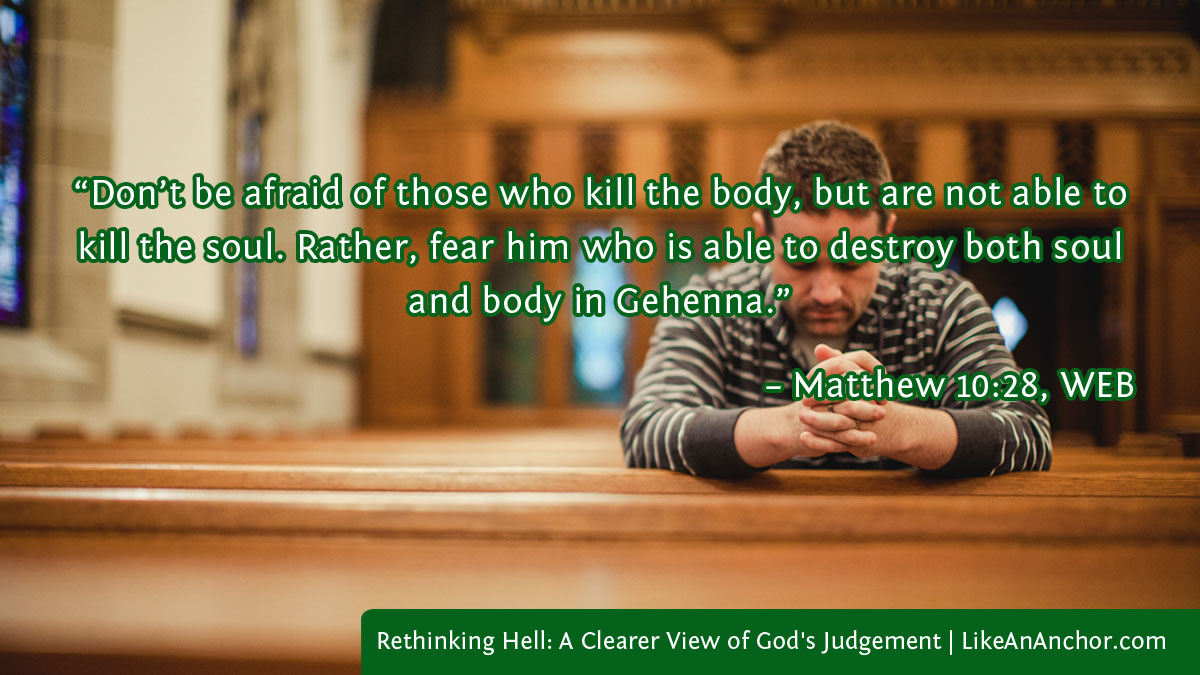
While the Bible does speak of a burning lake of fire, it doesn’t talk about humans staying there nor going there instantly when they die. After people die, the prevailing Biblical description is that they’ve fallen asleep and are awaiting the resurrection (John 11:11-13; 1 Cor. 15:6, 18, 31; 1 Thes. 4:13-15; 5:10; 2 Pet. 3:4; Dan. 12:2; and many others). Some people — the “firstfruits” that we discussed in last week’s post– will be raised from the dead to eternal life at Jesus Christ’s second coming. The rest of the dead stay asleep until a second resurrection.

A Second Resurrection
We don’t actually get a whole lot of information about what happens after the first resurrection and the Millennial reign described in Revelation 20:1-6. We are told in the description of the first resurrection that “The rest of the dead did not come to life until the thousand years were finished” (Rev. 20:5, NET). Skipping to the end, we read this:
Then I saw a large white throne and the one who was seated on it; the earth and the heaven fled from his presence, and no place was found for them. And I saw the dead, the great and the small, standing before the throne. Then books were opened, and another book was opened—the book of life. So the dead were judged by what was written in the books, according to their deeds. The sea gave up the dead that were in it, and Death and Hades gave up the dead that were in them, and each one was judged according to his deeds. Then Death and Hades were thrown into the lake of fire. This is the second death—the lake of fire. If anyone’s name was not found written in the book of life, that person was thrown into the lake of fire.
Revelation 20:11-15, NET
At this point in the future, “the devil who deceived them” has already been “thrown into the lake of fire and sulfur, where the beast and the false prophet are too, and they will be tormented there day and night forever and ever” (Rev. 20:10, NET). That’s the only mention of eternal torment, though. The people who follow the devil die in the “second death.” They’ll be consumed, burned-up like the rubbish thrown in ghenna.
Death as the punishment for sin fits with God’s warnings to humanity from the very beginning (Gen. 2:15-17; 3:2-3). God’s message is consistent throughout scripture. If you follow His way, then you will live. If you do not, then you are choosing death.
I call heaven and earth to witness against you today that I have set before you life and death, the blessing and the curse. Therefore choose life, that you may live, you and your descendants, to love Yahweh your God, to obey his voice, and to cling to him; for he is your life, and the length of your days.
Deuteronomy 30:19-20, WEB
This message continues through the old and new testaments. Sin leads to death, but following God results in life (Rom. 6:22-23; 8:5-7; 2 Cor. 2:15-16; 1 John 3:14). God doesn’t control or manipulate us with the threat of everlasting punishment. He sets two very simple choices before us: life forever with Him, or permanent death.
- Note: you could argue my reading of everlasting punishment using verses like Matthew 25:41-46 and Mark 9:42-48. For Matthew 25, I would say that just because the fire is everlasting doesn’t mean the people cast in it stay alive, and that the phrase “everlasting punishment” can just as easily be read “punishment that is irreversible” (because they die in the second death, which fits with Rev. 20:15). For Mark 9, where “hell” is translated from ghenna, I really don’t know what the phrase “worm does not die” means. The Hebrew and Greek both refer to maggots/grubs such as would eat dead flesh, which doesn’t make much sense to me with either interpretation–if the people die, why don’t the worms? and if the people don’t die, why does it say “worm does not die” instead of something like “soul does not die”?
Readings on Judgement
Last week I spent quite a bit of time talking about N.T. Wright’s teachings on the resurrection. He has comparatively little to say about hell, though. He goes through the Medieval hell symbolism and meaning of Gehenna (p. 177-178), mentions that while final judgement was accepted as part of God’s plan it wasn’t widely discussed in the epistles (p. 177), and covers different modern views on hell (p. 178). What he does state is that “God is utterly committed to set the world right in the end,” and that means there will be no people in His future world who worship “that which is not God as if it were” and who fail “fully to reflect the image of God” (p. 179).
God will condemn evil, and Wright thinks that those who reject God will “cease to bear the divine image at all” and continue to “exist in an ex-human state” (p. 182-183). That, however, ignores his own teaching that people do not inherently have immortal souls and doesn’t address what the Bible says about the lake of fire. I do, however, like the way Wright speaks of a “final condemnation for those who, by their idolatry, dehumanize themselves and drag others down with them” (p. 180). We know God doesn’t desire that any perish (1 Tim. 2:4; 2 Peter 3:9), but there will be people who end up in the lake of fire and this seems a good way of summing up their condition.

The Churches of God that I’ve attended with most of my life venture into more specifics about the final judgement. Their main teachings are well represented in United Church of God’s booklet “What Happens After Death?” In brief, it goes like this: Those who are not the firstfruits will be resurrected to physical life after the Millennium and given a chance to understand God’s word. After a period of time (some say 100 years) they’ll be judged and the ones who’ve refused to repent will die in the lake of fire. The others will live on in God’s kingdom.
This teaching holds great hope, as well as relief for our worries about people who have not yet committed their lives to Jesus. It also relieves us of a sense of urgency to convert people before they die because we believe there’s a time in the future when they’ll be given the chance to know Him. If they aren’t saved in this life, they’ll have an opportunity to escape eternal death in the second resurrection.
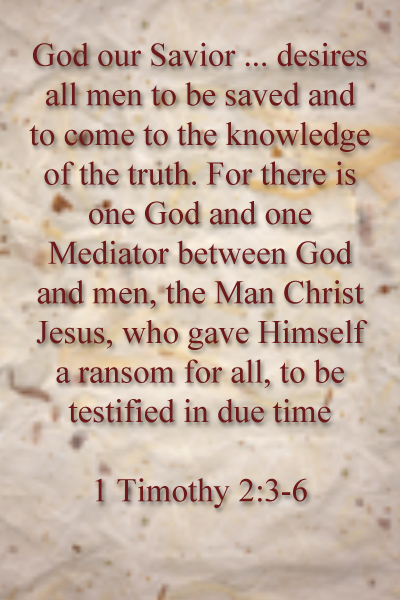
There are a few things that this interpretation doesn’t explain, though. One thing that has to do more with implications than accuracy is that lack of urgency to convert people. We know that God is the one who chooses whether to call someone and open their eyes, and that those who do not choose Him now will have an opportunity in the second resurrection. But we should still care about sharing His word with people today. We’re supposed to be like God, and since He “wants all people to be saved and to come to a knowledge of the truth” that should be our desire as well (1 Tim. 2:4, NET).
The time frame of this judgment is also in question. Romans 2:1-16 indicates that all will be judged based on their actions in this life. It talks of God exercising abundant mercy towards those who didn’t know Him and yet lived good lives, but there’s also the promise of “wrath and anger to those who live in selfish ambition and do not obey the truth but follow unrighteousness” (Rom. 2:8, NET). Yet if people are judged as soon as the books are opened in Rev. 20:12, what about the babies, children, and others who never had a chance to do works by which they could be judged? God’s mercy, justice, and love seems to demand they be given a chance to know Him, which implies a time-gap between resurrection and judgement but that is not explicit in the scripture.
Consistent, Trustworthy God

I don’t have all the answers. What I do know is that, in the years after Jesus’s original apostle’s death, Christian religion generally adopted a terrifying version of God who tortures unbelievers in hell for all eternity. Even if we don’t understand everything about God’s final plan for those who don’t know Him now, it is time to recapture a vision of God that is more consistent with how He reveals Himself as One who is love, justice, and mercy.
His justice demands recompense for sin, but He also has no desire that anyone perish (or suffer forever) and He will be merciful to everyone. For some, this mercy involves granting salvation because they come to repentance and follow Him with a pure heart. For others, that mercy involves letting them die the final, second death because they can’t be allowed to continue in rebellion against Him. That’s a God we can trust, One Who will keep His promises to reward those who follow Him with life and those who persist in disobedient rebellion with death.
Another thing I think we can say for certain is that it’s best to follow God now if we have that option, not to wait for what seems like a second-chance in the future. The firstfruits do receive a greater reward. If you are faithful to God, He will be faithful to reward you according to His promises. That’s what the church should be teaching–not threatening people with “you’ll burn in hell” but rather encouraging them to pursue God and take hold of the “better promises” and the “better resurrection” that comes with following Him now (Heb. 8:6; 11:35, WEB).
Featured image by Anggie from Lightstock

 Like An Anchor