Waiting In Hope

In the lady’s scripture writing group that I’m part of in our local church congregation, the theme for January is “Wait on the Lord.” When I was writing a scripture earlier this month, I noticed that some translations of Psalm 31:24 used the word “hope” and others used the word “wait.” Those are two very different words in English, so I wondered how they could be so connected in Hebrew that “hope” is just as good of a translation for the word as “wait.”

I’ve heard quite a few native English speakers describe Hebrew as weird and frustrating. How can you have words that mean completely opposite things depending on the context? It makes no sense! But the more I study the Bible and read about Hebrew language and thought, the more I appreciate that Hebrew isn’t a more limited language than English. It’s just a very different kind of language. Lois Tverberg compares languages to painting styles–Hebrew uses broader brush strokes and a more limited color pallet (i.e. number of words; about 8,000 for Hebrew) while English uses a fine-tipped brush, different colors, and more colors (there are about 100,000 English words). Language shapes so much of how we think, so if we want to understand the thought process of the people God used to write the Bible, it helps to learn more about the languages they used.

A Look At Hebrew Language

Be strong, and let your heart take courage,
    all you who hope in Yahweh.

Psalm 31:24, WEB

Be strong and confident,
all you who wait on the Lord.

Psalm 31:24, NET

In English, these different translations make it seem like the verse could mean two completely different things. For English speakers, hoping in Yahweh isn’t at all the same thing as waiting on the Lord. We think of hope as a feeling of expectation, desire, or trust (Oxford Languages via Google). Waiting is something we do until something else happens, a staying in place or delaying action (Oxford Languages via Google). If you’re excited about the thing you’re waiting on or trust that it could happen you might feel hope, but they’re not necessarily connected.

The Hebrew word translated either “hope in” or “wait on” is yachel/yahal (יָחַל, H3176). It’s a verb (action word) that is primarily translated “hope” in the KJV, but also “wait,” “trust,” and “tarry.” The Theological Wordbook of the Old Testament (TWOT) states that the word carries “the idea of ‘tarrying’ and ‘confident expectation, trust'” as well as “hope” (TWOT entry 859). They explain the hope-wait connection like this:

yahal is used of ‘expectation, hope’ which for the believer is closely linked with ‘faith, trust’ and results in ‘patient waiting.’ … This yahal ‘hope’ is not a pacifying wish of the imagination which drowns out troubles, nor is it uncertain (as in the Greek concept), but rather yahal ‘hope’ is the solid ground of expectation for the righteous.”

TWOT entry 859

Yahal “is a close synonym to batah ‘trust’ and qawa ‘wait for, hope for'” (TWOT 859). We won’t look at batah in this post, but most of the other verses I’ve been writing this month translate “wait” from the word qavah or qawa (קָוָה, H6960). This word “means to wait or to look for with eager expectation” (TWOT 1994). Qavah has to do with waiting in faith, trusting in God, hope for the future. The root verb qawa is most often translated “wait” and “look for” in the KJV. It’s the derivative noun tiqvah that’s usually translated “hope” or “expectation.” There are also several other words that can be translated “wait.” Some of these are also translated “hope,” including sabar/shabar (H7663: “to inspect, examine, wait, hope, wait upon [BDB]) and others without the hope connotation, such as chakah (H2442: “wait, wait for, await” [BDB]). We won’t dive into all these different words in this post, but I wanted to bring them up to demonstrate the wait/hope connection is woven throughout the language.

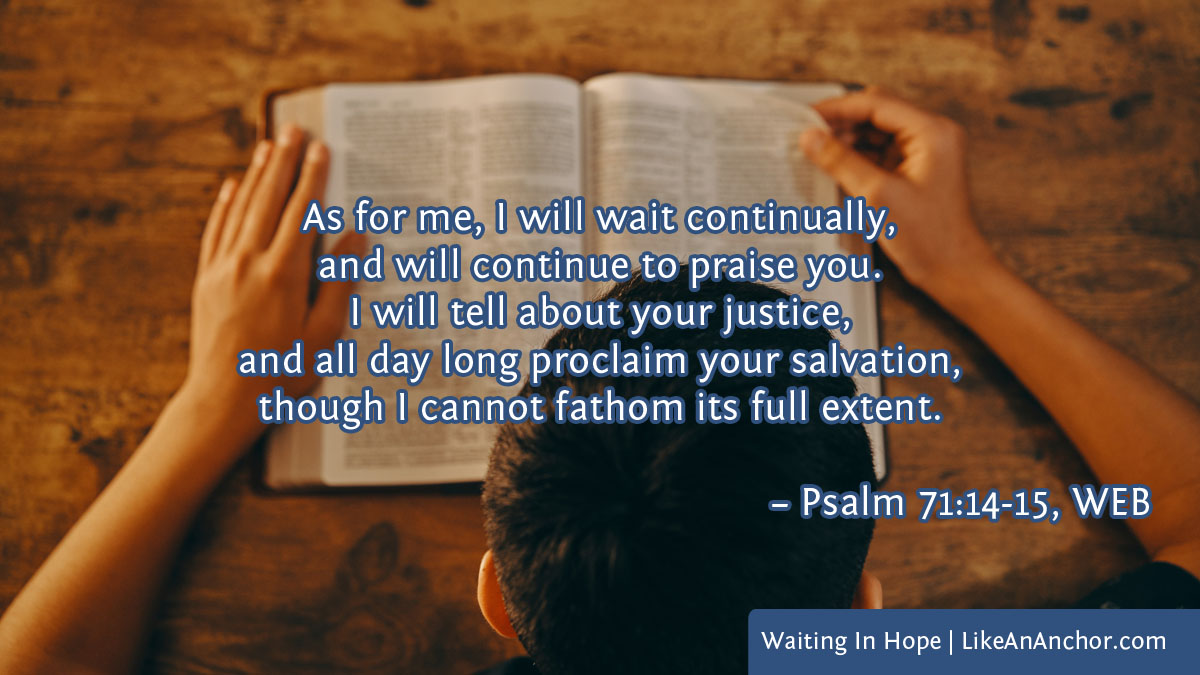
Image of a man reading the Bible overlaid with text from Psalm 71:14-15, WEB version: "As for me, I will wait continually, and will continue to praise you. I will tell about your justice, and all day long proclaim your salvation, though I cannot fathom its full extent."
Image by Matt Vasquez from Lightstock

Confident Expectation

Once I started thinking about “wait” and “hope” as being connected, it’s almost impossible not to see it. The first time the word yahal appears in the Bible is in Genesis 8:12. This is after the flood, while Noah, his family, and all the animals are still on the ark.

At the end of forty days, Noah opened the window of the ship which he had made, and he sent out a raven. It went back and forth, until the waters were dried up from the earth. He himself sent out a dove to see if the waters were abated from the surface of the ground, but the dove found no place to rest her foot, and she returned into the ship to him, for the waters were on the surface of the whole earth. He put out his hand, and took her, and brought her to him into the ship. He waited yet another seven days; and again he sent the dove out of the ship. The dove came back to him at evening and, behold, in her mouth was a freshly plucked olive leaf. So Noah knew that the waters were abated from the earth. He waited yet another seven days, and sent out the dove; and she didn’t return to him any more.

Genesis 8:6-14, WEB

There are two times in this passage where an English translation says, “He waited.” The first time, the Hebrew word is chûl/chı̂yl (H2342): “to twist, whirl, dance, writhe, fear, tremble, travail, be in anguish, be pained” (BDB definition). Clearly, this is not a hopeful sort of waiting. It’s an anxious waiting. But then, after the dove comes back with “a freshly plucked olive leaf” so that Noah knew the waters were starting to dry up, the type of waiting changes. This time, “he yahal yet another seven days.” Now, Noah had a reason to hope and the way that he waited changed.

Unfortunately, there isn’t an English word that would capture wait/hope as a dual meaning. Translators either have to pick one or the other, or replace the single word with a whole phrase that means something similar. The Amplified Bible translation (AMP) does this for yahal sometimes (though not in Genesis 8). AMP renders Psalm 31:24 as “Be strong and let your hearts take courage, All you who wait for and confidently expect the Lord.” That’s what Noah was doing, at least once he’d seen evidence that the earth was growing back after the flood.

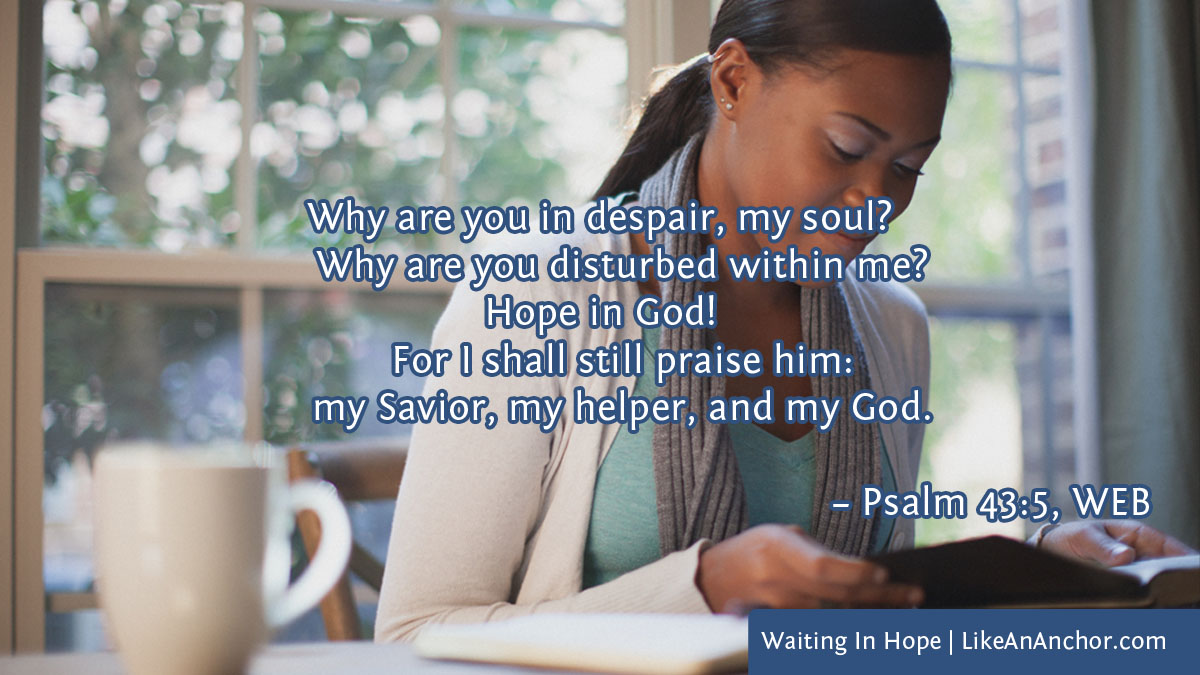
Image of a woman reading the Bible overlaid with text from Psalm 43:5, WEB version: "Why are you in despair, my soul? Why are you disturbed within me? Hope in God! For I shall still praise him: my Savior, my helper, and my God."
Image by Pearl from Lightstock

God Shows Up

When studying a Hebrew word, I often like to focus on how the word is used in Psalms because those songs are so much about the relationship between people and God. Relationships lie at the heart of Christianity, and I find it particularly insightful to look at how people of faith used certain words when recording their feelings, thoughts, and worship.

We see yahal in 19 verses in Psalms, including some that describe a situation where it doesn’t seem like “hope” is the expected response. While “hope” is the traditional default translation, the NET translators maintain that “to wait” is the “base meaning” of yahal and whether “the person waiting is hopeful or expectant” depends on context (footnote on Ps. 42:5). I wonder, though, if the authors meant there to be some hints of hope even in the ones where it doesn’t seem (to us) to fit the context. After all, there are other words the authors could have used for “wait.”

Behold, Yahweh’s eye is on those who fear him,
    on those who hope in his loving kindness,
    to deliver their soul from death,
    to keep them alive in famine.
Our soul has waited for Yahweh.
    He is our help and our shield.
For our heart rejoices in him,
    because we have trusted in his holy name.
Let your loving kindness be on us, Yahweh,
    since we have hoped in you.

Psalm 33:18-22, WEB

Here, “hope” is translated from yahal and “waited” from chakah (the NET translates all of them “wait”). Now, this one (Psalm 33) is a psalm of praise, and it makes sense to our minds that we’d see “hope” in this context. But we also see “I hope in you, Yahweh” (Ps. 38:15) in a psalm that begins with God’s indignation and wrath (Psalm 38) and the instruction “hope in” or “wait for” God (Ps. 42:5, 11; 43:5) when suffering despair and persecution (Psalms 42; 43). Those are the times when we need hope the most. And one of the reasons that we can have hope that’s a “confident expectation” rather than something uncertain is because God has showed up so many other times when we (and other people of faith) waited for Him.

A Sure, Certain Hope

Image of a woman looking up at the sky, overlaid with blog's title text and the words, "Several Hebrew words can be translated either "wait" or "hope." Learning about the wait-hope connection that Bible writers saw can help us hold on to hope today when we're waiting on God."
Image by Brightside Creative from Lightstock

One of God’s promises that we’re still waiting on is that He will resurrect all His faithful followers from the dead. That’s not something that’s happened yet. Like so many of God’s promises, some people (even in the 1st century, right after Jesus’s life, death, and resurrection) say that it won’t happen. But, as Paul points out, God’s track record proves that He can follow-through on His promises.

Now if Christ is being preached as raised from the dead, how can some of you say there is no resurrection of the dead? But if there is no resurrection of the dead, then not even Christ has been raised. And if Christ has not been raised, then our preaching is futile and your faith is empty. … And if Christ has not been raised, your faith is useless; you are still in your sins. Furthermore, those who have fallen asleep in Christ have also perished. For if only in this life we have hope in Christ, we should be pitied more than anyone. But now Christ has been raised from the dead, the firstfruits of those who have fallen asleep. 

1 Corinthians 15:12-14, 17-20, NET

For Paul, the fact that God the Father raised Jesus Christ from the dead proves that He will raise “those who have fallen asleep in Christ” as well. Our hope in the resurrection is a confident expectation because there’s already proof that God can do it, just like Noah’s hope that the water would recede became confident when he saw evidence of plant life on the earth.

You are my hiding place and my shield.
    I hope (yachal) in your word. …
Uphold me according to your word, that I may live.
    Let me not be ashamed of my hope (seber).

Psalm 119:114, 116, WEB

God’s word contains many promises that we can read about. They’re backed up by His proven character, and because He is trustworthy we know that when we wait hopefully, He’s not going to disappoint us or make it so that we’d be ashamed of following Him.

Being therefore justified by faith, we have peace with God through our Lord Jesus Christ; through whom we also have our access by faith into this grace in which we stand. We rejoice in hope of the glory of God. Not only this, but we also rejoice in our sufferings, knowing that suffering produces perseverance; and perseverance, proven character; and proven character, hope: and hope doesn’t disappoint us, because God’s love has been poured into our hearts through the Holy Spirit who was given to us. For while we were yet weak, at the right time Christ died for the ungodly. 

Romans 5:1-6, WEB

Just reading through the Bible and observing how people talk about hope, we can see that it’s connected with confident expectation and it’s something that Biblical writers treat as certain as long as it’s pointed towards God. Studying the Hebrew language a little bit more and learning that wait and hope are so closely connected in that language can help us understand on a deeper level how the Biblical writers understood hope and waiting on God. It can teach us about both the Old Testament, which was written in Hebrew, and the New Testament, which was written by Jewish people who were deeply influenced by their linguistic history. And that can help us hold on to hope today when we’re waiting on God to do something in our lives or fulfill His promises.


Featured image by Ben White

Keep Planting, Even If You’re Weeping

Last week, I’d stayed up later than usual and instead of reading a chapter in Acts before bed, I turned to the Psalms to find a short passage to read. I just happened to open the Bible (a Tree of Life Version that I keep in my nightstand) to Psalm 126. Something about this translation caught my eye, and it prompted today’s post. Here’s the full psalm to start us off:

When Adonai restored the captives of Zion,
it was as if we were dreaming.
Then our mouth was filled with laughter,
and our tongue with a song of joy.
Then they said among the nations,
Adonai has done great things for them.”
Adonai has done great things for us
    —we are joyful!
Restore us from captivity, Adonai,
like streams in the Negev.
Those who sow in tears
will reap with a song of joy.
Whoever keeps going out weeping,
    carrying his bag of seed,
will surely come back with a song of joy,
    carrying his sheaves.

Psalm 126, TLV

It’s that last verse that captured my attention: “Whoever keeps going out weeping, carrying his bag of seed, will surely come back with a song of joy, carrying his sheaves.” It might (if you’re at all familiar with American gospel songs and Protestant hymns) make you think of the 1874 hymn “Bringing in the Sheaves.” For me, the part that captured my attention is this “keeps going out” line.

Keeping Going Out

In Psalm 126:6, some translations simply say, “He who goes out weeping” (WEB) but the TLV and others like the NKJV include this sense of continuing to go out while you’re weeping. The setting for this psalm is restoration from captivity. Israel had gone into captivity, and now God delivered them and brought them back to the land. The psalmist is looking back on this and making an agricultural analogy.

Suppose you’re in the spring, ready to plant, but something happens. It’s a set back, a tragedy, a calamity, a grief-inducing event. It’s the sort of thing that would make you weep. At that point, you have a choice. You can “keep going out” and sowing into the future, or you could give up. But you know that if you want to reap a harvest, you need to plant seed. Similarly, the metaphorical future “harvest” that we get in our own lives is determined (at least in part) by what we “sow” now.

Do not be deceived. God will not be made a fool. For a person will reap what he sows, because the person who sows to his own flesh will reap corruption from the flesh, but the one who sows to the Spirit will reap eternal life from the Spirit. So we must not grow weary in doing good, for in due time we will reap, if we do not give up.

Galatians 6:7-9, NET

If the agricultural metaphor isn’t working for you, we can relate it to other things with a cause and effect. If you put a steady diet of unhealthy food into your body, you’ll get an unhealthy body; if you eat healthy foods, you’ll have a healthier body. Sowing (like how we eat and whether we exercise) is an investment in the future, for better or worse.

Notice that Paul says “we must not grow weary in doing good” and that we should “not give up.” Sowing is a long-term investment. It takes time for the seed to sprout, grow, and bear fruit. We might not see the results of it for quite some time. As Psalm 126 says we need to “keep going out” to sow, trusting that God will give us a good harvest.

Planting In Hope

The word “hope” isn’t used in the psalm that we’re looking at today, but it’s an essential ingredient for what we’re talking about here.

 For it is written in the law of Moses, “Do not muzzle an ox while it is treading out the grain.” God is not concerned here about oxen, is he? Or is he not surely speaking for our benefit? It was written for us, because the one plowing and threshing ought to work in hope of enjoying the harvest. 

1 Corinthians 9:9-10, NET (bold italics mark a quotation from Deut. 25:4)

Here, Paul is saying that teachers of the word have the right to make their living by preaching the gospel (1 Cor. 9). The basic principle is that if you put the work into something, you have a right to expect to enjoy the results of that labor. Hope in the Bible isn’t something nebulous. When hope is related to God, there’s a level of certainty to it. God provides a solid anchorage for our hope (Heb. 6:19), giving us good reason to confidently expect that if we keep going out sowing, we will eventually bring in a harvest with joy.

 Not only this, but we ourselves also, who have the firstfruits of the Spirit, groan inwardly as we eagerly await our adoption, the redemption of our bodies. For in hope we were saved. Now hope that is seen is not hope, because who hopes for what he sees? But if we hope for what we do not see, we eagerly wait for it with endurance.

Romans 8:23-25, NET

Come Back Rejoicing

One of the things that we humans can find frustrating is that God is a long-term thinker. When He promises to give us the desires of our heart, for example (Ps. 37:6), we want that to happen immediately. I didn’t expect it to take 15+ years and a healthy dose of heartache before He answered my prayers to be a wife and mother, but then I found myself marrying a wonderful man and just over a year later having a beautiful daughter with him. I don’t think I’d be so blessed now if I hadn’t continued “sowing into” my life and my relationship with God during the season of weeping.

When we read, “all things work together for good for those who love God, who are called according to his purpose” (Rom. 8:28, NET), we often forget that Paul is talking on a cosmic timescale. Before the statement about all things working together for good, he says, “I consider that our present sufferings cannot even be compared to the coming glory that will be revealed to us” (Rom. 8:18, NET; see Rom. 8:18-30). Sometimes–even often–a harvest of joy happens now, in our human lives. But even if it doesn’t happen now, it will certainly happen at the end if we don’t give up.

My aim is to know him [Jesus Christ], to experience the power of his resurrection, to share in his sufferings, and to be like him in his death, and so, somehow, to attain to the resurrection from the dead.

Not that I have already attained this—that is, I have not already been perfected—but I strive to lay hold of that for which Christ Jesus also laid hold of me. Brothers and sisters, I do not consider myself to have attained this. Instead I am single-minded: Forgetting the things that are behind and reaching out for the things that are ahead, with this goal in mind, I strive toward the prize of the upward call of God in Christ Jesus. Therefore let those of us who are “perfect” embrace this point of view. If you think otherwise, God will reveal to you the error of your ways.

Philippians 3:10-15, NET

Scripture encourages us to look beyond our immediate circumstances with hope, trusting in the glorious future that God has planned for us. Long-term, if we’re going to “reap” the future God promises to His firstfruits, we need to keep pressing on toward the goal of eternal life. It’s this perspective that lets us “consider it nothing but joy when you fall into all sorts of trials, because you know that the testing of your faith produces endurance” and endurance helps bring us to perfection (James 1:2-3, NET). You’ll reap blessings in this life as well (especially if you have a mindset that looks for and recognizes them), but the biggest blessings we have are the opportunity to become God’s children and the promise of eternal life forever with Him after He “harvests” us with great joy.


Featured image by vargazs from Pixabay

Song Recommendation: “Bringing In The Sheaves”

Praise When You Just Don’t Understand

It’s pretty easy to praise when something good happens. You realize that God protected you from an accident, or that He made things line up just right to get a better job. Or you just feel happy and blessed and that bubbles out in praise.

But what about when things don’t make sense and you’re studying and trying to find answers in the Bible but they don’t seem to be there? Or when something bad is happening and you know that there are commands to be joyful even in trials but you just don’t feel happy? Or when something happens to a friend and you don’t know the full story, but you’re upset along with them? Maybe praise is the farthest thing from your mind and instead you just feel confused, angry, or betrayed.

Or what about the times when you take an objective look at your life, everything seems to be going well, but you still feel anxious or depressed? Sometimes the things we’re struggling with are inside our heads, and from the outside it looks like everything’s going great. How do you praise God in those moments, when you’re not sure why you feel terrible and when you might even feel guilty for struggling because God has blessed you so richly?

When we feel confusion, hurt, anger, or anything else that makes it hard to praise God we often also feel distant from Him. God didn’t go anywhere, so it’s up to us to reach out to Him and ask Him to help us feel His presence again. I touched on this topic years ago when I wrote about a breakup and MercyMe’s song “Even If” and also in another study about Lamentations 3. But those were more about hope and trust, and today I want to talk about praise when things don’t make sense to us.

Image of a woman with her hand lifted in praise overlaid with text from 1 Cor. 13:8-10, 12, NET version: “Love never ends. But if there are prophecies, they will be set aside; if there are tongues, they will cease; if there is knowledge, it will be set aside. For we know in part, and we prophesy in part, but when what is perfect comes, the partial will be set aside.  ... then I will know fully, just as I have been fully known.”
Image by Pearl from Lightstock

Remember

Right now, I’m not in a season of my life where I feel super confused about what God is doing. Rather, I’m in a place where I can look back at times where I was confused and realize, “Oh, that’s what was going on.” For years, I’d been going through cycles of praying to God for a husband, going to Him for comfort with a broken heart, and asking if I should give up that dream because it didn’t seem like He was going to work things out for me to get married. And now here I am, getting married in just a few weeks and buying a house and talking about having kids. God didn’t work this out on the timeline I was expecting, but He worked it out better even than I expected; I still catch myself marveling at how good this relationship is and how happy I am with him.

It’s interesting looking back on how hopeless and confused I felt sometimes, knowing now how God was going to work things out. I do believe God allows us free will, and I’m not sure how much of this He had planned exactly, but it sure seems like He was working things out for me and my husband to be together. I want to remember this the next time I wonder what God is doing and why He hasn’t fixed things yet.

Then I thought, “I will appeal to this:
    the years of the right hand of the Most High.”
I will remember Yah’s deeds;
    for I will remember your wonders of old.
I will also meditate on all your work,
    and consider your doings.

Psalm 77:10-12, WEB

Over and over in the Bible, we’re admonished to remember. “Remember all Yahweh’s commandments, and do them,” “remember all the way which Yahweh your God has led you,” and that “your God redeemed you” (Num. 15:39; Deut. 8:2, 15:15 WEB). “Remember the words of the Lord Jesus,” “remember the former days, in which, after you were enlightened,” and “remember the words which were spoken before by the holy prophets and the commandment of us” (Acts 20:35; Heb. 10:32; 2 Pet. 3:2 WEB). Our memory of God’s goodness and faithfulness thus far gives us the hope needed to trust and praise Him when we’re in a season where we don’t know why He’s working the way He is.

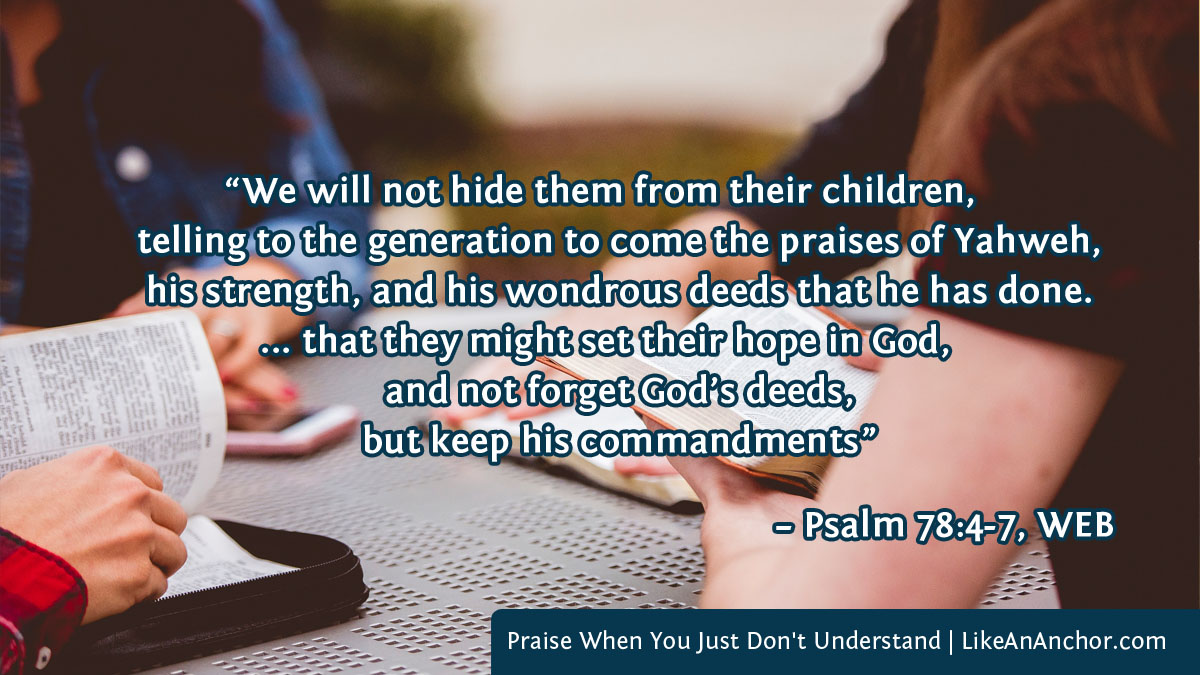
Image of four people sitting around a table studying the Bible, overlaid with text from Psalm 78:4-7, WEB version: “We will not hide them from their children, telling to the generation to come the praises of Yahweh, his strength, and his wondrous deeds that he has done. ... that they might set their hope in God, and not forget God’s deeds, but keep his commandments”
Image by Ben White from Lightstock

We Don’t Know The Full Measure

I feel like a lot of times, we can trace our fears, anger, confusion, and frustrations back to not understanding what God is doing. Deep down, we might feel like it’d be a whole lot easier to trust Him if He’d just explain Himself clearly. But God didn’t design us to be all-knowing; I doubt our human minds could handle a fraction of the information we’d need to truly understand things. When we realize that, sometimes we can flip the feeling of frustration with not knowing everything over into awe of the God who does know everything.

But I will always hope,
    and will add to all of your praise.
My mouth will tell about your righteousness,
    and of your salvation all day,
    though I don’t know its full measure.

Psalm 71:14-15, WEB

Psalm 71 is a prayer for protection, asking God not to disappoint you when you run to Him for refuge. There are people in the psalmist’s life hinting that God has forsaken him, but he calls on God to prove them wrong. Verse 15 caught my eye (and gave me the idea for this study) because of the psalmist’s promise to speak of God’s righteousness and salvation even though they don’t fully understand it.

The topic of voicing truths about God when you don’t understand what He’s doing makes me think of Job. God described him as a righteous man at the beginning of the book, but Job still went through horrible trials and the people who should have comforted him instead wanted to diagnose his moral failings. Job and his friends all missed that there was something else going on in the background that they didn’t understand. In the end, Job didn’t get answers to the questions that he’d asked God. Instead, God showed up in person to tell him that he didn’t know the full measure of what was going on (see my post “The Central Question of Job: A Broader Perspective On Suffering“).

Much like Job, we might not always understand why tough things are happening. We might go back and forth trying to figure out possible reasons. Sometimes it might actually be because we did something wrong and we need a wake-up call to change (which is what Job’s friends thought was going on there). Sometimes we might be trying to force our own will on a situation where we need to let go and let God work it out in His timing. Sometimes bad things happen because we live in a fallen world that’s imperfect and is full of other imperfect people who hurt us, intentionally or accidently. And sometimes there might be something going on in the background that we’re ignorant of (which is what was actually happening in Job’s story). No matter what the root cause, it’s important to seek God during these times.

Your hands have made me and formed me.
    Give me understanding, that I may learn your commandments.
Those who fear you will see me and be glad,
    because I have put my hope in your word.
Yahweh, I know that your judgments are righteous,
    that in faithfulness you have afflicted me.
Please let your loving kindness be for my comfort,
    according to your word to your servant.

Psalm 119:73-76, WEB

We can echo this psalmist in praying for understanding so we can obey God’s commandments, hope in his word, and trust in his righteousness. But we also need to make peace with the fact that we won’t always understand everything. That can be challenging for those of us whose relationship with God is largely intellectual, but it’s a truth we need to acknowledge if we’re going to make it past our own egos and have a humble relationship with God.

Balancing Humility and Knowledge

Image of a silhouetted person lifting their hands to pray with the blog's title text and the words "How do we keep on praising and trusting God when we don’t understand what He’s doing?"
Image by Brittney Borowski from Lightstock

When Paul wrote to the Corinthian church, one of the things he addressed in his first letter was a debate they were having regarding whether it was okay to eat meat that had been sacrificed in an idol’s temple, then sold in the market. The reminder he gives his readers for that topic is a good one to keep in mind for other situations as well.

 With regard to food sacrificed to idols, we know that “we all have knowledge.” Knowledge puffs up, but love builds up. If someone thinks he knows something, he does not yet know to the degree that he needs to know.

1 Corinthians 8:1-2, NET

Because God is working with us, we have a certain amount of knowledge. We can even say with accuracy that we know more than most people in the world, at least about the things of God (Ps. 119:99). We certainly shouldn’t devalue the knowledge we have or give up on deepening our knowledge of God (for example, Paul tells us to worship and sing praises with our understanding as well as our spirits/hearts [1 Cor. 14:15]). But we still only “know in part” (1 Cor. 13:9, 12, NET). We need to let the understanding God has blessed us with remind us to be humble before Him.

We need to strike a healthy balance between humility and knowledge. It shouldn’t really be all that difficult; the more we really know about and understand God the more our relationship with Him should inspire true humility in us. And this isn’t just something Paul talked about. Peter’s letters also remind us that humility is vital before God and that He grants deep knowledge to His people.

And all of you, clothe yourselves with humility toward one another, because God opposes the proud but gives grace to the humble. And God will exalt you in due time, if you humble yourselves under his mighty hand by casting all your cares on him because he cares for you.

1 Peter 5:5-7, bolt italics a quote from Prov 3:34 

May grace and peace be lavished on you as you grow in the rich knowledge of God and of Jesus our Lord! I can pray this because his divine power has bestowed on us everything necessary for life and godliness through the rich knowledge of the one who called us by his own glory and excellence.

2 Peter 1:2-3, NET

It can be frustrating to feel like things aren’t going the way you hoped or planned. It can be equally frustrating to feel like you don’t know what’s going on or aren’t sure what you should do next. It might even make us angry (if you’re struggling with anger or have in the past, I recommend checking out this thought provoking Truth Be Told podcast episode). Through whatever it is we’re struggling with or that we’re questioning, we need to remember the big picture.

God is in control. He is trustworthy now and in the future, just like He’s been trustworthy since the beginning of time. It’s okay for us not to know the “full measure;.” We don’t really need all the answers now. Let’s do our best to balance our knowledge (and our desire for knowledge) with humility to obey and trust God while also hoping in His promises and praising Him with all our hearts and minds.


Featured image by Shaun Menary from Lightstock

Spiritual Tenacity

The word “tenacity” comes into English “from Latin tenacitas ‘an act of holding fast,’ from tenax (genitive tenacis) ‘holding fast, gripping, clingy; firm, steadfast'” (Online Etymology Dictionary). It’s not a word that’s used in any of the Bible translations I frequently read (WEB, NET, TLV, KJV), but the same concept is expressed with terms such as “hold fast” or the related idea of endurance.

When we hold fast to something on a physical level, it’s either because we love it so much (e.g. hugging your child tight) or because we need something to keep us from falling or getting pulled away (e.g. clinging to a rope when climbing a cliff or holding onto a tree branch to keep from being swept away in a flash flood). Something similar is happening on a spiritual level.

When we’re living in covenant with God and have a relationship with Him, He wants a close and loving relationship with us. He also expects an exclusive relationship, but there are other things pulling at our time and attention that could draw us away from Him if we don’t hold on tight. Putting something before Him, making covenant relationships with conflicting things, or holding tight to something other than God would mean that we’re being unfaithful to Him (Ex. 34:12-14). In contrast, holding fast to God involves having a faithful, love-filled relationship with Him.

What are you Holding Onto?

In the Old Testament, Joshua warned ancient Israel about the importance of staying faithful to God. With God’s guidance, Joshua led them into the promised land, fought and conquered the land under God’s leadership, and saw the people settled in their promised inheritance. The surrounding nations weren’t completely gone, though, and neither were the influences from Israel’s past. So when Joshua was old, he called Israel together to give them instructions and warnings.

Therefore be very courageous to keep and to do all that is written in the book of the law of Moses, that you not turn away from it to the right hand or to the left; that you not come among these nations, these that remain among you; neither make mention of the name of their gods, nor cause to swear by them, neither serve them, nor bow down yourselves to them; but hold fast to Yahweh your God, as you have done to this day. …

“But if you do at all go back, and hold fast to the remnant of these nations, even these who remain among you, and make marriages with them, and go in to them, and they to you; know for a certainty that Yahweh your God will no longer drive these nations from out of your sight; but they shall be a snare and a trap to you, a scourge in your sides, and thorns in your eyes, until you perish from off this good land which Yahweh your God has given you.”

Joshua 23:6-8, 12-13, WEB (emphasis added)

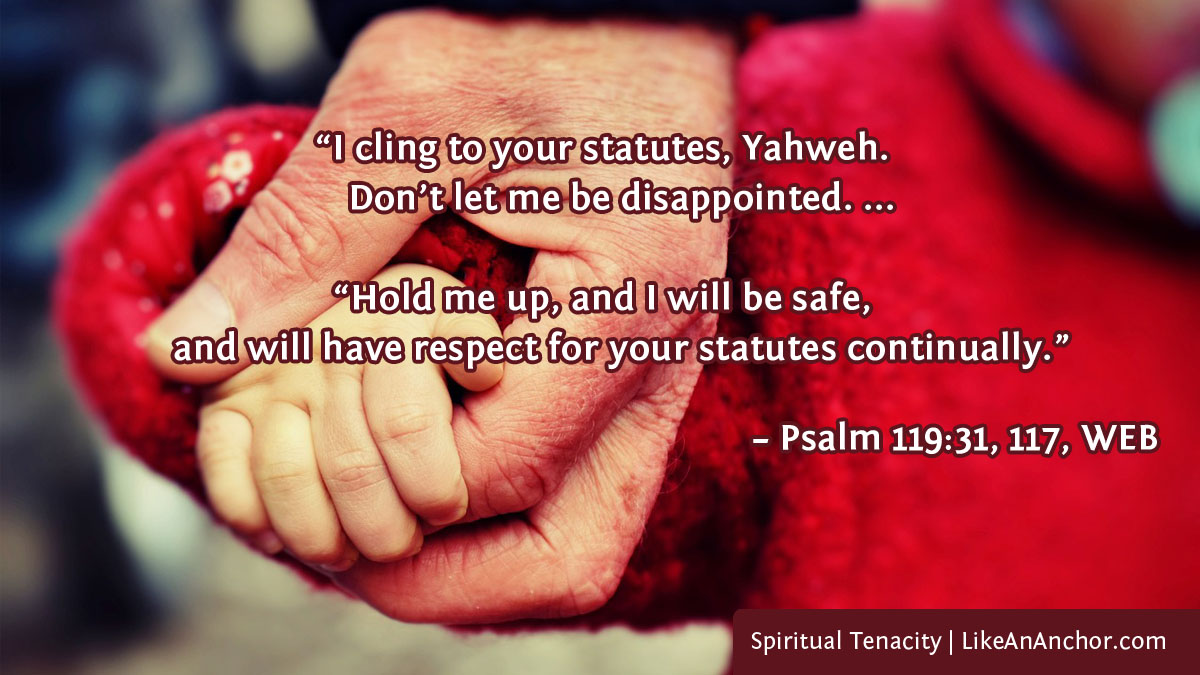
Here, Joshua presents the people with two options. They can “hold fast to Yahweh your God” or they could “hold fast” to the ungodly nations around them. Similarly, we see other people in the Bible holding fast to either good or bad things. A psalmist tells the Lord, “I hold fast to your rules” (Ps. 119:31, NET). Yahweh promises good things to those who “hold fast to my covenant” and keep the Sabbath (Is. 56:1-7, WEB). God praised Job to Satan as an example of “a pure and upright man,” saying, “he still holds firmly to his integrity” (Job 2:3, NET).

In contrast, there are others who “hold fast to their deception” (Jer. 8:5, NET). Proverbs says, “The evil deeds of the wicked ensnare him. The cords of his sin hold him firmly” (Prov. 5:22, WEB). Jesus chided people who rejected God’s law to “hold fast to human tradition” (Mark 7:1-8, NET). Clearly, we need to be careful what we’re clinging to. Are we holding on to God, or to things that are trying to tug us away from Him? Trying to do both isn’t going to work. “No man can serve two masters,” Jesus said, “for either he will hate the one, and love the other; or else he will hold to the one, and despise the other” (Matt. 6:24, KJV). We need to make sure the one we “hold to” is God.

Holding on to Hope

There are strict warnings about who or what we choose to hold onto in this life. We can’t have divided loyalties when we come to God. He’ll work with us through our doubts, but He expects us to choose Him when it comes down to it. The admonition to us today is still the same as the one Joshua gave Israel: “hold fast to Yahweh your God.”

God also told people in the Old Testament to hold onto His covenant, including the Sabbaths (which are a sign of being in covenant with God). That continues today. For example, Paul told the Corinthian church to “hold firm the traditions” and “hold firmly the word which I preached to you” in an epistle contextualized by his discussion of the Feast of Unleavened Bread (1 Cor. 11:2; 15:2, WEB). Paul also gave similar instructions in three other letters (2 Thes. 2:15; 1 Tim. 1:18-19; Tit. 1:8-9). We need to carefully hold on to the truth God gives us and obey his instructions. And when we do that, we’re holding on to some amazing things.

Christ is faithful as a Son over his house. We are his house, if we hold fast our confidence and the glorying of our hope firm to the end. … we have become partakers of Christ, if we hold the beginning of our confidence firm to the end.

Hebrews 3:6-7, 13 WEB (emphasis added)

Therefore since we have a great high priest who has passed through the heavens, Jesus the Son of God, let us hold fast to our confession. …

And let us hold unwaveringly to the hope that we confess, for the one who made the promise is trustworthy.

Hebrews 4:14; 10:23 NET (emphasis added)

 God wanted to demonstrate more clearly to the heirs of the promise that his purpose was unchangeable, and so he intervened with an oath, so that we who have found refuge in him may find strong encouragement to hold fast to the hope set before us through two unchangeable things, since it is impossible for God to lie. We have this hope as an anchor for the soul, sure and steadfast

Hebrews 6:17-19, NET (emphasis added)

Look how positive this wording is. We’re to “hold fast” to our confidence in Christ and the glory of hope, the confession of our faith and hope, and the hope of joy set before us in the future. Holding onto God, His word, righteousness, and goodness also means holding onto hope and joy. It makes me think back to part of our Isaiah study from earlier this year about the joy found in keeping covenant with God (see “Isaiah Study: Joy in the Sabbath Covenant With God“). In a close relationship with God, obedience flows naturally from love and honoring God brings joy while strengthening hope.

“Hold on to What You Have”

We can sum up the Bible’s “hold fast” instructions with this verse: “hold fast to what is good. Stay away from every form of evil” (1 Thes. 5:21-22, NET). Our spiritual walk requires tenacity–a conviction to hold tight to God and the goodness associated with Him while rejecting the things which would want to pull us away or present alternative things to cling to.

Something that helps us greatly in our quest to hold fast to good is that Jesus holds fast to us. He says that He and the Father hold Their people in Their hands (John 10:27-29). He also holds the keys to death, the spirits of God, the angels of the churches, and the keys to David’s kingdom–wonderous things we can only begin to understand (Rev. 1:16-18; 2:1; 3:1, 7). It’s in the letters to the churches in Revelation that Jesus describes Himself as holding these things, and it’s also here that He counsels us to keep holding on.

I am coming soon. Hold on to what you have so that no one can take away your crown. …  The one who has an ear had better hear what the Spirit says to the churches.

Revelation 3:11, 13, NET

The “crown” here “refers to a wreath … worn as a symbol of honor, victory, or as a badge of high office” (NET footnote on Rev. 3:11). It’s not so much a symbol of ruling as it is of victory. Think of the laurel crowns in ancient Rome and Greece that still influence our language today; we use the word “laurels” for “a tangible symbol signifying approval or distinction” (Vocabulary.com).

We’re part of a spiritual war. We’ve joined up on God’s side–the one guaranteed victory in the end. Until the time when we receive our crowns of victory, we’re called to be soldiers in a war that mostly takes place on a spiritual plane but also bleeds into the physical realm. I have a book about this called Like An Anchor Study Guide: The Armor of God coming out early next year, but for now I’ll direct you to my series of blog posts on Spiritual Warfare if you want to read more about this.

You will be hated by everyone because of my name. Yet not a hair of your head will perish. By your endurance you will gain your lives.

Luke 21:17-19, NET

Jesus Christ and God the Father are the ones who make victory possible. We get to play a role, too. It’s our job to hang on to them and endure. That’s how we win. Spiritual tenacity is a vital component to living a victorious, godly life.


Featured image by S. Hermann / F. Richter from Pixabay

Don’t Give Up! Keep Running Your Race of Faith Without Looking Back

Do you ever feel stuck in the past and discouraged by how hard it is to move forward? You’re a Christian and you know that’s supposed to give you hope, but somehow that just doesn’t seem to be the case.

It’s disheartening to feel as if you can’t move forward from your past or that there is no way out of your present. Especially if you feel like you’ve done something so wrong or your circumstances are so hopeless that there’s no point trying to fix things. These sorts of worries weigh us down emotionally and spiritually. They can make us feel heavy, foggy, and hopeless (and may lead to other symptoms of depression as well).

Jesus never promised that life as a Christian would be without trials. He only promised to help us through those trials, and since He has all power and authority in heaven and earth this is an incredible promise (Matt. 28:18). It can be easy, though, to lose sight of the big picture and get distracted by all sorts of nasty things that cling to us, weighing us down and making it hard to keep moving forward. We might wonder how to get unstuck, or even if it’s possible.

The Cage Door Is Open

One thing I’ve realized is that most of the things that are holding onto me are also, at least to some extent, things that I’m holding onto right back. Jesus promises to make us free and to wash us clean of any sin. If we stay in a cage or keep rolling in the dirt, then it’s not because He has failed in some way. It’s because we’re still susceptible to the attacks of the enemy and the pulls of the world.

I don’t say this to make us feel guilty or ashamed (that’s another thing that weighs us down, and shame is not a productive emotion). I want to encourage you to shift your perspective. Instead of seeing yourself as a victim trapped in a locked cage made from whatever’s holding on to you (fear, past sins, personal shortcomings, etc), you can picture yourself as someone in an open cage where God is holding the door and asking you to come out. He knows it’s hard. He knows it’s frightening. He knows there are often circumstances outside your control that keep pulling you backwards. But He isn’t giving up and He’ll be there patiently helping you for as long as it takes. Read more

Trusting God When You’re Confused By Him: A Study of Lamentations 3

A couple of weeks ago, we talked about the practice of lament. It’s something we rarely discuss in modern Christianity, but it makes up more than 1/3 of the psalms and you can find lament throughout the rest of scripture as well. Instead of hiding their pain, people who lament take it to God in prayer. They turn to Him, bring their complaint in an honest, heartfelt way, ask boldly for help and then, equally boldly, choose to trust in God. I ended that first post about learning how to lament with a quote from my favorite passage in Lamentations:

This I recall to my mind; therefore I have hope. It is because of Yahweh’s loving kindnesses that we are not consumed, because his compassion doesn’t fail. They are new every morning. Great is your faithfulness. “Yahweh is my portion,” says my soul. “Therefore I will hope in him.” (Lam. 3:21-24, all quotes from WEB translation)

This passage is lovely and hopeful, but it’s not the whole story of Jeremiah’s lament. It’s not even his concluding thought for this particular poem. Lament isn’t about convincing yourself to be happy. It’s about trusting God even when you’re not sure you want to. It’s about inviting Him to help you deal with hurt, loss, confusion, anger, and other complex, painful emotions. Hope is part of it, a key part, but there’s a lot more going on as well.

Feeling as If God Is Failing You

The third poem of Lamentations (each of the 5 chapters in this book is a separate poem) begins with the words, “I am the man who has seen affliction by the rod of his wrath.” Unlike other poems in Lamentations, Jeremiah doesn’t start by talking about all of the Lord’s people and how their sufferings affect them. This is about him and what God has done to him, personally. Jeremiah begins this poem talking about how it feels to believe that God is targeting him in particular for intense suffering. Read more