When we talk about psychological functions in Myers-Briggs® types, the tertiary function often gets over looked. Usually, we talk about the two that we use most often or about the inferior function that usually shows up under stress. These three functions are hugely important. Our dominant and co-pilot processes need to work together for us to have healthy, balanced personalities. And we need to understand the inferior function so we’re better equipped to recognize and deal with how we react to stressful situations. But the tertiary function is also important.
The tertiary function is also called the “relief function.” In Personality Hacker’s car model (affiliate link), they call it the 10-year-old because that’s the level of maturity this function typically has. Psychologist John Beebe named it the “Eternal Child” after one of Carl Jung’s archetypes. Though we don’t talk about this function nearly as much as some of the others, it’s also a key part of our personality. Understanding the tertiary function, and how it relates to the other functions, can really help us understand ourselves.
Growth And The Functions
In terms of typology, personal growth happens when we’re using both our introverted and our extroverted sides, as well as our judging and perceiving sides. Working to find a balance between our dominant and co-pilot processes leads to growth and change because we’re exercising all these aspects of our personality. Read more →
Stress is something we all have to deal with. It’s part of being human. But how we each react to stress is, at least partly, determined by our personality types.
Each personality type has four mental processes called “cognitive functions” that they use when living their day-to-day lives. These functions describe how our minds work. For example, an ESTJ type is most comfortable using Extroverted Thinking to make decisions in the outer world. That’s supported by their co-pilot Introverted Sensing, which is their preferred way to learn and process information. Then they have a tertiary process called Extroverted Intuition, which they’re not quite as comfortable with. The fourth function, in this case Introverted Feeling, is called the inferior process and it’s not well developed at all.
When we’re stressed-out our minds typically go to our inferior process. (We can also “loop” between our dominant and tertiary, but that’s a topic for another post). This explains why we start acting out of character when under stress. Stress throws off the familiar, comfortable balance of our mental processes and changes how we deal with things. And because we each use a different combination of these mental functions, a stress-response is going to look a little different for each type.
Why Study Stress-Responses?
Recognizing what a stress-reaction looks like for different types can help us in several ways. If you’re in any kind of relationship with someone, knowing what happens when they’re stressed can give you a different perspective on them when they start to act out a character. Instead of being puzzled by their behavior, you can recognize it as the way they respond to stress.
In terms of our relationship with ourselves, knowing our own stress reactions can help us recognize when we need to practice some self-care. If you’re starting to go into your inferior function, then it’s time to take a look at your life and figure out what’s the cause of your stress and how you can get yourself back into balance. Read more →
You know when you’re struggling with something bad that happened to you and someone says, “Just get over it,” but you know it’s not that simple? For some reason, this particular hurt lodged deep inside and letting go seems well-nigh impossible.
For this post, I’m not talking about a hurt like grief over losing someone you love. We know why things like that are hard to “get over,” and in many cases it wouldn’t be appropriate to move on quickly. Most people recognize that hurts of that sort require time to heal and grieve. I’m talking about interpersonal hurts that might seem “little,” but have a big impact anyway. For example…
You express an authentic part of yourself (like your happy, fun-loving side), then people assume that’s all there is to your personality.
You receive 99% positive feedback about a project, but that 1% haunts you anyway.
You help someone out of the goodness of your heart, but others misinterpret your motives.
You decide to open up to someone, then lie awake at night worrying about their reaction.
Hurts like this touch on the core of who we are and/or our relationships with other people. These hurts are often deeply individual, and others might not understand them. If you don’t care what other people think of you, then you’re not going to understand why someone else is so upset about the one person in their life who’s a critic. If you find it easy to adapt to different social situations, you might not understand why someone’s so upset about not being able to express their true self all the time.
The reason why things like this can hurt us so deeply is often nuanced and complicated, but it has a lot to do with how we use the Feeling sides of our personalities. Everyone has a Feeling side (whether or not there’s an F in your four-letter Myers-Briggs® type), and we each use this part of our personality a little differently. Read more →
I saw Black Panther yesterday, so naturally today’s post is a new installment in the superhero Myers-Briggs types series. I know I get pretty excited about most of the MCU films, but this one is seriously good. I love the hero characters and the principles they stand for like loyalty and peace. The acting is great, the plot’s tight, I love the music (I’m listening to the score as I type), and while it still has a superhero-movie feel it doesn’t shy away from digging into some really deep and difficult subjects.
T’Challa’s judging functions are pretty easy to pin-point: Fi/Te. But the fact that he uses Introverted Feeling and Extroverted Thinking when making decisions only tells us that he’s either a TJ or FP type. We’re going to need a little more to go on than just those two functions if we’re going to narrow-down a type for him. After Captain America: Civil War came out, most people typed T’Challa as an ISFP. However, a couple of the discussions I found online pointed out that he’s an ENTJ in the comics. I haven’t read the comics, though, so this typing is only going to focus on his film portrayal. From that, I ended up going with ISFP.
A Personal Code
Everyone has and uses both a Thinking and a Feeling mental process as part of their personality type. They’re both a “Judging” function, which means you use them to make decisions and answer “should” questions. The one you’re most comfortable with is either your driver process or co-pilot, and then its opposite is either your inferior or tertiary process. Personality Hacker uses nicknames for the Jungian cognitive functions, and I think they make it easier to talk about exactly what I mean when saying T’Challa uses Fi/Te when making decisions.
Introverted Feeling is nicknamed “Authenticity” and it’s an ISFP’s primary function. It’s an internally focused, subjective process that mostly boils down to making decisions based on what “feels right” to you. Unlike the Extroverted Feeling process, it’s not primarily worried about what other people think. Authenticity is concerned with making a decisions that lines up with one’s own personal beliefs. And that’s what we see in T’Challa.
Though T’Challa certainly cares for other people, when he makes decisions they’re in line with what he believes is right rather than what will make the majority of the people around him happy. Fi is the mental process that drives his decision at the end of the film to share Wakanda’s resources with the world (see — I told you we were going to talk spoilers). And this personal code is also why he let his father’s killer live at the end of Civil War. He discovered that killing an unarmed man for revenge wasn’t in line with his moral compass (though making sure he faces justice is). Similarly in this new film, he offered to save his cousin’s life even after the man tried to kill him and steal Wakanda.
Impersonal Logic
Extroverted Thinking, or “Effectiveness,” is a much more impersonal function than Introverted Feeling, though it’s still used for making decisions. It’s an ISFP’s fourth function — the one they’re least comfortable using.
Effectiveness users look for the most efficient answer to a question. In other words, this process makes decisions based on what’s going to work. This is why in Civil War T’Challa tells Natasha that he doesn’t approve of all the politics. It’s because a hundred people arguing in a room doesn’t seem like an effective or efficient way to actually get things done.
I also don’t think his decision to go after Bucky himself was just fueled by an emotional type of revenge. It was also a coldly logical assessment of the most efficient way to handle the problem since he knows that, as Black Panther, he can take down a super assassin. Since Te is where an ISFP goes when stressed, it makes sense that one of the times we most clearly see T’Challa using it is after his father’s murder.
Interacting With The Real World
SP types have a certain advantage in physically-demanding tasks since this mental process is so focused on real-time interaction with the outer world. While being the Black Panther certainly enhances T’Challa’s abilities as a warrior, this new film shows us that he’s quite capable without them. He displays the sort of “real-time kinetic” intelligence that Personality Hacker says characterizes types that use the Extroverted Sensing, or “Sensation,” process. On a side-note, the ritualistic combat you see in Black Panther is inspired by real-world African martial arts, which is pretty cool.
SP types thrive on being in the middle of the action. And since Sensation is their Learning/Perceiving function, this is also how they prefer to learn new information. The things they can experience and verify with their five senses are the things that seem most reliable. And they often use their skill for interacting with the real world in creative, productive ways, earning ISFPs nicknames like Artist, Composer, and Producer.
As an SP type, T’Challa isn’t content with delegating tasks and that he can do himself. He goes after his enemies personally, even when not required by tradition and ritual. And he doesn’t just want to read reports or have people come to him to say what’s going on in Wakanda. We see him visiting his people and interacting with their worlds first-hand. He’s also interactive when planing missions. For example, there’s an early scene in Black Panther where he’s watching a projection of a convoy he’s about to attack as part of a rescue mission and he picks up one of the projected trucks to move it around and get a closer look.
Possibilities and Patterns
As far as we know, T’Challa is the first Black Panther to reveal his powers to the world at large. And he’s certainly the first king of Wakanda to share their country’s secrets with the world. While there is a struggle between the part of him that believes in a vision for Wakanda’s future where they help the world and his duty as king to protect his own people above the others, the idealistic visionary side wins out.
An ISFP has Introverted Intuition as their tertiary or “10-year-old” mental process. It’s also called “Perspectives” and it functions as a pattern-recognition system. ISFPs typically have conscious access to their Perspectives function, but it’s not always reliable. T’Challa is mature enough to recognize this and does not rely on his Ni too much or make a rash decision based on it.
However, he’s also comfortable enough with Intuition to not shy away from what his friend Nakia and sister Shuri have to say about considering a future where Wakanda and its technology play a larger role in the world. And as an Ni-user myself, I find it very satisfying that Wakanda’s first outreach center will be built in the location where T’Challa’s father killed his own brother and abandoned the brother’s son to protect Wakanda’s secret. It brings the pattern together in a way that feels right.
If you enjoyed this post, check out my other MCU typings:
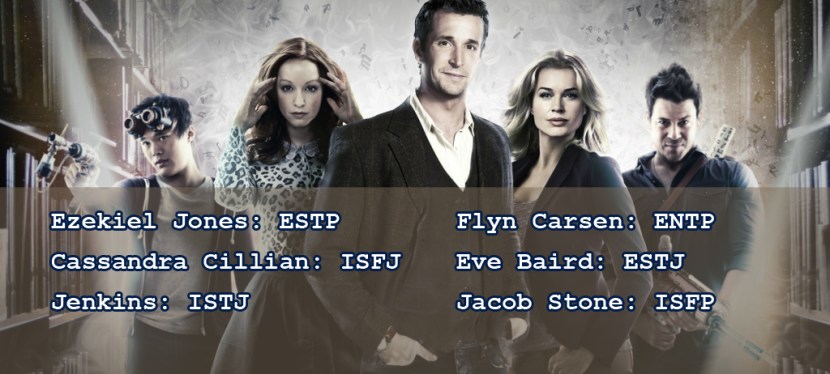
The Librarians is one of my favorite TV shows. What could be better than a team of bookworms saving the world from runaway magic? Sure it’s campy and can’t be taken too seriously, but isn’t that part of the appeal?
Typing fictional characters is one of my favorite things to do in blog posts. I’d started writing this one for last week, but when I realized how many of the Librarians characters are Sensing types I thought it’d be a great follow-up to my “Myths About Sensing Types” post. One of the more pervasive myths about Sensors is that they’re neither intelligent nor imaginative. Since all the main characters in this show except Flynn are Sensors, The Librarians provides a perfect example to the contrary.
Please note: I type using cognitive functions, which are the basis of Myers-Briggs theory. If you’re not familiar with this concept or want a refresher, check out this articles: The Simplest Guide To Myers-Briggs Functions Ever
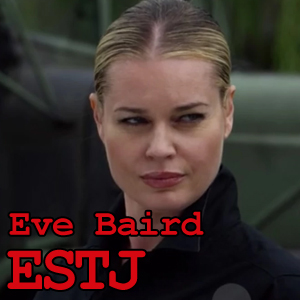
Eve Baird: ESTJ
Eve is the easiest character to type, partly because she’s such a stereotypical example of the type nicknamed “Supervisor” or “Guardian.” ESTJs are known for their blunt demeanor, no-nonsense attitudes, and ability to keep things moving forward. They also care about keeping the world running as it should be, a trait Eve devotes to keeping the Library safe and magical artifacts out of the wrong hands.
ESTJs lead with a judging function called Extroverted Thinking/Effectiveness. That means Eve’s preferred mental process involves measuring and managing impersonal criteria when making decisions. There are examples of this in literally every episode. Read more →
Last week I posted my chart with Disney villains Myers-Briggs types. It turned into such a big post that I finally split it in half — Sensing types in Part One and Intuitive types today in part two (some of you probably saw the whole post last week. It was live for a few hours before I decided splitting it up would be more manageable). To re-cap, here’s my criteria for which villains are included in this chart:
I then added a few other popular villains, paying special attention to the villains from films where I’ve already typed a Disney heroine.
To keep the number of villains manageable, I decided not to type any of their side-kicks or secondary villains.
I’m only typing the animated versions. This is mostly to maintain consistency, since sometimes the type changes in live-action reboots (such as Maleficent becoming more INFJ when she got her own film).
As I mentioned last week, if you compare this chart to the ones I made for Disney Princesses, you’ll see they’re almost opposite each other. The spots on the chart that stood empty for the Princesses (ENFJ, INTJ, INTP) now have at least one occupant and some of the spots bursting with princesses don’t have any villains at all. The biggest trend seems to be Feeling types equal “good” and Thinking types equal “evil” (which really bugs me, but that’s a rant for another time).
There’s not much to go on for typing some of the villains. They’re often caricatures of personality types rather than fully-fleshed out characters. By necessity, associating a villain with a certain types means looking at the most negative stereotypes of that type. But Disney typing is fun, so even when we don’t have much to work, I’m going to take a guess at the character. You’re welcome to shout-out in the comments about what you do and don’t like! Have fun 🙂
I love NF type villains. They’re not the typical choice for a fictional bad guy and their motives aren’t always immediately understandable, which is part of makes them an unexpected and unpredictable character.
Fe: Types that lead with Fe often have the easiest time connecting with people. Which means they can be the most charming, manipulative villains you’ll ever see. Hans’ entire plan is based on charming one of the sisters into marrying him (which he does easily by creating an instant connection with Anna). He’s also writing a narrative that makes him “the hero that’s going to save Arandel” as he manipulates all Elsa’s advisors until they’re begging him to be king.
Ni: This shows up in his long-term thinking. As the youngest of 13 brothers, he decided that taking over a different kingdom was better than the life he could see continuing on in the future at home.
Se: Typically a fun-loving and risk-taking aspect of personality, which helps him charm Anna initially and also shows up in his physical skills like dancing and swordfighting.
Ti: Logic is not an ENFJ’s strongest suit. Hans’ entire plan rests on getting people to feel the way he wants them to rather than not on something concrete and he doesn’t have a backup plan.
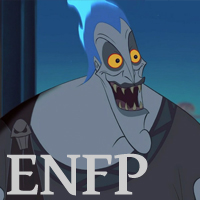
Hades — ENFP
There’s little disagreement that Disney’s Hades is an NP type and none at all that he’s an extrovert. People just can’t agree on Thinking or Feeling. Both ENxP types lead with Ne, so it comes down to whether he uses Fi/Te (ENFP) or Ti/Fe (ENTP) to make decisions. Read more →









 Like An Anchor