I’d been trying to decide what topic to write about this week, and then one morning I woke up with this phrase running through my head: “our salvation is now nearer than when we became believers.” I think I might have been dreaming about editing a blog post, since I woke up feeling like I needed to add it to an article. I couldn’t think of an existing post that needed editing, so I decided to look up where the quote came from, check out the context, and see where that took me.
Owe no one anything, except to love one another, for the one who loves his neighbor has fulfilled the law. For the commandments, “Do not commit adultery, do not murder, do not steal, do not covet,” (and if there is any other commandment) are summed up in this, “Love your neighbor as yourself.”Love does no wrong to a neighbor. Therefore love is the fulfillment of the law.
And do this because we know the time, that it is already the hour for us to awake from sleep, for our salvation is now nearer than when we became believers. The night has advanced toward dawn; the day is near. So then we must lay aside the works of darkness, and put on the weapons of light. Let us live decently as in the daytime, not in carousing and drunkenness, not in sexual immorality and sensuality, not in discord and jealousy. Instead, put on the Lord Jesus Christ, and make no provision for the flesh to arouse its desires.
I quote the first part of this passage a lot, but I always stop after the part about love fulfilling the law. If you keep reading, Paul adds a sense of urgency to his instruction to fulfill the law by loving each other. We should “do this because we know the time.” What does that mean? And if Paul could say, “the day is near” to readers almost 2,000 years ago, what would he say to us today?
Image by Chris Mainland from Lightstock
Getting Ready For the End
As you read the New Testament, it seems clear that the apostles originally thought Jesus’s second coming would happen in their lifetimes, but that they eventually realized it was farther off in the future. That didn’t soften their sense of urgency, though. Paul probably wrote Romans around 57 A.D. and John wrote his letters around 100 A.D., and yet they both have the same sense of urgency (dates from Britannica.com).
Do this, knowing the time, that it is already time for you to awaken out of sleep, for salvation is now nearer to us than when we first believed. The night is far gone, and the day is near. Let’s therefore throw off the deeds of darkness, and let’s put on the armor of light.
Romans 13:10-11, WEB
Little children, these are the end times, and as you heard that the Antichrist is coming, even now many antichrists have arisen. By this we know that it is the final hour.
1 John 2:18, WEB
One of the things that we can learn from this sense or urgency is that even if Jesus doesn’t return in our lifetimes, it’s useful to live as if He will. This is the final hour. The Day of the Lord is near. We do live in the end times. Whether Jesus returns in our lifetimes or not, we have a finite amount of time for our human lives here on this earth. And if God has opened our eyes to the truth, we’ve entered a relationship with Him and committed to following Him in this life, then we’re part of His house and His judgement starts with us.
For the culmination of all things is near. So be self-controlled and sober-minded for the sake of prayer.Above all keep your love for one another fervent, because love covers a multitude of sins.
1 Peter 4:7-8, NET (bold italics mark a quotation from Prov. 10:12)
But let none of you suffer as a murderer or thief or criminal or as a troublemaker.But if you suffer as a Christian, do not be ashamed, but glorify God that you bear such a name.For it is time for judgment to begin, starting with the house of God. And if it starts with us, what will be the fate of those who are disobedient to the gospel of God?And ifthe righteous are barely saved, what will become ofthe ungodly and sinners?So then let those who suffer according to the will of God entrust their souls to a faithful Creator as they do good.
1 Peter 4:15-19, NET (bold italics mark a quotation from Prov. 11:31)
As the church of God (the faithful, believing body of Jesus Christ), we’re judged based on how we live our lives here on this earth. What happens to unbelievers is a little more vague, but their resurrection happens at a different time and their judgement is handled a little differently (see “Rethinking Hell: A Clearer View of God’s Judgement“). For us, though, this is our time to learn about God and live His way of life, with the hopeful expectation that in the final judgement after the resurrection we’ll hear “well done, good and faithful servant” (“Rethinking Heaven: Capturing A Vision Of The Resurrection“).
Heading Toward Salvation
Image by Anggie from Lightstock
One of the interesting things about the verse we started with in Romans 13 is that Paul says, “our salvation is now nearer than when we became believers.” Modern Christianity tends to treat salvation as a thing that happens when you commit to Jesus Christ, but the New Testament writers treat salvation as a process that begins with our commitment to follow God for the rest of our lives (Phil 3:8-16, for example). This topic comes up in some of the most sobering warnings that Biblical writers deliver to New Covenant Christians.
Therefore leaving the teaching of the first principles of Christ, let’s press on to perfection—not laying again a foundation of repentance from dead works, of faith toward God, of the teaching of baptisms, of laying on of hands, of resurrection of the dead, and of eternal judgment. This will we do, if God permits. For concerning those who were once enlightened and tasted of the heavenly gift, and were made partakers of the Holy Spirit, and tasted the good word of God and the powers of the age to come,and then fell away, it is impossible to renew them again to repentance; seeing they crucify the Son of God for themselves again, and put him to open shame. For the land which has drunk the rain that comes often on it and produces a crop suitable for them for whose sake it is also tilled, receives blessing from God;but if it bears thorns and thistles, it is rejected and near being cursed, whose end is to be burned.
Hebrews 6:1-8, WEB
It is vital that we press on once the salvation process begins, building on the elementary principles we first learned. We’re supposed to grow as believers and become more and more like God the Father and Jesus Christ. If we’re not growing, then we’re falling away and that’s a dangerous thing. Notice, though, what the author of Hebrews says right after issuing this sobering warning.
But, beloved, we are persuaded of better things for you, and things that accompany salvation, even though we speak like this. For God is not unrighteous, so as to forget your work and the labor of love which you showed toward his name, in that you served the saints, and still do serve them. We desire that each one of you may show the same diligence to the fullness of hope even to the end, that you won’t be sluggish, but imitators of those who through faith and perseverance inherited the promises.
Hebrews 6:9-12, WEB
Though the author penned these warnings, he’s sure that the people he’s writing to are doing “better things … that accompany salvation.” The warning isn’t because he thinks they’re all about to miss out on eternal life, but because he wants them to be awake, diligent, and press on faithfully “even to the end.”
As we look at the world around us, many Christians feel that things are getting so bad it must be close to Jesus’s return. We’re not the first generation to feel this way, but whether we’re right or not we should live with a sense of urgency in our walk as believers. We’re not supposed to be afraid, but we are supposed to be aware of the dangers in complacency. It’s our duty to keep following God faithfully, holding onto the hope He has given us firmly, and keep learning and growing as part of our living, dynamic relationship with the Father and Jesus.
After I posted last week’s article, “What Happened to the Ritual Uncleanness Laws After Jesus’s Sacrifice?” I continued meditating on the ramifications of the changes we talked about in that post. I find it especially amazing to think about the difference in how easy it is to access God now.
For example, let’s say I lived during a time in the Old Testament history when Israel was mostly faithful to God and there was a temple with priests serving in it. Something wonderful happens, and I want to thank Yahweh for this gift. I can just pray, but I’m not King David or a prophet and probably don’t have the gift of the Holy Spirit and so maybe it doesn’t feel like that’s the best way to get God’s attention. But I know that the Torah says people can offer an offering to Yahweh with thanksgiving as the motivation (Lev. 7:11-15). I get everything ready to take that offering to the priests, but then my period starts. Now, I’m ritually unclean for at least the next 7 days and I can’t go into the temple or touch any holy thing. If I bled longer than that, I’d have to count 7 days after the bleeding stops, then go to the priest with “two turtledoves, or two young pigeons” as an offering to become ritually clean again. There are actually quite a lot of things that can make me “unclean,” blocking my access to God. Even when I’m clean, I don’t have the same access that a priest would or even a prophet. God doesn’t talk with me, unless I find myself in very unusual circumstances.
Today, if I want to thank God for something, I can do so very easily. I can approach the Father directly in prayer through the name of Jesus Christ whenever I want, and it’s as if I’m stepping into the most holy parts of the temple to come into God’s presence (John 16:23-27; Heb. 10:19-22). There aren’t restrictions on when I can do that, or things that make me so unclean I can’t come to Him in prayer. Even if I sin (which results in a type of defilement that still damages relationship with God), I still get to go to God directly through Jesus to repent and ask for forgiveness (1 John 1:5-10; 2:1-6). I don’t have to go through any other person or do any rituals in order to access God.
I think we take that level of access to God for granted. It doesn’t seem unusual to us; that’s just how it’s always been because we’ve only experienced a relationship with Him under the New Covenant and not under the Old. But when we study Old Testament believers, even considering all the things we have in common with them, it also highlights how much changed with Jesus’s sacrifice. This sort of study can give us a greater appreciation of everything that God the Father and Jesus the Lamb have done for us.
Image by Claudine Chaussé from Lightstock
A New, More Relational Covenant
If you’re reading this the day that it posted on my blog, then tomorrow night (the evening of April 21/beginning of Nisan 14) is when we’ll be keeping the Passover this year. When we keep the Passover as New Covenant Christians, it’s in remembrance of Jesus’s pivotal sacrifice and the commencement of the New Covenant.
For I received from the Lord what I also passed on to you, that the Lord Jesus on the night in which he was betrayed took bread, and after he had given thanks he broke it and said, “This is my body, which is for you. Do this in remembrance of me.” In the same way, he also took the cup after supper, saying, “This cup is the new covenant in my blood. Do this, every time you drink it, in remembrance of me.” For every time you eat this bread and drink the cup, you proclaim the Lord’s death until he comes.
1 Corinthians 11:23-26, NET
We’ll be gathering together to remember Jesus and what He did to enact a new covenant, which we’ve agreed to participate in. Passover commemorates the major turning point in God’s plan. For thousands of years, He’d promised His people that He would fix the relationship between them and replace the covenant that they broke with one that was even better. When Jesus died, that happened. The promised Messiah became the once-for-all-time sacrifice that forgives sin, the only High Priest we’ll ever need, and the Head of the body of believers that is the temple where God dwells.
But now Jesus has obtained a superior ministry, since the covenant that he mediates is also better and is enacted on better promises. For if that first covenant had been faultless, no one would have looked for a second one.But showing its fault, God says to them,
“Look, the days are coming, says the Lord, when I will complete a new covenant with the house of Israel and with the house of Judah. “It will not be like the covenantthat I made with their fathers, on the day when I took them by the hand to lead them out of Egypt, because they did not continue in my covenant and I had no regard for them, says the Lord. “For this is the covenant that I will establish with the house of Israel after those days, says the Lord. I will putmylaws in their mindsand I will inscribe them on their hearts. And I will be their God and they will be my people. “And there will be no need at allfor each one to teach his countryman or each one to teach his brother saying, ‘Know the Lord,’ since they will all know me, from the least to the greatest. “For I will be merciful toward their evil deeds, and their sins I will remember no longer.”
Hebrews 8:6-12, NET (bold italics mark a quotation from Jer 31:31-34)
God wants a deep relationship with His people. Notice His focus when describing the New Covenant. He’s writing His laws inside their minds and hearts (not just on scrolls they could hear someone else read). He’s inviting them to call Him their God and claiming them as His people. He promises, “they will all know me.” He also says He’ll be merciful to them and forget the sins that they should justly be punished for. He wants a new kind of relationship with people, one where they know Him at a heart-level and experience relational intimacy with Him. We have that new relationship now, or at least the opportunity for it, and we should appreciate what a great blessing that is.
Image by Pearl from Lightstock
Longing For God’s Presence
In the Old Testament, people placed a very high value on the privilege of encountering God’s presence, perhaps because it was more difficult for an average person to do that. They marvel that they’re able to visit God’s tabernacle or temple. They express delight in having any contact whatsoever with Yahweh. If God actually talked with them, they were awestruck and terrified.
David, one of God’s closest friends in the Old Testament, placed a very high value on the unique relationship he had with Yahweh. Speaking of himself, the king, he sang to God, “You make him glad with joy in your presence” (Ps. 21:6, WEB). When he committed a grave sin, he prayed, “Don’t throw me from your presence, and don’t take your Holy Spirit from me” (Ps. 51:11, WEB). David knew not to take God’s presence in his life for granted. It was precious, something to hold onto and value highly. Other psalmists had similar responses (Psalm 42:1-4; 73:28; 84:1-12).
How lovely are your dwellings, Yahweh of Armies! My soul longs, and even faints for the courts of Yahweh. My heart and my flesh cry out for the living God. …
Blessed are those who dwell in your house. They are always praising you. …
For a day in your courts is better than a thousand. I would rather be a doorkeeper in the house of my God, than to dwell in the tents of wickedness.
Psalm 84:1-2, 4, 10, WEB
When was the last time you genuinely longed for God this way? When you cried out for Him because you wanted to be in His presence, not because you wanted something from Him? When you wanted to be near Him, praising Him alongside His other covenant people? When you’d rather be at God’s house or temple (in the New Covenant, that temple is His people) for even just one day than have a thousand days anywhere else?
I’ve sang this psalm before (“Better Is One Day” and “Doorkeeper“), but I think I’ve been guilty of leaving the sentiment in the psalm behind after the music ends. Sometimes I forget to ask God to be with me unless I’m feeling lonely or hurt or in need of something from Him. I’m not always excited to go to church services and sing to God, at least not so excited that it overshadows how much I look forward to anything else.
Better To Walk With God Than Any Other Way
Image by Anggie from Lightstock
In the New Testament, expressions of thankfulness for the privilege of a close relationship with God seem quieter than the ones we find in the Old Testament. The New Testament doesn’t record new psalms or songs that highlight enthusiastic praises. Most of the New Testament is letters, and if we’re not paying close attention we might miss the passionate emotion behind those letters. But look at how Paul talked about his feelings regarding Jesus’s relationship with him.
If someone thinks he has good reasons to put confidence in human credentials, I have more …But these assets I have come to regard as liabilities because of Christ.More than that, I now regard all things as liabilities compared to the far greater value of knowing Christ Jesus my Lord, for whom I have suffered the loss of all things—indeed, I regard them as dung!—that I may gain Christ, and be found in him, not because I have my own righteousness derived from the law, but because I have the righteousness that comes by way of Christ’s faithfulness—a righteousness from God that is in fact based on Christ’s faithfulness.My aim is to know him, to experience the power of his resurrection, to share in his sufferings, and to be like him in his death, and so, somehow, to attain to the resurrection from the dead.
Philippians 3:4, 7-11, NET
Paul is expressing a very similar sentiment to what we see in Psalm 84, it’s just not as poetical. His main goal is to know Jesus and become like Him. Nothing else can possibly compare to the great honor of being “found in Him,” no matter how impressive it might look from a human perspective.
See how great a love the Father has given to us, that we should be called children of God! For this cause the world doesn’t know us, because it didn’t know him. Beloved, now we are children of God. It is not yet revealed what we will be; but we know that when he is revealed, we will be like him; for we will see him just as he is.
1 John 3:1-2, WEB
When we really let it sink in that God is making us His children, we should marvel at the greatness of His love. We’ll even get to be like Him in the future and “see him just as he is.” This is a level of closeness and relationship that the people in the Old Testament could only dream about; the psalms rarely mention God as a Father-figure (Ps. 2:7; 68:5; 89:26; 103:13) and the promise “I will be a father to you, and you will be my sons and daughters” wasn’t explicitly clear until the New Covenant (2 Cor. 6:18, NET). The faithful Old Covenant believers will get to experience the same future that we do–they’ll “be made perfect together with us” (Heb. 11:39-40, NET)–but we have a fuller taste during our human lives of the relationship that God wants to have with His people.
Rather than take the close, personal relationship we have with God for granted, we should be even more thankful for our access to God than the people writing Psalms were. It’s incredible that we can talk to and spend time with the creator of the universe, and that He wants us to call Him our Abba, Father (Rom. 8:15). What an incredible privilege to have such a relationship with God!
The law God delivered to Israel at Mount Sinai included different types of commands. Efforts to sort them into categories aren’t usually all that helpful, but there are some general observations we can make. It’s clear from reading the Torah that not every command carries the same “weight,” if I can use that imperfect term. For example, some of these laws clearly categorize certain behavior as “sin.” These require repentance and animal sacrifice to cleanse (for example, refusing to act as a witness or swearing a rash oath [Lev. 5:1, 4-6] ). Some sins are serious enough they couldn’t be cleansed that way, and resulted in the perpetrator being cut off from the covenant congregation or even executed unless they were directly forgiven by God (murder, for example, Num. 35:15-34; 2 Sam. 12:7-14). (Note: all sins ultimately result in death without God’s intervention, and in that sense there aren’t “worse” or “better” sins [Rom. 3:23; 6:23; Jam. 2:8-11]).
There are other commands in the law that don’t necessarily involve sin. These regard things that result in a person being “unclean” until a certain time, at which point they might wash or offer a small sacrifice. This “uncleanness” is related to being common or unsanctified–the opposite of being holy and set apart for sacred use. It’s not something we talk about much anymore, but it was very important to God in the Old Testament. So what happened?
When we do talk about this concept, we often refer to it as “ritual uncleanness” to differentiate it from “sinful uncleanness.” I’ve been pondering this concept for years, and I finally want to share a formal Bible study post on the subject. Please just keep in mind as you read that this is a big topic, and the depth of God’s truth is something we could study our whole human lives without learning everything. I might get some things wrong or not explain things the best way (which is why I’ve been reluctant to write on the topic), but I think there’s value in sharing things we’re still learning about so that we can grow and learn together.
What Makes Someone “Unclean”?
First, I do need to point out that there isn’t always a clear-cut division between sin and uncleanness. For example, in Leviticus 5:1-6 it talks about four things that can make a person guilty: refusing to testify as a witness, touching an unclean animal, touching “the uncleanness of man,” and swearing a rash oath. All those things required confession of sin and a trespass offering. This indicates a connection between certain types of uncleanness and sin.
However, there are other things that make someone unclean which have a different outcome. For example, in Leviticus 11 God shares a list of clean and unclean animals. Only the clean animals may be eaten or offered to Him as a sacrifice. For the unclean animals, He says, “By these you will become unclean: whoever touches their carcass shall be unclean until the evening” (Lev. 11:25, WEB). There’s no mention of a sin offering, simply an uncleanness that expires at the end of the day. That sort of uncleanness doesn’t get you into trouble unless you then do something that God tells you not to do while unclean (such as eat of a holy offering [Lev. 7:19-21]).
If you were ritually unclean, you could not enter the holy places (tabernacle or temple) or touch any holy thing until you became clean again (Lev. 12:4; 22:1-6; 2 Chr. 23:18-19). That cleansing might happen at a certain time, or after washing in water, or after offering a sacrifice. Sometimes cleansing involved a combination of those things, as for lepers (Lev. 14) and those with a “discharge” (Lev. 15). The reason for this hyper-focus on ritual cleanliness was God’s holiness and presence among the people.
You shall not make yourselves abominable with any creeping thing that creeps. You shall not make yourselves unclean with them, that you should be defiled by them. For I am Yahweh your God. Sanctify yourselves therefore, and be holy; for I am holy. You shall not defile yourselves with any kind of creeping thing that moves on the earth. For I am Yahweh who brought you up out of the land of Egypt, to be your God. You shall therefore be holy, for I am holy.
Leviticus 11:43-45, WEB
You shall have a trowel among your weapons. It shall be, when you relieve yourself, you shall dig with it, and shall turn back and cover your excrement; for Yahweh your God walks in the middle of your camp, to deliver you, and to give up your enemies before you. Therefore your camp shall be holy, that he may not see an unclean thing in you, and turn away from you.
Deuteronomy 23:13-15, WEB
There is “a distinction between the holy and the common, and between the unclean and the clean” (Lev. 10:10, WEB). God is holy and clean, and there are things that are part of being human in a post-fall world that are unholy or unclean. Remember, holiness involves “set-apartness” for sacred use (H6944 qodesh, BDB definition). People and things aren’t holy unless God makes them that way, separating them to Himself.
Image by Matt Vasquez from Lightstock
Does God Care About Cleanness in the New Testament?
We’re not told exactly why touching certain animals, a woman being on her period, or a man having leprosy make someone “unclean” in the ceremonial sense. But we do know that up to the time of Jesus, these ritual cleanliness laws were enforced. In one case, “ten men who were lepers met” Jesus, but “stood at a distance” as they cried out, “Jesus, Master, have mercy on us!” (Luke 17:12, WEB). Jesus told them to go show themselves to the priest, as the Law instructed so they could be declared ceremonially clean after being cured of leprosy.
But there was something different about Jesus. He didn’t seem concerned with the fact that they were ritually unclean. He even touched some of the lepers He healed (Matt. 8:3) and He let a bleeding woman touch Him (Luke 8:43-48). He could cleanse someone in an instant, from sin or from ritual impurity.
Today, we don’t tell a woman on her period that she can’t come before God’s presence in prayer or go to church, or tell her husband that if he touches any surface she does that he’s similarly restricted. And we’re right to do so, but why is that? What changed from the Old to New Testament that the things making people ritually unclean no longer seem to matter to God when they mattered so much before?
The interesting thing is, cleanliness does still matter to God. In the Greek, we often see the word “holy” used to translate the word hagios, where the “fundamental idea is separation, consecration, devotion to the service of Deity, sharing in God’s purity” (G40, Zodhiates). The word is also sometimes translated “saint,” on the assumption that all of God’s people are holy (Rom. 1:7; 15:25-26; 1 Cor. 1:2; 3:17; Heb. 3:1). In 1 Corinthians 7:14, hagios is contrasted with the word koinos, common, defiled, or “Levitically unclean” (G2839, Thayer).
And if a woman has a husband who is not a believer and he is happy to live with her, she should not divorce him.For the unbelieving husband is sanctified because of the wife, and the unbelieving wife because of her husband. Otherwise your children are unclean, but now they are holy.
1 Corinthians 7:13-14, NET
Notice that things here work differently than they did in the Old Testament. Then, if one of the holy people interacted with an unclean thing they became temporarily unclean. Now, if one of the holy people is married to an unbeliever, “the believer is not defiled by the unbeliever” (G37, Zodhiates). Rather, the unbeliever is sanctified by their association with the believer so that the children might be holy to God. Something changed between the Old and New Testament/Covenant so people set apart as holy to God aren’t defiled by “common” things. In at least some cases, they can even sanctify someone who isn’t one of God’s holy people.
Image by Inbetween from Lightstock
What Changed With Jesus’s Sacrifice?
Of course, the big change between Old and New Covenant happened with Jesus’s sacrifice. That sacrifice provided a different type of cleansing than the one provided by the washings, sacrifices, and rituals of the Old Covenant.
For the law possesses a shadow of the good things to come but not the reality itself, and is therefore completely unable, by the same sacrifices offered continually, year after year, to perfect those who come to worship.For otherwise would they not have ceased to be offered, since the worshipers would have been purified once for all and so have no further consciousness of sin?But in those sacrifices there is a reminder of sins year after year. For it is impossible for the blood of bulls and goats to take away sins. …
Therefore, brothers and sisters, since we have confidence to enter the sanctuary by the blood of Jesus, by the fresh and living way that he inaugurated for us through the curtain, that is, through his flesh,and since we have a great priest over the house of God, let us draw near with a sincere heart in the assurance that faith brings, because we have had our hearts sprinkled clean from an evil conscience and our bodies washed in pure water.
Hebrews 10:1-4, 19-22, NET
Sacrifices couldn’t perfect or purify people. But Jesus can, and because of Him we can confidently enter the holy sanctuary. Remember, unclean things can’t come into God’s presence. But God’s not interested in leaving barriers between Him and His people anymore. Jesus’s death tore the veil in the physical temple separating the Holy of Holies from the rest of the temple, and now the whole body of believers is the holy temple of God. Also, we can now enter God’s presence directly through Jesus in prayer. When we’re living in Him, we don’t have to worry about being ritually unclean and if we become sinfully unclean, we can still come straight to God and seek forgiveness (Heb. 4:14-16; 1 John 2:1-6).
Blessed is the God and Father of our Lord Jesus Christ, who has blessed us with every spiritual blessing in the heavenly realms in Christ. For he chose us in Christ before the foundation of the world that we should be holy and blameless before him in love.He did this by predestining us to adoption as his legal heirs through Jesus Christ, according to the pleasure of his will— to the praise of the glory of his grace that he has freely bestowed on us in his dearly loved Son.In him we have redemption through his blood, the forgiveness of our offenses, according to the riches of his grace that he lavished on us in all wisdom and insight.
Ephesians 1:3-8, NET
And you were at one time strangers and enemies in your minds as expressed through your evil deeds, but now he has reconciled you by his physical body through death to present you holy, without blemish, and blameless before him— if indeed you remain in the faith, established and firm, without shifting from the hope of the gospel that you heard.
Colossians 1:21-23, NET
Jesus’s sacrifice is what washes us clean from all impurity, including ritual uncleanness and sinful unholiness. In both Ephesians and Colossians, Paul points out that the Father chose to make us holy–part of the saints–and did that through Jesus Christ. We are holy, blameless, blemish-free, and washed clean, and we’ll stay that way “if indeed we remain in the faith.”
Do We Have A Role In Keeping Clean?
Image by Jantanee from Lightstock
Because of Jesus’s sacrifice, we don’t have to worry about the things related to ritual uncleanness anymore. Jesus makes us pure, holy, and washed clean. But as mentioned previously, some uncleanness comes from sin rather than simply from association with common things. Sin is a serious thing; it separates people from God (Is. 59:1-2). God does not want separation between us, so He’s working to make us holy but we also still need to honor God’s laws, avoid the type of uncleanness that comes from sin, and repent as soon as we become aware that we’ve missed the mark (1 John 1:5-10; 2:1-6).
This I say therefore, and testify in the Lord, that you no longer walk as the rest of the Gentiles also walk, in the futility of their mind, being darkened in their understanding, alienated from the life of God because of the ignorance that is in them, because of the hardening of their hearts. They, having become callous, gave themselves up to lust, to work all uncleanness with greediness. But you didn’t learn Christ that way, if indeed you heard him, and were taught in him, even as truth is in Jesus: that you put away, as concerning your former way of life, the old man that grows corrupt after the lusts of deceit, and that you be renewed in the spirit of your mind,and put on the new man, who in the likeness of God has been created in righteousness and holiness of truth. …
Be therefore imitators of God, as beloved children. Walk in love, even as Christ also loved us and gave himself up for us, an offering and a sacrifice to God for a sweet-smelling fragrance. But sexual immorality, and all uncleanness or covetousness, let it not even be mentioned among you, as becomes saints; nor filthiness, nor foolish talking, nor jesting, which are not appropriate, but rather giving of thanks. Know this for sure, that no sexually immoral person, nor unclean person, nor covetous man, who is an idolater, has any inheritance in the Kingdom of Christ and God.
Ephesians 4:17-24; 5:1-5, WEB
Here, “uncleanness” is translated from akathartos (G169). It means “not cleansed, unclean” in a ceremonial or moral sense (Thayer). It is an antonym of katharizo (G2511), “to make clean” physically, morally, or “in a levitical sense” (Thayer). Just a little later in the letter to the Ephesians, Paul says that Christ sanctified (hagiazo [G37], to make holy) and cleansed (katharizo) the church “with the washing of the water by the word, so that he may present the church to himself as glorious—not having a stain or wrinkle, or any such blemish, but holy and blameless” (Eph. 5:25-27, NET).
In the past, ritual uncleanness meant someone following God could not enter the holy places or touch any holy thing. The Father and Jesus erased that distance between Them and Their people by making us holy things that aren’t defiled by the commonness of the world. They also washed away the sins that distance us from God. The sins They’ve already washed can’t come back, but that doesn’t mean that we should go wallow in the filthiness of sin because Jesus cleaned us up. We don’t need to worry about ritual uncleanness, but we do need to make sure if we participate in sin that we repent and come back to Him for spiritual renewal and assistance to grow and change.
People often criticize Christians who still value God’s law by saying things like, “You pick and choose which ones to follow” or “The law was done away with!” I’ve addressed the latter argument in other posts, and I think this study on ritual uncleanness vs. sinful uncleanness helps answer the first criticism. There are some rules in the Old Covenant that don’t apply anymore because they were legal codes for ancient Israel. There are others that we don’t need to follow anymore because we don’t need to worry about ritual uncleanness. Then there are others that are part of God’s Law (which is connected to, but not exactly the same as the Old Covenant) and which both pre-date the Old Covenant (for example, Noah new about clean and unclean meat animals [Gen. 7:2; 8:20]) and which continue into the New Covenant (for example, the two greatest commandments and all the others that depend on them [Mark 12:28-34; Rom. 13:8-10]). Basically, we know we’re not under the Old Covenant; we’re under the New Covenant and in that covenant God makes us holy and writes His law inside our hearts (Heb. 8:6-13; 10:8-18). We still study God’s law to understand what He’s written inside us and we follow His law to honor Him and because it helps teach us how to be like Him.
If I mention the parable where a ruler travels to a far country and gives his servants money to do something with until he gets back, you likely think of the parable of the talents recorded in Matthew 25. It’s one of the most familiar parables in the Bible. There’s another parable in Luke 19, the parable of the minas, which I think is less familiar to people even though it’s very similar. I was curious to look at both and compare the two.
Chronologically, the Parable of the Minas comes first in the story of Jesus’s ministry. He shared this parable in Jericho as He was heading to Jerusalem for His final Passover (Luke 18:31; 19:1, 11, 28). The Parable of the Talents is also something He shared before His final Passover, but this time after He entered Jerusalem (Matt. 21); it’s part of what we call the Olivet Prophecy (Matt. 24-25). In between these parables, we have Jesus’s “Triumphal Entry” into Jerusalem (Matt. 21:1-11; Luke 19:28-40). As He approached the city, He sent two disciples ahead to fetch a donkey’s colt for Him to ride, fulfilling a prophecy recorded by Zechariah (Zech. 9:9).
As prophesied, “the whole crowd of his disciples began to rejoice and praise God with a loud voice for all the mighty works they had seen” (Luke 19:37, NET). They shouted praises to God, and connected Jesus’s entry to Jerusalem with a Messianic psalm, crying out “Hosanna to the Son of David! Blessed is the one who comes in the name of the Lord!Hosanna in the highest!” (Matt. 21:9-11, NET, quoting Ps 118:25-26). Hosanna literally means “Save us now” (Ps. 118:25, WEB) or “O Lord, save us” (NET footnote on Matthew 21:9).
They had Jesus’s identity right: He is the prophesied Messianic king. However, they didn’t understand that He was here this time to die for our sins and that His kingdom-bringing coming was still in the future. That misunderstanding is one of the reasons Jesus spoke the parables we’re looking at today.
Image by José Roberto Roquel from Lightstock
Kingdom Context
When Jesus entered Jericho on His way to Jerusalem, “a man named Zacchaeus … a chief tax collector” was so eager to see Him he climbed a tree to get up above the crowds. Jesus called to Him and said, “I must stay at your house today.” Zacchaeus was overjoyed, but the crowds murmured against Jesus for being “the guest of a man who is a sinner” because tax collectors were seen as traitors (NET footnote on Luke 3:12) (Luke 19:1-7).
But Zacchaeus stopped and said to the Lord, “Look, Lord, half of my possessions I now give to the poor, and if I have cheated anyone of anything, I am paying back four times as much!” Then Jesus said to him, “Today salvation has come to this household, because he too is a son of Abraham!For the Son of Man came to seek and to save the lost.”
While the people were listening to these things, Jesus proceeded to tell a parable, because he was near to Jerusalem, and because they thought that the kingdom of God was going to appear immediately.
Luke 19:8-11, NET
It’s not immediately apparent what the conversation with and about Zacchaeus might have to do with the parable of the minas, but that is clearly the context. Jesus makes the statement about salvation coming to Zacchaeus because “the Son of Man came to seek and to save the lost,” then immediately tells a parable to the people who were listening to those words. Luke tells us that Jesus shared this particular parable because people didn’t understand the timing for the kingdom of God.
Not long after, once Jesus was in Jerusalem, He spoke a parable about the kingdom, answered a question about the resurrection, and challenged people about how they viewed the Messiah (Matt. 22:1-14, 23-33, 41-46). He also spoke woes to “the experts in the law and the Pharisees” who taught God’s law, but don’t actually do what God expects (Matt. 23). Finally, as He walked away from the temple courts, He told His disciples that all those buildings would be torn down. This prompted them to ask Him a private question: “Tell us, when will these things happen? And what will be the sign of your coming and of the end of the age?” (Matt. 24:1-3, NET). Perhaps they’d understood the lesson of the first parable–the kingdom of God would not appear immediately–and now they wanted more information. Jesus did give them warning signs to watch out for, but rather than focusing on the “when,” He highlights how His disciples are to prepare for His second coming and what He expects from their conduct.
“Therefore you also must be ready, because the Son of Man will come at an hour when you do not expect him.
“Who then is the faithful and wise slave, whom the master has put in charge of his household, to give the other slaves their food at the proper time? Blessed is that slave whom the master finds at work when he comes. I tell you the truth, the master will put him in charge of all his possessions. But if that evil slave should say to himself, ‘My master is staying away a long time,’ and he begins to beat his fellow slaves and to eat and drink with drunkards, then the master of that slave will come on a day when he does not expect him and at an hour he does not foresee, and will cut him in two, and assign him a place with the hypocrites, where there will be weeping and gnashing of teeth.
Matthew 24:46-51, NET
This warning is the immediate lead-in to the parable of the 10 virgins, the parable of the talents, and the parable of the sheep and the goats. The word “slave” is used both here in the warning about being ready and in the parables of the talents and minas. In Greek, it’s the word doulos (G1401). It’s often translated “servant,” but “slave” or “bondservant” is a better translation. Doulos means “one who is in a permanent relation of servitude to another, his will being altogether consumed in the will of the other” (The Complete WordStudy Dictionary: New Testament, Spiros Zodhiates, entry 1401). It could be involuntary slavery, or voluntary and total submission to God. Paul and other apostles frequently use the word to refer to themselves and others serving God, including at times every Christian (Rom. 1:1; Gal. 1:10; Phil. 1:1; Col. 4:12; 2 Tim. 2:24; Tit. 1:1; Jas. 1:1; 1 Pet. 2:16; 2 Pet. 1:1; Jude 1:1). Even Jesus Himself was a doulos of the Father (Phil. 2:7).
I wanted to spend some time on this word before we get into the parables themselves because it’s easy to misunderstand, whichever translation you’re reading. The people in these parables are not hired servants who can just walk away whenever they want, but they’re also not in the terrible, involuntary condition that we think of when we read “slave” with our modern eyes. They are bound to the king in the parable the same way Paul was bound to Jesus Christ and God the Father.
Image by Matt Vasquez from Lightstock
The King Goes Away
The two parables begin in a similar fashion.
Therefore he said, “A nobleman went to a distant country to receive for himself a kingdom and then return.And he summoned ten of his slaves, gave them ten minas, and said to them, ‘Do business with these until I come back.’But his citizens hated him and sent a delegation after him, saying, ‘We do not want this man to be kingover us!’
Luke 19: 12-16, NET
“For it is like a man going on a journey, who summoned his slaves and entrusted his property to them. To one he gave five talents, to another two, and to another one, each according to his ability. Then he went on his journey.”
Matthew 25:14-15, NET
We’re talking about a lot of money in these parables. For the first, “A mina was a Greek monetary unit worth 100 denarii or about four months’ wages for an average worker based on a six-day work week” (NET footnote on Luke 19:13). Putting that in perspective, the median income of an American in 2022 was $37,600 a year, so four month’s wages would be about $12,533. That’s a pretty large sum of money to hand someone all at once, but the amount in the second parable is even larger.
In the second parable, Jesus says the man gives his slaves a talent. This “was a huge sum of money, equal to 6,000 denarii. One denarius was the usual day’s wage for a worker” (NET footnote on Matt. 18:24). That’s about 250 months, or almost 21 years worth of an average worker’s wages. Using our median American salary again, it’s about $783,333 for one talent. The one who got five talents would have about $3.9 million. A mina is a decent chunk of money, but a talent is an unbelievably large sum.
I wonder what people thought hearing these parables, especially the people who heard both parables. The 12 disciples would have heard both, and I doubt they were alone in following Jesus all the way to Jerusalem and continuing to listen to Him. Imagine yourself listening to that first parable, possibly putting yourself inside the story. The boss called you, one of just 10 employees, and said, “Here’s $12,500 to do business with until I get back. Let’s see how you handle it.” Then you listen to the second parable, and it’s a similar situation except this time the boss calls just three of you in and gives one person $800,000, one person $1.6 million, and the last person $3.9 million. It might seem unfair, or leave you confused. You’d be hanging on every one of Jesus’s words to find out what happened next.
Image by Pearl from Lightstock
The Rewards
Some time passes in both parables. We don’t know how much, but there’s time for the bondservants to conduct business and increase the money they’d been entrusted with. Then the ruler returns, apparently without sending advance notice of the date of his arrival, the same way Jesus says He will at His second coming.
When he returned after receiving the kingdom, he summoned these slaves to whom he had given the money. He wanted to know how much they had earned by trading. So the first one came before him and said, ‘Sir, your mina has made ten minas more.’ And the king said to him, ‘Well done, good slave! Because you have been faithful in a very small matter, you will have authority over ten cities.’ Then the second one came and said, ‘Sir, your mina has made five minas.’ So the king said to him, ‘And you are to be over five cities.’
Luke 19: 15-18, NET
In this parable, the rewards are directly tied to the outcome. The king gave each bondservant identical amounts of money, and he rewarded them according to what they’d done with the money. The parable of the talents flips this.
The one who had received five talents went off right away and put his money to work and gained five more.In the same way, the one who had two gained two more. But the one who had received one talent went out and dug a hole in the ground and hid his master’s money in it.After a long time, the master of those slaves came and settled his accounts with them. The one who had received the five talents came and brought five more, saying, ‘Sir, you entrusted me with five talents. See, I have gained five more.’ His master answered, ‘Well done, good and faithful slave! You have been faithful in a few things. I will put you in charge of many things. Enter into the joy of your master.’ The one with the two talents also came and said, ‘Sir, you entrusted two talents to me. See, I have gained two more.’ His master answered, ‘Well done, good and faithful slave! You have been faithful with a few things. I will put you in charge of many things. Enter into the joy of your master.’
Matthew 25:16-23, NET
In this parable, the bondservants were given different amounts of money, to “each according to his ability” (Matt. 25:18, NET). Then the king came back, and the two who’d doubled the amount of money were given the same commendation for faithfulness and the promise that the king would put them “in charge of many things.”
I find it interesting that in the parable of the minas, everyone gets the same gift and then the rewards reflect what they did with the gift. Then in the parable of the talents, the gifts reflect the people’s known abilities and when they do something with the gift, they receive the same commendation. Taken together, I find both of them reassuring messages. They indicate that while God does pay attention to our abilities and what we do with the gifts He gives us, everyone who does something with those gifts receives a reward. And it’s a good reward, often with very little difference between what you get and what someone else gets.
Image by WhoisliketheLord Studio from Lightstock
The One Who Did Nothing
If the parables stopped there, the message wouldn’t contain any warning or urgency. But Jesus is trying to teach people about the kingdom of God. He wants them to know it’s not happening right now, but that they need to be doing something while they wait. And so we return to one last bondservant, one who didn’t do as the ruler expected with the gift he’d received.
Then another slave came and said, ‘Sir, here is your mina that I put away for safekeeping in a piece of cloth.For I was afraid of you, because you are a severe man. You withdraw what you did not deposit and reap what you did not sow.’ The king said to him, ‘I will judge you by your own words, you wicked slave! So you knew, did you, that I was a severe man, withdrawing what I didn’t deposit and reaping what I didn’t sow? Why then didn’t you put my money in the bank, so that when I returned I could have collected it with interest?’ And he said to his attendants, ‘Take the mina from him, and give it to the one who has ten.’But they said to him, ‘Sir, he has ten minas already!’‘I tell you that everyone who has will be given more, but from the one who does not have, even what he has will be taken away.’”
Luke 19: 20-26, NET
Then the one who had received the one talent came and said, ‘Sir, I knew that you were a hard man, harvesting where you did not sow, and gathering where you did not scatter seed, so I was afraid, and I went and hid your talent in the ground. See, you have what is yours.’ But his master answered, ‘Evil and lazy slave! So you knew that I harvest where I didn’t sow and gather where I didn’t scatter? Then you should have deposited my money with the bankers, and on my return I would have received my money back with interest!Therefore take the talent from him and give it to the one who has ten.For the one who has will be given more, and he will have more than enough. But the one who does not have, even what he has will be taken from him.And throw that worthless slave into the outer darkness, where there will be weeping and gnashing of teeth.’
Matthew 25:24-30, NET
The phrasing is almost exactly the same in the two parables. One bondservant hid the mina or talent and said it was because he was afraid. The ruler is harsh, he explained, and so it was better not to do anything at all. Maybe the bondservant was afraid of losing money, of not measuring up, and so he was paralyzed by his fear of imperfection (as we might be as Christians, if we worry that God will judge us harshly when we fail). Or perhaps the clue to this bondservant’s motive is in the master’s criticism of him as “evil and lazy;” maybe he knew to do better but thought he’d have more time or that it wasn’t all that important and so didn’t bother doing anything (as we might if we think God doesn’t or shouldn’t expect anything from us).
In both cases, the ruler judges the servant based on his own excuse. If the ruler is a harsh man who expects to receive something back that he didn’t work for himself, the bondservant could have at least put the money in the bank so it was earning interest. It did no good to anyone sitting in a hole in the ground or wrapped up in the back of a drawer. I often think of this as saying, “Well, God, you expect too much so I thought it would be better not to do anything” and having God say something like, “You could have at least gone to church and tithed to support other people who were doing what I asked them to.”
Image by Anggie from Lightstock
Though we’re living about 2,000 years after the people who first heard these parables, we’re in a very similar situation. We wonder when Jesus is coming back. Sometimes we think it could be very soon, sometimes it feels like a long way away. We need to remember that we are living in the end times (John said we have been since the first century [1 John 2:18]), but also that we’re not permitted to know the exact time of Jesus’s return (Acts 1:6-7). We also need to remember that what might seem like a delay is actually God showing great patience and mercy (2 Peter 3:8-10).
The parables of the talents and minas remind us that we have a responsibility to honor the master who gave us great gifts and asked us to do something with them while He’s gone. He is coming back and we’ll give an accounting to Him for how we’ve lived our lives and the choices we’ve made. That’s a good reminder for us, particularly now as we approach Passover this year mindful of Paul’s admonition to examine ourselves before participating in the Passover. God is merciful and gracious. He doesn’t expect too much of us, just that we stay faithful to Him and do something with the gifts He’s given us. If we find we’ve fallen short of that charge, we still have time to repent and ask Him for guidance to follow Him more faithfully.
As we approach Passover (Pesach) and the Feast of Unleavened Bread (Chag HaMatztot), I like to think about Jesus Christ’s sacrifice and the symbolism associated with that. For New Covenant believers, the principal symbols of Passover are foot washing, eating unleavened bread, and drinking red wine. Those are the three things Jesus did at His last Passover here on earth that He told His followers to continue doing (John 13:1-17; Luke 22:14-20).
Today, I want to specifically focus on the bread that symbolizes Jesus’s body. At first, I’d intended to study altars in the New Testament to dig into Hebrews 13:10 more deeply, but I was only a few minutes into that study when I felt prompted to take things in a different direction this week. We’ll still go to Hebrews, but from a different direction than I’d expected when I first started thinking about the topic.
Image by Matt Vasquez from Lightstock
The Bread of Life
Because of my focused interest in covenants, I typically spend more time in my Passover studies focused on the wine that Jesus described as “the new covenant in my blood” (Luke 22:20, NET). Today, though, let’s take a look at the bread part of the Passover service. Matthew and Mark’s accounts are nearly identical, so I’ll just quote one of them and Luke.
So the disciples did as Jesus had instructed them, and they prepared the Passover. When it was evening, he took his place at the table with the twelve. … While they were eating, Jesus took bread, and after giving thanks he broke it, gave it to his disciples, and said, “Take, eat, this is my body.”
Matthew 26:19-20, 26 NET
Now when the hour came, Jesus took his place at the table and the apostles joined him.And he said to them, “I have earnestly desired to eat this Passover with you before I suffer. …Then he took bread, and after giving thanks he broke it and gave it to them, saying, “This is my body which is given for you. Do this in remembrance of me.”
Luke 22:14-15, 19, NET
Here, Jesus and His disciples were observing the first holy time of the year on God’s sacred calendar. As commanded, they’re eating the Passover meal on the evening that begins Nisan 14 on the Hebrew calendar. Per Exodus 12:8, that meal includes “bread made without yeast” or “unleavened bread.” The bread was already there, but Jesus assigned a new, deeper meaning to it. Now when we take Passover, the unleavened bread we eat reminds us of Jesus’s body and His sacrifice. It might also remind us of a discussion recorded in John’s gospel.
Jesus’s miraculous feeding 5,000 people is recorded in every gospel (Matt. 14:13-21; Mark 6:30-34; Luke 9:10-16; John 6:1-13). Interestingly, John includes an extra piece of information: “Now the Jewish Feast of the Passover was near” (John 6:4, NET). This would be the Passover one year before Jesus’s death (NET footnote on John 6:4). John also goes on to describe what happened after the miracle. The crowds followed Jesus to the other side of the lake, hoping for more food. Jesus used the opportunity to talk to them about “food that remains to eternal life—the food which the Son of Man will give to you” (John 6:27, NET). Now, they thought this sounded like a pretty good deal, maybe even better than the manna in the wilderness (Ex. 16.4-36; John 6:28-34). They challenged Him to perform a miracle, and He challenged them to understand at a deeper level.
“I tell you the solemn truth, the one who believes has eternal life.I am the bread of life.Your ancestors ate the manna in the wilderness, and they died. This is the bread that has come down from heaven, so that a person may eat from it and not die. I am the living bread that came down from heaven. If anyone eats from this bread he will live forever. The bread that I will give for the life of the world is my flesh.”
Then the Jews who were hostile to Jesus began to argue with one another, “How can this man give us his flesh to eat?” Jesus said to them, “I tell you the solemn truth, unless you eat the flesh of the Son of Man and drink his blood, you have no life in yourselves. The one who eats my flesh and drinks my blood has eternal life, and I will raise him up on the last day.For my flesh is true food, and my blood is true drink. The one who eats my flesh and drinks my blood resides in me, and I in him.Just as the living Father sent me, and I live because of the Father, so the one who consumes me will live because of me. This is the bread that came down from heaven; it is not like the bread your ancestors ate, but then later died. The one who eats this bread will live forever.”
John 6:47-58, NET
My guess is that Jesus was thinking ahead one year, to the next Passover when He would tell His disciples the unleavened bread represented His body and the red wine His blood. He wants us to understand how much we need Him. Physical food keeps us alive for a while, but “eating” Him–taking Him inside us and accepting His sacrifice–is far more important. A real relationship with Jesus will keep us alive forever.
The author of Hebrews spends a lot of time explaining how the Old Testament sacrifices, tabernacle/temple, and priesthood all pointed to Jesus. Near the end of the book, the author says, “We have an altar that those who serve in the tabernacle have no right to eat from” (Heb. 13:10, NET). This hearkens back to an Old Covenant practice: the priests serving in the tabernacle or temple ate from the meat of the sacrifices offered in the temple (Lev. 10:10-18; Num. 18:22-24; 1 Cor. 9:13-14).
The priests and the Levites—all the tribe of Levi—shall have no portion nor inheritance with Israel. They shall eat the offerings of Yahweh made by fire and his portion. They shall have no inheritance among their brothers. Yahweh is their inheritance, as he has spoken to them. This shall be the priests’ due from the people, from those who offer a sacrifice, whether it be ox or sheep, that they shall give to the priest: the shoulder, the two cheeks, and the inner parts. You shall give him the first fruits of your grain, of your new wine, and of your oil, and the first of the fleece of your sheep. For Yahweh your God has chosen him out of all your tribes to stand to minister in Yahweh’s name, him and his sons forever.
Deuteronomy 18:1-5, WEB
The Levites–the tribe that all priests came from under the Old Covenant–didn’t inherit land with the rest of the tribes of Israel. Instead, they inherited a special relationship with Yahweh God. New Covenant believers do not directly correlate to the Old Testament priesthood, but we do have similarities with them and the Levites. Peter tells us we’re part of a “priesthood” and Revelation describes the saints as “priests” (1 Pet. 2:5, 9; Rev. 1:5-6; 20:5-6). We also don’t have an inheritance or citizenship on this earth; our citizenship is in heaven and our inheritance is connected with Jesus Christ (Rom. 8:16-17; Phil. 3:20). The verse we opened with from Hebrews indicates we have another similarity with them as well: we’re allowed to “eat from” the altar.
Jesus Christ is the same yesterday and today and forever! Do not be carried away by all sorts of strange teachings. For it is good for the heart to be strengthened by grace, not ritual meals, which have never benefited those who participated in them. We have an altar that those who serve in the tabernacle have no right to eat from. For the bodies of those animals whose blood the high priest brings into the sanctuary as an offering for sin are burned outside the camp. Therefore, to sanctify the people by his own blood, Jesus also suffered outside the camp.We must go out to him, then, outside the camp, bearing the abuse he experienced.
Hebrews 13:8-14, NET
The author of Hebrews just spent a huge section of this letter explaining that Jesus Christ is both the High Priest and the perfect, once-for-all-time sacrifice offered for sins (Heb. 8-10). If we get to “eat from” the altar where He offered His sacrifice, then we’re eating from Jesus Himself. It’s about partaking of His sacrifice, just like we do at Passover.
1 Corinthians is a letter closely tied to Passover and the Feast of Unleavened Bread. In that letter, Paul asks a rhetorical question about the Israelite priesthood: “Are not those who eat the sacrifices partners in the altar?” (1 Cor. 10:18, NET). The Greek word translated “partners” is koinonos (G2844), which also means “associate, comrade, companion … sharer, in anything” (Thayer’s Dictionary). It is the root word of “fellowship,” the Greek word koinonia (G2842), which describes a believer’s proper relationship with God and His whole family as a “fellowship, association, community, communion, joint participation” (Thayer’s Dictionary; see 1 John 1:3-7). It’s the word that’s translated “sharing” in the verses leading up to the one we just quoted:
I am speaking to thoughtful people. Consider what I say. Is not the cup of blessing that we bless a sharing in the blood of Christ? Is not the bread that we break a sharing in the body of Christ? Because there is one bread, we who are many are one body, for we all share the one bread. Look at the people of Israel. Are not those who eat the sacrifices partners in the altar?
1 Corinthians 10:15-18, NET
When we “eat” Jesus Christ’s symbolic body, we’re participating in the altar. Our part in the Passover service is to accept deliverance from God and confirm our covenant commitment to Him. Jesus is the only way to salvation; His sacrifice atones for our sins (Acts 4:11-12; 1 John 2:1-3; 4:9-10). It doesn’t just happen automatically, though: we’re expected to participate to a certain degree, namely, by repenting and believing and committing to follow Him (Mark 1:14-15; 16:16; Acts 2:37-38; Rom. 10:8-11). Once we do that, our lives should change. Passover reminds us of that every year.
For I received from the Lord what I also passed on to you, that the Lord Jesus on the night in which he was betrayed took bread, and after he had given thanks he broke it and said, “This is my body, which is for you. Do this in remembrance of me.” In the same way, he also took the cup after supper, saying, “This cup is the new covenant in my blood. Do this, every time you drink it, in remembrance of me.” For every time you eat this bread and drink the cup, you proclaim the Lord’s death until he comes.
For this reason, whoever eats the bread or drinks the cup of the Lord in an unworthy manner will be guilty of the body and blood of the Lord. A person should examine himself first, and in this way let him eat the bread and drink of the cup. For the one who eats and drinks without careful regard for the body eats and drinks judgment against himself. That is why many of you are weak and sick, and quite a few are dead.But if we examined ourselves, we would not be judged. But when we are judged by the Lord, we are disciplined so that we may not be condemned with the world.
1 Corinthians 11:23-32, NET
As Thayer’s Dictionary says when defining koinonia, our fellowship with God as part of His body of believers involves “joint participation.” When we participate in Passover, symbolically taking in the body of Jesus that He sacrificed for us, we’re part of something much bigger than ourselves. We’re reminding ourselves of the covenant commitment we made with God, of His sacrifice that we’ve accepted on our behalf, and of the way we ought to live as people transformed by Jesus. That’s one of the reasons we’re supposed to examine ourselves before taking the Passover–to make sure we’re doing so “in a worthy manner” that correctly values Jesus’s sacrifice and the fellowship God invites us into as part of His family.
A lot of times, I think we assume that Christianity is a New Testament religion and the Old Testament (OT) is just history or a book that the Jewish people use as their religious text. But if you read a translation of the New Testament (NT) like the New English Translation (NET) that highlights the times when Jesus and the NT writers quote the OT, you’ll see that the believers writing the NT were deeply connected to the OT.
When Jesus died and rose again, He didn’t invent a new religion and name it “Christianity.” He was there as the next step in God’s plan that stretches from Genesis to Revelation and beyond. Our faith is a continuation of what came before. Because of that, we have much more in common with Old Testament believers than we might initially assume. For one thing, we serve the same God. There are some major differences between the Old and New Testaments, but those differences have to do with updates and changes that God made to His relationship with people (and which He prophesied in the OT). God didn’t change, and His basic expectations for people as well as His preferred type of relationship with us didn’t change either.
Image by Lamppost Collective from Lightstock
1) We Are In Covenant With God
If you want to understand how God relates to human beings, you have to study covenants. That’s the structure that God uses for His relationships with people in the Old and New Testaments. They are binding agreements with expectations for both parties. Those expectations–the terms of the relationship agreement, if you will–are established by God. We get to decide if we agree to enter the covenant with Him or not, but we don’t get the option to change how the covenant works.
There are multiple covenants in the OT, but the ones we discuss most often are the Abrahamic Covenant and the Sinai Covenant. The “Old Covenant” usually refers to the Sinai Covenant. The laws given alongside that covenant are part of that covenant agreement, but in many cases also pre-date it (e.g. Noah knew about clean and unclean meats and how to build an altar to Yahweh [Gen. 7:2; 8:20]; Abraham and Jacob knew about tithing [Gen. 14:19-20; 28:20-22]; Joseph knew sleeping with Potiphar’s wife was a sin against God [Gen. 39:7-9]).
Just like us today, Old Testament believers were in covenant with God. Some were in multiple covenants (David, for example, was under the Old Covenant and he received a kingship covenant we call the Davidic Covenant). They couldn’t perfectly keep the covenants, though. God always holds up His side of covenants perfectly, but human beings aren’t that reliable and He knows it. That’s why He promised the Messiah would come, end the Old Covenant, die to free everyone from their sins by taking the penalty for them on Himself, and establish a New Covenant (Jer. 31:31-34; Heb. 8). We’re part of that New Covenant, which was one of the promises contained in the Old Covenant.
2) We Fall Short of God’s Standards
Like Old Covenant believers, the covenant agreement we’ve made with God includes expectations for our behavior and the way we properly relate to Him (Rom. 6; Gal. 5). But we’re human, and we all fall short of God’s perfect standards. The only human being who ever perfectly kept covenant with God is Jesus Christ. We might look back at ancient Israel’s example and think we’d never be as unfaithful and ungrateful as them, but NT writers have some stern warnings against such an assumption.
For I do not want you to be unaware, brothers and sisters, that our fathers … were all drinking from the spiritual rock that followed them, and the rock was Christ. But God was not pleased with most of them, for they were cut down in the wilderness.These things happened as examples for us, so that we will not crave evil things as they did. … These things happened to them as examples and were written for our instruction, on whom the ends of the ages have come. So let the one who thinks he is standing be careful that he does not fall.
1 Corinthians 10:1, 4-6, 11-12, NET
By and large, Old Covenant believers didn’t have the holy spirit or a personal relationship with God like we do (though there were exceptions, like David). But they weren’t unaware of God’s law or the covenant agreement they made. Two NT writers even go so far as to say they had the gospel preached to them just like we did (Heb. 4:1-2; 1 Pet. 4:5-6). Yet they still fell short. We have the same human tendencies, and we need to be on guard against making the same mistakes. And when we do sin (“miss the mark,” in Hebrew), we need to repent and ask for forgiveness.
Image by Alyssa Marie from Lightstock
3) Our Sins Are Purified by Blood
In the Old Covenant, God’s law commanded blood sacrifices of animals to atone for sins. God had very specific requirements for these sacrifices, and they needed to be repeated every time someone became aware of their own sin (see, for example, Leviticus 4:22-35). There was also a yearly sacrifice offered by the high priest on the Day of Atonement (Yom Kippur) to cleanse the people. God promised that if they did these things as commanded, “You shall be clean from all your sins before Yahweh” (Lev. 16:30, WEB).
The writer of Hebrews tells us that those sacrifices were not actually capable of perfecting the people worshiping God in the OT (Heb. 9:9; 10:1). In fact, “it is impossible for the blood of bulls and goats to take away sins” (Heb. 10:4, WEB). That does not mean God was lying when He told OT believers that He would forgive them. It means their forgiveness depended on something other than the animal sacrifices. Some of the OT believers even knew that; David wrote that sacrifices weren’t what God really desired (Ps. 40:6; 51:16-17) and Job knew that the Lord was his redeemer, not sacrificial offerings (Job 19:25-26).
For if the blood of goats and bulls and the ashes of a young cow sprinkled on those who are defiled consecrated them and provided ritual purity,how much more will the blood of Christ, who through the eternal Spirit offered himself without blemish to God, purify our consciences from dead works to worship the living God.
And so he is the mediator of a new covenant, so that those who are called may receive the eternal inheritance he has promised, since he died to set them free from the violations committed under the first covenant.
Hebrews 9:13-15, NET
The NT writers often treat us New Covenant believers as if we were once under the Old Covenant and are now free from it to live under the New Covenant. Paul in particular often talks about us previously living under that Old Covenant law even when he’s writing to Gentiles. He’s including us in the story of the plan of God, like we personally participate in the narrative of making a covenant with God, breaking it, needing redemption, being freed from sin by Christ, and entering a New Covenant with Him (e.g. Rom. 7:1-6). This connects us with the whole plan of God, and indicates that those who died in faith before Christ’s sacrifice are also set “free from the violations committed under the first covenant” by His redemptive work even though it happened after they’d lived and died.
But when this priest had offered one sacrifice for sins for all time, he sat down at the right hand of God, where he is now waiting untilhis enemies are made a footstool for his feet.For by one offering he has perfected for all time those who are made holy.
Hebrews 10:12-14, NET (italics mark allusion to Ps 110:1)
In Greek, “for all time” is translated from the phrase eis to dianekes.Eis (G1519) is a preposition meaning “into, unto, to, towards, for, among” (Thayer). To is the definite article (i.e. “the,” not always translated because Greek uses it more often than English). Dianekes (G1336) is an adjective meaning “continuously, continuous” (Thayer). The phrase only appears in Hebrews 10:12, 14 and it highlights that Jesus’s sacrifice is “continual, perpetual, protracted” (Zodhiates). Most certainly it covers from Jesus sacrifice onward into the future, but His sacrifice also covered those in the past to whom God had promised forgiveness.
4) We’re Called Out to be Different
We’re likely familiar with the New Testament instruction that Christians should be different from the world around us. We’re supposed to stand out like lights in a world of darkness (Matt. 5:13-16; Phil. 2:15). We’ve been chosen by God to belong to Him, to be different from the world, and to be visible examples of His way of life.
But you are a chosen race, a royal priesthood, a holy nation, a people of his own, so that you may proclaimthe virtues of the one who called you out of darkness into his marvelous light. You once were nota people, but now you are God’s people. You were shownno mercy, but now you have received mercy.
1 Peter 2:9-10, NET
The NET Bible marks allusions to OT passages with italics and direct quotes with bold italics. Here, Peter uses “various allusions and quotations from Exod 19:5-6; 23:22 (LXX); Isa 43:20-21; and Mal 3:17” and quotes “from Hos 1:6, 9; 2:23” (NET footnotes). He’s making the point that New Covenant believers are called out as God’s special people who belong to Him, and he’s doing that using Old Testament passages like this one:
For you are a holy people to Yahweh your God. Yahweh your God has chosen you to be a people for his own possession, above all peoples who are on the face of the earth.
Deuteronomy 7:6, WEB
In addition to being chosen as God’s own special people, OT believers were also intended to shine as lights in the world. The OT just uses different phrasing to make that point.
Behold, I have taught you statutes and ordinances, even as Yahweh my God commanded me, that you should do so in the middle of the land where you go in to possess it. Keep therefore and do them; for this is your wisdom and your understanding in the sight of the peoples who shall hear all these statutes and say, “Surely this great nation is a wise and understanding people.” For what great nation is there that has a god so near to them as Yahweh our God is whenever we call on him?What great nation is there that has statutes and ordinances so righteous as all this law which I set before you today?
Deuteronomy 4:5-8, WEB
People were supposed to be able to look at ancient Israel living in covenant with God and marvel at their wisdom, understanding, and greatness. We see this happening only very occasionally in Israel’s history (the reign of Solomon is the only example I can think of [1 Kings 4:34]). God’s not giving up on this goal, though (Isa. 62:1-2). People should be able to recognize us as God’s people. Jesus specifically says they’ll know we’re His disciples by the love we have for each other, and Paul says the same thing can happen when someone witnesses us prophesying in church (John 13:34-35; 1 Cor. 14:24-25).
5) The Greatest Thing We Can Do
Image by Lamppost Collective from Lightstock
God’s expectation and purpose for us haven’t changed that much since the time of His very first interactions with human beings. Jesus highlights this by pointing back to the Old Covenant when someone asked Him about the greatest commandment.
Now one of the experts in the law came and heard them debating. When he saw that Jesus answered them well, he asked him, “Which commandment is the most important of all?” Jesus answered, “The most important is: ‘Listen, Israel, the Lord our God, the Lord is one. Lovethe Lord your God with all your heart, with all your soul, with all your mind, and with all your strength.’The second is: ‘Love your neighbor as yourself.’ There is no other commandment greater than these.”
The expert in the law said to him, “That is true, Teacher; you are right to say that he is one, and there is no one else besides him.And to love him with all your heart, with all your mind, and with all your strength and to love your neighbor as yourself is more important than all burnt offerings and sacrifices.”When Jesus saw that he had answered thoughtfully, he said to him, “You are not far from the kingdom of God.” Then no one dared any longer to question him.
Mark 12:28-34, NET
The NET footnotes on these verses say they’re quoting Deuteronomy 4:35; 6:4-5; Leviticus 19:18, and Joshua 22:5. Because the expert in the law properly understood these commands from the Old Testament, Jesus told him he wasn’t “far from the kingdom of God.” That kingdom is what we’re striving toward as NT believers. We might not think that looking back to God’s commands from the Old Testament would help with that, but Jesus says that they do.
In the Old Testament and the New, God wants a relationship with human beings. Since the very beginning, He’s been working with groups of people that He chose and called out from the world. He welcomes them into covenant with Him, makes provision for when they fall short of His expectations, purifies them from their sins through sacrifice, and asks them to follow Him with their whole hearts. Many of the things that He asks of us today are the same things He wanted in His relationships with people in the Old Testament. Indeed, one of the reasons for the change of covenant was so that He could get closer to achieving that relationship (Eze. 11:17-20; 36:22-28; Jer. 31:31-34; 2 Cor. 6:16-18). Now, just as back then, He wants to be our God and He wants us to be His people, His sons and daughters.









![Image of several Bibles on a table as people study together, overlaid with text from Acts 10:14-15, 28, WEB version: But Peter said, “Not so, Lord; for I have never eaten
anything that is common or unclean.”
A voice came to him again the second time, “What God has cleansed, you must not call unclean.” ...
[Peter] said to them, “You yourselves know how it is an
unlawful thing for a man who is a Jew to join himself or come to one of another nation, but God has shown me that I shouldn’t call any man unholy or unclean.”](https://likeananchor.com/wp-content/uploads/2024/04/ritual-uncleanness-4.jpg)






![Image of a cup of wine and piece of flatbread overlaid with text from 1 Cor. 10:16, AMPC, version: “The cup of blessing [of wine at the Lord’s Supper] upon which we ask [God’s] blessing, does it not mean [that in drinking it] we participate in and share a
fellowship (a communion) in the blood of Christ (the Messiah)? The bread which we break, does it not mean [that in eating it] we participate in and share a
fellowship (a communion) in the body of Christ?”](https://likeananchor.com/wp-content/uploads/2024/03/eat-jesus-bread-4.jpg)
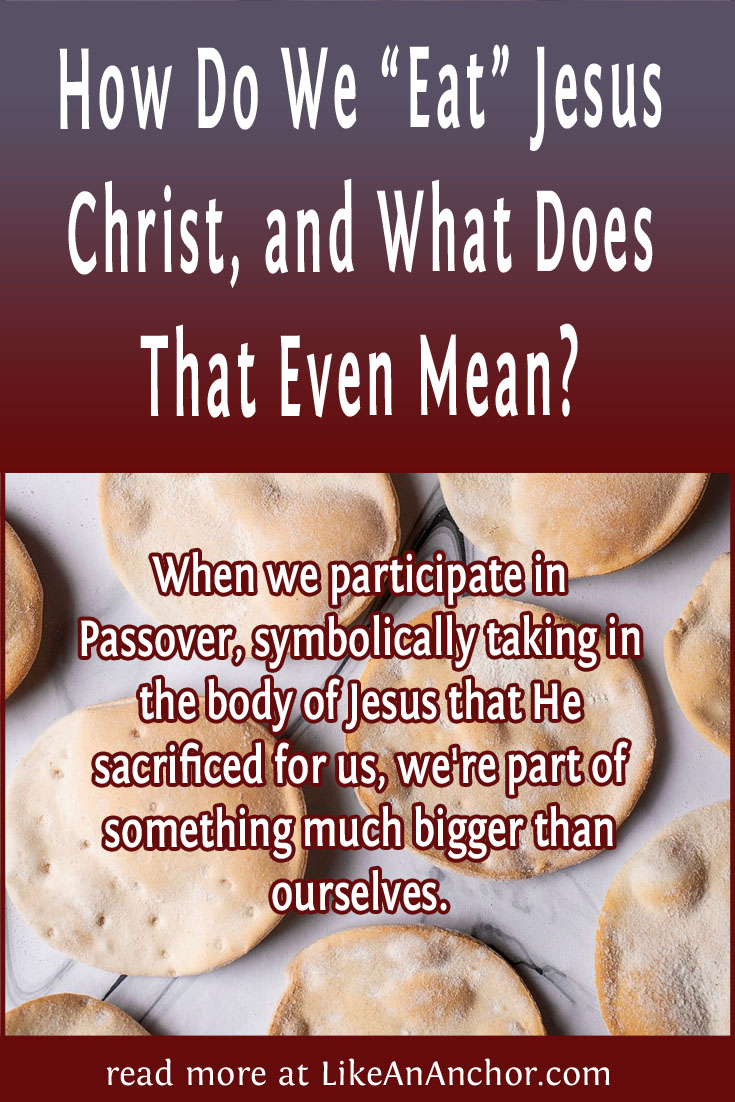



 Like An Anchor