The Need to Tend Our Spiritual Gardens

Suppose you and your neighbor were to plant a vegetable garden. One of you put the plants and seeds in, watered them once, then stepped back to let it all grow naturally. The other watered and weeded diligently, trimmed where needed, staked up the vines, and poured time and attention into the garden. The first will have a small harvest, if any, from plants choked by weeds and eaten by bugs. The second will enjoy a bountiful harvest of tasty, healthy vegetables. That’s the analogy Gary Thomas uses in his book Sacred Pathways to talk about growth in the Christian life.

“Some of us live with the mistaken impression that our faith needs only to be planted, not tended. Becoming a mature Christian, some think, is like becoming six feet tall — it either happens or it doesn’t. This is not the view of those who have written the classics of our faith or the view of the writers of scriptures (see, for example, Philippians 2:12-13; 1 Timothy 4:15-16; James 1:4; 2 Peter 1:5-11).” — Gary Thomas, Sacred Pathways, p. 232

The Bible is full of talk about spiritual growth and fruitfulness. We can’t do anything to earn salvation or accomplish reconciliation with God on our own — that only happens through the work of Jesus Christ. But once He gives us the precious gift of salvation He expects us to do something with it. That “something” can be summarized as “grow.”

Growing Your Gift

Examples of God’s expectation for growth are found in the parables of the talents and of the ten pounds. A lord goes to a far country, entrusting great wealth to his servants. When he returns, every servant who increased their gift (no matter by how much) is praised as “good and faithful,” and welcomed into the lord’s kingdom. There’s one servant, though, who did nothing with their gift except hide it. It sat in the ground, useless. This servant is the only one who is not praised. The lord actually takes their gift away and then casts them out (Matt. 25:14-30; Luke 19:11-27).

I honestly don’t see how people can read the Bible and still teach “once saved, always saved.” It is true that no one has the power to take you away from God (John 10:28-29), but you can reject God’s gift, or continue in sin without repenting, or neglect to use and grow what He’s given you (Heb. 10:26-31; Gal. 5:16-21; Matt. 18:21-35). Even the Apostle Paul didn’t think he could sit back and relax, assured that he’d get eternal life no matter what he did post-conversion (Phil. 3:11-14; 1 Cor. 9:27).

If we choose to do things that separate us from God and don’t then come back to Him and ask for forgiveness, we could miss out on the kingdom. God tells us how to get there and He even died to make it possible. He very much wants us to accept, use, and grow the gift He’s given us. But He won’t force us to.

The Need To Tend our Spiritual Gardens | LikeAnAnchor.com
Photo credit: J Garget via Pixabay

Tending To Your Salvation

Talking about how God can take back gifts which He gives (a Biblical idea that’s found right there in the Jesus’s parables) is not designed to make us live in a state of uncertainty and terror, wondering if we’re “really saved.” Paul clearly didn’t think he should live in despair and doubt because he hadn’t yet attained the end goal of a Christian life. On the contrary, it motivated him to keep growing and striving to follow God.

God doesn’t really ask much of us when you boil it all down. Just the things needed for a good relationship. Love Him. Respect Him. Abide by the boundaries He sets. Apologize if you do something to wrong Him. Use the gifts He’s given you instead of setting them aside like they don’t matter.

So then, my beloved, even as you have always obeyed, not only in my presence, but now much more in my absence, work out your own salvation with fear and trembling. For it is God who works in you both to will and to work, for his good pleasure. (Phil. 2:12-13, all quotes from WEB translation)

Salvation is something Jesus accomplished once for all humanity, and He is the only path to eternal life (Heb. 9:12; 10:11-12; Acts 4:12). Salvation is also a life-long process that we’re involved with as God works in and through us.

Be diligent in these things. Give yourself wholly to them, that your progress may be revealed to all. Pay attention to yourself and to your teaching. Continue in these things, for in doing this you will save both yourself and those who hear you. (1 Tim. 4:15-16)

Paul isn’t telling Timothy that he can save himself or his congregants in the same sense that Christ saved us. But he is pointing out that we are involved in the ongoing aspects of salvation. To return to the garden analogy, people can plant and water spiritual gardens but only God can make them grow (1 Cor. 3:6-9). We’re expected to work on growing, but God’s the one who makes all that growth possible.

The Need To Tend our Spiritual Gardens | LikeAnAnchor.com
Photo credit: congerdesign via Pixabay

Producing Fruit to Glorify God

Paul describes us in 1 Corinthians as “God’s farming.” In Romans, he uses another agricultural analogy by describing the people of God as trees with grafted branches. Israel is God’s olive tree, and when He opened salvation up to a wider group of people it was like He “grafted in” branches from wild olive trees. As the farmer, God is allowed to graft in or prune out as He pleases. He can even graft people back in after they’ve been cut out so long as they repent and turn back to Him in sincerer belief (Rom. 11:16-24). And we get to play a role in whether or not we stay grafted in.

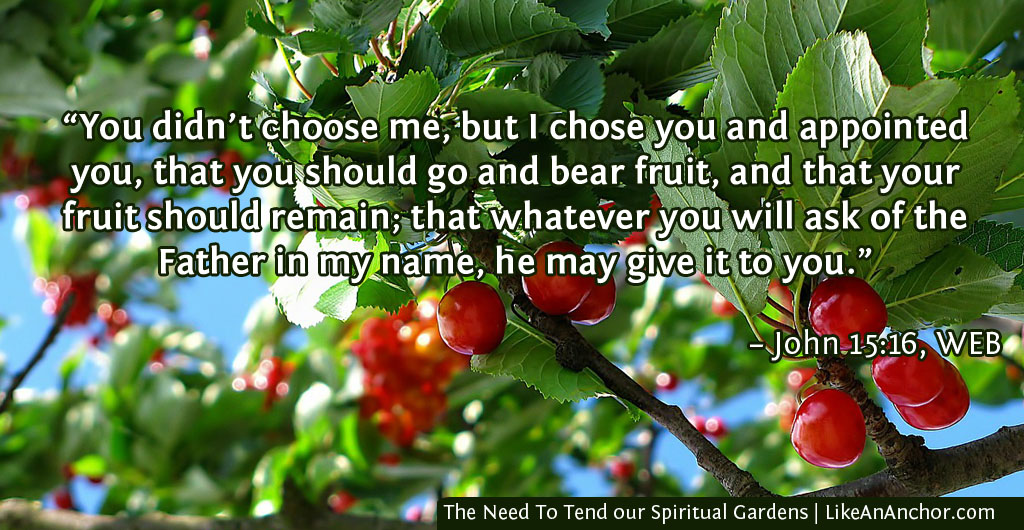
“I am the true vine, and my Father is the farmer. Every branch in me that doesn’t bear fruit, he takes away. Every branch that bears fruit, he prunes, that it may bear more fruit. … I am the vine. You are the branches. He who remains in me and I in him bears much fruit, for apart from me you can do nothing. If a man doesn’t remain in me, he is thrown out as a branch and is withered; and they gather them, throw them into the fire, and they are burned.  … In this my Father is glorified, that you bear much fruit; and so you will be my disciples. (John 15:1-2, 5-6, 8)

In another place, Jesus tells us that we will know false prophets by their fruits. We can discern whether or not someone is trustworthy by how they live and the fruits they produce. God applies the same logic to us; He knows us by our fruits (Matt. 7:17-23). And we are warned, like the people John the Baptist preached to, “every tree therefore that doesn’t produce good fruit” (e.g. “fruits worthy of repentance”) “is cut down, and thrown into the fire” (Luke 3:7-9).
The Need To Tend our Spiritual Gardens | LikeAnAnchor.com
Photo credit: Jiří Rotrekl via Pixabay

God Is Eager To Help Us Grow

Now, don’t go thinking all this talk of pruning and burning is happening because God doesn’t like us or wants to terrify us. He’s not up there waiting for any excuse to wack us out of the Vine. On the contrary, these things serve as a warning so that we’ll understand exactly how important it is that we stay close to Jesus Christ (the source of our life, as the roots that feed a plant) and commit to living in a Godly way (having a character that produces spiritual fruit). So long as we make even the tiniest effort, God is ready and eager to facilitate our growth.

Consider the lilies, how they grow. They don’t toil, neither do they spin; yet I tell you, even Solomon in all his glory was not arrayed like one of these. … Don’t seek what you will eat or what you will drink; neither be anxious. … But seek God’s Kingdom, and all these things will be added to you. Don’t be afraid, little flock, for it is your Father’s good pleasure to give you the Kingdom. (Luke 12:27, 29, 31-32)

The Need To Tend our Spiritual Gardens | LikeAnAnchor.com
Photo credit: Delynn Talley via Pixabay

One of the key characteristics of God’s kingdom is that it grows (Luke 13:18-21). And we’re invited to be a part of that. Seek Him. Grow with Him. Keep adding to your faith moral excellence, knowledge, self-control, perseverance godliness, brotherly affection, and love (2 Pet. 1:5-8). Produce fruit of love, joy, peace, patience, kindness, goodness, faith, gentleness, and self-control (Gal. 5:22-23).

One of the most encouraging studies I’ve ever done (for me at least) was on how God talks about human perfection. So long as we’re growing toward the goal of being perfect, as He is perfect, He treats us as if we’re already there. We don’t have to get everything right all the time or worry we’re not good enough. The only way to fail is to not even try. So long as we put effort into tending our spiritual gardens and do not neglect the gifts He has given us, God will make certain that we live abundant, fruitful lives that lead to the best eternal outcome.


Featured image credit: Dean Moriarty via Pixabay

Fighting on the Battlefield of Forgiveness

Last week’s post was about how much God wants to forgive us. This week’s is about how much we need to forgive each other. There are plenty of Bible verses about this topic and so, like most Christians, I knew how important forgiveness is before writing this post. But something Paul said in one of his letters made me want to take a closer look at the subject.

The reasons Paul gives for forgiving someone in the Corinthian church provide us with a compelling reason for forgiving others. I’d never thought about forgiveness being a key part of spiritual warfare before, but I do now. Whether or not we choose to forgive is one of the things that determines whether Satan gets an advantage over us, or we get an advantage over him by drawing closer to God.

Don’t Give an Advantage to Satan

For background, in Paul’s first letter to the Corinthians, he told them they needed to put a man out of their church who was actively engaging in sexual sin (1 Cor. 5). Now, in the second letter, Paul has heard that this man repented and Paul tells the church to forgive him and accept him back.

This punishment which was inflicted by the many is sufficient for such a one; so that on the contrary you should rather forgive him and comfort him, lest by any means such a one should be swallowed up with his excessive sorrow. Therefore I beg you to confirm your love toward him. … Now I also forgive whomever you forgive anything. For if indeed I have forgiven anything, I have forgiven that one for your sakes in the presence of Christ, that no advantage may be gained over us by Satan, for we are not ignorant of his schemes. (2 Cor. 2:6-8, 10-11, all quotes from WEB translation)

Choosing to withhold forgiveness– even when someone has sinned so egregiously they were put out of the church; even when you’ve heard about their repentance from someone else instead of seeing it for yourself — would give an advantage to Satan. The Greek word pleonekteo (G4122) carries the idea of taking advantage of or  defrauding someone. The word for “covetousness” comes from this word (The Complete WordStudy Dictionary: New Testament, by Spiros Zodhiates Th.D.).

Talk of Satan (which means “adversary”) gaining an advantage over us also brings to mind the idea that we’re in a spiritual battle. If you don’t forgive, you’re giving the adversary a foothold in your life. And that ought to be a terrifying thought. However, it is something we can prevent because, as Paul says, we’re not ignorant of his schemes.

Armor Up With God’s Help

We are part of a spiritual battle. The adversary (ha Satan in Hebrew) is fighting against God’s family, and we’re part of that family. Every human being has the potential to become part of God’s family and those of us in covenant with God are already adopted as His children.

Beloved, now we are children of God. It is not yet revealed what we will be; but we know that when he is revealed, we will be like him; for we will see him just as he is. Everyone who has this hope set on him purifies himself, even as he is pure. (1 John 3:2-3)

God’s adversary hates what God loves. Satan accuses us before our God day and night (Rev. 12:10; Job is also an example). He tries to use his wiles against us, and he’s behind the “the spiritual forces of wickedness in the heavenly places” that we wrestle against (Eph. 6:10-13). The last thing we should want to do is give Satan an advantage over us in this fight. Rather, we want to stay close to God, put on His armor, stand, and resist the devil.

Fighting on the Battlefield of Forgiveness | LikeAnAnchor.com
Photo credit: Michael Siebert via Pixabay

Avoid Things That Separate You From God

The reason that unforgiveness is so very dangerous (I think) is connected to the wedge it drives between us and God. We’re more vulnerable to the adversary’s attacks when we are not sticking close to the source of our armor and strength. There are certain things that separate us from God, and we need forgiveness and reconciliation to heal the breach of relationship that sin causes. But we don’t get forgiveness if we’re not willing to give it.

For if you forgive men their trespasses, your heavenly Father will also forgive you.  But if you don’t forgive men their trespasses, neither will your Father forgive your trespasses. (Matt. 6:14-15)

Jesus’s parable in Matthew 18:21-35 puts this in even more chilling language. In this parable, forgiveness that has already been given by a master to an indebted servant is withdrawn because that servant refuses to forgive someone who owes him a much smaller debt. Jesus caps this parable off by saying, “So my heavenly Father will also do to you, if you don’t each forgive your brother from your hearts for his misdeeds.” That’s quite a sobering statement.

God is merciful and good. He knows forgiveness can be so hard that sometimes it feels like fighting a battle. He doesn’t abandon us just because we’re struggling. But He does expect us to make an effort to deliberately, consistently forgive other people. Carrying bitterness, grudges, anger, and judgmental attitudes around will not help our Christian walk and can, in fact, hinder it.

Consider Jesus’s Example

Therefore let’s also, seeing we are surrounded by so great a cloud of witnesses, lay aside every weight and the sin which so easily entangles us, and let’s run with perseverance the race that is set before us, looking to Jesus, the author and perfecter of faith (Heb. 12:1-2)

Fighting on the Battlefield of Forgiveness | LikeAnAnchor.com
Photo credit: Devanath via Pixabay

Whenever it becomes difficult to lay aside the weight of unforgiveness, look to Jesus. The book of Hebrews tells us to “consider him who has endured such contradiction of sinners against himself, that you don’t grow weary, fainting in your souls” Heb. 12:3). When we consider the example He set us, we see Him forgiving even in the worst of circumstances.

When they came to the place that is called “The Skull”, they crucified him there with the criminals, one on the right and the other on the left. Jesus said, “Father, forgive them, for they don’t know what they are doing.” (Luke 23:33-34)

If Jesus could forgive the people who tortured and killed him while He was hanging on the cross, surely we can forgive whatever it is that people have done to us. Especially because God has given us warnings and instructions through His Bible and help through His holy spirit. We know the dangers of unforgiveness and we have what we need to follow Christ’s example. Let’s resolve to forgive, and to keep forgiving as often as need be, following the example of Christ and resisting the adversary’s influence so “that no advantage may be gained over us by Satan, for we are not ignorant of his schemes.”


Featured image credit: Thomas Anderson via Pixabay


Mercies from Yahweh of Armies

Work, work your thoughts and therein see a king at war who holds those guilty that defy him. Behold him facing a besieged town, shouting out all the terrors that await those who persist in defiance, yet offering mercy if only they will yield to his authority. Note his relief when one chooses mercy, his gentleness with those who trust him and his swift vengeance on those who persist in rebellion.

I borrow this scene from my favorite Shakespeare play, Henry V (Act 3, prologue, Scene 2). But it’s also a Biblical image. We sometimes lose sight in the modern world that the KJV phrase “Lord of hosts” literally means “Yahweh of Armies.” One of the most often used titles of God is about Him personally going forth with a host of armies organized for war.

This is a comforting image when God is fighting against our enemies. But sometimes, “Yahweh’s anger burns against his people,” particularly when “they have rejected the law of Yahweh of Armies and despised the Holy One of Israel” (Is. 5:24-25). Even when that happens, though, God deeply desires to show mercy. His justice demands punishment for sin (Heb. 10:30-31), but His mercy offers a path to forgiveness and salvation (1 Pet. 2:24-25).

It’s common in modern churches to say that God was vengeful and frightening in the Old Testament but is gentle and loving in the New. Such a disconnect is not supported by scripture. Both the Father and the Word (who we now know as Jesus) have been active throughout history. They’re unchanging. In order to have a fuller, more accurate vision of who God is and what He is doing, we need to acknowledge that He is both wrathful justice and gentle mercies.

Mercies from Yahweh of Armies | LikeAnAnchor.com
Photo credit: Lamppost Collective via Lightstock

God’s Desire to Forgive

After the death of righteous Josiah, king of Judah, his son Jehohaz reigned for just 3 months before an Egyptian king dethroned him and set up his brother Jehoiakim in his place. This new king “did that which was evil in Yahweh his God’s sight” (2 Chr. 35:25-36:8). At this time, God was actively working through the prophet Jeremiah, and He sent him with a message.

In the fourth year of Jehoiakim the son of Josiah, king of Judah, this word came to Jeremiah from Yahweh, saying, “Take a scroll of a book, and write in it all the words that I have spoken to you against Israel, and against Judah, and against all the nations, from the day I spoke to you, from the days of Josiah, even to this day. It may be that the house of Judah will hear all the evil which I intend to do to them; that they may each return from his evil way; that I may forgive their iniquity and their sin.” (Jer. 36:1-3, all verses quoted from WEB translation unless otherwise noted)

Jeremiah’s prophecies contain warnings, corrections, lessons, and promises. From God’s words here in the passage I just quoted, it seems one of His main goals in sharing all those warnings was to save people from the consequences of their own disobedience.

Read more

Titles of Jesus Christ: David’s Son

Over and over in the gospels, people cry out to Jesus, “Have mercy on us, you son of David!”

Why is the Messiah’s title as David’s son the one that blind men and a Canaanite woman latched on to as they asked for healing? (Matt. 9:27; 15:22; 20:30-31; Mark 10:46-48; Luke 18:35-39). Why did the people shout, “Hosanna to the son of David!” when Jesus entered Jerusalem, and why did that make the chief priests and the scribes so indignant? (Matt. 21:9, 15; Mark 11:10). What is the significance of this title?

It would be easy to gloss over Jesus’ title as David’s son, simply taking it as fulfillment of a few prophecies that said Messiah (the Hebrew equivalent to “Christ,” which means “anointed”) would come from King David’s descendants. But the Biblical writers treat this as a highly significant fact, and I think it’s worth looking into more closely.

Fulling A Covenant Promise

I’ve talked about the covenant aspect of Jesus being descended from David in several posts already, including “Inheriting Covenants.” The Lord made a covenant with David that He would establish his offspring’s kingdom forever, and that connected with the promise of Messiah (2 Sam. 7:12-15).

Yahweh has sworn to David in truth. He will not turn from it: “I will set the fruit of your body on your throne. If your children will keep my covenant, my testimony that I will teach them, their children also will sit on your throne forever more.” (Ps. 132:11-12, all verses from WEB translation)

David’s descendants eventually fell into disobedience and lost the physical kingdoms of Israel and Judah. But Jesus — a sinless, obedient son of David — inherited the covenant promise. According to Peter, David actually knew that would be the end result of God’s promises to him about his descendants. Read more

Titles of Jesus Christ: Our Peace

I think that when we hear Jesus talked about as “Prince of Peace” or “Our Peace,” we usually think of Him making strife cease. We picture Him setting up a world without war and fixing the strife between human beings and God. Those are definitely part of what’s going on, but there’s also a whole lot more. We can dive deeper into what “peace” means — and gain a deeper understanding of who Jesus is and what He is doing — by studying into the Hebrew word shalom.

Shalom is a key Biblical concept. It occurs over 250 timed in the Old Testament, and that’s not counting related words like shalem. It’s most often translated “peace,” though the King James Version uses about 30 different English words. Those include prosperity (Ps. 35:27), rest (Ps. 38:3), safety (Is. 41:3), using shalom as a salutation or greeting (Judg. 18:15; 1 Sam. 25:5), and in reference to someone’s welfare (Gen. 29:6; Ex. 18:7).

The Hebrew word shalom comes from the root verb shalem, which means “completeness, wholeness, harmony, fulfillment.” That’s all included in shalom as well, along with the English meaning of “peace” as an absence of strife. Also wrapped up in this concept is the implicit “idea of unimpaired relationships with others and fulfillment of one’s undertakings (Theological Wordbook of the Old Testament, by Harris, Archer, and Waltke, entry 2401a). It’s a much more nuanced word than we give it credit for in English translations.

Restitution and Healing

Shalom is wholeness — nothing missing, nothing broken. It is a state that humans don’t end up in naturally. God created us perfect, but we’re now fallen people living in a fallen world. Peace is an elusive thing.

There is no soundness in my flesh because of your indignation, neither is there any shalom in my bones because of my sin. (Ps. 38:3, Hebrew word added, all quotes from WEB translation)

Sin is something we’re all guilty of, and it’s something that causes brokenness. We’re not whole or complete, and the covenants that people of the past made with God are broken by humanity’s sin. If you want to fix something that’s broken, missing, or stolen, God requires restitution (shalem in Hebrew) in order to satisfy the requirements of law (Ex. 22:3, 5-6, 12, 14). In order to fix what is wrong with us, the process of restitution required something on a greater level than animal sacrifice or paying some money.

Read more

Titles of Jesus Christ: Firstborn and Heir

Who is Jesus Christ? Some consider Him a prophet, some a teacher who had some good things to say about peace and love, others say He was a madman. As Christians, we know Him as the Son of God who died to save us from our sins, rose again, and continues to be actively involved in our lives. But what does it really mean that He’s God’s Son, and why does that particular title matter to us?

God, having in the past spoken to the fathers through the prophets at many times and in various ways, has at the end of these days spoken to us by his Son, whom he appointed heir of all things, through whom also he made the worlds. (Heb. 1:1-2, all scriptures from WEB translation unless otherwise noted)

Firstborn’s Birthright

In Old Testament times, being a firstborn son was a big deal. You were the bekor (H1060), eldest son  and therefore the bekorah (H1062, birthright) was yours. You received a double portion when the father divided his inheritance (Deut. 21:15-17). There was a special blessing involved (Gen. 27). It was so important that any disruption to this birthright was cause for Biblical writers to take special note (Gen. 25:31-34; 48:9-19; 1 Chr. 5:1-2).

According to a message I recently watched on YouTube titled “Hebrews: Yeshua’s Amazing Qualifications,” the rights of the firstborn traditionally included a few other things as well. The eldest son acted as the family’s spiritual leader, acquired spiritual favor and honor, and inherited the blessings of Abraham. Heirship involved authority over the father’s possessions. Before there was a Levitical priesthood (which Yahweh accepted in place of the firstborns, as noted in Num. 3:12-13, 41; 8:16-18), the firstborn would even act as priest for the family.

Many parallels between Jesus and the Hebrew firstborns are easy to spot. He is the family’s spiritual leader, acting as “head of all things to the church” under the Father’s authority (Eph. 1:15-23). He is also High Priest of an order that supersedes the Levitical order as the Levites superseded what came before (Heb. 7:11-28). And that’s not where the parallels end. Read more