How Visible Is Your Commitment to Christ?

The culture we live in is not a godly one. None of us can say we live in a “Christian nation.” While we may share some values with the dominant culture(s), living the way Jesus did involves a very different lifestyle than the ones that are most socially acceptable.

That leaves Christians with a choice. We can either lie-low and try to fit in as much as we can, or we can embrace the fact that a commitment to living like Christ involves living counter-culturally. The later is hard. But if we want to become part of God’s family, we have to become like Him instead of staying like the world.

How Visible Is Your Commitment to Christ? | marissabaker.wordpress.com

We need a transformative relationship with Jesus

It’s not something we like to think about, but the scriptures indicate that not everyone who thinks they’re following Jesus will actually end up in His kingdom. One of these passages is found in Jesus’ sermon on the mount. It’s a serious, scary warning that we do well to pay attention to.

Not everyone who says to me, ‘Lord, Lord,’ will enter into the Kingdom of Heaven; but he who does the will of my Father who is in heaven. Many will tell me in that day, ‘Lord, Lord, didn’t we prophesy in your name, in your name cast out demons, and in your name do many mighty works?’ Then I will tell them, ‘I never knew you. Depart from me, you who work iniquity.’ Everyone therefore who hears these words of mine, and does them, I will liken him to a wise man, who built his house on a rock. (Matt. 7:21-24, WEB)

We learn several important things from this passage. Firstly, it’s possible to think you’re following Jesus and still not be in a relationship with Him. Whether or not He knows you is more important than the showy things you do in His name.

Secondly, He tells us how to become people He knows. We must do His Father’s will, hear His teachings, and act on them. Those actions will give us a strong foundation so that when life pounds on us we won’t fall (Matt. 7:25-27). It’s also going to drastically change how our lives look. Read more
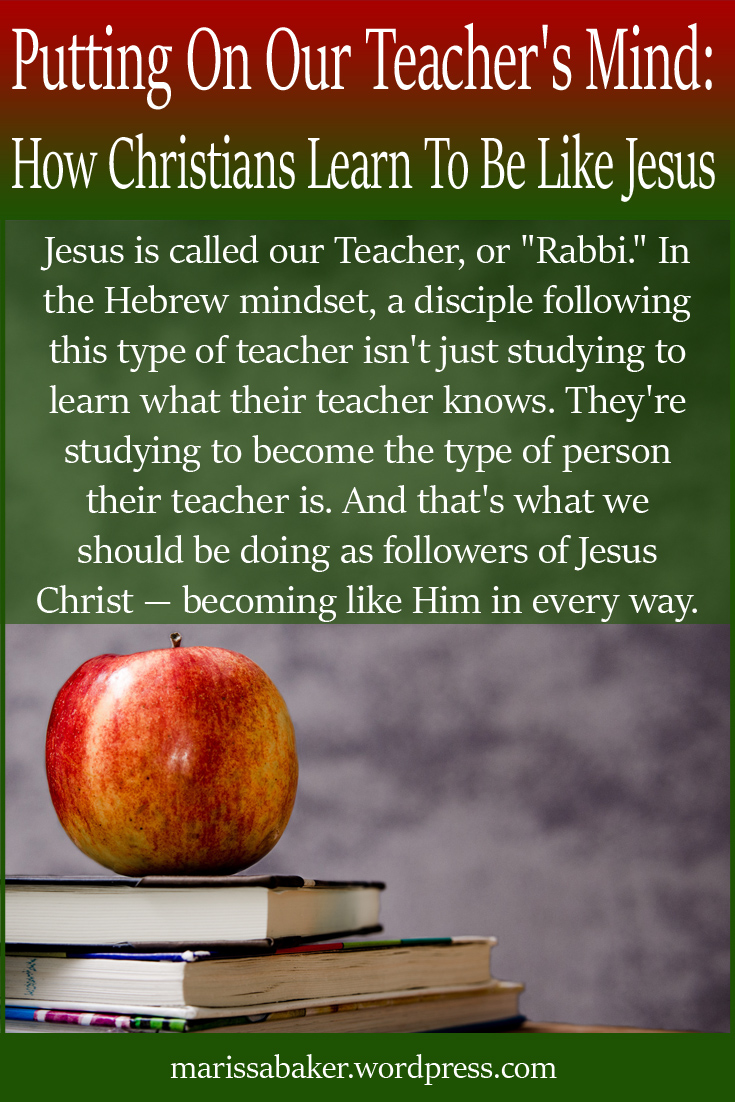
Putting On Our Teacher’s Mind: How Christians Learn To Be Like Jesus

When we go to school or a lecture or seminar, we’re typically looking to find out what the teacher knows. And it’s rare for most of us to have a continuing relationship with a single teacher, unless you’re in an apprenticeship situation. We tend to think of teachers as people you get information from, not necessarily someone you mimic or have a relationship with (though it’s great when that does happen).

These assumptions color how we respond to the Bible’s description of Jesus as Teacher or Rabbi (Matt. 19:16; John 1:38, for example). Being a student of this type of teacher goes beyond just listening to what he has to say. The relationship between a rabbi and their disciples, or talmidim in Hebrew, went deeper.

those who leave family to study and follow the ways of their teacher [rabbi].  They study not only to learn what their teacher knows but to become the type of man their teacher is.” (Psalm 11918.org)

Being taught in this sense isn’t just about taking in knowledge. It’s about changing who you are and how you think.

Putting On Our Teacher's Mind: How Christians Learn To Be Like Jesus | marissabaker.wordpress.com
Image credit: Michal Jarmoluk via StockSnap

Our Two Great Teachers

We’re not just pulling this idea that disciples of Jesus should become like Him out of Jewish tradition. It comes straight out of the Bible. Jesus said, “A disciple is not above his teacher, but everyone when he is fully trained will be like his teacher” (Luke 6:40, WEB). That’s our goal — to become exactly like our Teacher. And while this title is usually applied to Christ, it also includes God the Father.

It is written in the prophets, ‘They will all be taught by God.’ Therefore everyone who hears from the Father, and has learned, comes to me. (John 6:45, WEB)

Both member of the God-family are closely involved with teaching us. And as we learn from them, we’re to become like them. The idea that we can become like God is so incredible it’s almost unbelievable, but that really is our ultimate goal (1 John 3:1-2). They mean for us to become part of their family and even share in their oneness (John 17:20-23).

Patterned After God

In his first letter to the Corinthians, Paul talks about how we need God’s spirit in us to learn the things God gives us. God’s truths don’t make sense to “the natural man … because they are spiritually discerned” (1 Cor. 2:9-15, WEB). We need God’s spirit to unlock our minds and transform them. And this process results in us developing “the mind of Christ” (1 Cor. 2:16, KJV).

Let this mind be in you, which was also in Christ Jesus (Phil. 2:5, KJV) Read more

The Incredible Reasons God Gives Us For Not Being Afraid

It’s all well and good to say, “God doesn’t want you to be afraid,” like we did in last week’s post. But that doesn’t actually help much with getting rid of our fear. Even knowing He’s patient with our fearfulness doesn’t take the fear away.

Thankfully, God’s doesn’t just order, “Fear not,” and leave it at that. He offers specific promises that give us tangible reasons not to be afraid. And when we are fearful, those promises can help us overcome to act in faith despite our fears. This past week, I went through the Bible looking for all the reasons God gives for us not being afraid. There are many, but I’ve sorted them into four main categories:

The Incredible Reasons God Gives Us For Not Being Afraid Looking At Scriptural Mission Statements For People Following Jesus | marissabaker.wordpress.com
Photo credit: HarveyMade via Lightstock

God Is With You

Before Moses’s death, God inspired Him to share these words with Israel:

Be strong and courageous. Don’t be afraid or scared of them; for Yahweh your God himself is who goes with you. He will not fail you nor forsake you. (Deut. 31:6, WEB)

The number one reason we have for living without fear is that God Himself is with us. And not just as a church or a group of people. Individuals can also receive this promise, as did Isaac (Gen. 26:24), Joshua (Josh. 1:9), David (Ps. 23:4), Solomon (1 Chr. 28:20), and Jeremiah (Jer. 1:8).

Don’t you be afraid, for I am with you. Don’t be dismayed, for I am your God. I will strengthen you. Yes, I will help you. Yes, I will uphold you with the right hand of my righteousness. (Is. 41:10, WEB)

God promises not to let us down or leave us alone. That means the most powerful being in existence is at your side through everything. He doesn’t leave us to figure things out on our own nor abandon us in our struggles. Read more

What Does God Have To Say About Fear?

Is being afraid a sin? I think most of us, me included, would say it isn’t sinful in and of itself. Fear is often a natural gut reaction to things happening around us, and it serves a self-preservation role. It only becomes an issue if we act on it wrongly or let it paralyze us and prevent right action. But maybe I’m wrong. Maybe I’m letting my own fears cloud my perspective on this issue. Because it seems God takes our fearfulness more seriously.

He that overcometh shall inherit all things; and I will be his God, and he shall be my son. But the fearful, and unbelieving, and the abominable, and murderers, and whoremongers, and sorcerers, and idolaters, and all liars, shall have their part in the lake which burneth with fire and brimstone: which is the second death. (Rev. 21:7-8, KJV)

Some translations say “cowardly” instead of “fearful,” but the Greek deilos really does mean timid or afraid. Strong’s dictionary adds that it implies faithlessness. Hence Jesus’ question, “Why are you so afraid? How is it that you have no faith?” to the disciples in a storm (Mark 4:37-40, WEB). Is it really the case that God sees our fears and timidity as lack of faith?

What Does God Have To Say About Fear? | marissabaker.wordpress.com
Photo credit: HarveyMade via Lightstock

The Right Kinds of Fear

The Bible talks about fear in both positive and negative ways. The kind of fear that is connected with reverence and respect for God and His authority is good. In fact, it’s essential.

This is the end of the matter. All has been heard. Fear God, and keep his commandments; for this is the whole duty of man. For God will bring every work into judgment, with every hidden thing, whether it is good, or whether it is evil. (Ecc. 12:13-14, WEB)

Fear of God has long been a commanded part of following Him (Deut. 5:29; 6:2; 10:12). And in the New Testament, the apostles tell us to perfect “holiness in the fear of God” (2 Cor. 7:1, WEB), to “work out your own salvation with fear and trembling” (Phil. 2:12, WEB), and to live our lives on earth “in reverent fear” (1 Pet. 1:17, WEB). Read more

What’s The Church Supposed To Do?

If you ask the church that I’ve spent most of my life in what their mission is they have a ready answer: preaching the gospel and preparing a people. I can’t speak for your churches, but I imagine many (perhaps even most) of them would also point to some version of what we call The Great Commission as their mission statement.

Jesus came to them and spoke to them, saying, “All authority has been given to me in heaven and on earth. Go, and make disciples of all nations, baptizing them in the name of the Father and of the Son and of the Holy Spirit, teaching them to observe all things that I commanded you. Behold, I am with you always, even to the end of the age. (Matt. 28:18-20, WEB)

Is this a commission? yes, it’s “an instruction, command, or duty given to … group of people.” Is it great? since it came from Jesus and involves a responsibility given His disciples, yes. But is it really meant as the defining mission statement for the entire church from Jesus’ resurrection to His return? I’m not so sure.

What's The Church Supposed To Do? Looking At Scriptural Mission Statements For People Following Jesus | marissabaker.wordpress.com
Photo credit: Pearl via Lightstock

A Sobering Warning

The religious leaders of Jesus’ day were the group He spent the most time criticizing and correcting. They professed to follow God’s highest standards but were in reality hypocrites. They did righteous looking things just to get attention (Matt. 23:5). They went to great lengths to convert people only to pervert their faith (Matt. 23:15). They placed too high an emphasis on money received as tithes and offerings (Matt. 23:16-19). They neglected the “weighty matters” of God’s law and instead followed their own traditions. They even turned the temple itself into a marketplace where they exploited people coming to worship God (John 2:14-16).

The scary thing is, these people honestly thought they were the most righteous God-followers out there. That serves as a warning today that church leaders and organizations have to be very careful where they place their focus. And so do we as individual members of Christ’s body.

A Greater “Commission”

We certainly shouldn’t ignore Christ’s instruction to go, disciple, baptize, and teach. But we need to make sure we’re thinking of that command from Matthew 28 in its proper context. Because there are two other commissions that Jesus plainly told us are His greatest commands. Read more

Lessons From Sukkot

My family and I just got back on Thursday evening from a wonderful Sukkot (Feast of Tabernacles) gathering in eastern Pennsylvania. While it was packed full of spiritual lessons, there wasn’t much time for the sort of personal Bible studies that typically end up becoming blog posts on Saturdays. So today I’m just going to share a few lessons I learned this past week:

  • I can organize people. If I’d known agreeing to plan a singles/young adult activity would have ended up involving 30+ people doing 5 different activities I would have probably wanted to hide under a desk. But it all went really well and I had lots of help from people who volunteered (or had someone volunteer them) to lead some of the activities.
  • The only ancient text with anywhere near as many copies still around as there are for the Bible is Homer’s Iliad and Odyssey. Stacked together, the existing copies for both those works would only be a few feet tall. In contrast, a stack of all the surviving Biblical manuscripts would be so tall it’s nearly outside earth’s atmosphere. Wow! (One of the speakers shared this fact in a Bible study about the reliability of the Bible.)
  • Spending a week with my boyfriend (who joined my family and our church group for the Feast) does not make living an 8-hour drive apart any easier. I suppose it’s a good thing that I miss him so much, though, since otherwise I’d have to re-think whether or not we should be dating. In related news, my new favorite love song is “Over And Over Again.” They played it at the dance our church group hosted and not only is my boyfriend a really good dancer but he also sings ❤
  • The “fear not” reminders just keep coming at me. On the second day of Sukkot someone gave a message about why those who are “fearful” are lumped in with murderers, sorcerers, etc. as people who won’t be in God’s kingdom (Rev. 21:8). The Greek word means “timid” or “cowardly” and carries the implication of faithlessness, as in a Christian who is too scared to act in faith doesn’t trust God enough. Thankfully, we serve a God who embodies the kind of love that casts out fear and who has the strength to help us overcome fears. That’s a reminder I need as I prep for giving my second seminar (I’m actually speaking in front of people again!) in a few months.
  • It’s always interesting to look back on sermons, Bible studies, and conversations at the Feast and find common themes. This year, I noticed an emphasis on shifting our focus as we move toward God’s kingdom. Instead of just focusing on, “How can I get into God’s kingdom?” we should be thinking about, “How can I be the kind of person God wants to bring into His family?” Those thoughts are related of course, but one’s focused on what we get out of our Christian walk and the other is focused on becoming like God in how we live our lives and interact with other people.

I’ve got a few other thoughts on things I learned and heard this Feast/Sukkot, but they’d be better served by each having a blog post all to themselves so we’ll wait on that. I hope you’ve all been having a wonderful week and have a fantastic weekend! I should be back to more of my usual posting routine by Monday, so I’ll “see” you then 🙂