Does God Allow Trials We Can’t Endure?

I recently read two separate articles that said this verse is inaccurate or at least grossly misinterpreted: “God will not allow you to be tempted beyond what you are can endure.” The example used was that Christians who commit suicide were obviously given a trial they couldn’t bear on their own, and they needed outside help. But does needing help from other people really invalidate this scripture, or is there something else going on?

Faithful to Help

The phrase quoted above is just a piece of a sentence in 1 Corinthians. Let’s look at the whole verse to get some context.

No temptation has overtaken you except such as is common to man; but God is faithful, who will not allow you to be tempted beyond what you are able, but with the temptation will also make the way of escape, that you may be able to bear it. (1 Cor. 10:13)

First we see the idea that no matter how alone or oppressed we feel, we’re not being given trials greater than that which is common to man — someone else, somewhere, has gone through something similar. This includes other human beings, of course, but it also includes Jesus Christ.

For we do not have a High Priest who cannot sympathize with our weaknesses, but was in all points tempted as we are, yet without sin. Let us therefore come boldly to the throne of grace, that we may obtain mercy and find grace to help in time of need. (Heb. 4:15-16)

Not only are trials like ours held in common with other people, but our Lord and Savior went through similar temptation and sufferings. One of the main reasons He did that was so that He could understand what we’re going through and offer His aid. As it says in 1 Cor. 10:13, “God is faithful,” and He will do that for us.

Secondly, we see that the promise which says God won’t let us be tempted beyond our endurance comes with an explanation for how He will do that. It’s not just that God protects us from trials unless we can get through them by gritting out teeth and pushing forward on our own. He “will also make the way of escape, that you may be able to bear it.”

Needing Others

This “way of escape” is intriguing. The wording implies intervention by God to create “escapes” for us in our trials, and action necessary on our part to take the offered escape. I imagine this sort of thing will look very different depending on the type of trial and who is going through the trial. Sometimes it may be what we think of as a literal escape, with the trial or temptation coming to an end. Or it could be that something changes to make the trial bearable. I’m sure we’ve all known someone with a long standing trial (like illness or chronic pain) who still has peace and joy in their lives.

and the peace of God, which surpasses all understanding, will guard your hearts and minds through Christ Jesus. …And my God shall supply all your need according to His riches in glory by Christ Jesus. (Phil. 4:7, 19)

Do we trust God to truly do this, to give us every thing we need in every circumstance? People will say something like, “well, that’s not true. You can’t just go through life with an ‘I don’t need anything but God” attitude. We need other people.” True to a certain extent, but where do you think those other people come from?

Does God Allow Trials We Can't Endure? marissabaker.wordpress.comGood friends — the people you can really talk with about anything and go to when you need help — are rare. We call them a blessing. So when we have people like this in our lives, I’d say that comes under God supplying all our needs, including our need for companionship. Perhaps sometimes the “way of escape” so we’re able to bear a trial comes in the form of another person. It could be a friend, or someone you barely know. Maybe it’s a therapist or a minister to offer counsel. Perhaps it’s a brutally honest sibling to knock some sense into you (hopefully not literally).

I’ve been on the receiving end of this from someone I’d only just met. I was at a church-sponsored weekend and feeling particularly vulnerable emotionally. I thought I was doing a pretty good job of hiding my heartache, but apparently not, because  a girl I’d been introduced to barley two days ago sought me out the last evening to ask what was wrong. The story spilled out and I started crying. Then she prayed aloud for me. It was incredible — I felt God’s Spirit present in a way unlike I’d ever felt before. That wasn’t the conclusion of that trial, but it did mark the escape for climbing out of it and back towards God.

When God sends us someone to help us through a trial, we should be careful not to push them away. But this works from both sides. We can also be the person who is provided by God to offer help.

Being a Blessing

Have you ever considered that? When we’re talking about trials, I think we’re more often inclined to think of how someone else can help us than how we can help other people. But if we expect that we’re going to benefit from the comfort and help of other believers, we should also expect that God wants to use us to help them.

Let nothing be done through selfish ambition or conceit, but in lowliness of mind let each esteem others better than himself. Let each of you look out not only for his own interests, but also for the interests of others. (Phil. 2:3-4)

We’re supposed to be looking after our brethren, building them up, making sure they’re okay, and being sure to offer real encouragement and help rather than empty platitudes when they need aid.

If a brother or sister is naked and destitute of daily food, and one of you says to them, “Depart in peace, be warmed and filled,” but you do not give them the things which are needed for the body, what does it profit? (James 2:15-16)

It is similarly un-helpful (and can even be harmful) to just slap a scripture on someone’s emotional wounds and walk away. Saying, “God will supply all your needs”  or “don’t worry, He won’t give you anything you can’t endure” isn’t any help unless we’re willing to be used by God to supply those needs by listening to them, praying with and for them, and keeping in touch with them.

Example of Love

A new commandment I give to you, that you love one another; as I have loved you, that you also love one another. By this all will know that you are My disciples, if you have love for one another.” (John 13:34-35)

Love – agape – within the church is the sign that we are followers of Christ. That’s how important it is to have self-sacrificing love that seeks the good of others. Romans 12:1 talks of us presenting ourselves as “a living sacrifice.” We can look at the life of Jesus Christ to see a perfect example of what it means to live as a sacrifice in service to God. Have you ever noticed how much of His ministry involved helping other people? Pretty much all of it. And now He tells us that we and every one of our fellow believers are highly valued as His own temple and body “which He purchased with His own blood” (Acts 20:28).
Does God Allow Trials We Can't Endure? marissabaker.wordpress.comIf we’re going to claim that level of importance in God’s eyes, we must see others in the same light. Do we treat other people as if Christ is living in them? and we have to do this for our brethren whether or not we think it looks like Christ is in them. If we’re being honest, we know that we’ve also been seen doing things that are not Christ-like. We must be forgiving toward others if we want to be forgiven (Matt 6:12, 14-15). Really, we’re left without any good excuses for not helping others when we see them in need. If we’re following Jesus Christ, we will be loving and serving other people as much as possible. It’s as simple (and as complicated) as that.

So to answer the question that is the title of this post, I believe God does not let us go through trials or temptations that it is impossible for us to bear. They might not turn out the way we expect them to, but if we stay close to God we will turn out the way He expects us to. He will send us escapes and aid, and will open our eyes to recognize His help. And sometimes we’ll have the chance to follow Jesus’ example and be used by God to help another person.
Save

Choosing For His Glory

Last week, we talked about living our whole lives in the context of praising God. This study is directly related to that, and I want to begin by quoting a scripture that I almost referenced in that post but decided to save until today.

Therefore, whether you eat or drink, or whatever you do, do all to the glory of God. (1 Cor. 10:31)

I don’t know about you, but I know that right now my life isn’t at the point where I can say that every single thing I do is done with the intention of bringing God glory. But that is part of our goal while we are here on this earth. Every aspect of our lives should be contextualized by our relationships with God and Jesus.blog post "Choosing God's Glory" by marissabaker.wordpress.com

Every Single Thing

The idea of every part of our lives being lived for God’s glory can be a daunting prospect, as this level of self-control seems almost impossible to attain. That overwhelmed feeling is usually how I react to reading this verse:

Casting down arguments and every high thing that exalts itself against the knowledge of God, bringing every thought into captivity to the obedience of Christ (2 Cor. 10:5)

“Every thought”? That’s a tall order. It’s a bit less daunting, though, when we remember Jesus Christ’s words to the disciples in Matthew 19:26 — “With men this is impossible, but with God all things are possible.” Self-control is also one of the fruits of the Holy Spirit, so we know that it is attainable with God’s help (Gal. 5:22).

I also suspect that, while there may be some days when we literally have to battle every thought, that it gets easier. The closer we grow to God, the more automatic it will be to think and act like Him. Christ Himself is being formed in us (Gal. 4:19), along with His mind and thought processes (Phil. 2:5). Letting, inviting, asking Him to dwell in us is a step toward living all our lives for God’s glory (John 15:4, 8).

Let the word of Christ dwell in you richly in all wisdom, teaching and admonishing one another in psalms and hymns and spiritual songs, singing with grace in your hearts to the Lord. And whatever you do in word or deed, do all in the name of the Lord Jesus, giving thanks to God the Father through Him. (Col. 3:16-17)

You Are Dead

If we go back to the beginning of Colossians 3 to get context for the verse we just quoted, we find an interesting introduction to a passage that talks about putting to death our sins (verse 5) and putting on the new man who looks like Christ (verse 10).

If then you were raised with Christ, seek those things which are above, where Christ is, sitting at the right hand of God. Set your mind on things above, not on things on the earth. For you died, and your life is hidden with Christ in God. (Col. 3:1-3)

If we really are living as if we are dead to the world and our only life is wrapped up in Christ, of course we’ll be living for His glory.

How shall we who died to sin live any longer in it? Or do you not know that as many of us as were baptized into Christ Jesus were baptized into His death? Therefore we were buried with Him through baptism into death, that just as Christ was raised from the dead by the glory of the Father, even so we also should walk in newness of life. (Rom. 6:2-4)

Earlier, I suggested that we should be growing to the point where reacting in the same way that Christ would respond is automatic. If we struggle with anger, for example, it might still be our first impulse but we should be becoming more practiced at replacing it with love. C.S. Lewis had this to say about what first impulses can tell us about ourselves.

Surely what a man does when he is taken off his guard is the best evidence for what sort of a man he is? Surely what pops out before the man has time to put on a disguise is the truth? If there are rats in a cellar you are most likely to see them if you go in very suddenly. But the suddenness does not create the rats: it only prevents them from hiding. In the same way the suddenness of the provocation does not make me an ill-tempered man; it only shows me what an ill-tempered man I am. (C.S. Lewis, Mere Christianity)

As we mature as Christians we should be quicker to recognize our tendencies to sin, and with Christ in us we now have the power to resist temptation before it becomes sin. It is imperative that we be aware of and active in this process. We cannot passively overcome sin.

Therefore do not let sin reign in your mortal body, that you should obey it in its lusts. And do not present your members as instruments of unrighteousness to sin, but present yourselves to God as being alive from the dead, and your members as instruments of righteousness to God. (Rom. 6:12-13)

As human beings, we can’t be without a “master” — we’re either serving sin, or we’re serving God (Rom. 6:16-23). If we’re serving God in “obedience leading to righteousness,” then we’re also making conscious choices to not obey, or yield to, sin.

Bought and Redeemed

When Jesus Christ died for us, He ransomed us free from servitude to sin. We belong to Him, not to ourselves. Acts 20:28 describes the Church as “purchased with His own blood.” Peter says that false teachers who spread “destructive heresies” are “even denying the Lord who bought them” (2 Pet. 2:1). It is important that we recognize, rather than deny, this fact. blog post "Choosing God's Glory" by marissabaker.wordpress.com

Jesus’ incredible sacrifice cleansed us so that we could “serve the living God” (Heb. 9:14). He made a relationship possible between us and our creator. He established a new covenant “on better promises” that offers us eternal life as part of God’s family (Heb. 8:6). We don’t belong to this world or to Satan or to ourselves any more — we have been ransomed away from slavery to sin and to our own individual weaknesses. We now belong to the One who ransomed us, as His servants, His friends, His bride, His family, His body, His church, and His temple.

Do you not know that your bodies are members of Christ? … Or do you not know that your body is the temple of the Holy Spirit who is in you, whom you have from God, and you are not your own? For you were bought at a price; therefore glorify God in your body and in your spirit, which are God’s. (1 Cor. 6:15, 19-20)

Our physical bodies and our spirits — the intangible part of that makes me “me” and can communicate with God’s Spirit — belong to God. This fact does not, however, mean that we don’t have free will. Even within the choice to follow God (and it is a choice), there are many other choices we’ll have to make. I’ve been talking about this in relation to careers with a new friend I met through this blog. Our latest e-mails brought up the idea that God doesn’t care so much what you do to earn a living (with, you know, the obvious exceptions of earning money in a way contrary to the laws of God and man) as He cares how you conduct yourself in your work and whether or not you’re growing close to Him.

We Give You Glory

Returning to 1 Corinthians 10:31, which opened this post, the context is whether or not Christians could eat meat that was sacrificed to idols. That’s not really an issue for us today, but there’s still a lesson we can learn. Paul says it’s okay to eat or not eat this kind of meat, so long as the way you conduct yourself glorifies God.

Whatsoever is sold in the shambles, that eat, asking no question for conscience sake: for the earth is the Lord’s, and the fulness thereof. If any of them that believe not bid you to a feast, and ye be disposed to go; whatsoever is set before you, eat, asking no question for conscience sake. But if anyone says to you, “This was offered to idols,” do not eat it for the sake of the one who told you, and for conscience’ sake; for “the earth is the Lord’s, and all its fullness.” “Conscience,” I say, not your own, but that of the other. For why is my liberty judged by another man’s conscience? But if I partake with thanks, why am I evil spoken of for the food over which I give thanks? Therefore, whether you eat or drink, or whatever you do, do all to the glory of God. Give no offense, either to the Jews or to the Greeks or to the church of God, just as I also please all men in all things, not seeking my own profit, but the profit of many, that they may be saved. (1 Cor. 10:25-33)

Either choice was morally and legally acceptable before God on its own. But because we belong to God, Paul says that our choices need to be examined in the light of “will it bring God glory?” and “will it profit my brethren?” In the same way, once we answer the question, “can I, or can I not” do something legally in God’s eyes, we should then ask, “should I , or shouldn’t I?” It’s a matter of where our hearts are, and what is our motivation. This same topic is also discussed a few chapters earlier in 1 Corinthians, and that passage adds an even stronger warning.

But food does not commend us to God; for neither if we eat are we the better, nor if we do not eat are we the worse. But beware lest somehow this liberty of yours become a stumbling block to those who are weak. For if anyone sees you who have knowledge eating in an idol’s temple, will not the conscience of him who is weak be emboldened to eat those things offered to idols? And because of your knowledge shall the weak brother perish, for whom Christ died? But when you thus sin against the brethren, and wound their weak conscience, you sin against Christ. (1 Cor. 8:8-12)

That is serious. When our choices, even if they are perfectly acceptable based on our own knowledge, hurt our brethren, it is a sin against Christ. It’s the seam idea expressed in Matthew 25 — “inasmuch as you did not do it to one of the least of these, you did not do it to Me” (Matt. 25:41-46). It’s not enough to act based on knowledge of God’s laws, though that is certainly important. We must also be acting based on love, which builds up our brethren, and for the glory of god (1 Cor. 8:1-7).

In conclusion, the song “Glory” by Casting Crowns has been running through my head for two weeks, so I’m going to share it here:

Baruch Hashem

As I wrote in Monday’s post, my sister and I visited a Messianic congregation last Sabbath/Shabbat. The teaching given that day by the Rabbi centered around the Hebrew phrase “Baruch Hashem,” which translates as “bless the name” or “blessed be God.” Jewish people traditionally write the initials B”H at the top of a letter to begin their correspondence, as a way of contextualizing everything that follows as being for God’s glory. The composer Johann Sebastian Bach did something similar by starting each new piece of music with the initials JJ (Jesu Juva — Jesus help me) and ended his compositions with the letters SDG (Soli Deo Gloria — all glory to God).

blog post "Baruch HaShem" by marissabaker.wordpress.com

Bless The Lord

One of the songs we opened services with last week was my new favorite Christian song, Matt Redman’s 10,000 Reasons. Like many of the Psalms, it is about wholeheartedly singing and offering praise to God at all times, “whatever may pass and whatever lies before me.”

Bless the Lord, O my soul; and all that is within me, bless His holy name! (Ps. 103:1)

Praise the Lord, O my soul! While I live I will praise the Lord; I will sing praises to my God while I have my being. (Ps. 146:1-2)

Have you made it your purpose in life to praise God? Perhaps this comes naturally for some people, but I suspect it is hard for most of us to be in a continuing mindset of praise. When things are going well it is easier to feel  like praising, but we often get so distracted by how well things are going that we forget to offer glory to God. Things going badly can serve as a reminder, but when that happens our typical response is usually to beg God for help rather than praise Him.

But you are a chosen generation, a royal priesthood, a holy nation, His own special people, that you may proclaim the praises of Him who called you out of darkness into His marvelous light (1 Pet. 2:9)

One of the reasons we have been chosen is the show forth God’s praises, not just when we feel like it, but all the time. Ephesians 1:5-6 tells us that we were predestined to adoption as sons “to the praise of the glory of His grace.” Verses 12-14 add that we were “sealed with the Holy Spirit of promise,” redeemed, and purchased “to the praise of His glory.” Praising God is one of the key reasons we were created.

Praising His Glory

When we talk about God choosing us, we often turn to 1 Corinthians 1:26-29, about how God has selected the foolish, weak, and despised people who are nothing apart from Him so “that no flesh should glory in His presence.” There’s a “but” right after this, though.

But of Him you are in Christ Jesus, who became for us wisdom from God — and righteousness and sanctification and redemption — that, as it is written, “He who glories, let him glory in the Lord.” (1 Cor. 1:30-31)

We’re not told to just mope around and wallow in our insignificance. We are to be humble, yes, but there is also something we are to “glory in.” It’s not something that came from or belongs to us, though. Even if we have something which is impressive by the world’s standards, it still pales in comparison to what God gives us.

Thus says the Lord: “Let not the wise man glory in his wisdom, let not the mighty man glory in his might, nor let the rich man glory in his riches; but let him who glories glory in this, that he understands and knows Me, that I am the Lord, exercising lovingkindness, judgment, and righteousness in the earth. For in these I delight,” says the Lord. (Jer. 9:23-24)

If we’re going to talk about, glory in, and be inspired by something we have, it should be our relationship with God. I recently re-read a book called Refiner’s Fire written by Sylvia Bambola. It is fiction, but set during the very real reign of Nicolae Ceausescu in Romania during the 1980s. A large part of the plot centers around the horrible persecutions Christians endured under Ceausescu’s leadership.

When we sit in our comfy armchairs reading about the apostles “rejoicing that they were counted worthy to suffer shame for His name,” it seems marvelous, but rather far removed from our own experiences (Acts 5:41). Perhaps we wonder if Christians in general, or us in particular, would react like that today. We in the U.S. complain about being persecuted when public prayer is condemned — not a bit of praise to God for being counted worthy to suffer for Him. Christians in Romania gloried in sharing the love of Christ when it meant being beaten to death or incarcerated and tortured. Reading something like Refiner’s Fire kinda puts things in perspective.

Can we do this? Can we live our lives in the context of always glorifying God no matter the cost? Do we let people see God’s work in us without fearing how they will respond? Will we bless His name even if people give us weird looks, wonder at our sanity, take us to court, or perhaps worse in days to come?

Written In Our Hearts

We might not write B”H at the beginning of our correspondence any more, but God is writing something in our hearts that should result in our lives being contextualized by blessing His name.

But this is the covenant that I will make with the house of Israel after those days, says the Lord: I will put My law in their minds, and write it on their hearts; and I will be their God, and they shall be My people. (Jer. 31:33)

God is writing on us, while He is re-writing us in His image. Let’s think about this analogy for a moment. When you write on something, you change it. I write these blog posts in pen on notebooks before typing them up. Once I’ve done that, you can’t use that paper for anything else — it has been changed by the writing process and the words are there to stay. Even if I used pencil and erased it there would still be marks visible. God wants to have an even more indelible impact on us.

At one time, God wrote His laws on “tablets of stone” (Ex. 24:12). Now, He is writing on a surface far more precious with the potential to be far more enduring — our hearts. In a way, we are His letter to the world, and our whole life should be contextualized by that.

You are our epistle written in our hearts, known and read by all men; clearly you are an epistle of Christ, ministered by us, written not with ink but by the Spirit of the living God, not on tablets of stone but on tablets of flesh, that is, of the heart. (2 Cor. 3:2-3)

God’s work in us — what He is writing on us — should change the way we approach our entire lives. When people see us, they should be able to read what God has written in us, seeing His signature on all that we do.

Spiritually Fruitful

At the beginning of this week, I was reading Luke 3 and trying to come up with a topic to guide this week’s study and become today’s post when I came to these verses:

“Therefore bear fruits worthy of repentance, and do not begin to say to yourselves, ‘We have Abraham as our father.’ For I say to you that God is able to raise up children to Abraham from these stones. And even now the ax is laid to the root of the trees. Therefore every tree which does not bear good fruit is cut down and thrown into the fire.” (Luke 3:8-9)

This passage was particularly striking because I’d just heard a sermon about the phrase “abide in Me” from John 15:4 that relied heavily on the vine/branch and tree/root analogies.

What Shall We Do?

blog post "Spiritually Fruitful" by marissabaker.wordpress.com
pictures of our grapevines, taken yesterday

Looking closer at the phrase ” bear fruits worthy of repentance,” I wonder if the sense it means to convey is that we should be producing fruits in our lives that show we are sincerely repentant. The word “repentance” (G3341, metanoia in Greek) means, “a change or alteration of mind .. from evil to good or from worse to better” (Zodhiates).

What John calls attention to as he continues speaking is that people who thought their physical descent from God’s chosen people automatically made them acceptable to God were mistaken. We can make the same mistake today if we think that we’re part of God’s family simply because we’re attending the “right” church group. Like the people John was addressing, we must actually being doing something to show that we 1) recognized the need for change, and 2) are sincere about changing.

So the people asked him, saying, “What shall we do then?” He answered and said to them, “He who has two tunics, let him give to him who has none; and he who has food, let him do likewise.”

Then tax collectors also came to be baptized, and said to him, “Teacher, what shall we do?” And he said to them, “Collect no more than what is appointed for you.”

Likewise the soldiers asked him, saying, “And what shall we do?” So he said to them, “Do not intimidate anyone or accuse falsely, and be content with your wages.” (Luke 3:10-14)

The specific responses here are based on principles found throughout the Bible: “Let each of you look out not only for his own interests, but also for the interests of others” (Phil 2.4); “godliness with contentment is great gain” (1 Tim. 6:6), and the two great commandments (Matt. 22:37-40; Mark 12:29-31).

For the commandments, “You shall not commit adultery,” “You shall not murder,” “You shall not steal,” “You shall not bear false witness,” “You shall not covet,” and if there is any other commandment, are all summed up in this saying, namely, “You shall love your neighbor as yourself.” Love does no harm to a neighbor; therefore love is the fulfillment of the law. (Rom. 13:9-10)

Now that we have an idea of the kind of fruits we’re supposed to be producing, lets take a short detour from the discussion in Luke 3 and focus on how we can be spiritually fruitful.

How To Bear Fruit

blog post "Spiritually Fruitful" by marissabaker.wordpress.com

Abide in Me, and I in you. As the branch cannot bear fruit of itself, unless it abides in the vine, neither can you, unless you abide in Me. I am the vine, you are the branches. He who abides in Me, and I in him, bears much fruit; for without Me you can do nothing. … By this My Father is glorified, that you bear much fruit; so you will be My disciples. (John 15:4-5, 8)

The key to being spiritually fruitful is abiding in Jesus. If you look at a healthy vine, every branch firmly connected to the rootstock and main vine will also be healthy. It can’t be healthy by itself, though. The moment it’s disconnected from the vine it starts to wither and is no longer capable of fruiting. Similarly, we can’t do anything by ourselves — all our fruit is produced because of our closeness to Jesus.

And this I pray, that your love may abound still more and more in knowledge and all discernment, that you may approve the things that are excellent, that you may be sincere and without offense till the day of Christ, being filled with the fruits of righteousness which are by Jesus Christ, to the glory and praise of God. (Phil. 1:9-11)

All the fruit that we produce in our lives is a direct result of Jesus Christ’s involvement in us, and it is all for God’s glory. We’ve talked before in the weeks leading up to Pentecost about how closely Jesus Christ’s work in us is connected with the Holy Spirit indwelling us. This is yet another example — we cannot bear the fruits of the Spirit listed in Galatians 5:22-23 unless we are abiding in Him and keeping His commandments.

Unfruitful Branches

Let’s return to our imaginary healthy vine, and suppose that there are some branches on it that don’t have a good connection to the rootstock. They may be visibly withering and dying, or they might have great showy leaves that can initially hide the fact that they have no fruit. Those kinds of branches need to be trimmed out so they do not impact the overall health of the vine.

I am the true vine, and My Father is the vinedresser. Every branch in Me that does not bear fruit He takes away; and every branch that bears fruit He prunes, that it may bear more fruit. … If anyone does not abide in Me, he is cast out as a branch and is withered; and they gather them and throw them into the fire, and they are burned. (John 15:1-2, 6)

blog post "Spiritually Fruitful" by marissabaker.wordpress.com
pictures of our grapevines, taken yesterday

Like most of God’s instructions and warnings this boils down to a very simple principle. If you do good things (abide in Jesus, obey the commands), good things will happen to you (a relationship with God, eternal life). But if you do bad things (disobey, become arrogant and distant from God), bad things happen (no relationship with Him, death). This brings us right back to John the Baptist’s words in Luke.

And even now the ax is laid to the root of the trees. Therefore every tree which does not bear good fruit is cut down and thrown into the fire.” (Luke 3:9)

This is a warning, and it was also a prophecy of what Paul addresses in Romans 11. In this letter, Paul writes to the Gentile believers who were “grafted in” after so many of the Jews, like the ones John was talking to, refused to accept Jesus as the Messiah.

And if some of the branches were broken off, and you, being a wild olive tree, were grafted in among them, and with them became a partaker of the root and fatness of the olive tree, do not boast against the branches. But if you do boast, remember that you do not support the root, but the root supports you.

You will say then, “Branches were broken off that I might be grafted in.” Well said. Because of unbelief they were broken off, and you stand by faith. Do not be haughty, but fear. For if God did not spare the natural branches, He may not spare you either. Therefore consider the goodness and severity of God: on those who fell, severity; but toward you, goodness, if you continue in His goodness. Otherwise you also will be cut off. And they also, if they do not continue in unbelief, will be grafted in, for God is able to graft them in again. For if you were cut out of the olive tree which is wild by nature, and were grafted contrary to nature into a cultivated olive tree, how much more will these, who are natural branches, be grafted into their own olive tree? (Rom. 11:17-24)

This is both a sobering and an awesome message. God grafted us into Himself when He called us out of the world! He took something which was once opposed to Him (Rom. 8:7-8) and made us part of His church by attaching us to His Son — the Vine — and making us part of Christ’s body (Eph. 1:22-23).

The sobering part is a reminder of how dangerous it is to let our awe of what God has done for and in us slip away. Arrogance takes it’s place, here in Romans 11 and in Luke 3, with the idea that we’re important in and of ourselves. In reality, any importance we have comes from God. He did not choose us because of our own merit, or because of our heritage, or because of what church group we attend. He chose us because He is in the business of redeeming insignificant people and turning them into something glorious through His boundless grace and mercy (1 Cor. 1:26-31). Our response to that should be to cling ever closer to Him, and to be producing fruits in our lives that show how drastically we have been changed by Him.

Women Who Talked With God

Note: revisited and updated Dec. 2, 2023

In 2014, when I was studying the gift of prophecy as related to the role of women in the church, I started wondering about the women that God interacted with in the Bible. How many were there? What did He say to them, and what did they say to Him?

After compiling a list of women who talked with God, I double-checked my list by looking up other bloggers’ articles about biblical women God spoke to and women in authority roles. As I did this research, I came across other questions some people were asking:  “Why doesn’t God talk with women the way He does with men?” and even “Why does God hate women?”

I’m sure most of my readers will agree with me right away that God doesn’t hate women–the Bible reveals that God places a high value on women. Sometimes that can be hard to see because of modern preconceptions or extra-biblical church teachings, but it’s there when you look. We can see one of the proofs that God loves women (as He does all people) when we look at how He interacts with women in the Bible.

For purposes of this blog post, I’m including women God spoke to directly, women whose prayers were answered, women God spoke to through an angelic messenger, and women Jesus interacted with. I’m sure I could have missed some “women who spoke with God,” so if you think of any more please leave a comment.

Eve

God interacted with the first woman in a unique way. She was the crowning achievement of His creation. God didn’t make her at the same time as Adam, as He did with both sexes of animals, but created her only after Adam realized how incomplete he was without a wife (Gen. 2:18-23). She and Adam were both instructed by God (Gen. 3:2-3), and God spoke to each of them personally when He had to pass judgement on them for their sin.

Yahweh God said to the woman, “What have you done?”
The woman said, “The serpent deceived me, and I ate.”
… To the woman he said,
“I will greatly multiply your pain in childbirth.
    You will bear children in pain.
Your desire will be for your husband,
    and he will rule over you.”

Genesis 3:13, 16, WEB

Not a very nice conversation with God, but unfortunately one that Eve deserved, just as Adam deserved his more lengthy reprimand (Gen. 3:8-12, 17-19). I think the main takeaway from this (in terms of today’s post) is that God cared about and respected both Adam and Eve enough to address their sin and it’s consequences with them individually. God didn’t just talk with Adam and tell him to pass the sentence along to Eve (for example).

Sarah

Another woman whom the Lord spoke to directly was Abraham’s wife, Sarah. Their actual conversation was short, but we’ll have to quote a lengthy passaged to get the context since she is eavesdropping on the Lord’s conversation with her husband.

They asked him, “Where is Sarah, your wife?”

He said, “There, in the tent.”

He said, “I will certainly return to you at about this time next year; and behold, Sarah your wife will have a son.”

Sarah heard in the tent door, which was behind him. Now Abraham and Sarah were old, well advanced in age. Sarah had passed the age of childbearing. Sarah laughed within herself, saying, “After I have grown old will I have pleasure, my lord being old also?”

Yahweh said to Abraham, “Why did Sarah laugh, saying, ‘Will I really bear a child when I am old?’ Is anything too hard for Yahweh? At the set time I will return to you, when the season comes around, and Sarah will have a son.”

Then Sarah denied it, saying, “I didn’t laugh,” for she was afraid.

He said, “No, but you did laugh.”

Genesis 18:9-15, WEB

It is worth noting that before having this conversation with Abraham, the Lord made sure Sarah was within hearing range. God had already made this promise to Abraham in Genesis 17:19, and now He reiterated it to Sarah as well.

Hagar

I find God’s interactions with Hagar fascinating. She didn’t go looking for Him (as Rebekah would years later) but when He spoke to her she didn’t react in fear (as Sarah did). She may not have spoken with God directly; the Bible says “the angel of the Lord” was the one who spoke with her. However, “Angel of the Lord” is capitalized in some translations, where it is assumed to be a pre-incarnate appearance of Jesus. Either she spoke to the Word of God Himself, or she spoke to a messenger directly from Him.

He said, “Hagar, Sarai’s servant, where did you come from? Where are you going?”

She said, “I am fleeing from the face of my mistress Sarai.”

Yahweh’s angel said to her, “Return to your mistress, and submit yourself under her hands.” Yahweh’s angel said to her, “I will greatly multiply your offspring, that they will not be counted for multitude.” Yahweh’s angel said to her, “Behold, you are with child, and will bear a son. You shall call his name Ishmael, because Yahweh has heard your affliction. He will be like a wild donkey among men. His hand will be against every man, and every man’s hand against him. He will live opposed to all of his brothers.”

She called the name of Yahweh who spoke to her, “You are a God who sees,” for she said, “Have I even stayed alive after seeing him?”

Genesis 16:8-13, WEB

Not only did Hagar speak with “Yahweh’s angel,” but she also gave God a name — El Roi (H410 and H7210)–that is not used anywhere else in scripture. When I was reading Liz Curtis Higgs’ book Slightly Bad Girls of the Bible, one of the things she pointed out about Hagar was that she named God. It’s much the same thing the Psalmists do when saying things like, “You are the God who does wonders” (Ps. 77:14, WEB).

This wasn’t the only time God talked with Hagar, either. Years later, after Isaac was born, Abraham sent Hagar and Ishmael away. She found herself lost in the desert with her son dying of thirst.

The angel of God called to Hagar out of the sky, and said to her, “What troubles you, Hagar? Don’t be afraid. For God has heard the voice of the boy where he is. Get up, lift up the boy, and hold him with your hand. For I will make him a great nation.”

God opened her eyes, and she saw a well of water. She went, filled the container with water, and gave the boy a drink.

Genesis 21:17-19, WEB

If we ever feel too insignificant for God to notice, Hagar’s story is a good place to turn. She was an Egyptian slave girl mistreated by her masters, yet God spoke to her more often than to the women who were married to the patriarchs. For Hagar, as well as for us, He is El Roi, the God Who Sees.

Rebekah

Here we come to the first woman on our list who brought a prayer before God that He responded to directly. In this case, she was the one who started the conversation.

Isaac prayed to the Lord on behalf of his wife because she was childless. The Lord answered his prayer, and his wife Rebekah became pregnant. But the children struggled inside her, and she said, “Why is this happening to me?” So she asked the Lord, and the Lord said to her,

“Two nations are in your womb,
and two peoples will be separated from within you.
One people will be stronger than the other,
and the older will serve the younger.”

Genesis 25:21-23, NET

It’s so short you can almost read over it without noticing what’s going on. But what this tells us is that when Rebekah had an important question, she took it straight to God. She didn’t ask her husband, who had prayed for these babies, to inquire for her. She had a personal relationship with her Lord, and He answered when she called.

Deborah

When people start talking about strong women of the Bible, Deborah is usually the first on their list. She was one of the judges–“a mother in Israel”–who delivered God’s words to the people and who rode to battle alongside Israel’s general.

Now Deborah, a prophetess, the wife of Lappidoth, judged Israel at that time. She lived under Deborah’s palm tree between Ramah and Bethel in the hill country of Ephraim; and the children of Israel came up to her for judgment. She sent and called Barak the son of Abinoam out of Kedesh Naphtali, and said to him, “Hasn’t Yahweh, the God of Israel, commanded, ‘Go and lead the way to Mount Tabor, and take with you ten thousand men of the children of Naphtali and of the children of Zebulun? I will draw to you, to the river Kishon, Sisera, the captain of Jabin’s army, with his chariots and his multitude; and I will deliver him into your hand.’”

Barak said to her, “If you will go with me, then I will go; but if you will not go with me, I will not go.”

She said, “I will surely go with you. Nevertheless, the journey that you take won’t be for your honor; for Yahweh will sell Sisera into a woman’s hand.” Deborah arose, and went with Barak to Kedesh.

Judges 4:4-9

We can see why people like her so much. Two whole chapters are devoted to her, while some other judges get only a verse (like Shamgar in Judges 3:31). She had a gift of prophecy shown in Judges 4:6, 9, and 14. She wrote a song of praise recorded in Judges 5 that has much in common with songs of the more famous Moses and David.

Image of two people holding hands to pray together overlaid with text from Acts 2:16-18, NET version:  ““This is what was spoken about through the prophet Joel: ‘And in the last days it will be,’ God says, ‘that I will pour out my Spirit on all people,
and your sons and your daughters will prophesy, and your young men will see visions, and your old men will dream dreams. Even on my servants, both men and women, I will pour out my Spirit in those days, and they will prophesy.”
Image by Jantanee from Lightstock

Samson’s Mother

We come next to another story in Judges. Though she is named only as “the woman” or “Manoah’s wife,” her interactions with God’s messenger are particularly interesting.

Yahweh’s angel appeared to the woman, and said to her, “See now, you are barren and childless; but you shall conceive and bear a son.

Judges 13:3, WEB

The angel proceeded to give her instruction regarding her child and a prophecy that “He shall begin to save Israel out of the hand of the Philistines” (Jud. 13:5, WEB). She told her husband about this, who prayed, “Oh, Lord, please let the man of God whom you sent come again to us, and teach us what we should do to the child who shall be born” (Jud. 13:8, WEB).

God listened to the voice of Manoah, and the angel of God came again to the woman as she sat in the field; but Manoah, her husband, wasn’t with her.

Judges 13:9, WEB

Manoah came on the scene in the next few verses, but I’m struck by the idea that either the Angel of the Lord had poor timing or there was a reason that He initiated contact with the woman rather than her husband. I don’t know why this was, but I have a couple of theories. It could have something to do with the level-headedness she displays in verses 22-23. Or perhaps she was less skeptical/more faithful than her husband and more likely to accept a message delivered by God. Whatever the reason, God responded to Manoah’s prayer by sending an angel to visit his wife again.

Hannah

In the cases we’ve seen so far where a woman was childless, either her husband prayed for children (like with Isaac and Rebekah) or God told her she would have a child (like Sarah and Samson’s mother) Here in 1 Samuel, we find Hannah herself begging for a child.

She was in bitterness of soul, and prayed to Yahweh, weeping bitterly. She vowed a vow, and said, “Yahweh of Armies, if you will indeed look at the affliction of your servant and remember me, and not forget your servant, but will give to your servant a boy, then I will give him to Yahweh all the days of his life, and no razor shall come on his head.”

1 Samuel 1:10-11, WEB

The Lord answered her prayer and, in accordance with her vow, little Samuel was dedicated as a Nazarite (like Samson) and taken to serve in God’s temple. Hannah’s response to God’s favor and faithfulness was a beautiful prayer of praise, too long to quote here but which I encourage you to read: 1 Samuel 1:27-2:10.

Huldah

Huldah was only briefly referenced in my original version of this post, but she is a prophetesses whom God used to speak to men in power. We can assume the other prophetesses likely spoke with God as well (e.g. Miriam [Ex. 15:20), Isaiah’s wife (Is. 8:3), and Anna [Luke 2:36-38]), but we don’t have direct record of those conversations.

So Hilkiah the priest, Ahikam, Achbor, Shaphan, and Asaiah, went to Huldah the prophetess, the wife of Shallum the son of Tikvah, the son of Harhas, keeper of the wardrobe (now she lived in Jerusalem in the second quarter); and they talked with her.

She said to them, “Yahweh the God of Israel says, ‘Tell the man who sent you to me, “Yahweh says, ‘Behold, I will bring evil on this place, and on its inhabitants, even all the words of the book which the king of Judah has read. Because they have forsaken me, and have burned incense to other gods, that they might provoke me to anger with all the work of their hands, therefore my wrath shall be kindled against this place, and it will not be quenched.’” But to the king of Judah, who sent you to inquire of Yahweh, tell him, “Yahweh the God of Israel says, ‘Concerning the words which you have heard, because your heart was tender, and you humbled yourself before Yahweh, when you heard what I spoke against this place, and against its inhabitants, that they should become a desolation and a curse, and have torn your clothes, and wept before me; I also have heard you,’ says Yahweh. ‘Therefore behold, I will gather you to your fathers, and you will be gathered to your grave in peace. Your eyes will not see all the evil which I will bring on this place.’”

2 Kings 22:14-20, WEB

Huldah delivered God’s message, and King Josiah listened (2 Kings 23:1-30). There was no question of whether or not God could speak through her because she was a woman; He simply did, and that was that.

Mary

No list of this sort would be complete without mentioning Mary. She is probably the woman God interacts with most in the Bible, both in recorded conversations and during the years of Jesus Christ’s life as He grew up with her as His mother (Luke 2:48-49; John 2:3-4, 19:26-27).

Mary was a truly remarkable woman. When the angel Gabriel told her she will be the Messiah’s mother in Luke 1:26-38, she didn’t respond with skepticism, laughter, or protests to this extraordinary message. She simply asked a clarifying question and then said, “Yes, I am a servant of the Lord; let this happen to me according to your word” (Luke 1:38, NET).

She reminds me very much of Hannah. Both describe themselves as the Lord’s handmaid or servant, both are respectful and clever, and both have a song or prayer of praise recorded in scripture. You can read Mary’s in Luke 1:46-55.

 Women Jesus Spoke With

An entire book could be written about Jesus’s interactions with women. For purposes of space, I’ll just mention them briefly. Here are the ones I found, in no particular order:

Women of Influence

Image of a woman with an arm raised in worship, overlaid with blog's title text and the words, "The way God interacts with women and the key roles they play in scripture reveal that He places a high value on them, as He does on all people."
Image by Pearl from Lightstock

There are a number of important, godly women mentioned in the Bible that this list leaves off. There are no conversations recorded between them and God, but He was clearly working with them and I do want to mention them at least briefly. These include notable names like Rahab, Ruth, and Bathsheba who are counted in the genealogy of Jesus. It includes Ester and Abigail, who stopped bloodshed using their faith and diplomatic skills. It includes the wailing women in Jeremiah 9:17-21, King Lemuel’s mother whose words are recorded in Proverbs 31, and Priscilla whom Paul called a “fellow worker” in the faith. There was also the wise woman who lived in the city Abel of Beth Maachah, and was apparently a leader of the city (2 Sam. 20:15-22).

We can see from God’s interactions with women and the key roles they played in scripture that He places a high value on women, just as He does on men. We’re all made in God’s image, and He includes us in His church, His family, and His plan.


Featured image by Prixel Creative from Lightstock

Song Recommendation: “You Say” by Lauren Daigle

Gleaning Firstfruits

Before getting to today’s topic, I just wanted to mention how much I’ve enjoyed doing an actual count-down this year instead of just putting Pentecost on the calendar. It’s helped me focus my Bible study and kept me in mind of the timing for God’s calender rather than feeling like Pentecost sneaked up on me. Today is the 7th Sabbath in our count, which means Pentecost is tomorrow!

And you shall count for yourselves from the day after the Sabbath, from the day that you brought the sheaf of the wave offering: seven Sabbaths shall be completed. Count fifty days to the day after the seventh Sabbath; then you shall offer a new grain offering to the Lord. (Lev. 23:15-16)

Though this is one of the easiest Holy Days to see evidence of in the New Testament (largely due to the giving of the Holy Spirit in Acts), I think we’ll spend most of our time today in the Old Testament, particularly in the book of Ruth.

Lawns of Gleaning

Pentecost, also called the Feast of the Firstfruits/Harvest/Ingathering, is a harvest-time festival. The count to this day begins with a wave-sheaf “of the firstfruits of your harvest,” and the offerings on the day of Pentecost include “two wave loaves of two-tenths of an ephah” of “fine flour” “baked with leaven” that are described as “the firstfruits to the Lord” (Lev. 23:10, 17). After a lengthy passage of instructions for Pentecost, there is a verse that does not quite seem to fit.

When you reap the harvest of your land, you shall not wholly reap the corners of your field when you reap, nor shall you gather any gleaning from your harvest. You shall leave them for the poor and for the stranger: I am the Lord your God. (Lev. 23:22)

This is a repetition of a command also recorded in Leviticus 19:9-10, a command so important to God that He not only gave it twice, but He put one of those commands in the passage describing His most Holy Days. We can get some idea of how this practice works, and perhaps why it is so important, by looking at the book of Ruth.

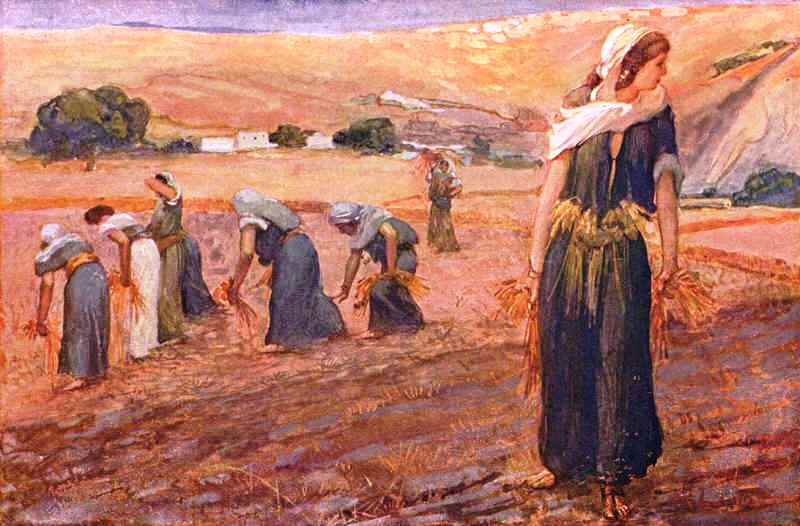
‘Ruth Gleaning’ watercolor by James Tissot (1896)

There’s a note in my study Bible that says, “by New Testament times” the book of Ruth was being “read at the Feast of Harvest (Pentecost) because much of the story is set in the harvest fields.” It was one of five books “read publicly at the Feasts of Israel.”

I dare say we all know the story. Naomi and her family moved to Moab during a famine in Israel. There, her two sons married. About 10 years later, Naomi’s husband and sons were dead and she returned home to Israel accompanied by her daughter in law, Ruth. We jump into the story as Ruth and Naomi arrive in “Bethlehem at the beginning of barley harvest” (Ruth 1:22).

So Ruth the Moabitess said to Naomi, “Please let me go to the field, and glean heads of grain after him in whose sight I may find favor.” And she said to her, “Go, my daughter.” Then she left, and went and gleaned in the field after the reapers. And she happened to come to the part of the field belonging to Boaz, who was of the family of Elimelech. (Ruth 2:2-3)

As we read further, we see Boaz went above and beyond what God’s law strictly required a landowner to leave for the poor. He offers Ruth protection and water, and asks her not to glean in any other field where he could not guarantee her safety (Ruth 2:8-9). Behind-the-scenes, he told his reapers to let grain fall for her on purpose and not to stop her if she wanted to glean even among the sheaves of grain (Ruth 2:15-16).

Unmerited Favor

There is much of Christ’s character visible in how Boaz treats Ruth when she first arrives in his field. Like Boaz did for Ruth, Jesus offers us His personal protection. He asks us not to stray from His laws because they are designed to keep us safe from the consequences of sin. He says, “If anyone thirsts, let him come to Me and drink” (John 7:37). Our response to this unearned favor ought to be much the same as Ruth’s.

So she fell on her face, bowed down to the ground, and said to him, “Why have I found favor in your eyes, that you should take notice of me, since I am a foreigner?” (Ruth 2:10)

This is much the same question David asked God in Psalms 8:4 and 144:3 — “What is man that You are mindful of him?” Every human is small and insignificant compared to God, and those of us who God has chosen for His particular attention are unimportant even by human standards.

But God has chosen the foolish things of the world to put to shame the wise, and God has chosen the weak things of the world to put to shame the things which are mighty; and the base things of the world and the things which are despised God has chosen, and the things which are not, to bring to nothing the things that are, that no flesh should glory in His presence. But of Him you are in Christ Jesus, who became for us wisdom from God—and righteousness and sanctification and redemption — that, as it is written, “He who glories, let him glory in the Lord.” (1 Cor. 1:27-31)

"Gleaning Firstfruits" marissabaker.wordpress.comGod is gleaning His firstfruits from the world’s rejects. He is taking people who are nothing and turning us into something glorious. He is taking strangers — like the Moabite Ruth — and adopting them into His family through Christ’s sacrifice.

But now in Christ Jesus you who once were far off have been brought near by the blood of Christ. …Now, therefore, you are no longer strangers and foreigners, but fellow citizens with the saints and members of the household of God (Eph. 2:13, 19)

Our Redeemer

The adoption process by which we become God’s children is, as we discussed last week, linked inseprably to Christ’s redeeming work (Eph. 1:5-7; Rom. 8:23; Gal. 4:3-7). There is a parallel for this as well in the story of Ruth, in the role Boaz plays as a kinsman redeemer.

And her mother-in-law said to her, “Where have you gleaned today? And where did you work? Blessed be the one who took notice of you.” So she told her mother-in-law with whom she had worked, and said, “The man’s name with whom I worked today is Boaz.” Then Naomi said to her daughter-in-law, “Blessed be he of the Lord, who has not forsaken His kindness to the living and the dead!” And Naomi said to her, “This man is a relation of ours, one of our close relatives.” (Ruth 2:19-20)

My study Bible says this last phrase could be translated “one that hath right to redeem.” We find the basis for the practice of a kinsman redeeming land in Leviticus 25: 25, 48-49. To prevent an inheritance from leaving the family, someone who was closely related, financially able, and willing to fill this role could redeem land that was sold. In some cases, as here in Ruth, when the man who the land originally belonged to had left a childless widow, the redeemer was expected to marry her per the command in Deuteronomy 25:5-10.

We see all this played out in Ruth 4:4-10 where Boaz must offer a more closely related kinsman the opportunity to redeem Naomi’s family’s land and marry Ruth.  This man refuses (which, being the hopeless romantic I am, I suspect was Boaz’s plan all along).

Stepping back a chapter and looking at Ruth’s request that Boaz play the part of a redeemer, we read about a practice that seems rather unusual. Since Naomi counsels this action and Boaz knew how to respond, I assume Ruth asking him to be her family’s redeemer (perhaps even this method of asking) was not considered unusual in their culture. Per Naomi’s instructions, Ruth lies down at Boaz’s feet when he is asleep and waits for him to notice her.

And he said, “Who are you?” So she answered, “I am Ruth, your maidservant. Take your maidservant under your wing, for you are a close relative.” (Ruth 3:9)

Looking at the Hebrew for “wing”, The Complete WordStudy Dictionary for the Old Testament says “the idiom to spread (one’s) wings over means to take to wife.” This same word is used in Ruth 2:12 when Boaz tells Ruth, “The Lord repay your work, and a full reward be given you by the Lord God of Israel, under whose wings you have come for refuge.” Ruth is asking Boaz for a type of protection that mirrors the relationship between God and Israel. The comparison is drawn even more strongly reading God’s words to Israel in Ezekiel 16.

“When I passed by you again and looked upon you, indeed your time was the time of love; so I spread My wing over you and covered your nakedness. Yes, I swore an oath to you and entered into a covenant with you, and you became Mine,” says the Lord God. (Ezk. 16:8)

In the same way, we who are part of the church have been “betrothed you to one husband” — Jesus Christ — and will be married “to Him who was raised from the dead” after He died in order to redeem us (2 Cor. 11:2; Rom. 7:4).

Taken together, the book of Ruth and the Feast of Pentecost teach us about the glorious unmerited favor that God pours out on us. We were strangers like Ruth and were not only invited to partake in what God provides, but cared for deeply and betrothed to His own Son, who gave His life to redeem His firstfruit Bride.