Learning God’s Law So We Can Love The Way He Loves

Every seven years, at the Feast of Tabernacles (Sukkot), God commanded ancient Israel to read the Law to the entire assembly (Deut. 31:10-13). This festival was one of three pilgrimage feasts during the year, and so most of the people would have gathered together to worship God for eight days (Lev. 23:33-43). That made it the perfect time to ensure as many people as possible heard the reading of the law. Remember, back then people wouldn’t have had personal copies of the Bible to read for themselves. They would (when the nation was working as God intended) learn from their parents as they grew up and from hearing the law read by priests. Eventually, by the time Jesus was growing up, many local synagogues had a copy of the Law and there was formal education for all the young people to learn God’s words and way.

Now when we observe the Feast of Tabernacles (at least the way we do things in my church), we hear sermons every day. We don’t read through the Torah every seven years, but we do hear from God’s word every day and because we all have Bibles, we can read the law for ourselves. But this week, I started wondering if I take full advantage of the opportunity I have to read God’s law. I spend most of my Bible study time looking at topics, and though I do read through the Bible cover-to-cover and then start over again it takes me a long while to do that. I might average going through it every 7 years or less, but it’s hard to say.

When Moses delivered the command to read the Law at the Feast of Tabernacles, he said, “you must read this law before them within their hearing. Gather the people—men, women, and children, as well as the resident foreigners in your villages—so they may hear and thus learn about and fear the Lord your God and carefully obey all the words of this law” (Deut. 31:11-12, NET). Notice the imperative here: you must read the law. It’s not optional, and everyone was included. There was a good reason behind this command. The people needed to hear and learn so that they would fear the Lord and carefully obey His commands. God’s people had a choice between living in covenant with Him and enjoying abundant life, or disobeying and walking down a path toward death (Deut. 30:11-20). He wanted them to have all the information they needed to choose life, just like He wants for people today (1 Tim. 2:3-4; 2 Peter 3:9).

Today, though, many of us aren’t sure what our relationship should be to God’s law. First-century Christians had these questions too, and Paul addresses the topic in many of his letters. We looked at part of his discussion related to how New Covenant believers inherit God’s law in last week’s post. The New Covenant doesn’t come with a brand new law, but rather a deeper, spiritual, and heart-level relationship with God’s laws (Jer. 31:31-33; Matt. 5:17-48). There are certain aspects of the commands in the Old Testament that don’t apply today (e.g. the temple sacrifices are fulfilled by Jesus’s sacrifice) but the rules God gave for living as His covenant people (e.g. the Ten Commandments) are still relevant because they teach us how to become “perfect, just as your Father in heaven is perfect” (Matt. 5:48, WEB).

Image of a man reading a book overlaid with text from Jeremiah 31:31, 33, NET version:  “Indeed, a time is coming,” says the Lord, “when I will make a new covenant with the people of Israel and Judah. ... I will put my law within them and write it on their hearts and minds. I will be their God and they will be my people.”
Image by Creative Clicks Photography from Lightstock

No Love Without Law

While listening to a sermon at the Feast of Tabernacles this year, one verse caught my ear in a way I’d never quite thought of before. It’s part of the Olivet prophecy where Jesus answer His disciples’ question, “Tell us, when will these things happen? And what will be the sign of your coming and of the end of the age?” (Matt. 24:3, NET). It’s interesting that rather than directly answering their “when” and “what” question, He gave them warnings and things they’d need to know as the time for His second coming drew closer. One of these warnings concerns the persecution of Jesus’s disciples. That started happening pretty much right away, is still happening today to Christians in many parts of the world, and will keep happening more and more as we get closer to Jesus’s return.

“Then they will hand you over to be persecuted and will kill you. You will be hated by all the nations because of my name. Then many will be led into sin, and they will betray one another and hate one another. And many false prophets will appear and deceive many, and because lawlessness will increase so much, the love of many will grow cold. But the person who endures to the end will be saved. And this gospel of the kingdom will be preached throughout the whole inhabited earth as a testimony to all the nations, and then the end will come.”

Matthew 24:9-14, NET

Today, I want to focus on the line, “because lawlessness will increase so much, the love of many will grow cold.” You might be more familiar with a translation like, “Because iniquity will be multiplied,” but “lawlessness” is the more accurate translation. The Greek word is anomia (G458). It is derived from a (used to make a word negative) and nomos (G3551), which means law. In a Biblical sense, that mostly refers to the Law of God. Therefore, anomia means “the condition of without law” either “because ignorant of it” or “because of violating it” (Thayer G458). It can also be translated “contempt,” “iniquity, wickedness,” or “unrighteousness” because that’s the result of living lawlessly.

This statement from Jesus might seem odd to some. Why would a lack of law mean that there’s no love? Depending on your background, you might think that laws are oppressive and restrictive rather than loving. Or you might already see laws in a more Biblical sense, as guards to keep us from hurting ourselves and others. As Paul says, “the law is holy, and the commandment is holy, righteous, and good” (Rom. 7:12, NET). God reveals His laws to us as an expression of His divine character and a guide for how to live rightly in the world He created. If we obey those commands and laws, we’ll be developing His character in us.
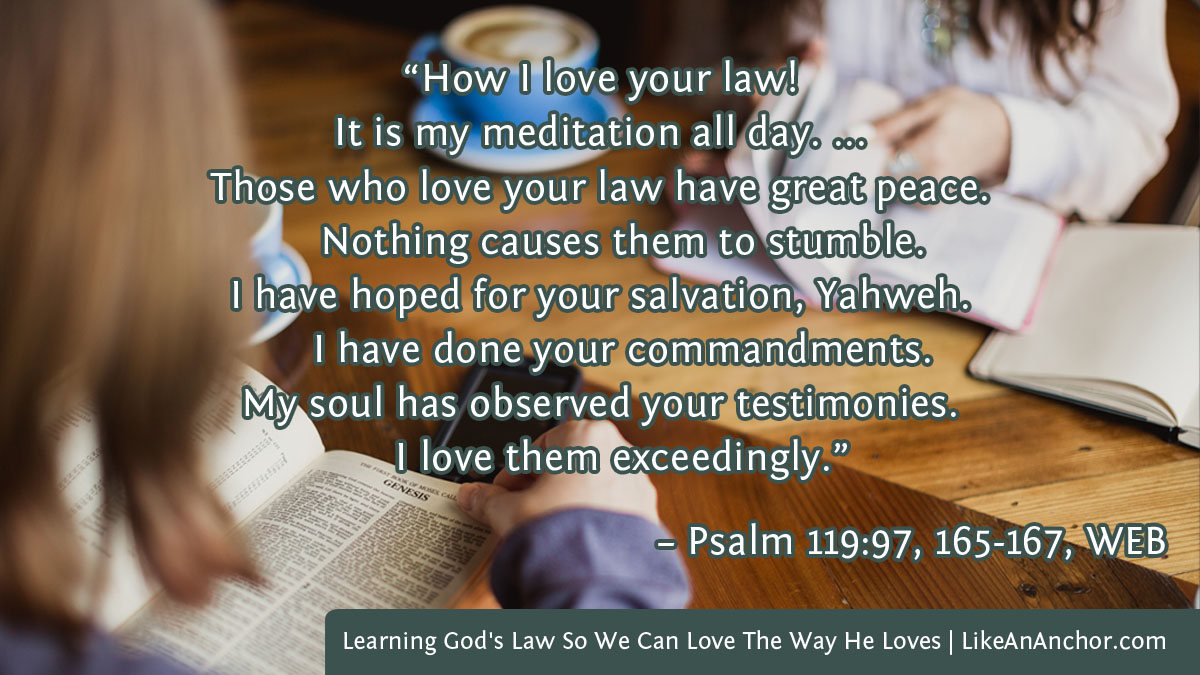
Image of two women Bible studying overlaid with text from Psalm 119:97, 165-167, WEB version:  “How I love your law! It is my meditation all day. ... Those who love your law have great peace. Nothing causes them to stumble. I have hoped for your salvation, Yahweh. I have done your commandments. My soul has observed your testimonies. I love them exceedingly.”
Image by Shaun Menary from Lightstock

Learning to Love Like God

“God is love” (1 John 4:8, 16), and it comes as no surprise that we’re instructed to make His love an integral part of our character. Paul calls love “the more excellent way,” excelling even faith and hope (1 Cor. 12:31-13:13). He also says that if we’re truly loving one another, then we’re fulfilling God’s law.

Owe no one anything, except to love one another, for the one who loves his neighbor has fulfilled the law. For the commandments, “Do not commit adultery, do not murder, do not steal, do not covet,” (and if there is any other commandment) are summed up in this, “Love your neighbor as yourself.” Love does no wrong to a neighbor. Therefore love is the fulfillment of the law.

Romans 13:8-10, NET (BOLD ITALICS IN ORIGINAL TO MARK OT QUOTES)

Over and over throughout scripture, we see God’s love paired with His law. Loving God and loving your neighbor are the two greatest commandments, according to Jesus Himself (Matt. 22:36-40). God gave us His laws because He loves us and He expects us to obey His laws if we love Him. The apostle John expands on this idea, saying that we can tell whether or not we genuinely love God by how well we’re following His commandments.

(My little children, I am writing these things to you so that you may not sin.) But if anyone does sin, we have an advocate with the Father, Jesus Christ the Righteous One, and he himself is the atoning sacrifice for our sins, and not only for our sins but also for the whole world.

Now by this we know that we have come to know God: if we keep his commandments. The one who says “I have come to know God” and yet does not keep his commandments is a liar, and the truth is not in such a person. But whoever obeys his word, truly in this person the love of God has been perfected. By this we know that we are in him. The one who says he resides in God ought himself to walk just as Jesus walked.

1 John 2:1-6, NET
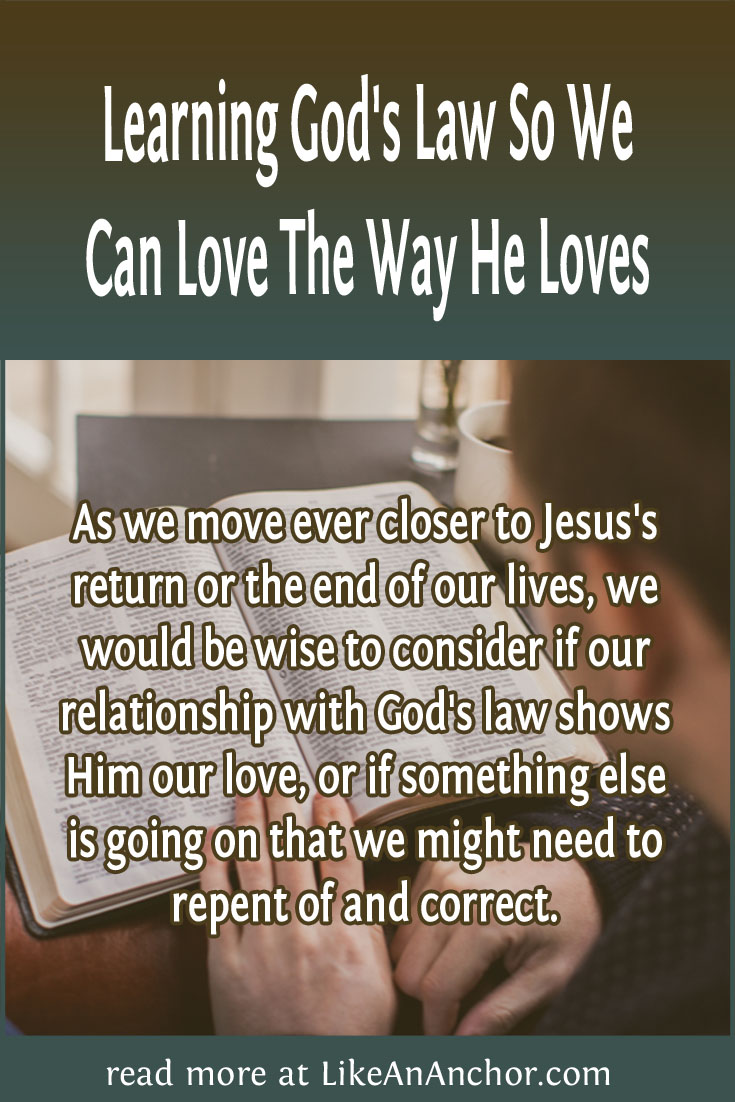
Image of a man studying the Bible with the blog's title text and the words "As we move ever closer to Jesus's return or the end of our lives, we would be wise to consider if our relationship with God's law shows Him our love, or if something else is going on that we might need to repent of and correct."
Image by Anggie from Lightstock

We’re not saved by keeping God’s commandments, but when we have a saving, transforming, relationship with Jesus and the Father we will be keeping their commandments. We’re saved by God’s grace, and then the proper response to that grace is to faithfully keep covenant with God and do as He says. If we don’t want to obey God, then we don’t really love Him or know Him. That might be a hard truth to swallow sometimes, but that’s what John teaches us here because he learned it from Jesus (John 14:15, 21; 15:10-12).

 Everyone who practices sin also practices lawlessness; indeed, sin is lawlessness. And you know that Jesus was revealed to take away sins, and in him there is no sin. Everyone who resides in him does not sin; everyone who sins has neither seen him nor known him. Little children, let no one deceive you: The one who practices righteousness is righteous, just as Jesus is righteous.

1 John 3:4-7, NET

Here once again, we see that word anomia. People who are genuinely part of God’s covenant don’t live lawlessly. As John pointed out earlier in his letter, we might sometimes sin (and when we do, we have Jesus as Advocate to help us repent and return) but we shouldn’t be living habitually sinful lives. One of the key reasons that Jesus came to this world and died was “to set us free from every kind of lawlessness and to purify for himself a people who are truly his, who are eager to do good” (Titus 2;14, NET). We need to take this seriously and not dishonor Him, or treat Him in an unloving way, by living lawless lives.

When Jesus comes back, He will tell the lawless, “I never knew you” (Matt. 7:21-23). That’s certainly not what we want to hear! Rather, we want to be those who’ve responded to His love by loving Him and our fellow Christians so much that we obey God’s word as a result of our transformative relationship with Him. As we move ever closer to Jesus’s return or the end of our lives (whichever comes first), we would be wise to consider whether our relationship with God’s law shows Him our love, or if something else is going on that we might need to repent of and correct.

Jesus warned that “because lawlessness will increase so much, the love of many will grow cold.” We need to be careful that the lawlessness in the world around us doesn’t cool our love, and that we are not living lawlessly ourselves. John treats loving other people and keeping God’s commandments as something we can look at to see if we’re sincerely loving and following God, and we can follow his example when we examine ourselves and study our Bibles. The more we love God, spend time with Him, and internalize His words, the better we’ll know how to love the way that He loves.


Featured image by Pearl from Lightstock

Song Recommendation: “How I Love Thy Law, O Lord” (one of my favorite hymns that my church has in their hymnal)


Keeping The Feast As God’s Covenant Community

If you’re reading this when it posts, then today (Sept. 30, 2023), is the first day of the Feast of Tabernacles (Sukkot). As we made preparations to keep this Feast, I’ve been thinking about a book of the Bible that, at first glance, you might think doesn’t have much to do with the holy days. Usually when talking about God’s holy times, we turn to some place like Leviticus 23, which outlines all the days God says are holy to Him. This year, though, I’ve been thinking about Romans.

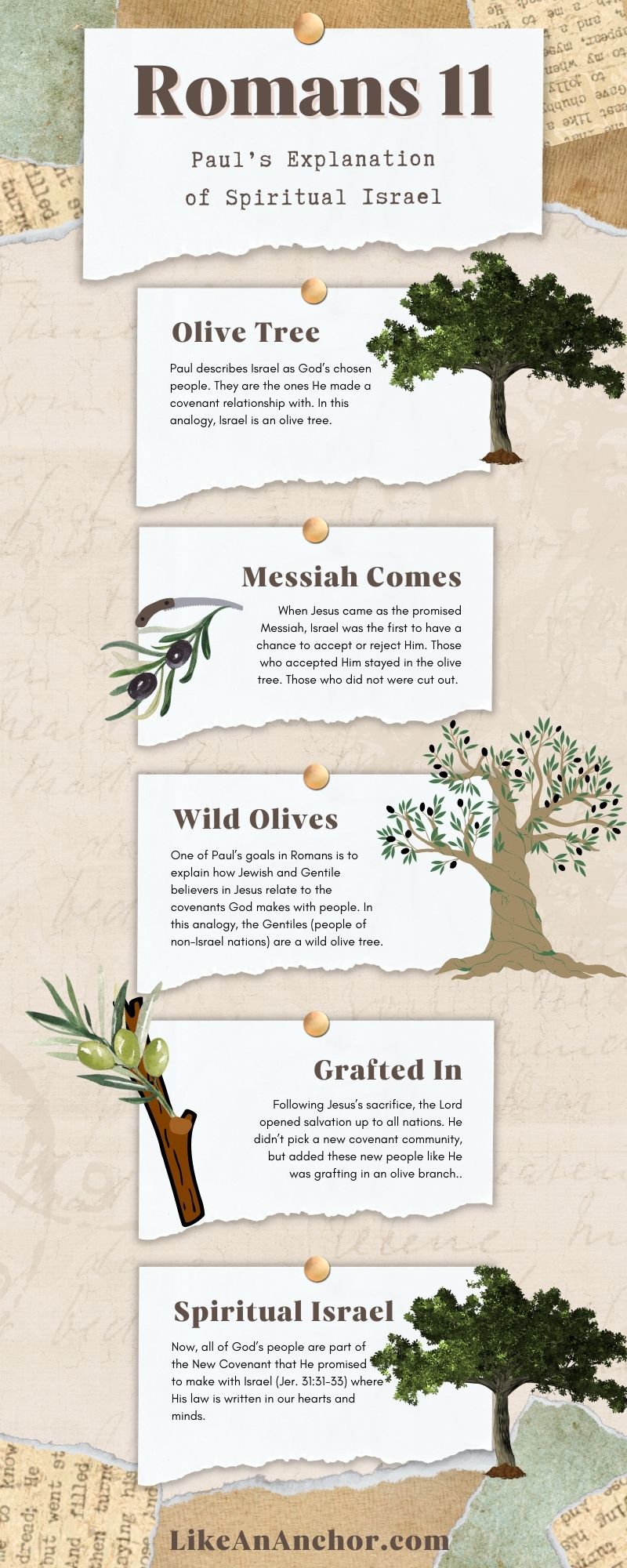
I’m sure I’ve mentioned before that Paul’s letter to the Romans is one of my favorite books in the Bible. There’s so much depth to it; I think I could spend a lifetime studying it and not fully understand everything. While reading Romans 10 and 11 a few weeks ago, I sketched out some notes trying to visualize the olive tree grafting analogy that Paul uses when discussing how New Covenant Christians and Gentile believers (those who were not ethnically part of Israel) become part of God’s community of faith, and what happened to the Jewish people who did not accept Jesus as the Messiah. Earlier, I also sketched out a chart trying to illustrate the different ways that Paul speaks to Jewish and Gentile converts about God’s law. I turned one into an infographic and one into a sort of flowchart. These visualizations helped me, and I’m sharing them in hope they might be useful to others as well.

Two Paths to Get to Christ

Often, I think Christians make the mistake of thinking that Christianity was a new religion started by Jesus and that the Jews today are still keeping the faith described in the Old Testament. What we ought to realize is that Jesus came as the next step in God’s plan for His people. He was the promised Messiah, and those who accepted Him continued along the path God laid out for His people from Genesis onward. Assuming you believe that Jesus is the Messiah, then those who didn’t believe in Him are the ones who broke off and went a different direction. That’s what Paul is addressing in this section of Romans. 

Brothers and sisters, my heart’s desire and prayer to God on behalf of my fellow Israelites is for their salvation.  For I can testify that they are zealous for God, but their zeal is not in line with the truth.  For ignoring the righteousness that comes from God, and seeking instead to establish their own righteousness, they did not submit to God’s righteousness. For Christ is the end of the law, with the result that there is righteousness for everyone who believes. 

Romans 10:1-4, NET

Paul was a Jewish man who had zeal for God that originally didn’t line up with the truth. He persecuted Christians at first, but when Jesus dramatically revealed Himself to Paul as the Messiah, Paul aligned His zeal with God’s truth. After that, he wanted all of his fellow Israelites to have a similar awakening. At this point, rather than aligning themselves with God’s truth, the way that they were trying to follow His law involved doing things their own way. Christ brings an end to trying to keep the law as a way to establish your own righteousness.

The Greek word for “end” here can mean the end or completion point, but it also means “the end to which all things relate, the aim, purpose” (Thayer, G5056, 1d). Now, remember that when we’re interpreting Paul we need to keep in mind that, as a faithful apostle, he would not contradict one of Jesus’s teachings. Jesus said, “Do not think that I have come to abolish the law or the prophets. I have not come to abolish these things but to fulfill them” (Matt. 5:17, NET). Here, He’s saying that He came “to fulfil, i.e. to cause God’s will (as made known in the law) to be obeyed as it should be, and God’s promises (given through the prophets) to receive fulfilment” (Thayer, G4137, 2c3). Therefore, Paul is not saying that Jesus got rid of the law. He’s pointing out that we don’t become righteous by keeping the law.

Paul taught both Jewish and Gentile Christians. These two groups had different relationships to the law of God as they came into the church. For Jewish Christians, “the law was our schoolmaster to bring us unto Christ, that we might be justified by faith” (Gal. 3:24, KJV). For Gentile Christians (particularly those who weren’t already “God fearers” who’d aligned themselves with the Jewish faith), they came to Jesus by faith first and learned about God’s laws afterwards. You’ll often see Paul telling his Jewish readers that it’s important to keep God’s law on a heart level now and to understand they can’t make themselves righteous, and teaching his Gentile readers to obey God but not accept extra Jewish traditions they’d added on top of the law.

Chart illustrating the ways Paul outlines for Jewish and Gentile Christians to both enter the New Covenant community with God.
Image by Marissa Martin, created with Canva

For Moses writes about the righteousness that is by the law: “The one who does these things will live by them.” But the righteousness that is by faith says … “The word is near you, in your mouth and in your heart” (that is, the word of faith that we preach), because if you confess with your mouth that Jesus is Lord and believe in your heart that God raised him from the dead, you will be saved. For with the heart one believes and thus has righteousness and with the mouth one confesses and thus has salvation. For the scripture says, “Everyone who believes in him will not be put to shame.” For there is no distinction between the Jew and the Greek, for the same Lord is Lord of all, who richly blesses all who call on him. For everyone who calls on the name of the Lord will be saved.

Romans 10:5-6, 8-13 (bold italics in original to mark OT quotes)

Paul uses quotes from the Old Testament to support his thesis that Jewish and Gentle Christians are part of the same spiritual family. God wants all His people in community together, joined into one covenant relationship with Him. For many of the Gentiles, this is the first time they’ve been in covenant with God. For the Jewish believers, the New Covenant was a promise contained in the Old Covenant. Whichever way they came into the family, they’re now both part of that New Covenant with God.

Grown or Grafted into One Tree

So I ask, God has not rejected his people, has he? Absolutely not! For I too am an Israelite, a descendant of Abraham, from the tribe of Benjamin. God has not rejected his people whom he foreknew! Do you not know what the scripture says about Elijah, how he pleads with God against Israel? “Lord, they have killed your prophets, they have demolished your altars; I alone am left and they are seeking my life!” 

But what was the divine response to him? “I have kept for myself seven thousand people who have not bent the knee to Baal.” So in the same way at the present time there is a remnant chosen by grace. And if it is by grace, it is no longer by works, otherwise grace would no longer be grace. What then? Israel failed to obtain what it was diligently seeking, but the elect obtained it. …

I ask then, they did not stumble into an irrevocable fall, did they? Absolutely not! But by their transgression salvation has come to the Gentiles, to make Israel jealous …  Now I am speaking to you Gentiles. Seeing that I am an apostle to the Gentiles, I magnify my ministry, if somehow I could provoke my people to jealousy and save some of them. For if their rejection is the reconciliation of the world, what will their acceptance be but life from the dead?

Romans 11:1-7, 11, 13-15, NET (bold italics in original to mark OT quotes)

Through His prophets, God revealed that He always intended to open up salvation to all nations after the Messiah came. Even before that, He allowed people from non-Israelite nations to join the covenant community if they really wanted. As Paul was writing, though, this broad preaching of the good news to all the nations was a new and exciting thing.

This doesn’t mean God started a brand new family/community, though. He transitioned His family to a new and better covenant, and welcomed new members in. Those who didn’t want to come with Him into the New Covenant got cut out of the community (at least for a little while). I find this easier to wrap my head around with a visualization. If you’re subscribed to my newsletter, you’ve already seen this infographic. I sent it out on Wednesday to give newsletter readers a sneak peak and to ask for feedback on the design.

Infographic illustrating the "grafted in" analogy Paul uses for how Jewish and Gentile Christians enter the New Covenant community with God.
Image by Marissa Martin, created with Canva

The Things We Do In God’s Family

Image of ___ with the blog's title text and the words "By celebrating God's Feasts, we're honoring Him as His covenant-keeping people."
Image created with Canva

One of the things that stood out to me when I was reading Misreading Scripture with Individualist Eyes by E. Randolph Richards and Richard James was the way they described Paul’s letters discussing Jewish and Gentile believers. One of the things Paul is doing when writing to believers, including in his Romans letter, is telling them they are part of a new community. In collectivist cultures, people get their identity from a group. Before conversion, Jews and Gentiles were part of different communities with different expectations, beliefs, and codes of conduct. Now, though, they are part of God’s covenant community.

When we’re in God’s community as part of His family, there are certain expectations that come with that. For example, we’re expected to treat God’s name with respect and honor Him with our words and conduct. He expects us to come to Him when we need help rather than turn to something else first. We’re to love the Father and Jesus, and Jesus said if we love Him then we will keep His commandments. Most Christians today already know that this includes the 10 Commandments, but those aren’t the only aspects of God’s law that transfer to the New Covenant. They’re more of a summary.

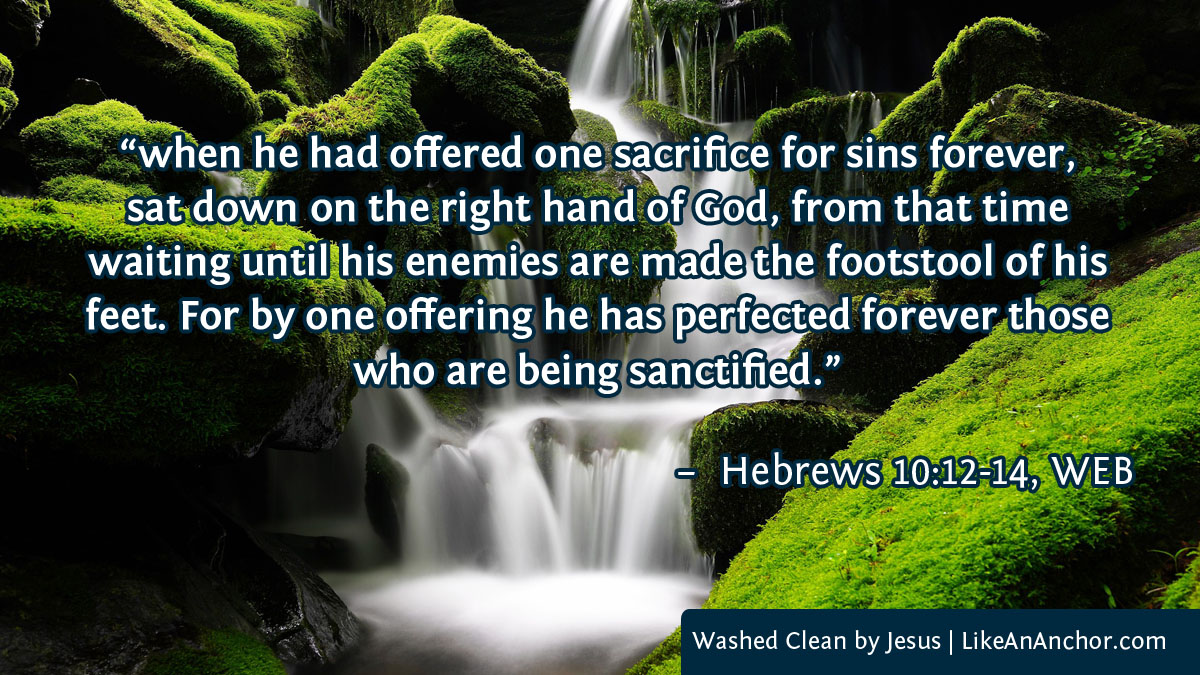
As already mentioned, Jesus said He came to fill the law and the prophets to their fullest extent, not to abolish them (Matt. 5:17) In some ways, more is expected of us in the New Covenant rather than less. We don’t need to do all the sacrifices since “by one offering he [Jesus] has perfected forever those who are being sanctified” (Heb. 10:14, WEB), but we are expected to obey the law on a heart level and not just a letter level (Matt. 5:17-48). God’s laws and commands describe the things that we do as part of God’s family; the things that He expects from people who have a covenant relationship with Him. His Sabbaths and Holy Days are a key part of that for Spiritual Israel today. They are times when He calls for His children to come together, rejoice with each other and with Him, and learn more about Him. That’s what we’ll be doing for the seven days of the Feast of Tabernacles and the Eight Day that follows, just as Jesus did when He kept this Feast (John 7).


Featured image by Claudine Chaussé

How Do We Learn From God’s Judgements?

As I wrote last week’s post about “Seeking and Learning Righteousness,” I kept mentioning the connection between learning righteousness and paying attention to God’s judgements. The key scripture we looked at in that post reads, “Yes, with my spirit within me I will seek you earnestly; for when your judgments are in the earth, the inhabitants of the world learn righteousness” (Is. 26:9, WEB). 

It’s clear from this and other verses we looked at last week that we can learn righteousness from God’s judgements. But how? That was a question I thought of while writing, but didn’t really have the time to address. To answer this, we first need to understand what Isaiah means by God’s judgements.

More than Simply “Judgements”

The word translated “judgement” in Isaiah 26:9 is the Hebrew mishpat (H4941). Common translations include “judgement, justice, ordinance” (Brown-Driver-Briggs). This word is not confined to what we think of as the judicial function of government. The root word shapat means “to exercise [all] the processes of government” (Theological Wordbook of the Old Testament [TWOT], entry 2443). Furthermore, ancient understanding didn’t really separate the law from the lawgiver–“the centering of law, rulership, government in a man was deeply ingrained” (TWOT 2443). This makes perfect sense when we think of God as the Lawgiver and Ruler. The Bible treats His Law as an extension of His character.

For mishpat specifically, there are “at least thirteen related, but distinct, aspects of the central idea, which if to be rendered by a single English word with similar range of meaning ought by all means to be the word ‘justice'” (TWOT 2443c). These 13 meanings include “the act of deciding a case of litigation,” “a sentence or decision issuing from a magistrate’s court,” “an ordinance of law,” and “one’s right under law,” among others.” One other key meaning is “sovereignty, the legal foundation of government in the sense of ultimate authority or right.” People today expect this to be centered in laws and governing documents, but in scripture “The mishpat is God’s” (TWOT 2443c; Deut. 1:17). He has all authority, and when He exercises judgement/justice He does so as head of everything (not just a single branch of government).

When we speak of learning from God’s mishpat, that includes learning from His sovereign authority, His ordinances of law, and His just legislative rulings. Mishpat appears 421 times in the Old Testament so obviously we can’t look at every verse right now, but we can look at some examples of how God expected people to interact with His mishpat.

  • God chose to share His plans about Sodom and Gomorrah with Abraham before it happened because “I have known him, to the end that he may command his children and his household after him, that they may keep the way of Yahweh, to do righteousness and justice (mishpat)” (Gen. 18:19, WEB). One of the reasons the Lord trusted Abraham is because he kept Yahweh’s mishpat and would teach the people under his care to do so as well.
  • The laws/rules/ordinances/commands revealed to Moses at Mount Sinai are called mishpat: “Moses came and told the people all Yahweh’s words, and all the ordinances(mishpat); and all the people answered with one voice, and said, ‘All the words which Yahweh has spoken will we do'” (Ex. 24:3, WEB). (See also Lev. 18:4-5; 20:22; 25:18; 26:46).
  • The people of Israel had to keep all the Lord’s mishpat if they wanted to inherit the promises He made. They were warned not to add to or take away from God’s commands, nor to forget them. They also had a responsibility to pass on the mishpat to their children, as Abraham did to his. If they kept the mishpat, God would give them great blessings (Deut. 4:1-14; 5:1-22, 31-33; 7:12-13; 11:1; 26:16-19).
  • David, whom God described as “a man after my heart, who will do all my will” (Acts 13:22, WEB), said, “I have kept Yahweh’s ways, and have not wickedly departed from my God. For all his ordinances (mishpat) were before me. As for his statutes, I didn’t depart from them” (2 Sam 22:22-23, WEB).
  • We often say Solomon asked God for wisdom, but the specific wording when God responds is, “Because you … have asked for yourself understanding to discern justice (mishpat); behold, I have done according to your word. Behold, I have given you a wise and understanding heart” (1 Kings 3:11-12, WEB).
  • Judgement came on ancient Israel because they forsook God and stopped keeping His judgements/ordinances (1 Kings 11:31-33; Neh. 1:4-7; 9:28-29; Ezk. 5:5-8; 11:10-12; 20:11-24; Dan. 9:4-5). Notice that not keeping God’s mishpat is a sin and is linked with forsaking God Himself.
Image of a man watching a sunset overlaid with text from Deut. 11:1, WEB version:  “you shall love Yahweh your God, and keep his instructions, his statutes, his ordinances, and his commandments, always.”
Image by Aaron Kitzo from Lightstock

Lessons from Ancient Israel’s Relationship With God

I want to spend a little more time looking at ancient Israel’s relationship with God’s mishpat. When God instituted the Sinai Covenant with Israel, it was like a marriage ceremony. The laws and ordinances that He delivered are like the marriage vows that couples make. Both God and the people bound themselves together in a formal relationship–a covenant–and agreed to live by His mishpat (Ex. 24:3). As co-inheritors with Jesus Christ of the covenants God made with His people in the past, His mishpat are still relevant for us today and we can learn from the ways that God’s people in the past related to Him and His justice/ordinances.

There’s a passage in Ezekiel where God summarizes His relationship with the people of Israel thus far, and He pays particular attention to how they related to His mishpat. Ezekiel records that “some of the elders of Israel came to inquire of Yahweh,” and Yahweh responded by telling Ezekiel, “Cause them to know the abominations of their fathers” (Ezk. 20:1, 4, WEB). As we read the history of Israel from the Lord’s perspective, keep in mind that He uses the word “abominations” to describe what the people did. The actions they took against Him and His mishpat were very serious.

“So I caused them to go out of the land of Egypt, and brought them into the wilderness. I gave them my statutes, and showed them my ordinances (mishpat), which if a man does, he will live in them. Moreover also I gave them my Sabbaths, to be a sign between me and them, that they might know that I am Yahweh who sanctifies them.

“But the house of Israel rebelled against me in the wilderness. They didn’t walk in my statutes, and they rejected my ordinances (mishpat), which if a man keeps, he shall live in them. They greatly profaned my Sabbaths. Then I said I would pour out my wrath on them in the wilderness, to consume them. But I worked for my name’s sake, that it should not be profaned in the sight of the nations, in whose sight I brought them out.  Moreover also I swore to them in the wilderness, that I would not bring them into the land which I had given them, flowing with milk and honey, which is the glory of all lands;  because they rejected my ordinances (mishpat), and didn’t walk in my statutes, and profaned my Sabbaths; for their heart went after their idols. Nevertheless my eye spared them, and I didn’t destroy them. I didn’t make a full end of them in the wilderness. I said to their children in the wilderness, ‘Don’t walk in the statutes of your fathers. Don’t observe their ordinances (mishpat) or defile yourselves with their idols.  I am Yahweh your God. Walk in my statutes, keep my ordinances (mishpat), and do them.  Make my Sabbaths holy. They shall be a sign between me and you, that you may know that I am Yahweh your God.'”

“But the children rebelled against me. They didn’t walk in my statutes, and didn’t keep my ordinances (mishpat) to do them, which if a man does, he shall live in them. They profaned my Sabbaths. Then I said I would pour out my wrath on them, to accomplish my anger against them in the wilderness. Nevertheless I withdrew my hand, and worked for my name’s sake, that it should not be profaned in the sight of the nations, in whose sight I brought them out. Moreover I swore to them in the wilderness, that I would scatter them among the nations, and disperse them through the countries; because they had not executed my ordinances (mishpat), but had rejected my statutes, and had profaned my Sabbaths, and their eyes were after their fathers’ idols.”

Ezekiel 20:10-24, WEB

This tragic story is not just ancient history. Paul told New Covenant Christians in Corinth, “These things happened to them as examples and were written for our instruction, on whom the ends of the ages have come. So let the one who thinks he is standing be careful that he does not fall” (1 Cor. 10:11-12, NET). We need to learn from the lessons of Israel’s history in the Old Testament so that we don’t make the same mistakes, such as rejecting the mishpat of our God. Then and today, God wants people who have a relationship with Him to live in and walk in His justice/ordinances/judgements. We’re supposed to become holy as He is holy, and doing what He tells us to is part of that process.

Image of two women reading Bibles overlaid with text from 1 Peter 1:13-15, WEB version:  "“Be sober, and set your hope fully on the grace that will be brought to you at the revelation of Jesus Christ—as children of obedience, not conforming yourselves according to your former lusts as in your ignorance, but just as he who called you is holy, you yourselves also be holy in all of your behavior”
Image by Shaun Menary from Lightstock

Trained in Righteousness Today

Talking about the ordinances of God from the Old Testament makes some modern Christians uncomfortable. This is due to misinformation about how New Covenant believers relate to God’s laws. For example, Paul is often misread as doing away with God’s law. He preempted that reading by asking and answering a question: “Do we then nullify the law through faith? May it never be! No, we establish the law” (Rom. 3:31, WEB). This sentiment echoes something Jesus Himself said.

“Do not think that I have come to abolish the law or the prophets. I have not come to abolish these things but to fulfill them. I tell you the truth, until heaven and earth pass away not the smallest letter or stroke of a letter will pass from the law until everything takes place. So anyone who breaks one of the least of these commands and teaches others to do so will be called least in the kingdom of heaven, but whoever obeys them and teaches others to do so will be called great in the kingdom of heaven. For I tell you, unless your righteousness goes beyond that of the experts in the law and the Pharisees, you will never enter the kingdom of heaven!”

Matthew 5:17-20, NET

The scribes, or “experts in the law,” and Pharisees were a group of people that Jesus called out for putting on a righteous show while neglecting the true spiritual meaning of God’s laws and leaving “justice, mercy, and faith” undone (Matt. 23). Jesus wants His people to follow His words faithfully from the heart, not to put on a righteous show. Aligning ourselves with Jesus is how we become truly righteous.

That’s how the mishpat of God help us learn righteousness. The Law is an expression of God’s character, and keeping it aligns people with Him. Paul compared the Law to a “tutor to bring us to Christ, that we might be justified by faith” (Gal. 3:24, WEB). Even today, the mishpat of God (which we’re to keep on a spiritual and literal level as New Covenant believers with the law written in our hearts) point us to our Savior and help us learn righteousness.

You, however, must continue in the things you have learned and are confident about. You know who taught you and how from infancy you have known the holy writings, which are able to give you wisdom for salvation through faith in Christ Jesus. Every scripture is inspired by God and useful for teaching, for reproof, for correction, and for training in righteousness, that the person dedicated to God may be capable and equipped for every good work.

2 Timothy 3:14-17, NET

When Paul wrote these words to Timothy, the “holy writings” and “scripture” he refered to are what we now call the Old Testament. Over and over in those scriptures, we learn that righteousness and justice are something that God loves and that those who love Him will keep His mishpat (Deut. 11:1; 30:16; Ps. 33:5; 37:28). God pleads with His people to walk in and follow His mishpat and practice righteousness because that’s the way to life (Lev. 18:5; Neh. 9:29; Ezk. 18:9). Then, just as today, God “wants all people to be saved and to come to a knowledge of the truth” (1 Tim. 2:4, NET; see also 2 Pet. 3:9 and Ezk. 18; 33).

There are no human beings who can claim to be perfectly righteous on their own, “for all have sinned” (Rom. 3:10, 23, WEB). It is Jesus Christ’s act of righteousness that makes it possible for us to really become righteous (Rom. 5:17-18). Now that He has called us, we are obligated to obey God our Savior as servants of righteousness (Rom. 6:12-23). We’re not justified by our own righteousness, but having been justified by Jesus we must choose to live according to His righteousness. God’s mishpat train us in how to do that.

Called To Holiness

Image of a man praying with the blog's title text and the words "Scriptures say we can learn righteousness from God's 
judgements.  How?"
Image by WhoisliketheLord Studio from Lightstock

Like Timothy, we need God’s word “for teaching, for reproof, for correction, and for training in righteousness” so that we who are “dedicated to God may be capable and equipped for every good work” (2 Tim. 3:16-17, NET). God has called us for a purpose, which involves becoming part of His family. We’re literally supposed to become like Him. This is a process that won’t be completed until Jesus Christ’s return.

When Paul tells his readers they are “called to be saints,” the word translated “saints” literally means a holy thing/people (Rom. 1:7; G40 hagios). Peter expands on this idea when he says we must be “obedient children” who, “like the Holy One who called you, become holy yourselves in all of your conduct, for it is written, ‘You shall be holy, because I am holy‘” (1 Peter 1:15-16, NET [bold italics a quote from  Lev 19:2]). God expects holiness and righteous conduct from those He calls into a relationship with Him.

The simplest way to put this is that we’re to follow Jesus’s holy and righteous example (Acts 3:14; 1 Cor. 11:1; Eph. 5:1-2). Expand on it a little more, and you get the two greatest commandments–love God and love your neighbor (Mark 12:28-34; Rom. 13:8-10). For more detailed instructions on how to be holy and righteous, we go to the Lord’s words, laws, ordinances, and teachings (those mishpat we’ve been talking about). God’s word shows us what people who are becoming holy do and do not do. As we obey His commands out of love for Jesus and the Father, we are training in righteousness and becoming holy like He is holy.


Featured image by Matt Vasquez from Lightstock

Washed Clean by Jesus

I read a chapter in my Bible each night before bed, and I recently finished Exodus and moved into Leviticus. This book is full of God’s laws and instructions for His people Israel, and much of it has to do with ceremonial uncleanness.

Those parts of the Torah might not seem as if they have anything to do with us today. There isn’t a temple building anymore or a priesthood conducting animal sacrifices. We don’t worry about doing things that might make us unclean until evening or take turtledoves and lambs to the temple to ask God to pass over our sins. But the fact that we don’t have to worry about that anymore means something changed, and that something isn’t God. He’s the same yesterday, today, and forever (Mal. 3:6; Heb. 13:8). He’s still just as holy as He was in the Old Testament. What’s changed is something having to do with our holiness and God’s relationship with us.

This “something” is that Jesus’s sacrifice cleanses us from our sins. The fact that we say “cleanses” us from sin, though, points to the same problem Leviticus was trying to deal with. God is holy, but holiness is not the default state of human beings. Sins (and even things that aren’t sin which once resulted in ceremonial uncleanness) would separate us from God if there wasn’t a way of washing us. I think this is why the New Testament writers spend so much time talking about cleanliness and holiness. When they described what Jesus is doing in us, they’re working with this background knowledge that God didn’t allow unclean people into His temple.

Uncleanness and Sin

In the Old Covenant law, people became ritually unclean in several ways. One was by sinning, which required sacrifices offered as atonement even though they couldn’t actually remove sin. There were also ways to become ritually unclean without sinning, such as by touching animal carcasses or dead bodies, contracting leprosy, having a baby, and having sex (Lev. 5:2;12:2; 13:3, 44-45; 15:1-33). All sin made people unclean, but not all the ways to become unclean involved sin.

Even though many of the things that resulted in ritual uncleanness weren’t sins, they could still disqualify you from entering the temple or eating of the holy things (Lev. 7:19-21; Chr. 23:18-19; Rev. 21:23-27). Because God is holy, His people had to “make a distinction between the holy and the common, and between the unclean and the clean” so they wouldn’t die by defiling God’s dwelling place with their uncleanness (Lev. 10:10-11; 15:31). God is still holy today, but the process for making us clean is much more lasting and complete.

For if the blood of goats and bulls, and the ashes of a heifer sprinkling those who have been defiled, sanctify to the cleanness of the flesh, how much more will the blood of Christ, who through the eternal Spirit offered himself without defect to God, cleanse your conscience from dead works to serve the living God?

Hebrews 9:13-14, WEB

Washed by Jesus

Jesus spent quite a bit of time during his earthly ministry engaging in debate with the religious leaders of His day. One thing in particular that He pointed out to them was that their efforts to be clean had gotten off-track. It wasn’t the outward cleanliness that mattered the most, but the holiness of the heart (Matt. 23:25-27; Luke 11:40-42). This doesn’t mean we ignore the outside, but outward things aren’t our focus; the outside becomes clean as a result of the cleaning happening inside us.

In John’s account of Jesus’s final Passover, he mentions that “many people went up to Jerusalem from the rural areas before the Passover to cleanse themselves ritually” (John 11:54-56). This is a detail I’ve overlooked in the past; it just seems like a note explaining something about the culture at the time. But a short time later at Passover, Jesus has this conversation with Peter:

Peter said to him, “You will never wash my feet!”

Jesus answered him, “If I don’t wash you, you have no part with me.”

Simon Peter said to him, “Lord, not my feet only, but also my hands and my head!”

Jesus said to him, “Someone who has bathed only needs to have his feet washed, but is completely clean. You are clean, but not all of you.” For he knew him who would betray him, therefore he said, “You are not all clean.”

John 13:8-11, WEB

We are clean in every sense–ritually and in terms of forgiveness for sin–if Jesus Christ washes us. Paul emphasizes this in one of his letters, saying “Christ also loved the assembly, and gave himself up for it;  that he might sanctify it, having cleansed it by the washing of water with the word, that he might present the assembly to himself gloriously, not having spot or wrinkle or any such thing; but that it should be holy and without defect” (Eph. 5:25-27, WEB).

Jesus’s sacrifice mediates a new covenant that involves more immediate and lasting cleansing than was ever available under the old covenant (Heb. 9:13-15, 22-24; 10:1-14). Instead of making it possible for us to walk inside a physical temple dedicated to God, Jesus’s cleansing makes us part of God’s undefiled spiritual temple (1 Cor. 3:16-17; 6:16-20; 2 Cor. 6:15-18). It goes beyond just being allowed to visit God. We actually get to be part of His dwelling place.

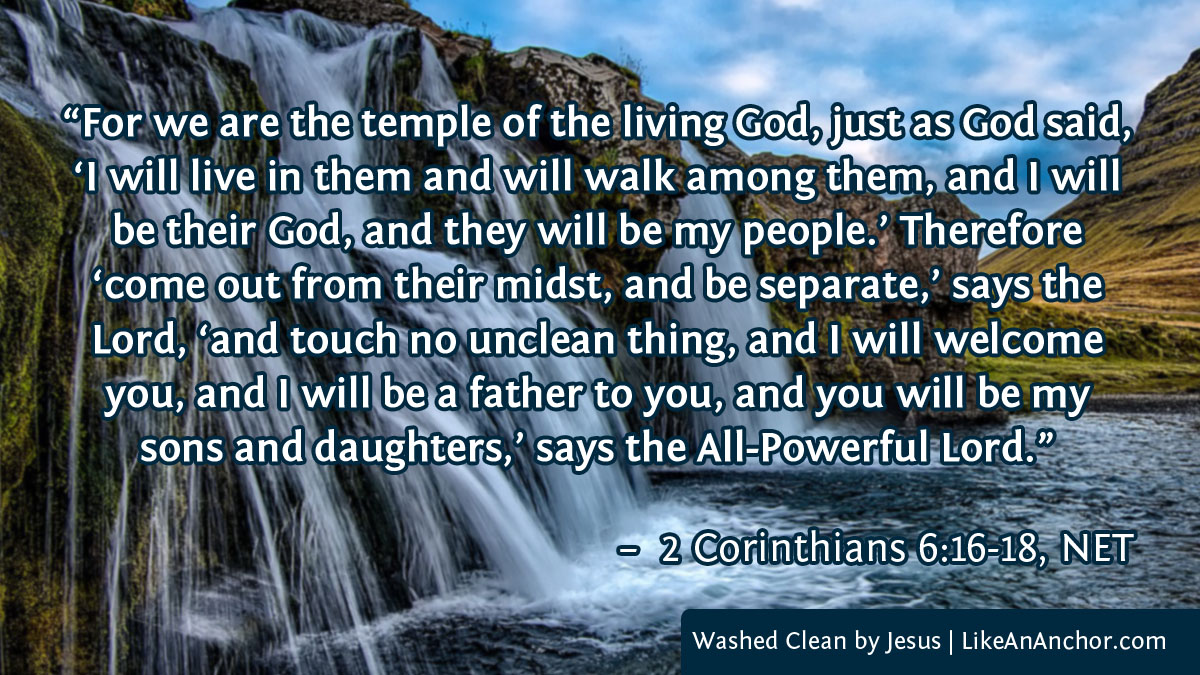
Image of a waterfall, with text from 2 Cor. 6:16-18, NET version: "For we are the temple of the living God, just as God said, ‘I will live in them and will walk among them, and I will be their God, and they will be my people.’ Therefore ‘come out from their midst, and be separate,’ says the Lord, ‘and touch no unclean thing, and I will welcome you, and I will be a father to you, and you will be my sons and daughters,’ says the All-Powerful Lord.”
Image by David Mark from Pixabay

Dwelling in the Clean Vine

Becoming clean is something that Jesus does to us. Staying clean is something we’re involved in. It’s part of a lifelong process of becoming holy the way that God is holy (Matt. 5:48; 1 Pet. 1:15-16). We need to “cleanse ourselves from all defilement of flesh and spirit, perfecting holiness in the fear of God” (2 Cor. 7:1, WEB). We’re actively involved in the process of sanctification because we choose what behaviors shape the sort of people we are (1 Cor. 5:6-8; 2 Tim. 2:20-21).

“I am the true vine, and my Father is the farmer. Every branch in me that doesn’t bear fruit, he takes away. Every branch that bears fruit, he prunes, that it may bear more fruit. You are already pruned clean because of the word which I have spoken to you. Remain in me, and I in you. As the branch can’t bear fruit by itself unless it remains in the vine, so neither can you, unless you remain in me. …

“In this my Father is glorified, that you bear much fruit; and so you will be my disciples. Even as the Father has loved me, I also have loved you. Remain in my love. If you keep my commandments, you will remain in my love; even as I have kept my Father’s commandments, and remain in his love.”

John 15:1-4, 8-10 WEB

The way we stay clean is by staying firmly attached to Jesus and following Him. Under the Old Covenant, we could have become “unclean” in all sorts of ways and becoming clean again involved the passage of time and/or ritual washing or sacrifice (depending on how you became unclean). Now under the New Covenant, Jesus washes us clean all the time so long as we’re sticking close to Him.

Staying in God’s Presence

Jesus doesn’t let anything that could make us “unclean” stand in the way of us getting into God’s presence. The relationship we have with God isn’t cut off if we touch an unclean animal or become seriously ill; there’s no more ritual uncleanness to worry about. However, God still cares about the way we live our lives.

Just like there was a difference between ritual uncleanness and law-breaking sin in the Old Testament, there’s a similar difference today. The first doesn’t matter at all anymore–Jesus takes care of washing us from any ritual uncleanness. The second doesn’t have to matter, but still could. Jesus’s sacrifice washes sins away as easily as any other uncleanness, but in this case we’re also supposed to stop sinning after we’re washed clean and repent if we make a mistake.

Do you not know that you are God’s temple and that God’s Spirit lives in you? If someone destroys God’s temple, God will destroy him. For God’s temple is holy, which is what you are.

1 Corinthian 3:16-17, NET

The word translated “destroy” here is phtheirō (G5351), and it can also mean “corrupt” or “defile,” though most modern translations use “destroy” (see Thayer’s Dictionary and KJV translation). I wonder if Paul was thinking about the effect that uncleanness had in the Old Testament when he wrote this. If something that was holy touched something that was unclean, then the holy didn’t sanctify the unclean–the holy thing became corrupted (Haggai 2:11-14). God doesn’t want that happening in His temple (i.e. the church body of believers).

If you look back at Jesus’s words in John 15, you see that remaining in Him involves keeping His Father’s commandments. Jesus washes us from sins as well as from ritual uncleanness, but we’re still not supposed to do things that would defile us. If we do realize we’ve sinned, then we’re supposed to repent and ask for forgiveness so He can wash those sins away again just like He did the first time we were sanctified (1 Cor. 6:9-11). The cleanness of our souls should matter to us because one of our chief desires should be to dwell in the presence of God (Psalm 16:11; 140:13), and He doesn’t have close relationships with people who won’t let Him wash them (as Jesus told Peter in John 13:8-11). So let’s stay close to God, repenting if we sin and continually praising Him for cleansing and making us holy so we can dwell with Him.

Featured image by jplenio from Pixabay

Finding Treasures, New and Old, in the Pages of Scripture

Have you ever been reading a familiar part of the Bible–one of the gospels, for example–and came across something you’d never noticed before? I don’t know how many dozens of times I’ve read Matthew, and just a few weeks ago I noticed a verse that I don’t think I’ve ever thought about before. It comes right after a collection of several parables about the kingdom of heaven, and Jesus says,

“Have you understood all these things?” They replied, “Yes.” Then he said to them, “Therefore every expert in the law who has been trained for the kingdom of heaven is like the owner of a house who brings out of his treasure what is new and old.”

Matthew 13:51-52, NET

As I’ve pondered this verse over the past few weeks while studying the kingdom of God, one thing that jumps out at me is the importance Jesus puts on the old and the new. Treasuring both seems like a different recommendation than what some other scriptures teach us about how to relate to the old and the new. But Jesus also makes this sound like something we’re supposed to do. An “expert in the law” (also translated “scribe” or “Torah scholar/teacher”) who is trained (or “discipled”) for the kingdom seems like someone who has paid close attention to Jesus’s teachings and understand them. So how can we imitate this disciple-scholar’s approach to the kingdom of God?

An Old and New Commandment

Describing someone who is trained or discipled for the kingdom as bringing out old and new treasures can seem strange in light of Jesus’s other teachings. The parables of the new patch on an old garment and new wine in old wineskins make it seem like the new and old is incompatible (Luke 5:36-39). Later, Paul writes about cleaning out the old so we can be new, and of the old passing away because we are new in Christ (1 Cor. 5:7; 2 Cor 5:17). Part of figuring out this puzzle involves asking the question, “Old and new what?” because not all these passages are talking about the same old and new things. In addition to keeping that in mind, I think the key to unlocking this mystery is found in John’s writings:

Dear friends, I am not writing a new commandment to you, but an old commandment which you have had from the beginning. The old commandment is the word that you have already heard. On the other hand, I am writing a new commandment to you which is true in him and in you, because the darkness is passing away and the true light is already shining.

1 John 2:7-8, NET

Jesus did not do away with the old commandments and words of God (Matt. 5:17-20). He did, however, bring something new to add to it, including a new covenant which would supersede the old (Heb. 8-9). Part of participating in this new covenant involves us cleaning old things that are incompatible with godliness out of our lives (that’s what Paul was talking about in the Corinthians passages). It also involves properly balancing and appreciating the new and old treasures of God’s word.

Called into the New, Founded on the Old

People often think of Christianity as something new that Jesus started. The way scripture talks about it, though, “Christian” is just a new name applied to believers who were continuing to follow the teachings of the one true God and align with His unfolding plan as Jesus revealed the next steps. Our faith’s roots aren’t found in the first century C.E.–they’re found “in the beginning” when God created the heavens and the earth. Jesus coming as the Messiah was the next step in the plan God had laid out even before He laid the foundations for the earth (Matt. 25:34; Eph. 1:4; 1 Pet. 1:20).

As part of His work here on earth, Jesus revealed more fully how to worship God and invited us to “serve in the new life of the Spirit and not under the old written code” (Rom. 7:6, NET). Now, is Paul saying here that the old has no value? “Absolutely not!” Rather, he argues that “we uphold the law” when we live by faith” (Rom. 3:31; 6:15; 7:7).

For God, who said “Let light shine out of darkness,” is the one who shined in our hearts to give us the light of the glorious knowledge of God in the face of Christ.

2 Corinthians 4:6-7, NET

The work God is doing in us and the knowledge He gives us are amazing treasures. Part of this treasure of understanding involves an appreciation of the value both of the new and old things that God has given His people. Through His extraordinary power and mercy, we are called into a new thing founded on very old truths.

Finding and Keeping Kingdom Treasures

If we go back to the kingdom of heaven parables that Jesus shared before making the statement where we started this post, we find that He talked about treasure there, too.

“The kingdom of heaven is like a treasure hidden in the field, which a man found and hid. And because of his joy, he goes out and sells all that he has and buys that field.

“Again, the kingdom of heaven is like a merchant searching for fine pearls. Upon finding a pearl of great value, he went out and sold all that he had and bought it.” …

Then He said to them, “Therefore every Torah scholar discipled for the kingdom of heaven is like the master of a household who brings out of his treasure both new things and old.”

Matthew 13:44-46, 52, TLV

God’s kingdom is a treasure so precious we should be willing–and even joyful–to give up whatever is needed to get the kingdom (Matt. 10:21; Luke 18:22). And we should be collecting and treasuring things related to the kingdom, such as the “treasures of wisdom and knowledge” hidden in Jesus (Col. 2:3, see also Matt. 6:19-21). As we continue to learn and grow, let’s appreciate the rich history of our faith and our own personal experiences, as well as the new things God teaches and the glorious future He has planned.

Featured image by Oliver Eyth from Pixabay

What Happens When God Takes Justice to the Next Level?

In the sermon on the mount, Jesus talks about commands given to ancient Israel and then gives new guidelines for how to obey God from a heart level. He wants us to shine as lights in the world so that all “can see your good deeds and give honor to your Father in heaven” (Matt. 5:14-16, NET).

As preface to taking the commands to a spiritual level, Jesus says, “Do not think that I have come to abolish the law or the prophets. I have not come to abolish these things but to fulfill them” (Matt. 5:17, NET). In other words, He has come “to cause God’s will (as made known in the law) to be obeyed as it should be, and God’s promises (given through the prophets) to receive fulfillment” (Thayer’s dictionary entry on G4137, pleroo). And lest anyone think that the new covenant Jesus brings will make obedience any less of a priority, he adds, “unless your righteousness goes beyond that of the experts in the law and the Pharisees, you will never enter the kingdom of heaven!” (Matt. 5:20, NET).

We must have a righteousness that “goes beyond” the letter of the law. It’s no longer enough to not murder; Jesus expects us not to despise or condemn others as well (Matt. 5:21-22). Not cheating on our spouses isn’t enough; we’re not even to lust after someone who doesn’t belong to us (Matt. 5:27-28). God has always cared more about the state of the human heart than what we do, and now that desire for heart and spirit-level obedience is made even more explicit. We might even say that what Jesus reveals demands a higher degree of commitment to God than what He expected under the Old Covenant.

A Life for a Life

One of the commands Jesus talks about is, “You have heard that it was said, ‘An eye for an eye, and a tooth for a tooth” (Matt 5:38, WEB). This alludes to three passages in the Torah (according to the reference list in MySword Bible app): Exodus 21:24, Leviticus 24:20, and Deuteronomy 19:21.

The rest of the people will hear and become afraid to keep doing such evil among you. You must not show pity; the principle will be a life for a life, an eye for an eye, a tooth for a tooth, a hand for a hand, and a foot for a foot.

Deuteronomy 19:2-21, NET

The NET footnote on this verse says, “This kind of justice is commonly called lex talionis or ‘measure for measure’… It is likely that it is the principle that is important and not always a strict application. That is, the punishment should fit the crime and it may do so by the payment of fines or other suitable and equitable compensation.” This interpretation may well be true, and perhaps Jesus had this in mind when He mentioned this law in His sermon. Maybe people had begun applying it too strictly and missed the heart of God for fairness and justice.

Jesus does not, however, tell people they need to keep applying this law but in a slightly different way. For the other “you have heard … but I say to you” passages, Jesus reinforces keeping the law and makes it more broadly applicable while taking it to a heart level. For example, “Do not break an oath” becomes “do not take oaths at all” (Matt. 5:33-37). This time, though, the exact connection to a broader spiritual application isn’t so direct.

What Happens When God Takes Justice to the Next Level? | LikeAnAnchor.com
Image by Peter H from Pixabay

Mercy over Judgement

You have heard that it was said, ‘An eye for an eye and a tooth for a tooth.’ But I say to you, do not resist the evildoer. But whoever strikes you on the right cheek, turn the other to him as well. And if someone wants to sue you and take your tunic, let him have your coat also. And if anyone forces you to go one mile, go with him two. Give to the one who asks you, and do not reject the one who wants to borrow from you.

Matthew 5:38-42, NET, quoting Exodus 21:24; Leviticus 24:20.

In the past, God’s law let you exact equal retribution for a crime. Someone knocks your tooth out, they lose their tooth. God is a God of justice and judgement, and every time there is sin someone has to pay for it. One thing implied by that rule of justice is that when you transgress the law you will also be punished. That’s where we start to realize how much we need God to also be a God of mercy, and indeed He is.

For the one who obeys the whole law but fails in one point has become guilty of all of it. For he who said, “Do not commit adultery,” also said, “Do not murder.” Now if you do not commit adultery but do commit murder, you have become a violator of the law. Speak and act as those who will be judged by a law that gives freedom. For judgment is merciless for the one who has shown no mercy. But mercy triumphs over judgment.

James 2:10-13, NET , quoting Exodus 20:13-14

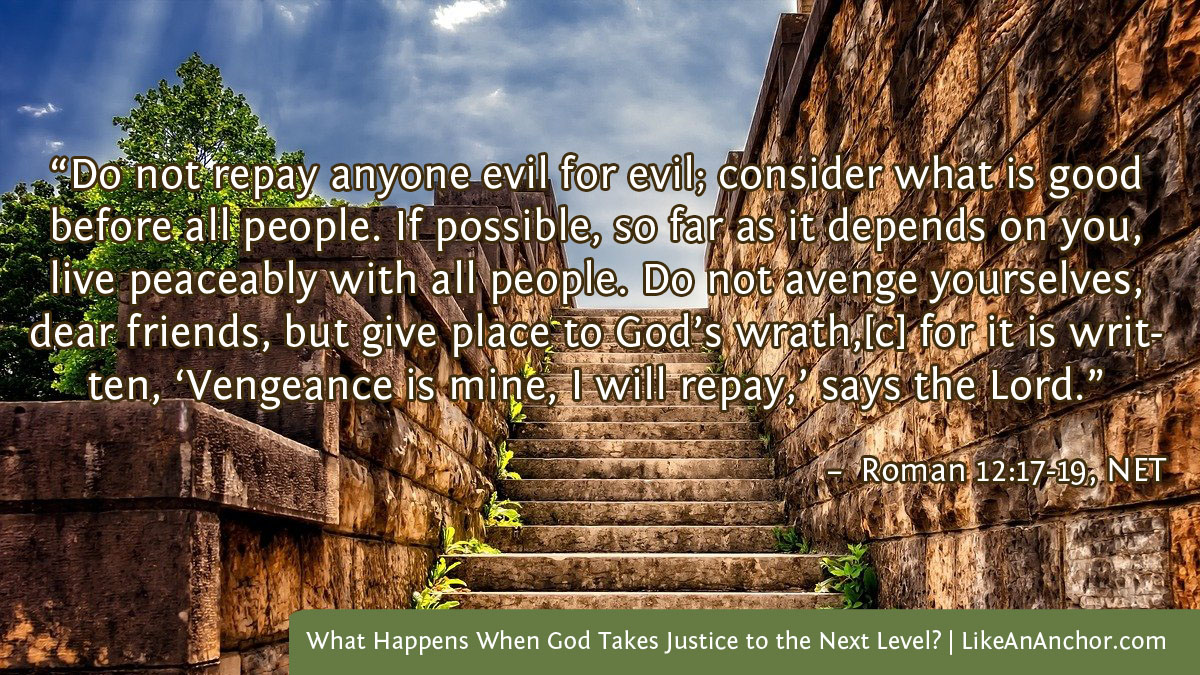
God wants to show us mercy. He delights in seeing it triumph over judgement. But if we want God to show us mercy, we must also show mercy when we have that opportunity. When someone hits you you don’t hit them back; you turn the other cheek, turn vengeance over to God, and live at peace with everyone you can (Rom. 12:17-21).

Mimicking Jesus’s Mercy

What Happens When God Takes Justice to the Next Level? | LikeAnAnchor.com
Image by Gianni Crestani from Pixabay

It is worth noting that when Jesus says, “resist not an evil doer,” the Greek word is anthistemi (G436). The only positive case of it being used between people is when Paul stood up to Peter’s hypocrisy in shunning Gentile believers (Gal. 2:11-17). It is also used when we’re told to “resist the devil” (James 4:7; 1 Peter 5:8-9) and to “withstand in the evil day” wearing God’s armor (Eph. 6:13). The command in the Sermon on the Mount does not mean we can’t correct someone in the spirit of love when they’ve made an error or that we do not resist the power behind all evil. We are, however, to commit ourselves to showing mercy and letting go of the option to revenge ourselves on someone else.

When God takes justice and fairness to the next level, it turns into mercy, long-suffering, peace, and love. The principle of “a life for a life” finds its fulfillment in Jesus Christ dying to free us from all the things we’ve done that deserve death. He gave His life to redirect the “compensation due sin,” which “is death” (Rom. 6:23, LEB), to Himself even though He did not deserve to suffer and die.

Our human nature might rise up against this “turn the other cheek” passage and say that it isn’t fair to let others get away with these sorts of things. But it also was not “fair” that Jesus died instead of us to pay the penalty for our sin. His mercy triumphed over judgement, and if we follow Him in spirit and in truth our mercy should also triumph over judgement.

Featured image by christian schwartz from Pixabay