
Love is a central theme in the Bible. It’s inarguably one of the most important things in scripture, because “God is love” and He presents love not only as central to His character but to our Christian walk as well.
You might have heard that there are multiple Greek words for love. Eros is love that desires. Philia is friendship love. Storge is family love. Agape is selfless love. Only philia and agape appear in the Bible (except for storge in a few derivative or compound words), but this still makes English translation challenging since we only have one word for love. Some Bible versions try to deal with this by translating agape as charity (KJV) or philia as “brotherly kindness” (certain WEB verses, for example). In many cases, though, both are simply translated “love.”
While the brief definitions I gave in the previous paragraph are correct, they’re incomplete. Pages of dictionaries, a plethora of scholarly papers, and numerous books have been written trying to define Christian love and tease out the differences between philia and agape. In many cases, these definitions focus on agape, often because the authors see philia as a lesser sort of love. It is true that agape is used far more often than philia in scripture. However, this does not mean that agape is a higher form of love, that it’s never used negatively, or that it doesn’t overlap in meaning with philia. Both words are important and both are used of God’s love for us, our love for God, and love between people.

What is the Historical Context for Agape?
The Bible writers didn’t invent a new word for love when they used agape, but finding out what the word meant in pre-Christian writings has been a challenge (if anyone knows of good sources on this, please send them to me!). In Classical Greek, the focus was more on eros (particularly for Plato) and philia (particularly for Aristotle) (Holst, 2021). The only sources I’ve found on how the word was used before Christianity are Biblical Greek dictionaries.
Thayer’s Greek Lexicon, originally published in 1889, stated that the word form agape is “a purely Biblical and ecclesiastical word” (Greek 26. Agapé, n.d.). He states that “secular authors” including Aristotle and Plutarch used the form agapasis, and he does “not remember to have met with it” in the Jewish writers Philo and Josephus. Agape does appear in the Septuagint (the Greek translation of the Hebrew Old Testament that dates from the 3rd to 1st centuries B.C.), which provides some background for how Jesus and other NT writers (particularly Paul, John, Peter, and Jude) use the word.
According to a search of the Greek Septuagint with Strong’s numbers in the Bible software program eSword, agape appears 15 times in 14 verses in the Old Testament (2 Sam. 13:15; Ecc. 9:1, 6; Song 2:4-5, 7; 3:5, 10; 5:8; 7:7; 8:4, 6-7; Jer. 2:2). In these verses, agape is used for human love, including romantic love. The root word of agape, agapao, appears 209 times in 196 verses as the main word for “love” in the Greek Old Testament. This includes the love of God for us (for example, Deut. 4:37; 7:13; Prov. 3:12; Is. 43:4; Mal. 1:2) and the love we’re supposed to have for God (for example, Deut. 6:5; 10:12; Prov. 15:9 Is. 56:6). Its usage is not, however, confined to Godly love. It’s used much the same way that the English word “love” is today, with a range of meaning depending on context.
The modern Christian understanding of agape is heavily influenced by Swedish theologian Anders Nygren, who began publishing his multi-part work Eros and Agape in 1930. For Nygreen, eros was central to Greek society and stood in sharp contrast to the Christian agape, which was an utterly unique type of love (Grant, 1996; Holst, 2021). Nearly every paper I’ve found on the topic of agape cites Nygren’s work, either in passing or in a direct response to his claims. Nygren ignored philia entirely, and claimed that agape is a type of love that originates with God alone and involves His “pure, unmotivated love for human beings” (Holst, 2021, p. 55). Following in Nygren’s footsteps, I often hear agape defined as the highest love. Other loves are often minimized as emotional and unstable. As we’ll see, this is a skewed reading of the Biblical texts.
What is the Historical Context for Philia?
There’s more historical information about philia. For Aristotle, philia “is the human good which nobody would choose to live without” (Holst, 2021, p. 56). He devoted two books to the subject of philia, typically translated “friendship,” and it is central to his code of ethics. For Aristotle, friendship is a virtue linked with justice and trust. It also has to do with understanding the virtuous self in relation to community with others.
In the Septuagint, philia appears 9 times, all in Proverbs. The related word philos appears 27 times. These words are used to describe romantic, friendly, and familial love, love for things, and the actions of kissing or embracing (e.g. Gen. 27:14; 37:4; 50:1; Prov. 7:18; 8:17; 10:12; 29:3; Hos. 3:1). In the Septuagint, at least, philia is a slightly more specific word for love than agape. It’s still used in a variety of ways, but it is used for affectionate and friendly love rather than used more generally for all types of love as agapao is.
Though philia is mostly connected to friendships, it’s not only for people who are already close friends but also for guests because hospitality “lays the basis for all friends to begin to trust each other” (Holst, 2021, p. 65). It is in this dynamic of “guest friendship” that Holst (2021) argues philia enhances our understanding of agape because both involve relating to other people. Economist Luigino Bruni (2010) borrows the phrase “l’inconditionnalité conditionnelle” (conditional unconditionality) from sociologist Alain Caillé to describe philia as something that takes a first step toward friendship unconditionally, but is then “conditional” upon the other person responding (p. 400-01). We shall return to this idea later.
What About Love for God?
Nygren’s definition of agape fits with the way that I hear people talk about agape in church today, save for one thing. For him, “agape toward God is impossible. Agape is of God. The human response to God is faith” (Grant, 1996, 6). Nygren apparently based this assumption on Paul’s writings and ignored the gospels and John’s letters completely. This aspect of Nygren’s stance on agape is similar to Aristotle’s view on philia. For Aristotle, philia can only exist between two equals, making friendship between humans and a god impossible (Bruni, 2010).
In examining the Bible as a whole, it becomes clear that not only are people capable of loving God, but that we are required to do so. But what sort of love can we have for God? In the Septuagint, agapao is the word for “love” that’s used to describe God’s love for us and our love for God. In the New Testament, agape, agapao, and philia are all used for godly love. For example, God the Father loves the Son with both agape (John 3:35) and phileo (John 5:20). Our love for God is typically identified as agape, but also (far more rarely) as philia (John 16:27; 1 Cor. 16:22).
There’s an exchange between Peter and Jesus that’s often cited to clarify the difference between agape and philia. It takes place after Jesus’s arrest, Peter’s denial of Jesus, and Jesus’s death and resurrection. Here is that passage in the Amplified Bible, which takes care to clarify which type of love Jesus and Peter are referring to.
So when they had finished breakfast, Jesus said to Simon Peter, “Simon, son of John, do you love Me more than these [others do—with total commitment and devotion]?” He said to Him, “Yes, Lord; You know that I love You [with a deep, personal affection, as for a close friend].” Jesus said to him, “Feed My lambs.” Again He said to him a second time, “Simon, son of John, do you love Me [with total commitment and devotion]?” He said to Him, “Yes, Lord; You know that I love You [with a deep, personal affection, as for a close friend].” Jesus said to him, “Shepherd My sheep.” He said to him the third time, “Simon, son of John, do you love Me [with a deep, personal affection for Me, as for a close friend]?” Peter was grieved that He asked him the third time, “Do you [really] love Me [with a deep, personal affection, as for a close friend]?” And he said to Him, “Lord, You know everything; You know that I love You [with a deep, personal affection, as for a close friend].” Jesus said to him, “Feed My sheep.”
John 21:15-17, AMP
When I hear a minister in the churches I attend talk about this passage, they usually make it sound like Peter just couldn’t measure up to the type of love that Jesus demanded. Agape is a higher form of love than philia, they say, and Peter missed the mark. But Spiros Zodhiates (1992) has a different reading. He says that claiming friendship, philia, with Jesus “was an upgrading by Peter of his devotion to Christ” (p. 65). Peter had denied knowing Jesus, much less being friends with Him, and “the Lord did not accept Peter’s self-upgraded love from agape (26) to philia (5373), friendship” (Zodhiates, 1992, p. 65). It is presumptuous to declare ourselves God’s friends, though He can make that claim on us (Luke 12:4; John 15:13-15; James 2:23).
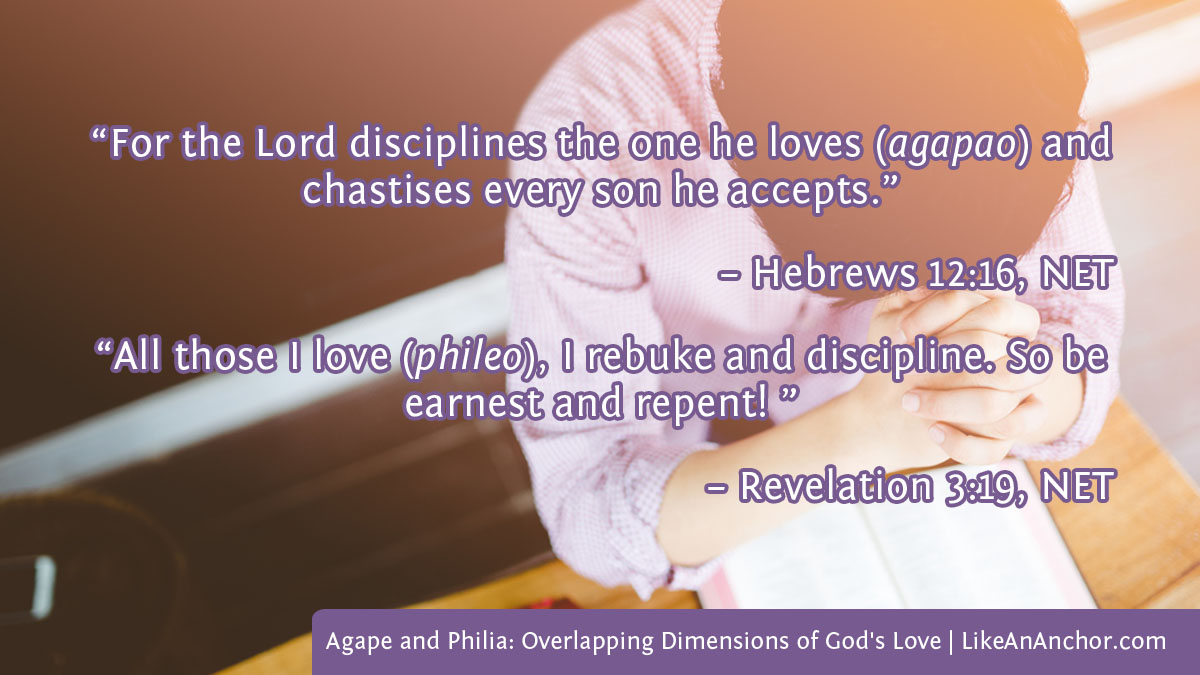
These two different readings illustrate the different ways that we can look at the relationship between agape and philia. We can read one as a greater love and one as a lesser love, or we can read them as different types of love. Zodhiates (1992) notes that scholars often produce “strained and awkward interpretations” when they try to draw rigid distinctions between the two words (p. 1445). There are differences, but there is also a lot of overlap between these two Biblical words for love. They are even used interchangeably in certain contexts. For example, in the phrase, “disciple whom Jesus loved,” John uses the word phileo in John 20:2 and agapao in John 21:7. Similarly, when two different authors talk about God correcting those he loves, one uses agapao (Heb. 12:6) and one uses phileo (Rev. 3:19). It really doesn’t seem useful to say one is better or worse than the other or even to draw too many distinctions between the two. They are both powerful ways to love.
Conditionality in Relation to Agape and Philia
While there is a lot of commonality between agape and phlia, including contexts where they are interchangeable, there are also some differences we can look at. I want to return to this idea of “unconditional conditionality” related to philia. Though Bruni (2010) is writing about eros, philia, and agape as categories of economic reciprocity, his analysis of the terms in relation to social-historical context and scripture provides insight into the nuances of meaning. For philia, the one who moves to initiate the friendship initially does so unconditionally, without underlying motives (Bruni, 2010, p. 399-400). If, however, the other person does not respond, the friendship is interrupted. In the same way, Jesus places a condition upon His philia: “You are my friends (philos) if you do what I command you” (John 15:14, NET). Similarly, God the Father’s philia for human beings happens because of how they feel about the Son: “the Father himself loves (phileo) you, because you have loved (phileo) me and have believed that I came from God” (John 16:27, NET). We can have friendship-love with God only when we respond to His unconditional offer and reciprocate with trust, love, and loyalty.
In contrast, agape for Bruni (2010) is unconditional, relational, potentially universal, and expects nothing in return (p. 403). He bases his definition on the way that agape works in Christian communities, citing another Greek word koinonia to describe the fellowship present in a body of believers led by Jesus, who epitomized agape (p. 404). The parable of the unforgiving slave (Matthew 18:23-35) provides for Bruni an example that hints at the reciprocal expectations of a philia relationship (philia serving as an ethical framework for relationships in Greek society [Holst, 2021]) but then supersedes them with the agapic expectation to freely receive gifts from God and then freely give to others (Bruni, 2010, p. 405).
For this is the way God loved (agapao) the world: He gave his one and only Son, so that everyone who believes in him will not perish but have eternal life.
John 3:16, NET
God’s agape isn’t dependent on human response. We’re supposed to respond to His love, but He is agape, expresses agape, and is motivated by agape regardless of how people react to Him. When Jesus told His followers to “love (agapao) your enemy,” He followed it by saying this is part of being like our “Father in Heaven, since he causes the sun to rise on the evil and the good, and sends rain on the righteous and the unrighteous” (Matt. 5:44-45, NET). God also demonstrated His agape for His enemies when Jesus died for us while we were still sinners alienated from and opposed to God (Rom. 5:6-11).
God the Father and Jesus Christ are going to have love that is unconditional, benevolent, and wants what’s best for you regardless of your response to Him. They’ve already demonstrated their agape for everyone by Jesus dying to make reconciliation possible. This universal love does not, however, mean that we don’t have a role to play. We still need to repent, believe, and commit to God if we want to receive the salvation that He offers and to fully participate in His love. There’s a relational aspect to both philia and agape that helps explain the overlaps in meaning between the two words.

The Dimension of Emotion
One of the criticisms I hear leveled at philia is that it’s an emotional love, unlike the purportedly more rational and stable agape. This is not a weakness of philia, but it is a characteristic. According to Thayer’s lexicon, Christ tells us to agape, not philia, our enemies “because love as an emotion cannot be commanded, but only love as a choice” (Greek 5368. Phileó, n.d.). This is not, however, the whole story. There are certain people that we are required or encouraged to have philia for as well as agape.
Paul wrote, “If any man doesn’t love (phileo) the Lord Jesus Christ, let him be cursed,” or “anathema” (1 Cor. 16:22, WEB). We must have emotional, friendly, affectionate love for Jesus as well as unconditional, committed love. Far more often, though, the command to love God is expressed with agape. The most important commandment is “Love (agapao) the Lord your God with all your heart, with all your soul, with all your mind, and with all your strength.’ The second is: ‘Love your neighbor as yourself’” (Mark 12:30-31, NET).
We also must have both philia and agape love for other people in the church. The compound word philadelphia (love+brother) is often translated “brotherly kindness” or “brotherly love.” It’s something that we’re commanded to have for our brethren, the other people in God’s church with whom we share fellowship (koinonia) (Rom. 12:10; 1 Thes. 4:9; Heb. 13:1; 1 Pet. 1:22; 3:8). Unlike our enemies, with whom we are not required to share mutual interests or affection, our brothers and sisters in Christ are people that we are supposed to care about.
The Vast Importance of Love
Thus far, I’ve focused a lot on philia because I think it’s often overlooked or minimized in discussions of Biblical love. Both philia and agape are part of faith; character traits that we must add on to the foundation of our commitment to God (2 Pet. 1:5-7). But I want to be careful that examining the importance of philia doesn’t minimize the importance of agape.
Forms of the word agape are used 535 times in the New Testament (eSword search for G25, G26, G27 [agapao, agape, agapetos) in contrast to forms of the word philia appearing 55 times (eSword search for G5384, G5360, G5373 [philos, phileo, philia]). Those numbers don’t include the times philia is part of a compound word (like philadelphia/philadelphus [G5360/G5361, used 7 times), but uses of agape still outnumber philia by quite a wide margin. It’s also the word used in some of the most pivotal discussions of love in the Bible, such as 1 John 2-5.

Dear friends, let us love one another, because love is from God, and everyone who loves has been fathered by God and knows God. The person who does not love does not know God, because God is love. By this the love of God is revealed in us: that God has sent his one and only Son into the world so that we may live through him. In this is love: not that we have loved God, but that he loved us and sent his Son to be the atoning sacrifice for our sins.
Dear friends, if God so loved us, then we also ought to love one another. No one has seen God at any time. If we love one another, God resides in us, and his love is perfected in us. … We love because he loved us first.
If anyone says “I love God” and yet hates his fellow Christian, he is a liar, because the one who does not love his fellow Christian whom he has seen cannot love God whom he has not seen. And the commandment we have from him is this: that the one who loves God should love his fellow Christian too.
1 John 4:11-16, 19-21, NET
Every time “love” appears in 1 John, it’s translated from a form of the word agape. Here we see that God is love, that He loves us, that we can love in the same way because of Him, and that if we really love Him we’ll love all of His people as well. We see that godly agape is enabled by God; i.e. we love because He loved.
We should note here that there are also ungodly expressions of agape (Luke 11:43; John 3:19; 12:43; 1 John 2:15), which is why it’s inaccurate to simply define agape as “godly love.” There are even passages that talk about the agape of God in contexts where a clarification likely wouldn’t be necessary if agape was always “of God” (Rom. 5:5; 8:39; 2 Thes. 3:5; 1 John 2:5; 3:17; Jude 1:21). With this caveat, we can say that the New Testament writers almost exclusively focus on the godly version that’s defined in 1 Corinthians 13.
Love is patient, love is kind, it is not envious. Love does not brag, it is not puffed up. It is not rude, it is not self-serving, it is not easily angered or resentful. It is not glad about injustice, but rejoices in the truth. It bears all things, believes all things, hopes all things, endures all things. Love never ends.
1 Corinthians 13:4-8, NET
We have no such Biblical definition for philia, perhaps because friendly, affectionate love is much easier to understand (and more often explored in secular writings of the time) than unselfish, unconditional love. Paul also tells us in this passage that agape is absolutely essential to the Christian walk, and that it’s even more important than hope and faith (1 Cor. 13:1-3, 13). There are broad definitions we can give for philia and agape, including certain general distinctions between the two, that have an historical, scholarly, and most important biblical basis. What we must not do, however, is make the claim that agape is the highest or only form of godly love just because it sounds good (see Truth Be Told podcast episode, “It’ll Preach, But Is It True?). Philia and agape together—along with related words used by Biblical writers—help us understand God’s incredible love for us. There are some differences between the two, and agape is highlighted as a chief Christian virtue, but the two words also overlap quite a bit, especially in the context of godly love.
References
Bruni, L. (2010). Éros, Philia et Agapè. Pour une théorie de la réciprocité, plurielle et pluraliste [Eros, Philia and Agape. For a Theory of Reciprocity, Plural and Pluralist]. In La gratuité: Eloge de l’inestimable (pp. 389–413). Revue du M.A.U.S.S.
Grant, C. (1996). For the Love of God: Agape. The Journal of Religious Ethics, 24(1), 3–21.
Greek 26. agapé. (n.d.). Bible Hub. https://biblehub.com/greek/26.htm
Greek 5368. phileó. (n.d.). Bible Hub. https://biblehub.com/greek/5368.htm
Holst, J. (2021). Philia and Agape: Ancient Greek Ethics of Friendship and Christian Theology of Love. In S. Hongladarom & J. J. Joaquin (Eds.), Love and Friendship across Cultures: Perspectives from East and West (Singapore, pp. 1–191). Springer Nature Singapore. https://doi.org/10.1007/978-981-33-4834-9
Zodhiates, S. (Ed.). (1992). The Complete WordStudy Dictionary: New Testament. AMG Publishers.
Featured image by Lamppost Collective from Lightstock

Song Recommendation: “Your Love is Extravagant” by Casting Crowns


















 Like An Anchor