Where Do You Find Your Self-Value?

Before we can become the best versions of ourselves and have a right view of ourselves, we have to recognize our true value. The world will tell you that your relationship with yourself is the most important relationship you have, and that increasing your self-esteem will correct any problems you have with feeling like you’re not enough in some way. But following that advice isn’t deeply satisfying because I think deep down we all realize that we can’t assign value to ourselves.

That begs the question, “Who can assign value to you?” Other people, society, or impersonal metrics aren’t good measures either. The only satisfactory answer is God. Only the Creator can assign value to His creation. He knows what He created you for and who He created you to be, and therefore only He can declare how valuable you truly are.

Testing Where To Look For Value

We’ve been talking about Ecclesiastes here on this blog for a couple week now (click here to read “Crash Course in Ecclesiastes” and here for “Letting Death Give Us Perspective On Life“). One of the things that Solomon does in this book is present an in-depth analysis of all the different places that we can look for value.

Solomon experiments with finding value in his own wisdom, in pleasure, in wealth, in fine works, in great power, and in the legacy you leave for future generations. But he describes it all as “vanity” (hebel, H1892) — a transitory, unsatisfactory thing. As we modern people read through Ecclesiastes, we often label Solomon as depressed (probably accurate) and having low self-esteem. But Solomon himself doesn’t describe the problem as not esteeming himself enough. He knows the self isn’t a good place to look for value, and he wants something or someone else to give life meaning and tell him his purpose.

As Solomon works though his existential crisis, he concludes that meaning can only be found in God. God is the one who sets everything in motion and the only one with an accurate perspective on His plan (Ecc. 3:1-15). He’s in heaven and we’re on earth, so we need to be wary of jumping to conclusions about things we know nothing about (Ecc. 5:1-7). In the end, everything boils down to our duty to fear God and keep His commandments (Ecc. 12:13-14). That’s the key to understanding who we are and where our value lies. Read more

The Bridegroom’s Pledge

If you’ve been reading this blog for a while, you probably know my favorite way of looking at the Lord’s relationship with His people is as a love story. This seems to be one of God’s favorite analogies as well, since He weaves betrothal and marriage imagery throughout His word.

Pentecost, which takes place tomorrow, isn’t often talked about in the context of God’s love story. It’s best known among Christians as the day when the disciples received the Holy Spirit in Acts 2 and as a harvest festival from the Old Testament. But just a little digging into this day’s context within a Hebrew mindset and Jewish tradition reveals how strongly it’s connected with the love story God is writing between Him and His people.

A Promise To Come Back

The Bridegroom's Pledge | marissabaker.wordpress.com
Photo by Brooke Cagle on StockSnap

The Jewish name for Pentecost is Shavuot, which means “sevens” in reference to counting seven weeks of seven days from the Sabbath after Passover. Pentecost is then kept on the Sunday after the seventh Sabbath (hence the name “Pentecost,” which means count fifty). The root word for Shavuot is shaba, which means the number seven as well as an oath or pledge (TWOT entry 2318 and 2319).

In Jewish wedding traditions, brides are chosen by the groom’s father just as God the Father chooses whom to call into relationship with His Son. The groom pays a bride price for her, just as Jesus (or Yeshua, to use His Hebrew name) bought us with His own blood (1 Cor. 6:15-20). The betrothal agreement was a covenant, the same type of relationship that God has made with His people at least as far back as Noah. Once the bride consents to this arrangement the marriage covenant was sealed with a cup of wine, as Yeshua sealed His covenant with us at Passover (Luke 22:20; 1 Cor. 11:25).

Then the bridegroom went away to prepare a home for His bride, which is what Yeshua told His disciples He’d be doing while He was gone (John 14:1-3). A Jewish bridegroom would be gone for about one to two years before returning to claim his bride. He didn’t just drop off the face of the earth, though. He left a gift with her and made an oath or pledge to come back.

A Gift For The Bride

When Abraham’s servant found a wife for Isaac, he “brought out jewels of silver, and jewels of gold, and clothing, and gave them to Rebekah” (Gen. 24:53, WEB). Similarly, Yahweh talks about the lavish gifts of clothing and jewelry He gave Israel when He entered into covenant with them (Ezk. 16:8-14). Our bridegroom, Yeshua, did something similar for us on the day of Pentecost. Read more

Not All God’s Love Is Unconditional: How To Become A Friend Of God

Do you ever feel like God just loves you because that’s something He does for everyone, not because He actually likes you?

That’s how I started the seminar I gave back in December, which I’m finally getting around to sharing on this blog. I’m willing to say that I’m not the only person who’s ever felt this way about God’s love, at least some of the time. There are a couple different things that play-in to this idea, but I think at least part of it is that usually when we talk about love in the Bible, we focus on the Greek word agape, which describes God’s unconditional love for all people. But there’s another word for love that talks about God’s affection for His friends. Depending on which resource you look at there are up to eight different words for “love” in Greek, though most people focus on these four:

  • Agape — selfless, benevolent love
  • Philos —  friendly, affectionate love
  • Storge — natural, family love
  • Eros — passionate, romantic love

We’re going to talk about agape and phileo, since those are the two used in the Bible. Together, agape and the root word agapao appear a total of 263 times in the New Testament. Philos and the closely related word phileo are used only 54 times, though it also appears in several compound words like philadelphos (brotherly love) and philostorgos (family love).

It would be pretty easy to look at these numbers and say agape is the most important kind of love in the Bible. And considering it’s the word used in the phrase, “God is love,” I’d say that’s a pretty good description. It’s also the word for love that’s defined in 1 Corinthians 13. There isn’t any other word that gets such a thorough analysis in scripture. But maybe our emphasis on agape, even though it’s correct, comes at the expense of a good understanding of another important word, phileo.

Do You Love Me?

The difference between agape and philos might not seem significant at first glance. But there’s a conversation in John’s gospel that illustrates how different these two words for love can be. This conversation takes place after Jesus’ resurrection. His disciples had gone fishing and He met them on the beach, had dinner with them, and then asked Peter a question. In most Bible versions I’m familiar with, both agape and philos are translated in these verses as “love.” I like the World English Bible, since it makes clear that there are two different concepts at play.

Jesus said to Simon Peter, “Simon, son of Jonah, do you love [agape] me more than these?”

He said to him, “Yes, Lord; you know that I have affection [phileo] for you.”

He said to him, “Feed my lambs.” He said to him again a second time, “Simon, son of Jonah, do you love me?”

He said to him, “Yes, Lord; you know that I have affection for you.”

He said to him, “Tend my sheep.” He said to him the third time, “Simon, son of Jonah, do you have affection for me?”

Peter was grieved because he asked him the third time, “Do you have affection for me?” He said to him, “Lord, you know everything. You know that I have affection for you.”

Jesus said to him, “Feed my sheep.”

John 21:15-17, WEB

The few times I’ve heard people address this passage, they usually say Jesus was asking Peter to reach for a higher form of love and Peter just wasn’t getting it. They think Peter couldn’t measure up to agape, so he used a lesser word to describe his love. But Peter’s the guy who stepped out of a boat and started walking across the water to get to Jesus (Matt. 14:26-29). He doesn’t hold himself back. And just a few days before this conversation he’d denied even knowing Jesus, so I imagine he’s anxious to show that he really does love Him.

I don’t think Peter saw phileo as a lesser form of love. I think he was trying to say, “Yes, of course I love you with agape. But even more than that I’m your friend – we share common interests and I care about you.” And that’s why he was so sad when Jesus used the word phileo when he asked the third time, “Do you love me?” Because it must have seemed like Jesus was asking, “Do you really care about me, Peter?”

A Closer Look At Philos

The difference between these two kinds of love isn’t as simple as just saying agape is godly love and phileo is friendly love. Both words are used of God’s love for people and of our love for God. There’s quite a bit of overlap in how they’re used, but we can still make a few general observations.

Agape doesn’t always involve emotion, although it can, but it always means being interested in the ultimate good of the ones you love. It’s the word used to describe the kind of love that prompted God to sacrifice His own son for the entire world, and which He commands us to show toward our enemies (John 3:16; Luke 6:27). God doesn’t tell us we have to have warm fuzzy feelings for our enemies, but He does want us to care about what happens to them and hope for a good outcome in much the same way He wants everyone to “choose life” (Deut. 30:19; 2 Pet. 3:9).

Phileo tends to be more specific than agape, since you only feel it for those you share goals and interests with. In fact, it’s often translated “friend” instead of love.” This word always involves affection and emotion. Jesus uses phileo when He talks about how He and the Father work together (John 5:20). Paul uses it to talk about the relationship between believers who have a common interest in following God (Tit. 3:15). But the thing about phileo that’s really amazing happens when it’s used of a relationship between God and a human being.

Not All God's Love Is Unconditional: How To Become A Friend Of God | marissabaker.wordpress.com

Friends of God

There are a few specific people who the Bible identifies as personal friends of God. Jesus had friends when he lived on this earth, such as Lazarus and John (John 11:11; 20:2). There were also people in the Old Testament who were friends with God. James tells us that Abraham was called God’s friend after “he offered Isaac his son on the altar” (James 2:23). At that point, Abraham had faithfully demonstrated for years that his interests were in line with God’s plan. That type of shared interests is part of phileo, the friendship love.

Abraham is not the only person in the Old Testament who God treated as a friend. We’re told “the Lord spoke to Moses face to face, as a man speaks to his friend” (Ex. 33:11). God also called David “a man after My own heart, who will do all My will” (Acts 13:22). As these people’s interests lined up with God’s and they moved in the direction He was leading, they became His friends. Christ’s friendship with His disciples followed much the same pattern, and that is the kind of relationship we’re now offered with God the Father and with Jesus Christ.

God’s Conditional Love

Not All God's Love Is Unconditional: How To Become A Friend Of God | marissabaker.wordpress.com

Jesus said, “Greater love has no one than this, that someone lay down his life for his friends. You are my friends, if you do whatever I command you” (John 15:13 WEB). In this verse, “friends” is translated from phileo. Because phileo involves sharing common interests with the people you love, this particular love that Jesus offers is conditional upon us keeping His commandments (unlike agape, which is often, though not always, framed as unconditional).

God is going to have a certain amount of agape for you whether you keep His commandments or not. In other words, He has a love for all people that wants the best for them and hopes that they will choose to follow Him and enter a relationship so that our shared love can increase and become more affectionate and intimate. If you want God to be your friend and to enjoy a deeper level of love and connection with Him, then you have to share His interests. You need to be in covenant with Him (in that way, love is very similar to grace). God’s invitation to have a deeper relationship with Him through covenant isn’t something we’re supposed to think of as a strict/unkind “do this or I won’t love you” ultimatum. Rather, it’s about developing a real relationship based on shared interests, character traits, and goals.

God’s commands (and the whole Bible, really) are a guide-book for developing His character. They reveal the things that He cares deeply about and if we want to be His friends, then we need to care about those things as well. And that’s why it’s so important to develop a regular Bible study practice–so we can keep getting to know who God is and what He wants and how we can become like Him.

Developing God’s Interests

Shared interests and goals are an essential part of the type of love described by phileo. When we’re thinking about that in the context of developing a friendship with God, it means that we’re literally becoming the type of person that Jesus Christ is.

As our Teacher, Jesus is the template we pattern ourselves after. In a Hebrew mindset, someone who is following a teacher, or Rabbi, isn’t just there to learn what the teacher knows. Their goal is to become the type of person that teacher is. And this should also be our goal as we seek friendship with God. The more we become like Him in how we think, act, and speak, the closer we are to being full-grown Christians who’ve attained “to the measure of the stature of the fullness of Christ,” as Paul says in Ephesians 4:13 (WEB).

Just as I have loved you, you also love one another. By this everyone will know that you are my disciples.

John 13:34-35, WeB

Just as he who called you is holy, you yourselves also be holy in all of your behavior.

1 Peter 1:15, WEB

These verses are just a couple examples of how we grow to become like Christ. Loving others the exact same way Jesus loves us will show everyone that we’re really His students. And Peter reminds us that we’re called to become holy the same way that God is holy. In fact, the more we become like God, the closer a relationship we’ll have with Him. And the closer a relationship we have with Him, the more we’ll become like God. It’s a lovely cycle of increasing intimacy, commonality, and affection.

God’s Friendship Love For Us

Another part of developing God’s mindset and becoming friends with Him is having a proper perspective on who the Father and Son really are and how They both feel about us. This is actually one of my favorite verses in the whole Bible. It’s Jesus speaking to His disciples on His last Passover. He says,

“In that day you will ask in my name; and I don’t say to you, that I will pray to the Father for you, for the Father himself loves [phileo] you, because you have loved me, and have believed that I came from God.”

John 16:26-27, WEB

In John’s Passover account, Jesus uses philos to describe how He feels about His disciples several times. But this is the only place where it’s used of how God the Father feels for us. By using the word phileo in this passage instead of agape, Christ is telling us that God feels affection for us and He has shared interests with us on the condition that we love and believe in Jesus.

With these words, Jesus assures His disciples and us today that the Father personally listens to our prayers because of His friendly, affectionate love for us and because of our belief on His Son Jesus. If you can honestly say you love Jesus and believe that He’s the son of God, then God Himself wants to be your friend. God is agape and He has a baseline level of that kind of love for every person in the world (John 3:16-17). God’s phileo, on the other hand, is reserved for those He’s in relationship with–the ones who share His interests, believe in His word, and enter a covenant with Him.

Not All God's Love Is Unconditional: How To Become A Friend Of God | marissabaker.wordpress.com

Our Friendship With God

As I mentioned earlier, agape is used much more frequently than phileo, so there aren’t as many verses we can look at to keep expanding on this topic. But we do have a few that give us a glimpse into how God feels about us as part of His family.

“As many as I love, I reprove and chasten. Be zealous therefore, and repent. Behold, I stand at the door and knock. If anyone hears my voice and opens the door, then I will come in to him, and will dine with him, and he with me.”

Revelation 2:19-20, WEB

Now, I know that part about reproving and chastening doesn’t sound very affectionate but it’s part of us being in God’s family. If He didn’t care about us, He would just let us go off and do our own thing and reap the consequences. That’s not in His nature, though. He wants to see us choose good things because He has agape love for us. And once we start to choose Him, then His affection drives Him to build an ever deepening relationship with us. We get to experience His agape more deeply and we get to share phileo with Him as we draw closer to Him by entering covenant with Him and keeping His commandments.

Because this is a relationship, the friendship love has to go both ways. We’re supposed to reflect affection right back at God the Father and Jesus Christ. And even though people will tell you that agape is more important than phileo as a type of love, it turns out that having this kind of love for our Creator is not optional.

If any man love not the Lord Jesus Christ, let him be Anathema Maranatha.

1 Corinthians 16:22, KJV

The word anathema (G331) means something that is accursed or given up to destruction. Greek scholar Spiros Zodhiates says it does not “denote punishment intended as discipline but being given over or devoted to divine condemnation.” Maran-atha (G3134) is an Aramaic word which literally means “our Lord has come.”

When you break this phrase down, it’s telling us that someone who does not love–and that is phileo–Jesus Christ will be judged at the Lord’s coming, and probably not in the way they were hoping. It could be translated, “If anyone does not affectionately love the Lord Jesus Christ, let him be set aside for condemnation when the Lord returns.”

How To Become God’s Friends

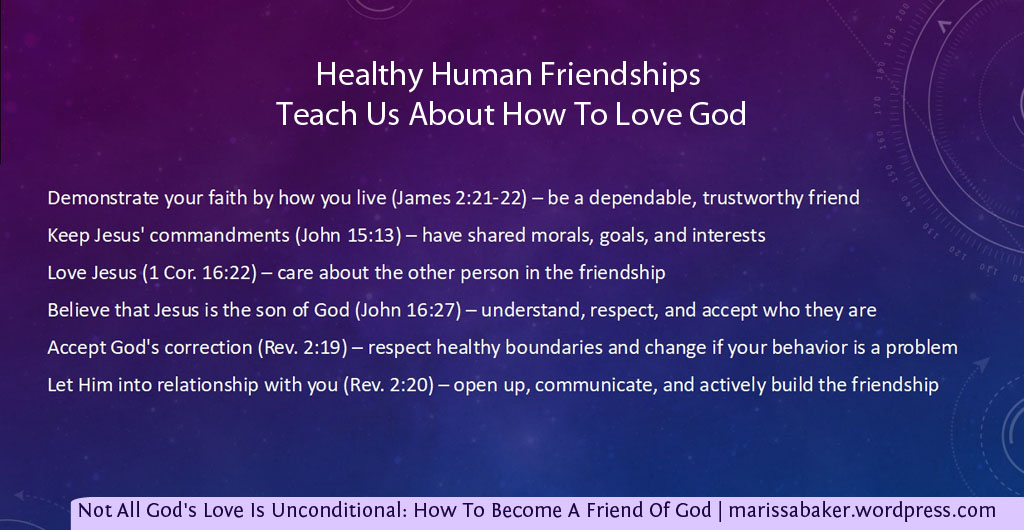
We’ve covered quite a few verses about loving and being loved by God, so let’s start pulling it all together and answer the question implied by this blog post’s title: How do you become a friend of God? When you boil it down to the main points in the verses we looked at, it actually seems pretty simple:

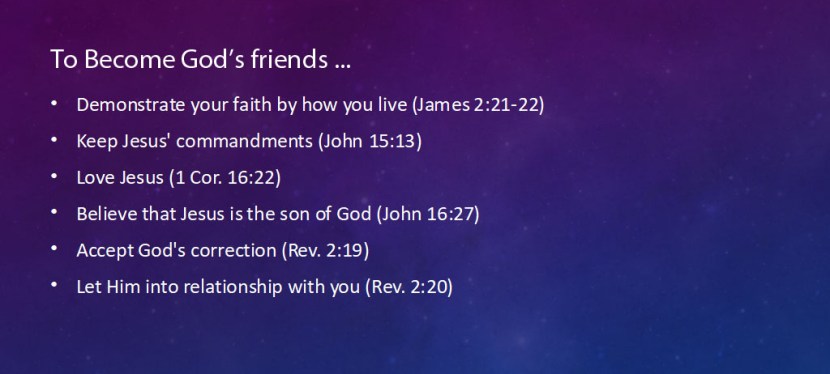
  • What James writes about Abraham points out the importance of demonstrating your faith by how you live (James 2:21-22)
  • Jesus Himself said we need to keep His commandments if we want to be His friends (John 15:13)
  • Paul shared that it’s vitally important to love Jesus Christ (1 Cor. 16:22)
  • Jesus shared that His Father’s love is connected to our love for Him and belief in Jesus as the son of God (John 16:27)
  • Christ’s letter to Laodicea tells us it’s important to accept God’s correction and to let Him into relationship with you (Rev. 2:19-20)

And that’s pretty much it. That’s all you have to do if you want to befriend the creator of the universe. It looks simple in neat little bullet points, but I think we all know that when we start trying to put it into practice it’s not always that easy. The points about how to become God’s friends might be easier to grasp, though, when we think of our experiences making friends with other human beings. The same things that are important in healthy human friendships are important to a relationship with God.

Not All God's Love Is Unconditional: How To Become A Friend Of God | marissabaker.wordpress.com

And Now We Add Agape

Before we close, there is one more point I want to make. Let’s think back to when Jesus asked Peter, “Do you love me?” I think Peter initially thought phileo was a better kind of love because of how much it involves emotions. But phileo is not complete on its own; it needs agape added to it. Agape is the kind of love that keeps loving when feelings are gone or when they are crowded out by fear. In that regard, it’s very much like faith which keeps believing even though it can’t see exactly what’s going to happen next. And Peter did learn this lesson, for it’s in his epistle that we are told to add agape to our expressions of phileo for other people.

For this very reason, make every effort to add to your faith excellence, to excellence, knowledge; to knowledge, self-control; to self-control, perseverance; to perseverance, godliness; to godliness, brotherly affection (phileo); to brotherly affection, unselfish love (agape). For if these things are really yours and are continually increasing, they will keep you from becoming ineffective and unproductive in your pursuit of knowing our Lord Jesus Christ more intimately.

2 Peter 1:5-8, NET

We need to learn this lesson today just as much as Peter’s first readers did. Our love for God and our fellow believers needs an element of emotion and feeling–we’re supposed to be friends with them. Our love also needs to be stable and unconditional because we must act with love even when we don’t feel “in love.” Both types of love are needed to maintain a friendship with God.

What’s The Church Supposed To Do?

If you ask the church that I’ve spent most of my life in what their mission is they have a ready answer: preaching the gospel and preparing a people. I can’t speak for your churches, but I imagine many (perhaps even most) of them would also point to some version of what we call The Great Commission as their mission statement.

Jesus came to them and spoke to them, saying, “All authority has been given to me in heaven and on earth. Go, and make disciples of all nations, baptizing them in the name of the Father and of the Son and of the Holy Spirit, teaching them to observe all things that I commanded you. Behold, I am with you always, even to the end of the age. (Matt. 28:18-20, WEB)

Is this a commission? yes, it’s “an instruction, command, or duty given to … group of people.” Is it great? since it came from Jesus and involves a responsibility given His disciples, yes. But is it really meant as the defining mission statement for the entire church from Jesus’ resurrection to His return? I’m not so sure.

What's The Church Supposed To Do? Looking At Scriptural Mission Statements For People Following Jesus | marissabaker.wordpress.com
Photo credit: Pearl via Lightstock

A Sobering Warning

The religious leaders of Jesus’ day were the group He spent the most time criticizing and correcting. They professed to follow God’s highest standards but were in reality hypocrites. They did righteous looking things just to get attention (Matt. 23:5). They went to great lengths to convert people only to pervert their faith (Matt. 23:15). They placed too high an emphasis on money received as tithes and offerings (Matt. 23:16-19). They neglected the “weighty matters” of God’s law and instead followed their own traditions. They even turned the temple itself into a marketplace where they exploited people coming to worship God (John 2:14-16).

The scary thing is, these people honestly thought they were the most righteous God-followers out there. That serves as a warning today that church leaders and organizations have to be very careful where they place their focus. And so do we as individual members of Christ’s body.

A Greater “Commission”

We certainly shouldn’t ignore Christ’s instruction to go, disciple, baptize, and teach. But we need to make sure we’re thinking of that command from Matthew 28 in its proper context. Because there are two other commissions that Jesus plainly told us are His greatest commands. Read more

As You Love Yourself

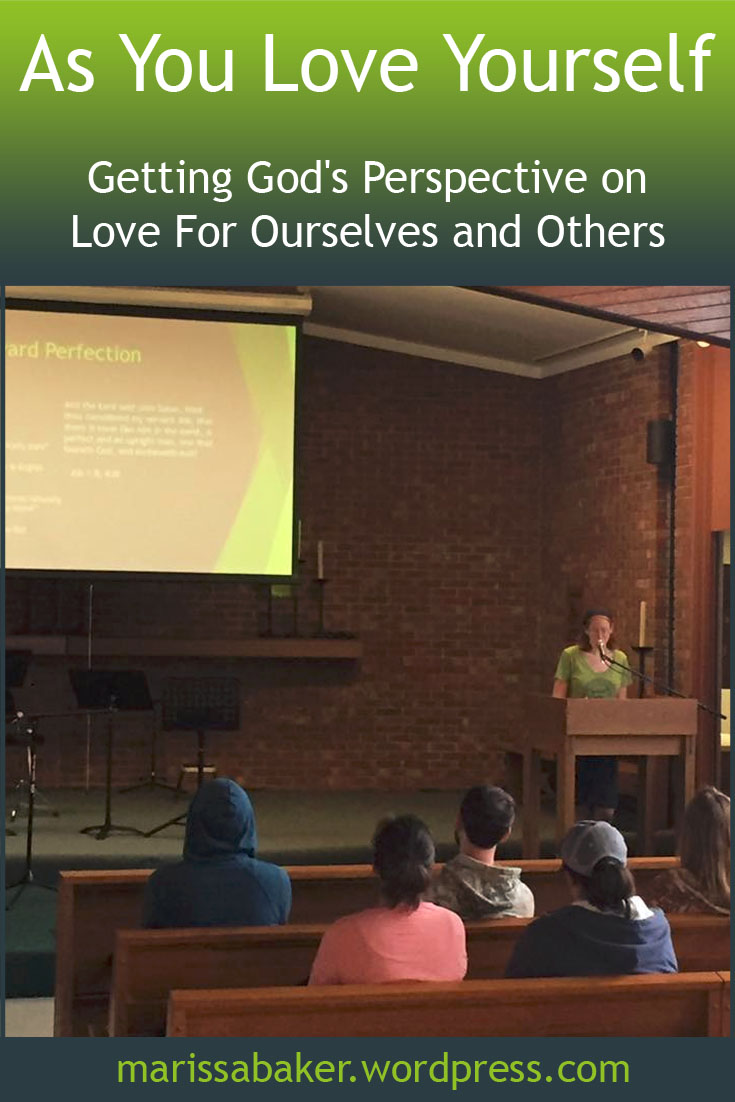
Last weekend at a Young Adult retreat, I gave my first seminar. And it went so well! Praise the Lord — I know anything good I write comes from Him and the fact that I delivered a spoken message in front of people without looking nervous or having a panic attack is a clear “God thing.” Since people liked it in-person, I’ve adapted my notes for a blog post to share with you today.

When someone asked Jesus which was the greatest commandment in the law, He gave a two part answer. 1) “You shall love the Lord your God with all your heart, and with all your soul, and with all your mind, and with all your strength.” And 2) “You shall love your neighbor as yourself” (Mark 12:29-31, WEB). The theme for the retreat I spoke at was connecting with God and others, and that’s what these two great commandments are all about. The first tells us how to love God, which is the foundation for building a relationship with Him. And the second tells us how to love our neighbors. Jesus says to love them the same way we love ourselves.

But loving yourself isn’t something we talk about very much in Christianity. We focus on the “love your neighbor” side of this command. If we talk about the “as yourself” part, it’s often assumed that you already know how to love yourself. That’s part of our culture, right? We have a self-acceptance movement and a focus on looking out for “number one.” If anything, I think most Christians would say we love ourselves too much. So we don’t talk about it, just assuming we know how to show love towards ourselves and that we can use this as a guide for how to love others. But do we really know how to love ourselves the way God wants us to?As You Love Yourself | marissabaker.wordpress.com

The word “love” in the verse we just looked at is translated from a agape. This is a benevolent love that always seeks good things for the person who you’re loving. While it does involve feelings, it’s not what you would call an emotion driven kind of love. For example, if you’re giving a friend advice and one option is going to make them happy and your life easier, but the other option is clearly better for their long-term good, agape is always going to pick the better one even though it’s harder.

Agape is an incredibly important concept in the Bible. Of the 356 times the words “love” or “charity” appear in the King James Version of the New Testament, 320 are translated from a form of agape (that’s just shy of 90%). It’s so important that the Bible gives us a full definition in 1 Corinthians 13.

“Love is patient and is kind; love doesn’t envy. Love doesn’t brag, is not proud, doesn’t behave itself inappropriately, doesn’t seek its own way, is not provoked, takes no account of evil; doesn’t rejoice in unrighteousness, but rejoices with the truth; bears all things, believes all things, hopes all things, endures all things. Love never fails.” (1 Cor. 13:4-8, WEB)

Let’s ask some questions based on this verse:

  • Are you patient and kind with yourself?
  • Do you let yourself get eaten up with envy, bragging, or pride?
  • Are you treating yourself in a way you’d consider inappropriate if you were doing it to others?
  • Do you get unreasonably angry with yourself?
  • Do you keep an account of the bad things you’ve done so you can use it to beat yourself up?
  • Are you dwelling on the unrighteous things you’ve done or rejoicing in the ways you follow God’s truth?
  • Do you stick by yourself, believe in your ability to do better, and hope good things for your future?

When I asked how many people could honestly say they’re loving and kind toward themselves in this way, only one person raised their hand. But when I asked, “How many of you feel guilty about the idea of showing love toward yourself?” about half the group raised their hands. That included me, which is why I actually felt kinda weird talking about the subject of love like this. It sounds a little selfish, doesn’t it? And we know selfishness is bad. So let’s take a moment to clarify a few things.As You Love Yourself | marissabaker.wordpress.com

Real love never stops with yourself. If you’re the only object of your love and you always put yourself first, then you have a problem. That’s what it means to be selfish and self-centered. But avoiding selfishness doesn’t mean you refuse to take care of yourself. We’re to offer ourselves to God as a living sacrifice, not abuse ourselves. If you never meet your own needs or do those loving things mentioned in 1 Corinthians 13 for yourself, then you’re going to burn-out. And God loves you way too much to want that.

To see ourselves and care for ourselves and others properly, we need to understand how God sees and cares for us. Most of the time when I hear people talk about asking God to let you see yourself the way He sees you, they’re talking about discovering hidden faults. And that is important, because we all know the verses that talk about our inability to know our own hearts. We need God’s perspective to show us where we should change and grow as we keep moving toward perfection. But if we want a more complete picture of how He sees us, then we also need to understand how much He values us.

The reason the two most important commands are about loving God and loving others is because God Himself is love. Agape is the key element of His essential character. But sometimes, even if it’s not something we’d say out loud, we think that God loves us more when we’re being good. We treat ourselves as if God’s love is conditional on our having already achieved perfection. But it’s not. Remember Romans 5:8 says, “God demonstrates His own love toward us, in that while we were still sinners, Christ died for us” (LEB). The Father and Jesus Christ thought you were worth the price of Jesus’ life even before you were saved. So don’t you dare say you’re not worth loving now.As You Love Yourself | marissabaker.wordpress.com

One of the most interesting studies I’ve ever done was about how God uses the word “perfect” in the Bible. He describes Job as “a perfect and an upright man” twice at the beginning of the story (Job 1:8 and 2:3). We know Job learned and grew as a result of the trials he went through, and yet God could describe him as “perfect” with complete honesty before that growth happened. We tend to think of perfect as the best that you can get, but from this example we see that’s not really how God uses the word.

The Hebrew word translated “perfect” is tam (H8535). The word refers to completeness and entirety, but doesn’t necessarily mean finished. Rather, the Theological Wordbook of the Old Testament says the root of tam (H8552; tamam) refers to someone moving “naturally toward that which is ethically sound.” Thus, followers of God can be described as “perfect” while still on the path toward perfection. God will take care of perfecting you – He just needs you to keep moving forward. God loves us even with all our flaws and weaknesses and ways we fall short. He also wants us to grow toward being the best people we can be in Him because that’s what leads to the best outcome we can get – having a relationship with Him that lasts into eternity.

Becoming part of God’s family is made possible because He is love. Having God’s agape directed toward you is amazing. The strength of that love has literally shaped the way the entire universe functions. It’s what motivated the Father to send His Son to this earth to live in a human body and become our sympathetic High Priest as well as the sacrifice that makes salvation possible. If that was the only kind of love God had toward us it would be more than enough and more than we ever had a right to hope for. But it’s actually not the only way God the Father and Jesus Christ love us.

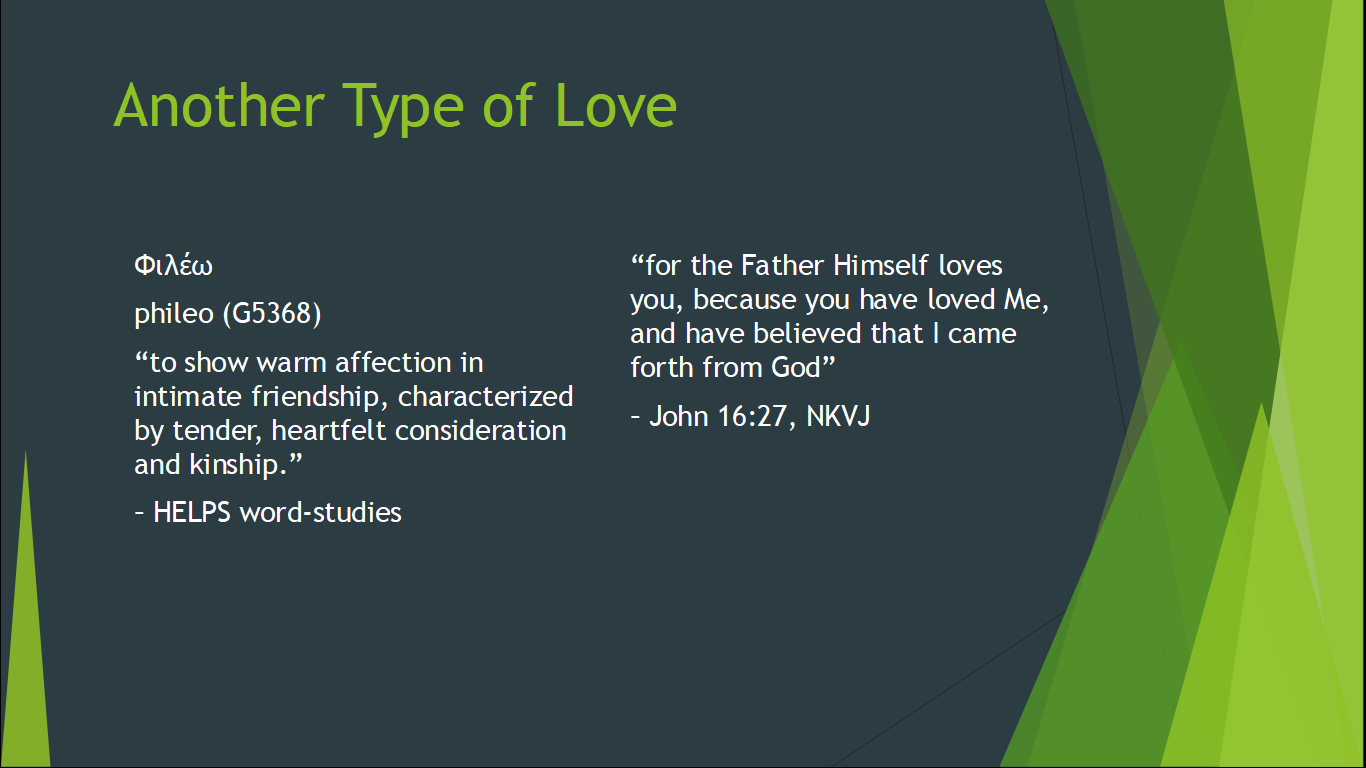
One of my favorite Bible verses reads, for the Father himself loves you, because you have loved me, and have believed that I came from God” (John 16:27. WEB). Seems simple enough, but this word is not agape. It’s translated from phileo (G5368). According to Spiros Zodhiates’ Greek dictionary, the word phileo means “to have affection for someone.” HELPs word studies adds that it is “characterized by tender, heartfelt consideration and kinship.” Phileo implies having common interests or friendship with the object of one’s love. This type of love is one we can readily identify with because it’s what we feel for our closest friends.As You Love Yourself | marissabaker.wordpress.com

Have you ever thought about God loving you like that? In the context of John 16, Jesus is assuring His disciples that the Father personally listens to our prayers because of His friendly, affectionate love for us and because of our belief on His Son Jesus. If you can honestly say you love Jesus and believe that He’s the son of God, then God Himself wants to be your friend. God is agape and He has that love for every person in the world. God’s phileo, on the other hand, is reserved for those He’s in relationship with – the ones who share His interests, believe in His word, and enter a covenant with Him.

All this love that God has poured into our lives shows us how we’re to relate to ourselves and to others. As John says, “We love, because he first loved us” (1 John 4:19, LEB). The love God has poured into our lives shows us how to love ourselves as well as how to love others because we learn to see ourselves and others the way He sees us. C.S. Lewis touches on this in The Screwtape Letters. This book is composed of a series of fictional letters written from one demon to another teaching them how to seduce human beings away from God, whom they refer to as “The Enemy.” (I know that sounds a bit strange, but it’s a fantastic book that puts a different perspective on talking about what God wants for us.)

The Enemy wants him, in the end, to be so free from any bias in his own favor that he can rejoice in his own talents as frankly and gratefully as in his neighbor’s talents—or in a sunrise, an elephant, or a waterfall. He wants each man, in the long run, to be able to recognize all creatures (even himself) as glorious and excellent things. He wants to kill their animal self-love as soon as possible; but it is His long- term policy, I fear, to restore to them a new kind of self-love—a charity and gratitude for all selves, including their own; when they have really learned to love their neighbors as themselves, they will be allowed to love themselves as their neighbors. For we must never forget what is the most repellent and inexplicable trait in our Enemy; He really loves the hairless bipeds He has created and always gives back to them with His right hand what He has taken away with His left.

The thing Screwtape finds disgusting is a facet of Christianity that gives us great cause for rejoicing. God does not want you to hate yourself. He wants you to love Him, and your neighbors, and yourself all in a right and proper way. So, now that we’ve talked about what love is and how God shows love toward us, let’s go back and fill in some answers to our first question.As You Love Yourself | marissabaker.wordpress.com

Here’s the list I came up with when prepping for the seminar.

  • accept the love God is giving you
  • take time for yourself to read the Bible, meditate, and pray
  • understand and find ways Godly to meet your needs
  • work through your stressful emotions instead of burying them
  • be kind to your shortcomings
  • turn the things that cause you anxiety over to God
  • push yourself to improve and develop your strengths
  • remember God made you human and gave you limits
  • Accept God’s gifts of rest, good food, and exercise
  • build good boundaries

Now here’s your homework. Make sure you’re doing these things for the people around you as well as yourself. For example, you could help your roommate with the housework so they aren’t worried about finding time to study and pray. You can be patient with the shortcomings of the people you go to church with and encourage them keep trying. While you’re taking care of yourself as a person who is incredibly valuable to God, remember the people around you hold the same value in his eyes.

In closing, I want to quote C.S. Lewis again. This is from an article titled “The Weight of Glory” (click to read the full text). Here, Lewis talks about the potential for each human being to enter the family of God.

“It is a serious thing to live in a society of possible gods and goddesses, to remember that the dullest and most uninteresting person you talk to may one day be a creature which, if you saw it now, you would be strongly tempted to worship. … It is in the light of these overwhelming possibilities, it is with the awe and the circumspection proper to them, that we should conduct all our dealings with one another, all friendships, all loves, all play, all politics. There are no ordinary people. You have never talked to a mere mortal.”

In 2 Peter 3:9, it says the Lord is “not willing that any should perish but that all should come to repentance” (KJV). God sees the potential of every human being He has created to become something wonderful. And He wants us to see that, too. That’s what Lewis is getting at in these passages. As part of our expression of agape, we need to start seeing our neighbors as candidates for eternal life and valuing their potential as highly as we know God values ours.

A couple years ago, I was a funeral and the speaker said the man we were there to remember “lived his life as though it had eternal consequences.” That’s what God intends us to do as well. How we view and treat ourselves and others will have consequences that stretch far beyond this life. We need to keep our eternal potential in mind when we make decisions about how we treat ourselves and by extension how we interact with others. Jesus said, “You shall love your neighbor as yourself.” I hope we now have a better idea of exactly how to do that.As You Love Yourself | marissabaker.wordpress.com

Save

Save

Save

Save

Save

Courage To Feel

I recently finished reading, and then immediately re-reading, Fill These Hearts by Christopher West. It’s a powerful rebuttal to the lie that Christianity is a joyless religion of laws and suppressed desires. West touches on many points regarding marriage and the plan of God that I hit in my book God’s Love Story, a subject you know is dear to my heart. I could probably write half a dozen posts inspired by Fill These Hearts (I already quoted from it in last week’s post), but here’s the part I want to focus on today:

Christianity is the religion of desire — the religion that redeems eros — and its saints are the ones who have had the courage to feel the abyss of longing in their souls and in their bodies and to open … all their desires for love and union to the Love and Union that alone can satisfy. … the saints have learned to open eros (their yearning for love) to Eros (God’s passionate love for them).” (p. 39)

Seeing God’s love described as Eros might make you a little uncomfortable at first (it had that effect on me). Eros is the Greek word for passionate or sexual love. This word doesn’t even appear in scripture, although erotic love is alluded to. The word we usually associate with God’s love — and rightly so — is agape. Read more