Those Out Of The Way

How ought Christians treat people who don’t understand God’s ways? There’s a very real temptation to belittle and criticize others for not believing the same things we do. Yet that’s not the sort of spirit God looks for in those who follow Him.

While keeping the Feast of Tabernacles (Sukkot) this year, one of the speakers shared a story from his time at a Bible college (click here for sermon recording). He and his classmates were assigned to read Emily Dickinson and analyze her theology. They picked it to bits, critiquing every way she didn’t understand their church’s teachings on the purpose and future of mankind. When they presented it to their teacher, they expected high marks.

Instead, the teacher grew angry. “You’re belittling the miracle of your calling,” he said. When we as Christians expect those who’ve not been called into God’s truth to understand, we aren’t acknowledging the miracle God performed when He enlightened us. When we condemn those who are earnestly seeking God and don’t have all the pieces, we condemn ourselves for a lack of compassion (and for arrogance in thinking we have all the right answers). We become like those Jesus criticized “who trusted in themselves that they were righteous, and despised others” (Luke 18:9-14).click to read article, "Those Out Of The Way" | marissabaker.wordpress.com

Seeking Their Good

God never intended for His people to stand in condemnation on those who don’t understand His ways. Yes we’re to know the difference between right and wrong and urge people to repent of their sins and build a relationship with God, but we’re not to attack them. We have a command to judge ourselves and we’re given limited judgement within the church (e.g. not allowing someone who openly practices sin, in spite of their profession to follow Jesus, to fellowship in the church see 1 Cor. 5:1-13). But is not godly to belittle and criticism people. Instead, we should respect the potential God has placed within all humans. Read more

Balancing Views On Singleness and Marriage

Most modern Christian churches develop a culture that prioritizes marriage. We know marriage is a good thing and that it’s part of God’s plan for humanity. Marriage pictures the union between Christ and His church. Beyond the spiritual aspects, it’s also held-out to young people as a sort of “prize” for listening to what the Bible says about purity pre-marriage.

Since we think of marriage as such a good thing, we think of the opposite as something negative. Western culture is, on the whole, very binary. If something is good, the opposite is bad. Our minds don’t naturally consider that both could be good in the proper context. With this mindset, singleness is treated as less-desirable and if a single person doesn’t want to marry we think there’s “something wrong” with them. But is this really how God views things?

Seeking Balance

It’s a safe bet all my Christian readers know of the verses discussing marriage in a positive light. The marriage relationship was established at creation and in the New Testament Paul connects it to Christ and the church (Gen. 2:18-24; Eph. 5:22-32). Proverbs 18:22 maintains that “he who finds a wife finds a good thing.” Marriage is certainly seen as a good thing in the Bible. I’m not disputing that and I still hope someday to get married. But I think we make a mistake if we assume marriage’s goodness makes being single a bad thing. Read more

I got a “What if …”

Almost 80 degrees and Tiger wants to snuggle with me and a blanket.
Almost 80 degrees and Tiger wants to snuggle with me in a blanket.

Today’s post is a bit different than usual. During my Tuesday morning Bible study, my cat looked so comfortable snuggled up on my lap that I spent some extra time meditating on the Word. I’d been in Genesis writing about our Creator, and a thought popped into my head. I want to share this idea with you today and ask for feedback. Please comment! Diving deeper into God’s mysteries shouldn’t be done in a void — I believe God wants us to grow together and “sharpen” each other (and also to call each other out if we notice someone studying something that’s not in line with scripture).

Okay, so we know that God has had a plan in mind since before creation and that plan involves building a family (Eph.1:3-6). We also know that the church is described as the bride of Jesus Christ (2 Cor. 11:2; Rev. 19:6-9) and we’re told that human marriage is a “great mystery” that points to the relationships between Christ and His church (Eph. 5:22-33).

What if God began revealing these aspects of His plan from the very beginning in the way He chose to create man and woman? or, to put it another way, what if the way God created man and woman teaches us that He didn’t want to be alone and that He’s fashioning a helper comparable to Him? Read more

The Church Isn’t Ruining Your Love Life

This past week, Boundless.org shared two posts related to Joshua Harris and courtship culture on their Facebook page. One was an NPR interview with Harris and the other was a link to Harris’ call for feedback on the ways I Kissed Dating Goodbye has affected you. It’s a popular topic, since so many people in the churches blame courtship culture for problems in their relationships and hurt in their lives. They say the church’s attitude towards dating and courtship made them feel ashamed of their bodies and their sexual desire, that it set up intimidating expectations for relationships, and it is why they’re still single (or, for some, unhappily married).

The complaints aren’t all directed at courtship culture, either. Another article I saw this week was published by Relevant Magazine and didn’t mention courtship at all. How Christians Ruin Dating is specifically addressing ways that singles in the church feel their fellow Christians are ruining their dating lives. There’s too much obsession with romance, too much gossiping about couples, too much emphasis on marriage. We just need to chill, they argue.

The Church Isn't Ruining Your Love Life | marissabaker.wordpress.com
photo credit: Idyll by Hernán Piñera, CC BY-SA via Flickr

For those of us who are single young adults in the church, there’s no denying that the culture we grew up in influences how we view dating and relationships. But we’re also grown-ups and it’s time to stop blaming the church for all our relationship problems and take responsibility for the choices we’re making. We can’t keep using the argument “Christians ruin dating” as an excuse for not finding relationships. Courtship culture, church gossips, the pressure to get married … those don’t keep us from finding a spouse. We do that when we use the problems surrounding Christian dating as an excuse to not ask someone out, or to turn someone down when they ask us out, or to sabotage potential relationships. Read more

Does My Personal Example Matter?

I’m borrowing the title for this post from a sermon I heard last month. The speaker said “Does my personal example matter?” was a question Google didn’t have an answer for, and he was right — searching this phrase only turns up results on “personal matters” and “personal opinions.” Searching for “Why is it important to set a good example?”, though, turns up some interesting results. On the first page, you’ll see articles on parents setting a good example for children, leading by example in the workplace, and the importance of role models. Clearly, there are those who believe your personal example does matter.
Does My Personal Example Matter?  | marissabaker.wordpress.com

Most of the articles I saw connected setting an example with leadership. Indeed, this is inherent to the English definition of the word “example” (as found on Merriam-Webster.com):

: a person or way of behaving that is seen as a model that should be followed

: one that serves as a pattern to be imitated or not to be imitated

: one that is representative of all of a group or type

In the Greek, we have several words translated “example,” but they build a similar picture to our English idea. Tupos (G5179) means a print, prototype, pattern or model. Hupogrammos (G5261) is something that’s written down so it can be copied. Hupodeigma (G5262) refers to an example, pattern, or representative of a type. Deigma (G1164) means an example, specimen, or sample.

A Model To Follow

As Christians, we’re called both to follow an example and to be an example.

For to this you were called, because Christ also suffered for us, leaving us an example, that you should follow His steps (1 Pet. 2:21)

This verse is the only time hupogrammos is used in scripture. The word comes from hupo (before/under) and grapho (to write). It paints a picture of a teacher writing out letters and phrases for a student to copy. In effect, Peter is telling us to study and “trace over” the lines of Christ’s life exactly.

We can also learn from the examples of our fellow believers. James tells us to “take the prophets, who spoke in the name of the Lord, as an example of suffering and patience,” and mentions Job as a specific example (James 5:10-11). These and others, like the people in the faith chapter, are positive examples modeling Godly life.

Other examples show us what not to do. Israel’s history was “written for our admonition” and “these things became our examples, to the intent that we should not lust after evil things as they also lusted” (1 Cor. 10:11, 6). Ananias and  Sapphira are another example of how we ought not to act. Such examples serve as a model of what happens when we stray from God.

Jesus Christ is the key to knowing which examples to follow. Paul writes, “Imitate me, just as I also imitate Christ” (1 Cor. 11:1). We need to know the example of Christ, follow Him, and check our role models against the pattern He set. Only then will be be able to tell which examples are worth imitating.

Being An Example

I mentioned earlier that setting a good example is connected with being a leader. Everyone in the church has leadership and ministerial responsibilities, though to different extents and in different roles. We’re all part of “a royal priesthood, a holy nation, His own special people, that you may proclaim the praises of Him who called you” (1 Pet. 2:9). Part of this calling involves Jesus Christ making “us kings and priests to His God and Father” (Rev. 1:6). Those are roles of responsibility, roles that people look to for an example.

As we follow the Lord, we can inspire and reach others by our examples, as the Thessalonians did. Paul wrote to them, saying, “you became examples to all in Macedonia and Achaia who believe. For from you the word of the Lord has sounded forth,” and not just locally. Their faith in God “has gone out, so that we do not need to say anything” (1 Thes. 1:7-8). Their example was more effective at preaching than words.
Does My Personal Example Matter?  | marissabaker.wordpress.com

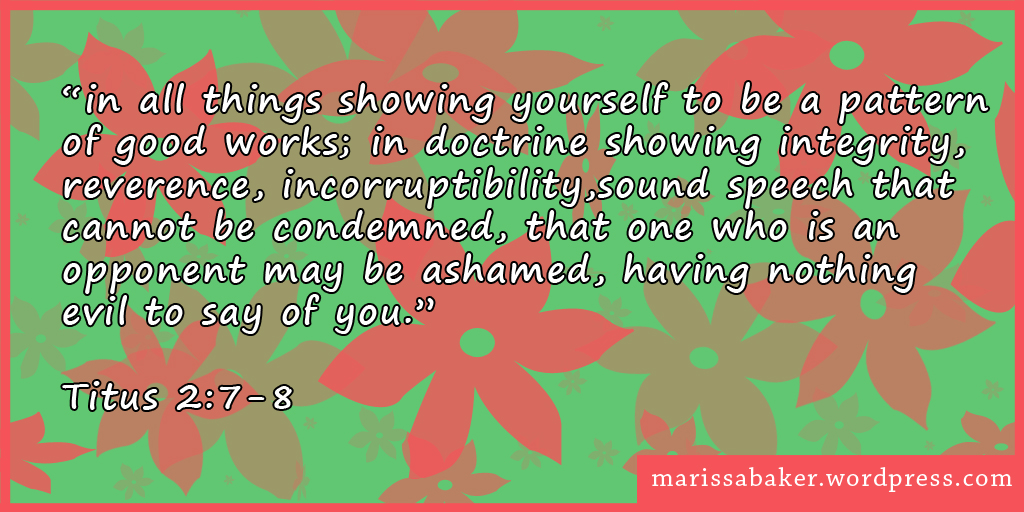
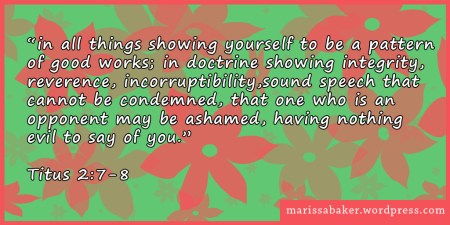
Indeed, we teach by what we do equally (if no more) effectively than by what we say. Writing to a young minister, Paul told him to teach “sound doctrine,” yes, but also to lead by example — “showing yourself to be a pattern of good works; in doctrine showing integrity, reverence, incorruptibility” (Tit. 2:1, 7).

Shepherd the flock of God which is among you, serving as overseers, not by compulsion but willingly, not for dishonest gain but eagerly; nor as being lords over those entrusted to you, but being examples to the flock (1 Pet. 5:2-3)

Representatives

In addition to patterning an example for other believers, we’re also supposed to be examples of what a Christ-follower looks like.

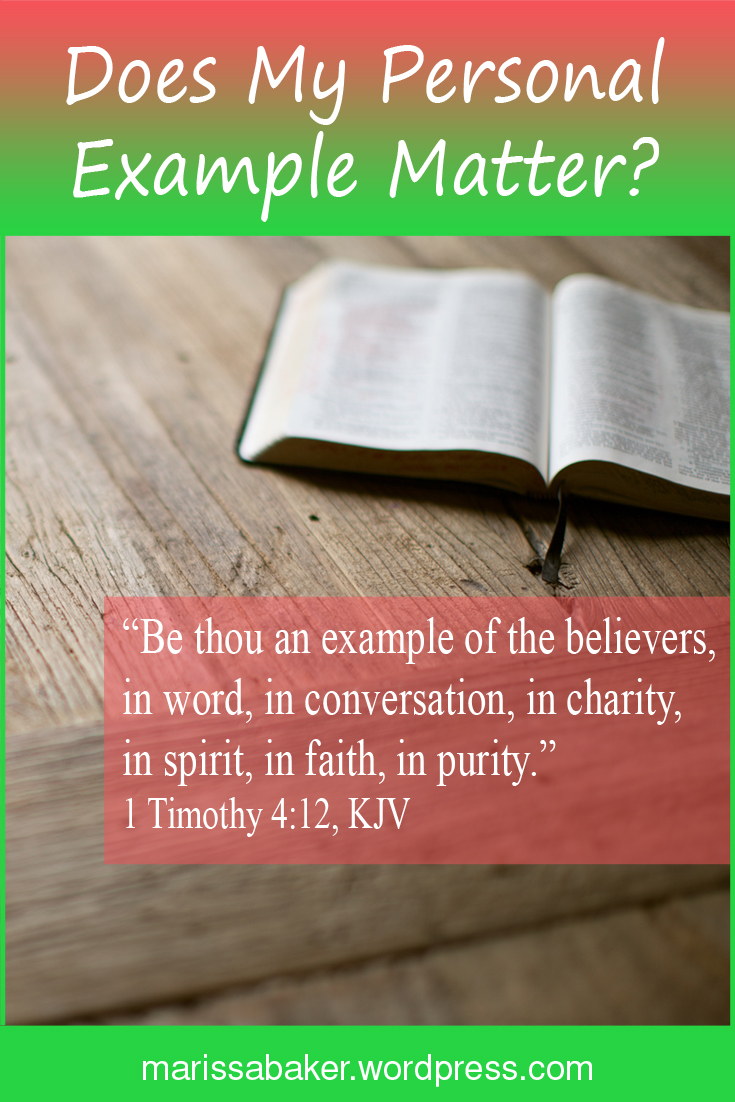
Let no man despise thy youth; but be thou an example of the believers, in word, in conversation, in charity, in spirit, in faith, in purity. (1 Tim. 4:12, KJV)

No matter our age, ability, gift, or role in the church, we can serve as a representative of the Christian type. We are “the epistle of Christ … written not with ink, but with the Spirit of the living God; not in tables of stone, but in fleshy tables of the heart.” (2 Cor. 3:3). We can be seen, “known and read of all men” (2 Cor. 3:2). Indeed, as some have said, you may be the only Bible some people ever read.

Our example doesn’t just “matter.” It’s powerful. We have the amazing opportunity, and responsibility, to show the world how God’s people are supposed to live — to be Christ’s body as we model His love for our brethren and for everyone on the planet.

Download God's Love Story at https://www.smashwords.com/books/view/577523


Loving Christ’s Body

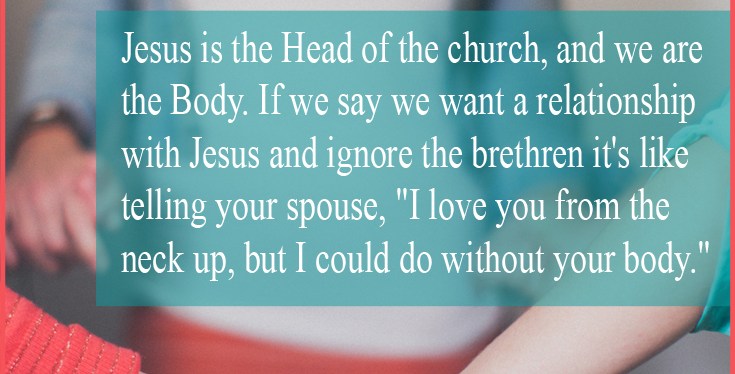
Not too long ago, I heard an analogy on a Christian radio station that stuck with me. It was a pastor trying to convince listeners they need a church to fellowship with. He said that since the church is Jesus Christ’s body and He is the Head, if we say we want a relationship with Jesus and ignore the brethren it’s like telling your spouse, “I love you from the neck up, but I could do without your body.”

Loving Christ's Body | marissabaker.wordpress.com

Vital Commandments

This analogy is not an exaggeration. John’s writings make very clear the high value Jesus puts on love among believers. If we can’t love our brethren, we’re actually incapable of loving God. Read more