Choosing For His Glory

Last week, we talked about living our whole lives in the context of praising God. This study is directly related to that, and I want to begin by quoting a scripture that I almost referenced in that post but decided to save until today.

Therefore, whether you eat or drink, or whatever you do, do all to the glory of God. (1 Cor. 10:31)

I don’t know about you, but I know that right now my life isn’t at the point where I can say that every single thing I do is done with the intention of bringing God glory. But that is part of our goal while we are here on this earth. Every aspect of our lives should be contextualized by our relationships with God and Jesus.blog post "Choosing God's Glory" by marissabaker.wordpress.com
Every Single Thing

The idea of every part of our lives being lived for God’s glory can be a daunting prospect, as this level of self-control seems almost impossible to attain. That overwhelmed feeling is usually how I react to reading this verse:

Casting down arguments and every high thing that exalts itself against the knowledge of God, bringing every thought into captivity to the obedience of Christ (2 Cor. 10:5)

“Every thought”? That’s a tall order. It’s a bit less daunting, though, when we remember Jesus Christ’s words to the disciples in Matthew 19:26 — “With men this is impossible, but with God all things are possible.” Self-control is also one of the fruits of the Holy Spirit, so we know that it is attainable with God’s help (Gal. 5:22).

I also suspect that, while there may be some days when we literally have to battle every thought, that it gets easier. The closer we grow to God, the more automatic it will be to think and act like Him. Christ Himself is being formed in us (Gal. 4:19), along with His mind and thought processes (Phil. 2:5). Letting, inviting, asking Him to dwell in us is a step toward living all our lives for God’s glory (John 15:4, 8).

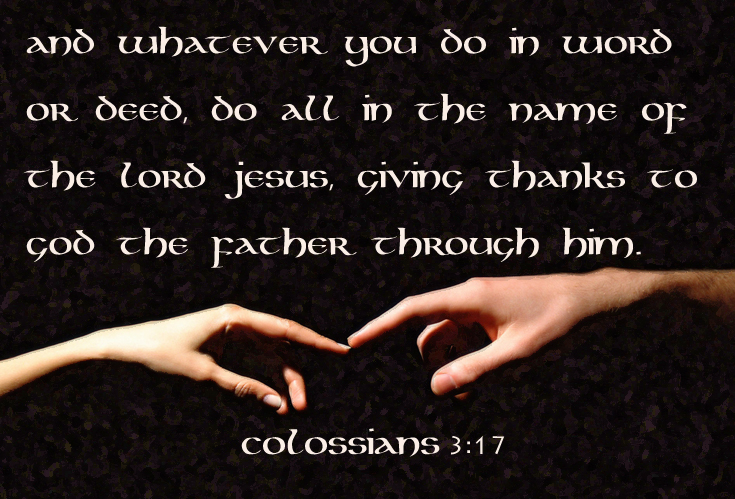
Let the word of Christ dwell in you richly in all wisdom, teaching and admonishing one another in psalms and hymns and spiritual songs, singing with grace in your hearts to the Lord. And whatever you do in word or deed, do all in the name of the Lord Jesus, giving thanks to God the Father through Him. (Col. 3:16-17)

You Are Dead

If we go back to the beginning of Colossians 3 to get context for the verse we just quoted, we find an interesting introduction to a passage that talks about putting to death our sins (verse 5) and putting on the new man who looks like Christ (verse 10).

If then you were raised with Christ, seek those things which are above, where Christ is, sitting at the right hand of God. Set your mind on things above, not on things on the earth. For you died, and your life is hidden with Christ in God. (Col. 3:1-3)

If we really are living as if we are dead to the world and our only life is wrapped up in Christ, of course we’ll be living for His glory.

How shall we who died to sin live any longer in it? Or do you not know that as many of us as were baptized into Christ Jesus were baptized into His death? Therefore we were buried with Him through baptism into death, that just as Christ was raised from the dead by the glory of the Father, even so we also should walk in newness of life. (Rom. 6:2-4)

Earlier, I suggested that we should be growing to the point where reacting in the same way that Christ would respond is automatic. If we struggle with anger, for example, it might still be our first impulse but we should be becoming more practiced at replacing it with love. C.S. Lewis had this to say about what first impulses can tell us about ourselves.

Surely what a man does when he is taken off his guard is the best evidence for what sort of a man he is? Surely what pops out before the man has time to put on a disguise is the truth? If there are rats in a cellar you are most likely to see them if you go in very suddenly. But the suddenness does not create the rats: it only prevents them from hiding. In the same way the suddenness of the provocation does not make me an ill-tempered man; it only shows me what an ill-tempered man I am. (C.S. Lewis, Mere Christianity)

As we mature as Christians we should be quicker to recognize our tendencies to sin, and with Christ in us we now have the power to resist temptation before it becomes sin. It is imperative that we be aware of and active in this process. We cannot passively overcome sin.

Therefore do not let sin reign in your mortal body, that you should obey it in its lusts. And do not present your members as instruments of unrighteousness to sin, but present yourselves to God as being alive from the dead, and your members as instruments of righteousness to God. (Rom. 6:12-13)

As human beings, we can’t be without a “master” — we’re either serving sin, or we’re serving God (Rom. 6:16-23). If we’re serving God in “obedience leading to righteousness,” then we’re also making conscious choices to not obey, or yield to, sin.

Bought and Redeemed

When Jesus Christ died for us, He ransomed us free from servitude to sin. We belong to Him, not to ourselves. Acts 20:28 describes the Church as “purchased with His own blood.” Peter says that false teachers who spread “destructive heresies” are “even denying the Lord who bought them” (2 Pet. 2:1). It is important that we recognize, rather than deny, this fact. blog post "Choosing God's Glory" by marissabaker.wordpress.com
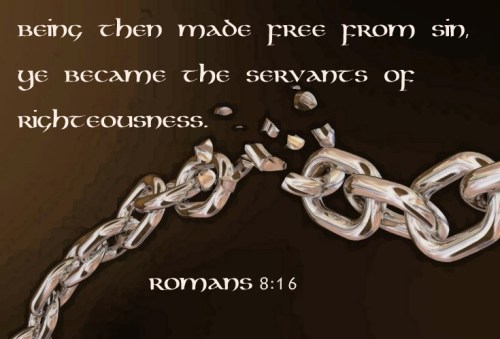
Jesus’ incredible sacrifice cleansed us so that we could “serve the living God” (Heb. 9:14). He made a relationship possible between us and our creator. He established a new covenant “on better promises” that offers us eternal life as part of God’s family (Heb. 8:6). We don’t belong to this world or to Satan or to ourselves any more — we have been ransomed away from slavery to sin and to our own individual weaknesses. We now belong to the One who ransomed us, as His servants, His friends, His bride, His family, His body, His church, and His temple.

Do you not know that your bodies are members of Christ? … Or do you not know that your body is the temple of the Holy Spirit who is in you, whom you have from God, and you are not your own? For you were bought at a price; therefore glorify God in your body and in your spirit, which are God’s. (1 Cor. 6:15, 19-20)

Our physical bodies and our spirits — the intangible part of that makes me “me” and can communicate with God’s Spirit — belong to God. This fact does not, however, mean that we don’t have free will. Even within the choice to follow God (and it is a choice), there are many other choices we’ll have to make. I’ve been talking about this in relation to careers with a new friend I met through this blog. Our latest e-mails brought up the idea that God doesn’t care so much what you do to earn a living (with, you know, the obvious exceptions of earning money in a way contrary to the laws of God and man) as He cares how you conduct yourself in your work and whether or not you’re growing close to Him.

We Give You Glory

Returning to 1 Corinthians 10:31, which opened this post, the context is whether or not Christians could eat meat that was sacrificed to idols. That’s not really an issue for us today, but there’s still a lesson we can learn. Paul says it’s okay to eat or not eat this kind of meat, so long as the way you conduct yourself glorifies God.

Whatsoever is sold in the shambles, that eat, asking no question for conscience sake: for the earth is the Lord’s, and the fulness thereof. If any of them that believe not bid you to a feast, and ye be disposed to go; whatsoever is set before you, eat, asking no question for conscience sake. But if anyone says to you, “This was offered to idols,” do not eat it for the sake of the one who told you, and for conscience’ sake; for “the earth is the Lord’s, and all its fullness.” “Conscience,” I say, not your own, but that of the other. For why is my liberty judged by another man’s conscience? But if I partake with thanks, why am I evil spoken of for the food over which I give thanks? Therefore, whether you eat or drink, or whatever you do, do all to the glory of God. Give no offense, either to the Jews or to the Greeks or to the church of God, just as I also please all men in all things, not seeking my own profit, but the profit of many, that they may be saved. (1 Cor. 10:25-33)

Either choice was morally and legally acceptable before God on its own. But because we belong to God, Paul says that our choices need to be examined in the light of “will it bring God glory?” and “will it profit my brethren?” In the same way, once we answer the question, “can I, or can I not” do something legally in God’s eyes, we should then ask, “should I , or shouldn’t I?” It’s a matter of where our hearts are, and what is our motivation. This same topic is also discussed a few chapters earlier in 1 Corinthians, and that passage adds an even stronger warning.

But food does not commend us to God; for neither if we eat are we the better, nor if we do not eat are we the worse. But beware lest somehow this liberty of yours become a stumbling block to those who are weak. For if anyone sees you who have knowledge eating in an idol’s temple, will not the conscience of him who is weak be emboldened to eat those things offered to idols? And because of your knowledge shall the weak brother perish, for whom Christ died? But when you thus sin against the brethren, and wound their weak conscience, you sin against Christ. (1 Cor. 8:8-12)

That is serious. When our choices, even if they are perfectly acceptable based on our own knowledge, hurt our brethren, it is a sin against Christ. It’s the seam idea expressed in Matthew 25 — “inasmuch as you did not do it to one of the least of these, you did not do it to Me” (Matt. 25:41-46). It’s not enough to act based on knowledge of God’s laws, though that is certainly important. We must also be acting based on love, which builds up our brethren, and for the glory of god (1 Cor. 8:1-7).

In conclusion, the song “Glory” by Casting Crowns has been running through my head for two weeks, so I’m going to share it here:

God’s Thoughts

Doing a study on how God thinks might in some ways seem futile, since Romans 11:33-34 says His ways are past finding out” and implies that no human has or can know “the mind of the Lord.” But another verse that borrows this thought from Isaiah 40:13 and Jeremiah 23:18 gives a bit more hope for today’s topic.

For “who has known the mind of the Lord that he may instruct Him?” But we have the mind of Christ. (1 Cor. 2:16)

The context of this verse is explaining how God, through His Holy Spirit, gives us access to His thoughts. Because we have been called and given His Spirit, “we might know the things that have been freely given to us by God” (1 Cor. 1:12). That doesn’t mean we know, or can know, everything, but it does mean we can begin to understand the mind of God and have Christ’s mind formed in us (Phil. 2:5).

God’s Thoughts Are…

Seek the Lord while He may be found, call upon Him while He is near. Let the wicked forsake his way, and the unrighteous man his thoughts; let him return to the Lord, and He will have mercy on him; and to our God, for He will abundantly pardon. “For My thoughts are not your thoughts, nor are your ways My ways,” says the Lord. “For as the heavens are higher than the earth, so are My ways higher than your ways, and My thoughts than your thoughts.” (Is. 55:6-9)

Before these verses tell us how much higher God’s thoughts are than ours, it instructs us to change the patterns of our own thinking. Our thoughts must be in the right place before we can begin to understand how God thinks. In order to “return to the Lord,” we have to forsake unrighteous thoughts and wicked ways.

casting down arguments and every high thing that exalts itself against the knowledge of God, bringing every thought into captivity to the obedience of Christ, (2 Cor. 10:5)

Though we are created in God’s image, we can’t assume that means His thoughts are similar to ours. They are far higher, and to have a relationship with Him we need to recognize that our pattern of thinking needs to change — to become more like the One we were originally patterned after.

He Knows Our Thoughts

In sci-fi, we describe the ability to read someone else’s thoughts as telepathy. We could say God has this superpower, which is an idea I find both awe-inspiring and a bit scary. He can understand us from the perspective of sensing our innermost thoughts and driving motivations. If we feel lonely or misunderstood, this is a comfort. But when we’ve done something wrong it is impossible to hide from Him.

O Lord, You have searched me and known me. You know my sitting down and my rising up; You understand my thought afar off. You comprehend my path and my lying down, and are acquainted with all my ways. For there is not a word on my tongue, but behold, O Lord, You know it altogether. …

Where can I go from Your Spirit? Or where can I flee from Your presence? If I ascend into heaven, You are there; if I make my bed in hell, behold, You are there. If I take the wings of the morning, and dwell in the uttermost parts of the sea, even there Your hand shall lead me, and Your right hand shall hold me. (Ps. 139:1-4, 7-10)

blog post "God's Thoughts" by marissabaker.wordpress.comThis is my favorite Psalm. I usually find the idea of being known so intimately by my Lord a huge comfort. Who else can literally know every aspect of who you are, understand you perfectly, and still love you?

How precious also are Your thoughts to me, O God! How great is the sum of them! If I should count them, they would be more in number than the sand; when I awake, I am still with You. …

Search me, O God, and know my heart; try me, and know my anxieties; and see if there is any wicked way in me, and lead me in the way everlasting. (Ps. 139:17-18, 23-24)

Once we ask God for this kind of relationship, though, it’s not all about being accepted just as we are. God loves us now, exactly as He finds us, but one aspect of this Love is that He will not allow us to remain imperfect versions of ourselves. He has to be working in us and with us to change us, to make us more like Him.

For the word of God is living and powerful, and sharper than any two-edged sword, piercing even to the division of soul and spirit, and of joints and marrow, and is a discerner of the thoughts and intents of the heart. And there is no creature hidden from His sight, but all things are naked and open to the eyes of Him to whom we must give account.

Seeing then that we have a great High Priest who has passed through the heavens, Jesus the Son of God, let us hold fast our confession. For we do not have a High Priest who cannot sympathize with our weaknesses, but was in all points tempted as we are, yet without sin. Let us therefore come boldly to the throne of grace, that we may obtain mercy and find grace to help in time of need. (Heb. 4:12-16)

His Thoughts Toward Us

Though He knows every one of our thoughts, and sees all our foibles and faults (even the ones we manage to keep hidden from other people), God’s own thoughts toward us are good things. Another scripture I take great comfort in is part of a letter Jeremiah the prophet wrote when the Jews were carried away captive as a result of their disobedience to God. Even in that context, God was still planning good things for them and thinking of them kindly.

For I know the thoughts that I think toward you, says the Lord, thoughts of peace and not of evil, to give you a future and a hope.  Then you will call upon Me and go and pray to Me, and I will listen to you. And you will seek Me and find Me, when you search for Me with all your heart. I will be found by you, says the Lord, and I will bring you back from your captivity; I will gather you from all the nations and from all the places where I have driven you, says the Lord, and I will bring you to the place from which I cause you to be carried away captive. (Jer. 29:11-14)

It’s interesting that here as well as in Isaiah 55:6 there is the idea of seeking the Lord. Both times when we’re talking about God’s thoughts in relation to us, we are instructed to seek Him because He wants to be found. He wants us to love Him, to try and understand Him, and to grow in His character — to learn to think the way He thinks.

Gleaning Firstfruits

Before getting to today’s topic, I just wanted to mention how much I’ve enjoyed doing an actual count-down this year instead of just putting Pentecost on the calendar. It’s helped me focus my Bible study and kept me in mind of the timing for God’s calender rather than feeling like Pentecost sneaked up on me. Today is the 7th Sabbath in our count, which means Pentecost is tomorrow!

And you shall count for yourselves from the day after the Sabbath, from the day that you brought the sheaf of the wave offering: seven Sabbaths shall be completed. Count fifty days to the day after the seventh Sabbath; then you shall offer a new grain offering to the Lord. (Lev. 23:15-16)

Though this is one of the easiest Holy Days to see evidence of in the New Testament (largely due to the giving of the Holy Spirit in Acts), I think we’ll spend most of our time today in the Old Testament, particularly in the book of Ruth.

Lawns of Gleaning

Pentecost, also called the Feast of the Firstfruits/Harvest/Ingathering, is a harvest-time festival. The count to this day begins with a wave-sheaf “of the firstfruits of your harvest,” and the offerings on the day of Pentecost include “two wave loaves of two-tenths of an ephah” of “fine flour” “baked with leaven” that are described as “the firstfruits to the Lord” (Lev. 23:10, 17). After a lengthy passage of instructions for Pentecost, there is a verse that does not quite seem to fit.

When you reap the harvest of your land, you shall not wholly reap the corners of your field when you reap, nor shall you gather any gleaning from your harvest. You shall leave them for the poor and for the stranger: I am the Lord your God. (Lev. 23:22)

This is a repetition of a command also recorded in Leviticus 19:9-10, a command so important to God that He not only gave it twice, but He put one of those commands in the passage describing His most Holy Days. We can get some idea of how this practice works, and perhaps why it is so important, by looking at the book of Ruth.

‘Ruth Gleaning’ watercolor by James Tissot (1896)

There’s a note in my study Bible that says, “by New Testament times” the book of Ruth was being “read at the Feast of Harvest (Pentecost) because much of the story is set in the harvest fields.” It was one of five books “read publicly at the Feasts of Israel.”

I dare say we all know the story. Naomi and her family moved to Moab during a famine in Israel. There, her two sons married. About 10 years later, Naomi’s husband and sons were dead and she returned home to Israel accompanied by her daughter in law, Ruth. We jump into the story as Ruth and Naomi arrive in “Bethlehem at the beginning of barley harvest” (Ruth 1:22).

So Ruth the Moabitess said to Naomi, “Please let me go to the field, and glean heads of grain after him in whose sight I may find favor.” And she said to her, “Go, my daughter.” Then she left, and went and gleaned in the field after the reapers. And she happened to come to the part of the field belonging to Boaz, who was of the family of Elimelech. (Ruth 2:2-3)

As we read further, we see Boaz went above and beyond what God’s law strictly required a landowner to leave for the poor. He offers Ruth protection and water, and asks her not to glean in any other field where he could not guarantee her safety (Ruth 2:8-9). Behind-the-scenes, he told his reapers to let grain fall for her on purpose and not to stop her if she wanted to glean even among the sheaves of grain (Ruth 2:15-16).

Unmerited Favor

There is much of Christ’s character visible in how Boaz treats Ruth when she first arrives in his field. Like Boaz did for Ruth, Jesus offers us His personal protection. He asks us not to stray from His laws because they are designed to keep us safe from the consequences of sin. He says, “If anyone thirsts, let him come to Me and drink” (John 7:37). Our response to this unearned favor ought to be much the same as Ruth’s.

So she fell on her face, bowed down to the ground, and said to him, “Why have I found favor in your eyes, that you should take notice of me, since I am a foreigner?” (Ruth 2:10)

This is much the same question David asked God in Psalms 8:4 and 144:3 — “What is man that You are mindful of him?” Every human is small and insignificant compared to God, and those of us who God has chosen for His particular attention are unimportant even by human standards.

But God has chosen the foolish things of the world to put to shame the wise, and God has chosen the weak things of the world to put to shame the things which are mighty; and the base things of the world and the things which are despised God has chosen, and the things which are not, to bring to nothing the things that are, that no flesh should glory in His presence. But of Him you are in Christ Jesus, who became for us wisdom from God—and righteousness and sanctification and redemption — that, as it is written, “He who glories, let him glory in the Lord.” (1 Cor. 1:27-31)

"Gleaning Firstfruits" marissabaker.wordpress.comGod is gleaning His firstfruits from the world’s rejects. He is taking people who are nothing and turning us into something glorious. He is taking strangers — like the Moabite Ruth — and adopting them into His family through Christ’s sacrifice.

But now in Christ Jesus you who once were far off have been brought near by the blood of Christ. …Now, therefore, you are no longer strangers and foreigners, but fellow citizens with the saints and members of the household of God (Eph. 2:13, 19)

Our Redeemer

The adoption process by which we become God’s children is, as we discussed last week, linked inseprably to Christ’s redeeming work (Eph. 1:5-7; Rom. 8:23; Gal. 4:3-7). There is a parallel for this as well in the story of Ruth, in the role Boaz plays as a kinsman redeemer.

And her mother-in-law said to her, “Where have you gleaned today? And where did you work? Blessed be the one who took notice of you.” So she told her mother-in-law with whom she had worked, and said, “The man’s name with whom I worked today is Boaz.” Then Naomi said to her daughter-in-law, “Blessed be he of the Lord, who has not forsaken His kindness to the living and the dead!” And Naomi said to her, “This man is a relation of ours, one of our close relatives.” (Ruth 2:19-20)

My study Bible says this last phrase could be translated “one that hath right to redeem.” We find the basis for the practice of a kinsman redeeming land in Leviticus 25: 25, 48-49. To prevent an inheritance from leaving the family, someone who was closely related, financially able, and willing to fill this role could redeem land that was sold. In some cases, as here in Ruth, when the man who the land originally belonged to had left a childless widow, the redeemer was expected to marry her per the command in Deuteronomy 25:5-10.

We see all this played out in Ruth 4:4-10 where Boaz must offer a more closely related kinsman the opportunity to redeem Naomi’s family’s land and marry Ruth.  This man refuses (which, being the hopeless romantic I am, I suspect was Boaz’s plan all along).

Stepping back a chapter and looking at Ruth’s request that Boaz play the part of a redeemer, we read about a practice that seems rather unusual. Since Naomi counsels this action and Boaz knew how to respond, I assume Ruth asking him to be her family’s redeemer (perhaps even this method of asking) was not considered unusual in their culture. Per Naomi’s instructions, Ruth lies down at Boaz’s feet when he is asleep and waits for him to notice her.

And he said, “Who are you?” So she answered, “I am Ruth, your maidservant. Take your maidservant under your wing, for you are a close relative.” (Ruth 3:9)

Looking at the Hebrew for “wing”, The Complete WordStudy Dictionary for the Old Testament says “the idiom to spread (one’s) wings over means to take to wife.” This same word is used in Ruth 2:12 when Boaz tells Ruth, “The Lord repay your work, and a full reward be given you by the Lord God of Israel, under whose wings you have come for refuge.” Ruth is asking Boaz for a type of protection that mirrors the relationship between God and Israel. The comparison is drawn even more strongly reading God’s words to Israel in Ezekiel 16.

“When I passed by you again and looked upon you, indeed your time was the time of love; so I spread My wing over you and covered your nakedness. Yes, I swore an oath to you and entered into a covenant with you, and you became Mine,” says the Lord God. (Ezk. 16:8)

In the same way, we who are part of the church have been “betrothed you to one husband” — Jesus Christ — and will be married “to Him who was raised from the dead” after He died in order to redeem us (2 Cor. 11:2; Rom. 7:4).

Taken together, the book of Ruth and the Feast of Pentecost teach us about the glorious unmerited favor that God pours out on us. We were strangers like Ruth and were not only invited to partake in what God provides, but cared for deeply and betrothed to His own Son, who gave His life to redeem His firstfruit Bride.


Comfort and Peace

It’s Sabbath number 2 out of 7 in our count to Pentecost (Lev. 23:15-16). As we get closer to Pentecost, I wanted to focus more of my studies on the Holy Spirit. I’ve already written about the Holy Spirit in the book of Acts, but there is so much more to cover.

This week, while reading through John 14, 15, and 16, what stood out to me was the word “comforter” (KJV) to refer to the Holy Spirit, particularly in connection with this verse:

Peace I leave with you, My peace I give to you; not as the world gives do I give to you. Let not your heart be troubled, neither let it be afraid. (John 14:26)

I have a troubled heart. By myself, I’m worried, fearful, distracted, anxious, and would rarely leave the house. But the better my relationship with God is, the more at peace I am. This is a subject close to my heart, because I know first-hand how much worse my anxiety gets if I drift away from God and the comfort of His presence.

Comfort

The word “comforter,” or “helper” in the NKJV, is used in John 14:16, 14:26, 15:26; and 16:7. It’s from the Greek word parakletos (G3875), which is the same word used to describe Jesus Christ as our “advocate” in 1 John 2:1. According to the Complete Word Study Dictionary of the New Testament by Dr. Spiros Zodhiates, it refers “to an aid of any kind. … one who comes forward on behalf of and as the representative of another.” It is translated “comforter” or “helper” because the root word, parakaleo (G3870), means “to aid, help, comfort, encourage.”

"Comfort and Peace" marissabaker.wordpress.com

The use of this word here in John seems to tie the work of the Holy Spirit directly to Christ’s role as our Comforter. He said the Spirit “will testify of Me” and that it was good for the disciples that He leave them so that He could send the Holy Spirit (John 15:26; 16:7). Again quoting Zodhiates’s dictionary, it says the Spirit “undertakes Christ’s office in the world while Christ is not in the world as the God-man in bodily form,” acting as “Christ’s substitute on earth.”  Perhaps this is why we are told “if anyone does not have the Spirit of Christ, he is not His” (Rom. 8:9).

On Our Behalf

One of the themes in the book of Hebrews is what Christ does on our behalf. He was made like us and suffered in our place so that He could be our “merciful and faithful High Priest” who makes “propitiation for the sins of the people” and “is able to aid those who are tempted” (Heb. 2:176-18).

For we do not have a High Priest who cannot sympathize with our weaknesses, but was in all points tempted as we are, yet without sin. Let us therefore come boldly to the throne of grace, that we may obtain mercy and find grace to help in time of need. (Heb. 4:15-16)

Because of what Christ did, and does, for us, we have assurance that we can obtain help from God. Our High Priest “is also able to save to the uttermost those who come to God through Him, since He always lives to make intercession for them” (Heb. 7:25). He died to obtain our “eternal redemption,” and now appears “in the presence of God for us” (Heb. 9:12, 24).

These roles Christ is filling for us should be a great comfort. Read Hebrews 10:19-25 — it is not a description of someone who is fearful or discomfited. We have boldness in Jesus, a “full assurance of faith,” and know that we can receive abundant comfort from Him and the Father through the Holy Spirit.

Blessed be the God and Father of our Lord Jesus Christ, the Father of mercies and God of all comfort, who comforts us in all our tribulation, that we may be able to comfort those who are in any trouble, with the comfort with which we ourselves are comforted by God. For as the sufferings of Christ abound in us, so our consolation also abounds through Christ. (2 Cor. 1:3-5)

Peace

The assurance of having Jesus present through the Holy Spirit as our Comforter, Advocate, and Helper should work a change in the state of our hearts. In John 14, He said that He gives His peace to us. This word “peace” is from the Greek eirene (G1515), and it means “a state of untroubled, undisturbed, well-being.” It can mean an “absence or end of strife,” but that is not necessary for the inner peace which Christ is referring to here, and which is a fruit of the Spirit (Gal. 5:22).

Be anxious for nothing, but in everything by prayer and supplication, with thanksgiving, let your requests be made known to God; and the peace of God, which surpasses all understanding, will guard your hearts and minds through Christ Jesus. (Phil. 4:6-7)

In Ephesians, Jesus Christ is called “our peace” because He brought us into covenant with God and gave us “access by one Spirit to the Father”  (Eph. 2:13-18). He made peace between us and God by removing the sin which separated us from Him, and gives us inner peace as a result of this new relationship.

For God has not given us a spirit of fear, but of power and of love and of a sound mind. (2 Tim. 1:7)

Look at what we are given. Power that makes us able and capable (G1411 dunamis). Love which actively and benevolently does good (G26 agape). Discipline, self-control and sound judgement (G4995 sophronismos). That is just part of the comfort and peace that God makes available to us through His Spirit if we remain in fellowship with Him.


The “God Of The Old Testament”

After celebrating a lovely Feast of Unleavened Bread that concluded this past Monday, it’s time to start counting down to Pentecost. Per Leviticus 23:15-16, this Sabbath is the first of seven in the count to Pentecost. I’ll probably talk about this more over the next few weeks, but first I want to post about a topic that has been on my mind of late.

The phrase “God of the Old Testament” just seems to keep coming up in arguments and messages in the churches. It typically goes one of two ways: either we’re trying to pin-down who the God of the Old Testament was (i.e. the Father or the One who became Christ), or we’re contrasting the God of the Old Testament with the God of the New as if they were two different beings.

In some ways, I think this comes under the category of “stupid things we say in the church.” It’s misleading and confusing. For one thing, scripture is very clear that there wasn’t just one “God of the Old Testament” — there had always been two Beings mentioned and recognized in scripture.

Two in the OT

As you’ve probably read/heard before, the word translated “God” in the opening chapters of Genesis is plural. We can see two Beings so closely related They can be refereed to by one plural name. In the same way, we use a family’s last name to encompass several individuals, e.g. the Bakers or the Martins. Even without knowing Hebrew, the fact that there are two Beings here is made clear when They say, “Let Us make man in Our image, according to Our likeness” (Gen. 1:26).

Throughout the Old Testament, there are examples of people who knew there were two God-beings. The most well-known is probably Psalm 110:1 — “The Lord said to my Lord, ‘Sit at My right hand, till I make Your enemies Your footstool.'” There were other writer’s besides David, though. Take Agur for example.

Who has ascended into heaven, or descended? Who has gathered the wind in His fists? Who has bound the waters in a garment? Who has established all the ends of the earth? What is His name, and what is His Son’s name, if you know? (Prov. 30:4)

Two God-beings appear in Daniel’s prophesies, too.

I was watching in the night visions, and behold, One like the Son of Man, coming with the clouds of heaven! He came to the Ancient of Days, and they brought Him near before Him. Then to Him was given dominion and glory and a kingdom, that all peoples, nations, and languages should serve Him. His dominion is an everlasting dominion, which shall not pass away, and His kingdom the one which shall not be destroyed. (Dan. 7:13-14)

Christ referred to this scripture as part of His affirmative answer when the high priest asked him, ““Are You the Christ, the Son of the Blessed?” (Mark 14:61-62).

The Word

The fact that Old Testament writers knew about two God-beings does not answer the question of which of Them interacted directly with Their people. Though “God of the Old Testament” is an ill-fitting phrase, it is often used as short-hand for “the member of the Godhead who interacted with people throughout the Old Testament.”

We can, at least, determine from scripture the answer to that question. One of the clearest passages addressing this is in 1 Corinthians when Paul is talking about Israel’s history.

Moreover, brethren, I do not want you to be unaware that all our fathers were under the cloud, all passed through the sea, all were baptized into Moses in the cloud and in the sea, all ate the same spiritual food, and all drank the same spiritual drink. For they drank of that spiritual Rock that followed them, and that Rock was Christ. (1 Cor. 10:1-4)

It really can’t get much plainer than that. Paul additionally says, “nor let us tempt Christ, as some of them also tempted,” identifying The Word, the One who came to be known as Jesus Christ, as the God who Israel tempted (1 Cor. 10:9). We can conclude, therefore, that the One who spoke with Moses about Israel tempting Him was The Word.

because all these men who have seen My glory and the signs which I did in Egypt and in the wilderness, and have put Me to the test now these ten times, and have not heeded My voice, they certainly shall not see the land of which I swore to their fathers, nor shall any of those who rejected Me see it. (Num. 14:22-23)

One of the many things Jesus said which upset the Jews of His day was that He had seen Abraham. The implication that accompanied this statement — that He was God — made them want to stone Him.

“Your father Abraham rejoiced to see My day, and he saw it and was glad.” Then the Jews said to Him, “You are not yet fifty years old, and have You seen Abraham?” Jesus said to them, “Most assuredly, I say to you, before Abraham was, I AM.” (John 8:56-58)

The Being Abraham talked to when “the Lord appeared to him by the terebinth trees of Mamre” before the destruction of Sodom and Gomorrah is typically interpreted as a pre-incarnate appearance of Jesus Christ (Gen 18:1). As The Word, Jesus has been entrusted with expressing the thoughts of the Godhead to man. That’s what logos, the Greek word used in John 1:1, means — an expression of intelligence. Since we know from Hebrews 13:8 that Christ’s character is constant, it makes sense that this role would be consistent throughout the Bible.

No one has seen God at any time. The only begotten Son, who is in the bosom of the Father, He has declared Him. (John 1:18)

Christ repeats this, saying He is the only one who has seen the Father (John 6:46) and that no one else at that time knew the Father (John 7:28-29). There’s also 1 John 4:12 — “no one has seen God at any time.” These verses are uncomplicated and clear, leaving little room for doubt that while there have always been two Beings in the God-family, the Word who became Christ was responsible for interacting with Their creation.

Redeeming His Creation

In the beginning was the Word, and the Word was with God, and the Word was God. He was in the beginning with God. All things were made through Him, and without Him nothing was made that was made. (John 1:1-3)

The “let us” phrase in Genesis 1 shows that both the Father and Son were involved in creation. When we add John 1, we start to see a more complete image of Their roles with The Word being the One who spoke everything into existence (Ps. 33:6). Some will argue, however, that it’s a mistranslation or something of the kind. Perhaps we could say this of one verse, but what about seven?

Two of these remaining 6 verses that I found talk about God creating the universe though Jesus Christ:

To me, who am less than the least of all the saints, this grace was given, that I should preach among the Gentiles the unsearchable riches of Christ, and to make all see what is the fellowship of the mystery, which from the beginning of the ages has been hidden in God who created all things through Jesus Christ (Eph. 3:8-9)

God, who at various times and in various ways spoke in time past to the fathers by the prophets, has in these last days spoken to us by His Son, whom He has appointed heir of all things, through whom also He made the worlds (Heb. 1:1-2)

Another verse that fits in here is Revelation 3:14, which describes Jesus as “the Beginning of the creation of God.” Zodhiates’ study Bible points out that the Greek word translated “beginning” is arche, which “literally refers to Him as the originator or cause of creation.” That Christ’s work was a focus in the act of creation is brought forward by three more verses that say “by Him are all things” (Heb. 2:10; 1 Cor. 8:6).

He is the image of the invisible God, the firstborn over all creation. For by Him all things were created that are in heaven and that are on earth, visible and invisible, whether thrones or dominions or principalities or powers. All things were created through Him and for Him. And He is before all things, and in Him all things consist.  (Heb. 1:15-17)

As the One responsible for the act of creation, it was fitting for The Word to redeem His creation by His own sacrifice. That this was planned from the beginning, we can see from His description as “the Lamb slain from the foundation of the world” (Rev. 13:8). We also see that God gave us grace ” in Christ Jesus before time began” (2 Tim. 1:9). This also fits in with the narrative arch that runs throughout the Bible of Jesus redeeming a Bride, which I talk about at greater length in chapters 2-4 of “God’s Love Story.”

The Constancy of God

The other thing I want to briefly address is the idea that God was a different person in the Old and New Testaments. We hear, and perhaps say, that God in the Old Testament was a vengeful, angry God and that God in the New Testament is all peace and forgiveness. But this does not fit with verses that say there is “no variation or shadow of turning” with the Father, and Jesus Christ is “the same yesterday, today, and forever” (James 1:17; Heb. 13:8).

“And it shall be, in that day,” says the Lord, “That you will call Me ‘My Husband,’ and no longer call Me ‘My Master,’ … “I will betroth you to Me forever; yes, I will betroth you to Me in righteousness and justice, in lovingkindness and mercy; I will betroth you to Me in faithfulness, and you shall know the Lord. … And I will have mercy on her who had not obtained mercy; then I will say to those who were not My people, ‘You are My people!’ and they shall say, ‘You are my God!’” (Hos. 2:16, 19-20, 23)

This kind of love, the longing for a personal relationship with His people, can be found throughout the Old Testament, just as reminders of the righteous judgement of God can be found in the New Testament.

Anyone who has rejected Moses’ law dies without mercy on the testimony of two or three witnesses. Of how much worse punishment, do you suppose, will he be thought worthy who has trampled the Son of God underfoot, counted the blood of the covenant by which he was sanctified a common thing, and insulted the Spirit of grace? For we know Him who said, “Vengeance is Mine, I will repay,” says the Lord. And again, “The Lord will judge His people.” It is a fearful thing to fall into the hands of the living God. (Heb. 10:28-31)

God, both the Father and the Son, are unchanging and faithful. Both have always been here, and each has fulled a consistent role in Their dealings with Their Creation. “The God of the Old Testament” is a misleading phrase that has led to offense and confusion regarding what should be a relatively straight-forward topic. Both God-beings have always been present and active, though Jesus Christ’s role as the Word is more visible in interactions with the creation.

Much Too High A Price

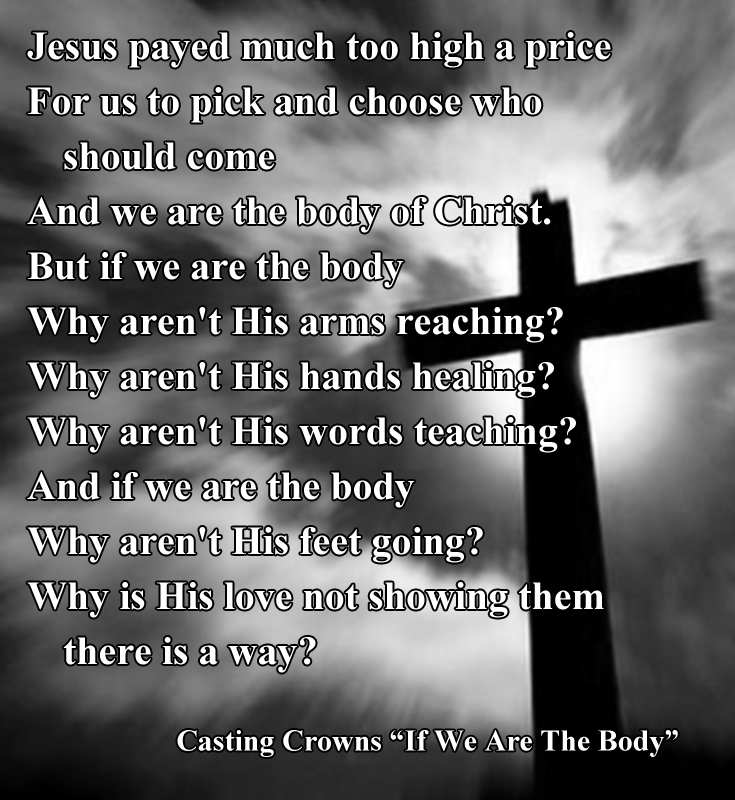
I wrote last week about questions the church can ask herself regarding our role as the body of Christ. Like the Casting Crowns song “If We Are The Body,” it was meant as a challenge for the church as a whole to reach out with compassion, heal others, teach Jesus Christ’s words, walk in His steps, and love everyone. The reason for this is mentioned in the line which provides me with a title: “Jesus payed much too high a price / For us to pick and choose who should come / And we are the body of Christ.”

What Price?

Christ said, “I am the good shepherd. The good shepherd gives His life for the sheep” (John 10:11). That, in a nutshell, is the price paid. He willingly gave up first His eternal existence with the Father and then His human life to be a sacrifice for sins (John 1:1-2, 14). A more complete picture of what this entailed can be found in Isaiah 52:13-53:12. Here’s a few verses:

He is despised and rejected by men, a Man of sorrows and acquainted with grief. And we hid, as it were, our faces from Him; He was despised, and we did not esteem Him. Surely He has borne our griefs and carried our sorrows; yet we esteemed Him stricken, smitten by God, and afflicted. But He was wounded for our transgressions, He was bruised for our iniquities; the chastisement for our peace was upon Him, and by His stripes we are healed. (Is. 53:3-5)

I have a hard time thinking of what to write after this. It’s so deeply moving to think of how much He suffered for my sake, and for your sake, and for the entire world (John 1:29; 4:42; 6:33; 12:47).

For God so loved the world that He gave His only begotten Son, that whoever believes in Him should not perish but have everlasting life. For God did not send His Son into the world to condemn the world, but that the world through Him might be saved. (John 3:16-17)

I find it interesting that John 3:16-17 doesn’t say that Christ died to save the church — it says He died for the entire world. The goal is to save as many people as possible (2 Pet. 3:9).

Paid For Whom?

No one can come to Christ unless the Father draws them (John 6:44), and once that happens “he who believes in the Son has everlasting life” (John 3:36). If someone shows up at church with that one requirement — belief in Jesus Christ — then we have no right to turn them away. Their belief is a sign that God is working with them. Look how strongly Christ rebuked His disciples when they thought certain people were not worth His time:

Then they brought little children to Him, that He might touch them; but the disciples rebuked those who brought them. But when Jesus saw it, He was greatly displeased and said to them, “Let the little children come to Me, and do not forbid them; for of such is the kingdom of God. Assuredly, I say to you, whoever does not receive the kingdom of God as a little child will by no means enter it.” (Mark 10:13-15)

"Much Too High A Price." marissabaker.wordpress.comIn Matthew, Jesus further said, “Whoever receives one little child like this in My name receives Me. Whoever causes one of these little ones who believe in Me to sin, it would be better for him if a millstone were hung around his neck, and he were drowned in the depth of the sea” (Matt. 18:5-6) Since we are all God’s children, whatever age we are, I think it safe to extend what Christ says concerning His little ones to every new believer. James 2 talks about not showing partiality, or respecting people based on how much money they have. This principle can be extended to other factors as well. Take the example of “strangers” who joined Israel in the Old Testament.

“Also the sons of the foreigner who join themselves to the Lord, to serve Him, and to love the name of the Lord, to be His servants — everyone who keeps from defiling the Sabbath, and holds fast My covenant — even them I will bring to My holy mountain, and make them joyful in My house of prayer. Their burnt offerings and their sacrifices will be accepted on My altar; for My house shall be called a house of prayer for all nations.” The Lord God, who gathers the outcasts of Israel, says, “Yet I will gather to him others besides those who are gathered to him.” (Is. 56:6-8)

In our modern churches of God, a similar situation might be new people coming into the church without a Worldwide background and no clue who Mr. Armstrong was. Or maybe people in other groups that we not-so-secretly wonder if they are really part of the body. It is not our place to make judgements about who is and who is not part of Christ’s body and living in His sheepfold (John 10:16). If someone believes in Him, we should welcome them with open arms. If they keep His Sabbaths and enter into covenant with Him, like the strangers in Israel, we must not dismiss them.

Then Peter opened his mouth and said: “In truth I perceive that God shows no partiality. But in every nation whoever fears Him and works righteousness is accepted by Him.” (Acts 10:34-35)

This statement should disabuse us of any notion that people of a certain social class or church background or ethnic group are in some way better or worse than others. The Pharisees had that idea — “We have Abraham as our father” — and John the Baptist told them they were a “brood of vipers” and “that God is able to raise up children to Abraham from these stones” on the ground near the river. Their background did not matter, only that they repent and “bear fruits worthy of repentance” (Matt. 3:7-9).

What Should We Do?

"Much Too High A Price." marissabaker.wordpress.comThe Father and Jesus want to save every single person who will let them. Are we helping them in that goal as members of the body of Christ? Or are people “tripping over me” when they try to reach God (Rom. 14:13)? We are so quick to take and cause offense, to indigently puff up and bluster at people over even trivial things like music selection, whether or not to worship with hands raised, and are jeans appropriate for church services. But look at Paul’s attitude:

Give no offense, either to the Jews or to the Greeks or to the church of God, just as I also please all men in all things, not seeking my own profit, but the profit of many, that they may be saved. (1 Cor. 10:32-33)

How much less strife would there be within the church and in our interactions with those who do not yet believe if this were our attitude!

Let each of us please his neighbor for his good, leading to edification. For even Christ did not please Himself; but as it is written, “The reproaches of those who reproached You fell on Me.” (Rom. 15:2-3)

When we set aside our selfishness and look after other people before ourselves, we are following in Christ’s footsteps. When we are becoming like the “head over all things to the church,” we truly begin acting like the body of Christ (Eph. 1:22-23). We are supposed to imitate God and “walk in love, as Christ also has loved us and given Himself for us, an offering and a sacrifice to God for a sweet-smelling aroma” (Eph. 5:2). In the night He was betrayed, Jesus said, “This is My commandment, that you love one another as I have loved you” (John 15:12). Lest we think this statement is ambiguous, John spells it out clearly in his first epistle: “By this we know love, because He laid down His life for us. And we also ought to lay down our lives for the brethren” (1 John 3:16). Still, we might try to find some wiggle-room in this command. It only says to love the brethren — I don’t have to love all those other people, right? Wrong.

But I say to you, love your enemies, bless those who curse you, do good to those who hate you, and pray for those who spitefully use you and persecute you, that you may be sons of your Father in heaven; for He makes His sun rise on the evil and on the good, and sends rain on the just and on the unjust. For if you love those who love you, what reward have you? Do not even the tax collectors do the same? And if you greet your brethren only, what do you do more than others? Do not even the tax collectors do so? Therefore you shall be perfect, just as your Father in heaven is perfect. (Matt. 5:44-48)

Well there it is — not a smidgin of wiggle-room left. We have to love everyone the way God loves them and the way He loves us. Jesus paid the highest price ever paid so that the world could be saved. He is not going to look kindly on our actions if we try to pick and choose who is worth our love and who we should “let in” to His body. That’s not our call.

"Much Too High A Price." marissabaker.wordpress.com