Finding Jesus in the Old Testament

Several times during Jesus’s ministry, He told people that the scriptures they read told them about Him. For example, He told some, “You study the scriptures thoroughly because you think in them you possess eternal life, and it is these same scriptures that testify about me” (John 5:39, NET). Remember, they would have just had the Old Testament at this time. The gospel events were happening in front of them, but they didn’t have written records yet pointing out which prophecies Jesus fulfilled and cross-referencing Old and New Testament writings the way we do today. And yet, Jesus told people that “everything written about me in the law of Moses and the prophets and the psalms must be fulfilled” (Luke 24:44, NET). He expected at least some of the people He spoke with to recognize that the law, prophets, and psalms all pointed to a Messiah and that He was that promised Messiah.

When I think about these scriptures, I wonder if I could have recognized that there was a coming Messiah from reading the Old Testament (OT). Even with the benefit of New Testament (NT) perspective, I struggle to see Him in the law of Moses. Not even all of the psalms and prophecies that NT writers identify as Messianic seem like something I’d have recognized when just reading the OT. Like the disciples on the road to Emmaus, we need Jesus to intervene in our minds to open our understanding (Luke 24:13-35). In fact, there are scriptures indicating it’s impossible to understand God’s word or have a relationship with Him unless the Father and Jesus take an active role in your life (John 6:44; 14:6).

At this point, we might ask ourselves several different questions, such as, “How much did believers in the Old Testament know?” and “How did salvation through Jesus (since you can’t be saved through anyone else [Acts 4:12]) work for people who lived and died before His sacrifice?” For today, though, I want to focus on the question, “Which verses in the Old Testament clearly point to Jesus Christ?” Or, since we’ll be looking at the OT that was written in Hebrew, to Yeshua the Messiah?
Image of a man studying the Bible overlaid with text from Matt. 16:16-17, NET version:  Simon Peter answered, “You are the Christ, the Son of the living God." Jesus answered, “Simon, Jonah's son, God has blessed you. No person on earth has showed you this. But my Father in heaven has showed you.”
Image by Matt Vasquez from Lightstock

Clarifying Names

The name “Jesus” is the English transliteration (representing a word from one language with the sounds and alphabet of another) of the Greek name Iēsous, which comes from the Hebrew name Yehoshua or Yeshua (H3091). The name means “Yahweh is salvation,” from the words Yahweh or Yehovah (H3068, God’s proper name [Ex. 4:15-16]) and yasha (H3467, “to save, be saved, be delivered” [BDB]). Yasha is the main root of a group of Hebrew words. Frequently used derivatives include yeshuah (H3444, salvation), teshuah (H8668, help, rescue, salvation) , and names such as Joshua, Hosea, Isaiah (Theological Wordbook of the Old Testament [TWOT] entry 929).

You won’t ever see the name “Jesus” in the Old Testament, but you frequently see the name Yeshua: it is translated into English as Joshua. There’s no prophecy in the Old Testament that says the Messiah will be named Yeshua. When Jesus was born, His name likely wouldn’t have stood out too much. Joshua is a popular name even today, and I doubt it was unusual in Jesus’s day considering the historic Yeshuas that people would have been familiar with (e.g. Moses’s successor Joshua son of Nun and Joshua the son of Josedech who appears in Haggai’s prophecies).

“Christ” is more of a title than a name. It is a transliteration into English of the Greek word christos (G5547), which is a translation (rendering the meaning of a word into the corresponding word in another language) of the Hebrew word mashiyah or Messiah (H4899). Both the Greek and Hebrew words mean “anointed” (Thayer; BDB). The root word mashach (H4886, anoint or rub with oil) is used most frequently of kings and priests sanctified for the Lord, and it’s also used twice of prophets (TWOT 1255). For example, it’s used when Yahweh chose Saul as the first king of Israel.

“Tomorrow about this time I will send you a man out of the land of Benjamin, and you shall anoint (mashach) him to be prince over my people Israel. He will save (yasha) my people out of the hand of the Philistines; for I have looked upon my people, because their cry has come to me.”

1 Samuel 9:16, WEB

Mashiyah (H4899, anointed one) is most frequently used in the Old Testament to refer to kings (TWOT 1255c). It also became closely associated with the God-being we now know as Jesus. By the time Jesus arrived, the Jews of His day were looking for the promised Messiah or Christ (Luke 3:15; 22:67; John 1:41-42; 4:25-29; 7:26). We still call prophecies from the OT that point to Jesus Messianic passages. It might surprise us, then, that if we compare all the verses using yasha and its related words to all the verses using masach and its related words, there are only 5 scriptures that use both and none of them are Messianic prophecies (1 Sam. 9:16; 2 Sam. 22:51; Psalm 8:50; 20:6; 28:8).

Image of a woman studying the Bible overlaid with text from John 4:25-26, NET version:  The woman said to him, “I know that Messiah is coming” (the one called Christ); “whenever he comes, he will tell us everything.”
Jesus said to her, “I, the one speaking to you, am he.”
Image by MarrCreative from Lightstock

Prophecies of the Messiah

There actually aren’t as many OT prophecies identifying the coming Messiah/Christ by the title “anointed” as you might think. It honestly surprised me, but when you realize that the Hebrew word mashiyah was “almost exclusively reserved as a synonym for ‘king'” (TWOT 1255c), then it becomes more understandable how OT readers realized that the spirit-filled, victorious, salvation-bringing God-being who would come in the name of the Lord should be called Messiah. We can see this in some of the disciples’ reactions to first meeting Jesus.

One of the two who heard John and followed him was Andrew, Simon Peter’s brother. He first found his own brother, Simon, and said to him, “We have found the Messiah!” (which is, being interpreted, Christ). He brought him to Jesus. … Philip found Nathanael, and said to him, “We have found him, of whom Moses in the law, and the prophets, wrote: Jesus of Nazareth, the son of Joseph.” …

Jesus saw Nathanael coming to him, and said about him, “Behold, an Israelite indeed, in whom is no deceit!”

Nathanael said to him, “How do you know me?”

Jesus answered him, “Before Philip called you, when you were under the fig tree, I saw you.”

Nathanael answered him, “Rabbi, you are the Son of God! You are King of Israel!”

John 1:40-42, 45, 47-49, WEB

Andrew called Jesus “the Messiah.” Phillip called Him the one “of whom Moses in the law, and the prophets, wrote.” Nathaniel called Him, “the Son of God” and “King of Israel.” They knew they were waiting for the Messiah, God’s son and the King of Israel, from reading the law and the prophets. Thanks to the Father’s revelation working in their lives, they could correctly identify that Jesus was the Christ (Matt. 16:13-20). Perhaps they were all thinking of Psalm 2, where the author talks about “Yahweh and … his Anointed,” who is also “King on my holy hill of Zion” and the Son of God.

Daniel also prophesied about “the Anointed One, the prince” (Dan. 9:25-26, WEB). Isaiah spoke of a descendent of David who would be full of God’s spirit and rule on David’s throne (implying an anointing even when it’s not explicitly mentioned) (Isaiah 9:1-7; 11:1-5; 61:1). Psalms talk about a strong, ruling, righteous, and anointed king (Ps. 45:1-7; 110:1-5). With those scriptures, as well as whatever oral traditions might have been passed down (depending on how much the people of God knew about His plan that didn’t make it into official scriptural writings), the people of Jesus’s day had the background needed to know they were looking for a Messiah. Even then, not everyone who met Jesus (Yeshua) was able to recognize that He was the Christ (Messiah). They needed God to give them eyes to see, ears to hear, and hearts to understand (Mat. 13:10-17).

Asking to Understand

Image of two hands holding a small Bible, overlaid with blog's title text and the words, "When you know where and how to look, you can see Jesus all throughout the Old Testament writings."
Image by Maura Griesse from Lightstock

When you know where to look, it’s not that hard to find Jesus in the Old Testament or to read the OT and see that there’s a coming Messiah. But without God working in your mind and heart, you won’t know to look. People can read the Bible over and over, even memorize huge sections, but still miss key truths because they’re just reading on their own with a human perspective. God is the one who makes His Bible come alive.

I think sometimes Christians forget how thankful we ought to be to God for letting us understand His word. And when we do that, we might also forget that we don’t yet know everything fully (1 Cor. 8:1-2; 13:12). For me at least, studying the prophecies of Jesus in the OT helps me realize that. Without God’s help and the records of fulfilled prophecies in the NT, I’d understand much less than I do now. And maybe there’s still more to learn, if I’m willing to ask.

“Ask and it will be given to you; seek and you will find; knock and the door will be opened for you. For everyone who asks receives, and the one who seeks finds, and to the one who knocks, the door will be opened. Is there anyone among you who, if his son asks for bread, will give him a stone? Or if he asks for a fish, will give him a snake? If you then, although you are evil, know how to give good gifts to your children, how much more will your Father in heaven give good gifts to those who ask him!”

Matthew 7:7-11, NET

We need to remember to thank God for the understanding He has granted us, and keep asking to know Him more deeply. One way we can participate in knowing Him at a deeper level is to prayerfully study His entire Bible. The questions I opened with today–“How much did believers in the Old Testament know?” and “How did salvation through Jesus work for people who lived and died before His sacrifice?”–are the types of questions a speaker at my church invited listeners to study in a message I heard last week.

That message focused on Abraham, and it’s fascinating to look at the conversations God had with him and at what the NT writers say about Abraham and God’s relationship. One verse even talks about the gospel being preached to Abraham, and in another Jesus said that Abraham “was overjoyed to see my day” (John 8:56; Gal. 3:7-16). Abraham probably knew a lot more about the Messiah than I’d realized just from reading his story, and he didn’t even have scrolls to study of the law, psalms, and prophets. Perhaps we can also understand more deeply by studying the relationships and revelation that God granted to those Old Testament heroes of faith (the people in Heb. 11, for example) and by asking God to speak into our lives similar to the way that He spoke to them.


Featured image by Inbetween from Lightstock

Song Recommendation: “Psalm 45 (A Noble theme)”

Isaiah Study: Looking Toward the Messiah

In Jewish communities, and many Messianic Jewish groups as well, there’s a tradition of reading through the Torah once a year. The first five books of the Bible (the Law or Torah) are divided into sections called parashot. Those are paired with selections from the Prophets, called haftarot, that link the Torah to events in Israel’s history. All around the world, synagogues read the same sections each week. They’ve been doing this on the same schedule every year since around 400-500 AD.

I already knew about the Torah portions from my time attending with a Messianic congregation, so that didn’t surprise me when I read about it in Reading the Bible with Rabbi Jesus: How a Jewish Perspective Can Transform Your Understanding by Lois Tverberg. But I was surprised to learn this tradition is based on one that’s much older. In 1806, thousands of early Jewish texts were discovered that included “multiple synagogue lectionary lists” splitting the Torah into “150-170 readings, likely taking about three and a half years to complete” (Tverberg p. 195-96). This older tradition read through the Torah just like people do today, but the selected readings from the prophets were different. In the older tradition, the readings are more focused on “a glorious future kingdom and a coming Messianic age” (p. 197).

So what does all this have to do with our ongoing study of Isaiah 40-66? While we can’t know exactly which passages from the Prophets Jesus and His followers heard alongside the Torah in their synagogues (the liturgy readings weren’t standardized until later) we can make a reasonable guess based on the early scripture lists we do have. In those lists, “over half of the prophetic readings came from Isaiah, especially chapters 40-66, which focus on promises of redemption and renewal” (Tverberg p. 199). Those are the same passages we’ve been studying. They’re also passages that Jesus quoted and Paul references in many of his letters (click here for a list of Isaiah quotes in the New Testament).

If you’re familiar with the Servant Song prophecies in Isaiah, the choice of these scriptures to point toward the Messiah shouldn’t come as a surprise. All four of these famous Messianic prophecies come from the last part of Isaiah. Those aren’t the only Messianic messages in the final 27 chapters, though. If you read the first post in this series, you’ll see I made a list of key themes that I want to study more extensively. The list included (among other things) a focus on redemption, deliverance, salvation, and restoration that are connected to the promise that God will call a Servant to redeem His servants. This is also related to God’s covenant faithfulness; the Messiah is coming because God is faithful to His promises.

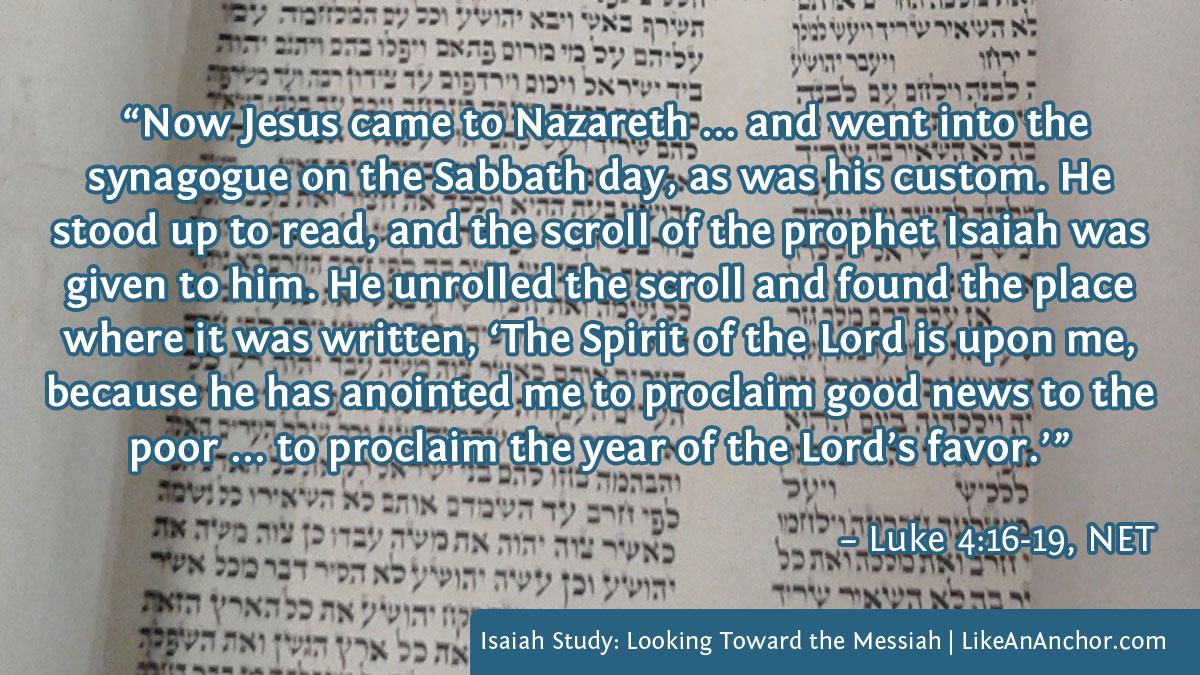
Image shows an open scroll with Hebrew writing with a quote from Luke 4:16-19, NET version:  “Now Jesus came to Nazareth ... and went into the synagogue on the Sabbath day, as was his custom. He stood up to read, and the scroll of the prophet Isaiah was given to him. He unrolled the scroll and found the place where it was written, ‘The Spirit of the Lord is upon me, because he has anointed me to proclaim good news to the poor ... to proclaim the year of the Lord’s favor.’”
Image by Marissa Baker

The Servant Songs

We’ve been talking about the Servant Songs for weeks now, but haven’t taken a close look at them yet. In my first post,  I mentioned you can find these prophecies in Isaiah 42:1–9; 49:1–13; 50:4-11; 52:13– 53:12. I also said these aren’t the only the only prophecies in Isaiah 40-66 and that God’s words in this section aren’t just for people who were anticipating the Messiah’s first coming. They’re also for us today, who are awaiting Jesus’s second coming. We can see that as we look through the four servant songs all together.

First Song

The first Servant Song speaks of the Messiah as a servant chosen by God (Is. 42:1–9). The Servant “will bring justice to the nations” without shouting or raising his voice. This prophecy also speaks of Yahweh (the name God applies to Himself in Ex. 3:15) holding the Servant’s hand and making Him “a covenant for the people, as a light for the nations.” Yahweh affirms this will happen; it’s one of the “new things” He’s declaring in this section of Isaiah. You’ll find this first Servant Song quoted in Matthew 12:15-21, Luke 2:26-32, and Romans 15:12.

Second Song

The second Song is written in first-person; the Servant is speaking (Is. 49:1-13). He says, “Yahweh has called me from the womb” to accomplish reconciliation by bringing God’s covenant people back to Him. Again, Yahweh calls the Servant “a light to the nations, that you may be my salvation to the end of the earth.” This passage speaks of the Servant accomplishing powerful deliverance, backed-up with Yahweh’s power and might. It’s quoted in Luke 2:28-32, Acts 13:47, and 2 Corinthians 6:2. In Acts 13:47, Paul and Barnabas apply part of this prophecy to their work as they follow in the Messiah’s footsteps. This indicates that while the Servant Songs are Messianic (they point to Jesus), at least part of this one can also apply to those following in Jesus’s footsteps.

Third Song

The third song presents the Servant more as suffering than triumphant (Is. 50:4-11). It speaks of Yahweh teaching the servant and giving Him wisdom for working with people. It also speaks of the Servant voluntarily submitting to suffering inflicted by other people, and affirms that “the Lord Yahweh will help me.” Like the second Song, this one is written from the Servant’s perspective and affirms His trust in Yahweh. According to SimplyBible.com’s list of Isaiah quotes, this song is not quoted directly in the New Testament. I suspect, though, that the gospel writers might have had this Song in mind when they wrote about people being astonished at the wisdom and authority of Jesus’s teachings (Matt. 13:54; Mark 1:22; Luke 4:32).

Fourth Song

The final servant song might be the most famous (Is. 52:13– 53:12). It’s certainly the one I’m most familiar with; in my church we read it every Passover. It’s also the Servant song that’s most often quoted in the New Testament (Matt. 8:16-17; Mark 15:27-28; Luke 22:37; John 12:37-38; Acts 8:32; Rom. 10:16; 15:21; 1 Pet. 2:22-25). And that list only includes direct quotes; there are other scriptures, like Christ’s discussion of servants ruling kingdoms, that likely allude to this passage (Luke 22:25-30).

In this Passage, God says that His Servant “will cleanse many nations,” but in the process He will suffer so much His face will become unrecognizable. This is one of the Messianic prophecies that speaks most clearly and graphically of the terrible things Jesus suffered to pay the price for our transgressions. Again, there are themes of justice and light, as well as inheriting a kingdom, but the focus is on the suffering of Messiah and what He means to accomplish with with His suffering.

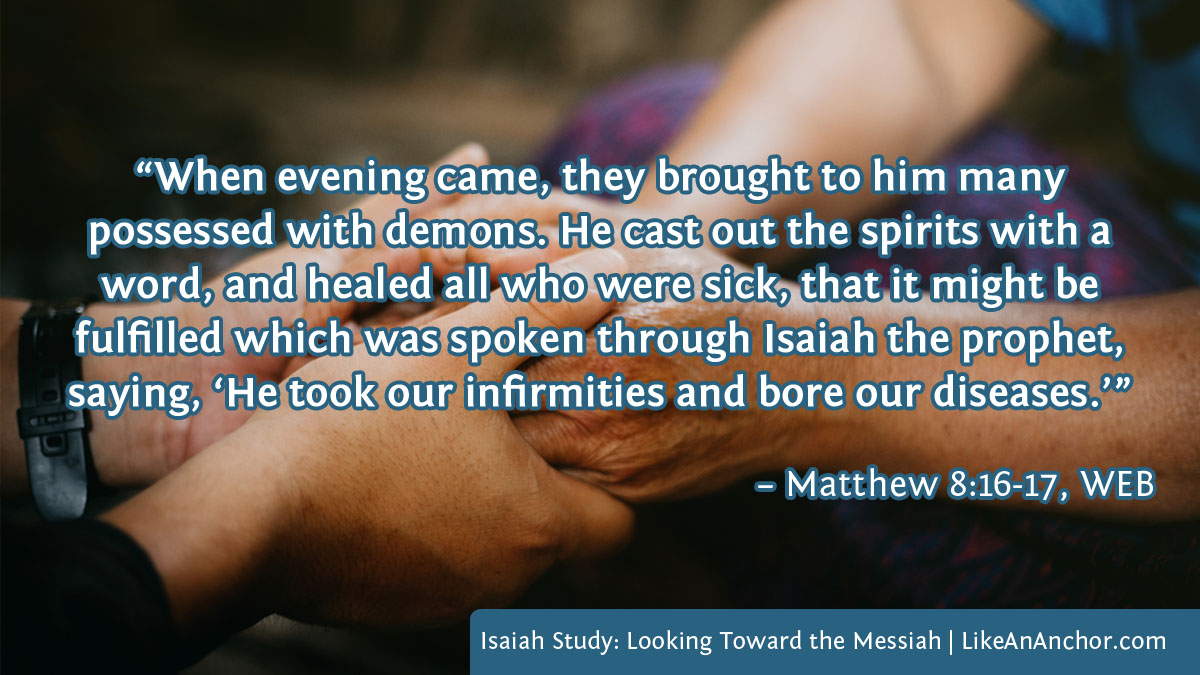
Image shows two people's hands clasped together with a quote from Matthew 8:16-17, WEB version: “When evening came, they brought to him many possessed with demons. He cast out the spirits with a word, and healed all who were sick, that it might be fulfilled which was spoken through Isaiah the prophet, saying, ‘He took our infirmities and bore our diseases.’”
Image by Jantanee from Lightstock

A Mission of Redemption, Salvation, and Release

In the WEB translation for Isaiah 40-66, the word “redeem” shows up 24 times. “Salvation” is here 19 times and “save” 12 times. “Deliver” is used 12 times. “Help” 10 times. “Restore” is here 4 times, “release” 3 times, and “preserve” 2 times. (These numbers also include related words like “deliverer” and “redeemed”). These words related to God’s work in saving His people show up all through Isaiah 40-66; not just in the Servant Songs. Throughout these chapters, God is focused on the redemption, salvation, deliverance, and restoration of His people. He’s sharing His plans to help, release, and preserve us.

But now Yahweh who created you, Jacob,
and he who formed you, Israel, says:
“Don’t be afraid, for I have redeemed you.
I have called you by your name.
You are mine.
When you pass through the waters, I will be with you,
and through the rivers, they will not overflow you.
When you walk through the fire, you will not be burned,
and flame will not scorch you.
For I am Yahweh your God,
the Holy One of Israel,
your Savior.”

Isaiah 43:1-3, WEB

Break out into joy!
Sing together, you waste places of Jerusalem;
for Yahweh has comforted his people.
He has redeemed Jerusalem.
Yahweh has made his holy arm bare in the eyes of all the nations.
All the ends of the earth have seen the salvation of our God.

Isaiah 52:9-10, WEB

The Lord Yahweh’s Spirit is on me,
because Yahweh has anointed me to preach good news to the humble.
He has sent me to bind up the broken hearted,
to proclaim liberty to the captives
and release to those who are bound,

Isaiah 61:1, WEB

Passages like these are found all around the Servant Songs, sprinkled throughout Isaiah 40-66. They reveal God’s redeeming purpose and join the Servant Songs in pointing toward the Messiah. Jesus even quoted the passage from Isaiah 61 (with one line added from Isaiah 58:6) when He went into the synagogue to His hometown on the Sabbath day. It appears that He was reading the Torah portion and associated passage from the Prophets that day, and used Isaiah 61 to teach about His role as God’s servant (Luke 4:15-21). The way He read this passage might not seem too startling to us, but by saying that He’s fulfilling this prophecy Jesus boldly proclaimed Himself as the Messiah. It was such a startling claim that His hearers were “filled with rage” and threw him out of town (Luke 4:22-30).

If you read through Isaiah 40-66, you’ll see God is talking about deliverance on multiple levels. He’s speaking to Ancient Israel at the time, promising deliverance from captivity. He’s also pointing to a time when the Messiah would come with spiritual deliverance from sin–that’s what happened when Jesus came to this earth and died for us. On top of that, God’s revelations at the end of Isaiah look farther forward to a time when the entire world will be renewed and restored.

A New Thing

Image of a woman looking down a railway track holding a Bible. It is overlaid with the blog's title text and the words "Just as the Jewish people of Jesus's day looked for a Messiah and focused on prophecies of His first coming, we today can eagerly look forward to 
His second coming.
Image by Kristen McDow from Lightstock

It’s fascinating to see links between the New and Old Testament. Studying these patterns gives us a deeper appreciation for the Bible and a deeper understanding of Jesus. Sometimes, though, it might not seem all that relevant today since the prophecies are already fulfilled. But we can still learn from them, and not all of them are entirely done yet. Just as the Jewish people of Jesus’s day looked for a Messiah and focused on prophecies of His first coming, we today can look forward eagerly to His second coming. Let’s take another look at the end of the first Servant Song prophecy.

“I am Yahweh.
    That is my name.
    I will not give my glory to another,
    nor my praise to engraved images.
Behold, the former things have happened
    and I declare new things.
    I tell you about them before they come up.”

Sing to Yahweh a new song,
    and his praise from the end of the earth,
    you who go down to the sea,
    and all that is therein,
    the islands and their inhabitants.

Isaiah 42:9, 10, WEB

While the Servant Song seems to wrap up in verse 9 (though Yahweh also discusses “my servant” in verses 18-19 while rebuking those who trust in false gods), a new song continues in verse 10. It’s the first time in this part of Isaiah that God directly states He’s doing something new and exciting. As we’ll see more thoroughly in next week’s post, this “new thing” that He’s doing with the Messiah is the beginning of a larger project to make all things new.

We’re still waiting for the complete fulfillment of the Messianic prophecies in Isaiah. Reading God’s promises to send the Messiah back to redeem us mightily, establish His kingdom, and complete His “new” work can still encourage us as we await Jesus’s return.

Featured image by Inbetween from Lightstock

Titles of Jesus Christ: David’s Son

Over and over in the gospels, people cry out to Jesus, “Have mercy on us, you son of David!”

Why is the Messiah’s title as David’s son the one that blind men and a Canaanite woman latched on to as they asked for healing? (Matt. 9:27; 15:22; 20:30-31; Mark 10:46-48; Luke 18:35-39). Why did the people shout, “Hosanna to the son of David!” when Jesus entered Jerusalem, and why did that make the chief priests and the scribes so indignant? (Matt. 21:9, 15; Mark 11:10). What is the significance of this title?

It would be easy to gloss over Jesus’ title as David’s son, simply taking it as fulfillment of a few prophecies that said Messiah (the Hebrew equivalent to “Christ,” which means “anointed”) would come from King David’s descendants. But the Biblical writers treat this as a highly significant fact, and I think it’s worth looking into more closely.

Fulling A Covenant Promise

I’ve talked about the covenant aspect of Jesus being descended from David in several posts already, including “Inheriting Covenants.” The Lord made a covenant with David that He would establish his offspring’s kingdom forever, and that connected with the promise of Messiah (2 Sam. 7:12-15).

Yahweh has sworn to David in truth. He will not turn from it: “I will set the fruit of your body on your throne. If your children will keep my covenant, my testimony that I will teach them, their children also will sit on your throne forever more.” (Ps. 132:11-12, all verses from WEB translation)

David’s descendants eventually fell into disobedience and lost the physical kingdoms of Israel and Judah. But Jesus — a sinless, obedient son of David — inherited the covenant promise. According to Peter, David actually knew that would be the end result of God’s promises to him about his descendants. Read more

The Light From The Beginning, Part Two

Jesus Christ identified Himself as the light of the world. This would have been no surprise to people familiar with the scriptures, for God has always connected Himself with light. It’s a common analogy in scripture — light is found with God and whatever is not of God is in darkness. As I’ve studied this concept, I’ve been excited to realize the Light connection goes even deeper than I originally knew (and probably far deeper than I’ve yet discovered as well). To quote Paul, “Oh the depth of the riches both of the wisdom and the knowledge of God! How unsearchable are his judgments, and his ways past tracing out!” (Rom. 11:33, WEB)

Last week, we started with a side-by-side comparison of the opening verses from Genesis and John’s gospel. As we learned in that post, John and several Jewish rabbis identify the Light spoken of in Genesis with the Messiah. We know this Messiah is Jesus (Messiah and Christ both mean “anointed, who says He came to this earth in human form as “the light of the world”). You’ll want to make sure you’ve read last week’s post before continuing with this one. Click here to go back and read “The Light From The Beginning, Part One.”

From Darkness to Light

God has “called you out of darkness into his marvelous light” for a reason (1 Pet. 2:9). God longs for a relationship with us, but “God is light” and we cannot enter the relationship that He wants to have with us if we are walking in darkness.

This is the message which we have heard from him and announce to you, that God is light, and in him is no darkness at all. If we say that we have fellowship with him and walk in the darkness, we lie, and don’t tell the truth. But if we walk in the light, as he is in the light, we have fellowship with one another, and the blood of Jesus Christ, his Son, cleanses us from all sin. (1 John 1:5-7, WEB)

It is one of the central truths of the Christian faith that God loves us and wants us to be in relationship with Him. Light does not, however, fellowship with darkness (2 Cor. 6:14). Apart from the work of Jesus in us as the Light, we would not be able to draw close to God. Following Him is what takes us out of darkness to walk in Light. Read more

The Light From The Beginning, Part One

Let’s start today’s post by comparing two passages of scripture:

In the beginning was the Word, and the Word was with God, and the Word was God. The same was in the beginning with God. All things were made through him. Without him, nothing was made that has been made. (John 1:1-3, WEB)

In the beginning, God created the heavens and the earth. The earth was formless and empty. Darkness was on the surface of the deep and God’s Spirit was hovering over the surface of the waters. God said, “Let there be light,” and there was light. (Gen. 1:1-3)

In him was life, and the life was the light of men. The light shines in the darkness, and the darkness hasn’t overcome it. (John 1:4-5)

God saw the light, and saw that it was good. God divided the light from the darkness. God called the light “day”, and the darkness he called “night”. There was evening and there was morning, the first day. (Gen. 1:4-5)

Clearly, John meant us to connect the opening of his gospel with Genesis through his phrase, “in the beginning.” But that’s not the only connection. Light also links these two accounts. It’s not until later in the creation story that God makes the sun, stars, and moon, so this first Light must be something else. And it’s something powerful enough to cause Day and Night before any of the physical light sources we know of existed.

Messiah in Light

John identifies this Light at creation with the Messiah, Jesus (John 1:6-16). (Language note: Messiah is the Hebrew word for Christ. Both words mean “anointed”.) It’s not just Christians who’ve made this connection, though. Even Jewish rabbis who are still waiting for a Messiah other than Jesus recognize the Light in Genesis does refer to the Messiah.

God’s first words in the Bible are: ” ‘Let there be light!’ And there was light. And God saw the light, that it was good.” When we study the creation account closely we notice that it was not until the fourth day that God created the “two great lights”, the sun and the moon. The Sages understood this too to be a Messianic allusion, and so the Midrash known as Pesikhta Rabbah, which was read from the 9th century on in connection with feast days, asks, “Whose is this light which falls upon the congregation of the Lord?” and answers, “It is the light of the Messiah” …

The Rabbis considered the Aramaic word Nehora, ‘light’, to be one of the secret names of the Messiah, since we read in the Aramaic part of the book of Daniel that, “He knows what dwells in darkness, and light dwells with him” (2.22). (from “The Messiah In The Old Testament In The Light of Rabinnical Writings” by Risto Santala)

The Yalkut, a rabbinic anthology from the medieval period, says this:

‘And God saw the light, that it was good.’ This is the light of Messiah … to teach you that God saw the generation of Messiah and His works before He created the universe, and He hid the Messiah … under His throne of glory. (quoted in “What The Rabbis Know About The Messiah” by Rachmiel Frydland)

Even without knowing who the Messiah is, these rabbis understood that the Light in Genesis points to Messiah, whom they saw as the “center of all creation”

Read more

Walking Through Philippians 3: Paul’s Thoughts on Following Jesus

In 1 Corinthians 11:1, Paul said, “Be ye followers of me, even as I also am of Christ” (KJV). If we want a how-to guide for the way Paul follows Jesus, we can find a succinct version in the 3rd chapter of Philippians. This chapter is a bit unusual. Rather than speaking generally to his fellow believers or addressing a specific issue in the church, Paul gets real about his own walk of faith.

click to read article, Walking Through Philippians 3: Paul's Thoughts on Following Jesus | marissabaker.wordpress.com
photo credit: Samuel Zeller via StockSnap.io

Paul’s Zeal

We break into the middle of the letter to the church in Philippi. Paul has been warning against “dogs, “evil workers,” and “the mutilation.” He gives a general principle that physical things like circumcision aren’t what determines whether or not you’re part of God’s chosen people. “We are the circumcision,” he writes, “who worship God in the Spirit, rejoice in Christ Jesus, and have no confidence in the flesh” (Phil. 3:2-3). He then shifts to using himself as an example.

Though I also might have confidence in the flesh. If anyone else thinks he may have confidence in the flesh, I more so: circumcised the eighth day, of the stock of Israel, of the tribe of Benjamin, a Hebrew of the Hebrews; concerning the law, a Pharisee; concerning zeal, persecuting the church; concerning the righteousness which is in the law, blameless. (Phil 3:4-6)

What a pedigree! Under the Old Covenant, Paul was as perfect as you could get. There was no stain on his Israelitish lineage. His parents kept the Law and had him circumcised. He became an elite leader in the Jewish community and an expert in the Law, which he kept to the letter. He even actively persecuted heretics.

Then, suddenly, Jesus Himself showed up and told Paul those weren’t heretics. The Messiah had come and Paul was fighting the next step in God’s plan. In response, Paul gave up power, prestige, and (parts of) the belief system he’d poured his entire life into to follow Jesus. And that’s an aspect of Paul’s life that we’re supposed to imitate. Read more