
I’ve missed a couple weeks of blogging since our daughter was born, but I’m hoping to get back to weekly posts soon. For now, bi-weekly might be more doable (we’ll see how things go). Today’s post is our final study of Jesus’s model prayer. We’ve been focusing on the version in Matthew, which is part of the Sermon on the Mount where He’s talking about good and bad examples for how to pray (Matt. 6:5-15). There’s also a near-identical prayer recorded in Luke, where Jesus responded to a disciple’s request that Jesus teach them to pray (Luke 11:1-13).
So pray this way:
Matthew 6:9-13, NET
Our Father in heaven, may your name be honored,
may your kingdom come,
may your will be done on earth as it is in heaven.
Give us today our daily bread,
and forgive us our debts, as we ourselves have forgiven our debtors.
And do not lead us into temptation, but deliver us from the evil one.
Luke’s version is a little shorter than the one in Matthew, and the final line there simply reads, “And do not lead us into temptation” (see NET footnotes on manuscript evidence for a shorter reading in Luke). Whichever recorded version we’re looking at, we can think of this prayer as a helpful outline for our own prayers. And if we want to include this “do not lead us into temptation” sentiment when we pray, it’s helpful to understand what it does (and doesn’t) mean.
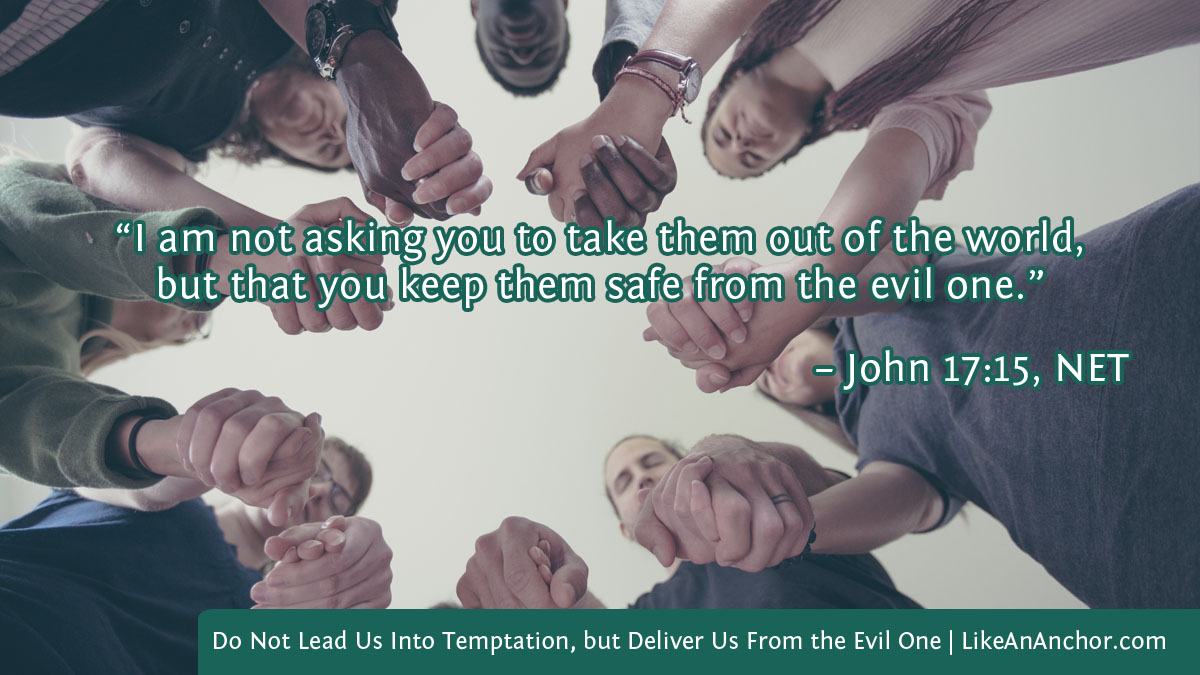
Do Not Lead Us Into Temptation
The last line of this prayer is a little tricky to interpret, at least at first glance, in light of other scriptures. James 1:13 says, “Let no one say when he is tempted, ‘I am tempted by God,’ for God cannot be tempted by evil, and he himself tempts no one” (NET). The English translation of Matthew 6, at least, makes it appear that Jesus is advising us to pray against something (God leading us into temptation) that wouldn’t happen anyways. Looking at another piece of prayer advice that He gave his disciples helps clear this confusion up.
Then they went to a place called Gethsemane, and Jesus said to his disciples, “Sit here while I pray.” … Then he came and found them sleeping, and said to Peter, “Simon, are you sleeping? Couldn’t you stay awake for one hour? Stay awake and pray that you will not fall into temptation. The spirit is willing, but the flesh is weak.”
Mark 14:32, 37-38, NET
This is actually very similar to what Jesus told his disciples to pray in the model prayer. Both verses use the same Greek word for temptation, periasmos (G3986). This word involves putting something to the test. It’s “an experiment, attempt, trial, proving” that can include an internal or external “enticement to sin” for the purpose of making a “trial of man’s fidelity, integrity, virtue, constancy” (Thayer). In both cases, Jesus advised them to pray that this didn’t happen. Testing isn’t a pleasant experience. God will let it happen sometimes, though, when it’s for our good and when He knows we could succeed.
My brothers and sisters, consider it nothing but joy when you fall into all sorts of trials (periasmos), because you know that the testing of your faith produces endurance. …
Happy is the one who endures testing (periasmos), because when he has proven to be genuine, he will receive the crown of life that God promised to those who love him. Let no one say when he is tempted, “I am tempted by God,” for God cannot be tempted by evil, and he himself tempts no one. But each one is tempted when he is lured and enticed by his own desires. Then when desire conceives, it gives birth to sin, and when sin is full grown, it gives birth to death. Do not be led astray, my dear brothers and sisters.
James 1:2-3, 12-16, NET
Testing serves a purpose. It can strengthen our faith, provided that we overcome the test and not give into the temptation to sin. The NET footnote on Matthew 6:13 says “The request do not lead us into temptation is not to suggest God causes temptation, but is a rhetorical way to ask for his protection from sin.” In other words, we might see this as a prayer that we not be tested but we can also see it as a prayer that if we’re tested, we won’t fail the test.
So let the one who thinks he is standing be careful that he does not fall. No trial (periasmos) has overtaken you that is not faced by others. And God is faithful: He will not let you be tried beyond what you are able to bear, but with the trial (periasmos) will also provide a way out so that you may be able to endure it.
1 Corinthians 10:12-13, NET
When God allows tests and trials, He intends for us to successfully overcome them and prove the genuineness of our faith. If we couldn’t endure the test, He wouldn’t let it happen. We need to be cautious and humble, though, and not just assume we’ve hit a point in our spiritual growth where we won’t be tempted or that we won’t fall if tempted. I think that’s also what Jesus is hinting at in the model prayer. Our prayers should include an acknowledgment that we need God’s help “delivering us from evil” to avoid sin and overcome tests when they do come.
Deliver Us From the Evil One
Depending on the translation you’re reading, the end of Matthew 6:13 might read “deliver us from evil” or “deliver us from the evil one.” The Greek word poneros (G4190) can mean evil in a general sense, but here “it is most likely personified since it is articular (τοῦ πονηροῦ, tou ponērou)” (NET footnote). You can see other examples of this word being personified and standing in for the devil in Matt. 13:19, 38; John 17:15; 1 John 2:13-14. One of those examples is from the prayer that Jesus prayed right before his death.
I am no longer in the world, but they are in the world, and I am coming to you. Holy Father, keep them safe in your name that you have given me, so that they may be one just as we are one. … I have given them your word, and the world has hated them, because they do not belong to the world, just as I do not belong to the world. I am not asking you to take them out of the world, but that you keep them safe from the evil one.
John 17:11, 14-15, NET
Jesus told us to pray for deliverance from evil, and he modeled that by praying the Father would keep us safe from the evil one. Jesus’s followers later wrote about God faithfully delivering us from evil people, evil deeds, and the evil one, or Satan (2 Thes .3:2-3; 2 Tim. 4.18; 1 John 5:18-19). We are also counseled to take up the armor of God to provide defense against the evil one.
Clothe yourselves with the full armor of God, so that you will be able to stand against the schemes of the devil. For our struggle is not against flesh and blood, but against the rulers, against the powers, against the world rulers of this darkness, against the spiritual forces of evil in the heavens. For this reason, take up the full armor of God so that you may be able to stand your ground on the evil day, and having done everything, to stand. Stand firm therefore, by fastening the belt of truth around your waist, by putting on the breastplate of righteousness, by fitting your feet with the preparation that comes from the good news of peace, and in all of this, by taking up the shield of faith with which you can extinguish all the flaming arrows of the evil one.
Ephesians 6:11-16, NET
I have a whole book on the armor of God (Like An Anchor Study Guide: Armor of God), so we won’t go into it in too much detail in this post. But if we’re going to pray “do not lead us into temptation, but deliver us from the evil one,” we need to have some understanding of what sort of evil we’re praying to be delivered from and that includes knowledge of the fight that we’re in. “The whole world lies in the power of the evil one” (1 John 5:19), but we are people of God whom God protects, promises to strengthen against temptations, and delivers from the devil.
Quick note for those wondering why there isn’t going to be another post titled “For yours is the Kingdom, the power, and the glory forever:” manuscript evidence suggests that this phrase was added at some point, possibly for use in church liturgy (NET footnote on Matt. 6:13). Since it likely wasn’t part of the original prayer, I decided not to include it in this blog series.
If you want to catch up on or reread the previous posts in this series, here are the links: “Hallowed Be Your Name,” “May Your Kingdom Come,” “May Your Will Be Done On Earth As It Is In Heaven,” “Give Us Today Our Daily Bread,” and “Forgive Us Our Debts, as We Have Forgiven Our Debtors.”
Featured image by Matt Vasquez from Lightstock
Song Recommendation: “The Lord’s Prayer” by Hillsong Worship











 Like An Anchor